
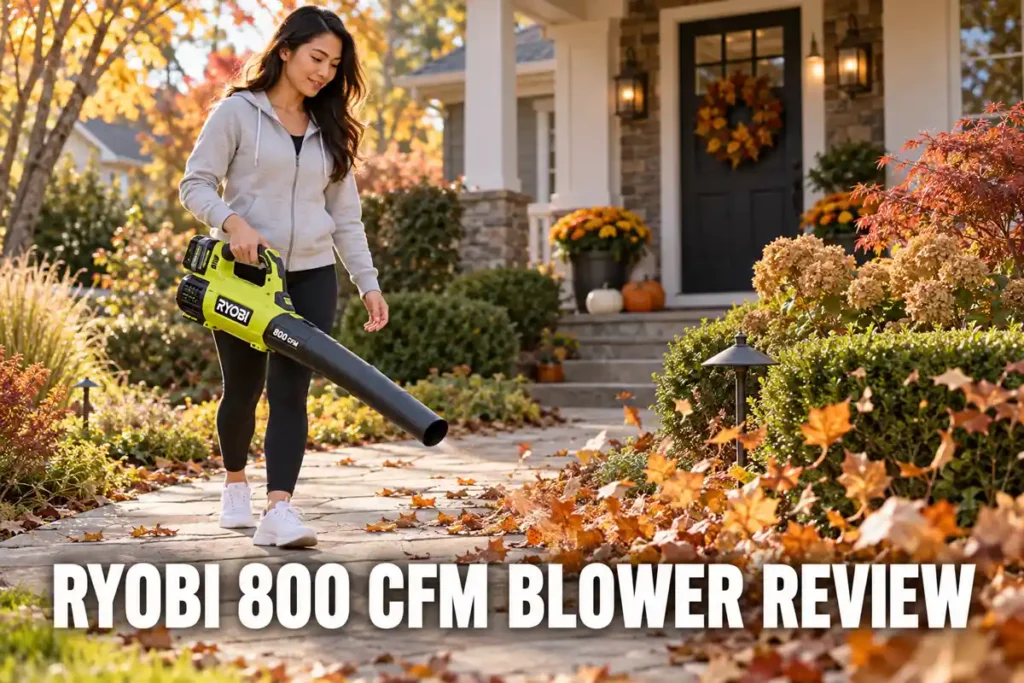
My Ryobi 800 CFM blower review gives the RY40HPLB01 a yes for anyone who already owns Ryobi 40V packs and a skip for anyone starting from zero. The listing sells the blower alone, with no battery and no charger, and the 8 Ah pack behind the best results can cost more than the blower. I plan a leaf season in minutes, so I counted packs before I counted CFM, then ran the tool on the lawn around the house, the gravel yard and the strips under the plum rows. Below are the force, runtime, noise, weight and warranty limits, and the jobs where it fits.
Affiliate Disclosure: Garden Power Scout is a proud participant in the Amazon Services LLC Associates Program. As an Amazon Associate, we earn from qualifying purchases, at no extra cost to you.
Ryobi 800 CFM Blower Review: My Verdict in Brief
The RY40HPLB01 pushes about 25 N on high and runs about 12 minutes at full power on an 8 Ah pack. That clears dry and damp leaves, pruning twigs and gravel dust around a house lot, and it falls short on deep soaked mats. Because the listing is the tool only, you also need a Ryobi 40V pack and a charger, and the strong results come with the 8 Ah pack. The tool alone sits in the mid-range tier, and the full setup moves to premium.
- Who it is for: owners of Ryobi 40V packs who clear a house lot, a drive and a farm yard.
- What it does best: a wide, fairly quiet push at about 75 dBA at the ear, with a speed tip for slab seams and gravel edges.
- The main trade-off: about 12 minutes at full power, and 10.5 lb in one hand with the 8 Ah pack.
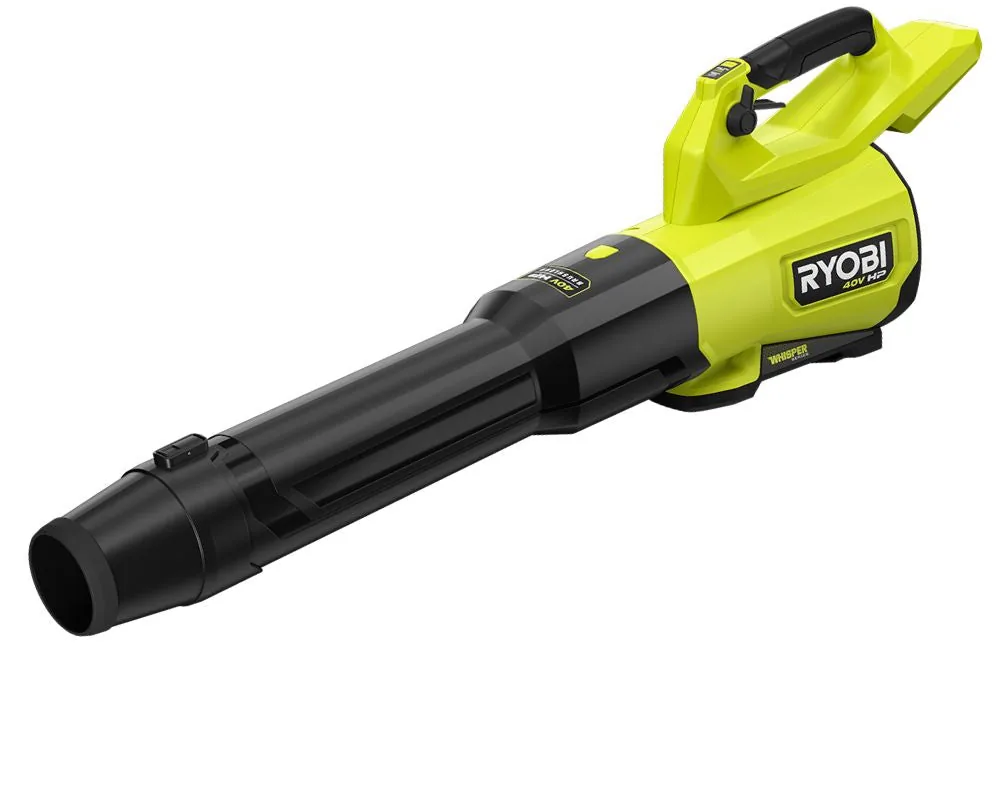
What the Ryobi 40V HP Brushless 800 CFM Whisper Series Blower Is and What Comes in the Box
It is a cordless handheld with a brushless motor, a one-hand tube and a two-finger paddle trigger. The manual lists the blower, the tube, a speed tip and the operator’s manual in the box, and the bare tool weighs 6.4 lb. It blows only, because Ryobi says it is not designed for vacuum use.
The model number takes a little decoding. The manual and the listing carry RY40HPLB01, Ryobi’s own tool-only page prints RY40HPLB01B, and the kit with an 8 Ah pack and a charger is RY40HPLB01K, so the Ryobi 40V HP Brushless 800 CFM RY40HPLB01 name covers the whole family.
What You Still Need to Buy
This listing is the Ryobi 800 CFM blower tool only, so it arrives without power. A working setup needs two more things:
- A Ryobi 40V battery. Any Ryobi 40V pack fits the tool, and the strong results in this article come from the 8 Ah pack that Ryobi puts in its kit.
- A Ryobi 40V charger. The listing includes none.
Buying the 8 Ah pack on its own can cost more than the blower, so a buyer with no packs should price the pack and the charger before the tool. With packs already on the shelf, the blower is a mid-range purchase.
Ryobi RY40HPLB01 Specs at a Glance
Two rows decide the fit: force and full-power run time, and both depend on the pack. A newton is the push of the air against a surface, and 25 N is a little over 5 lb. Airflow and air speed are Ryobi’s figures for the Ryobi 40V HP brushless 800 CFM blower, and the other rows describe the tool on an 8 Ah pack.
| Spec | Figure |
|---|---|
| Type | Cordless handheld blower, brushless, no vacuum mode |
| Airflow, maker’s figure | 800 CFM |
| Air speed, maker’s figure | Up to 180 mph with the speed tip |
| Blowing force | About 18 N on low, about 25 N on high |
| Run time, maker’s claim | Over 85 minutes on low with an 8 Ah pack |
| Run time at full power | About 12 minutes in Max Power, about 15 in Max Run Time, 8 Ah pack |
| Weight | 6.4 lb bare; 10.5 lb with an 8 Ah pack |
| Noise at the ear | About 71 dBA on low, about 75 dBA on high |
| Tool warranty | 5 years for household use; 90 days for business or commercial use |
Setup and First Use
Setup takes no tools. Pull on the tube after you fit it: according to Ryobi’s manual, a correctly assembled tube is difficult to separate. I make that pull a habit before every session.
- Take the battery off before you assemble anything.
- Push the tube onto the outlet until the latch locks, then pull on it to test the lock.
- Click the speed tip onto the end of the tube the same way when you want the narrow jet.
- Line up the raised rib on the pack with the groove in the battery port and push until the latch snaps in.
- Press the mode button to pick Max Power or Max Run Time. The blower remembers the last mode.
- Pull the trigger to the speed you want, push the cruise lever down and release the trigger. Pull the lever up to cancel.
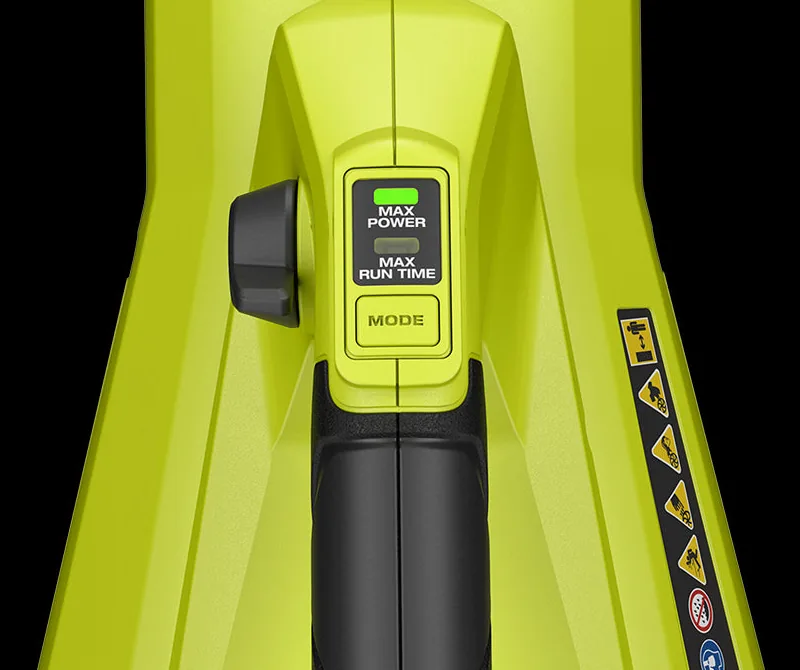
The mode button carries the two lights, Max Power and Max Run Time. Max Run Time stretches the full-power run from about 12 minutes to about 15, so I treat it as a small saving and not as a second gear.
Performance on Leaves, Gravel and Wet Mats
Air volume moves a pile, but force decides what leaves the ground. The 800 CFM rating is a peak figure, and it does not arrive together with the 180 mph, so the 18 N on low and 25 N on high are the numbers to plan with.
Dry and Damp Leaves on the Lawn
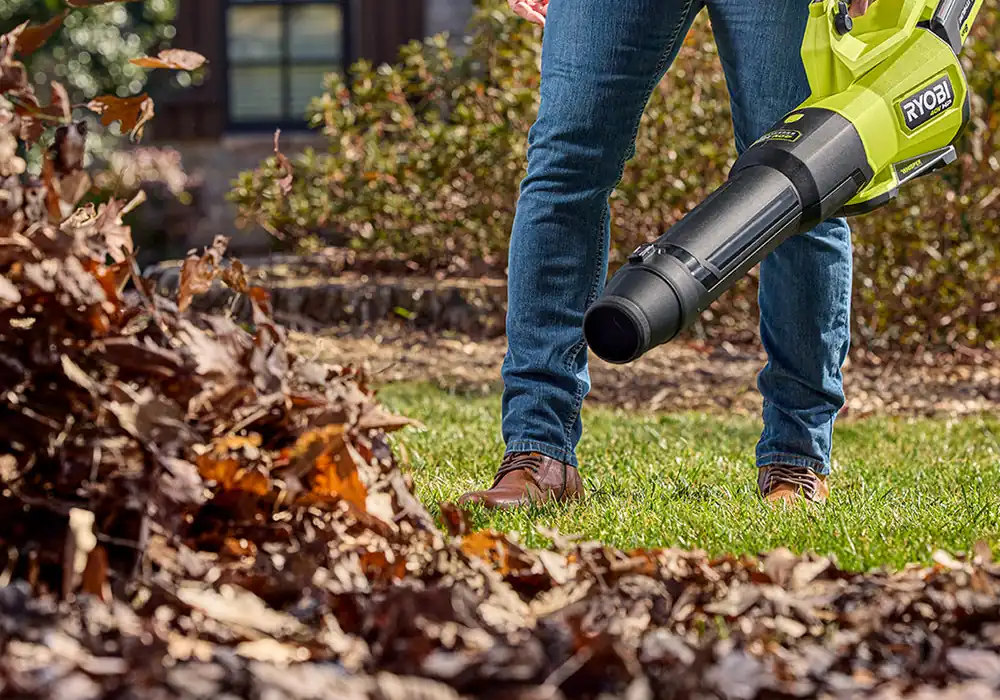
On the lawn around the house I run the speed tip off and sweep wide, which rolls dry shade-tree leaves toward the alley in one line. Damp leaves follow on high. Next to my old gas handheld there is no mix and no pull cord, and the price is the shorter run.
Wet Mats on the Work Pad
After rain, the soaked mat on the concrete pad in front of the machinery shed is where 25 N reaches its limit. Wet leaves cling by water film and weight, so volume under the edge beats speed on top. Blown from above, the mat slid sideways in one sheet. With the speed tip on and the nozzle low at the edge, I peeled it back in strips, and a deep mat is still a rake job at this force.
Gravel, Slab Seams and Pruning Twigs
The speed tip earns its place on slab seams, where the narrow jet digs grit out of the joints. On the gravel yard I keep the trigger low and the tube near the ground, and I keep people, cars and windows out of the debris path.
For pruning twigs and sawdust under the plum rows I pick Max Run Time, and for the wet strip along the hedgerow I switch to Max Power. I blow around the outer edges of a pile and never into the centre, as the manual advises.
Battery Runtime and the 85-Minute Claim
According to Ryobi, the blower runs over 85 minutes on an 8 Ah pack with the trigger held low. At full power the same pack gives about 12 minutes in Max Power and about 15 in Max Run Time. Full power draws roughly a kilowatt or more from a pack that holds about 290 watt-hours, so even the biggest pack empties in minutes.
By pack energy alone, a 4 Ah pack holds half as much, so expect roughly half those minutes, about 6 in Max Power. That is an estimate from the energy, not a timed run. Ryobi publishes no cold-weather range, and cold cuts the output of any lithium pack, so a November morning gives fewer minutes than October.
For a November Saturday I budget in minutes. I count on two to three charged 8 Ah packs for the lawn and the gravel yard, and I treat the strips under the plum rows as a separate day.
Noise, Weight and Balance
The Ryobi is a quiet blower that feels heavy in one hand once the big pack is on.
Noise and Hearing Protection
At the operator’s ear the blower reads about 71 dBA on low and about 75 dBA on high, which is quiet for a blower. Fuel-powered tools are louder: NIOSH sampling of 80 landscaping workers found significantly more noise and carbon monoxide with fuel-powered blowers than with battery versions, and 94 of 119 full-shift noise results were still at or above 85 dBA (1). In a field test of two leaf blowers and a hose vacuum, single machines measured 85 to 101 dB(A) at the work spot (2).
On the concrete pad it sounds like a fan and not an engine, and I still wear earplugs and glasses from the first trigger pull, as the manual requires. I press the plugs in until they seal, since a Cochrane review notes that poor earplug fit may limit protection for about 40 percent of users (3).
Weight, Balance and Vibration
The tool weighs 6.4 lb bare and 10.5 lb with the 8 Ah pack, and it is 40 inches long. The pack alone is about 4 lb, close to 40 percent of what you carry. What I noticed first was the lean: Ryobi set the battery bay and the grip further back, so the nozzle tips forward on its own.
Ryobi publishes no vibration figure for this blower. In a study of 17 groundskeepers, handheld blowers sat at the low end of the vibration measured, yet three workers’ average daily exposure across all their tools reached the action limit (4). Hours add up, so I rest my hands at every pack swap.
Care, Storage and Warranty
Take the pack off before you clean, adjust, transport or store the tool, and wipe the body with a dry cloth. According to Ryobi’s manual, the tool never goes under a hose or out in rain, and gasoline, brake fluid and penetrating oil stay away from the plastic.
Store it indoors and dry, away from garden chemicals and de-icing salts, and never hung so the trigger is pressed. A pack ages fastest when it sits full and hot: a modelling study of lithium-ion cells stored for 36 months found large degradation at 131 F and a 90 percent charge (5).
Ryobi’s manual gives the tool five years for personal, family or household use and 90 days for business or commercial use. Ryobi decides how farm or orchard work is classed, so a working orchard should ask before counting on the five years. The pack carries its own warranty, which Ryobi lists at three years.
Who Should Buy It and Who Should Skip It
This Ryobi blower suits one buyer best: the owner of a house lot who already has Ryobi 40V packs on the shelf. Pack count and job size decide the rest.
Buy It If
- You already own at least one Ryobi 40V pack, ideally an 8 Ah one.
- You clear a quarter acre to about half an acre of lawn, drive and yard.
- You want a blower quieter than gas near the house.
Skip It If
- You own no Ryobi 40V packs and the budget is tight.
- Your main job is an acre of soaked leaves under trees.
- You want a vacuum or a mulcher, or you need commercial warranty cover.
Drawbacks and Common Problems
The tool-only listing and the 25 N force ceiling decide whether you buy; the run time and the weight decide how a working day goes.
Drawbacks to Know About
- Bare tool: the pack and the charger come on top.
- Short full-power run: about 12 minutes on an 8 Ah pack, so carry a second pack for any job past the driveway.
- Weight with the big pack: 10.5 lb in one hand, fine for a drive and tiring over an hour.
- Force ceiling: about 25 N on high, well below a gas backpack on an acre of wet leaves.
Common Problems and How to Avoid Them
- The tube comes loose. It has to click into its latch, so pull on it after fitting.
- A half-seated pack falls out. Push until the latch snaps in.
- Run time falls far below the box claim. The 85-minute figure is on low, so at full power plan in minutes.
- Ladder work. The manual says not to use the tool on a ladder or unstable support, and ladder falls at work sent an estimated 34,000 people to US emergency rooms in 2011 (6).
- Wet weather. Ryobi publishes no weather rating, and the manual forbids use in rain or wet conditions.
How the Ryobi 800 CFM Blower Compares With Alternatives
Three blowers come up when buyers weigh a Ryobi 800 CFM leaf blower against other cordless handhelds. More are in our leaf blower guides.
EGO LB7654 for a Complete Kit
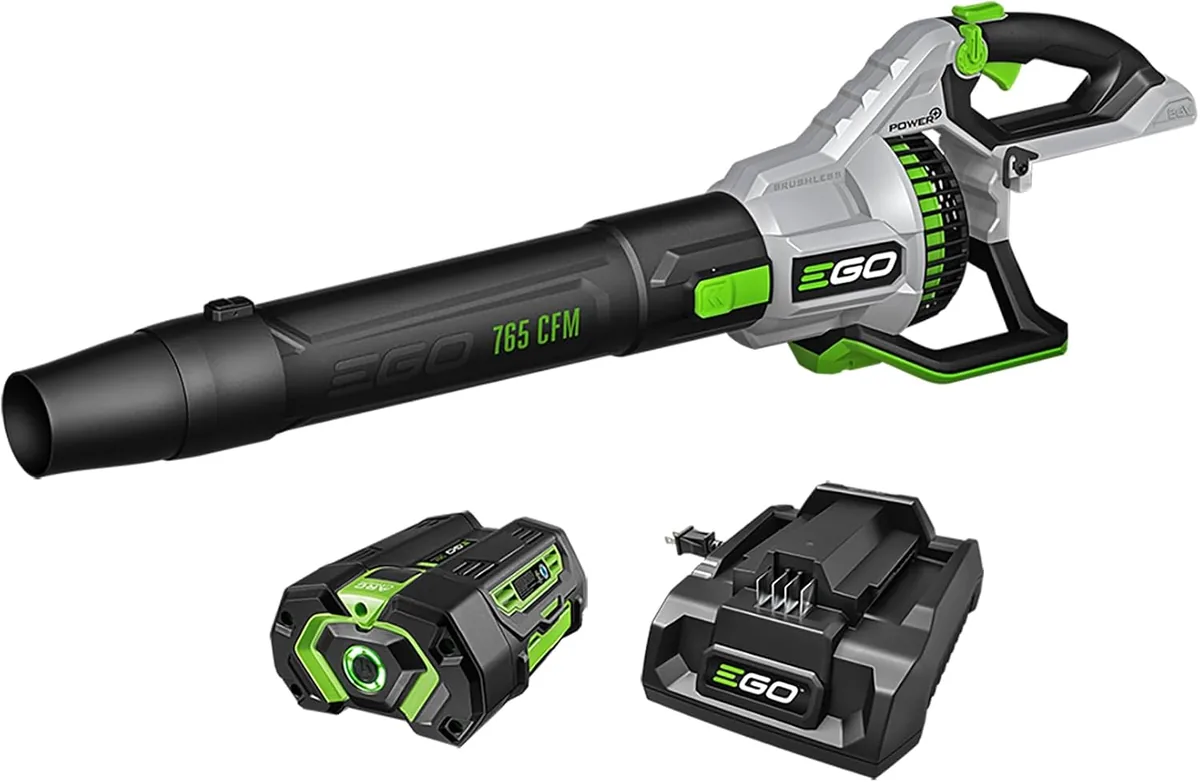
The EGO LB7654 puts a 5.0 Ah pack and a charger in the box, so the entry cost is one purchase. Its turbo setting, near 25 N like the Ryobi’s high, lasts about 13 minutes on that pack, and the kit suits a buyer with no battery platform.
Ryobi 40V HP 730 CFM for the Step Down
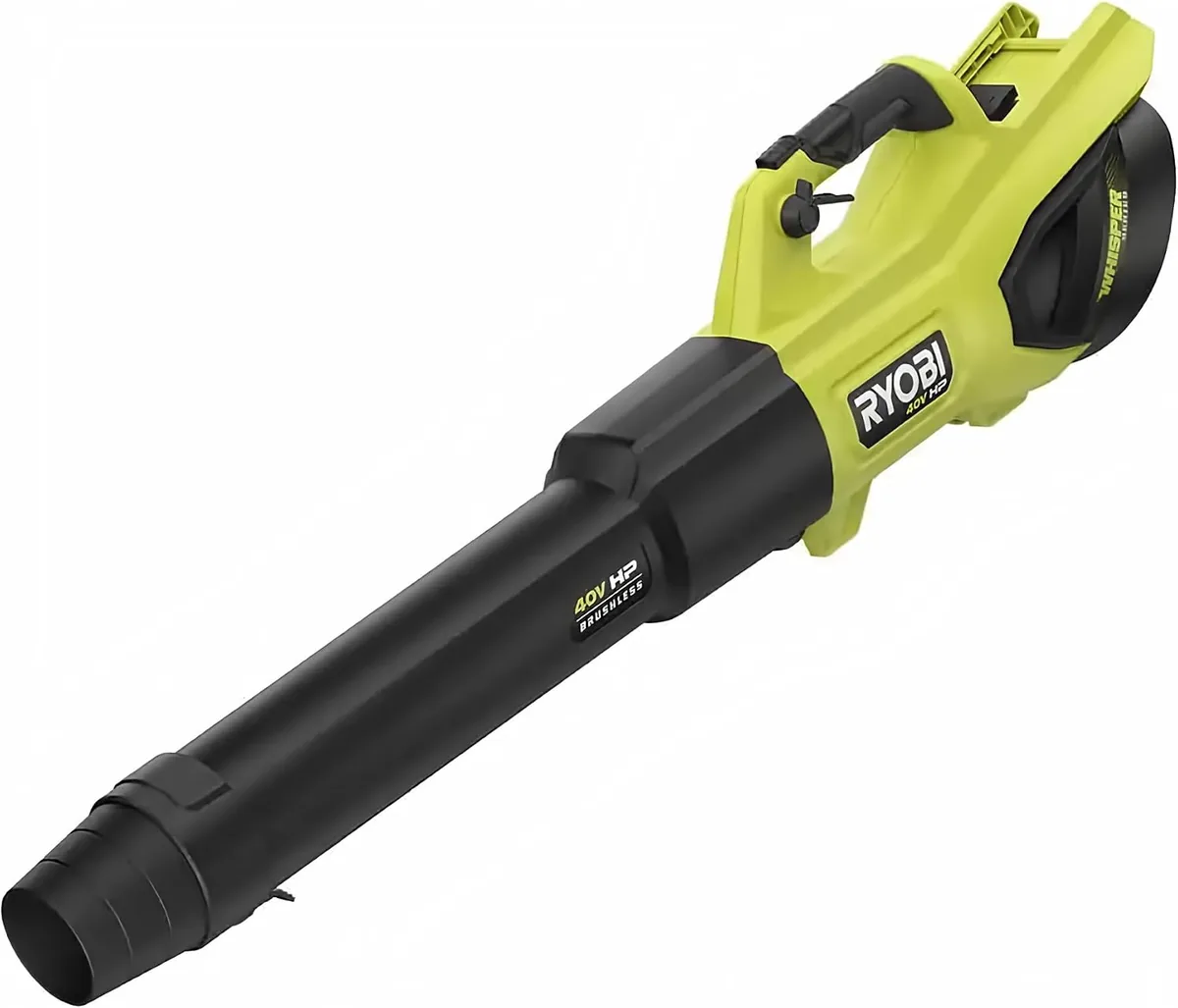
The Ryobi 730 CFM blower takes the same 40V packs and weighs about the same bare, but it peaks near 20 N against about 25 N here. An owner who is happy with it has little reason to move up.
EGO LB8803-2 for Two Packs in the Box
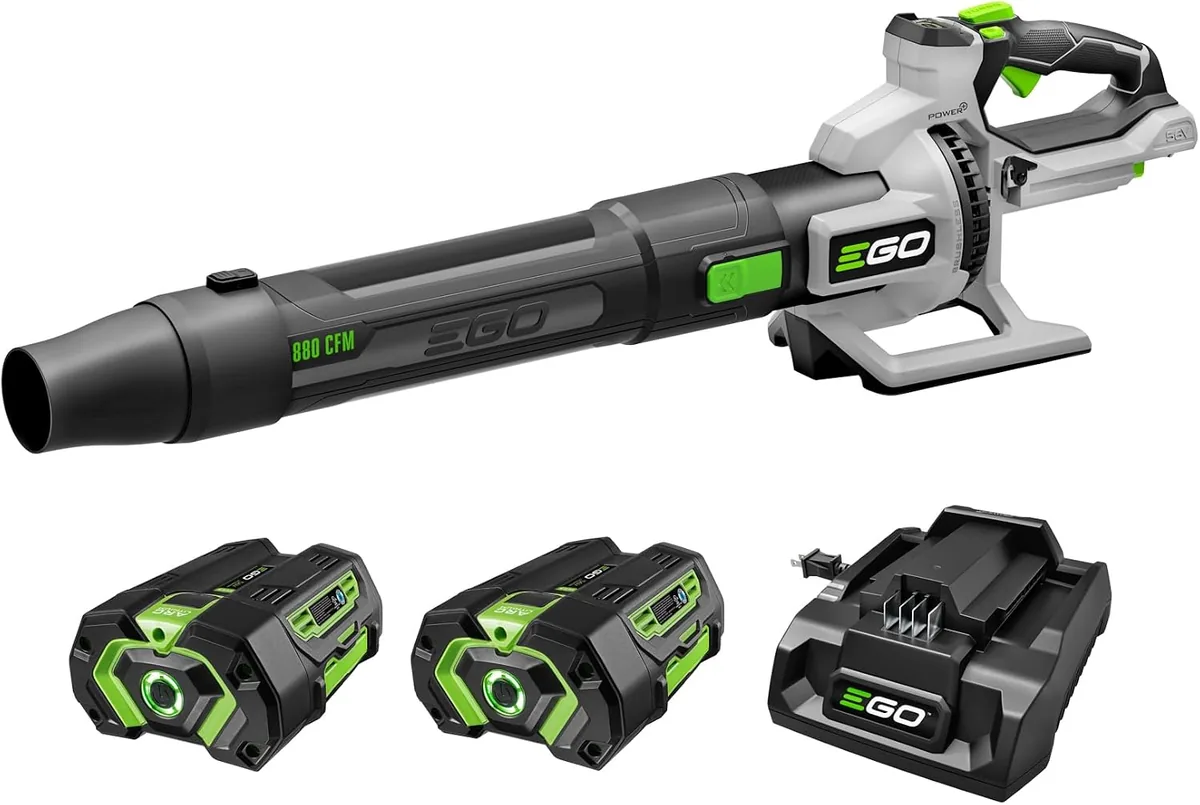
According to EGO, the LB8803-2 moves 880 CFM on turbo, and two 4.0 Ah packs and a charger come in the box, so a pack swap extends the job. It suits a buyer who wants a premium kit and a swap-and-keep-going routine.
My Final Recommendation
I recommend the RY40HPLB01 to Ryobi 40V owners who clear a house lot, a drive and a farm yard and want a quieter blower with about 25 N of push on high. Expect about 12 minutes at full power from an 8 Ah pack and 10.5 lb in one hand. Skip this tool-only listing as a first Ryobi purchase, for soaked leaf mats and for long orchard alleys, and ask Ryobi which warranty term a working orchard gets. My Ryobi 800 CFM blower review verdict is a yes if a charged 8 Ah pack already sits on your shelf and a skip if you would have to buy one first.
Frequently Asked Questions
Is 800 cfm good for a leaf blower?
800 CFM is high for a cordless handheld leaf blower, but force decides how well it clears. The Ryobi 800 CFM model pushes about 18 N on low and about 25 N on high, enough for dry and damp leaves on a house lot and less than a gas backpack.
Which Ryobi leaf blower is considered the best?
The Ryobi leaf blower considered the best for handheld work is the RY40HPLB01 at 800 CFM, about 70 CFM above the 730 CFM model. It suits owners who already have Ryobi 40V packs, while a buyer with none should skip this tool-only listing and a 730 owner can stay put.
Is a Ryobi leaf blower worth buying?
A Ryobi leaf blower is worth buying when you already own Ryobi 40V packs and want one battery system for many tools. The tool-only listing needs a pack and a charger, and the 8 Ah pack can cost more than the blower, so a buyer with no packs should skip it as a first purchase.
What are some common issues with Ryobi leaf blowers?
The common issues with the Ryobi 800 CFM blower are a short full-power run of about 12 minutes on an 8 Ah pack and 10.5 lb of weight with that pack. The tube must also click into its latch, and a pack that is not fully seated can fall out.
Which leaf blower is better, Ryobi or EGO?
The better leaf blower between Ryobi and EGO depends on the battery you already own, because a pack and charger cost extra with the Ryobi tool. The EGO LB7654 gives a complete kit in one box, while the Ryobi wins for anyone who already owns 40V packs and wants one battery system for many tools.
References
- Alexander BM, Graydon PS, Pena M, Feng HA, Beamer BR. Hazardous exposures and engineering controls in the landscaping services industry. Journal of Occupational and Environmental Hygiene. 2025;22(3):189-202.
- Walker E, Banks JL. Characteristics of Lawn and Garden Equipment Sound: A Community Pilot Study. J Environ Toxicol Stud. 2017;1(1).
- Morata TC, Gong W, Tikka C, Samelli AG, Verbeek JH. Hearing protection field attenuation estimation systems and associated training for reducing workers’ exposure to noise. Cochrane Database of Systematic Reviews. 2024;5(5):CD015066.
- Chen N, Yang S, Oh J. Evaluation of hand-arm vibration (HAV) exposure among groundskeepers in the southeastern United States. Annals of Work Exposures and Health. 2025;69(1):81-95.
- Asiri M, Kedhim M, Jain V, et al. Impact of temperature and state-of-charge on long-term storage degradation in lithium-ion batteries: an integrated P2D-based degradation analysis. RSC Adv. 2025;15(28):22576-22586.
- Socias CM, Chaumont Menendez CK, Collins JW, Simeonov P. Occupational Ladder Fall Injuries – United States, 2011. Morbidity and Mortality Weekly Report (MMWR), CDC/NIOSH. 2014.
Safety Note: Leaf blowers throw debris and can damage your hearing. Wear eye and ear protection, read the manufacturer’s manual, and check your local rules on noise and operating hours.