
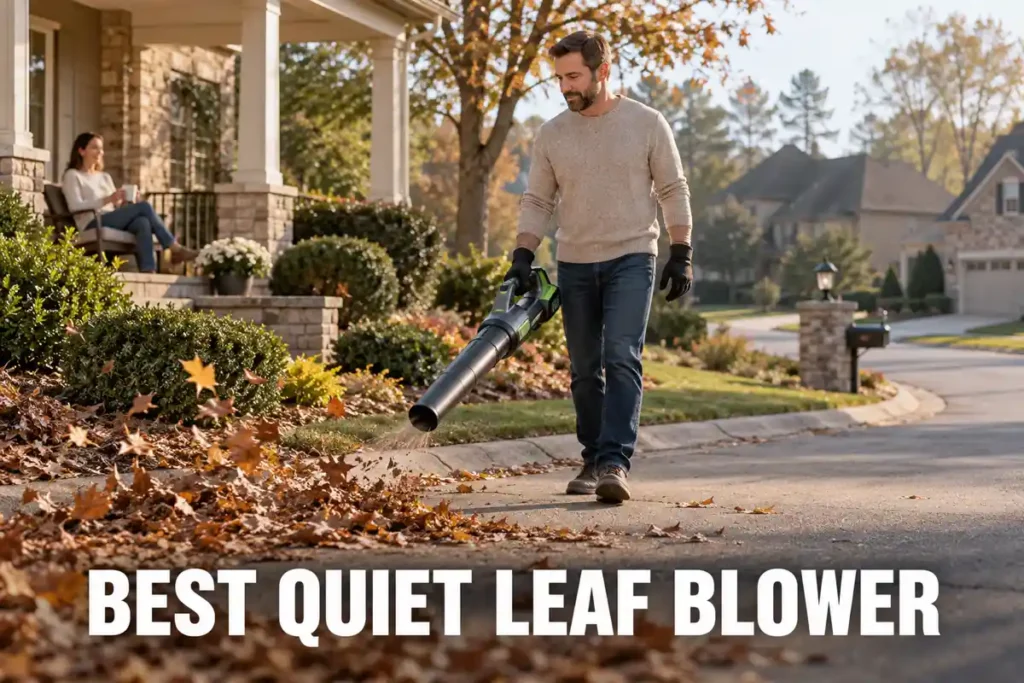
The best quiet leaf blower is the one whose sound rating names the standard it was taken under, because a bare dB number on a box cannot be ranked against another. I have run battery and gas blowers around my orchard, the yard and the machinery shed, and I trust a figure only when it says where and how it was taken.
Affiliate Disclosure: Garden Power Scout is a proud participant in the Amazon Services LLC Associates Program. As an Amazon Associate, we earn from qualifying purchases, at no extra cost to you.
Four of the five blowers below print a rating under ANSI B175.2, and my top pick is the Makita XBU03Z 18V LXT Brushless Blower (Tool Only). You get each figure with its kind, what the quiet costs in push, and the hearing and neighbor rules that apply.
Best Quiet Leaf Blower Reviews 2026 With 5 Picks Ranked by Sound Rating
These five are my selection for a yard where noise matters. Four run on a battery and one burns gas, and every battery blower is sold as a bare tool, so packs and a charger are separate purchases. Each block says which kind of figure its sound rating is and what you give up for the quiet.
1. Makita XBU03Z 18V LXT Brushless Blower (Tool Only) Best Overall
If an open window next door or a family at lunch decides when you can run a blower, start with the sound rating. The Makita XBU03Z carries the lowest rating on this page that rests on a named standard: according to Makita, 60 dB(A) under ANSI B175.2, a bystander rating taken at the standard’s rating distance of 50 ft. The box holds the blower only, with no battery and no charger, so you also need a Makita 18V LXT pack and its charger.
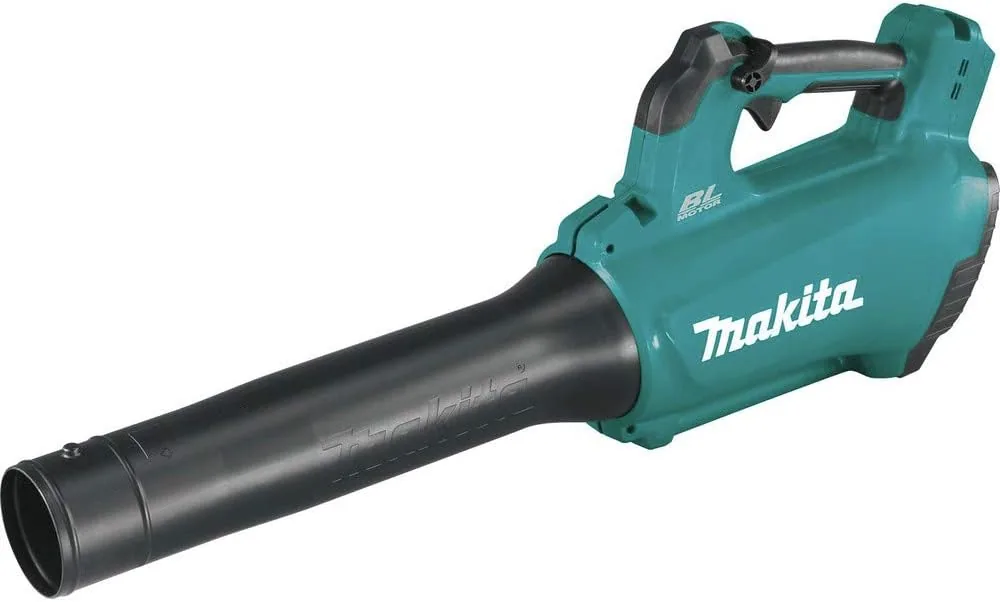
Makita XBU03Z 18V LXT Brushless Blower (Tool Only) Specs
Key Features:
- Named-standard rating: Makita prints its sound figure under ANSI B175.2, so you can set it beside another maker’s number that uses the same standard.
- Variable-speed trigger: More pressure gives more air, so a light pull handles light work.
- Cruise control lever: Turn it forward to raise the speed and back to lower it, and it holds the speed without the trigger.
- In-line fan design: According to Makita, it keeps the tool balanced in the hand.
- Hook hole: A hole in the bottom of the housing lets you hang the blower on a hook or a nail.
- Restart lock: The tool will not start when a pack goes in with the trigger pulled, which blocks a surprise start.
- XPT seals: Makita builds the tool to channel away dust and water, though the manual still says to keep it out of rain and to store it indoors.
The XBU03Z moves 459 CFM at its maximum, with a peak of 116 mph and an average of 96 mph, according to Makita. On a 5.0 Ah pack the push comes to about 11 N, roughly 2.5 lb against your hand, and that is what the quiet costs: enough for dry leaves, clippings and light debris, too little for a wet mat. Along the hedgerow, where a season of leaves and twigs had packed into the base, the stream skated over the top and left the bottom layer where it lay, so I finished that strip with a rake.
Makita lists 32 minutes at 10,800 rpm on one 5.0 Ah pack, and the figure varies with the cruise setting. At full power the same pack runs about 10 minutes, and a 4.0 Ah pack runs about 8 minutes by simple proportion to its energy. A low sound rating buys no extra minutes.
Late October brings a second job. The alleys have just been sown with cover crop, and the leaves keep dropping onto the seeded strips. I feather the trigger so the stream lifts the leaves and leaves the seed where it fell, and the XBU03Z allows that because its speed follows the pull of the finger. After a night of rain I wait a day, since that light a push will not lift leaves that have pasted themselves to wet soil.
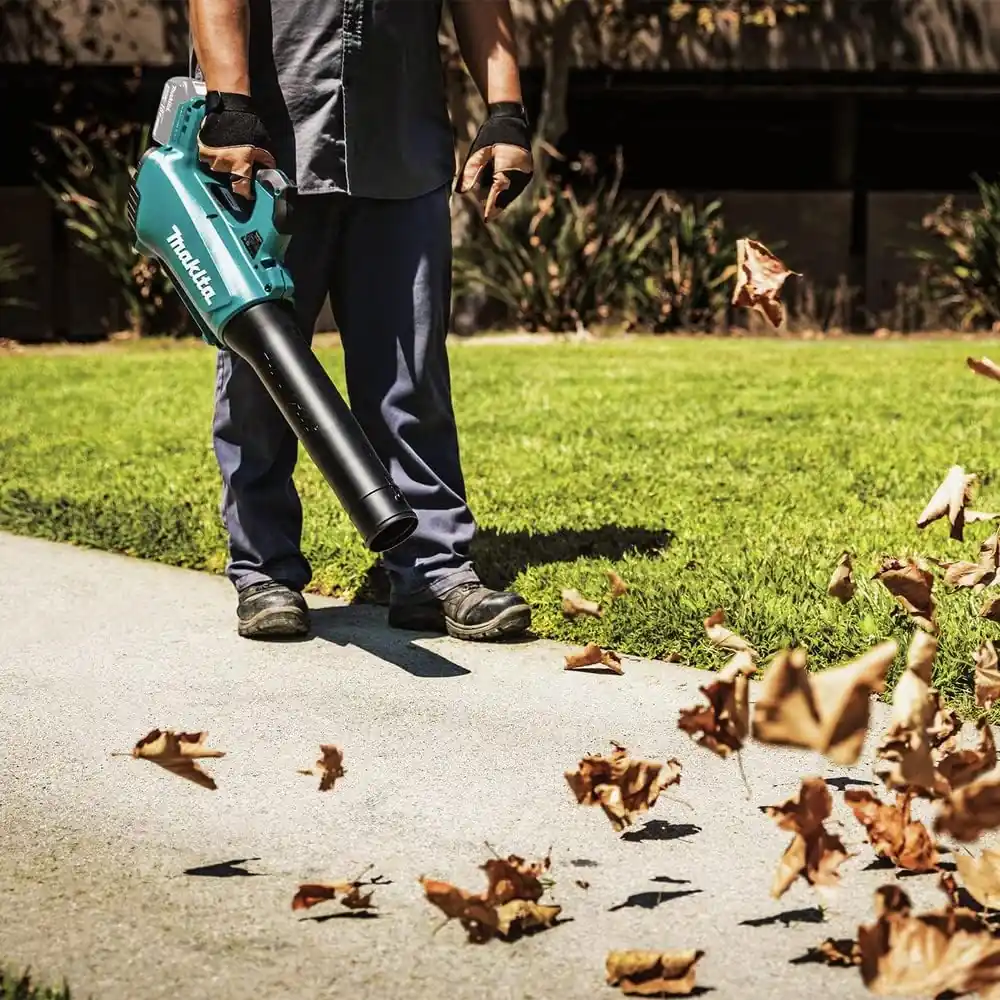
Around the young plum trees the stream lifted leaves off the mulch ring and left the mulch in place, so I hold the nozzle above the ring for that work.

WHY I CHOSE THIS
Mirko Lekić, Agricultural Engineer & Farm Owner
I chose the XBU03Z as the best quiet leaf blower on this page because its rating is the lowest one with a named standard behind it. I treat that lead as real on paper and small by ear, since a 1 dB gap is one nobody can hear. The rating buys a household-friendly tool for dry work, and it gives up push to get there.
The 60 dB(A) figure is a bystander rating, and at the operator’s ear the sound is higher: about 83 dBA at full output in the open. Makita’s manual lists goggles, a cap and a mask; add hearing protection too: wear earmuffs or earplugs from the first minute, and keep the mask on because blowing can raise dust carrying pesticides or fertilizers, which matters in an orchard.
The XBU03Z runs on any pack from Makita’s 18V LXT list, and Makita backs the tool with a 3-year limited warranty. The motor stops without warning when the protection trips on overload, overheating or a drained pack, so a tool that looks dead may only need a rest or a charged pack. Makita says to store the tool indoors, and the hook hole lets you hang it off the floor. The manual also asks for reasonable hours and no use near an open window, and the rating does not change that.
The XBU03Z suits an owner of Makita 18V packs whose work is short and dry: leaves on a drive, clippings on a path, dust on a shed floor, with the nozzle pointed away from people and open windows. Skip it with no LXT packs, with wet leaf mats, or with a lawn so big that one pack cannot finish it.
FINAL VERDICT
The XBU03Z gives you the lowest rating on a named standard and charges you in push. If you own the packs and your debris is dry, that trade is a fair one.
It is the quiet-rated blower for short, dry jobs.
2. Milwaukee M18 FUEL Dual Battery Blower 2824-20 (Tool Only) Best Premium
Plan on two M18 packs and a charger before the Milwaukee 2824-20 does anything: the box holds the blower only, and the tool will not start on one pack. Milwaukee recommends two HD8.0 or larger packs. In return you get a 64 dB(A) bystander rating at 50 ft under ANSI B175.2, according to Milwaukee’s manual, and about 18 N of push with two 8.0 Ah packs at full throttle, roughly 4 lb against your hand.
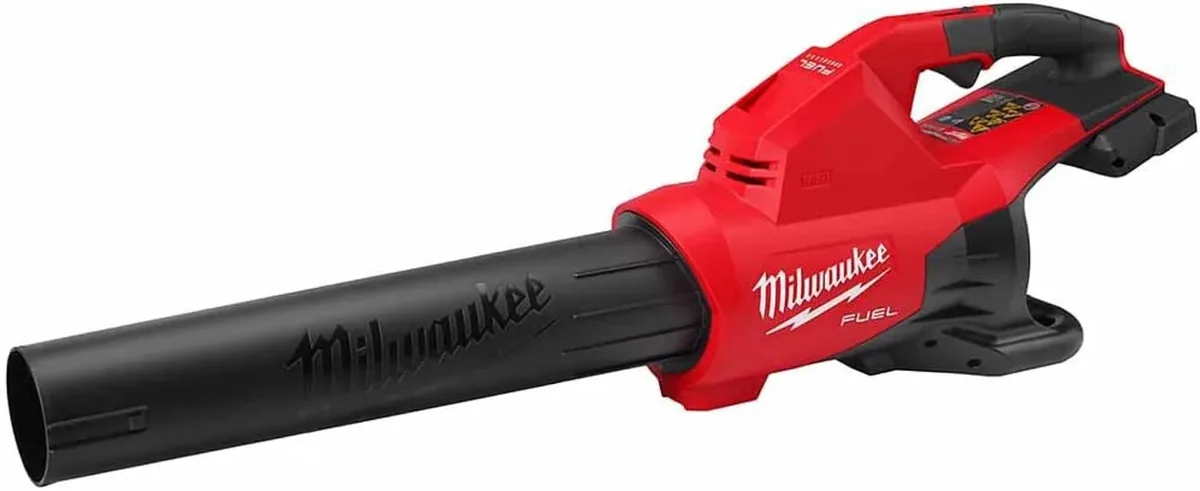
Milwaukee M18 FUEL Dual Battery Blower 2824-20 (Tool Only) Specs
Key Features:
- Printed 50 ft rating: The manual gives the 64 dB(A) figure as a 50 ft bystander level, so it sits on the same footing as any other rating under that standard.
- Two-battery power: Two M18 packs feed the 600 CFM maximum airflow, and the tool stops if either pack runs flat.
- Sliding lock-on lever: It sits in the center of the housing, so a left hand and a right hand use it the same way.
- Trigger on top of the lever: Pulling the trigger with the lever set gives full power, and letting go returns to the lever setting.
- Fast throttle: Milwaukee lists full power in under a second, so a pile gets the push the moment you ask for it.
- Pack gauge: It shows the remaining run time of the lowest pack, which is the one that decides when you stop.
- Removable tube: The tube snaps off for storage, which shortens the tool on a shelf.
Milwaukee lists 600 CFM as the maximum airflow, 145 mph as the air speed and 17.7 N as the push. The 64 dB(A) rating sits 4 dB above the 60 dB(A) class, which is about 1.3 times as loud, and the force is what those decibels buy: enough to roll pods and dry leaves off hard ground, not enough for a wet mat. After the autumn storm the machinery yard held seed pods and small branches. The 2824-20 rolled the pods off the concrete and left the branches where they lay, so I picked those up by hand.
Two 8.0 Ah packs run just over 15 minutes at full power, close to 2 hours at the third bar of the dial, and about 32 minutes with the dial set for a push of about 2.7 lb. Milwaukee’s own chart lists 26 minutes at full throttle on two HD12.0 packs. The tool stops when either pack runs flat, so two packs of the same capacity, both fully charged, give the run you expect.
Late autumn banks leaves against the fence line along the lane. Milwaukee’s manual says to hold the tube 5 to 6 inches above the ground and sweep side to side, and along the fence I work that stroke with the wind across my body, so the pile travels down the line and away from me. The tool is just over 34 in long, which suits a straight fence and gets awkward in the tight corner beside the shed door. The carry is about 10.7 lb with two 8.0 Ah packs, so I plan that job as a steady walk along the fence.
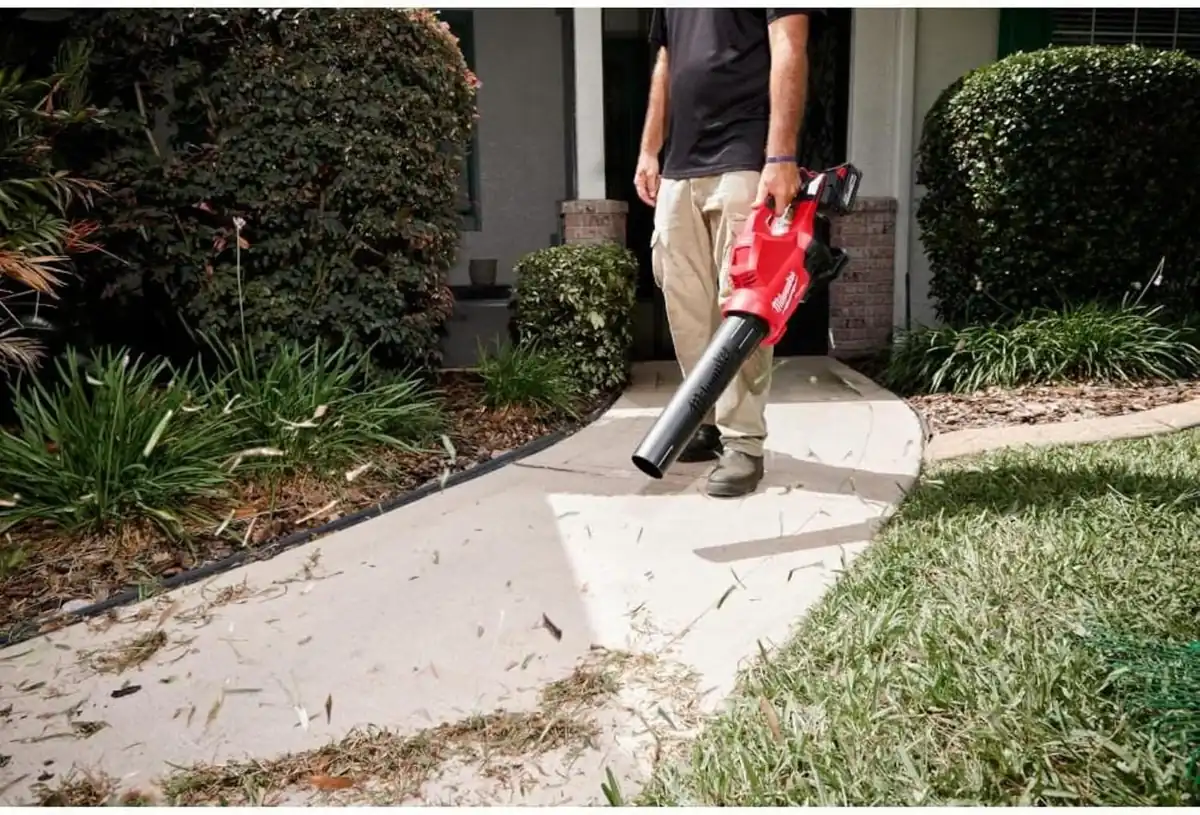
On Sundays I wait until the house is up before the first sweep, because 64 dB(A) at 50 ft is still a sound people indoors can hear. Milwaukee’s manual keeps bystanders 50 ft away, the same distance the rating is taken at.
WHY I CHOSE THIS
Mirko Lekić, Agricultural Engineer & Farm Owner
I chose the 2824-20 as my premium pick because its decibels buy force. Milwaukee rates the push at 17.7 N next to a 64 dB(A) rating, and the manual puts the distance and the standard behind the number. It earns the label only when the M18 packs are already yours.
Milwaukee’s manual requires eye protection, hearing protection and protective clothing and footwear. The 64 dB(A) rating is a bystander figure, and at the operator’s ear the reading is about 81 dB(A) at wide-open throttle, so put plugs or muffs in every time and add a dust mask on dry ground.
Milwaukee advises two packs of the same capacity, both fully charged, because the weaker one decides the run. The manual forbids use in rain or wet locations and gives 0 F to 125 F as the recommended ambient range. Milwaukee backs the tool with a 3-year limited warranty, and the packs carry a separate one. The manual lists the nozzle attachments as accessories, so check what your carton holds before you plan a flat-nozzle job.
Buy it if you already own two High Output M18 packs and your work is driveways, decks, shop floors and the lane around the yard, where force matters more than the lowest possible rating. Skip it if you would be buying the packs new, if you want a one-pack job, or if you need a tool for wet weather, because the manual forbids use in rain.
FINAL VERDICT
The 2824-20 pairs a printed 50 ft rating with 17.7 N of rated push. It earns its place only on a shelf that already holds two High Output M18 packs. Without them, skip it.
It is the premium blower for M18 owners who want push with a printed rating.
3. Makita XBU02Z 36V (18V X2) LXT Brushless Blower (Tool Only) Best Value
Check your shelf first: the XBU02Z needs two Makita 18V LXT packs and a charger, and the manual says it does not work on one pack. The box holds the tool only. For an owner of two packs it offers a 61 dB(A) rating under ANSI B175.2, according to Makita, a bystander rating taken at the standard’s rating distance of 50 ft. That makes it the value pick for that owner and a poor buy for everyone else.
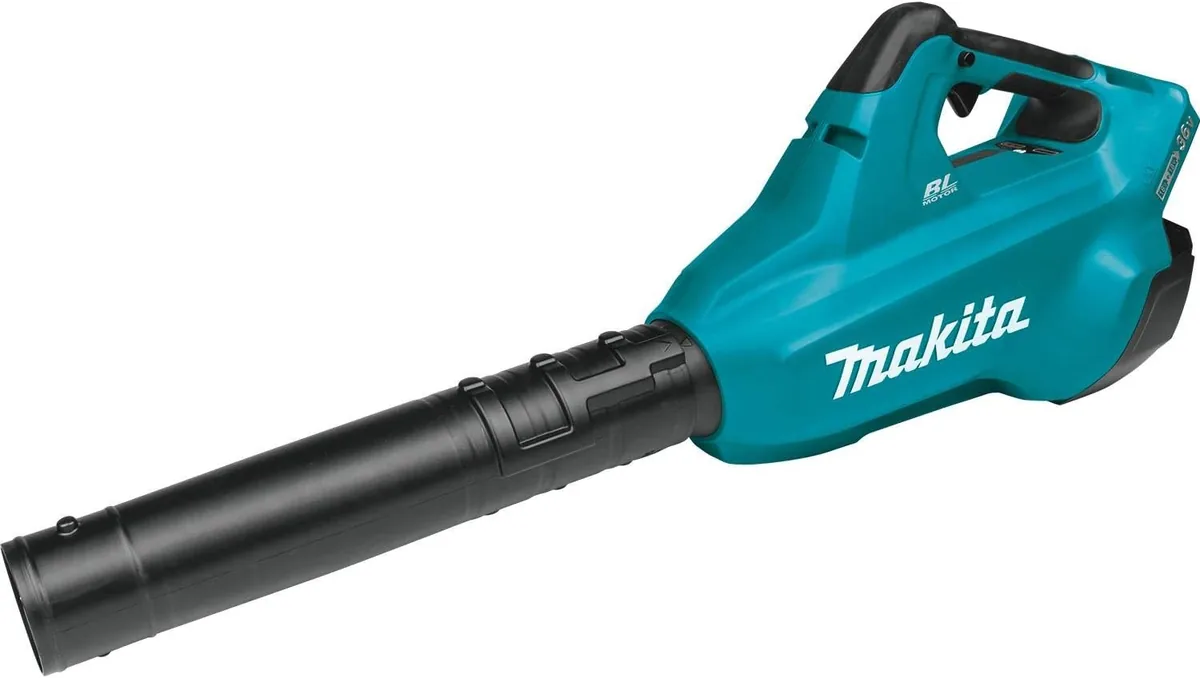
Makita XBU02Z 36V (18V X2) LXT Brushless Blower (Tool Only) Specs
Key Features:
- Named-standard rating: Makita prints 61 dB(A) under ANSI B175.2 on its product page, so the figure compares with any other rating that uses the same standard.
- Six-stage speed dial: It runs from 1 to 6 and turns while the tool runs, and the trigger works below the dial setting.
- Lock button: Pull the trigger, push the button and release, and the tool keeps running without a held trigger.
- Telescoping nozzle: Makita lists a 3-stage telescoping nozzle with the tool, which gives three lengths through three locking positions.
- Charge indicators: Lamps on the tool show the charge of each pack when you press the check button.
- Overheat and overload protection: The tool stops itself, and on overheating the battery indicators blink for about 60 seconds.
- Hook hole: A hole in the bottom of the housing lets you hang the blower on a hook.
Makita lists 473 CFM as the maximum airflow, with an average air speed of 120 mph and a maximum of 145 mph in the manual. I judge the tool by that airflow and speed: plenty for dry leaves and clippings on hard ground, a poor match for wet mats. The rating sits only 1 dB above the 60 dB(A) class, a gap nobody can hear. After the May mowing, the clippings that land on the alley edges go back into the alley on dial 3, and I set the dial once and let the trigger do the rest.
Makita’s page lists up to 28 minutes at 15,800 rpm on dial setting 3 with two 5.0 Ah packs, and its catalog lists up to 75 minutes on dial 1. Dial 6 spends the packs fastest, so a full-power run is shorter than the 28 minutes, and I plan the bigger jobs on dial 3 or below. Two 5.0 Ah packs hold about 180 Wh between them. A step or two down the dial before the packs warm up buys more minutes than waiting for the stop.
Along the drainage ditch, leaves collect in the grass on the bank below the lane. The telescoping nozzle has three locking positions, and I extend it to the longest, 36-5/8 in overall, so I can blow down the bank from the lane without stepping onto the slope. On the machinery yard I shorten it for control. The ditch bottom is the limit: leaves lying wet in the water line did not move, so I rake that part.
Stay off dial 6 in high heat, as Makita’s manual advises. An overheated tool stops on its own, and the battery indicators blink for about 60 seconds.
WHY I CHOSE THIS
Mirko Lekić, Agricultural Engineer & Farm Owner
I chose the XBU02Z as my value pick for an owner of two Makita 18V packs. With the packs already on the shelf, the tool is the only purchase, and it brings a bystander rating under a named standard and a six-stage dial. The value stops at the packs: a buyer who must purchase both pays for them on top of the tool.
A 61 dB(A) rating describes someone 50 ft away, and the ear at the handle hears far more, so wear earmuffs or earplugs from the first minute, along with the goggles, cap and mask Makita’s manual lists.
The manual describes this tool as intended for commercial use. It weighs about 9 lb with two packs and runs 36-5/8 in long at the longest nozzle setting, and Makita backs it with a 3-year limited warranty. On the first morning I slid in a single pack, pulled the trigger and got nothing, because the tool runs on two packs only. An overload trip also stops the motor with no indication, which looks like a dead pack, and Makita says to let a hot pack cool before you charge it and to keep the tool and packs out of any place that reaches 122 F.
Skip it if you own no Makita 18V packs: two packs and a charger come on top of the tool, and for that buyer it is a poor buy. Makita also sells this blower in a kit with two 5.0 Ah packs and a charger, which suits a starter better than the bare tool. Choose the bare tool when two LXT packs are already charged on your shelf and the work is driveways, shop floors and dry leaves in the yard.
FINAL VERDICT
The XBU02Z is good value on one condition: two 18V LXT packs you already own. If your shelf is empty, count the packs and the charger before the tool.
It is the value blower for a shelf that already holds two LXT packs.
4. ECHO PB-2520 25.4cc Gas Handheld Leaf Blower Quiet Gas
At the nearest plum row, about 100 to 150 feet from the house, I could still hear the PB-2520 from the yard door. ECHO prints 70 dB(A) at 50 ft, a bystander rating under ANSI OPEI B175.2, and it says little about the ear next to the handle. I recommend it as a quiet gas leaf blower for a buyer who wants gas and a rating that names its terms.
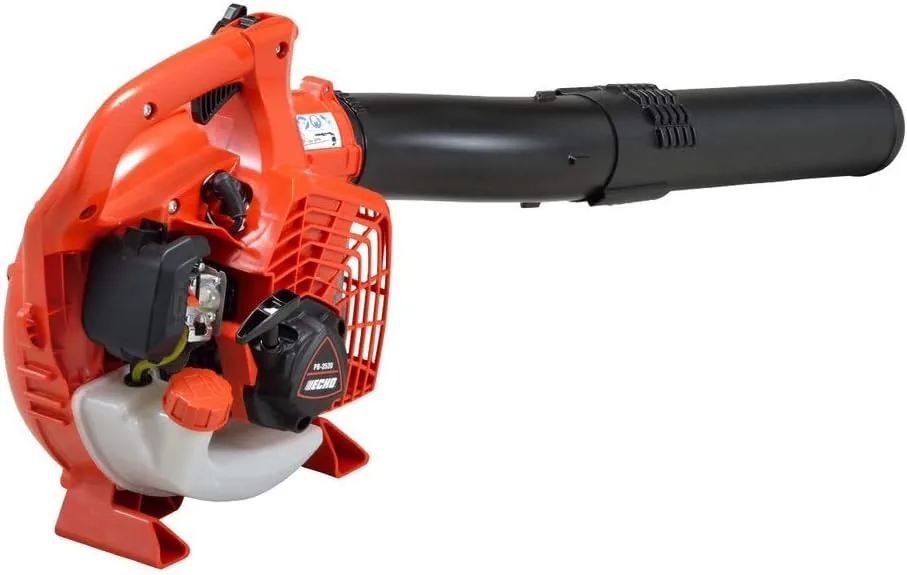
ECHO PB-2520 25.4cc Gas Handheld Leaf Blower Specs
Key Features:
- Rating on the label: 70 dB(A) at 50 ft is printed on the unit.
- Throttle position lever: it holds a low speed, which ECHO names for light work and local noise rules.
- Curved blower tube: according to ECHO, it gives rotational control and less fatigue.
- See-through fuel tank: you read the level at a glance.
- Tool-less air filter access: the filter comes out for cleaning without a screwdriver.
ECHO lists 453 CFM of airflow and 170 mph of air speed, both at the nozzle with the pipes on, and rates the push at 15.8 newtons, about 3.5 pounds of force: enough for dry leaves and clippings, not for a soaked mat. On the quarter-acre house lawn I set the lever low and walked from the shade trees toward the drive. The dry leaves ran ahead of the stream; the matted ones at the trunks stayed down until they dried.
Between passes the engine idles at 3,000 rpm, so the drone does not stop when my finger leaves the trigger. The cordless blowers I use go silent at once, and that changes how I plan work near the house.
ECHO’s manual asks for five minutes at wide open throttle every hour, because steady low speed builds carbon on the spark arrestor screen. Plan those loud minutes for open ground, far from the house.
WHY I CHOSE THIS
Mirko Lekić, Agricultural Engineer & Farm Owner
I gave the PB-2520 the Quiet Gas label because ECHO prints its sound with a distance and a standard. It is the only gas engine on this page, quiet for a gas blower and still loud at the handle. ECHO prints the same 70 for other models, so I never call it the quietest. I pick it for the buyer who wants gas and a checkable figure.
Wear hearing protection from the first pull until the engine stops, because the engine at your ear is far louder than a rating taken at 50 ft. The manual also asks for ANSI Z87.1 eye protection and keeps bystanders and pets 50 ft (15 m) away.
Fuel is a 50:1 mix of 89 octane unleaded gasoline (no E15 or E85) and approved two-stroke oil. Refuel outdoors over bare ground with the engine stopped and cool, then carry the blower at least 10 ft (3 m) away before you pull the cord; the exhaust holds carbon monoxide, so never run it indoors. Some US cities allow only blowers rated 65 dBA or less at 50 ft, which 70 will not meet. ECHO states 5 years consumer and 2 years commercial warranty, covering units sold by authorized ECHO dealers, so check the seller on the listing.
Buy it if you want a gas handheld whose sound rating names its terms, for dry leaves, clippings and paths. Skip it if your town sets a 65 dBA limit, if you want silence between passes, or for wet mats, gravel or a large lot.
FINAL VERDICT
The PB-2520 brings a gas handheld’s push at a rating that states its terms, with a fuel mix and a pull cord. It fits a yard where an engine is the plan and the town’s limit sits above 70 dB(A).
It is the quiet-for-gas handheld for dry yard work.
5. Ryobi 40V HP Whisper Series 730 CFM Blower (Tool Only) Best Whisper Series
The box holds the blower, a tube and speed tips, with no battery and no charger, so you must add a Ryobi 40V battery and charger. The Ryobi Whisper Series leaf blower then gives a variable trigger, a cruise lever and a turbo button. Ryobi’s sound rating is 57 dB with no distance, mode or standard, and that is why it stands last on this page.
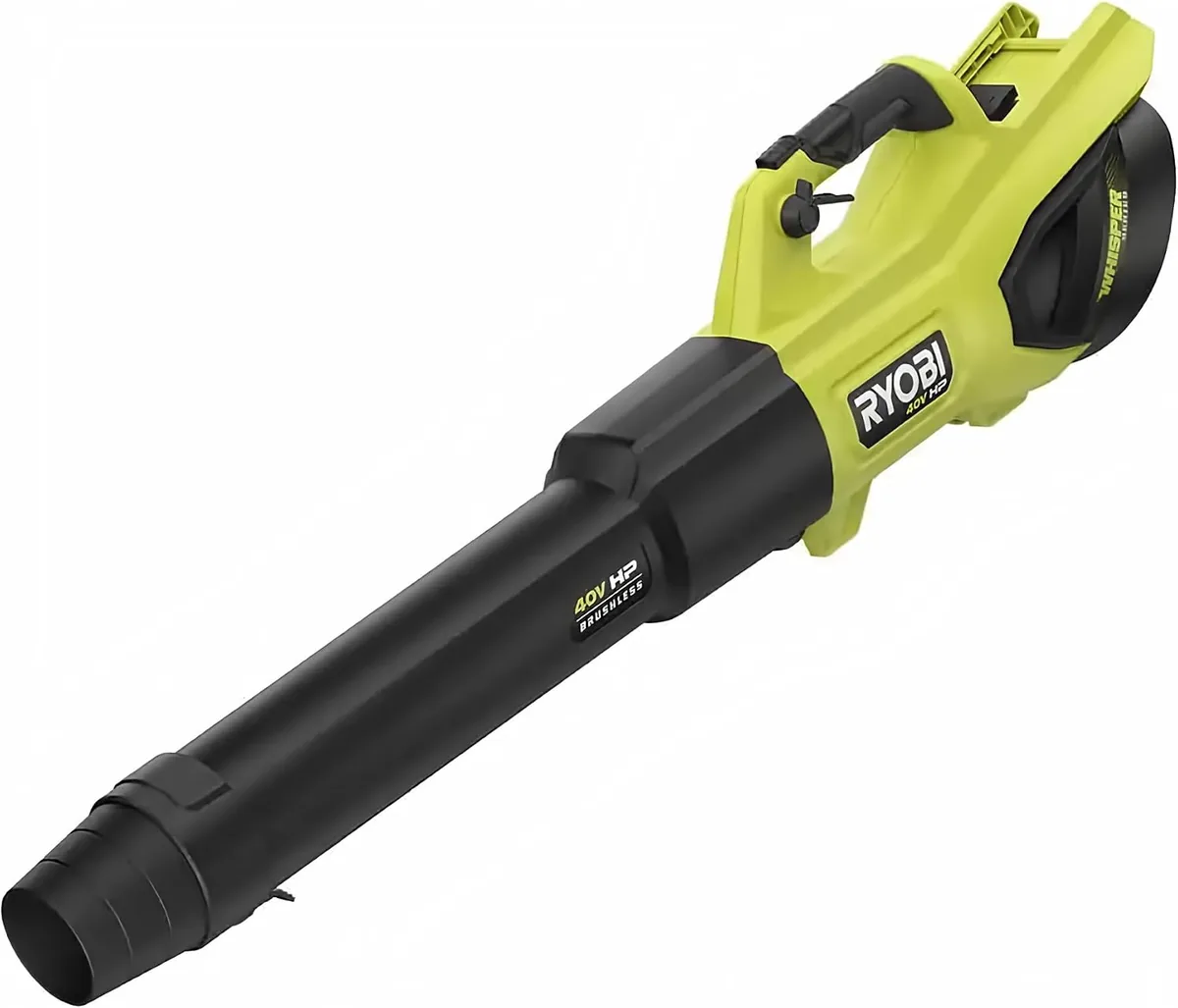
Ryobi 40V HP Whisper Series 730 CFM Blower (Tool Only) Specs
Key Features:
- Variable-speed trigger: more pull gives more air.
- Separate turbo button: held with the trigger, it raises the airflow to its maximum.
- Cruise control lever: it holds the trigger speed, so a long run needs no constant finger pressure.
- Speed tip: 190 mph with the tip fitted and 145 mph without it, according to Ryobi’s manual.
- Ryobi 40V platform: a pack from another Ryobi 40V tool runs it.
With a full 4.0 Ah pack the push comes to about 11 N on high and about 20 N on turbo, enough to roll dry leaves and shift damp ones but not to lift a soaked mat. In November I start at the trunk end of the tree-row strips and push the dry apricot leaves into the alley, where the mower shreds them.
One 4.0 Ah pack runs about 15 minutes on high and about 10 minutes on turbo, and it brings the weight to about 9.7 lb. Ryobi’s 2 hours needs two packs and the low trigger setting. On a cold November morning the pack gave out at the end of the row with a pile still in the alley, so I start on a full pack and keep turbo for the stubborn corner.
Around the pump head and its filter housing I keep the trigger light and loosen the damp leaves by hand first, as Ryobi’s manual says to loosen debris before blowing.
WHY I CHOSE THIS
Mirko Lekić, Agricultural Engineer & Farm Owner
I gave the 730 the Best Whisper Series label for its controls: a variable trigger, a cruise lever and a turbo button let me match effort to the job. It stands last on this page because Ryobi’s 57 dB has no stated distance or standard, so it cannot be set beside a rating taken 50 ft away. I recommend it to the owner who already has Ryobi 40V packs.
Wear hearing protection from the first trigger pull: Ryobi’s manual asks for it during extended use, and a bare dB number says nothing about the level at your ear. Keep people and pets at least 50 ft away, wear eye protection, and keep the blower out of rain.
Take the battery out when you fit the tube, carry the blower or store it. Ryobi limits the 5-year tool warranty to personal, family or household use and gives 90 days for business use, so a farm or landscaping business should read that line first. Ryobi says noise-dampening foam makes it 86% quieter than gas, with no baseline named.
This blower suits a homeowner who already owns Ryobi 40V packs and clears a house lot, a drive and a few paths. Skip it if you need a noise rating you can compare, a vacuum mode, or warranty cover for farm or business use.
FINAL VERDICT
The 730 gives a variable trigger, cruise and turbo on a 6.5 lb tool, and Ryobi’s noise number has no distance or standard. Take it if you already own Ryobi 40V packs.
It is the Whisper Series blower for an owner of Ryobi 40V packs.
How to Choose the Best Quiet Leaf Blower
You choose a quiet blower by reading one number correctly. I work through six points in order: which kind of sound figure you are reading, whether it can be ranked, what the quiet costs in push, battery against gas, the rules where you live, and the hearing protection that stays on regardless.
Bystander Rating or Sound at Your Ear
A sound figure answers one of two questions: what a bystander 50 ft away hears, or what the person holding the blower hears. The level at the ear is much higher than the bystander rating, and the gap differs by machine, so a page that sets one number beside the other has ranked nothing. Milwaukee’s manual gives the 2824-20 a rating of 64 dB(A) at 50 ft, and the level at the operator’s ear on full power is about 81 dB(A).
The first kind is a bystander rating under ANSI/OPEI B175.2, which rates the machine at 50 ft. Every maker that follows the standard rates at that same point, so the 50 ft rating is the one figure that lines up across brands. In a community field test of two leaf blowers and a hose vacuum, the sound levels at 50 ft agreed with the makers’ ratings (1).
| Kind of figure | Where it is taken | Who it describes | Can you rank brands with it? |
|---|---|---|---|
| Bystander rating (ANSI/OPEI B175.2) | 50 ft from the machine | A person standing nearby, such as a neighbor | Yes, when the standard is named |
| Sound at the operator’s ear | Within about 3 ft of the motor | The person holding the blower | Only against another ear figure taken the same way |
| Bare number with no distance or standard | Not stated | Not stated | No |
On the work pad in front of the machinery shed I am the person at the ear and the family home is the bystander, so I read both kinds of figure, one for each of us. The rating tells me what the house hears, and my own ear needs protection whatever the rating says.
Why a Bare Decibel Number Cannot Be Ranked
A number with no distance and no standard describes nothing you can set beside another. A 57 on one box could be taken at 50 ft and a 64 on another at arm’s length, and the lower number could be the louder machine. The setting matters too, because a rating on a low dial is not one taken at full power, and a box can call itself the best quiet leaf blower and print either figure with no word about where it was taken.
Leaf blower decibels also run on a logarithmic, hearing-weighted scale, so small gaps mean less than they look. Every 3 dB doubles the sound energy and every 10 dB sounds about twice as loud:
| Gap in dB(A) | Sound energy | How loud it sounds |
|---|---|---|
| 1 dB | About 1.3 times | A difference you will not hear |
| 3 dB | 2 times | About 1.2 times as loud |
| 4 dB | About 2.5 times | About 1.3 times as loud |
| 10 dB | 10 times | About twice as loud |
Pro Tip
A box that promises an ultra quiet leaf blower has made a claim, and only the number beside it can back the claim up. Look for the distance and the standard on the maker’s own spec page before you let a dB figure decide a purchase.
I ask two questions of every sound figure: where was it taken, and under which standard. A number that answers neither cannot take a place in the sound ranking.
What Quiet Costs in Push and Airflow
Moving air makes noise, so a blower tuned for quiet tends to give up some push. Push is the force of the jet at the nozzle, in newtons, and 1 N is about 0.22 lb of force, so 11 N is about 2.5 lb. CFM is the volume of air the blower moves per minute, and newtons say how hard the jet hits a wet leaf or a stone.
A jet with low push moves dry leaves easily and struggles with a wet mat. The best quiet leaf blower for you is therefore the one whose push still fits your hardest job, and three checks keep the comparison honest:
- Look for newtons: a printed force figure compares push at a glance, while airflow and speed figures compare only when both blowers quote them for the same nozzle and setting.
- Ask for minutes on high: the longest printed run time usually belongs to a low dial, and the minutes at full power are what a leaf job uses.
- Count the packs: a quiet cordless leaf blower that needs two packs costs the second pack too.
I rank a quiet blower by the push I get at its rating, because a blower I have to run on the top dial all morning is no quieter in my yard than a stronger one I run on a middle setting.
Battery or Gas for Noise
A battery blower has no engine. In NIOSH personal sampling of 80 landscaping workers at 11 sites, workers had significantly more noise exposure with fuel-powered leaf blowers, string trimmers and chainsaws than with battery versions (2). A quiet electric leaf blower on a battery pack still makes noise, but no engine runs behind it.
Engine noise can be extreme at the ear. A test of agricultural backpack machines, mist blowers among them, measured above 100 dB(A) at the operator’s ear for every machine except one (3). Those were farm machines, and an ear reading is a different kind of figure from the bystander ratings on this page, so the result rates none of the blowers here.
The two kinds of machine also sound different, and the difference decides how far the noise travels:
- Battery fan: a higher whine that fades faster with distance.
- Gas engine: a lower rumble that carries further and passes through walls and windows more easily.
- Either kind: louder on a higher dial.
In the field test above, the unweighted sound level ran 11 to 12.5 dB higher than the dB(A) level at every distance, which points to low-frequency sound that a dB(A) figure leaves out (1). A quiet gas leaf blower earns the word only against other gas machines, and its rating still has to carry a distance and a standard.
I do not trust my ears to rank two blowers, because a steady noise seems to fade while I work. I lean on the rated figure and keep my ears for the pitch.
Key Takeaway
On a rating with a named standard, the battery handhelds on this page sit at 60 to 64 dB(A) and the gas handheld at 70 dB(A), 6 to 10 dB higher.
Local Noise Rules and Hours
Many towns limit the hours a blower may run, some set a sound limit measured at 50 ft, and some restrict gas engines. A survey of 6,647 Canadian adults put landscaping equipment third among nine noise sources for annoyance, with 6.3% reporting high annoyance over the past year (4). The survey asked about annoyance, not sound levels, so it says nothing about any one blower, and it shows that neighbors notice landscaping machines as a group.
Check these four things before you buy:
- Hours: the weekday and weekend windows, and any ban on early mornings or evenings.
- Sound limit: a level such as 65 dBA at 50 ft, which a blower must be rated at or under.
- Engine rules: whether gas blowers are barred in your town or in certain months.
- HOA rules: associations often add their own hours and limits.
A limit written at 50 ft can be checked against a box only when the rating names its distance and standard. A 64 dB(A) rating sits under a 65 dBA limit and a 70 dB(A) rating sits over it, and the wording of the rule on the test method decides whether a given model counts. Your city, county and HOA codes are the final word. If a local rule rules out a gas engine for you, the leaf blowers section of this site sets out the other types.
Hearing Protection With the Best Quiet Leaf Blower
A quiet rating is a bystander figure, and the person holding the blower stands far closer to the noise than the 50 ft it describes. The level at the ear is well above the rating and differs by machine, so a hearing protector belongs on every job.
NIOSH recommends 85 dBA averaged over an eight-hour day and halves the allowed time for every 3 dBA more (5). At 88 dBA that leaves about 4 hours, and at 91 dBA about 2 hours. The limit covers the whole day, so a quiet blower adds to whatever else you run.
Plugs work only when they seal. A Cochrane review of hearing protection at work states that lack of earplug fit may limit protection for about 40% of users (6). Seat the plug fully before the blower starts.
I wear hearing protection for a ten-minute battery job as well, because the 85 dBA limit counts the whole day and my day also holds the mower.
Eye and Ear Protection
Wear eye protection every time and hearing protection whenever any blower runs, a battery model on its lowest dial included. Wear plugs and earmuffs together on a gas engine, and keep people, pets and windows out of the path of the air.
Quietest Leaf Blower Ratings and What Each Maker Prints
The table lists, for each pick, the maker’s sound rating and the standard behind it. Four of the five carry a bystander rating, and the fifth prints a number with no kind attached.
| Blower | Maker’s sound rating | Kind of figure | Standard and distance printed | Maximum airflow |
|---|---|---|---|---|
| Makita XBU03Z | 60 dB(A) | Bystander rating | ANSI B175.2, no distance printed | 459 CFM |
| Milwaukee 2824-20 | 64 dB(A) | Bystander rating | ANSI B175.2, at 50 ft | 600 CFM |
| Makita XBU02Z | 61 dB(A) | Bystander rating | ANSI B175.2, no distance printed | 473 CFM |
| ECHO PB-2520 | 70 dB(A) | Bystander rating | ANSI OPEI B175.2, at 15 m (50 ft) | 453 CFM |
| Ryobi 40V HP Whisper 730 | 57 dB | Bare number | None, no distance or setting | 730 CFM |
The XBU03Z carries the lowest rating with a named standard on this page. Makita names ANSI B175.2 for the XBU03Z and the XBU02Z and leaves the distance out, and the standard rates a bystander at 50 ft, so both sit on the same footing as the Milwaukee and the ECHO. The XBU02Z’s 61 dB(A) is 1 dB higher, a gap you will not hear.
The Milwaukee’s 64 dB(A) is 4 dB higher than the XBU03Z, about 1.3 times as loud. The ECHO’s 70 dB(A) is 10 dB higher, which sounds about twice as loud and carries ten times the sound energy.
The Ryobi’s 57 dB has no distance, no setting and no standard behind it, so the number cannot be set beside the four above it. Ryobi also calls the blower 86% quieter than gas and names no gas blower or distance as the baseline. A lower number with nothing behind it ranks below a higher number that has a standard, which is why the Ryobi stands last.
What a Quieter Rating Costs in Force
Quiet has a price in push, and the steps in the table show it. The Milwaukee pushes about half again as much as the Makita XBU03Z, for 4 dB more sound.
| Blower | Rating | Step from the XBU03Z | Push |
|---|---|---|---|
| Makita XBU03Z | 60 dB(A) | Starting point | About 11 N |
| Makita XBU02Z | 61 dB(A) | 1 dB more, not audible | No force figure from Makita |
| Milwaukee 2824-20 | 64 dB(A) | 4 dB more, about 1.3 times as loud | 17.7 N according to Milwaukee |
| ECHO PB-2520 | 70 dB(A) | 10 dB more, about twice as loud | 15.8 N according to ECHO |
The force figures come from different sources, so read the gap as a rough size. The gas handheld shows the other side of the trade: ECHO’s 15.8 N is less than Milwaukee’s 17.7 N, at 6 dB more sound, so a gas engine does not buy more push per decibel here.
The choice then comes down to your hardest job. Dry leaves on a drive sit within the push of the 60 dB(A) blower. For seed pods and packed debris, the extra 4 dB of the Milwaukee pays for the push, and the ECHO’s extra 10 dB pays for an engine and not for more force.
My Overall Verdict
Three of the five stand out, and the order follows the rating you can compare and the push you get for it.
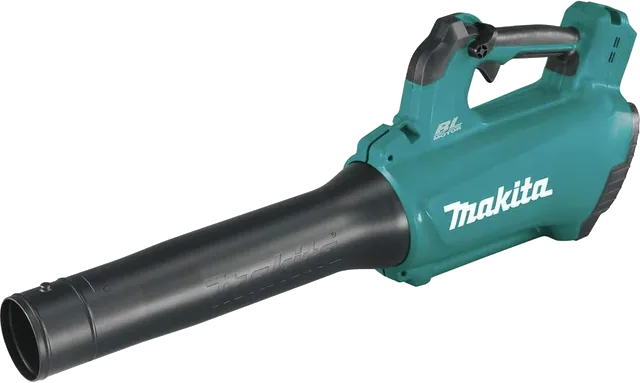
1. Makita XBU03Z 18V LXT Brushless Blower (Tool Only) Best Overall
Best for short, dry jobs if you already own Makita 18V packs: 60 dB(A) under ANSI B175.2, according to Makita, at about 6 lb with a pack.
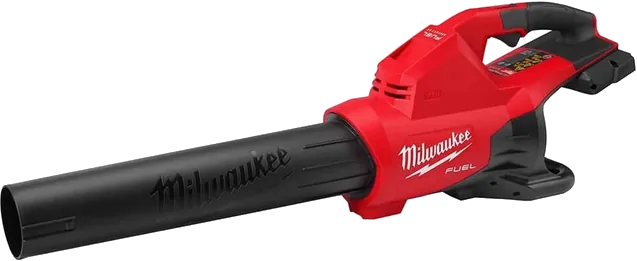
2. Milwaukee M18 FUEL Dual Battery Blower 2824-20 (Tool Only) Best Premium
Best when you want more push and own two M18 packs: 64 dB(A) at 50 ft and 17.7 N, according to Milwaukee.
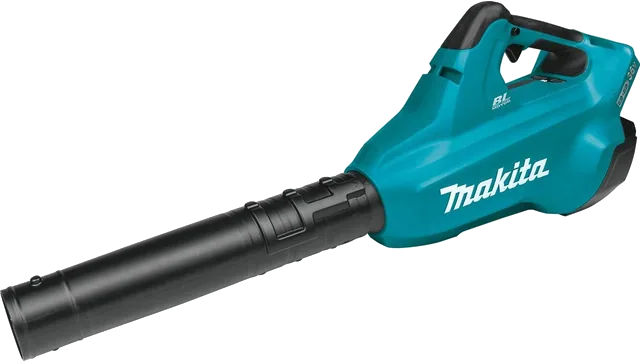
3. Makita XBU02Z 36V (18V X2) LXT Brushless Blower (Tool Only) Best Value
Best for owners of two Makita 18V packs: 61 dB(A) under the same standard and 473 CFM, with no battery to buy.
For a yard with close neighbors, the best quiet leaf blower is the one with the lowest rating you can check: the Makita XBU03Z 18V LXT Brushless Blower (Tool Only), when you own LXT packs and the work is short and dry.
Why Makita XBU03Z 18V LXT Brushless Blower (Tool Only) Might Be the Best Choice
The Makita XBU03Z 18V LXT Brushless Blower (Tool Only) is my best overall because it has the lowest sound rating on this page that comes with a named standard, 60 dB(A) under ANSI B175.2 according to Makita. It weighs about 6 lb with a pack, and one 18V pack runs it.
The trade-off is push and minutes. It pushes about 11 N with a 5.0 Ah pack and runs about 10 minutes on high, so it suits dry leaves and clippings and not wet mats. Makita sells it as a bare tool, so the pack and the charger are separate, and it makes the most sense for an owner of LXT packs.
Here is what puts it at the top:
✓ Sound rating: 60 dB(A) under ANSI B175.2, according to Makita.
✓ Airflow and speed: a 459 CFM maximum and a 116 mph maximum, according to Makita.
✓ One 18V pack: it runs on a single Makita 18V LXT pack, which a drill owner may already have.
✓ Cruise control lever: it holds a set speed without the trigger.
✓ Warranty: 3 years limited, according to Makita.
Frequently Asked Questions
Is there a quiet leaf blower available?
A quiet leaf blower is available if you judge quiet by a rating that names its standard, and the best quiet leaf blower of the four that print one is the Makita XBU03Z at 60 dB(A) under ANSI B175.2 according to Makita. The other three run from 61 to 70 dB(A).
What is the quietest leaf blower in the world?
The quietest leaf blower in the world cannot be named from spec sheets alone, but the lowest rating with a named standard on this page is the Makita XBU03Z at 60 dB(A) under ANSI B175.2. Ryobi prints a lower 57 dB for its Whisper Series 730, and with no distance or standard behind it that number cannot be ranked.
Is there such a thing as a silent leaf blower?
There is no such thing as a silent leaf blower, because moving that much air makes noise, and the lowest rating on this page is 60 dB(A) under ANSI B175.2. The sound at the ear of the person holding the blower is far higher than that rating, so hearing protection still applies.
Which blower fan is the quietest?
The quietest blower fan is the one with the lowest rating under the same standard, and on this page that is the Makita XBU03Z at 60 dB(A) under ANSI B175.2. Fan type alone settles nothing, because the printed rating taken at the same distance is what ranks one leaf blower against another.
How many decibels is a leaf blower?
A leaf blower rates from about 60 to 70 dB(A) on the bystander scale for the four rated models on this page, and it reads far higher at the operator’s ear. The Makita XBU03Z prints 60 dB(A) and the ECHO PB-2520 prints 70 dB(A), both under ANSI B175.2, so ask for the standard before you compare.
References
- Walker E, Banks JL. Characteristics of Lawn and Garden Equipment Sound: A Community Pilot Study. J Environ Toxicol Stud. 2017;1(1).
- Alexander BM, Graydon PS, Pena M, Feng HA, Beamer BR. Hazardous exposures and engineering controls in the landscaping services industry. Journal of Occupational and Environmental Hygiene. 2025;22(3):189-202.
- Calvo A, Preti C, Caria M, Deboli R. Vibration and Noise Transmitted by Agricultural Backpack Powered Machines Critically Examined Using the Current Standards. IJERPH. 2019;16(12):2210.
- Michaud DS, Marro L, Denning A, Shackleton S, Toutant N, McNamee JP. Annoyance toward landscaping equipment noise in Canada. JASA Express Letters. 2022;2(8):083602.
- National Institute for Occupational Safety and Health. Noise-Induced Hearing Loss. Noise and Hearing Loss. Centers for Disease Control and Prevention; 2024.
- Morata TC, Gong W, Tikka C, Samelli AG, Verbeek JH. Hearing protection field attenuation estimation systems and associated training for reducing workers’ exposure to noise. Cochrane Database of Systematic Reviews. 2024;5(5):CD015066.
Safety Note: Leaf blowers throw debris and can damage your hearing. Wear eye and ear protection, read the manufacturer’s manual, and check your local rules on noise and operating hours.