
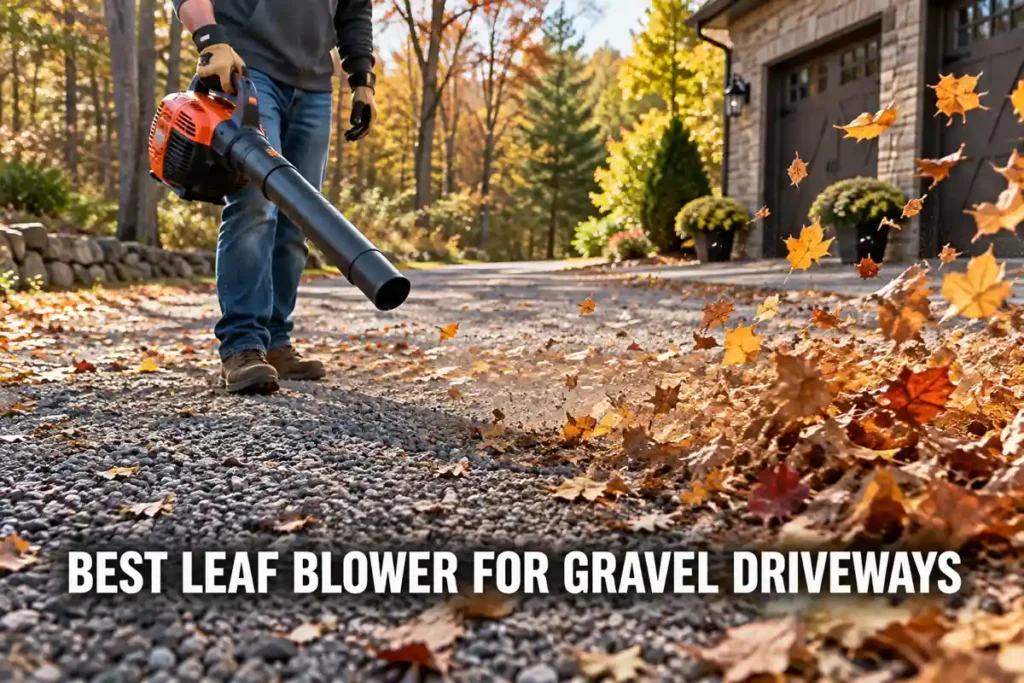
The best leaf blower for gravel driveways lifts the leaves and leaves the stones, and that depends on how finely you can turn the air down. A blower with one speed can throw crushed stone at windows, car paint and people. I clear the long gravel yard between my house and the machinery shed with a battery handheld, a corded blower and an old gas handheld, so the lowest setting is the first thing I check.
Affiliate Disclosure: Garden Power Scout is a proud participant in the Amazon Services LLC Associates Program. As an Amazon Associate, we earn from qualifying purchases, at no extra cost to you.
Below are my five picks, led by the EGO Power+ LB6504 650 CFM Blower Kit, followed by the buying advice on control, weight and run time.
Best Leaf Blower for Gravel Driveways Reviews 2026: 5 Models I Judge by Their Low End
These five are my picks for a long gravel drive. Each one can run well below full speed, so the choice comes down to weight, reach and what the control lets you hold.
1. EGO Power+ LB6504 650 CFM Blower Kit Best Overall
The EGO LB6504 is the cordless leaf blower with battery and charger in the box that lets me pick how hard the air hits a gravel drive. According to EGO, the continuous dial runs from 225 CFM at the bottom to 470 CFM, and a boost button adds a short burst up to 650 CFM. It is my Best Overall pick for a stone drive because the gentle end of that range is a number you can read and a setting you can hold.
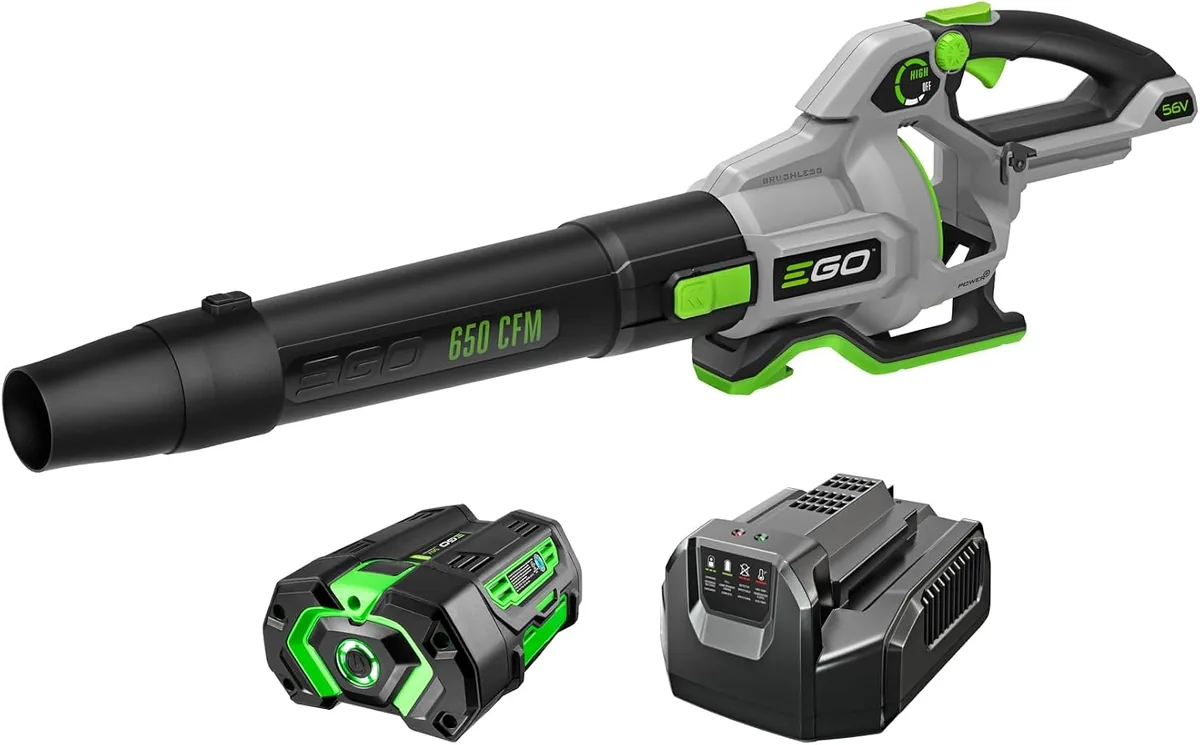
EGO Power+ LB6504 650 CFM Blower Kit Specs
Key Features:
- Lock-on dial: EGO says it holds the blower at any speed, so you set the gentle end once and rest your finger on a straight run.
- Variable-speed trigger: More pressure gives more air, so you can feather the stream along the edge of the drive.
- Boost button: It gives maximum speed only while held and drops back on release.
- Flat nozzle: It spreads the air over a wider area, so leaves move in a broad band.
- Tapered nozzle: It concentrates the air and raises the air speed, a tool for hard surfaces and a risk on loose stone.
- Low-setting run time: EGO lists up to 200 minutes on low with the 5.0 Ah pack, so gentle work on a long drive does not drain the battery.
- Strap point: The body has a hardpoint for a shoulder strap, sold separately.
On the crown of my drive, the bottom of the dial rolls dry apricot and plum leaves across the surface and leaves the crushed stone lying where it is. A rake does the opposite, because its tines drag stones into ridges along with the leaves. Leaves that have settled between the stones do not come up at 225 CFM, and I leave those for the first rain or the rake. Turn the dial higher and the stream starts to shift the stone as well, so on gravel the top of the dial is for the concrete and the bottom is for the stone.
The dial locks any speed I set, so my finger can rest on a long straight run, the trigger gives more air as I squeeze, and the boost button works only while I hold it. EGO lists up to 200 minutes on low, 30 on high and 15 on boost with the 5.0 Ah pack, so work at the bottom of the dial stretches a long way and boost is a short burst.
The weight shows up on the drive. The tool is 4.77 lb bare and about 9.8 lb with the pack, and it sits forward, so with no strap in the box the nozzle tips toward the stones. A steep angle digs gravel, so I hold the tube up to keep the stream shallow, and my forearm tells me when I forget. Where the drive meets the concrete pad by the machinery shed I fit the tapered nozzle for the faster stream, after I have walked the pad and picked up any stone that rolled onto it, and on the stone the flat nozzle stays on.
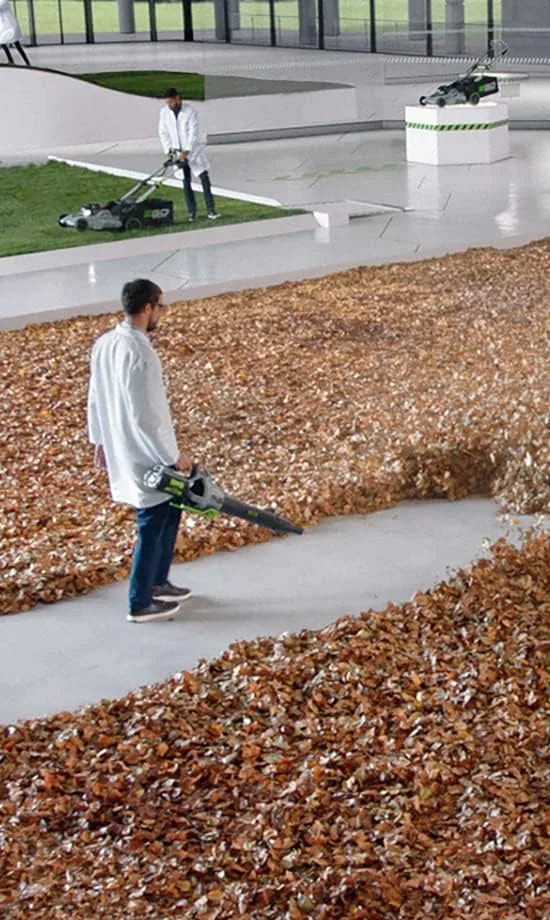
Stop the blower before you set it down. EGO’s manual says never to put a running blower on gravel, sand or debris, because the intake can pull it in and throw it at you or at bystanders, so turn the dial all the way back to off first.

WHY I CHOSE THIS
Mirko Lekić, Agricultural Engineer & Farm Owner
I chose the LB6504 for Best Overall because the low end of the dial is a printed number, and the dial holds it. EGO also puts a tapered and a flat nozzle in the box and lists a long low-setting run time, which covers a long gravel job on one pack. Best Overall here means the most complete low-speed control, with weight as the price. I accept that price for a stream that leaves the stone alone.
EGO’s manual requires ANSI Z87.1 eye protection and hearing protection, and wants bystanders, children and pets at least 50 feet away. It says to clear rocks and other throwable objects from the work area, which a gravel drive makes impossible, so the low setting is my own technique and EGO makes no claim for it. Walk the drive first and pick up glass, nails, wire and string. Boost is about 88 dB(A) at the ear, so wear ear protection whenever any blower runs.
Living with it is easy except for charging: the standard charger takes about 100 minutes, so I charge the night before. EGO gives a 5-year limited warranty on the tool and 3 years on the battery and charger for household use. The strap is a separate purchase, and on a drive of any length I buy it on day one.
Buy it if you have a gravel drive or yard and want one blower that drops to a gentle stream and holds it, with a pack that lasts through a long low-setting job. Skip it if you want a light tool, because about 9.8 lb with the pack tires the arm, or if your leaves lie in soaked mats that need a rake first.
FINAL VERDICT
The LB6504 earns Best Overall on a gravel page because the low end is written down, the dial holds it and the pack lasts through a long gentle job. The weight is the price. Pick it when you will carry extra pounds to keep the stone where it lies.
It is the dial-controlled blower I keep for the gravel drive.
2. Husqvarna 350iB Leaf Blaster Battery Blower Kit Best Premium
The Husqvarna 350iB lets you set the airflow with the trigger, park it there with the cruise control button and walk the drive with your finger off the trigger. It is my Best Premium pick, and the label rests on the price tier and the cruise control, with about 45 minutes on Husqvarna’s normal mode from the pack in the kit as a bonus. Husqvarna publishes maximums only, up to 800 CFM and up to 200 mph with the round nozzle, so the low end is something you find with the trigger.
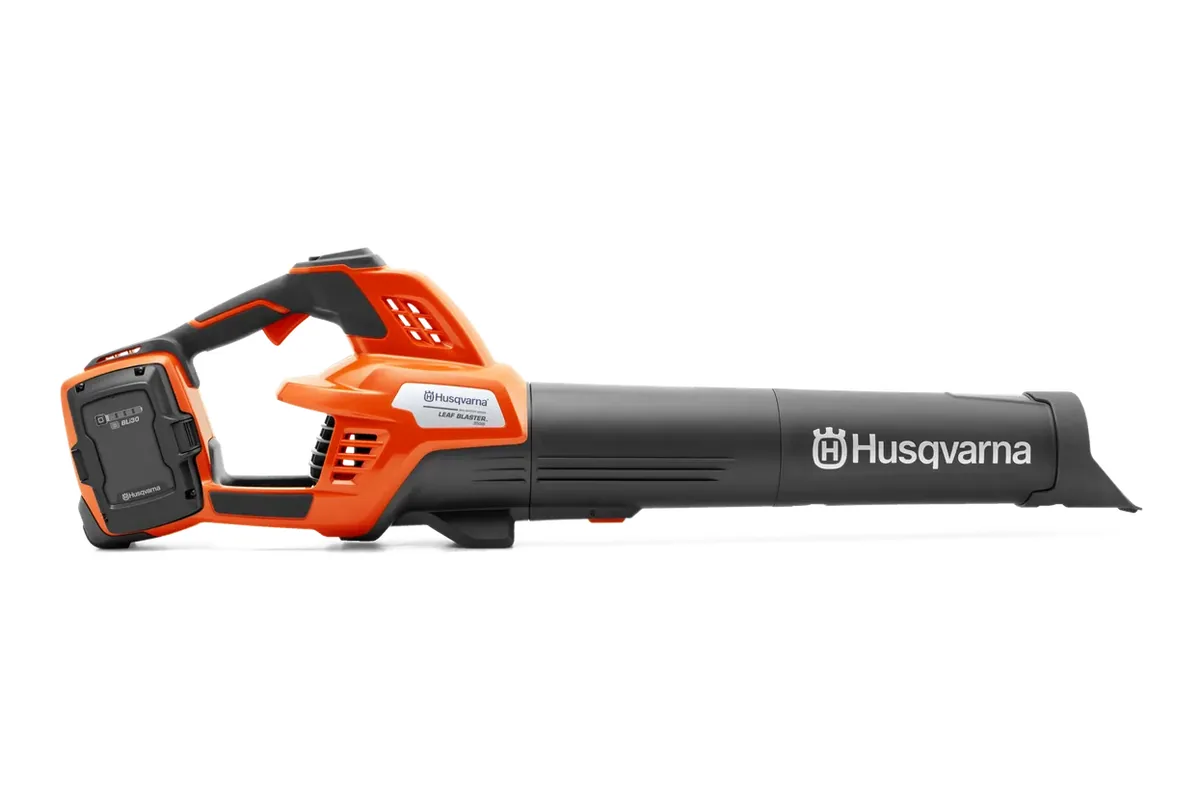
Husqvarna 350iB Leaf Blaster Battery Blower Kit Specs
Key Features:
- Cruise control button: Hold the trigger at the airflow you want, press the button and let go, and the blower keeps that airflow until you press it again.
- Variable-speed trigger: More squeeze gives more air, so you choose the airflow before you lock it in.
- Power boost button: It gives maximum airflow while pressed and returns to the earlier airflow on release, so it works as a short burst only.
- Round nozzle: It fits the lower tube for higher air speed, and Husqvarna’s maximum figures are with it fitted. The open tube is the other setup, and the one I use on stone.
- Scraper tool: A second attachment that loosens stuck leaves and debris before you blow them away.
- Pack and charger in the kit: One BLi30 battery and a QC250 charger come in the box, so the tool runs the day it arrives.
- Low vibration: Husqvarna lists 1.63 m/s2 at the rear handle and describes the tool as low in vibration load, which helps on a long pass.
Husqvarna’s manual gives the advice that suits gravel best: use the lowest possible airflow, because full airflow is seldom necessary and many jobs can be done at half airflow. On most passes along my drive the trigger stays near half. Squeezed to the stop, the 800 CFM is far more than a gravel drive needs, and the first thing to leave is the stone.
The controls are a trigger, a cruise control button and a boost button. To use cruise control I hold the trigger at the airflow I want, press the button and let go. Boost gives the maximum airflow while I press it and drops back to the earlier airflow on release. The kit pack runs about 37 minutes on the highest standard mode and about 14 on boost, and Husqvarna lists about 45 minutes on normal mode.
On a gravel drive the nozzle matters as much as the trigger. The round nozzle raises the air speed, and Husqvarna’s maximum figures are with it on, so I take it off on the stone and get a wider, slower stream that moves leaves without a jet behind them, then fit it again only on hard ground. The limit I found is the body: at about 10 lb with the pack and no harness in the box, a shallow angle held down a long drive tires my arm before the pack runs down.
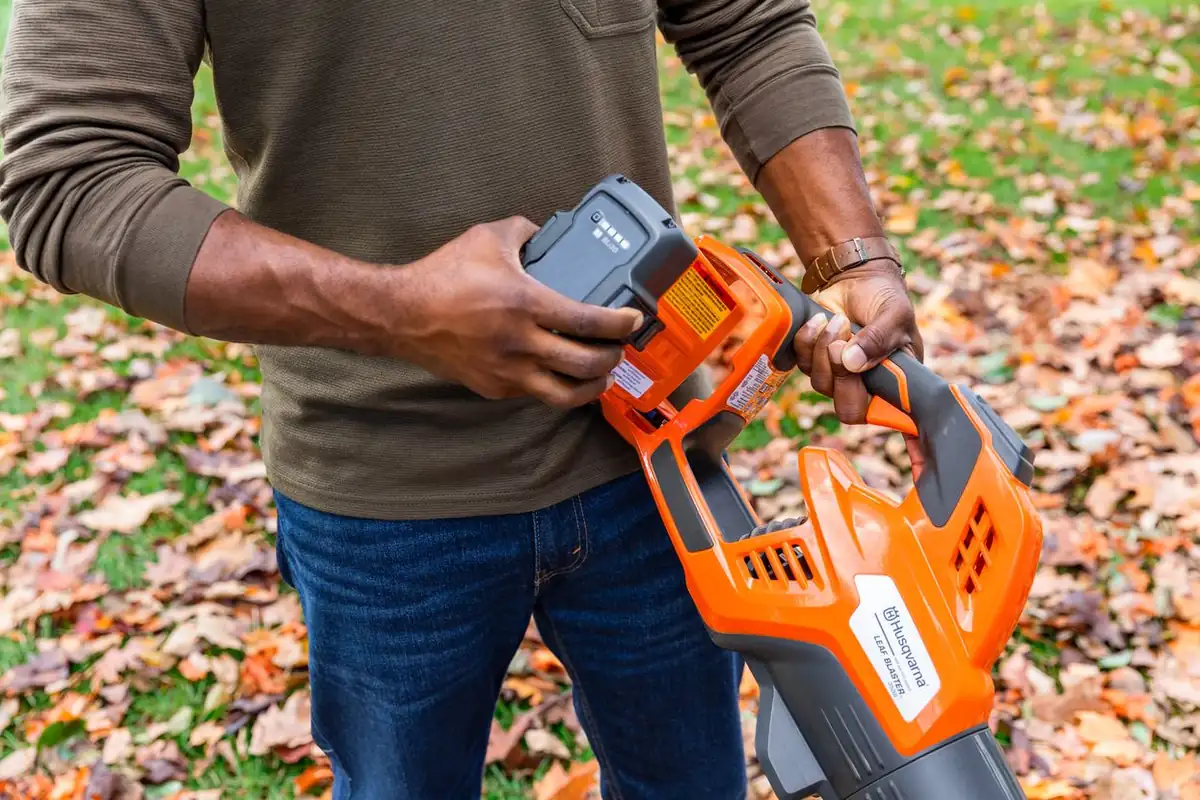
Press the cruise control button off before you turn toward the house or a parked car, because the blower keeps running at the set airflow with no finger on the trigger. I keep my thumb near the button for that reason.
WHY I CHOSE THIS
Mirko Lekić, Agricultural Engineer & Farm Owner
Best Premium here rests on cruise control and the premium price tier, plus a pack that runs long. The price buys those and the headroom to leave the tool at half. It buys no printed low setting, so the gentle end is yours to find, and Husqvarna’s own advice to work at half airflow is where I start on stone.
Husqvarna’s manual names thrown stones as a hazard and wants people and animals 15 m (50 ft) away. It requires approved eye protection (ANSI Z87.1 in the US), recommends hearing protection for longer sessions and asks for a breathing mask where dust is a risk. I wear ear protection every time the blower runs. I never run it in rain, fog, strong wind or intense cold, which the manual rules out, or from a ladder.
The QC250 charger fills the pack in about 70 minutes. The pack belongs to Husqvarna’s 36V system, and the manual says to use Husqvarna batteries only. Daily care is a dry cloth, never water, plus a clear air intake, since a blocked intake cuts power and heats the motor. Store the pack out of the sun between 41 and 77 F, at 30 to 50 percent charge for long storage, and charge it only in a dry space between 41 and 104 F.
Choose it when your drive is long enough that holding a trigger down would tire your finger, and when you want an airflow you set once and hold. Skip it if you want a printed low-setting figure, because Husqvarna publishes maximums only, or a light tool, because the pack makes the body heavy.
FINAL VERDICT
The 350iB asks you to find the gentle setting yourself, and it rewards you with an airflow that stays where you leave it. Most of its maximum airflow goes unused on stone, which suits a gravel drive. Choose it when a held airflow on a long drive is worth the weight in your hands.
It is the premium blower I set once and walk the drive with.
3. WORX WG520 Turbine Corded Leaf Blower Best Value
Plug in the WORX WG520 and you get a speed control that runs from 60 to 110 mph, with no pack to charge and no run time to watch. According to WORX’s manual, the control is variable speed, with airflow from 320 to 600 CFM across the range. It is my Best Value pick for a gravel drive that an outlet can reach, and the cord is exactly where it is weakest.
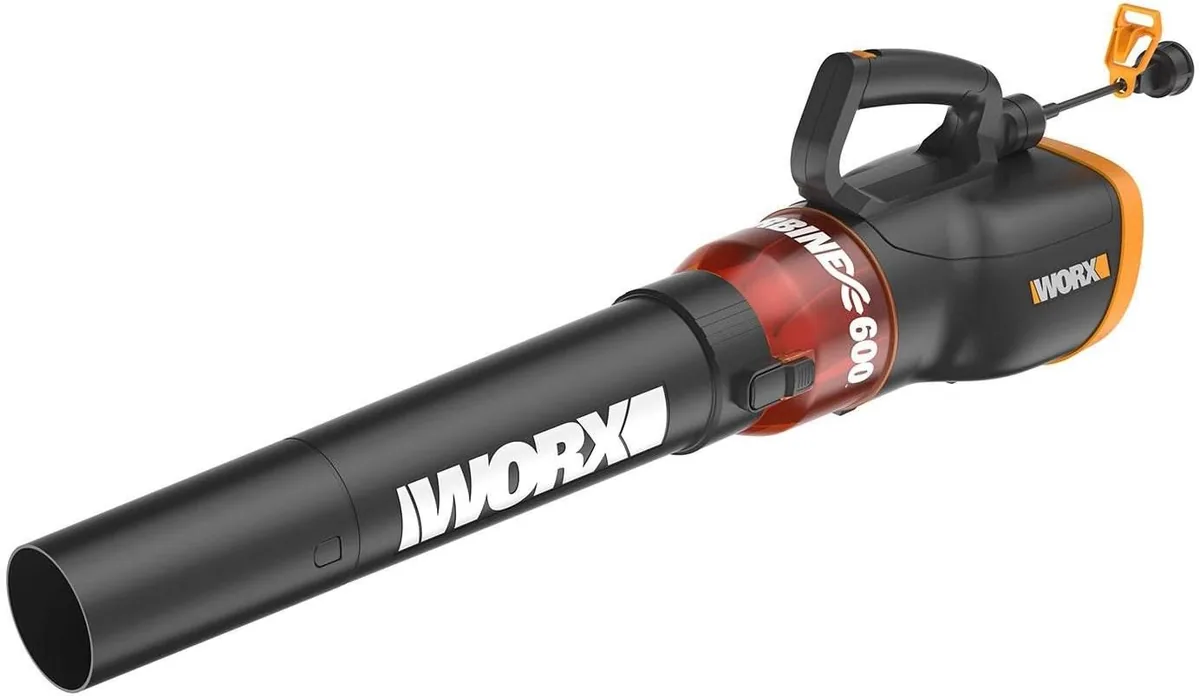
WORX WG520 Turbine Corded Leaf Blower Specs
Key Features:
- Variable speed control: One thumb control on the housing sets the speed across the range WORX prints.
- A real low end: WORX prints 60 mph and 320 CFM at the bottom of the range, so a gentle pass is on the spec sheet.
- Tapered tip: The straight tube narrows at the end, which keeps the stream tight enough to push leaves along the surface.
- Snap-together tube: Two sections click together without tools, so the blower is ready to run in a few minutes.
- Rear cord retainer: A hook on the back holds the extension cord, so a tug on the cord does not pull the plug.
- No run-time limit: The 12 A motor runs for as long as the cord reaches, so the length of the job never depends on a pack.
- 6.4 lb body: WORX lists the machine weight at 6.4 lb, light enough to hold the tube at a shallow angle.
WORX prints 60 mph and 320 CFM at the low end of the control, so the bottom of the range is the gravel setting. At full speed the WG520 moves up to 600 CFM and up to 110 mph, and on gravel that is a thrown-stone setting. On my drive I move the thumb control toward the low end for the first pass and raise it only on the concrete. Soaked leaves that have lain flat for days are beyond a stream this gentle, and the rake takes them.
The extension cord table in WORX’s manual decides how far this blower goes. For a 12 A tool it asks for 14 AWG wire up to 100 feet and 12 AWG up to 150 feet, outdoor-rated only, and the table stops there. My drive is about 150 feet, so the far end is as far as I take this blower. WORX builds in a short cord and puts none in the box, which makes the extension cord part of the purchase.
A cord on crushed stone is a different problem from a cord on a lawn: as I pull it along the drive it drags across the stone and flicks small stones sideways, so I run it along the grass verge and check it for cuts and cracks before each job. After a spring storm the drive carries small twigs and seed pods on top of the stone. With the control near the bottom of its range I sweep them to the verge, and the stone stays put while the twigs travel. The limit I found is that I have to find my low setting each time, so I try it on a short stretch of the drive before I commit.
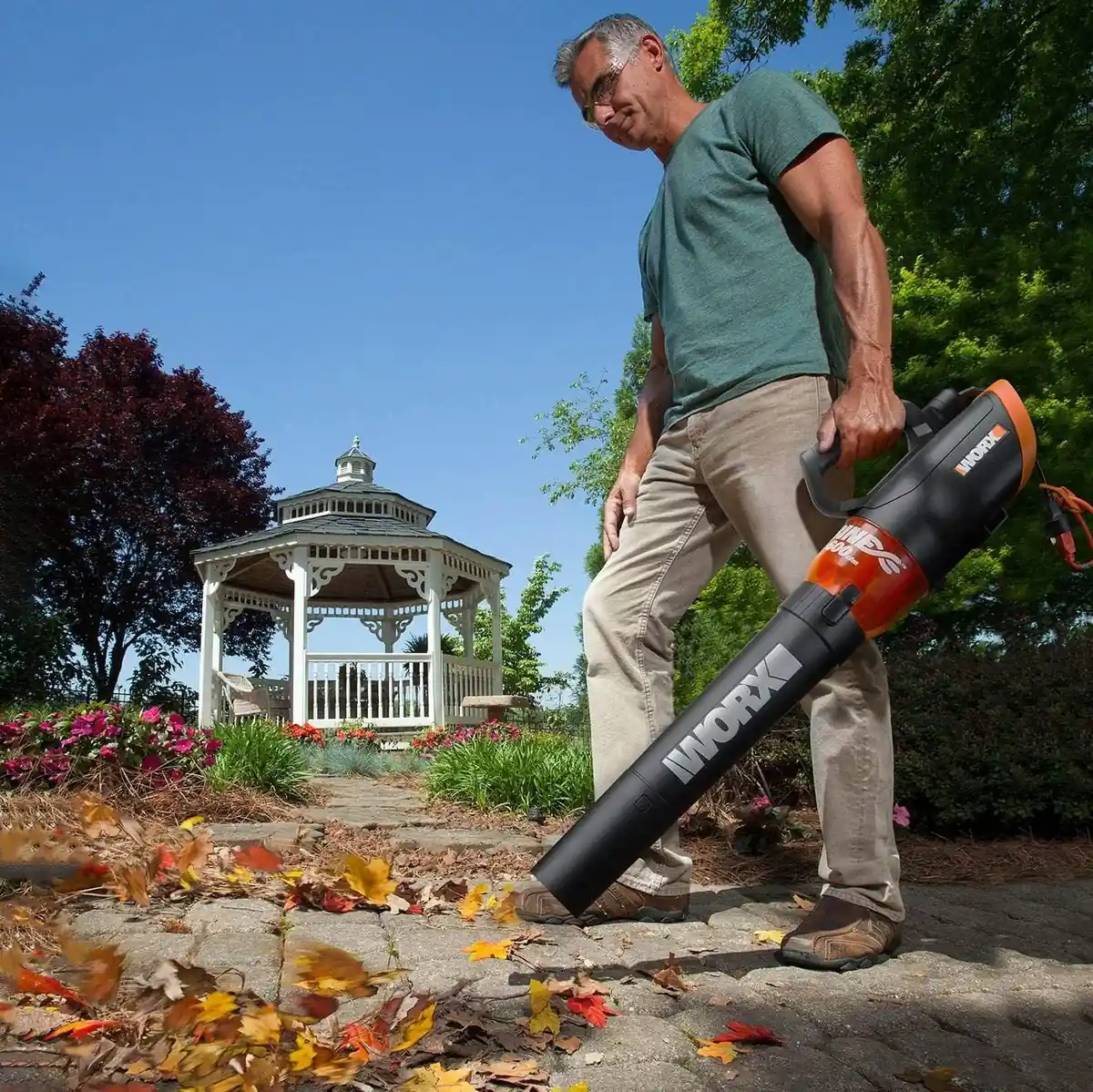
Loop the extension cord through the rear retainer before you start. The motor keeps spinning for a few seconds after you switch off, so wait for it to stop before you set the blower down.
WHY I CHOSE THIS
Mirko Lekić, Agricultural Engineer & Farm Owner
WORX earns Best Value because it gives you a printed low end, unlimited run time and a budget price tier in one tool. It carries a three-year limited warranty if you register within 30 days, and 24 months without that. That is why I call it the best leaf blower for the money on a drive an outlet can reach. It is also the weakest tool on this page for reach, since the cord ends where the manual’s table ends.
WORX’s manual says not to blow hard objects such as nails, bolts or rocks, to keep bystanders and pets away, and to wear safety goggles or other eye protection, long pants and shoes. The low setting on stone is my own technique, and WORX makes no claim for it. I wear ear protection every time the blower runs and use an outdoor-rated cord of the right gauge. WORX recommends a ground fault circuit interrupter outlet, which guards against shock but does not make wet use acceptable, since the manual rules out wet surfaces and rain.
As a variable speed electric leaf blower it asks for little upkeep: a damp cloth and mild soap, never a spray, because the bearings are self-lubricating, and no filter, fuel or pack to age. Store the blower and cord indoors, cool and dry. The cord is the annoyance, and the heavy 12 AWG cable a long run needs is a chore to haul around.
Skip it if the far end of your drive is beyond the manual’s cord table, if you work in the rain, or if you want a choice of nozzles. Pick it when the drive and the yard sit within one extension cord of a socket and you want gentle air at a budget price tier.
FINAL VERDICT
The WG520 gives a gravel drive a documented low end and unlimited run time for the least money on this page. The cord sets the limit, and the limit is clear in the manual’s table. Choose it when one outdoor-rated cord reaches every foot of the drive you clear.
It is the plug-in blower I use on a drive within cord reach.
4. Makita XBU03Z 18V LXT Brushless Blower (Tool Only) Best Lightweight Cordless
The box holds no battery and no charger, so you need a Makita 18V LXT battery and charger. With them, the XBU03Z gives you a variable-speed trigger and a cruise control lever on a tool of about 6 lb with a battery, according to Makita. That pairing suits a gravel drive, where the job is lifting leaves and leaving stones.
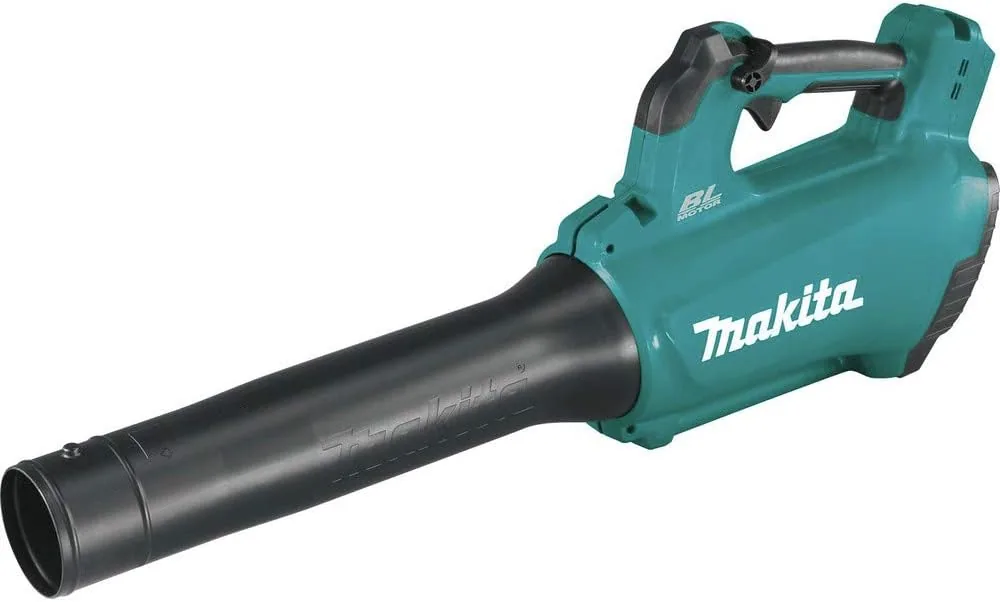
Makita XBU03Z 18V LXT Brushless Blower (Tool Only) Specs
Key Features:
- Variable-speed trigger: More pressure gives more air. Letting go stops the fan once the cruise lever is fully back.
- Cruise control lever: Turn it forward for more speed and back for less, and it holds the speed without the trigger.
- Squeeze above the setting: A harder pull still passes the lever setting.
- 32.5 in overall length: The nozzle sits ahead of your boots.
- Restart lock: A battery inserted with the trigger pulled or the lever forward will not start the tool.
On gravel the lever does the work, because I set it once and the speed stays where I put it. Along the driveway edge, where the stones scatter first, I park the lever low and keep the nozzle at a shallow angle. A harder squeeze goes above the lever setting, so I squeeze only for a stubborn clump, and the stones tell me if I overdo it. Makita gives 459 CFM as the maximum airflow and no figure for the low end, so I judge the low positions by eye.
According to Makita, one 5.0 Ah battery runs 32 minutes at 10,800 rpm, and the time varies with the lever. On full speed it runs about 10 minutes, so I plan the drive on the shorter figure and sweep it in sections with a spare battery charged. Dry leaves need no more push than that, and a damp mat packed between the stones needs a rake first, as Makita’s manual advises.
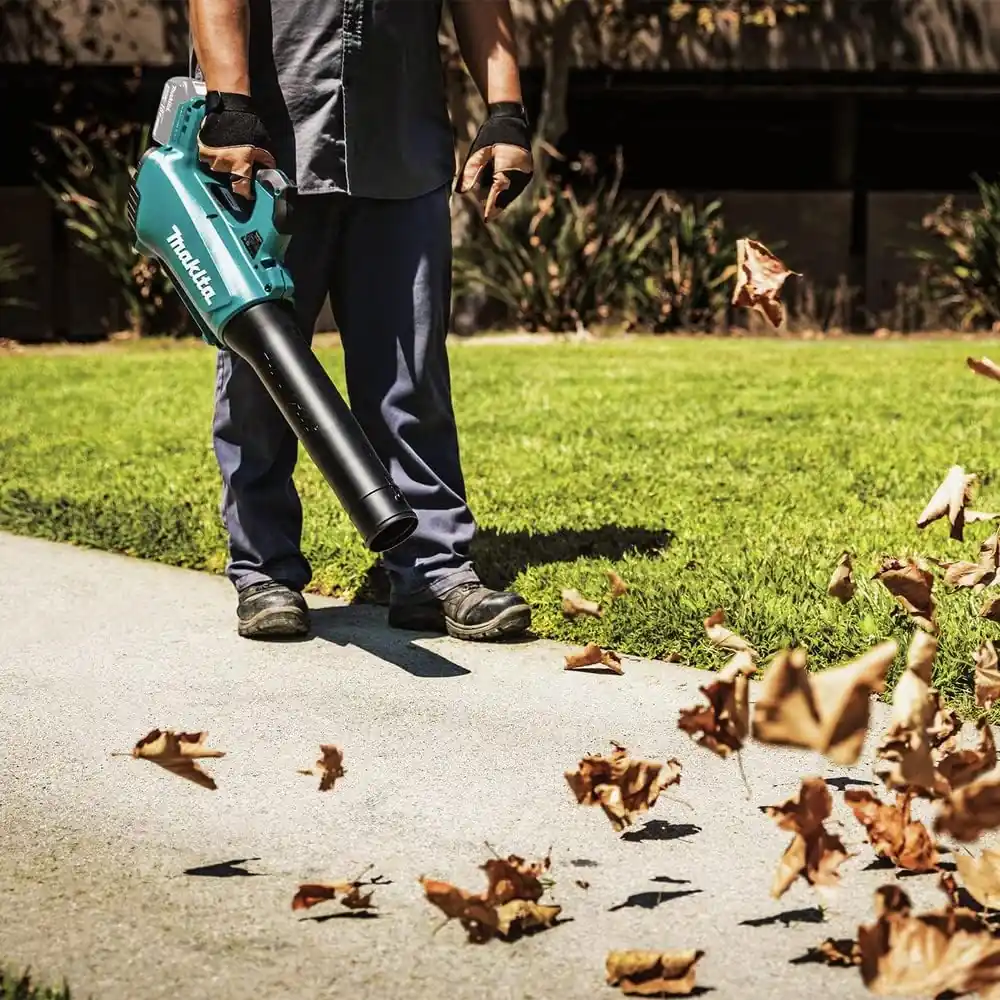
Never set the running blower on the ground. Makita’s manual says sand and dust enter the rear inlet and cause a malfunction, so switch off and pull the battery before you put it down.
WHY I CHOSE THIS
Mirko Lekić, Agricultural Engineer & Farm Owner
I chose the XBU03Z because it pairs a speed I can hold low with a weight my forearm can hold out at a shallow angle. That is why I call it the best lightweight cordless leaf blower for this surface. Count your batteries first.
Makita’s manual lists goggles (ordinary glasses are not safety glasses), a mask and closed-toe shoes. It says to keep people and pets away, never to blow debris toward bystanders and to stay clear of open windows; I also clear parked cars from the debris path first.
Makita rates sound at 60 dB(A) under ANSI B175.2, a bystander rating, and at the ear on full output it is about 83 dBA, so I wear earmuffs from the first minute. The motor stops with no warning when the protection trips on overload, overheat or a drained battery, so a tool that looks dead may need a rest or a fresh pack.
The XBU03Z suits an owner of Makita 18V LXT batteries who wants a low speed that stays put on a gravel drive. Skip it with no LXT batteries, with a drive long enough for one continuous run, or with damp mats of leaves.
FINAL VERDICT
The XBU03Z earns its place on gravel through a speed you can hold low and a weight your arm can carry. Choose it when LXT batteries are already on your shelf.
It is the light blower with a lever I set low for gravel.
5. ECHO PB-2520 25.4cc Gas Handheld Leaf Blower Best Handheld Gas
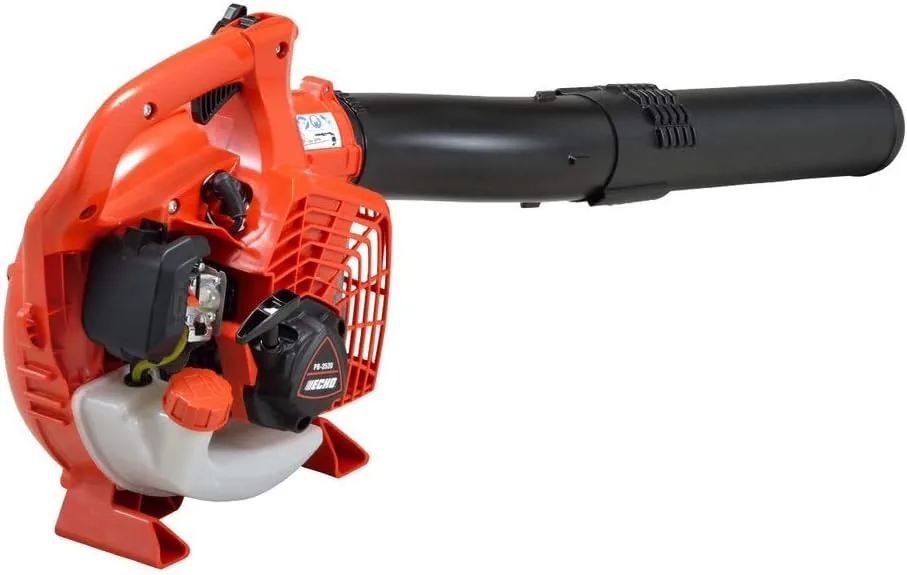
The far end of my gravel yard lies beyond where the corded blower in the workshop stops, and that is the job I give the ECHO PB-2520. It is a gas handheld with a throttle trigger and a position lever, at 8.6 lb dry with its pipes, according to ECHO. Its air control is the coarsest on this page, and I still pick it for a long drive with no outlet.
ECHO PB-2520 25.4cc Gas Handheld Leaf Blower Specs
Key Features:
- Throttle trigger: It moves the engine from the 3,000 rpm idle to 7,500 rpm wide open.
- Throttle position lever: It holds a steady engine speed, so your finger can rest.
- Curved blower pipe: According to ECHO, the curve gives rotational control and cuts fatigue.
- See-through fuel tank: You read the level from the side.
- Tool-less air filter access: The filter opens without a screwdriver, so the dust check is quick.
ECHO prints 3,000 rpm at idle and 7,500 rpm wide open, and no airflow figure for anything between. The manual says to use low speed for light work and never a higher speed than necessary, which is the rule that keeps gravel in place. The lever locks a position, so I find the low end by ear, and even there the finest chips on the crown of the drive moved, so I rake those.
The tank holds 18.6 fl oz and ECHO publishes no run time for it, so a long drive means planned refuels. Refuel outdoors with the engine stopped and cool, then carry the blower at least 10 ft (3 m) from the fuelling spot before you start it.
ECHO wants three minutes at idle first. I spend them walking the drive and picking up sticks and loose rocks by hand.
WHY I CHOSE THIS
Mirko Lekić, Agricultural Engineer & Farm Owner
Once a drive outruns a cord, an engine finishes it, and the PB-2520 does that at 8.6 lb dry with a lever that holds the speed. ECHO also states a 5-year consumer warranty. That earns it the best handheld gas leaf blower slot from me for long gravel drives. My wrist does the fine work.
Wear hearing protection from the first minute, because the 70 dB(A) rating is taken 50 ft away and ECHO publishes no figure at the ear. The manual also lists ANSI Z87.1 eye protection and gloves, and keeps bystanders and pets 50 ft (15 m) away.
Once an hour I point the tube at the open grass of the orchard alley and run the engine wide open for five minutes, because ECHO says steady low speed builds carbon on the spark arrestor screen. The exhaust holds carbon monoxide, so the engine runs outdoors only. Before winter I empty the tank and run the engine until it stops, as the manual’s storage steps say.
Buy it if your drive is long, has no outlet and you accept a pull cord and a measured mix. Skip it if you want a fine, repeatable low setting or live where local rules limit gas blowers. ECHO states 5 years for consumer use and 2 for commercial, and its warranty covers authorized ECHO dealers, so check the seller on the listing.
FINAL VERDICT
The PB-2520 reaches the end of a long drive with no outlet, although its air control is the coarsest on this page. Buy it for the length of the drive and skip it when every stone matters.
It is the gas handheld I take to the far end of the drive.
How to Choose the Best Leaf Blower for Gravel Driveways
A leaf blower for gravel driveway use has one job beyond moving leaves: it has to run well below its top speed. I judge every tool on seven points, from the lowest setting you can hold to where the stones, the people and the cars end up.
A Variable Speed Leaf Blower With a Real Low End
Look for a control that lets you set the speed in small steps and keep it there. A trigger does that while your finger holds the pull, and a lock-on dial, a cruise button or a cruise lever holds the setting for you. A boost button only adds speed on top of the setting, so it does nothing for a gentle pass.
- Trigger only: the speed follows your finger, and the setting is gone when you let go.
- Trigger plus a hold: a dial, button or lever keeps the speed with no finger on the trigger.
- Throttle lever on an engine: a gas tool holds a position, and the engine still turns over at idle.
Over a 150-foot yard my trigger finger tires long before the leaves are gone, so a control that holds my setting is worth more to me than a bigger number on the box.
Pro Tip
Find the maker’s own number for the lowest setting before you buy. A CFM or mph figure at the bottom of the control can be compared across tools, while the word variable on its own only describes the control.
Airflow Over Raw Speed
CFM is the volume of air leaving the tube each minute, and mph is how fast that air moves. A leaf is a wide, light sheet that a broad stream rolls along, and a stone is small and heavy and needs real speed to start moving. In wind tunnel tests on gravel beds, the wind speed at which the stones began to move continuously rose with the size of the stone, roughly with the square root of its diameter (1).
Those were steady winds over a whole bed and involved no blower jet, so they show the direction of the effect and give no setting. On my yard I want dry leaves to travel in one wide ribbon toward the hedgerow side, and a wide, gentle stream does that in fewer passes than a narrow, fast one.
| Figure | What it measures | What it means on gravel |
|---|---|---|
| CFM | Volume of air leaving the nozzle each minute | Carries a wide layer of leaves, so it is the figure to compare first |
| mph | Speed of the air leaving the nozzle | Starts stones moving once it is high enough, so a high maximum is a reason to turn the control down |
| Newtons | Push of the air at the nozzle | Describes a strong push, which a gravel drive does not need |
| Decibels | Sound level, at a distance the maker may or may not state | Check the distance behind the figure before you compare levels |
Makers print CFM and mph as two separate maximums, and a maximum belongs to full speed with a named nozzle. Newtons, where a maker prints them, describe the push of the air. NASA’s thrust page explains that a thrust force depends on how much gas is accelerated and on how much its velocity changes (2), so a high newton rating describes a strong push, and peak force is not the goal on stone.
A Wide Nozzle and a Shallow Angle
A tapered nozzle squeezes the stream, which narrows it and raises its speed. A flat nozzle spreads the same air over more ground, and a bare tube sits between the two. On gravel the flat shape is the kinder one, and a tool that ships with both lets you choose.
With a tapered nozzle held close I once dug a small bare patch in the crushed stone before I noticed, and the wide nozzle at the same height left the stone alone. Angle and distance are technique, and my separate guide on blowing leaves off gravel covers them in full. In short, keep the tube nearly level, keep the nozzle well above the stones, and raise the setting only when the leaves refuse to move.
Weight and Balance in a Lightweight Leaf Blower for a Gravel Driveway
A shallow angle is a wrist job, because the tube has to stay near level for the whole drive, and the weight in your hand decides whether it does. The weights the makers print for the five tools on this page run from about 6 lb to about 10 lb on different bases. A battery figure should include the pack, a gas figure should say dry or fueled, and a corded figure may or may not count the cord.
- Around 6 lb: a weight most people can hold level with one hand for a full pass.
- Around 9 to 10 lb: a weight that asks for two hands or a rest between passes, and tires the forearm before a long drive is clear.
Once the weight settles in the forearm, the tube starts to dip toward the stones, and a heavy tool begins to throw gravel.
Run Time on the Low Setting
A gravel drive is cleared slowly, so the minutes that matter are the ones on a low setting. Makers print minutes on high, on a mode they do not define, or not at all, and the pack size changes every figure.
- Setting: high, low, boost or an unnamed mode.
- Pack: the amp-hours of the pack the figure was taken with.
- Temperature: a cold pack gives fewer minutes than a warm one.
Lab work on lithium-ion cells shows reduced energy and power at low temperatures (3). That study used small cells in a lab and no tool pack, so it shows the direction of the effect and no figure for a blower. I plan the yard for a cold November morning, because that is when a pack gives the fewest minutes.
Cord, Pack or Tank for a Long Drive
The right leaf blower for driveway work starts with distance, because the length of the drive from the nearest outlet decides which power source can finish it.
| Factor | Cord | Battery pack | Gas tank |
|---|---|---|---|
| Reach | The cord plus an extension cord | As far as you walk, until the pack ends | As far as you walk, until the tank ends |
| Weight in hand | No pack or fuel on the tool | The pack rides on the tool | The engine and the fuel ride on the tool |
| Low end | Set by the model’s control | Set by the model’s control | A running engine at idle |
| Extra to buy | An outdoor extension cord of the right gauge | A spare pack for a long drive, and a charger if the box has none | Fuel, two-stroke oil and a fuel can |
A cord never runs out of minutes and stops where it ends. Measure from the outlet to the far end of the drive, and a corded tool is the pick for a drive the cord covers. The best corded leaf blower for a gravel drive is one whose cord and extension reach the far end without being moved.
A gas tool covers the longest drive on its own, and the price is noise, a pull cord and fuel mix. Fuel mix, the starting steps and the distance to move away from the fueling spot before you start differ by model, so refuel with the engine stopped and cool and follow the manual of the machine you buy.
Eye Protection, Ears and a Clear Zone
Emergency room records for lawn mowers show what a thrown stone does. Of about 120,000 estimated eye injuries in the US from 2004 to 2023, 77% came from projectiles, mostly grass, dirt and rocks, and only 2% of the projectile cases documented eye protection (4). That study is about mowers, and a stone thrown by a blower is the same kind of small, hard object traveling at an eye, so safety glasses with side shields go on before the blower starts.
A maker’s decibel figure is often a bystander rating taken 50 ft from the tool under ANSI B175.2, and some boxes print a figure with no distance at all, while your ear sits about 3 ft from the motor. NIOSH recommends an average of 85 dBA over an eight-hour day and halves the time allowed for every 3 dBA more (5). Groundskeepers at North Carolina public universities averaged 88 dBA over a workday by NIOSH’s method, and 77% of their individual averages went over 85 dBA (6).
I put plugs in and earmuffs over them before I start an engine.
- Bystanders and pets: out of the line of the air, and where a manual gives a distance it is 50 ft.
- Cars and windows: move the cars and close the windows that face the drive.
- The intake: never set a running blower down on the stone, because the air intake can pull gravel in.
Key Takeaway
On gravel, the best control is one you can set low and keep there. Judge a tool by its lowest setting, its weight with the pack on and the minutes it gives you at that setting.
How the Five Blowers Control the Air, Side by Side
Here are the five side by side, with each maker’s own words for the control and the lowest setting it documents. The table leaves the maximums out, because a maximum says nothing about the bottom of the control.
| Maker and model | How the air is controlled | Low end the maker documents | Nozzles |
|---|---|---|---|
| EGO LB6504 | Variable-speed trigger, a lock-on dial that holds any speed and a boost button | About 225 CFM at the bottom of the dial, which runs to 470 CFM | A tapered nozzle and a flat nozzle |
| Husqvarna 350iB | Variable-speed trigger, a cruise control button and a boost button | No low-end figure from Husqvarna; its manual advises the lowest possible airflow, and half airflow for many jobs | A round high-speed nozzle and a scraper tool |
| WORX WG520 | Variable speed, according to WORX’s manual | Variable speed from 320 to 600 CFM, according to WORX’s manual | One straight tube with a tapered tip |
| Makita XBU03Z | Variable-speed trigger and a cruise control lever | According to Makita’s manual, a range from 0 to 459 CFM, set with the trigger or the lever | The manual fits a front nozzle; flat and concentrator nozzles are separate parts |
| ECHO PB-2520 | Throttle trigger and a throttle position lever that holds a steady speed | According to ECHO, the engine idles at 3,000 rpm and runs at 7,500 rpm wide open | A curved pipe and a straight pipe |
Two makers put a number on the bottom of the control: according to EGO, the dial starts at about 225 CFM, and WORX’s manual starts its variable speed range at 320 CFM. Husqvarna, Makita and ECHO let you hold a speed below the maximum, and you find the right speed on your own drive by watching the stones.
Two of the three cordless picks come as a cordless leaf blower with battery and charger in the box, the EGO and the Husqvarna. The Makita is tool only: the box holds no battery and no charger, so it suits a buyer who already owns Makita 18V LXT packs. Each variable speed cordless leaf blower here holds a setting its own way, the EGO with a dial, the Husqvarna with a button and the Makita with a lever.
The WORX WG520 is the one corded pick, and as a variable speed electric leaf blower it never runs out of minutes. Its cord is the limit: no extension cord comes in the box, and WORX’s manual asks for 14 AWG outdoor cord up to 100 ft and 12 AWG up to 150 ft, where its table stops.
The ECHO PB-2520 is the one gas pick. ECHO’s manual asks for a full-throttle run of at least 5 minutes every hour, because long low-speed running builds carbon on the spark arrestor screen, so a gas tool does not stay on its lowest setting all day. The same manual says to refuel with the engine stopped and cool and to move 10 ft (3 m) from the fueling spot before you start.
Stones, People and Cars, in the Makers’ Words
EGO’s manual says to remove rocks from the work area, never to rest a running blower on gravel and to keep bystanders at least 50 ft away. Husqvarna and ECHO also give 50 ft, and Husqvarna names thrown stones. WORX warns against blowing hard objects such as rocks, and Makita says never to blow debris toward people or near an open window. Wear eye protection rated ANSI Z87.1 and hearing protection every time.
Blowers I Left Off This List and Why
Two kinds of blower stay off this list, and a gravel drive is the reason in each case.
- One speed or two fixed speeds: these controls give steps instead of a range, so nothing between the steps lets you find the setting where the stone stays put on your drive.
- Blower-vacuums: in vacuum mode, hard items such as sticks and rocks damage the impeller, and a gravel drive is made of rock. Used only as a blower, one with a variable control can be gentle, yet the vacuum mode that sells it is the one thing a stone drive rules out.
The best leaf blower for home use is not always the best one for a stone drive. Each kind is a fine tool on a lawn, and a drive of loose stone is the job that shows its limit.
My Overall Verdict
Three of the five stand out, and the order depends on the weight your arm will carry and how far the drive runs from an outlet.
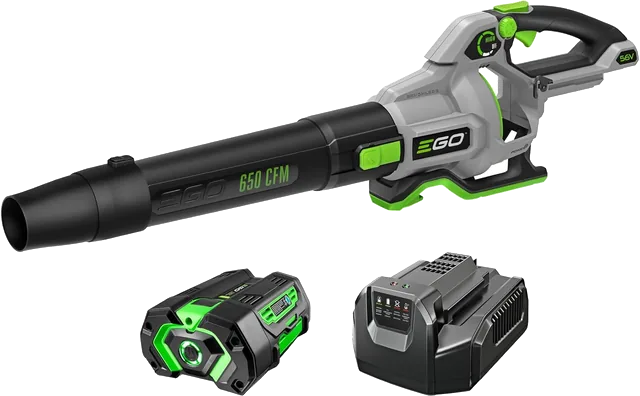
1. EGO Power+ LB6504 650 CFM Blower Kit Best Overall
Best for most gravel drives: a dial that holds any speed from about 225 CFM, two nozzles and about 200 minutes on low, according to EGO, if you can carry about 9.8 lb.
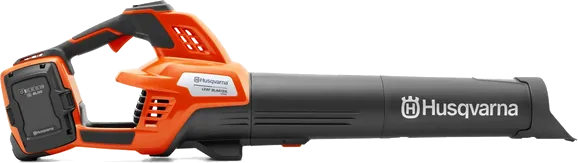
2. Husqvarna 350iB Leaf Blaster Battery Blower Kit Best Premium
Best for owners who want cruise control and about 45 minutes on the normal mode, according to Husqvarna, and can carry about 10 lb.
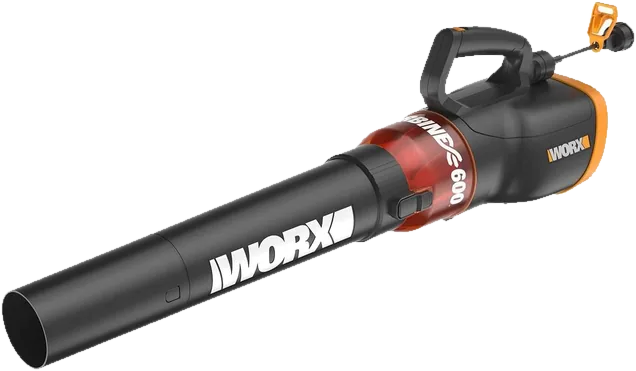
3. WORX WG520 Turbine Corded Leaf Blower Best Value
Best for a drive within reach of an outlet: variable speed from 320 CFM, according to WORX, 6.4 lb and no battery to buy.
The test on a long drive is a slow, wide stream that you set once and walk behind. The EGO Power+ LB6504 650 CFM Blower Kit does that with a dial and about 200 minutes on low from one pack, according to EGO, which makes it the best leaf blower for gravel driveways I can recommend to most owners.
Why EGO Power+ LB6504 650 CFM Blower Kit Might Be the Best Choice
The EGO Power+ LB6504 650 CFM Blower Kit is my best overall because it is the one cordless pick with a printed low end, a dial that holds it and a run time on low. On a long gravel drive, a dial that holds the setting keeps your finger off the trigger.
The trade-off is weight. At about 9.8 lb with its 5.0 Ah pack it is a heavy handheld, and no shoulder strap comes in the box, so a long pass tests your wrist.
Here is what puts it at the top:
✓ Dial: from about 225 CFM at the bottom to 470 CFM at the top.
✓ Two nozzles: a tapered and a flat nozzle in the box.
✓ Run time on low: about 200 minutes with the 5.0 Ah pack, according to EGO.
✓ Boost: a button that gives the maximum while pressed and then drops back.
✓ The kit: a 56V 5.0 Ah pack and a charger, about 100 minutes to charge.
Frequently Asked Questions
Can you use a leaf blower on gravel?
You can use a leaf blower on gravel when the tool has a speed control that holds a low setting and you keep the tube nearly level. A blower with one speed throws stone at windows, cars and people, so choose a trigger, a dial or a cruise control that you can set and hold.
Is it better to have more MPH or CFM in a leaf blower?
It is better to have more CFM than MPH in a leaf blower for gravel, because air volume lifts the leaf while extra speed is what starts a stone moving. Choose a tool with a real low end and a wide nozzle, and treat a high mph on the box as a reason to turn the control down.
Which type of leaf blower is better, battery or corded?
A battery blower is the better type for a long gravel drive with no outlet nearby, and a corded blower is the better type when the cord reaches the whole drive. This page picks the EGO LB6504 for battery reach and the WORX WG520 for a cord that never runs out of minutes.
How long does the battery last on lower speeds?
The battery lasts far longer on lower speeds than on high: according to EGO, about 200 minutes on low with the 5.0 Ah pack, against 30 on high. According to Makita, a 5.0 Ah battery gives 32 minutes at 10,800 RPM, and on full speed you should expect about 10 minutes of work.
What are great lightweight leaf blowers for a gravel driveway?
Great lightweight leaf blowers for a gravel driveway are the Makita XBU03Z, about 6 lb with a battery according to Makita, and the WORX WG520, 6.4 lb according to WORX. Each has a speed control you can hold low, but the Makita needs 18V packs you already own and the WORX needs an outlet within reach of its cord.
References
- Batt RG, Peabody SA II. Threshold friction velocities for large pebble gravel beds. J Geophys Res Atmos. 1999;104(D20):24273-24279.
- NASA Glenn Research Center. Thrust Equation. Beginners Guide to Aeronautics. Updated June 10, 2026.
- Ji Y, Zhang Y, Wang C-Y. Li-Ion Cell Operation at Low Temperatures. J Electrochem Soc. 2013;160(4):A636-A649.
- Stange NR, Jennissen CA. Lawnmower-Related Eye Injuries in the U.S., 2004 to 2023. Am J Ophthalmol. 2025;277:7-16.
- National Institute for Occupational Safety and Health. Noise-Induced Hearing Loss. Noise and Hearing Loss. Centers for Disease Control and Prevention; 2024.
- Balanay JAG, Kearney GD, Mannarino AJ. Assessment of Occupational Noise Exposure among Groundskeepers in North Carolina Public Universities. Environ Health Insights. 2016;10:83-92.
Safety Note: Leaf blowers throw debris and can damage your hearing. Wear eye and ear protection, read the manufacturer’s manual, and check your local rules on noise and operating hours.