
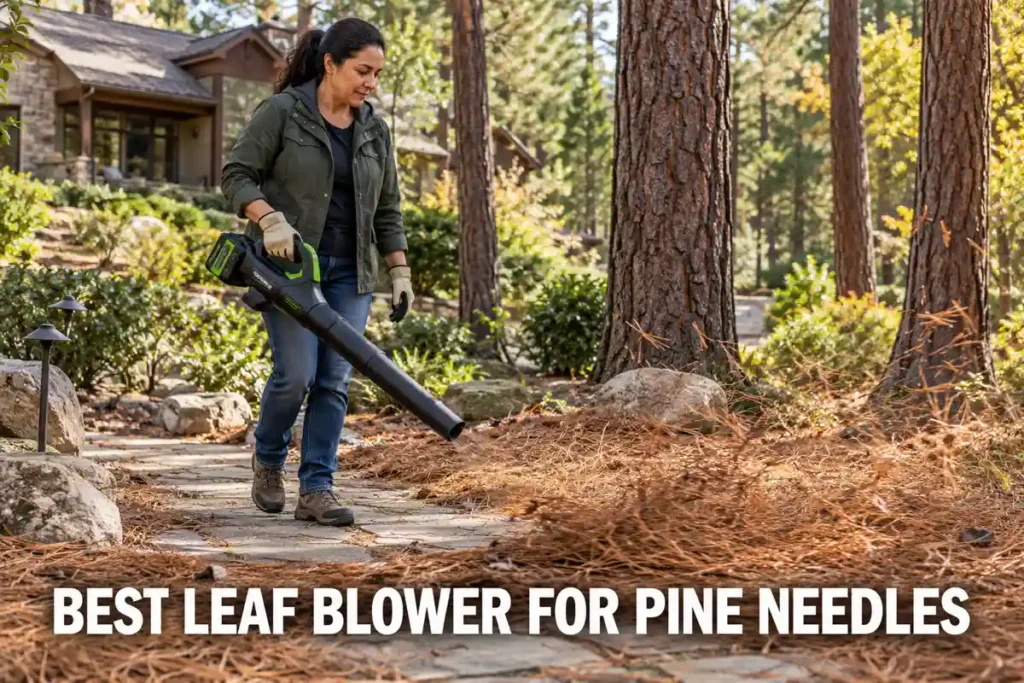
The best leaf blower for pine needles throws a fast, narrow jet, because a needle is a stiff rod and a wide, gentle stream slides over it. Around my 3.7-acre orchard the nearest thing to a needle mat is dry cover-crop stems and mowing residue wedged into the soft edge of the gravel yard, and that comparison is my own judgment.
Affiliate Disclosure: Garden Power Scout is a proud participant in the Amazon Services LLC Associates Program. As an Amazon Associate, we earn from qualifying purchases, at no extra cost to you.
Below are the five blowers I rank for the job, from a light cordless kit to gas backpacks, with the EGO Power+ LB7654 765 CFM Cordless Leaf Blower Kit as my top pick. Air speed at the nozzle and force come first, then airflow, speed control, run time or tank, and weight.
Best Leaf Blower for Pine Needles 2026 With 5 Models I Rank by Air Speed and Force
These are the five machines I rank for needles. Picks 1 to 3 cover a house lot, a long drive and a tight budget, and picks 4 and 5 fill two narrower jobs: a mid-size backpack and a very light kit. Every block says who should skip it, so you can cross a model off fast.
1. EGO Power+ LB7654 765 CFM Cordless Leaf Blower Kit Best Overall
The EGO LB7654 is the blower I hand to a homeowner who has tall trees over the driveway and a house lot to keep clear. Its tapered nozzle reaches 195 mph, past the 150 mph I look for when dry needles sit on a hard surface, and on turbo the pack in the box pushes about 25 N. There is no fuel to mix and no pull cord, which is why it is my Best Overall pick for most house lots.
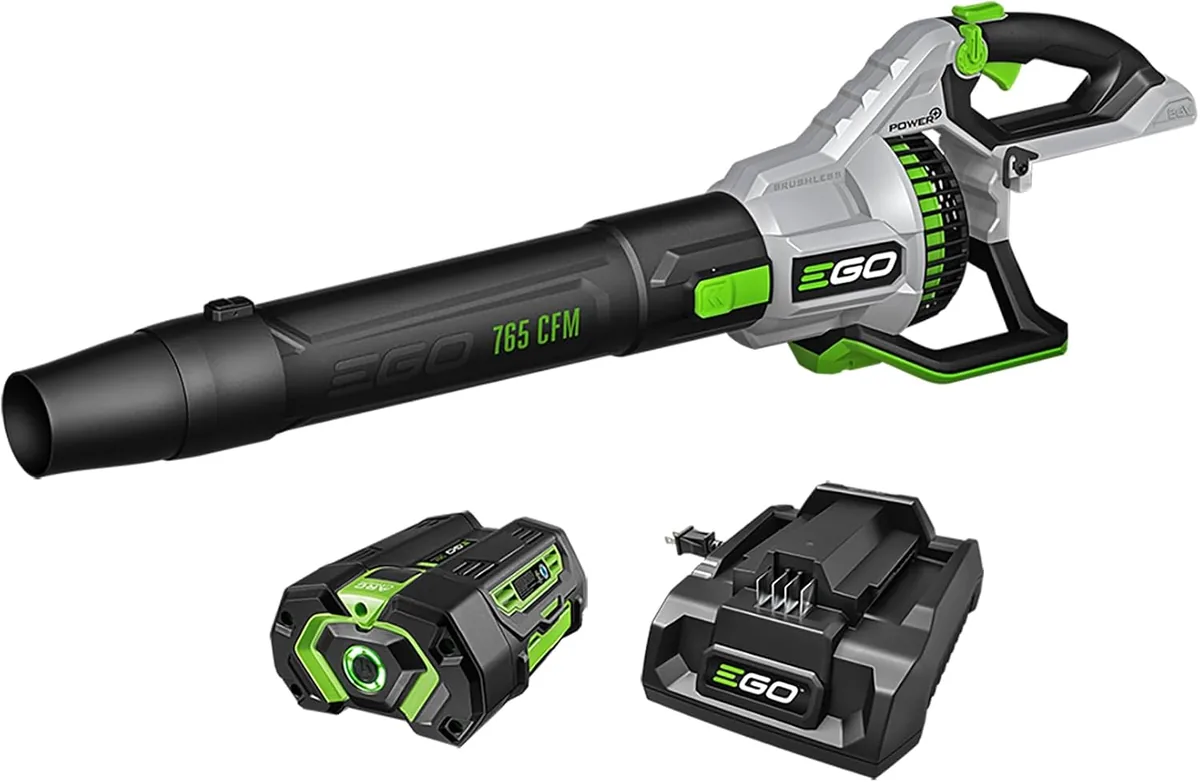
EGO Power+ LB7654 765 CFM Cordless Leaf Blower Kit Specs
Key Features:
- Tapered nozzle: It narrows the stream to 195 mph, so dry needles lift off hard surfaces and out of slab seams.
- Speed dial with lock: It holds any speed while your finger rests off the trigger, so a long sweep along a deck does not cramp the hand.
- Variable-speed trigger: More pull gives more speed, which lets you drop to a soft stream beside a mulch bed.
- Boost button: It raises the speed to the maximum while you press it, and it falls back to the dial setting when you let go.
- Spread nozzle: It widens the sweep for lawn debris and for the ground around fittings.
- Tool-free nozzle change: The nozzles push onto the tube and release with a button, so you can swap them with gloves on.
- 56V battery platform: The tool takes the EGO 56V packs, so a spare or a larger pack fits the same blower.
On hard surfaces the tapered nozzle does the work. According to EGO it gives 195 mph against 166 mph without it, and in the corner where my tool shed wall meets the slab it reaches dry bits that the head of my rake skips. Short grass asks for more: my working guide is about 190 mph and 20 N, and this blower meets it only on turbo, since the kit pack pushes about 16 N on high. Turbo in short bursts with the nozzle held low lifts what high only combs, and it spends the pack fast.
Plan by minutes. EGO’s manual rates the 5.0 Ah pack at about 150 minutes on low, 25 on high and 15 on boost, and the kit pack runs about 22 minutes on high and about 13 on turbo. Lower dial settings stretch the pack toward the low-speed rating. A long stretch of matted needles in grass takes more than one pack, so a second pack is the add-on to price in.
My second job for it is the ground around the irrigation pump head, where leaves and twigs pile against the fittings. I swap to the spread nozzle with gloves on and no tools, and I lock the dial low, because a fast stream can drive grit into the fittings. At the base of the hedgerow, where thin dry twigs sit tangled in last year’s grass, high only combed the top, so I rake one pass first, as EGO’s manual advises for packed debris. The limit is weight: EGO’s manuals put the tool at 4.6 lb and the pack at 4.96 lb, about 9.6 lb together, with more than half of it behind my hand.
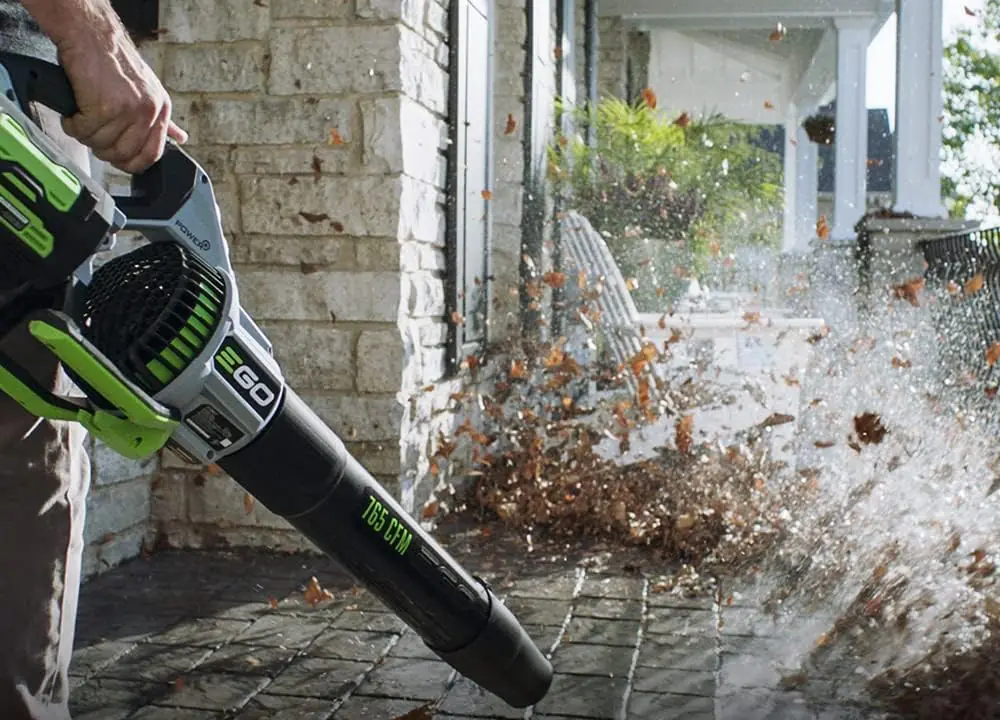
Work around the edges of a pile, as EGO’s manual advises, and keep the jet out of the middle, because a jet driven into a heap throws it wide. Gather the needles into a row first, then move the row.

WHY I CHOSE THIS
Mirko Lekić, Agricultural Engineer & Farm Owner
I chose the LB7654 because it does the ordinary job of a house lot without a fuel can: 195 mph at the tapered nozzle, a dial that holds any speed and a boost button for the patch that needs it. EGO’s manual lists keeping decks and driveways free from leaves and pine needles as a job, and it states that the blower is intended for household use. That makes it, in my judgment, the best leaf blower for home use when needles are the chore. If one blower has to cover the deck, the drive and the beds, this is the one.
Put hearing protection on before the first start, because EGO’s manual requires it, along with ANSI Z87.1 eye protection and a dust mask in dusty work. Keep people and pets 50 ft away, and never set the running blower on loose ground, since the intake pulls in gravel and throws it.
Upkeep is short: a clean cloth on the plastic, clear air intakes, and the battery out before any cleaning, as EGO’s manual says. After a month unused the pack puts itself to sleep at about 30 percent, so charge it fully before the next job, and keep the whole kit out of rain, since the splash rating is IPX4. A long needle job asks for a spare pack, and that spare takes a large share of the kit’s cost. According to EGO, the tool carries 5 years and the battery and charger 3 years for household use, and 1 year in commercial use.
Buy it if you keep a house lot clear of needles: a deck, steps, a driveway, mulch beds and a short lawn under trees that drop them, with one tool and no fuel can. Skip it for acreage, for a long run of woven needles in one sitting, or if 9.6 lb in one hand is more than your arm wants.
FINAL VERDICT
The LB7654 covers the whole ordinary job under needle-dropping trees: deck, drive, beds and a short lawn on turbo. It asks for a second pack in the heavy weeks. Pick it when the yard is a house lot you can clear in a few sessions.
It is the cordless blower I put first for a house lot.
2. Echo PB-9010T Gas Backpack Leaf Blower Best Premium
When the job is a long drive or acreage under pines, the ECHO PB-9010T is the blower that keeps its push to the far end. ECHO rates it at 48 N at the nozzle, the highest force any maker prints for a blower on this page, from a 79.9 cc two-stroke engine fed by an 83.8 fl oz tank. It sits in the premium price tier and it asks for a strong back and serious ear protection, so it is my Best Premium pick.
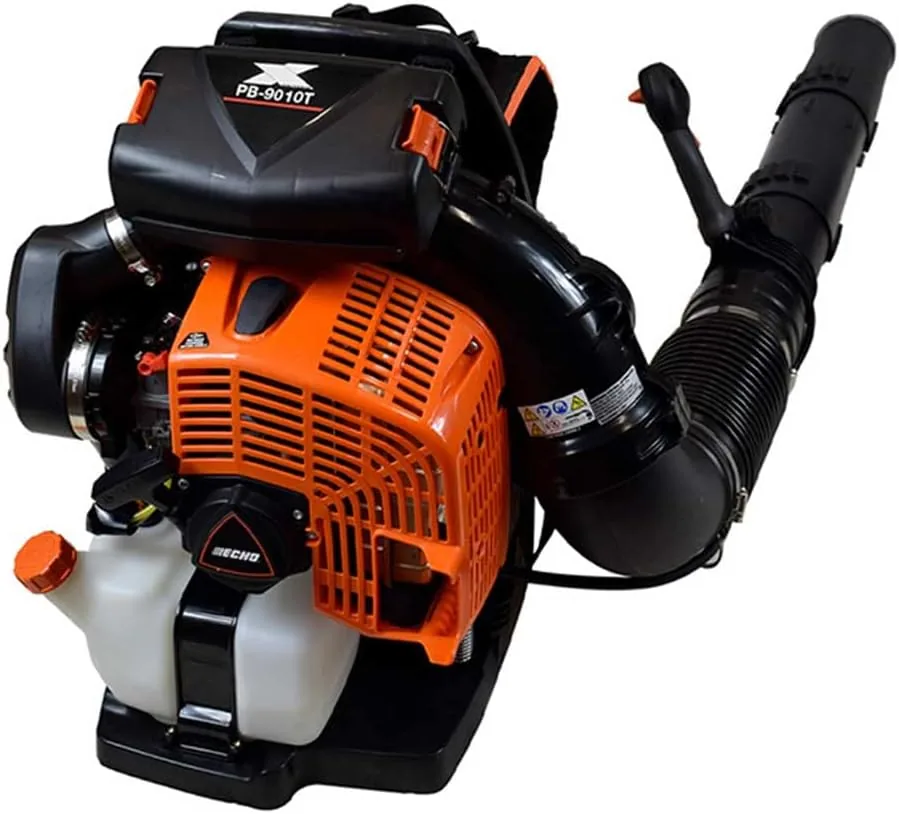
Echo PB-9010T Gas Backpack Leaf Blower Specs
Key Features:
- Tube-mounted trigger: It sits on the swivel pipe, so the aiming hand sets the speed and the other hand stays free.
- Position lever: It holds a set speed along a long pass, and it doubles as the stop at the end of its travel.
- See-through tank: You read the fuel level without opening the cap, so a refuel lands at the end of a pass.
- Purge bulb: Pressing it brings fuel to the carburetor before the first pull, which shortens a cold start.
- Pleated paper filter with a foam pre-filter: The large element sits above the engine under a cover, and the foam washes in detergent water.
- Posi-Loc pipes: The pipes lock into channels, so the nozzle end stays where you aim it.
- Cold weather insert: It fits over the air intake under the back cushion and ships in the box.
By my working guide of about 190 mph and 20 N for needles woven into short grass, the PB-9010T clears the mark by a wide margin, since ECHO lists 220 mph as its top air speed with the pipes on, which puts it among the 200 mph gas leaf blower models. The danger is too much jet. At full throttle on the concrete pad in front of my machinery shed, dry twigs and chaff scattered past the row I was building and clattered off the shed wall. With the position lever near the middle, the same engine gathered them into a row I could move.
Plan by the tank. It holds 83.8 fl oz, and from the fuel rate ECHO lists for this engine at full power I work out about 68 minutes of wide-open running per tank, with part throttle stretching it. The mix is 50:1 gasoline to two-stroke oil, at least 89 octane with no more than 10 percent ethanol, according to ECHO’s manual. Stop the engine and let it cool before you refuel, fill outdoors over bare ground, and carry the blower at least 10 ft from the fuelling spot before you start it.
The first cold start of the season shows the machine’s habits. I pump the purge bulb until fuel shows and four or five times more, as the manual says, pull with short strokes, and give the engine several minutes at idle before I open it up, always out on the pad and never in the shed. The cold sets the limit: ECHO says not to use it below 15 F, and the manual says the cold weather insert in the box may cost a little performance.
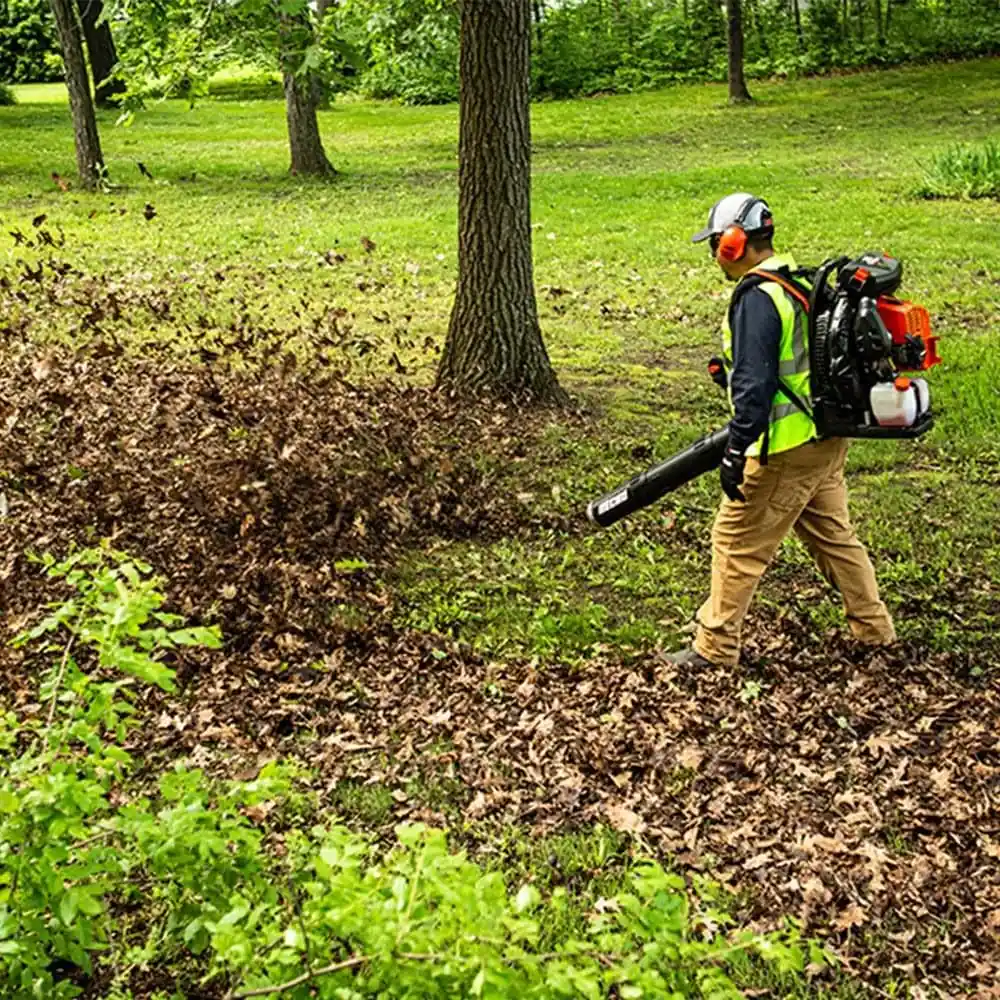
Rake the woven layer first and keep the pipe end clear of the ground. ECHO’s manual says to loosen packed debris with a rake, and a blocked pipe makes the engine over-rev.
WHY I CHOSE THIS
Mirko Lekić, Agricultural Engineer & Farm Owner
I give the PB-9010T the Best Premium label for two reasons that point the same way: it sits in the premium price tier, and 48 N is the most push any maker prints for a blower on this page. With an 83.8 fl oz tank behind that push, it is the machine I pick when a long drive or acreage under pines is the job. It is more tool than a small lot needs, and the right one when the lot is not small.
Wear earplugs and earmuffs together from the first minute, because at the operator’s ear a wide-open engine runs about 103 dBA, a level where hearing protection is mandatory. Add safety glasses and a dust mask, aim the exhaust away from your face, and keep the engine out of any closed space, since the exhaust holds carbon monoxide.
Upkeep follows the mix: shake the can before each use and finish a batch within 30 days, as ECHO’s manual says. At the end of the season I drain the tank outdoors, run the engine dry and, as the manual calls for on storage over 30 days, pour 7 cc of fresh two-stroke oil into the cylinder through the spark-plug hole. The load tires me first: about 31 lb fuelled by my sum, all on the shoulders because the US manual shows no hip belt. According to ECHO, the warranty is 5 years residential and 2 years for backpack blowers in agricultural or income-producing use, and it covers only units from authorized ECHO dealers, so confirm the seller on the listing before you order.
The PB-9010T suits a long drive, acreage under pines and heavy drops that a handheld needs many passes to clear, for an owner who already mixes two-stroke fuel. Skip it for a small lot, a street with noise rules, a back that cannot carry 31 lb, or anyone who dislikes a pull cord and a thirsty engine.
FINAL VERDICT
The PB-9010T is the premium pick for big ground, with the most rated force on this page and speed control in the aiming hand. The weight and the noise come with it. Take it on only when the ground is big enough to use that push and your shoulders can carry it.
It is the premium backpack for acreage under pines.
3. Echo PB-2520 Gas Handheld Leaf Blower Best Value
The ECHO PB-2520 is the best leaf blower for the money when the job is paving, mulch beds and thin dry needles. It reaches 170 mph at the end of its pipes, which clears my floor of about 150 mph for dry needles on a hard surface, from a 25.4 cc two-stroke engine with no battery to run down. It sits in the budget tier, and it is my Best Value pick for that scope.
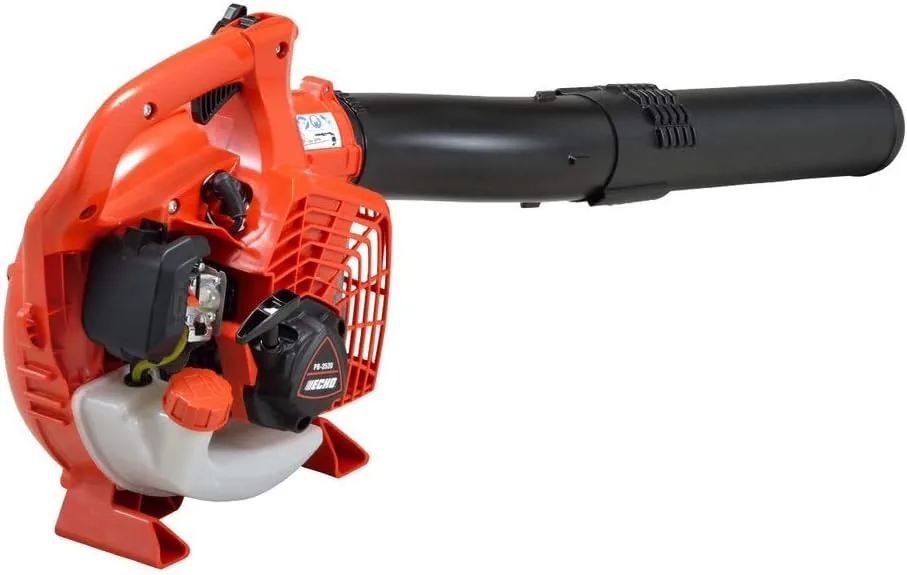
Echo PB-2520 Gas Handheld Leaf Blower Specs
Key Features:
- Throttle position lever: It holds an engine speed once you set it, so the trigger finger rests on a long sweep.
- Curved blower pipe: According to ECHO, it gives rotational control and less fatigue along paths and beds.
- Posi-Loc pipes: They lock the curved and straight pipes together, and the manual shows how to retighten them as use loosens the joint.
- Purge bulb: Pressing it brings fuel to the carburetor before the first pull.
- Tool-less air filter access: The cover opens by hand, so a check after a dusty job takes a moment.
- See-through fuel tank: You see how much mix is left without opening the cap.
- Double-grid air intake: According to ECHO, it reduces clogging and interference with clothing.
On a patio, a walk or the edge of a mulch bed, 170 mph lifts thin dry needles and leaf bits cleanly. Short grass is where it is weakest: ECHO’s 15.8 N sits under the 20 N I look for, so a thick woven mat in turf takes many passes, and a rake pass first helps. ECHO’s manual says to use no more speed than the job needs, and the position lever holds the setting once you choose it. On my first pass along the wood-chip path at the vegetable plot, the lever stood wide open and the jet threw chips onto the soil, so I lowered the setting and held the pipe higher.
A small 18.6 fl oz tank means frequent stops on a big yard, and that tells you the job it suits. The mix is 50:1 gasoline to two-stroke oil, which is 2.6 fl oz of oil per gallon, at least 89 octane with no more than 10 percent ethanol, according to ECHO’s manual. Stop the engine and let it cool before you refuel, fill outdoors over bare ground, and walk at least 10 ft from the fuelling spot before you pull the cord. Give the engine three minutes at idle before you open it up.
Next to the corded blower I keep in the workshop, the PB-2520 trades the cord for a fuel can, and it reaches the far edge of the house lawn where a cord runs out. The curved pipe keeps my wrist straight along the edge. The limit is the hand: at 8.6 lb dry with the pipes, and about 9.5 lb with a full tank by my sum, it is a one-hand tool, and no harness ships in the box, so the weight and the vibration stay in one arm. A strap is an optional extra.
Run it wide open for at least 5 minutes every hour, as ECHO’s manual asks. Low speed all day, which is how a needle job on paving tempts you to work, builds carbon on the spark arrester screen.
WHY I CHOSE THIS
Mirko Lekić, Agricultural Engineer & Farm Owner
I chose the PB-2520 for the price of the jet: a gas engine, 170 mph and no battery to charge for the least money of any tool here that clears my 150 mph floor. I call it the best handheld gas leaf blower for a tight budget, and the trade is a mixing bottle and a little carburetor care. For paving, beds and thin dry needles that trade is worth it. Do not buy it to scrub matted needles out of turf.
Wear hearing protection from the first pull: ECHO rates the engine at 70 dB(A) at 50 ft, a bystander figure, and the level at your ear is higher. Add eye protection to ANSI Z87.1, a dust mask in dusty work, sturdy gloves and closed shoes, and aim the exhaust away from your face, since it is hot and holds carbon monoxide.
Mix 50:1 in a measured bottle, because ECHO’s manual lists a wet muffler as a sign of a mix that is too rich, and my plug fouled once on a batch I poured by eye. ECHO’s manual allows no E15 or E85 and no mix older than 30 days, or 90 with stabilizer, and it asks for an empty tank before a month of storage. Refuelling stops add up on a big yard, because the tank holds only 18.6 fl oz. According to ECHO, the warranty is 5 years consumer and 2 years commercial, and ECHO’s limited warranty covers only units sold by authorized dealers, so check the seller on the listing before you order.
The PB-2520 suits paving, patios, mulch bed edges and thin dry needles for a buyer who accepts a fuel mix and a pull cord. Skip it for thick woven needles in grass, for a big yard where an 18.6 fl oz tank means constant stops, and for any street with noise rules.
FINAL VERDICT
The PB-2520 gives the least money for a jet that clears 150 mph, with an engine that never runs flat. It lifts thin dry needles from paving and beds. Buy it for needles on hard ground, and pass on it for needles woven into turf.
It is the budget gas handheld for paving and beds.
4. Husqvarna 360BT Gas Backpack Leaf Blower Best Mid-Size Backpack
According to Husqvarna, the 360BT sends a 232 mph jet out of its round nozzle, the highest air speed any maker prints for the blowers in this list, with 30 N of rated force behind it. That makes it the best backpack leaf blower for a property that needs backpack power but not the largest engine.
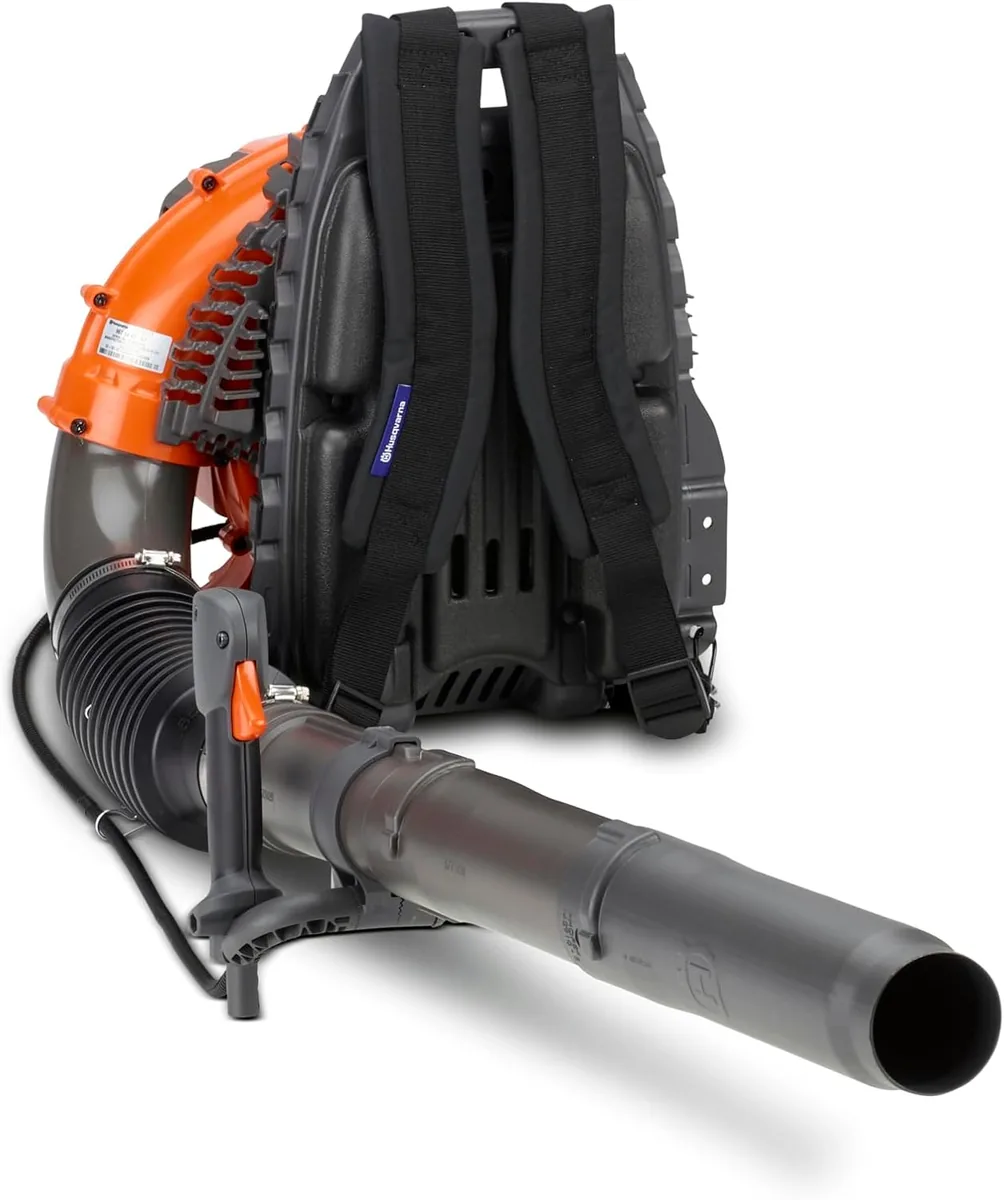
Husqvarna 360BT Gas Backpack Leaf Blower Specs
Key Features:
- Round blower nozzle: Husqvarna lists its top air speed here, and held low it lifts thin, stiff litter off hard ground.
- Four throttle positions: Full, one third, idle or stop; Husqvarna advises the lowest one that does the job.
- 74.4 fl oz tank: Enough fuel to plan a long run around one refill.
- Ventilated harness: According to Husqvarna, wide shoulder straps carry the load.
- Air purge bulb: It fills the carburetor before the first pull, so a cold start needs fewer tugs.
Husqvarna’s 631 CFM is the air in the pipe at the round nozzle; the listing’s 890 CFM is air inside the housing. At the foot of my plum rows the round nozzle, held low, rolled dry twigs and stiff leaf stems into a line, and the pile stayed a pile instead of scattering. Lift the tip to knee height and the jet spreads and slows, so keep it low.
Husqvarna publishes no run time. By my sum, the 74.4 fl oz tank lasts about 80 minutes at full power, and part throttle stretches that. The tank takes a 50:1 mix of unleaded gasoline (at most 10 percent ethanol) and two-stroke oil, and the manual says to mix no more than a month of fuel at a time.
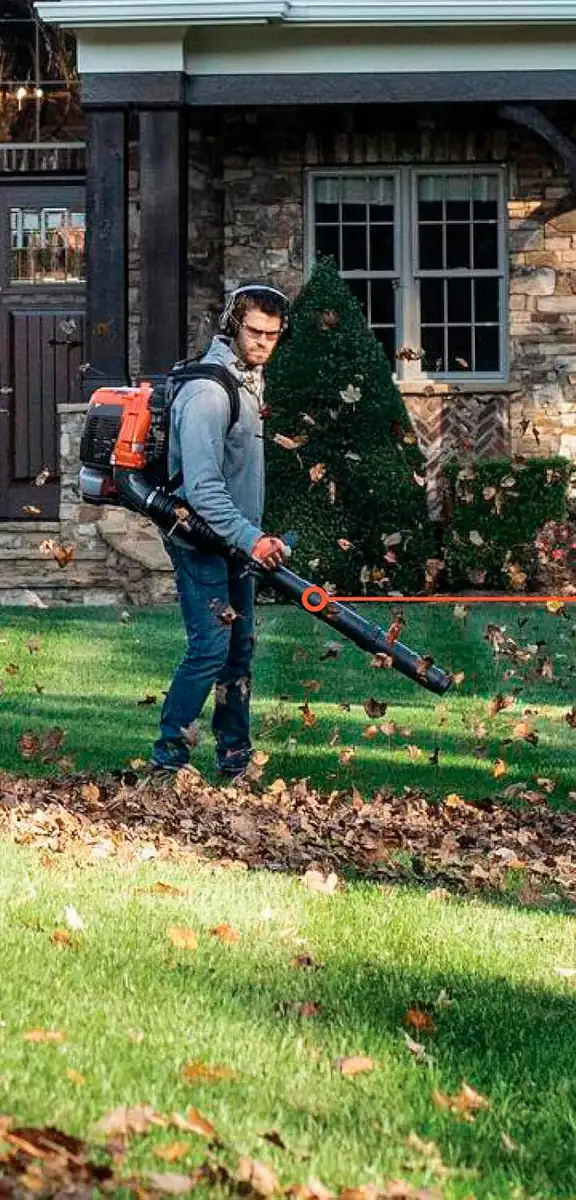
Beside an alley I have just sown with cover crop, I aim the tip along the headland, because a jet this fast drags seed along with the litter.
WHY I CHOSE THIS
Mirko Lekić, Agricultural Engineer & Farm Owner
I gave the 360BT the Best Mid-Size Backpack label for its proportions: a 65.6 cc engine gives backpack force at a carry weight I accept for a long session. I recommend it for long runs of dry, stiff litter where a handheld would be a chore.
At Husqvarna’s declared 95 dB(A) at the operator’s ear, wear earplugs and earmuffs together from the first minute, plus eye protection and a dust mask on dusty ground. Refuel outdoors with the engine stopped and cool, then carry the blower at least 10 ft from the fueling spot before you start it.
After a month of storage I carry the 360BT out to the yard before the first start, and it wants the choke closed, the purge bulb pressed and two to three minutes of warm-up. The manual has the air filter checked daily, the muffler screen brushed weekly and the plug replaced monthly. The muffler stays very hot even at idle, so the manual keeps objects 50 cm (about 20 in) from the outlet. Husqvarna’s US pages state no warranty length and route claims through a dealer, so check the seller on the listing and keep the receipt.
The 360BT suits long drives and orchard strips of dry, stiff litter, for an owner who mixes small batches and keeps to the plug schedule. Skip it for a small lot, a street with gas or noise rules, or if you dislike mixing fuel.
FINAL VERDICT
Choose the 360BT for long runs of dry, stiff litter if you accept the fuel mix, the plug schedule and the noise of a gas backpack. On a small lot or under a gas ban, the engine is more than the job needs.
It is the mid-size backpack I carry for long runs of dry litter.
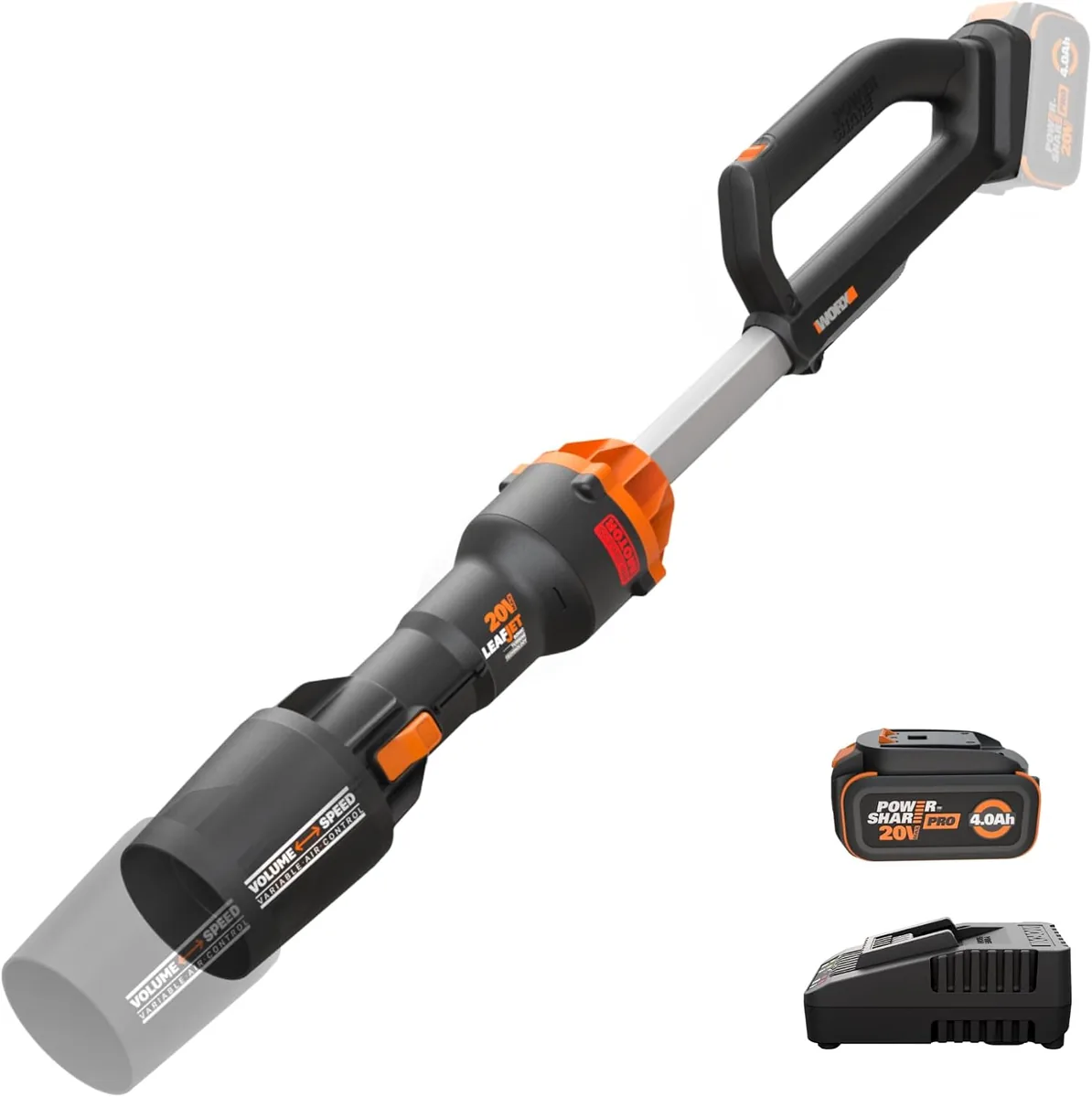
5. WORX WG543 20V Cordless Leaf Blower Kit Best Lightweight Cordless
At about 3.8 lb with the battery on, the WG543 is a cordless blower you can hold out at arm’s length for a long sweep. That makes it the best lightweight cordless leaf blower on this page for thin, dry needles on a deck, a step or a smooth path. WORX lists 130 mph, under my working guide of about 150 mph at the nozzle for dry needles on hard ground, so I treat it as a light-duty tool.
WORX WG543 20V Cordless Leaf Blower Kit Specs
Key Features:
- Sliding nozzle: A release button and a slide switch between speed mode and volume mode, which are separate peaks.
- Two power settings: On low, WORX lists 95 mph in speed mode and 305 CFM in volume mode, for tight spots and light litter.
- No cord, no fuel: It runs from the battery, with no fuel to mix and no rope to pull.
- PowerShare battery: The 20V pack fits other WORX 20V tools, so batteries swap between them.
- Battery and charger in the box: The kit works on arrival; a recharge takes about 2 hours.
That speed holds in speed mode, nozzle slid back, and WORX lists 410 CFM in volume mode, nozzle slid forward. The manual sets speed mode for grass and volume mode for hard ground such as concrete. On the mown edge of the first alley, dry clippings lifted off the stubble in speed mode, but a clump knit into the sod stayed put. A jet at this speed skims the top and does not dig out what has grown in, so needles woven into turf need a rake first.
WORX publishes no run time for the 4.0 Ah, 20V pack. A second pack turns the WG543 into a tool for more than one small job, since recharging the first takes about 2 hours.
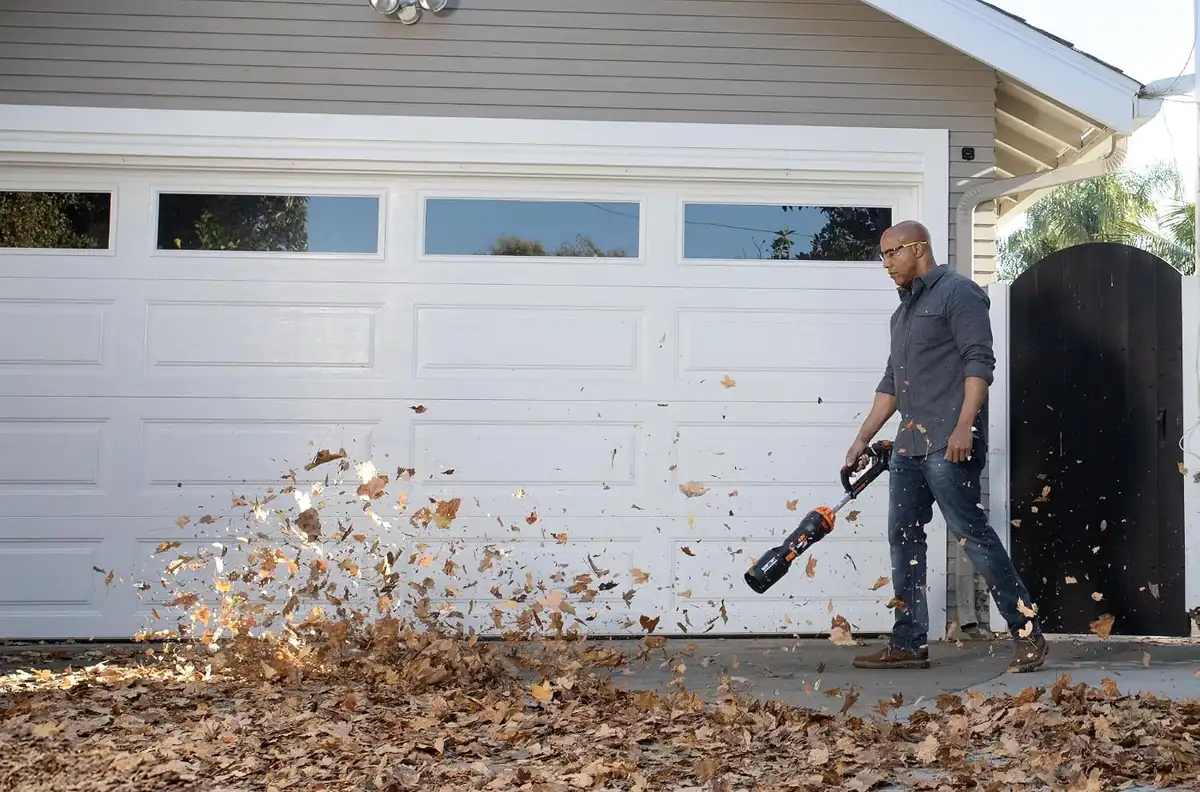
In the crate store, where a gas blower never runs, the first pass in speed mode raised a cloud of chaff. I slid the nozzle forward into volume mode and rolled the chaff toward the open door, with a dust mask on.
WHY I CHOSE THIS
Mirko Lekić, Agricultural Engineer & Farm Owner
I give the WG543 the Best Lightweight Cordless label on one fact: the weight of the blower with its battery on. Weight is its claim, and I recommend it only for the light end of the job, dry needles on a step or a smooth path.
The fan runs on for a few seconds after switch-off, so hold the blower until it stops. The manual has you remove the battery before cleaning the tube or changing an accessory.
Care is a damp cloth with mild soap, never a spray, and storage indoors with the battery out. According to WORX, the tool, battery and charger carry a three-year limited warranty if you register within 30 days, and 24 months otherwise. Next to the rake I used on the concrete pad, the WG543 tires my forearm instead of my shoulder, and I wear eye and ear protection with it, as I do with every blower.
The WG543 suits dry needles and light litter on a step, a path or smooth paving, and WORX 20V owners who share batteries. Skip it for needles woven into turf, for wet litter, or any job that needs a stated run time or blowing force.
FINAL VERDICT
Get the WG543 for light sweeping of dry needles on smooth ground, where weight matters more than force. If the needles are woven into turf, the job calls for a rake and a stronger machine.
It is the light cordless blower for dry needles on smooth ground.
How to Choose the Best Leaf Blower for Pine Needles
A needle is a thin rod that lies in grass and between stones, so a leaf blower for pine needles has to hit hard at the tip. Six checks decide the choice. Speed does the lifting and weight decides how long you keep going, so speed comes first.
Air Speed at the Nozzle With a Concentrator Tip
Air flows around a stiff needle, so the jet has to hit it hard. NASA’s page on dynamic pressure shows that the force of moving air on an object grows with the square of its speed (1). Twice the speed presses four times as hard, so speed at the nozzle comes before every other figure.
A concentrator tip is the tapered end that raises the speed and thins the stream. Some kits reach their top speed only with that tip fitted. A 200 mph gas leaf blower figure is a maker’s peak at the nozzle, and it fades with distance. At the soft edge of my gravel yard, where grass creeps in, a narrow stream gets under the stems that a wide one rolls over.
Pro Tip
Find out which nozzle the box speed belongs to. If the narrow tip is a separate purchase, plan on the lower figure.
My working guide for the speed at the nozzle, drawn from the figures makers print:
- Dry needles on a hard surface: about 150 mph at the nozzle or more, with a narrow tip.
- Dry needles on short grass: about 190 mph and about 20 N or more, usually on the strong setting.
- Soaked or knitted-in needles: the same speeds, after a rake pass loosens the layer.
No standard sets a pass mark for needles, so treat these bands as a way to sort machines. Your needles, your ground and the depth of the layer set the real result.
Force at the Nozzle, Then Airflow for Carrying the Pile
Speed lifts the edge of a mat, and force moves the layer along. NASA’s thrust page explains why, since the force of a gas stream depends on how much gas moves each second and how much that gas speeds up (2). Newtons at the nozzle fold volume and speed into one number, so I judge a powerful battery leaf blower by its newtons at the nozzle and its minutes at that setting.
Airflow comes second. CFM sets how wide a path the jet clears and how much it carries once a pile is moving. The CFM and the mph on a box are separate peaks that do not occur together, so I never multiply one by the other.
Some makers print newtons and others do not, and a missing figure is a reason to lean on speed and weight. I sort machines by speed first, then newtons, then CFM.
Variable Speed and Nozzle Choice for Beds and Gravel Edges
Needles lie in mulch beds, along gravel edges and beside plants, and a jet that lifts them from a driveway lifts mulch and stones too. A blower with one speed handles that mix poorly. Look for these controls:
- A variable trigger: the jet softens beside a bed without stopping the motor.
- A dial or lever that holds a speed: it rests your finger on a long edge.
- A second tip or nozzle: a narrow one for seams, a wide one for loose ground.
- A gas throttle that drops below full: an engine wide open belongs on the open drive and away from a bed edge.
Flying debris is the reason for the controls. A U.S. study of lawnmower-related eye injuries found that 77 percent came from projectiles, mostly grass, dirt and rocks, and only 2 percent of those cases documented eye protection (3). That study covers lawnmowers, and a blower also throws grass, dirt and stones, so safety glasses go on before any blower starts.
I keep the jet off the flowering strips beside my alleys, so there I drop to the lowest setting and hold the tip well back.
Eyes and Bystanders
Wear safety glasses or goggles, keep people, pets, windows and cars out of the debris path, and wear a dust mask when dry needles throw dust.
Minutes per Pack or Tank Against the Length of the Job
A drive under pines is a long job, and a stiff mat asks for the strong setting. Count the minutes on the strong setting and ignore the hours a maker prints for low. According to EGO, a 56V 5.0 Ah pack runs about 150 minutes on low, about 25 on high and about 15 on boost, so one pack answers three different questions.
The best cordless leaf blower for a needle job is the one whose strong setting outlasts your longest drive, and a spare pack settles a close call. A gas tank has no pack to run flat, so tank size sets the stops: the two backpacks here hold 74.4 and 83.8 fl oz and the handheld 18.6 fl oz.
- Strong-setting minutes with the pack that comes in the box.
- Your longest single stretch: the run you cannot stop in the middle.
- A spare pack or a second can staged where the job ends.
I plan in passes: my gravel driveway and yard run about 150 feet, so one pass down and one back is the unit I count.
Key Takeaway
Match the pack or tank to the longest stretch you cannot stop in the middle.
Weight and Harness for the Whole Job
Weight decides how long you can keep a steady angle. A tool that feels light at minute five feels heavy at minute forty, so I judge weight at the end of a drive. Read what each weight figure includes before you compare two tools.
| Figure on the listing | What it leaves out | What to add |
|---|---|---|
| Dry weight (gas) | The fuel | A full tank, which adds several pounds on a backpack |
| Weight with the battery (cordless) | Nothing, because the pack is on | A spare pack adds its own weight |
| Bare tool (cordless) | The battery | The pack, which can be half the weight you carry |
A backpack moves the load to your shoulders, and the harness decides whether it stays there. Check the manual or the box list for a hip belt before you count on one. Backpack blowers also pass vibration to the hand, and in a field study the risk depended on the hours of use each day (4), so I plan breaks into a long drive.
Best Gas Leaf Blower Against Battery on Noise, Fuel and Upkeep
A gas backpack gives you a tank that outlasts a pack and the most force on this page, and it costs you noise, mixed fuel and engine upkeep. A cordless kit needs no fuel mix and no engine service, though it still wants hearing protection and regular cleaning, and it runs out of minutes on the strong setting. My rule is battery for a lot up to about half an acre and gas for acreage or a long drive. Near the house I use battery, and I keep gas for the orchard end of the farm.
Makers print noise in different places. One backpack maker rates its machine at about 79 dB(A) as a bystander figure at 50 ft, and another declares 95 dB(A) at the operator’s ear, so the two numbers do not rank those machines against each other. In a study of groundskeepers at North Carolina universities, grounds equipment reached up to 109 dBA (5). NIOSH recommends 85 dBA over an eight-hour workday and half the time for every 3 dBA more (6).
Four habits keep a gas machine safe through a needle season:
- Mix: ratio, oil grade and how long mixed fuel keeps differ by maker and model, so follow the manual of the machine you buy. Husqvarna, for one, specifies 50:1 and never more than a month of mix at a time.
- Refuel: stop the engine, let it cool, fuel outdoors, then carry the blower at least 10 ft from the fuelling spot before you start it. Echo’s and Husqvarna’s manuals both give that distance.
- Exhaust: never run a gas engine in a shed or other closed space, because the exhaust carries carbon monoxide.
- Dust: Echo’s manual ties dusty cooling fins and blocked intakes to overheating, and Husqvarna’s says a blocked cooling system damages the engine, so check the filter and the fins before each dry-needle session. I do the same after a dusty day in the orchard.
Hearing Protection
Wear hearing protection with every blower while it runs: plugs and earmuffs together on a gas backpack, and at least plugs on the strong setting of a cordless kit.
Which Pick Fits Your Pine Needle Job
The speed and force a maker lists decide which jobs a pick can take, and the table shows where each one stops against the working guide above.
| Job | My pick | Speed and force the maker lists | Where it stops |
|---|---|---|---|
| Thin dry needles on a deck, porch or smooth path | WORX WG543 | 130 mph in speed mode; force not published by the maker | Under the 150 mph mark, so a thin dry layer only |
| Paving, bed edges and thin dry needles on short grass | Echo PB-2520 | 170 mph and 15.8 N, per Echo | Under the short-grass marks; a thick woven mat takes many passes |
| Driveway, deck and short grass on a house lot | EGO LB7654 | 195 mph with the tapered nozzle and 26 N maximum, per EGO; about 25 N on turbo | Turbo lasts about 13 minutes on the kit pack |
| A long drive or acreage under pines | Echo PB-9010T or Husqvarna 360BT | 220 mph and 48 N per Echo; 232 mph and 30 N per Husqvarna | Weight on the back and loud noise |
| Needles knit into turf or soaked through | A rake first, then the pick for your lot | Same speeds, after the layer is loosened | A blower alone slides over a soaked mat |
The EGO Power+ LB7654 765 CFM Cordless Leaf Blower Kit clears the short-grass speed mark with its tapered nozzle and reaches the 20 N mark only on turbo, so short grass means turbo in bursts. For a house lot it is the best handheld cordless leaf blower I rank for a drive, a deck and short grass.
Needles that are knit into turf or soaked through get a rake pass before any blower touches them.
| Pick | Weight and its basis | Run time or tank |
|---|---|---|
| 1. EGO LB7654 | About 9.6 lb with the 5.0 Ah pack on | About 22 minutes on high and about 13 on turbo |
| 2. Echo PB-9010T | About 27 lb dry | 83.8 fl oz tank |
| 3. Echo PB-2520 | 8.6 lb dry | 18.6 fl oz tank |
| 4. Husqvarna 360BT | 23.2 lb dry; about 27 lb with a full tank | 74.4 fl oz tank |
| 5. WORX WG543 | About 3.8 lb with the battery on | Run time not published by the maker |
The weights sit on different bases, so read each with its label, and add several pounds for fuel on the gas machines.
What happens to the pile matters too. Dry needles burn. A university field test of eight landscape mulches rated pine needles among the most hazardous in fire behavior, and the authors advise keeping pine needle mulch more than 30 feet from a house and using noncombustible material within 5 feet (7). That test burned mulch plots, so I treat the distance as a cautious guide for a pile.
Pile Safety
Stack dry needles well away from buildings, and keep them clear of the hot muffler of a running gas engine.
What I Left Off This List and Why
Five picks leave out several tools people ask about, and each omission rests on speed or on how the tool is sold. The best budget leaf blower for needles still has to reach about 150 mph at the nozzle, and the gas handheld in third place is the cheapest tool on this list that does.
- Corded blowers: the corded model with a regular offer tops out at 110 mph, under the 150 mph mark for dry needles on hard ground, and the corded model rated far faster is an older design that its maker no longer lists, sold only through other sellers. The cord also ties the job to an outlet. This list has no best corded leaf blower for those reasons.
- Small cordless tools: the ones I looked at top out at 116 to 130 mph and about 11 N of force. They suit a deck, and the lightweight cordless pick already covers that job with its battery in the box.
- More of the same: two more gas backpacks and a second two-battery cordless kit would repeat roles filled here, so I stopped at five rather than pad the list.
Other jobs have their own picks in my leaf blower guides.
My Overall Verdict
Three machines cover almost every needle job, and the right one depends on your ground, the length of your drive and the weight you will carry.
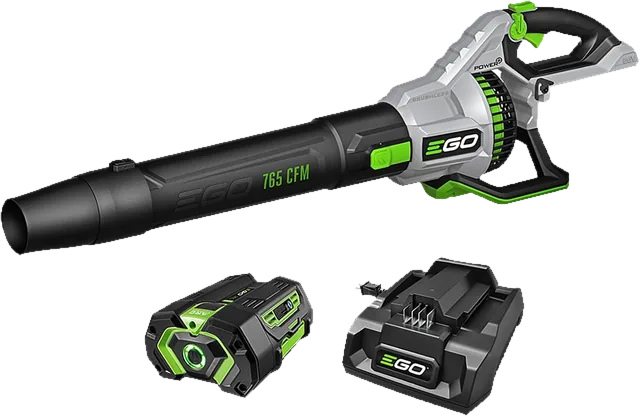
1. EGO Power+ LB7654 765 CFM Cordless Leaf Blower Kit Best Overall
Best for a house lot with needles on a drive, a deck and short grass, with 195 mph at the tapered nozzle and about 25 N on turbo.
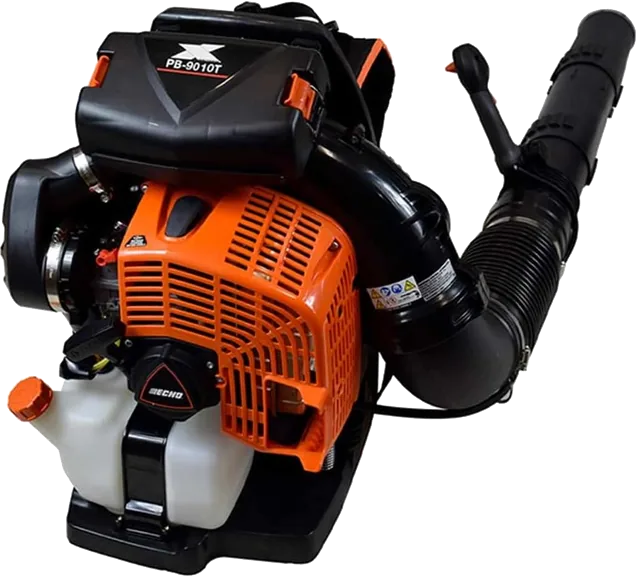
2. Echo PB-9010T Gas Backpack Leaf Blower Best Premium
Best for acreage or a long drive under pines, with 220 mph and 48 N per Echo and an 83.8 fl oz tank.
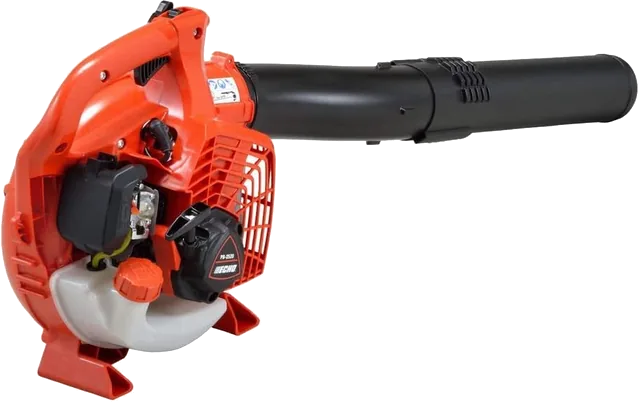
3. Echo PB-2520 Gas Handheld Leaf Blower Best Value
Best for paving, bed edges and thin dry needles on a small budget, with 170 mph and 15.8 N per Echo.
I recommend the EGO Power+ LB7654 765 CFM Cordless Leaf Blower Kit to most readers, since it needs no fuel and comes with its own pack, and I move to a gas backpack once the drive outlasts one pack. For a typical lot with needles on the drive and short grass, that makes the EGO the best leaf blower for pine needles on this list.
Why EGO Power+ LB7654 765 CFM Cordless Leaf Blower Kit Might Be the Best Choice
I pick it because it is the one cordless handheld here that clears the speed mark for short grass. According to EGO, its manual lists keeping decks and driveways free from leaves and pine needles as a job and calls the blower a household tool, which makes it the best leaf blower for home use on this list.
The trade-off is minutes and weight. Turbo lasts about 13 minutes on the kit pack, the tool is about 9.6 lb with the pack on, and the gas backpacks push harder, so I keep a second pack charged for a long drive.
What puts it first on my list:
✓ Speed: 195 mph with the tapered nozzle and 166 mph without it, according to EGO.
✓ Force: 26 N maximum, according to EGO, and about 25 N on turbo with the kit’s 5.0 Ah pack.
✓ Control: a variable trigger and a dial that locks any speed, so the setting holds on a long edge.
✓ Airflow: up to 765 CFM on boost and a dial range of 260 to 580 CFM, according to EGO.
✓ Kit: a 5.0 Ah pack, a charger and two nozzles, one tapered and one spread.
Frequently Asked Questions
Do leaf blowers work on pine needles?
Leaf blowers work on pine needles when the needles are dry, they lie on a hard surface or short grass, and the jet is fast and narrow. A soaked or knitted-in layer needs a rake pass first, because the stream slides over a matted layer instead of lifting it, and the blower then finishes the loosened needles.
What is the best tool to pick up pine needles from my yard?
The best tool to pick up pine needles from your yard is a fast blower to gather them and a rake or tarp to carry them off. A lawn sweeper suits a large, dry, level lawn, and a mower alone does not make needles disappear, so plan to carry the pile away in either case.
What is the best way to remove pine needles from my yard?
The best way to remove pine needles from your yard is to blow dry ones into a row with the wind at your back, rake any layer knitted into the turf first, and tarp the pile away. Work with the nozzle low from two directions, and switch to the rake when a pass stops gathering anything.
How to shred pine needles?
To shred pine needles, feed dry ones through a leaf shredder, because needles are light and move through one more easily than through a chipper. Chopped needles stay intact for months, so shredding shrinks the pile without making it disappear, and the pieces still need a bed or a pickup.
Do pine needles make soil acidic?
Pine needles can make soil more acidic, and how much depends on your soil and on the depth of the needle layer. Test the soil under a needle mulch once a year with a home pH kit, and adjust it only if the reading drifts out of the range your plants need.
References
- NASA Glenn Research Center. Dynamic Pressure. Beginners Guide to Aeronautics. Updated June 28, 2024.
- NASA Glenn Research Center. Thrust Equation. Beginners Guide to Aeronautics. Updated June 10, 2026.
- Stange NR, Jennissen CA. Lawnmower-Related Eye Injuries in the U.S., 2004 to 2023. Am J Ophthalmol. 2025;277:7-16.
- Alamin Gabasa SA, Md Razali KA, As’arry A, Abdul Jalil NA. Vibration Transmitted to the Hand by Backpack Blowers. IJAME. 2019;16(2):6697-6705.
- Balanay JAG, Kearney GD, Mannarino AJ. Assessment of Occupational Noise Exposure among Groundskeepers in North Carolina Public Universities. Environ Health Insights. 2016;10:83-92.
- National Institute for Occupational Safety and Health. Noise-Induced Hearing Loss. Noise and Hearing Loss. Centers for Disease Control and Prevention; 2024.
- Quarles S, Smith E. The Combustibility of Landscape Mulches. SP-11-04. University of Nevada Cooperative Extension; 2011.
Safety Note: Leaf blowers throw debris and can damage your hearing. Wear eye and ear protection, read the manufacturer’s manual, and check your local rules on noise and operating hours.