
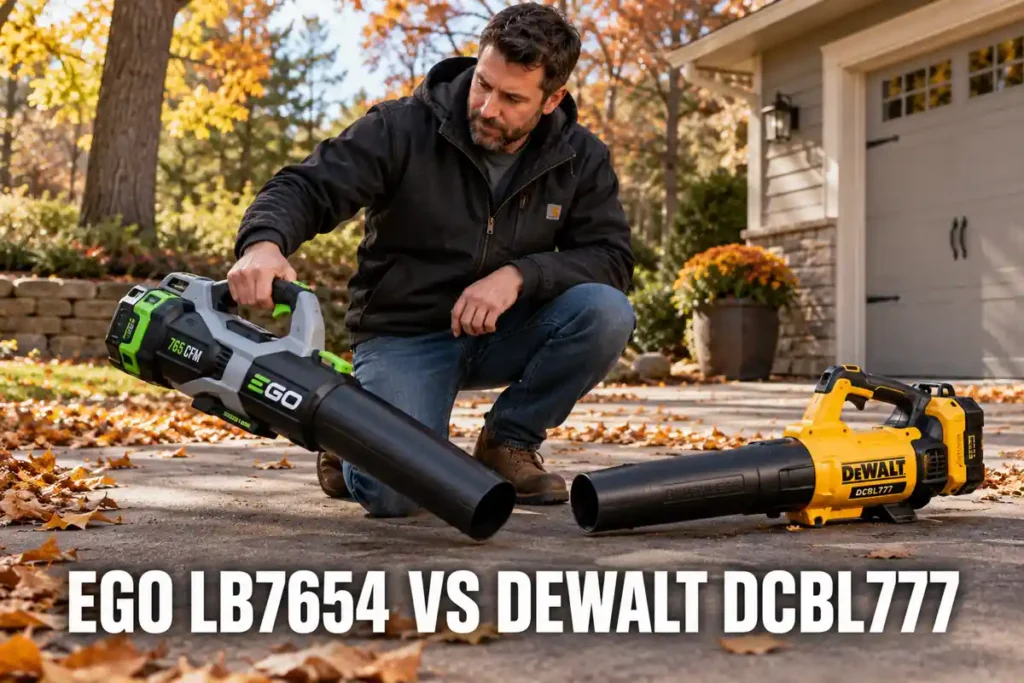
EGO LB7654 vs DeWalt DCBL777 is a tie on airflow, 765 against 760 CFM, and for most buyers the EGO kit is the one to buy: it pushes harder and carries lighter. The DeWalt wins for one buyer, the one whose shed already holds FLEXVOLT packs. I clear the yard concrete, the gravel edge and the plum rows every autumn, and I used both kits on that ground. Below I compare the boxes, the push, the runtime, the weight and the noise.
Affiliate Disclosure: Garden Power Scout is a proud participant in the Amazon Services LLC Associates Program. As an Amazon Associate, we earn from qualifying purchases, at no extra cost to you.
EGO LB7654 vs DeWalt DCBL777 Short Answer
Buy the EGO LB7654 kit if you are starting without a battery platform. Airflow is level, but the EGO reaches about 25 N of push on boost where the DeWalt reaches about 19 N on Turbo, and the EGO kit is the lighter carry. Buy the DeWalt if your shed already holds FLEXVOLT packs, and take the bare tool, since the batteries are the part you own.
Every row below names the mode, pack or kit behind the figure, and a row marked as a maker’s figure comes from EGO or DeWalt.
| Spec | EGO LB7654 kit | DeWalt DCBL777Y1 kit |
|---|---|---|
| In the box | LB7650 blower, one 5.0 Ah battery, CH3200 charger, tapered and spread nozzles, shoulder strap per EGO’s manual | DCBL777 blower, one FLEXVOLT battery, DCB1104 charger, concentrator and sweeper nozzles, shoulder strap |
| Pack energy, kit pack | 280 Wh (5.0 Ah at 56V) | 240 Wh (12.0 Ah at 20V, 4.0 Ah at 60V) |
| Airflow, maker’s figure | 765 CFM on boost | 760 CFM |
| Air speed, maker’s figure | 195 mph with the tapered nozzle | 160 mph |
| Push on the top mode | About 25 N on boost | About 19 N on Turbo |
| Push one step down | About 16 N on high | About 14 N on Normal |
| Runtime on the kit pack, one step down | About 22 min on high | About 18 min on Normal |
| Runtime on the kit pack, top mode | About 13 min on boost | About 14 min on Turbo |
| Weight, blower without battery | 4.6 lb | 7.1 lb |
| Weight, blower with the kit pack fitted | About 9.6 lb | About 10.3 lb |
| Noise at the operator’s ear | About 76 dB on high, 80 dB on boost | About 75 dB on ECO, 77 dB on Normal, 79 dB on Turbo |
| Rain | IPX4 splash rating | DeWalt’s manual says no use in rain or wet conditions |
Two rows decide it: the push on the top mode, where the EGO leads by about 6 N, and the weight with the pack fitted, where the EGO is lighter by about three-quarters of a pound.
What Is in Each Box
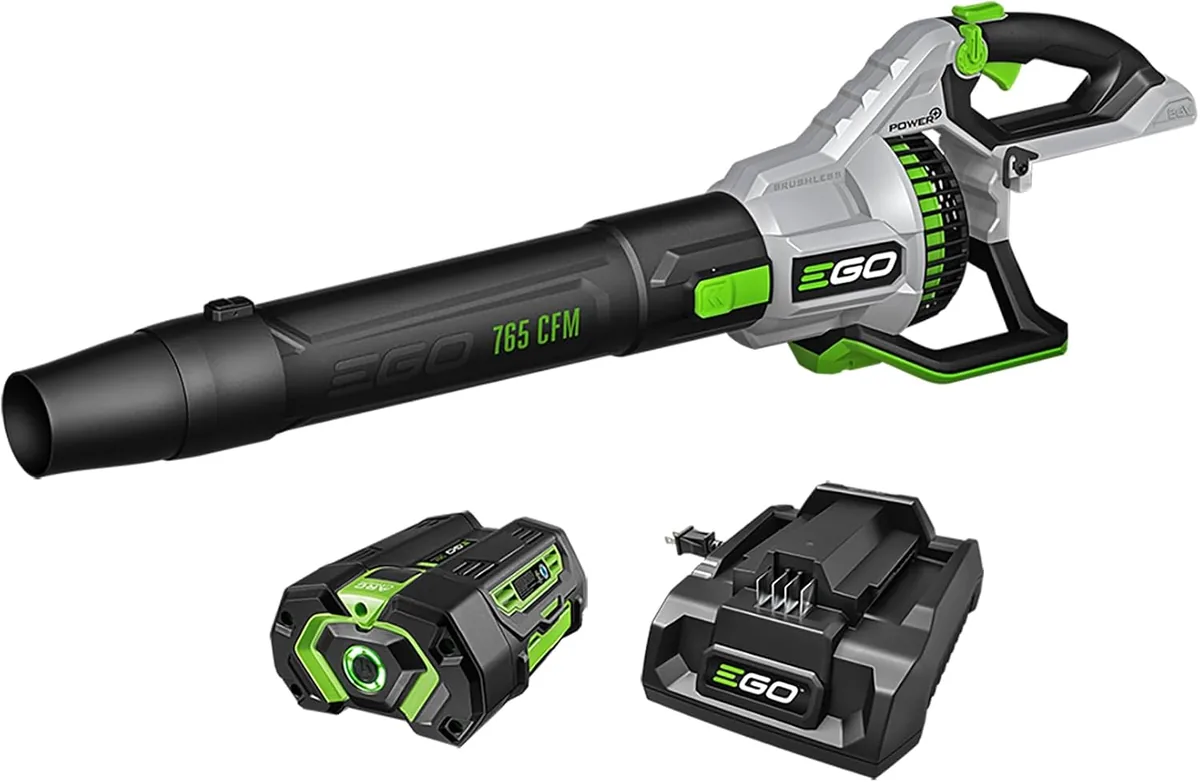
The EGO Power+ LB7654 765 CFM Blower Kit holds the LB7650 blower, one 5.0 Ah battery with a fuel gauge, the 320 W CH3200 charger, a tapered nozzle and a spread nozzle. According to EGO’s manual, a shoulder strap comes with it.
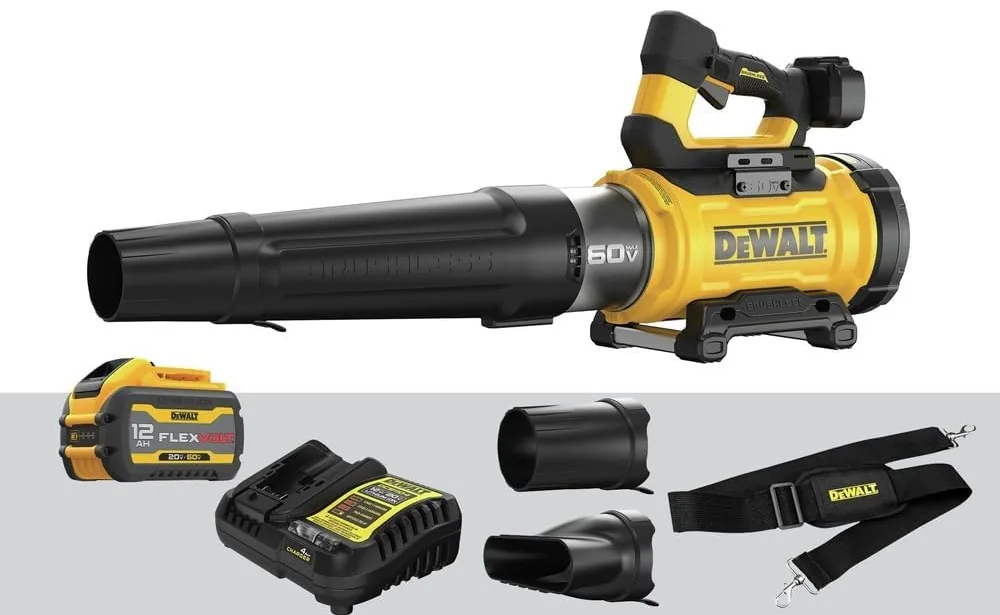
The DeWalt 60V blower with battery is the DeWalt DCBL777Y1 60V MAX Blower Kit, which holds the DCBL777 blower, a DCB1104 charger, a concentrator nozzle, a sweeper (flat) nozzle, a shoulder strap and one FLEXVOLT battery. That pack reads 12.0 Ah on a 20V tool and 4.0 Ah on a 60V tool like this blower, which is 240 Wh either way, and I call it the 12.0 Ah pack from here on.
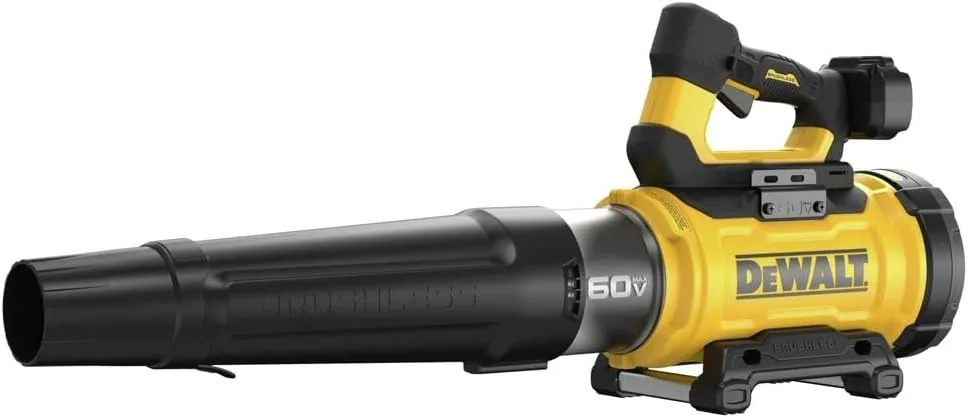
DeWalt also sells the same blower without battery or charger as the DCBL777B, which suits a buyer who already owns FLEXVOLT packs. EGO sells its blower alone as the LB7650, for a buyer who owns a 4.0 Ah or larger 56V battery.
Both kits sit in the mid-range to premium tiers and both work out of the box. The difference arrives with the second pack, because a spare pack costs a large share of either kit and a leaf Saturday asks for one. I plan a leaf Saturday in packs, not in acres, and I charge the spare the night before.
Winner: the platform decides, with the EGO kit for a buyer who owns none and the DeWalt tool alone for an owner of FLEXVOLT packs.
Airflow, Air Speed and Blowing Force
In the EGO 765 vs DeWalt 60V blower matchup, airflow is a tie: 765 CFM against 760 CFM, according to the makers. Air speed is not. EGO gives 195 mph with the tapered nozzle and DeWalt gives 160 mph.
With airflow level, speed is what separates them, and the push figures line up with it. The EGO reaches about 25 N on boost and the DeWalt about 19 N on Turbo, which is about 5.6 lb of push against about 4.3 lb, because 1 N is about 0.225 lb. CFM and top mph never occur at the same moment, so the push is the number that matches what the stream does.
One step down the gap narrows but stays: about 16 N on the EGO’s high setting against about 14 N on the DeWalt’s Normal mode. The DeWalt gives about 2 N less with its concentrator nozzle fitted, so I use that narrow tip for seams and stuck debris and not for extra push.
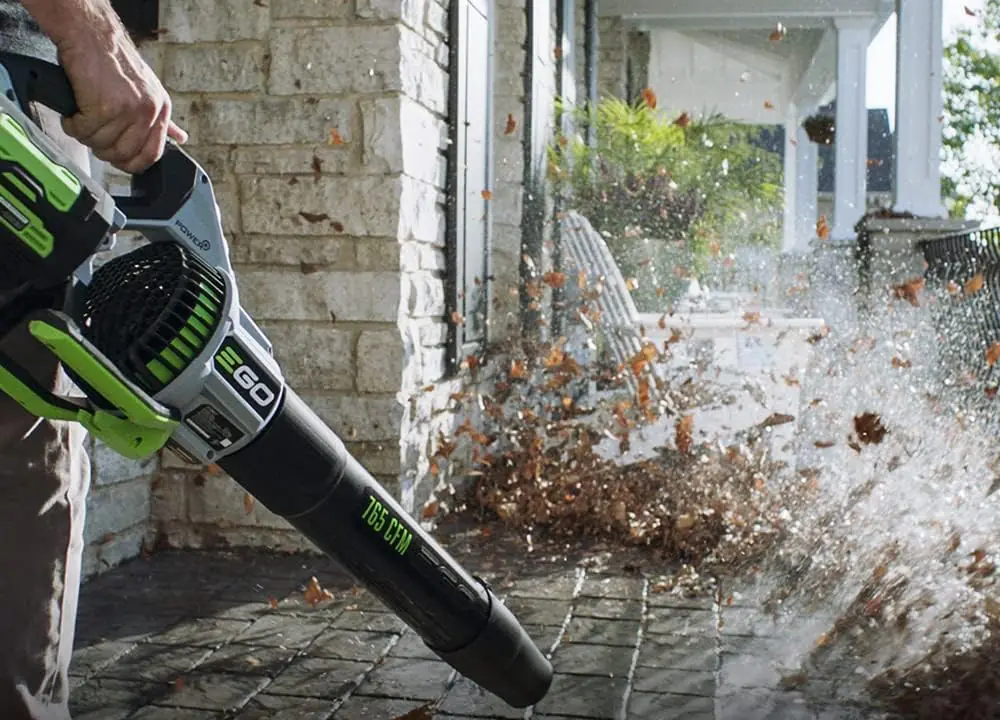
After a rainy week the plum leaves lie on the yard concrete as one wet mat. On high the EGO skated over the top layer, and a press on boost lifted the edge so the mat rolled out. That is a job I keep away from the DeWalt, because its manual rules out use in wet conditions.
Winner: EGO LB7654, because it is rated for faster air and pushes harder at the top and one step below it.
DeWalt 60V Blower vs EGO 56V Battery, Runtime and Charging
The EGO runs on EGO’s 56V packs and the DeWalt on FLEXVOLT 20V/60V packs, so the first question is which packs your shed already holds. The kit packs hold 280 Wh for the EGO and 240 Wh for the DeWalt, so the EGO carries a little more energy. Packs you already own outweigh every other number in this section.
One kit pack lasts about 22 minutes on the EGO’s high setting and about 13 minutes on boost. The DeWalt’s pack lasts about 18 minutes on Normal and about 14 on Turbo. One step below the top the EGO runs a few minutes longer, and on the top mode the two end within a minute of each other.
According to EGO, the pack lasts about 25 minutes on high, about 15 on boost and about 150 on low, and according to DeWalt it lasts up to 20 minutes in ECO, the mode with the least push. The low settings are not equal, so I compare at the same step.
- Cold: EGO gives 5 to 104 F as the working range for the blower, and its battery manual says a pack below about 50 F may pulse for the first minute while it warms. According to DeWalt, its pack works down to 0 F. On frost mornings I warm whichever pack I take out in the house first.
- Charging: According to EGO, the CH3200 charges the kit pack in about 70 minutes. The DeWalt charger waits until the pack sits between 40 and 104 F before it starts.
- Charge check: Both blowers stop when the pack runs flat, so I look at the charge before the last row of the plum strip. The EGO pack has a five-LED gauge that you press, and the DeWalt shows four charge LEDs on the tool.
Heat is the enemy of a stored pack. In cell-ageing tests across seven charge ranges, capacity loss depended on the charge range and the age of the cell (1). A model of 36 months of storage at 131 F and 90 percent charge found the electrolyte’s conductivity fell by more than 20 percent (2). DeWalt says never to store its pack where the temperature can reach 104 F, and EGO names 50 to 80 F as the best storage range, so I keep the DeWalt 60V blower battery and the EGO pack in the house through July, not in the machinery shed.
Winner: a near tie, with the EGO a few minutes longer one step below the top and the pack that holds more energy.
Weight, Balance and Controls
According to the makers, the EGO blower weighs 4.6 lb without its battery and the DeWalt weighs 7.1 lb. With the kit pack fitted, the EGO comes to about 9.6 lb and the DeWalt to about 10.3 lb, so the EGO is lighter in the hand by about three-quarters of a pound. The DeWalt carries its weight in the tool and the EGO in the pack: more than half of the EGO’s weight sits in the battery behind the grip, against about a third of the DeWalt’s.
With the EGO the weight sat behind my wrist, so on a long pass along the machinery shed I felt it in my shoulder and not my forearm. The DeWalt’s heavier head pulled the tube forward, and the strap, worn over one shoulder only as DeWalt’s manual says, took that load.
In a study of 17 groundskeepers, handheld blowers sat at the low end of tool vibration, about 1.9 m/s2 at the right hand, while the group’s lifetime vibration dose from all their tools was 33 times that of office workers (3). The practical point for these two kits is to change hands and rest the arm when you change the pack.
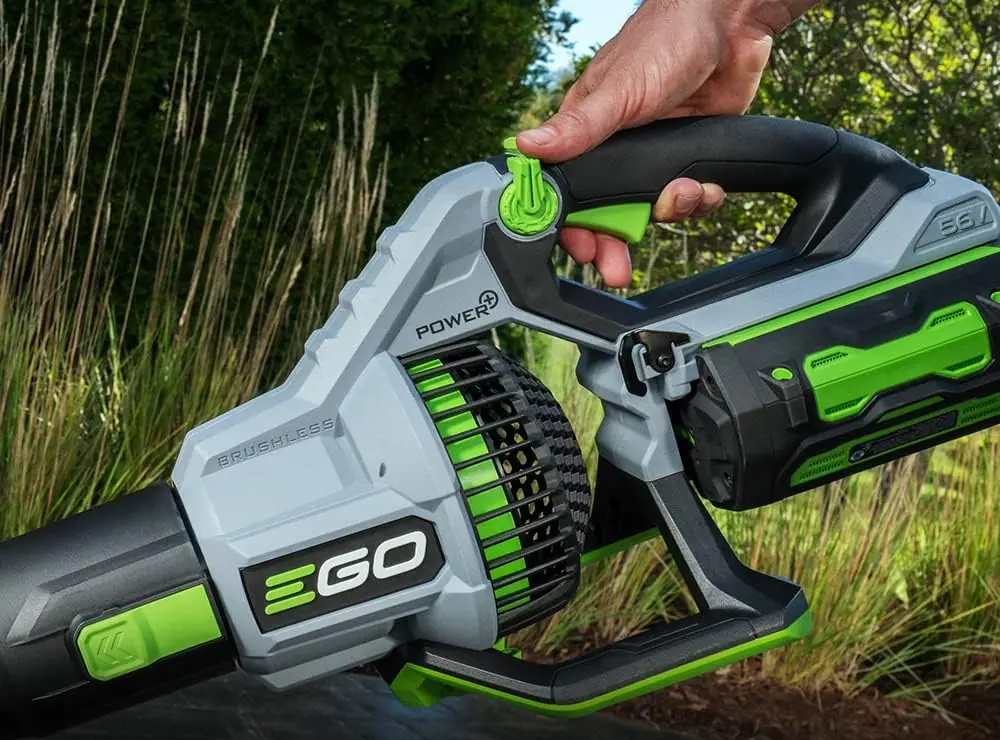
The EGO has a variable trigger, a lock-on dial on the left of the handle and a boost button you hold, and boost falls back to the dial setting when you let go. On a wet strip it was my thumb that tired first.
The DeWalt has a variable trigger, a speed lock button and a mode button that steps through ECO, Normal and Turbo, so Turbo is a set mode and no thumb stays down. Its speed lock is not a lock-off, so the trigger can still be pulled by accident. It starts in ECO every time, and at the shed door I kept forgetting that, so the first squeeze came out weak until I stepped up a mode.
Winner: a split, with the EGO for the lighter carry and the DeWalt for a buyer who prefers fixed modes to a dial.
Noise and Hearing Protection
At the operator’s ear the two blowers are close: about 76 dB on the EGO’s high setting and about 80 dB on boost, against about 75 dB on ECO, 77 dB on Normal and 79 dB on Turbo for the DeWalt. EGO publishes no noise rating. According to DeWalt, the blower runs at 63 dB for quiet operation, with no distance or mode named, and makes up to 78 percent less noise than a gas blower for a bystander 50 ft away.
Distance changes the number a lot. In a field test of two leaf blowers and a hose vacuum running together, the combined sound reached about 102 dB(A) at the center of the group and about 57 dB(A) at 800 ft (4).
In a study at North Carolina public universities, about 77 percent of groundskeepers’ shift averages by the NIOSH method were above 85 dBA (5). I press foam plugs in until they seal and pull muffs over them before the first squeeze. A Cochrane review notes that a poor fit may limit protection for about 40 percent of earplug users (6).
Protect Eyes and Ears
Wear ANSI Z87.1 eye protection and hearing protection every time, a dust mask on dusty ground, long pants and sturdy shoes. According to EGO, keep bystanders 50 ft away, and keep windows out of the debris path. Take the battery out before you change a nozzle or clear the intake, and on the DeWalt wait about 10 seconds for the fan to stop before you remove the tube.
Winner: none, because both blowers need hearing protection from the first squeeze.
Weather and Warranty
EGO rates its blower IPX4, which covers splashing water, and gives 5 to 104 F as its working range. DeWalt’s manual says not to use the blower under wet conditions or expose it to rain.
According to EGO, the tool carries a 5-year warranty and the battery and charger 3 years. DeWalt lists a 3-year limited warranty, 1 year of free service and a 90-day satisfaction guarantee.
Winner: EGO, on weather and on warranty.
Which Yard Needs Which Blower
I choose by the hardest job the blower has to win, and on my land that is wet plum leaves on concrete and gravel in November, not dry leaves in October. Platform and weather decide the rest.
| Job | Better fit | Why |
|---|---|---|
| You own no cordless battery platform | EGO LB7654 kit | One box works the day it arrives, with more push on boost |
| Wet leaf mat on concrete or gravel | EGO LB7654 | Boost pushes harder than the DeWalt’s Turbo, and the DeWalt’s manual rules out wet use |
| Dry lawn, driveway, deck or shop floor | Either | About 16 N and 14 N one step below the top is enough for dry debris |
| Pruning sawdust and twigs under the tree rows | Either | A low setting is enough: the EGO’s locked dial or the DeWalt’s ECO |
| FLEXVOLT packs already in the shed | DeWalt DCBL777B | The bare tool is the only cost |
On the dry concrete pad in front of the machinery shed, the DeWalt on Normal moved chaff and dried mud, and I did not miss the EGO’s boost there. Under the plum rows in late winter I drop either blower to a low setting for pruning sawdust, so the twigs travel to the alley where I mow them and not into the next row.
Choose the EGO LB7654 If
Choose the EGO LB7654 if you are starting from nothing and want a blower that works the day it arrives.
- You own no cordless battery platform, or you already own EGO 56V packs.
- The leaves are wet or packed, and you want boost for the stubborn edge.
- You carry the blower for a full pass, and three-quarters of a pound counts.
Skip it if your work is dry hard ground and your shed already holds FLEXVOLT packs, or if one pack, at about 22 minutes on high and about 13 on boost, ends before your job does. On a damp November morning this is the blower I take out first.
Choose the DeWalt DCBL777 If
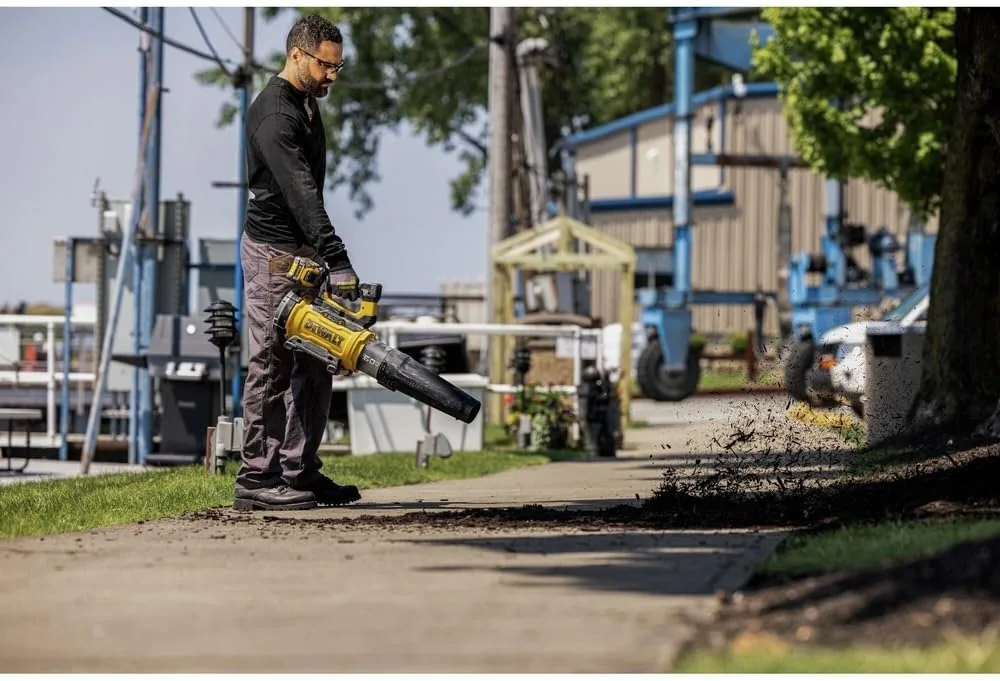
Choose the DeWalt DCBL777 if you already run FLEXVOLT packs and sweep dry, hard ground.
- You own FLEXVOLT 20V/60V packs, so the bare tool is the only thing you pay for.
- Your work is dry hard surfaces: driveways, decks, shop floors and the yard.
- You want fixed ECO, Normal and Turbo modes and a strap in the box.
Skip it if you own no FLEXVOLT packs and want the most push for the carry, or if wet leaf mats are your hardest job.
My Pick Between the Two
I pick the EGO LB7654 for most buyers. It works out of the box, pushes harder on boost, carries lighter and takes a splash of rain. The DeWalt DCBL777 is the pick for one buyer, the one who already owns FLEXVOLT packs, buys the bare tool and sweeps dry, hard ground, and for other sizes and budgets my leaf blower guides cover the rest of the range. In the EGO LB7654 vs DeWalt DCBL777 choice, I take the EGO kit unless my shed already holds FLEXVOLT packs and the ground stays dry.
Frequently Asked Questions
What are the main differences between the DeWalt blower and the Ego blower?
The main differences between the DeWalt DCBL777 and the EGO LB7654 are push, weight and battery platform, since airflow is level at 765 against 760 CFM. The EGO pushes about 25 N on boost against about 19 N and carries about three-quarters of a pound lighter, while the DeWalt runs on FLEXVOLT packs.
Is the 60v DeWalt blower worth it?
The 60V DeWalt blower is worth it when your shed already holds FLEXVOLT packs and you sweep dry, hard ground, because the bare tool is then your only cost. A buyer starting from nothing gets more push and a lighter carry from the EGO kit, with a pack and charger already in the box.
Does the DeWalt 60V blower work with a 20V battery?
The DeWalt 60V blower works with DeWalt’s 60V MAX and FLEXVOLT 20V/60V packs, and the kit comes with one FLEXVOLT pack. That pack reads 12.0 Ah on a 20V tool and 4.0 Ah on a 60V tool like this blower, so read the label when you shop for a second.
Is it better to have more mph or cfm in a leaf blower?
More CFM lifts and rolls a pile, and more mph peels debris off pavement, so the useful number is the push in newtons. These two blowers share about 760 CFM, yet the EGO’s 195 mph against 160 mph goes with about 25 N against about 19 N at the top.
What is the strongest ego blower?
EGO sells a stronger blower than the LB7654, the 880 CFM LB8803-2, and the LB7654 is the strong 765 CFM model in this pair, with about 25 N of push on boost. Next to the DeWalt kit it leads on push, about 25 N against about 19 N, and carries lighter.
References
- Gauthier R, Luscombe A, Bond T, et al. How do Depth of Discharge, C-rate and Calendar Age Affect Capacity Retention, Impedance Growth, the Electrodes, and the Electrolyte in Li-Ion Cells?. J. Electrochem. Soc. 2022;169(2):020518.
- Asiri M, Kedhim M, Jain V, et al. Impact of temperature and state-of-charge on long-term storage degradation in lithium-ion batteries: an integrated P2D-based degradation analysis. RSC Adv. 2025;15(28):22576-22586.
- Chen N, Yang S, Oh J. Evaluation of hand-arm vibration (HAV) exposure among groundskeepers in the southeastern United States. Annals of Work Exposures and Health. 2025;69(1):81-95.
- Walker E, Banks JL. Characteristics of Lawn and Garden Equipment Sound: A Community Pilot Study. J Environ Toxicol Stud. 2017;1(1).
- Balanay JAG, Kearney GD, Mannarino AJ. Assessment of Occupational Noise Exposure among Groundskeepers in North Carolina Public Universities. Environ Health Insights. 2016;10:EHI.S39682.
- Morata TC, Gong W, Tikka C, Samelli AG, Verbeek JH. Hearing protection field attenuation estimation systems and associated training for reducing workers’ exposure to noise. Cochrane Database of Systematic Reviews. 2024;5(5):CD015066.
Safety Note: Leaf blowers throw debris and can damage your hearing. Wear eye and ear protection, read the manufacturer’s manual, and check your local rules on noise and operating hours.