
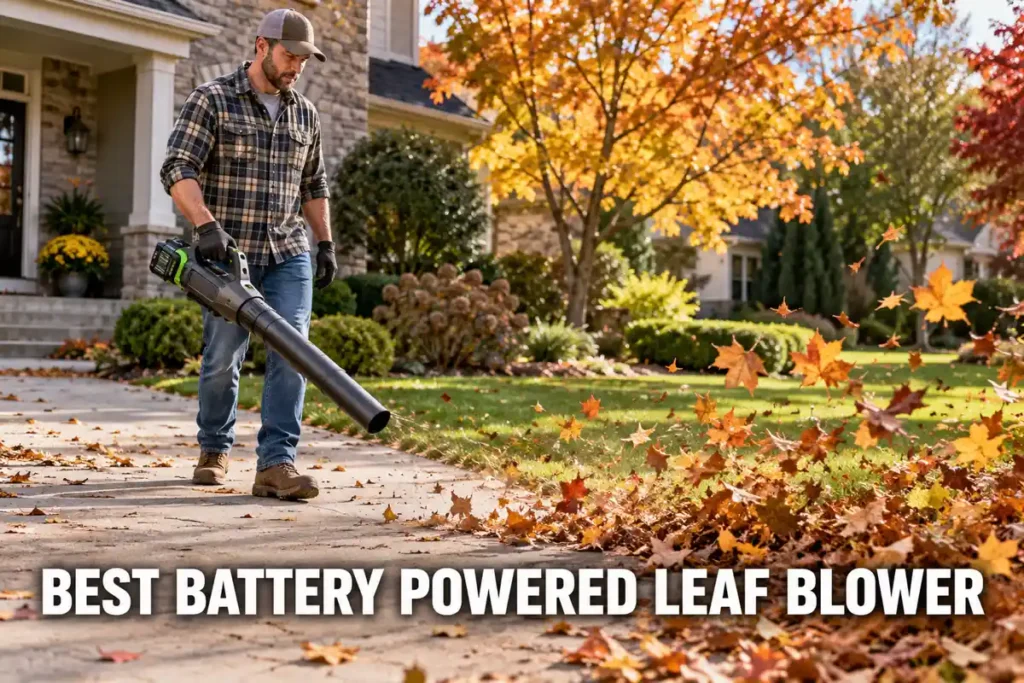
The best battery powered leaf blower is the one whose pack outlasts your longest job, so I read the battery label before the airflow rating. After a leaf season of swapping packs under my plum and apricot rows, I treat a pack the way I treated a sprayer tank on a big farm: how much it holds, how fast it refills and how many I need for the day.
Affiliate Disclosure: Garden Power Scout is a proud participant in the Amazon Services LLC Associates Program. As an Amazon Associate, we earn from qualifying purchases, at no extra cost to you.
Below are the nine blowers I recommend, from a kit on a small 20V pack to a two-pack 56V kit, and my top pick is the EGO POWER+ LB6504 650 CFM Cordless Leaf Blower Kit. Each block names the pack in the box, its watt-hours and what to add.
Best Battery Powered Leaf Blower Reviews 2026 With 9 Models Ranked by Pack and Platform
These nine cover the packs a yard job calls for, from a small 20V pack to two 56V packs and three bare tools that wait for the batteries you own. Each block names the pack in the box and says what a second one adds.
1. EGO POWER+ LB6504 650 CFM Cordless Leaf Blower Kit Best Overall
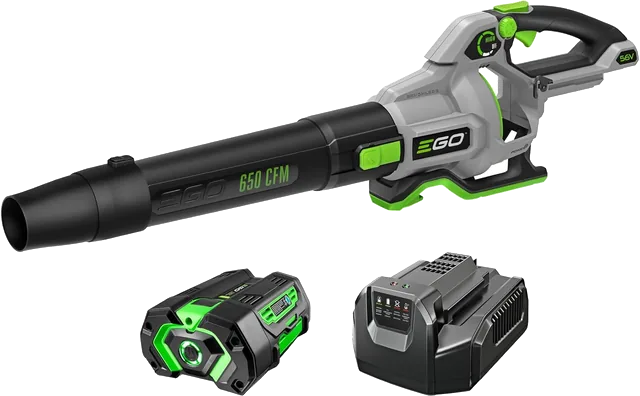
I count a leaf season in battery packs rather than acres, and the LB6504 gives me a full-size pack to count with: one 56V 5.0 Ah battery, 280 Wh. According to EGO it runs about 30 minutes on high, enough for the lawn and yard around the house in one go. It is my best overall pick for a quarter to half an acre, and the slow charger is the price of that big pack.
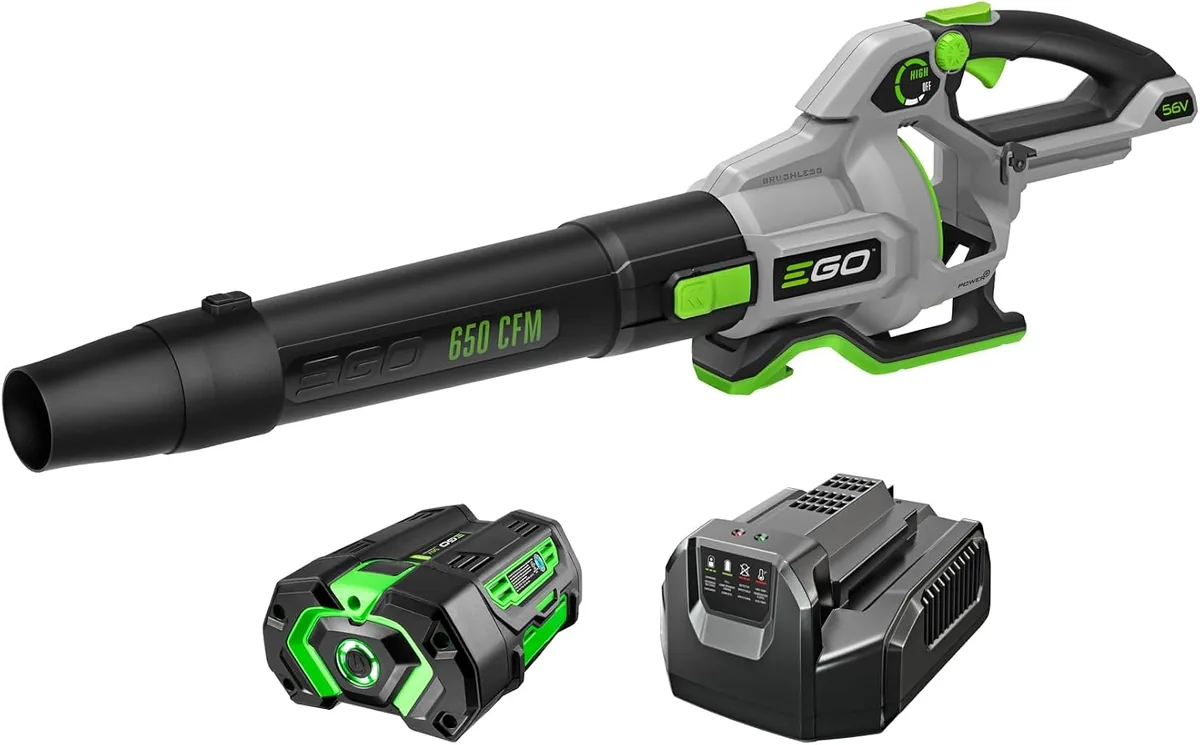
EGO POWER+ LB6504 650 CFM Cordless Leaf Blower Kit Specs
Key Features:
- 280 Wh pack: The 5.0 Ah battery carries enough energy for about 30 minutes on high by EGO’s rating, which covers a lawn and a yard on one charge.
- Long low setting: EGO rates the same pack at about 200 minutes on low, so light sweeping near the house takes a small slice of a charge.
- Five-light gauge: Each lit LED stands for about 20 percent of the pack, so you can tell whether the next row fits before you start it.
- Temperature guard: Charging waits until the pack sits between 41 and 104 F, and the pack shuts down above 158 F, which protects the cells in a hot shed or a cold garage.
- Lock-on dial: Set any speed with one hand and let the trigger finger rest, which suits the long low setting best.
- Boost button: Maximum speed while you hold it, back to the dial setting when you let go. It drains the pack in about 15 minutes of use.
- 56V ARC platform: According to EGO, every EGO 56V ARC battery fits, so a spare or a larger pack comes from the same family as other EGO tools.
Wet leaves on the concrete pad in front of the machinery shed are where the LB6504 lost. With the tapered nozzle the stream moves at 180 mph, yet the mat only slid across the concrete, because the blower lacked the volume to get under its edge. EGO rates the push at 21 N, newtons being the force the jet puts on a surface, and its own job list is hard surfaces such as driveways, walkways and decks. Dry leaves and light debris are what this blower finishes, so I leave soaked drifts to a rake.
I plan a leaf day by the pack. An hour of high takes about two packs, and one charger cannot keep up with one blower: a refill takes about 100 minutes on the box charger, so when a second pack runs out the first is still charging. A larger pack adds minutes and not push, since a 7.5 Ah pack gives about 21 N on boost against about 20 N for the kit pack.
In August the machinery shed floor collects dust and chaff, and that is a job for the long low setting. I turn the dial down, lock it, open both doors and put on glasses and a dust mask. The pack that gives about 30 minutes on high is rated at about 200 on low, so the sweep takes a small part of a charge. The limit is dried mud in the corners, which low air will not lift, so a stiff broom goes first.

Seat the empty pack on the charger as soon as it comes off the blower, before you coil the cord or put anything away. That clock only runs once the pack is on the charger.

WHY I CHOSE THIS
Mirko Lekić, Agricultural Engineer & Farm Owner
A 280 Wh pack in the box is why the LB6504 is my best overall pick. I prefer a blower whose own pack is sized for the yard over one that needs a spare to get through the front lawn, and this pack is sized for a quarter acre at a time. The 5-year tool and 3-year battery warranty cover the long view.
Take the pack out before you touch the intake. If the air thins, a twig may be lodged in the inlet, so I pull the battery, clear it by hand and put on eye and ear protection before I reseat it, and a pack never comes off while I stand on a ladder.
The pack is the part I look after. EGO’s manual says charging waits until the pack is between 41 and 104 F, so I charge it on the hall shelf and never on the cold shed floor. A pack left on the shelf for a month rests near 30 percent charge by design, so the one I put away after leaf season gets a full charge before the first job in spring. The kit sits in the upper mid-range, and over five seasons I treat the pack as the part that wears out first, while the plain charger is what annoyed me most.
Buy it if you clear a quarter to half an acre in sessions of about 30 minutes and charge the pack overnight. Skip it if you need the pack back on the blower within the hour, or if your yard means back-to-back sessions on one pack. Soaked leaf mats and acre-size cleanups are also beyond it.
FINAL VERDICT
The LB6504 is the kit I recommend when the pack decides the purchase: a full 280 Wh battery, a long low setting and a platform that takes every EGO pack. Plan around the slow charger and one charge covers a quarter-acre yard.
It is the one-big-pack EGO I build my leaf days around.
2. EGO POWER+ LB8803-2 880 CFM Two-Battery Leaf Blower Kit Best Premium
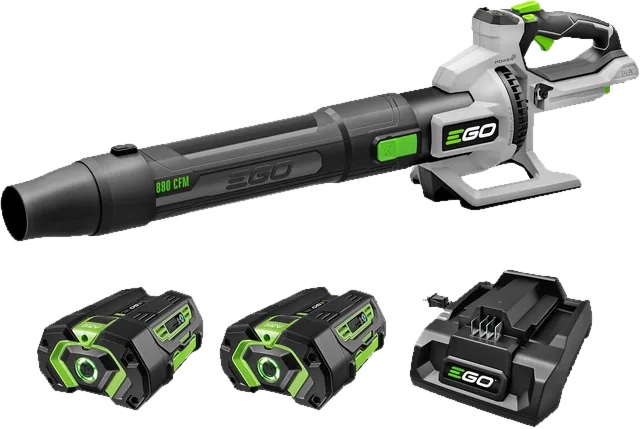
Two batteries in the box change how I plan a job with the LB8803-2: 448 Wh across two 4.0 Ah packs, used one after the other, with a screen on the housing that shows what is left. According to EGO the blower moves 880 CFM on turbo, though a pack holds only about 8 minutes of it. It is my premium pick for half an acre of mixed work, and a poor buy for a porch and a short drive.
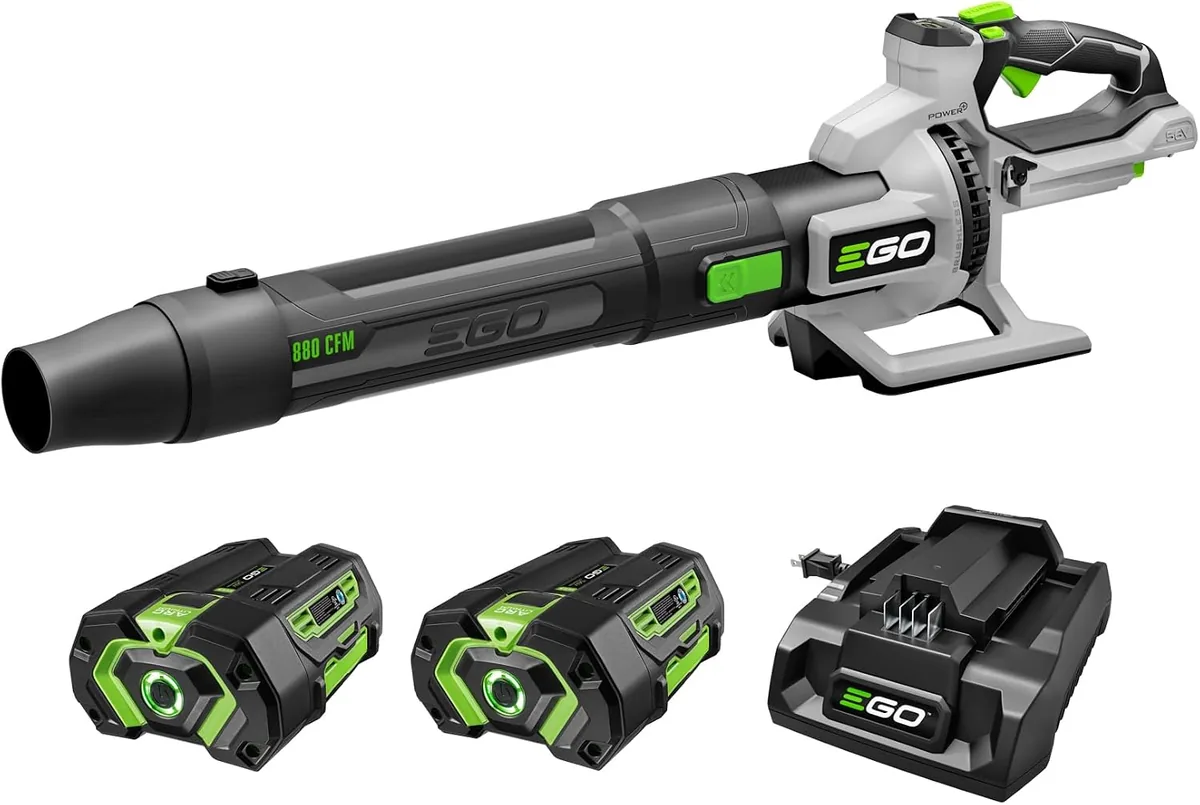
EGO POWER+ LB8803-2 880 CFM Two-Battery Leaf Blower Kit Specs
Key Features:
- Two 4.0 Ah packs: Each holds 224 Wh and they work one after the other, so the second pack extends the job without raising the peak.
- Bigger packs, more push: EGO rates the blower at 30 N, the kit packs give about 20 N on turbo, and a 12.0 Ah pack gets close to the rating.
- Live screen: It shows the fuel gauge, the battery icon and the speed bars, and switches off a minute after you release the trigger.
- 320 W charger: According to EGO, it refills a 4.0 Ah pack in about 55 minutes, so one pack can charge while the other works.
- 270 to 700 CFM trigger range: Middle bars stretch a pack well past the 12 minutes EGO rates on high, and 880 CFM is kept for turbo.
- Turbo button: Hold it for a burst of top airflow. It drops back to the previous speed when released, and each pack holds about 8 minutes of it.
- Open 56V platform: Any EGO 56V ARC pack fits, though a pack under 4.0 Ah limits the screen to two speed bars.
My work pad in front of the machinery shed is where the LB8803-2 earns its second pack. With the spread nozzle on and the trigger around the middle bars, the dry leaves leave the concrete in a wide, even sweep. The 880 CFM label applies only on turbo, and the trigger range runs from 270 to 700 CFM, so the middle bars do most of the pad. At those bars a pack lasts longer than the 12 minutes EGO gives for high, which is why I keep turbo for the patch by the door that needs it.
The pack, not the blower, sets how hard this one pushes. With the kit packs the turbo pushes with about 20 N, newtons being the force the jet puts on a surface, against EGO’s 30 N rating. A 7.5 Ah pack lifts it to about 24 N and a 12.0 Ah pack to about 29 N, so a larger pack buys push as well as minutes, and the two 4.0 Ah packs in the kit are the starting point.
After a storm the yard in front of the sheds is covered in seed pods and small twigs, and the crushed stone holds them in place. I run the tapered nozzle low to the ground with the trigger at a low bar, because at 200 mph the nozzle throws stones as readily as pods. I move the car, keep people and windows out of the debris path, and wear glasses. The limit is the grass edge, where pods have rooted into the sod and need a rake.
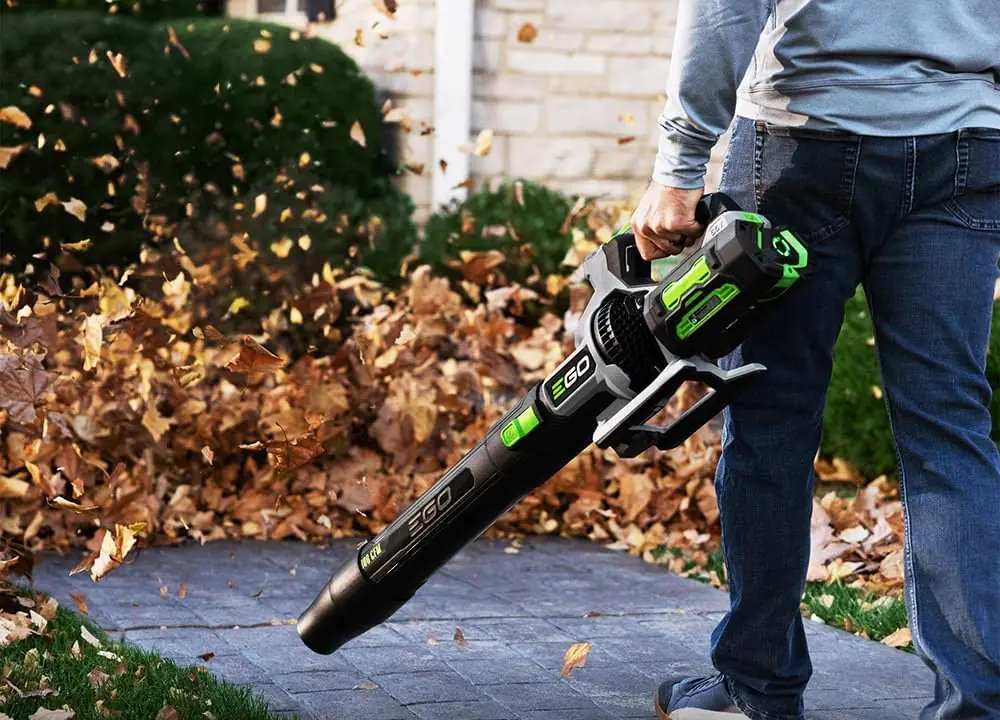
Mark the two packs with a strip of tape, 1 and 2, and alternate them from the first job. Each pack then takes half of the charge cycles, and neither one wears out a season ahead of the other.
WHY I CHOSE THIS
Mirko Lekić, Agricultural Engineer & Farm Owner
Two packs and a screen turn a long job into a plan, and that is why the LB8803-2 is my premium pick. With my old gas handheld every refill meant stopping the engine, letting it cool and mixing fuel, while here the pause is a pack swap and the screen tells me when it is coming. The premium pays for the second pack up front, and larger EGO packs can lift the push later.
Let a hot pack cool before it goes on the charger. A pack that has just run turbo is warm, and since it shuts down above 158 F and will not charge outside 41 to 104 F, I set it in the shade for a few minutes and then charge it indoors.
Each pack needs about 55 minutes on the box charger, more than four times as long as it lasts on high, so I put a pack on charge the moment it comes out. EGO rates storage at 50 to 80 F, and a pack left for a month rests near 30 percent, so I top both up before the first job after a break. Over five seasons the cost is two packs wearing in step, and EGO’s 3-year battery warranty is shorter than the 5 on the tool. What annoys me is that turbo lasts only about 8 minutes a pack, which is short for a premium kit.
Pick it if your yard needs more than one battery’s worth of work and you want to pace it by a screen: half an acre of lawn, yard and drive in one session. It also suits anyone who owns EGO 56V tools, since the packs carry over. Skip it if your jobs are a porch and a short drive, or if you expect sustained turbo or the full 30 N from the packs in the box.
FINAL VERDICT
The LB8803-2 is the premium kit for yards that outlast one battery. The extra money buys a second pack, a screen and room to grow into larger EGO packs.
It is the two-pack EGO I choose for jobs that outlast a battery.
3. Greenworks 40V 450 CFM Cordless Leaf Blower Kit Best Value
The Greenworks 40V clears a lawn, a drive and a patio of twigs and dry leaves with up to 450 CFM of air and up to 120 mph of air speed, and the 4.0 Ah battery and the charger already sit in the carton. A complete kit at a mid-range tier is why I call it the best battery leaf blower for the money, as long as the jobs are dry and light. I recommend it for a yard of up to about a quarter acre and not for a yard of soaked leaf mats.
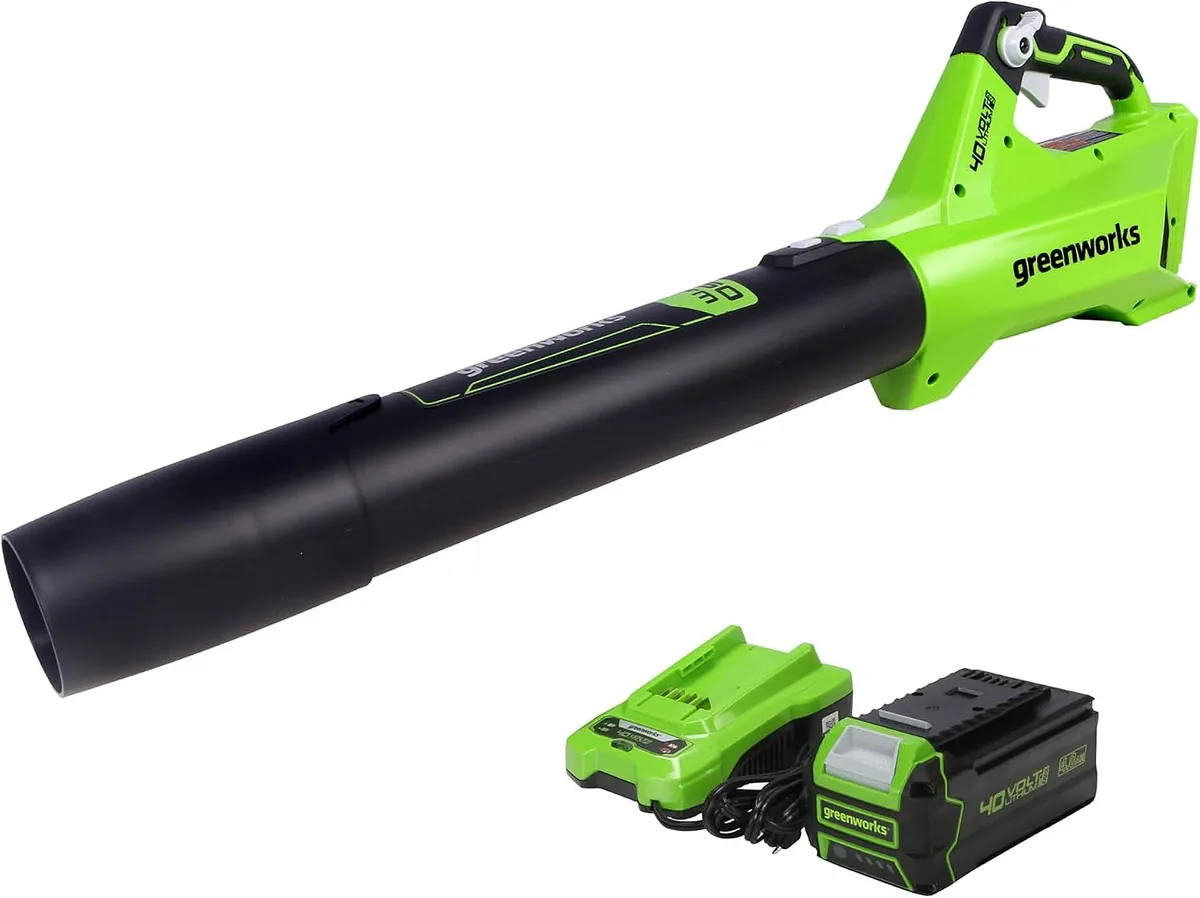
Greenworks 40V 450 CFM Cordless Leaf Blower Kit Specs
Key Features:
- Complete kit: The 4.0 Ah battery and the charger are in the box, so the first job needs no other purchase.
- Axial fan: The air runs straight down the tube, which keeps the stream steady and the housing compact.
- 450 CFM of volume: Volume is what rolls leaves, twigs and seed pods ahead of the nozzle, so a dry lawn clears in short passes.
- 120 mph of speed: Speed peels light dry debris off a hard surface, though it adds little against soaked leaves that stick to the ground.
- 40V platform: According to Greenworks, the pack fits more than 75 compatible tools, so a spare pack can also run a mower or a trimmer.
- 4.0 Ah pack in the carton: The first pack arrives with the blower, and a second pack of the same type stretches a long session.
- Household scale: A 450 CFM, 120 mph rating suits a lawn, a drive and a patio, which is the work this kit is priced for.
The house lawn before mowing is where this blower makes sense. Twigs and seed pods lie across the quarter acre after a windy week, and the 450 CFM stream moves them in short dry passes to the lawn edge, where I rake them up. Volume carries a dry pile, but it will not get under a soaked leaf mat, so I keep it to dry leaves and light debris.
The pack decides how I plan a job with this kit. A single 4.0 Ah battery is one short session, so I count a second pack as part of the real price for a long Saturday. Both packs come from the same 40V line, which means the spare earns its keep on other Greenworks tools too.
In late winter the pruning leaves sawdust and fine twigs under the plum rows. I hold the trigger low, keep the tube a few inches off the ground, and the blower moves the dry sawdust out to the alley, where the mower shreds it. The limit is damp sawdust, which clumps and needs a rake. A seam of packed dust on the concrete pad is the same story: 120 mph of speed lifts the loose top layer, and a stiff broom does the rest.
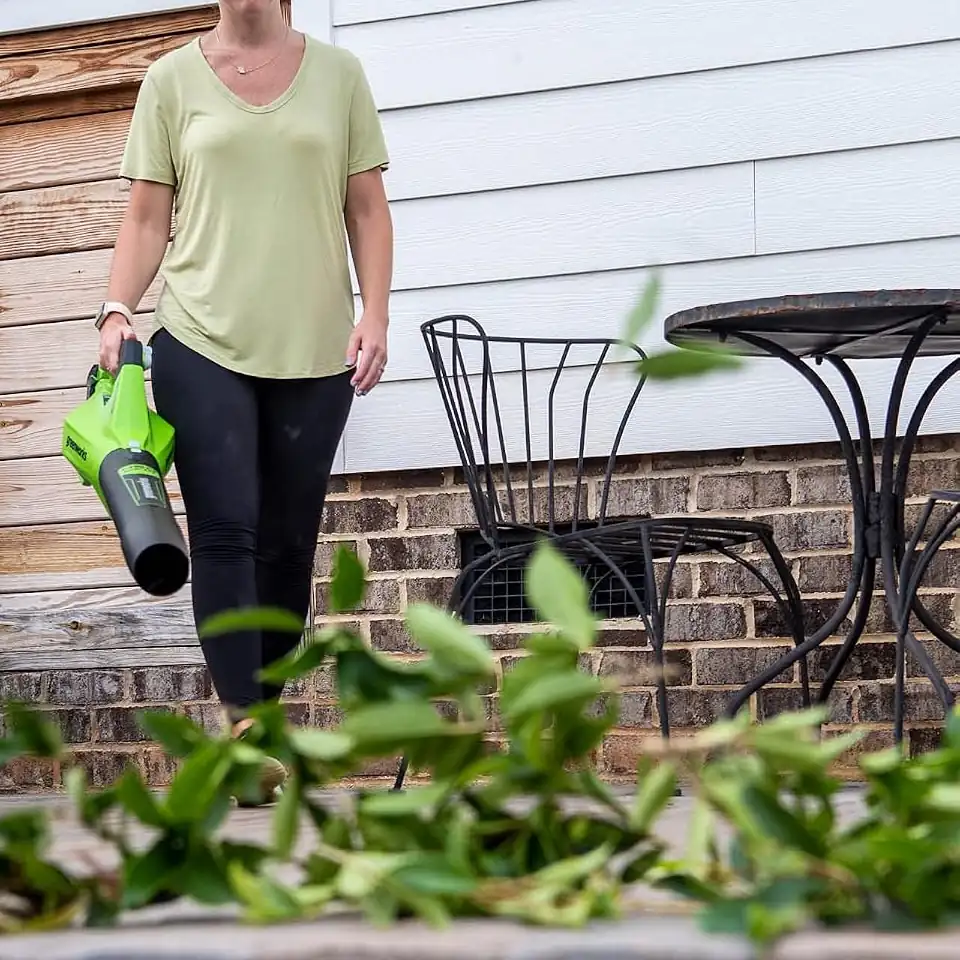
Loosen packed debris with a rake before you blow, and work around the edges of a pile rather than into its center. The stream then rolls the pile ahead of you instead of scattering it.
WHY I CHOSE THIS
Mirko Lekić, Agricultural Engineer & Farm Owner
A complete kit at a mid-range tier is why the Greenworks is my value pick. The battery and charger are in the box, so the first job needs nothing else, and the 40V platform lets a spare pack serve other Greenworks tools, which spreads its cost. I do not call it powerful. I call it good value for dry work.
Take the battery out before you clear the intake or change the tube. Wear glasses and ear protection from the first squeeze, add a dust mask on dry ground, and keep people and windows out of the debris path.
Living with this kit is mostly about the pack. I put it on the charger as soon as it comes off the blower and keep it indoors between jobs, and there is no fuel mix, plug or filter to buy. Over the seasons the pack is the part that wears out first, and a spare shares that wear. What annoyed me is how soon I wanted a second pack: one lawn and one drive sent me back to the charger.
Choose it if your yard is a lawn, a drive and a patio of up to about a quarter acre, if you want a complete 40V kit at a mid-range tier, and if you own or plan to buy other Greenworks 40V tools. Skip it if you face wet leaf mats or long sessions on one pack, and skip it if you want a published run time or force before you buy.
FINAL VERDICT
The Greenworks 40V is the kit I recommend when the budget is tight and the jobs are short and dry: complete in the box and part of a long line of 40V tools. Buy a second pack with it and let the first rest on the charger between jobs.
It is the complete 40V kit I keep for short dry jobs.
4. Greenworks 80V BL80L414 770 CFM Cordless Leaf Blower Kit Best With Battery and Charger
The box settles the battery question before the first leaf moves: an 80V 4.0 Ah pack that Greenworks lists at 288 Wh, and a 4 A charger that refills it in about 60 minutes. Four years of warranty cover the tool and the pack. I recommend the BL80L414 to a yard that already runs on 80V, and to anyone who wants the whole cordless system in one carton.
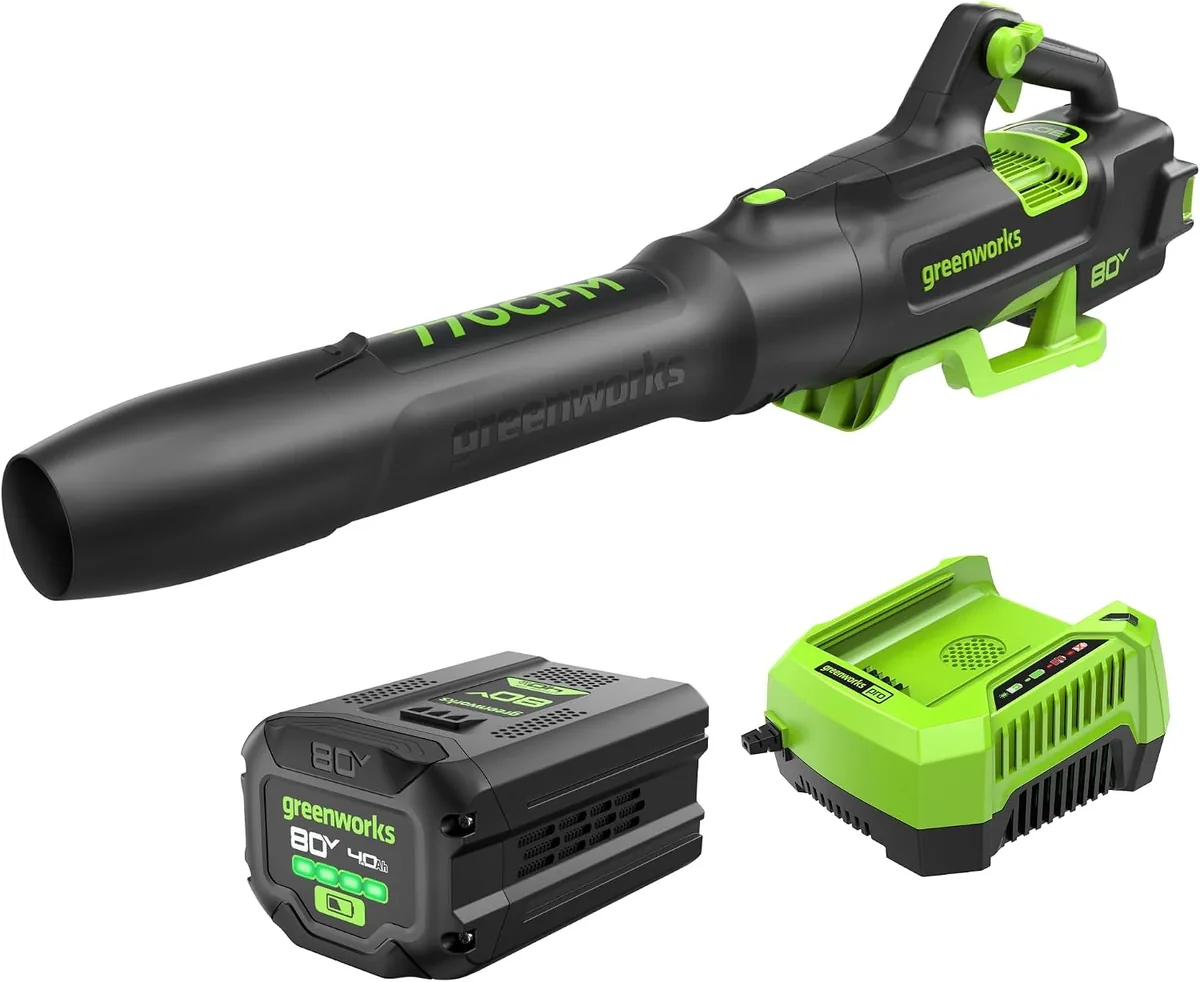
Greenworks 80V BL80L414 770 CFM Cordless Leaf Blower Kit Specs
Key Features:
- Complete charging set: A 4 A charger ships with the pack, so charging starts on day one.
- Quick refill: The included charger refills an empty pack in about 60 minutes, between the morning job and the afternoon one.
- Shared pack: One 80V battery type serves more than 75 Greenworks tools, which spreads the cost of a spare.
- Four-year cover on the pack: Greenworks covers the battery as well as the tool, and the battery wears first.
- Cruise control and turbo: Cruise holds a set speed, and turbo is a burst that drops back to it when released.
Greenworks rates 80 minutes at a 50 percent load and names no mode or nozzle for 770 CFM and 180 mph, so I read the box figures as a ceiling. On the crushed-stone drive and its grass edge I work at a steady middle speed with the tube low, and one pack covered the whole job. Full trigger on the matted corner by the hedgerow took the pack down faster.
A kit with one pack stops when that pack does. A second 80V pack is a real extra cost, yet it also runs the other tools on the platform. While my pack sat on the charger I raked the mulched tree bases by hand, work a blower would spoil by stripping the mulch.
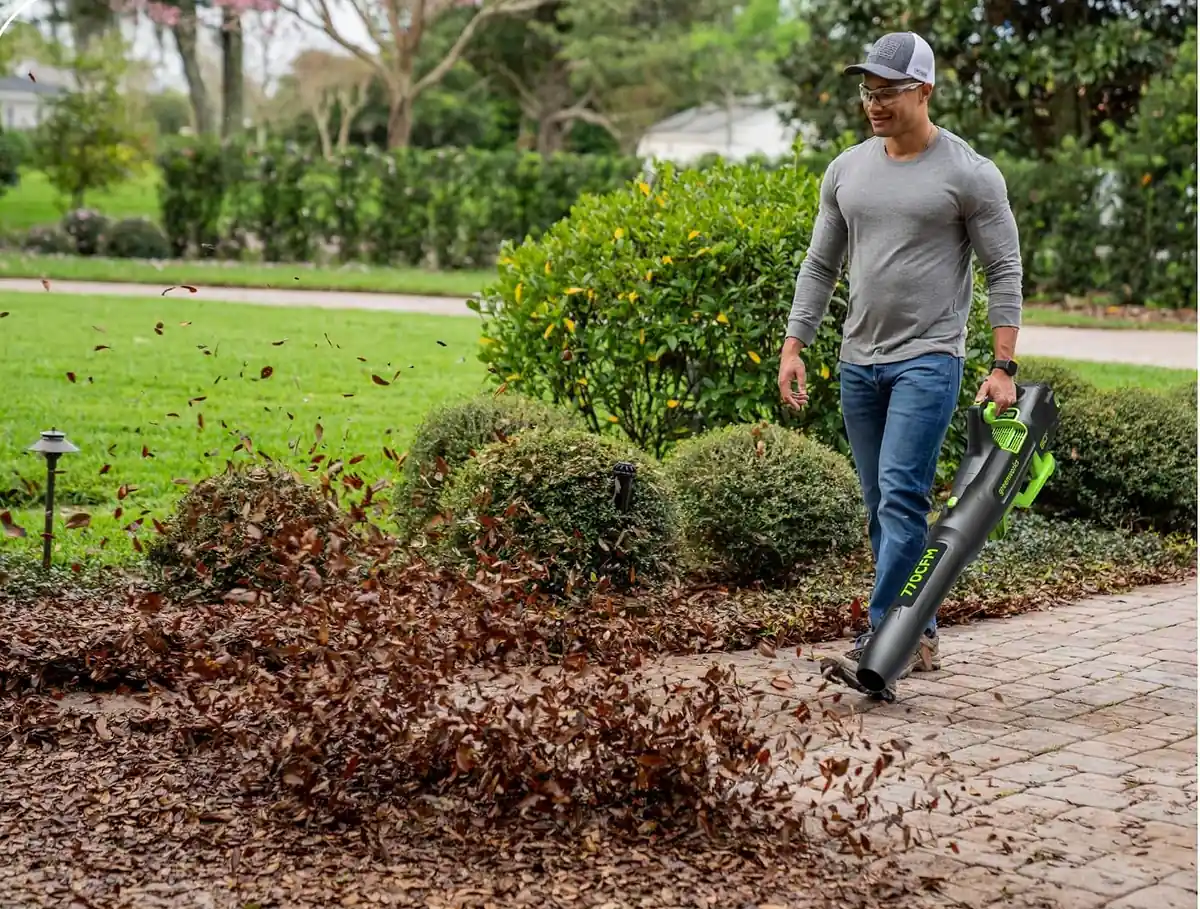
Store the pack indoors over winter, off the charger and out of the blower. Greenworks lists storage from 32 F up, which rules out an unheated shed in a hard frost.
WHY I CHOSE THIS
Mirko Lekić, Agricultural Engineer & Farm Owner
I give this kit the label of best cordless leaf blower with battery and charger because the carton holds the pack, the charger and a warranty that covers both. The pack then runs the rest of the 80V line, so the next tool needs no battery at all.
Charge the pack only between 39 and 104 F, and let a cold or hot pack reach room temperature first. Take the battery out before you touch the intake or change a nozzle, and keep the terminals and charger dry.
Over several seasons the battery is the part that costs money: the brushless motor has no brushes to replace, and there is no fuel mix, plug or filter to buy. I wear ear protection, glasses and a dust mask every time and check the intake after dusty work. The 80V pack is large, and by the end of a long session my forearm gave out before the pack did.
It suits you if your shed already holds 80V Greenworks tools, or you plan to add them, and you want the pack and charger decided for you. It suits half-acre jobs in short sessions. Skip it if you want a compact tool for the arm, need printed minutes for high and turbo, or work below freezing.
FINAL VERDICT
The BL80L414 earns its place by what the carton holds: the pack, the charger and a warranty that covers both. Buy it for an 80V yard, and skip it if a compact tool or a published high-speed run time matters more.
It is the 80V kit that arrives ready to charge.
5. WORX WG543 20V Cordless Leaf Blower Kit Best Lightweight
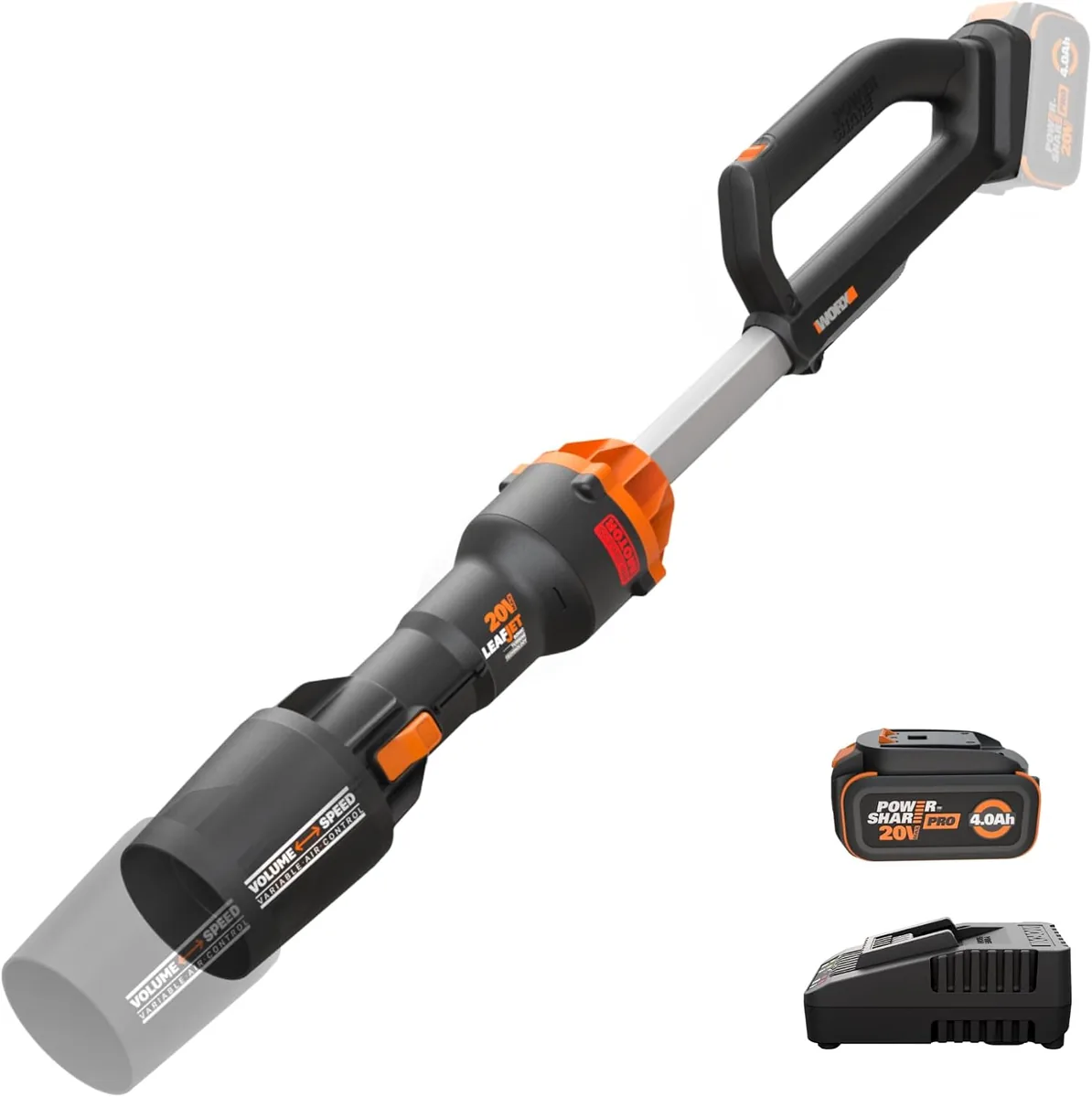
The pack is the whole story here: 20V and 4.0 Ah comes to about 80 Wh, under a third of what a 56V 5.0 Ah pack stores, and that small tank is why the complete kit weighs about 3.8 lb. I recommend the WG543 for patios, decks, walkways and the light end of leaf season, with one rule: plan every job around a second pack.
WORX WG543 20V Cordless Leaf Blower Kit Specs
Key Features:
- Small PowerShare pack: The 20V, 4.0 Ah battery holds about 80 Wh, which keeps the whole kit light enough for one hand.
- Shared platform: The pack seats in other WORX 20V tools, so a spare bought for the blower serves them too.
- Two modes from one nozzle: Forward gives 410 CFM of volume, back gives 130 mph of speed, and no second nozzle is needed.
- Two speed settings: Low runs 305 CFM and 95 mph for dust and light debris, and it draws less from a small pack than high.
- Brushless motor: With no carbon brushes, less of the pack’s energy is lost to friction and heat.
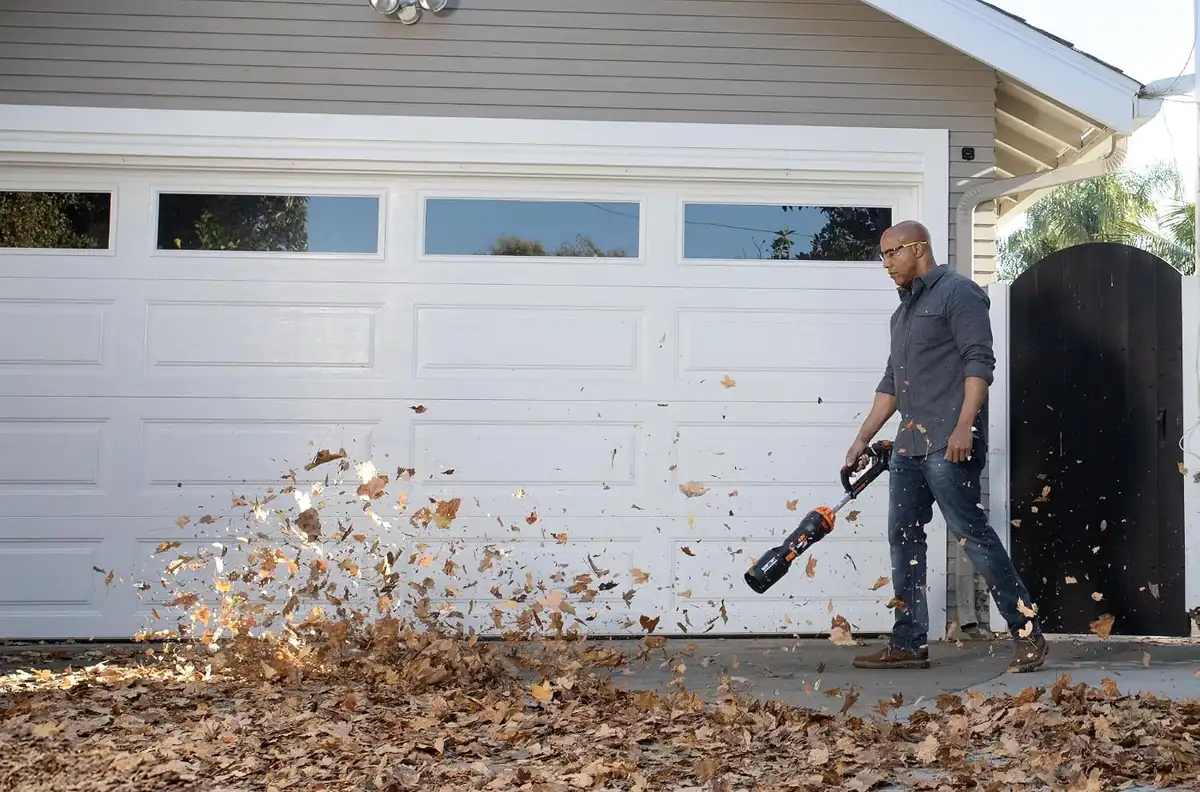
I hold the tube about 8 inches above the ground and sweep, as WORX advises. On the packed-soil paths of the vegetable plot the low setting moved dust and loose leaf bits without throwing the wood-chip mulch beside them. Leaves soaked into lawn grass are where it stops, and I leave that job to a rake.
WORX prints no run time, and a 4.0 Ah pack holds the least energy of any kit on this page, so I treat it as a one-job battery. The recharge takes about 2 hours, so a spare must be charged before I start, not while I work. A second pack doubles the working time, and that is the plan I buy this blower on.
WORX gives no minutes, so run the first pack down on a job you know, such as one walkway, and write the result on tape on the pack.
WHY I CHOSE THIS
Mirko Lekić, Agricultural Engineer & Farm Owner
A complete kit at about 3.8 lb is rare, and the small 80 Wh pack is what makes it possible. That is why the WG543 is my best lightweight battery leaf blower. The claim I make for it is lightest by a wide margin, and I do not call it powerful. The trade is a small pack and a 2 hour recharge.
Charge the pack between 32 and 104 F with the supplied charger only, and keep its terminals clear of metal. Take the battery out before you clean the tube or check the fan, and wear eye and ear protection, long pants and closed shoes.
Because the kit is so light, I carried it in my left hand while my right pushed the wheelbarrow of pruning twigs along the plum row. A pack this small is emptied often, so it goes through more charge cycles per season than a large one, and I expect to replace it first. WORX’s three-year cover applies if I register within 30 days.
Buy it for patios, decks, walkways and small yards, or if you already own WORX 20V tools whose batteries it can share. Skip it for wet leaf mats, orchard alleys or any job longer than one pack, and if you want minutes printed on the box.
FINAL VERDICT
The WG543 is the kit to buy when weight decides and the jobs are short, with a second pack ready on the charger. For long runs or heavy leaves, the small pack is the wrong tank.
It is the light kit I reach for on short jobs.
6. Milwaukee M18 FUEL 2724-20 450 CFM Handheld Blower (Tool Only) Best Handheld
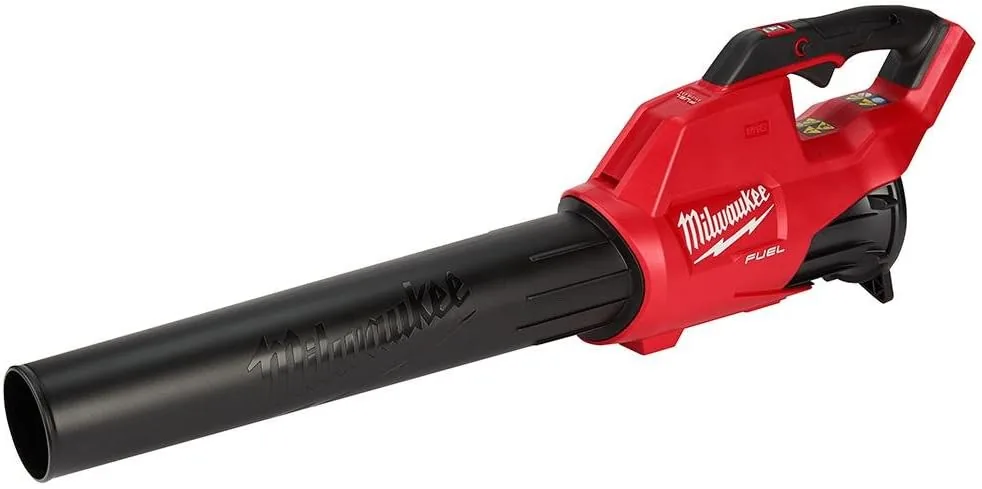
Buy the 2724-20 and you have bought half a blower: the tool ships with no battery and no charger, so the M18 pack on your shelf decides what it can do. According to Milwaukee, the 450 CFM rating goes with its 8.0 Ah High Output pack, which holds about 144 Wh. At 4.9 lb bare, it suits anyone who already owns M18 packs and wants a light tool for house-lot work.
Milwaukee M18 FUEL 2724-20 450 CFM Handheld Blower (Tool Only) Specs
Key Features:
- One platform: It takes any M18 pack, and according to Milwaukee the same packs run well over a hundred other tools.
- Pack-dependent output: Milwaukee ties 450 CFM to the 8.0 Ah High Output pack, so a smaller pack may fall short.
- High and low switch: A button sets high at 450 CFM or low at 295 CFM, and the trigger works within that limit.
- Lock-on button: It holds the trigger open, so a long pass needs no steady squeeze.
- Light tool body: At 4.9 lb bare, the tool is most of the weight in your hand, and an 8.0 Ah pack adds roughly 2 lb.
With a 9.0 Ah pack the push is about 11 N, newtons being the force the jet puts on a surface. That suits dry leaves, dust and chaff. On the machinery shed floor, doors open and dust mask on, the low switch at 295 CFM gathered chaff and dried mud into a pile, while high raised a cloud. A soaked mat on the lawn is a job for a stronger blower or a rake.
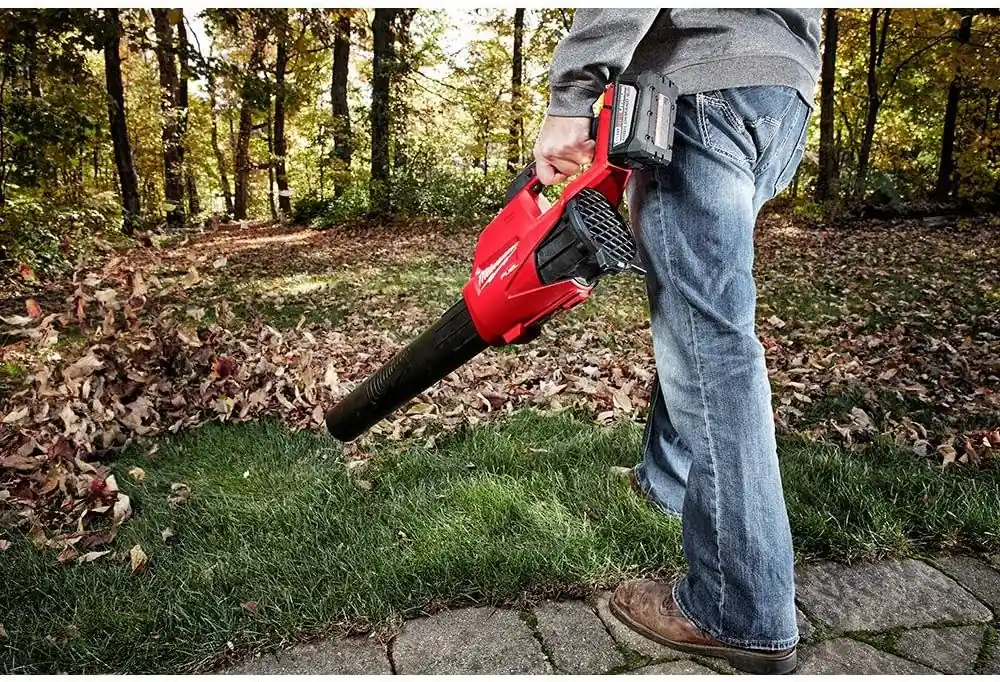
With an 8.0 Ah High Output pack the blower comes to about 7 lb, so the pack decides how it feels. When I swapped to a 5.0 Ah pack the tool felt lighter and the high setting lost some of its edge, which fits Milwaukee tying 450 CFM to the larger pack. In one hand it cleared chaff off the shed workbench while the other steadied a crate.
Use an 8.0 Ah High Output pack for leaf work and keep smaller packs for dust and light chores.
WHY I CHOSE THIS
Mirko Lekić, Agricultural Engineer & Farm Owner
I give the 2724-20 the label best handheld battery leaf blower for a light body that one hand can steer and a pack I may already own. Strength is not the reason, because the push is modest. With M18 batteries already on the bench, it is a low-cost step into cordless blowing.
Debris ricochets, so I wear side-shield eye protection, ear protection and a dust mask and keep people and windows well clear, at least 50 ft per Milwaukee. The pack comes off before I change the tube, and I buy from an authorized seller, which the warranty requires.
Over the seasons the cost sits in the pack, not the tool: a first-time buyer pays for the platform before the first leaf moves. What annoyed me is the bare tube: no nozzle comes with it, so tight corners get the full width of the stream.
Go for it if M18 packs already sit on your shelf and the work is a house lot, a drive, a patio and dry leaves. Skip it if the pack and charger would be new purchases, if the job is a soaked leaf mat or an orchard alley, or if you need a printed run time.
FINAL VERDICT
The 2724-20 is a sound buy for the M18 owner who wants a light blower and already has the packs. For a buyer with no M18 batteries, the platform costs more than the tool, and the push stays modest.
It is the light blower I add to batteries I already own.
7. DEWALT DCBL777B 60V MAX FLEXVOLT Blower (Tool Only) Best DeWalt Battery Blower
Buy the DCBL777B only if a FlexVolt pack already charges on your shelf, because the box holds the blower, two nozzles and a shoulder strap, and no battery or charger. According to DeWalt it moves up to 760 CFM at up to 160 mph and runs up to 20 minutes in ECO on a 12.0 Ah pack. In Normal mode on that pack it runs about 18 minutes.
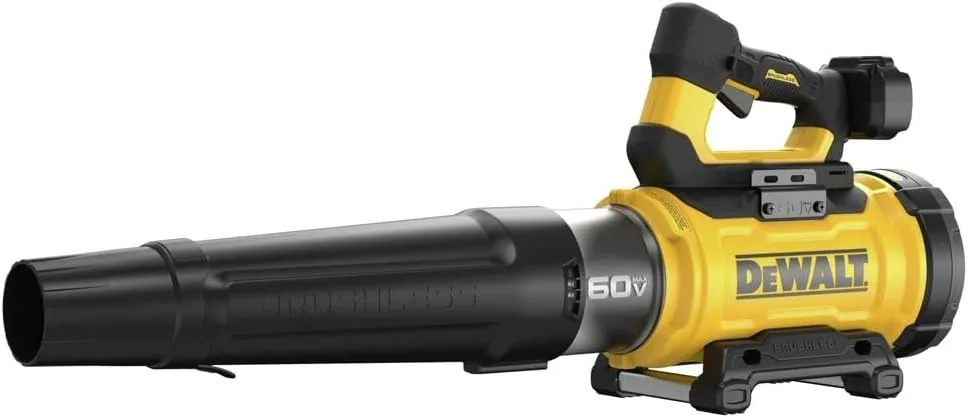
DEWALT DCBL777B 60V MAX FLEXVOLT Blower (Tool Only) Specs
Key Features:
- FlexVolt platform: It takes FlexVolt packs only, and the same packs run DeWalt’s 20V and 60V tools.
- Three speed modes: One button cycles ECO, Normal and Turbo, so you spend the pack where it counts.
- Speed lock: It holds the trigger once pressed fully, which spares your finger on a long pass.
- Foam-lined air intake: It damps the noise, to about 79 dB at the ear on turbo.
- Four-light charge gauge: A blinking white light warns of a low-battery shutdown.
According to DeWalt the DCBL777B tops out at 760 CFM, but the push I plan with is the push on the pack: with a 12.0 Ah pack it is about 14 N on Normal and about 19 N on turbo, where 19 N is roughly 4 lb of air pressing on a surface. Turbo is a different tool from ECO, and it still will not lift a soaked leaf mat. The blower starts in ECO every time, so on the gravel yard I press the speed button to Normal before the first pass, or the first push is the weak one.
DeWalt’s FlexVolt pack is labeled 12.0 Ah on a 20V tool and 4.0 Ah on a 60V tool like this one, with about 240 Wh either way. On that pack turbo runs about 14 minutes against about 18 on Normal, so it costs about a quarter of the run.
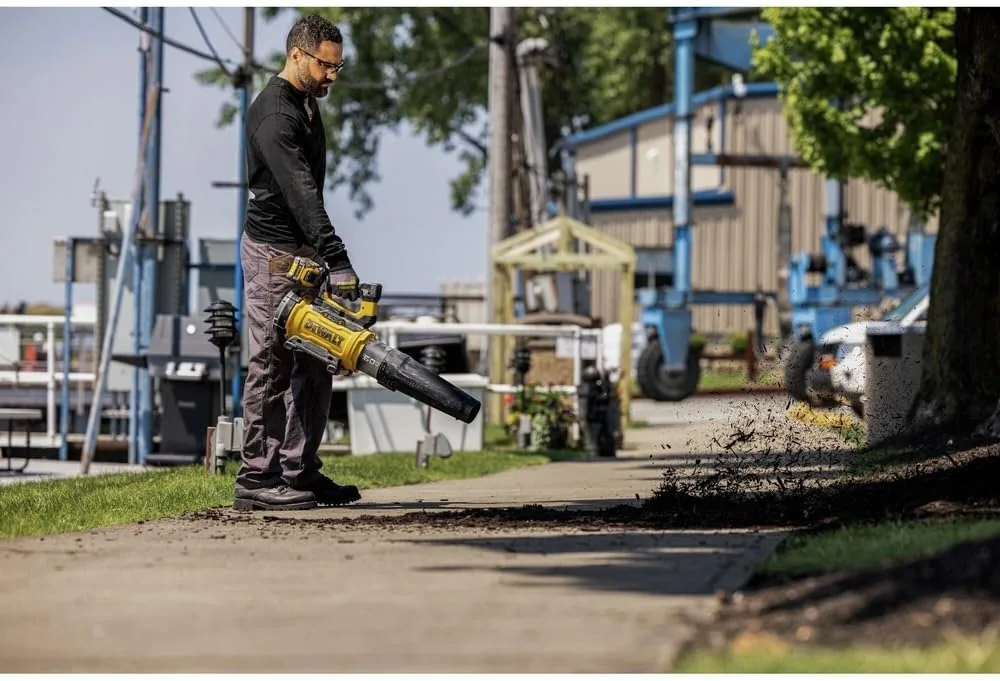
Sling the strap over one shoulder, never across the body, and hold the tube a few inches off the ground. Sweep side to side and advance slowly so the pile stays in front of the nozzle.
WHY I CHOSE THIS
Mirko Lekić, Agricultural Engineer & Farm Owner
The FlexVolt pack you may already own is why I call this the best DeWalt battery leaf blower. The bare tool turns a pack from your other DeWalt tools into a yard tool, and the foam-lined intake takes the edge off the noise. Its place is the gravel yard, the house lot and the farm drive.
Wear safety glasses and ear protection from the first squeeze, add a dust mask on dry ground, and keep people and windows out of the debris path. Take the pack off before you fit the tube or clear a blockage, then wait 10 seconds for the fan to stop.
DeWalt says to charge between 40 and 104 F and to store a pack charged, out of the charger, where it cannot reach 104 F. Next to my old gas handheld the sound is lower in pitch, and I still wear ear protection from the first minute. What annoyed me is the missing hang hole: I found no hook slot, and the blower now lies on a shelf.
FlexVolt packs on your shelf and jobs of 15 to 20 minutes make this a good fit. With no DeWalt packs, the pack and charger are most of the cost of the setup, so skip it.
FINAL VERDICT
Keep the DCBL777B for a tool shed that already holds a FlexVolt pack. As a first DeWalt purchase, skip it.
It is the 60V blower for a shelf of FlexVolt packs.
8. Milwaukee M18 FUEL Dual Battery Blower 2824-20 (Tool Only) Best Commercial
The 2824-20 holds its push from the start of a run to the end: according to Milwaukee, power stays constant through the whole discharge, and a sliding lock-on lever sets the speed in place of a turbo button. The price is two M18 packs and a charger, and none of them is in the box.
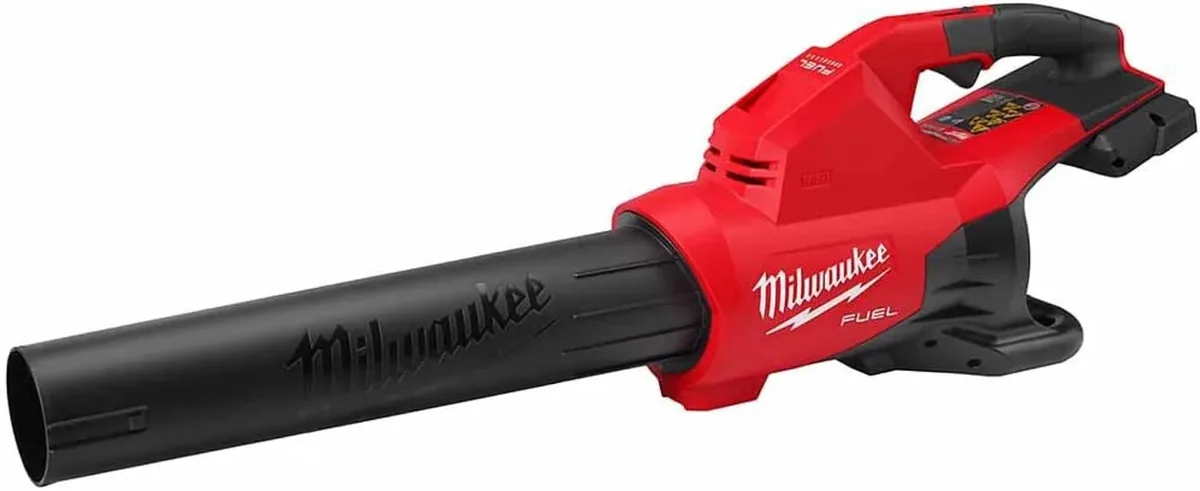
Milwaukee M18 FUEL Dual Battery Blower 2824-20 (Tool Only) Specs
Key Features:
- Dual M18 packs: Two 18-volt packs run it together as a 36-volt system, and it will not start on one.
- Constant power: Milwaukee says the push holds as the packs drain, so a pass does not fade.
- Sliding lock-on lever: It holds any speed in a left or right hand, and the trigger still gives full power.
- Fuel gauge on the tool: Four lights read the weaker pack, the one that will end the run.
- Instant response: Full throttle arrives in under a second.
With no turbo, what the trigger gives is all there is: about 17 N, where 17 N is roughly 4 lb of air pressing on a surface. That clears dry leaves, pruning twigs and gravel dust, and it only shivers a soaked leaf mat. Near the end of a run, the push did not sag as the packs drained, and then the blower simply stopped.
The best Milwaukee battery for leaf blower duty is a High Output pack: according to Milwaukee, the blower works best with two HD8.0 packs or larger, and it names no smaller pack as supported. Two 8.0 Ah packs hold about 288 Wh, and two 12.0 Ah packs hold about 432 Wh. Milwaukee’s chart gives 17.5 minutes at full throttle on two XC8.0 packs and 26 on two HD12.0.
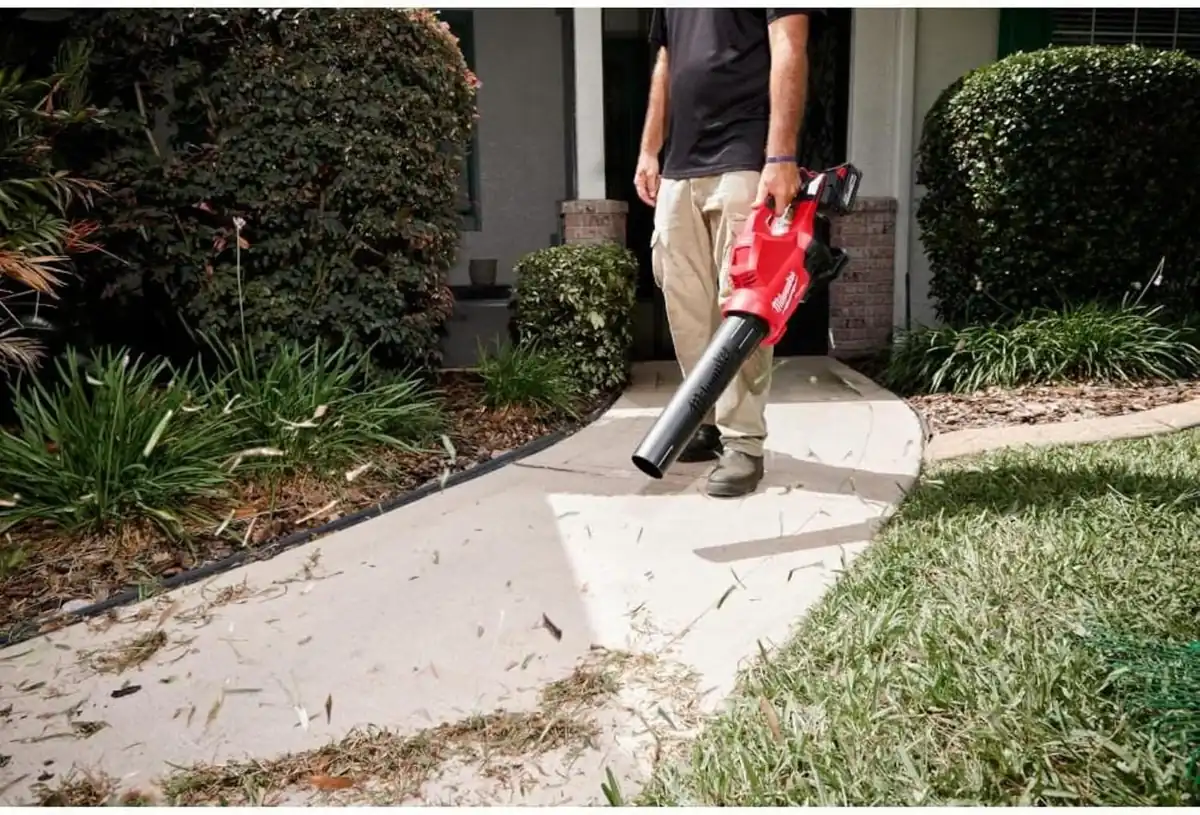
Pick up stones, glass and wire before you blow, because the air throws whatever it can lift.
WHY I CHOSE THIS
Mirko Lekić, Agricultural Engineer & Farm Owner
I call it the best commercial battery leaf blower on this list for its design. Milwaukee’s manual never calls it a commercial tool, so the label is mine. What earns it is the jobsite part: two big packs on a platform of well over a hundred tools, steady force and a three-year tool warranty. It does not mean an all-day run, since a pair of 8.0 Ah packs lasts about 15 to 18 minutes at full throttle.
Keep bystanders 50 feet away, wear eye protection with side shields and ear protection, and add a dust mask on dry ground. Take both packs off before you clean the tool or clear a blockage.
The blower stops when either pack reaches zero, even if the other is full, so I tape matching packs into pairs and charge each pair together. One pair is one session, and a longer day starts with the charge and not with the blower. Next to the corded blower in the workshop it has no cord to catch on a trunk, and it reaches the far end of the orchard.
Owners of two High Output M18 packs who clear a house lot, a drive or a farm yard in sessions of 15 to 20 minutes get the most from it. Skip it as a first M18 purchase, because two packs and a charger cost more than the blower, and skip it if soaked leaf mats are the daily job.
FINAL VERDICT
The 2824-20 earns its place when two High Output M18 packs already sit on your shelf and you want the same push from start to finish. As a first M18 purchase it asks for three buys in one.
It is the steady two-pack blower for a shelf of M18 packs.
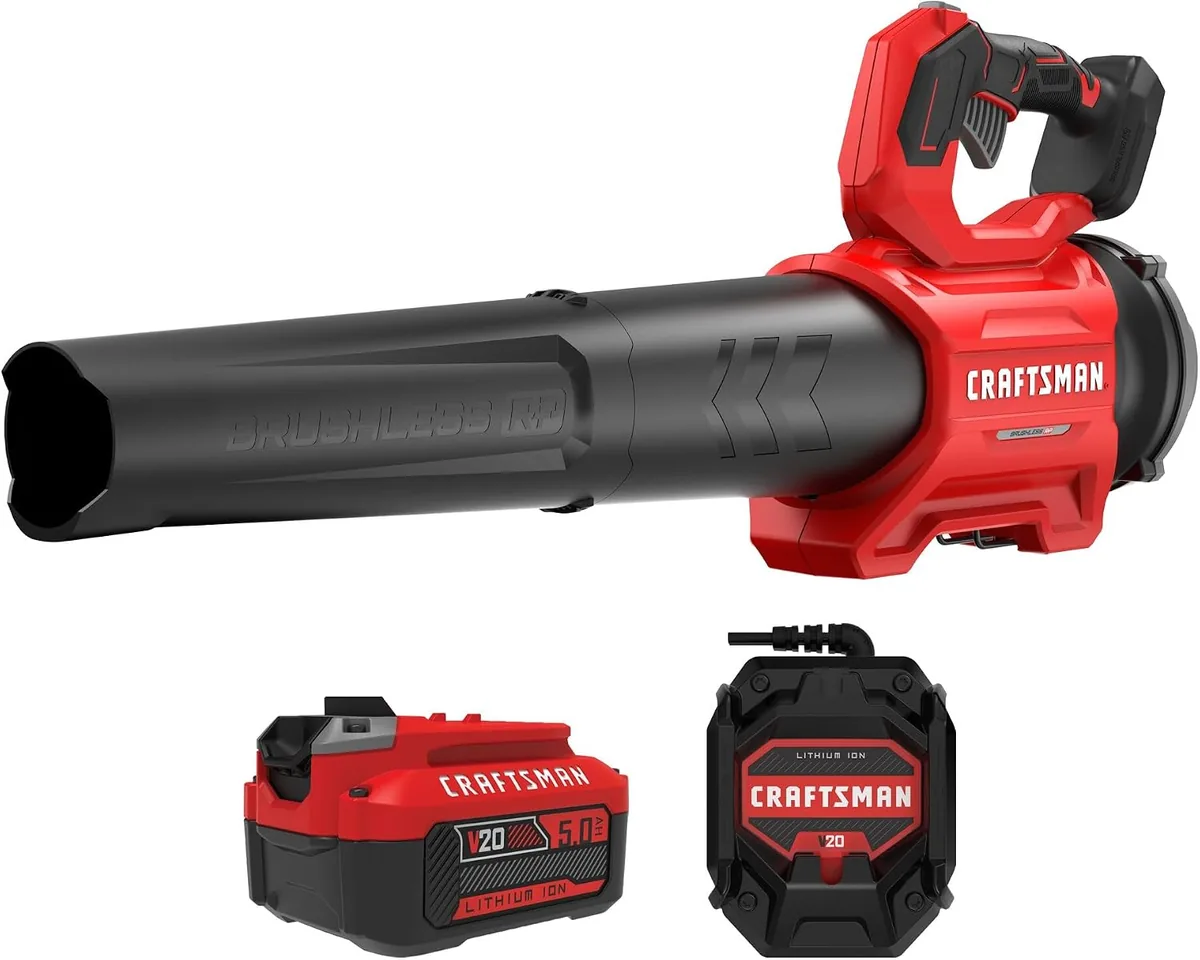
9. Craftsman V20 CMCBL730P1 Brushless Cordless Leaf Blower Kit Best Inexpensive
The CMCBL730P1 is an entry-tier kit built around its battery: a 5.0 Ah V20 pack of about 100 Wh and a charger come in the box. According to Craftsman it runs up to 24 minutes on low speed with no load. Craftsman’s manual limits it to household use, so a lawn-care business or any paid cleanup is outside what it was designed for.
Craftsman V20 CMCBL730P1 Brushless Cordless Leaf Blower Kit Specs
Key Features:
- 5.0 Ah V20 pack in the box: It holds about 100 Wh, so the kit works as soon as the charger finishes.
- V20 pack family: The manual lists several compatible pack sizes, so a second pack drops in and fits other V20 tools.
- Boost button: A press adds power for a heavy patch, and a second press drops back to the longer-running normal mode.
- Variable speed trigger: A light pull gives a soft stream, and a hard pull gives full air.
- Charger level lights: Four steps show under 50, 51 to 74, 75 to 100 percent and full.
According to Craftsman, the 410 CFM and 110 mph belong to Boost, and the maker prints no figure for normal mode. On the wet plum leaves in the first orchard alley, Boost lifted the edges of the mat and nothing more, and the pack ran down faster than it would have in normal mode. A rake finished the job.
Craftsman’s 24 minutes is a low-speed, no-load figure, so treat it as the ceiling for light work and plan on less once leaves are in the air. A second V20 pack is the simplest way to stretch a Saturday. Craftsman prints no charge time, so I put the pack on the charger the evening before.
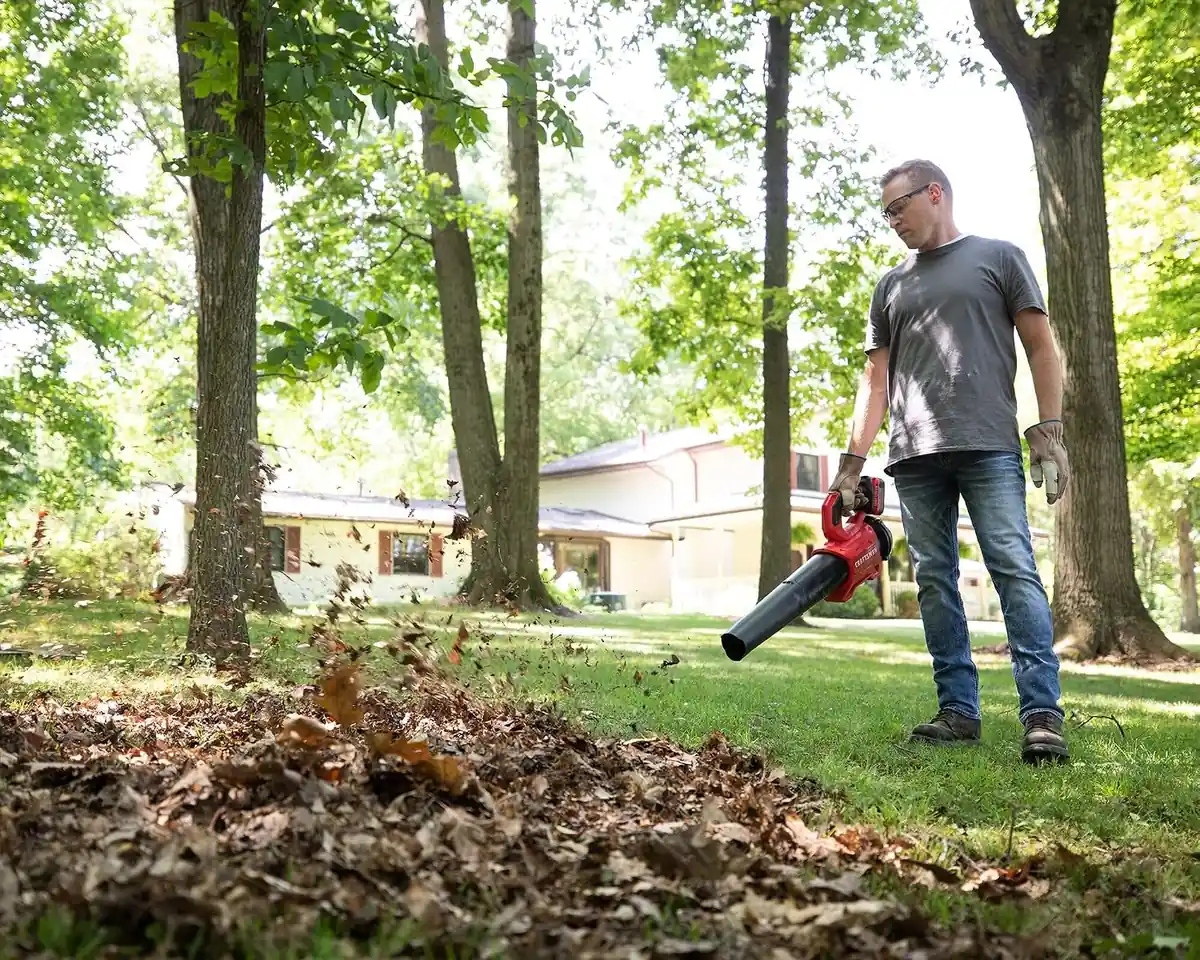
Start every job in normal mode, because the manual says it runs longer, and press Boost only on the thick part of a mat. A second press drops back to normal, so Boost stays a tool for one patch and never the setting for the whole pass.
WHY I CHOSE THIS
Mirko Lekić, Agricultural Engineer & Farm Owner
I name the CMCBL730P1 the best inexpensive battery powered leaf blower on this page because the 5.0 Ah pack arrives in the box with its charger. At the entry tier that means the kit works the day it arrives. I pick it for a lawn, a drive and a porch, and I stop there.
Wear ANSI Z87.1 safety glasses and ear protection, add a filter mask in dust, and keep people and windows out of the debris path. Pull the pack before you clear a blockage, because the fan keeps spinning for about 10 seconds after switch-off.
The charger will not start below 40 F or above 104 F, and Craftsman says charging is best between 65 and 75 F. On the first frost morning of the season the charger sat with its red light on until the pack from the shed had warmed in the kitchen. Weatherguard protects the tool only, so the pack and charger stay dry. Blow the vents out with dry air once a week.
It fits a small to quarter-acre lawn, a drive and a porch, and it fits best in a shed that already holds V20 tools. Skip it for wet leaf mats, orchard alleys and long runs on Boost, and skip it if you need a published weight or noise figure before you buy.
FINAL VERDICT
Buy the CMCBL730P1 when the budget is tight and you want a kit that arrives with its own 5.0 Ah pack and charger. Keep it to dry leaves, lawns and porches around the house.
It is the entry-tier kit with a full-size pack.
How to Choose the Best Battery Powered Leaf Blower
A battery blower is a motor with a fuel tank, and the tank is the pack. The best rated battery powered leaf blower is no use if its pack runs dry before the job does, so these seven checks start with watt-hours, minutes on high and the charger.
Battery Platform and Voltage
Start with the batteries you already own. A blower that takes your packs costs only the tool, while a new platform adds a pack and a charger that together often cost more than the blower body. The cheapest strong blower is the one that runs on packs from your own shelf. I run the cordless tools on the farm from as few pack families as I can, because a pack that moves from one tool to another is worth more than a bigger label number.
For an owner of several tools, the best battery operated leaf blower sits on the platform they already use. Voltage badges need care before you compare: a lithium-ion cell holds about 3.6 V, so five cells make 18 V, sold as 20V Max, ten cells make 36 V, sold as 40V Max, and fifteen make 54 V, sold as 60V Max. Compare the watt-hours the maker prints and ignore the badge.
| Platform | Badge | Example pack | Good to know |
|---|---|---|---|
| WORX PowerShare, Craftsman V20 | 20V Max | 4.0 Ah, about 80 Wh; 5.0 Ah, 100 Wh | The smallest packs in this class, suited to light jobs. |
| Greenworks 40V | 40V Max | 4.0 Ah, 144 Wh | Greenworks lists more than 75 compatible tools. |
| EGO | 56V | 5.0 Ah, 280 Wh | A larger EGO pack fits the same blower and lengthens the run. |
| Greenworks 80V | 80V Max | 4.0 Ah, about 290 Wh | The same pack runs more than 75 Greenworks tools. |
| DEWALT FlexVolt | 60V Max | 4.0 Ah at 60V, 240 Wh | A 60V MAX blower runs only on FlexVolt packs. |
| Milwaukee M18 | 18V | 8.0 Ah High Output, 144 Wh | Milwaukee prints no watt-hours, so this is 18 V times 8.0 Ah. Dual-battery blowers take two packs together. |
If you own DEWALT tools, the best battery for DEWALT leaf blower models is a FlexVolt pack: a plain 20V pack will not run a 60V MAX blower, and one FlexVolt pack reads 12.0 Ah on a 20V tool and 4.0 Ah on a 60V tool, with 240 Wh either way.
The mistake to avoid is a platform you will use for nothing else. The best cordless battery leaf blower for a new owner has a pack that also runs a mower or a trimmer, because every later tool then costs only the tool.
Kit or Tool Only
Six of the nine blowers on this page come as kits and three are bare tools, and a bare tool comes with no battery and no charger. It can still include nozzles and a strap. The listing says which you get in its title, with words such as tool only, bare tool, shell or battery sold separately. I read the included-components line before I read the airflow figure.
For a first-time buyer, the best leaf blower with battery in the box is a kit, since the maker sized the pack for the tool. A bare tool suits an owner who already holds two or more packs on that platform.
| The listing says | You get | You still need |
|---|---|---|
| Kit with battery and charger | Blower, one pack, one charger | A spare pack for any job past one charge |
| Kit with two batteries | Blower, two packs, one charger | A faster charger for long sessions |
| Tool only, battery sold separately | The blower alone | A pack and a charger from the same platform |
| Tool only, two packs required | The blower alone | Two matching packs and a charger |
The common mistake is comparing a bare tool’s price with a kit’s price. Add a pack and a charger to the bare tool first, and on a new platform the gap closes.
Amp-Hours and Watt-Hours in the Box
Amp-hours alone mislead. Watt-hours are the size of the tank: volts times amp-hours, and every figure on this page is the one the maker prints on the pack or its product page. A 4.0 Ah pack holds about 80 Wh on a 20V Max platform, 144 Wh on a 40V Max platform and about 290 Wh on an 80V platform, so the same amp-hour number can hide a gap of more than three times.
I rank packs by watt-hours first, the way I rank sprayer tanks by liters, and the brand comes last. Energy also costs weight: a 280 Wh pack weighs about 5 lb, which is half of what hangs from your hand in a full-size kit, so a pack larger than your longest job needs only tires the arm.
Key Takeaway
Multiply volts by amp-hours before you compare two kits. The bigger number is the bigger tank, whatever the badge says.
Minutes on High Against the Size of the Job
Runtime is watt-hours times 60, divided by the watts the motor draws. The minutes on the box usually describe low speed, and leaves ask for high, so plan on high. Turbo asks for far more, because fan power rises with the cube of fan speed and a fan that runs 26 percent faster needs roughly double the power.
| Pack in the tool | Label watt-hours | Minutes on high | Minutes on turbo or boost |
|---|---|---|---|
| 56V kit, one 5.0 Ah pack | 280 | About 30 | About 15 |
| 56V kit, one 4.0 Ah pack | 224 | About 12 | About 8 |
| 60V FlexVolt tool, one pack (4.0 Ah at 60V) | 240 | About 18 (Normal mode) | About 14 |
| 18V dual-battery tool, two 8.0 Ah packs | 288 | About 18 (full throttle) | No turbo mode |
| 18V dual-battery tool, two 12.0 Ah packs | 432 | About 26 (full throttle) | No turbo mode |
These are examples, not a ranking, because every row is a different motor. The two 56V kits show it: the 224 Wh pack holds 80 percent of the energy of the 280 Wh pack and gives 12 minutes on high against 30, since 224 × 60 ÷ 12 is about 1,120 W while 280 × 60 ÷ 30 is about 560 W. Compare packs by watt-hours, then look up the minutes your own blower gives on high.
Turbo costs minutes on every tool that has it, but not by a fixed share: 30 falls to 15, 12 to 8 and 18 to 14. My plan for a leaf Saturday is a count of packs, so I add up the high-speed minutes the night before and charge that many:
- Time the job: walk your longest job once at working speed and note the minutes with the trigger down.
- Divide: the job’s minutes on high by the minutes one pack gives.
- Round up: the result is the number of packs to charge the night before.
Wet leaves call for high speed, so plan on the low end of the minutes your blower lists. A blower-vacuum adds a load the table does not cover, and the best battery powered leaf blower vacuum is the model with more watt-hours than the job seems to need.
A long paved drive burns packs the same way, and a push model from the power sweepers category can take that job and spare them.
Charger Speed
The charger sets how soon a flat pack is a working pack. Charge time is roughly the pack’s watt-hours divided by the charger’s watts, and the box charger is often the slow one: across the kits I rank it runs from about 55 minutes to about 2 hours per pack. A pack that needs 2 hours turns a lunch break into a half-day wait.
When you shop for the best cordless leaf blower with battery and charger, check the charger’s time before the airflow, and note whether the platform sells a rapid charger as an extra.
Faster charging has a cost. A review of lithium-ion fast charging states that high charging currents are known to cause accelerated capacity and power fade, and it pays special attention to charging in the cold (1). I charge overnight on the box charger when I can, and I count a rapid charger as a tool for the busiest week of the season.
- Time per pack: the figure for your pack size, not the charger’s best case.
- Rapid option: whether the platform sells a faster charger, and at which price tier.
- Where it sits: indoors, dry and ventilated, because many chargers run a fan.
Battery Safety
Charge on a dry shelf indoors. Let a hot pack cool before it goes on the charger and let a frozen pack warm up first, and follow the maker’s manual for every pack.
A Second Pack and What It Adds
A second pack doubles the minutes in your hand. The box charger needs 55 minutes to about 2 hours per pack, so the first pack is only part way refilled when a 20-minute second pack goes flat: the spare covers the first session, and a second one back to back waits for the charger.
Alternating two packs also spreads the charge cycles across both of them. On a wet afternoon in the plum alleys one of my packs went flat with a pile still ahead of me, and since then a full spare rides with me.
- Your longest job passes the minutes one pack gives on high.
- Your box charger needs an hour or more to refill a pack.
- You work in cold weather, when every pack gives fewer minutes.
Dual-battery blowers make the second pack part of the tool. The best milwaukee battery for leaf blower work is a High Output pack of 8.0 Ah or more, and two of them run the blower together.
Past an hour of steady work the packs move to your back. A battery backpack carries them there, and the best battery backpack leaf blower belongs to a different class from the handhelds here, so none of my nine is one.
Pro Tip
Mark each pack with the month you bought it and alternate them, so one pack never does all the work while the other sits on the shelf.
Pack Life, Cold and Storage
A pack ages from heat, deep drains, fast charging and long storage at full charge. In a cycling study of commercial lithium-ion cells, the time to reach 80 percent of capacity varied by thousands of hours with discharge rate, depth of discharge and temperature (2).
Cold works differently and cuts the minutes you get today. Lab work on lithium-ion cells reports substantially reduced energy and power at low temperatures (3), so a pack that gave a full run in October gives less on a frost morning in November. I keep my packs in the house and carry them out when I start, so they begin the job warm.
In a study of three types of lithium-ion cells held at 16 charge levels, high charge was the main driver of capacity fade in storage, and the authors conclude that a high storage charge should be avoided (4). Follow the manual of your pack for long storage; where it names no figure, I leave mine at about half charge. Makers differ, and DEWALT’s manual advises storing a pack fully charged, so the manual of your own pack outranks any rule of thumb.
Heat is the other enemy. OSHA’s bulletin on small lithium battery devices states that damage to lithium batteries can occur when temperatures are too high, for example above 130 F, and that charging lithium-ion batteries below freezing can leave permanent metallic lithium on the anode (5). That rules out the hot shed, the parked truck and a frozen pack on the charger.
- Charge level: the figure in your pack’s manual, or about half, which is two to three bars on a five-bar gauge.
- Place: a cool, dry room at about 50 to 80 F by the maker’s manuals, never a hot shed or a parked vehicle.
- Before the season: top the packs up the week before leaf fall, and treat a clearly shorter run after a full charge as a pack near the end of its life.
What a Battery Blower Costs Over Five Seasons
The sticker price covers the first season only. Over five seasons the pack, the spare, the charger and one replacement decide the total, and electricity barely registers: a full charge of a 280 Wh pack draws well under half a kilowatt-hour from the wall.
| Path | First season | Seasons two to five | Good fit |
|---|---|---|---|
| Kit with one pack | Mid-range to premium tier | A spare pack in the mid-range tier, then one replacement pack | A house lot with jobs that fit one or two packs |
| Kit with two packs | Premium tier | One replacement pack | Long sessions with a recharge in the middle |
| Bare tool on a platform you own | Mid-range tier or less | Nothing extra, since your packs already work | Owners with two or more packs and a charger |
| Bare tool on a new platform | Mid-range to premium tier once the pack and charger are in | A spare pack, then only the tool for each later purchase | Buyers who plan a mower or trimmer on the same packs |
I budget one replacement pack by the fifth season, because a pack ages with the calendar as well as with use. A laboratory model built from cells cycled across seven charge ranges, three charge rates and two temperatures made capacity loss depend on both the charge range and the calendar age (6). The warranty terms I found run 3 to 5 years on the tool and 3 to 4 years on the battery where the maker lists it, so read the battery term on its own line.
Running Battery Blowers Through an Orchard Cleanup
Under the plum and apricot rows the work is a half day, and that is where a battery blower meets its limit. Three hours of blowing on high, with a pack giving about 12 to 30 minutes, is six to fifteen pack-runs, more than a pair of packs and one charger can supply. So I blow the tree-row strips and let the mower take the alleys, with mulching with a lawn mower shredding the dry leaves where they lie.
Wet leaves need high speed, so a pack that lasts 80 to 200 minutes on low gives a fraction of that under the wet row. Fallen fruit I pick up and carry out, since blowing only spreads it, and the packs are kept for leaves and twigs. I swap packs at the end of a row, before the gauge reaches one bar, and the pack I took off goes on the charger while I fill the wheelbarrow.
- Pack count: two full packs in hand and a third on the charger when the rows run long.
- Order of work: the tree-row strips first, while the packs are full, and the open alley last.
- Settings: high for wet mats and low for dry twigs, so the minutes go where the leaves are heaviest.
- Protection: eye protection every pass, hearing protection whenever a blower runs and a dust mask in the machinery shed.
My Overall Verdict
Three of the nine stand out, and the right one depends on the pack you need and the platform you already own.
1. EGO POWER+ LB6504 650 CFM Cordless Leaf Blower Kit Best Overall
Best for owners who want a full 280 Wh pack and a charger in one box, with the option of a larger EGO pack later.
2. EGO POWER+ LB8803-2 880 CFM Two-Battery Leaf Blower Kit Best Premium
Best for owners who want a spare in the box: two 4.0 Ah packs, so the first can start recharging while the second works.
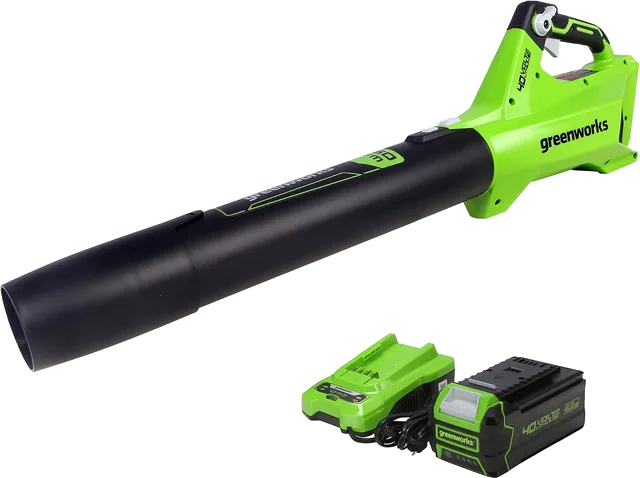
3. Greenworks 40V 450 CFM Cordless Leaf Blower Kit Best Value
Best for owners who want the lowest cost of the three and a 40V pack that also runs other Greenworks tools.
On my land the battery decides the day. The EGO POWER+ LB6504 650 CFM Cordless Leaf Blower Kit puts a full pack in one box, and if you size the pack to your longest job and add a spare, you have the best battery powered leaf blower for your yard.
Why EGO POWER+ LB6504 650 CFM Cordless Leaf Blower Kit Might Be the Best Choice
The EGO POWER+ LB6504 650 CFM Cordless Leaf Blower Kit is my best overall because the box holds a 5.0 Ah battery of 280 Wh, a charger and two nozzles, and I judge a blower by its tank. For a yard that one pack and a spare can cover, it is the best battery leaf blower I know.
The trade-off is the charger. The standard charger in the box needs about 100 minutes, and no strap comes with the kit, so budget for a spare pack and a faster charger.
Five things set the battery side of this kit apart:
✓ Pack size: a 5.0 Ah battery of 280 Wh in the box, the energy that decides every other number.
✓ Runtime: according to EGO, about 30 minutes on high and about 15 on boost per pack.
✓ Platform: every EGO 56V pack fits, so a larger pack later lengthens the run.
✓ Charging: about 100 minutes on the box charger and about 40 on EGO’s rapid charger.
✓ Warranty: 5 years on the tool and 3 years on the battery.
Frequently Asked Questions
What is the best battery powered leaf blower?
The best battery powered leaf blower for most homeowners is the EGO LB6504 kit, because its box holds a 5.0 Ah pack of 280 Wh and a charger. I pick it for that pack, a 5-year tool warranty and the option of a larger EGO pack later, and I buy a spare once a job passes one charge.
Are battery-powered leaf blowers worth it?
Battery-powered leaf blowers are worth it for yards where your longest job fits in one or two packs, because they start with a trigger and need no fuel, mixing or pull cord. They stop paying off when the work runs past the minutes your packs give on high, and then a gas backpack or a rake earns its place.
What battery-powered leaf blower has the longest run time?
The battery-powered leaf blower with the longest run time is the 56V EGO LB6504 kit, which gives about 30 minutes on high from its 5.0 Ah pack of 280 Wh, according to EGO. That is the most minutes on high of the picks that state one, and a spare pack doubles it.
What is the life of a leaf blower battery?
The life of a leaf blower battery depends on heat, deep drains and long storage at full charge, and the warranty is the part you can count on: 3 years on the EGO packs and 4 on the Greenworks 80V pack. I keep mine in a cool room and store them as the manual says.
Is a 40V leaf blower better than a 20V?
A 40V leaf blower is better than a 20V when the job needs more stored energy, because a 4.0 Ah pack holds 144 Wh at 40V against about 80 Wh at 20V. More energy is not more minutes, since a stronger motor spends it faster, so compare a kit’s minutes on high and its weight, not its voltage badge.
References
- Tomaszewska A, Chu Z, Feng X, et al. Lithium-ion battery fast charging: A review. eTransportation. 2019;1:100011.
- Preger Y, Barkholtz HM, Fresquez A, et al. Degradation of Commercial Lithium-Ion Cells as a Function of Chemistry and Cycling Conditions. J. Electrochem. Soc. 2020;167(12):120532.
- Ji Y, Zhang Y, Wang C-Y. Li-Ion Cell Operation at Low Temperatures. J Electrochem Soc. 2013;160(4):A636-A649.
- Keil P, Schuster SF, Wilhelm J, et al. Calendar Aging of Lithium-Ion Batteries. J Electrochem Soc. 2016;163(9):A1872-A1880.
- Occupational Safety and Health Administration. Preventing Fire and/or Explosion Injury from Small and Wearable Lithium Battery Powered Devices. Safety and Health Information Bulletin SHIB 06-20-2019. US Department of Labor; 2019.
- Gauthier R, Luscombe A, Bond T, et al. How do Depth of Discharge, C-rate and Calendar Age Affect Capacity Retention, Impedance Growth, the Electrodes, and the Electrolyte in Li-Ion Cells?. J. Electrochem. Soc. 2022;169(2):020518.
Safety Note: Leaf blowers throw debris and can damage your hearing. Wear eye and ear protection, read the manufacturer’s manual, and check your local rules on noise and operating hours.