
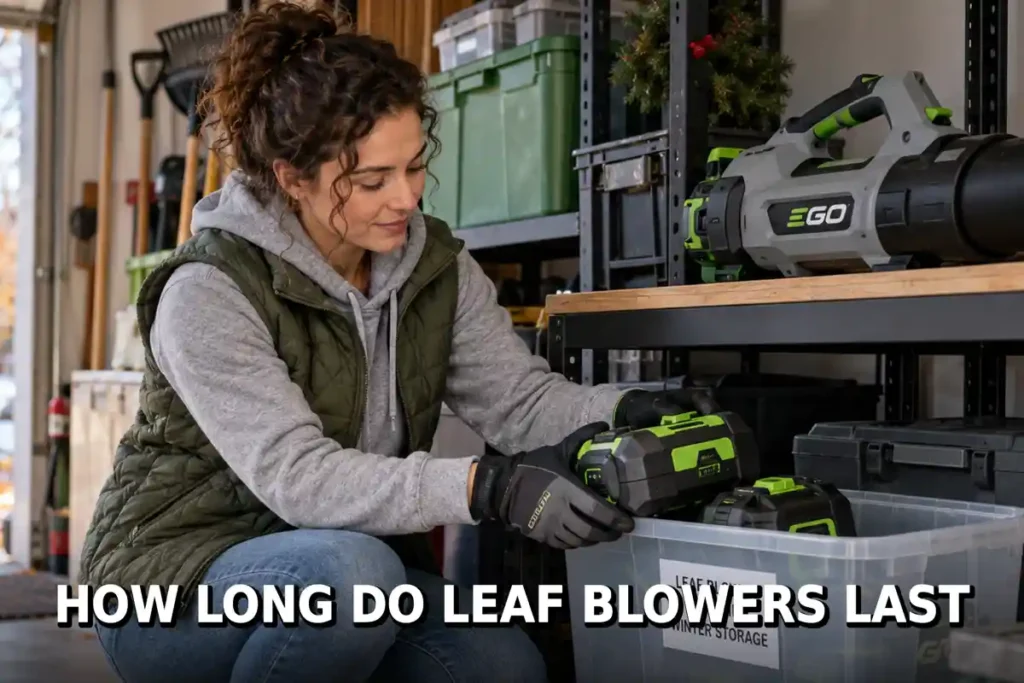
A leaf blower lasts about 8 to 10 years at home when it is gas or corded and about 6 to 8 years when it is a cordless tool. Those years are my experience. The battery pack goes sooner, and a home blower usually ends with one failed part rather than a worn-out machine.
I keep a gas handheld, a corded blower and a set of cordless packs running on a 3.7-acre orchard and the yard around the house, so I know which part gives up first on each. Below you get what makers and the EPA do publish, how to turn hours into years, the wear order by type, and a cost-per-season sum.
How Long Do Leaf Blowers Last?
The answer depends on the type of blower and on how hard it works. At home I get about 8 to 10 years from a gas or corded blower and about 6 to 8 from a cordless tool, and heavy use shortens both. On my land a blower rarely dies of old age. One part fails, and the repair either costs little or ends the machine.
| Blower type | Years at home | Part that usually ends it | What adds seasons |
|---|---|---|---|
| Gas handheld | About 8 to 10 | Carburetor, fuel lines or starter | Fresh fuel and a clean air filter |
| Gas backpack | About 8 to 10 | The same parts, plus harness and tube clamps | Fresh fuel, a clean filter and tight tube clamps |
| Corded | About 8 to 10 | Cord, switch or worn brushes | A cord kept clear of sharp edges |
| Cordless | About 6 to 8 for the tool, 3 to 5 for the pack | The pack, then the tool | A pack stored indoors, off the tool |
Read the table as a home-use rule of thumb. Work use shortens every row, and the hours section below shows how fast. The cordless row lists the pack separately because it goes first, but this guide stays with the whole tool.
What Makers Publish in Warranty Years and Emission Hours
Two sets of numbers exist in writing: an emission period in hours for gas engines and warranty years for the tool. Each one says what is covered or certified, and the two parts below explain what that means for you.
The Hours on a Gas Engine
Under EPA rules, a handheld gas engine is certified for a useful life of 50, 125 or 300 hours for light, medium or heavy use, or five years, whichever comes first (1). The maker picks the value that matches the expected median in-use life of its engines, and the EPA can require a different one (1).
That period is how long the engine must keep meeting the exhaust standards. It is an emissions durability period for certification, so it does not predict when a blower dies, it is not a warranty, and it does not apply to battery tools.
Warranty Years by Maker
A warranty covers what the maker repairs for free. According to EGO, the tool warranty on its cordless blowers is 5 years for home use and 1 year for professional or commercial use. The battery terms depend on the pack: check EGO’s warranty page for yours. Some makers cover the tool for longer than the pack.
Gas engines also carry an emission warranty. Under the EPA rule, the minimum period is two years from the date of sale, and it covers defects in materials and workmanship that keep the engine from meeting the exhaust standards (2). EPA can approve a shorter period for handheld engines in severe-service seasonal equipment, and on an engine with an hour meter a claim can be denied once the engine passes half of its emission hours. The maker can also deny a claim when improper maintenance or use caused the problem (2), which is one more reason to keep the filter and the fuel in order.
Hours of Use Per Year at Home and on a Farm
Hours explain why one blower lasts ten seasons in one yard and a fraction of that in another. A homeowner runs a blower for a few hours a year, and a crew runs it for hundreds. The first blower dies of age and old fuel, and the second dies of hours.
| Hours of use per year | Reaches 50 hours | Reaches 300 hours |
|---|---|---|
| 5 hours (a small home yard) | About 10 years | About 60 years |
| 20 hours (my yard, see below) | About 2.5 years | About 15 years |
| 40 hours (a busy farm or a large property) | About 1 year | About 7.5 years |
| 400 hours (daily crew work) | About 6 weeks | About 9 months |
The table is arithmetic on the certification categories and says nothing about when a blower wears out. The emission period also ends at five years, so anyone running a gas blower under about 60 hours a year meets the five-year limit before the 300-hour mark.
My Own Hours
My leaf season runs about eight weeks. I clear the house lawn and the yard in two or three sessions a week, and the orchard strips under the trees add time in the busiest weeks. Call it two hours a week, so about 16 hours, plus a few more for pruning cleanup in late winter and the dust in the machinery shed. Across all my blowers that is roughly 20 hours a year.
A single gas engine gets only part of those 20 hours, because the electric tools take their share. On my land old fuel and the calendar come before any hour count. Hours start to matter on a gas engine that runs 40 hours a year or more.
What Wears Out First on a Gas Blower
On a gas blower the order of failure follows the fuel. The fuel system goes first, then the parts that touch the air and the pull, and the engine itself goes last. Most of these are cheap fixes, and a few end the machine.
The Fuel System Goes First
Two-stroke fuel goes stale. According to Stihl, self-mixed fuel should be used within about 30 days, and stabilizer only helps when it goes into fresh fuel. Old mix gums the carburetor jets and the diaphragm, hardens the fuel lines and cracks the primer bulb. My old gas handheld refused to start after a month in the shed, and a gummed carburetor was the cause while the engine was fine.
A backpack blower of mine once bogged and surged after a long idle on old mix. The sound changed before the power did, and fresh fuel cured it. My habit now is to mix only what the season needs and to drain the tank and run the engine dry before winter.
Ethanol adds to the problem, and E15 pump fuel is not approved for small engines. In a 2009 US Department of Energy test of 28 small engines, the engines ran leaner as ethanol rose, and exhaust ran about 36 to 126 F hotter on E20 than on plain gasoline (3). The report could not say whether ethanol shortened engine life, because the residential handheld-class engines in the test failed on every fuel, plain gasoline included (3).
Parts That Wear With Use
- Spark plug: it fouls from a rich mix and wears with hours. I fouled one with a mix that was too rich, and a new plug fixed it.
- Air filter: dust loads it, and the engine loses power and runs hotter. A tap on a loaded filter restored my power once, and it cost nothing.
- Spark arrestor screen: it clogs with carbon and cuts power.
- Pull cord and recoil spring: the cord frays at the handle first. Replace the rope before it snaps.
- Fuel lines and primer bulb: they harden and crack with age, and both are small fixes.
- Tank, mounts and tube clamps: vibration loosens bolts and clamps. Check them at the start of each season.
Three failures usually end a gas blower: a scored cylinder or seized engine, a cracked housing, and a carburetor whose parts are no longer sold. A gummed carburetor is cleaned first, then rebuilt or replaced, so it ends the blower only when that repair costs about as much as a new unit. Everything else in the list is a repair.
Before Any Repair
Stop the engine and let it cool before you open the fuel cap or work on the blower. Pull the plug lead before you touch the plug or the fan, and wear eye protection and gloves.
What Wears Out First on a Corded or Cordless Blower
Electric blowers have no fuel to spoil, so they run longer between repairs. What fails is the cord, the switch, the motor brushes or the pack.
Motor, Cord and Switch
A brushed motor wears carbon brushes, and when they are gone the motor loses power or stops. A brushless motor has no brushes to wear and runs cooler, so I look for one on any tool I plan to keep for years.
Cords and switches take the abuse. On the farm the cord finds every tree trunk and every sharp edge, and a nicked cord or a loose switch is the usual end of a corded blower in my experience. A cracked fan housing and bearing noise come next. My corded blower starts at once after a month in the workshop, because there is no fuel in it to go off.
The Pack Goes Before the Tool
On a cordless blower the pack goes first, and it ages on the shelf as well as in use. A lab study of lithium-ion cells found the fastest capacity loss in cells stored fully charged and hot (4). Before you buy a tool, check that the maker still sells packs for its line, because when it drops a pack line the tool is stranded and a good blower becomes a bare shell.
How to Make a Blower Last Longer
Six habits add seasons, and each one answers a specific failure. Do the cheap ones every time and the rest once a season. This is the leaf blower maintenance I keep up on the farm.
- Clean the intake and the cooling fins after dusty jobs. A blocked intake starves a gas engine of air and a motor of cooling.
- Tap out the air filter after dusty work and replace it each season. A loaded filter is the cheapest failure to prevent.
- Mix fuel for the season only. Measure the oil, use fresh fuel and keep E15 out of the can. Drain the tank and run the carburetor dry before a long idle.
- Keep full power for the job that needs it. Full power is the hardest load on an engine, a motor and a pack, so I use it for the wet corner and drop back for the rest.
- Store it dry. Coil the cord loosely and keep the pack indoors, off the tool.
- Check bolts and tube clamps at the start of the season. Vibration works them loose.
Pro Tip
The dust in my machinery shed is fine enough to hang in the air, and it ends up in the intake. I wear a dust mask for that job, stop the blower before I clear the intake, and brush it clean afterwards.
Repair or Replace
The rule is simple: repair a wear part, replace a failed core. The table sorts the usual failures by the size of the fix, from a plug to a pack, and gives my call on each.
| Failure | Size of the fix | My call |
|---|---|---|
| Spark plug, air filter, pull cord, primer bulb, fuel line | Small fix | Repair |
| Carburetor cleaning or rebuild, carbon brushes, cord or switch | Mid-size fix | Repair on a tool in good shape |
| Replacement pack for a line that is still sold | Mid-size fix, sometimes close to a new budget unit | Repair if the tool is sound |
| Pack for a discontinued line, cracked housing, scored cylinder, no parts sold | Near a new budget unit | Replace |
My rule of thumb is to replace the blower when the repair costs more than about half of a comparable new one. A mid-size fix pays off early in a blower’s life, and on an old one the next failure tends to follow.
Cost Over Seasons for Gas and Cordless
The price on the shelf is only part of what a blower costs over its years. Each type asks for different things every season, and you can count them. The table lists them in tier words, so you can price each line where you live.
| Blower type | Bought every season | Bought now and then | Biggest single item |
|---|---|---|---|
| Gas | Fuel, two-stroke oil, a spark plug, an air filter | Fuel lines, a primer bulb, a pull cord, a carburetor service | A carburetor rebuild or replacement, while parts are sold |
| Corded | Nothing | A cord or switch, carbon brushes on a brushed motor | Rarely any |
| Cordless | Nothing beyond charging | One replacement pack over the tool’s years | That pack: a mid-size fix, sometimes close to a new budget unit |
A small yard burns little fuel, so the gas column stays short there. A large property or a long season lengthens it, and heavy use brings the repairs in every column sooner. Which type costs less over your seasons depends on what you pay for the blower, the pack and the fuel, and the table gives you the list to price.
Pick the Blower That Matches the Years You Need
A good deal of the damage to a blower happens while it sits in the shed, with old fuel in the tank or a full pack on the tool. I write the purchase date and the date of the last fuel change on the tool with a marker, so I can see at a glance whether an old blower is worth a repair. When it is time to buy, the leaf blower guides on this site compare the types, and the warranty page for the model sets what the maker will fix for free. What decides how long leaf blowers last is the type you buy, the fuel or pack you keep fresh, and the one part that fails first on that type.
Frequently Asked Questions
What is the life expectancy of a leaf blower?
The life expectancy of a leaf blower is about 8 to 10 years at home for a gas or corded model and about 6 to 8 years for a cordless tool, in my experience. Heavy use shortens those figures, and the pack on a cordless blower usually goes sooner than the tool.
How long do gas leaf blowers last?
Gas leaf blowers last about 8 to 10 years at home in my experience, and fresh fuel decides whether they get there. Daily crew work shortens that, and the order of wear stays the same: fuel system first, then the plug, the filter and the pull cord.
How long do electric leaf blowers last?
Electric leaf blowers last about 8 to 10 years when corded and about 6 to 8 years for the cordless tool in my experience. The pack on a cordless model usually goes sooner, at about 3 to 5 years.
How much should I spend on a leaf blower?
How much you should spend on a leaf blower depends on how many hours a year it runs. A few hours a year in a home yard is covered by a budget or mid-range corded or cordless unit. Dozens of hours a year on a farm or a large property call for a mid-range or premium blower, with a brushless motor on an electric one and a pack line the maker still sells.
Why do leaf blowers stop working?
Leaf blowers stop working when one wear part fails: old fuel in a gas engine, a worn plug or pull cord, a frayed cord or worn brushes on a corded model, or a tired pack on a cordless one. Age and storage cause most of these, and the sections above show the order for each type.
References
- Electronic Code of Federal Regulations. 40 CFR §1054.107: What is the useful life period for meeting exhaust emission standards? Accessed October 12, 2026.
- Electronic Code of Federal Regulations. 40 CFR §1054.120: What emission-related warranty requirements apply to me? Accessed October 12, 2026.
- Knoll K, West B, Clark W, et al. Effects of Intermediate Ethanol Blends on Legacy Vehicles and Small Non-Road Engines, Report 1 – Updated. NREL/TP-540-43543; ORNL/TM-2008/117. National Renewable Energy Laboratory; 2009.
- Mao Z, Farkhondeh M, Pritzker M, Fowler M, Chen Z. Calendar Aging and Gas Generation in Commercial Graphite/NMC-LMO Lithium-Ion Pouch Cell. J. Electrochem. Soc. 2017;164(14):A3469-A3483.
Safety Note: Leaf blowers throw debris and can damage your hearing. Wear eye and ear protection, read the manufacturer’s manual, and check your local rules on noise and operating hours.