
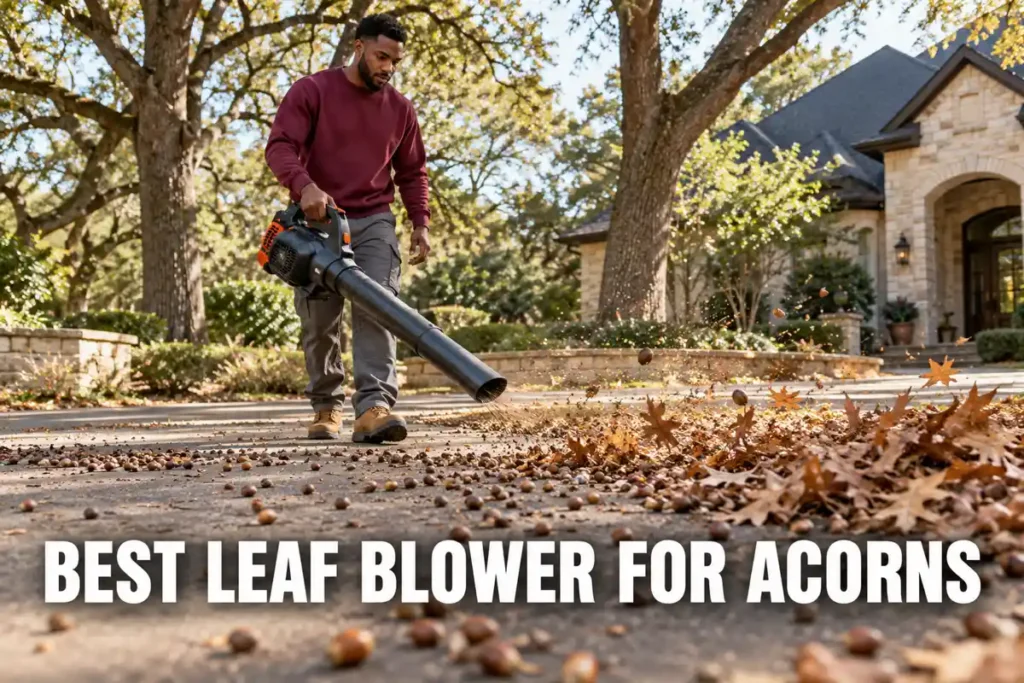
The best leaf blower for acorns puts enough force at the nozzle for your grass, because an acorn is a dense, round seed that rolls and settles at the base of the grass, and air volume alone will not lift it. I farm a plum and apricot orchard, so dense debris lying in short grass is a job I know, and I run every machine below on my own land.
Affiliate Disclosure: Garden Power Scout is a proud participant in the Amazon Services LLC Associates Program. As an Amazon Associate, we earn from qualifying purchases, at no extra cost to you.
Below are my five picks, with force, weight and tank or runtime beside each, and my top pick is the ECHO PB-9010T Gas Backpack Leaf Blower. I also say when a picker or a sweeper beats every blower here.
Best Leaf Blower for Acorns 2026 With My 5 Picks by Job and Comfort
These are the five machines I pick for acorns, each for a different job: two gas backpacks with the most force, a budget gas handheld, a lighter backpack for a house yard and one cordless kit. The order follows the job, the price tier and the comfort of carry, so compare force in each spec table. Picks 1 and 2 carry the most push, and each block says who should skip the machine.
1. ECHO PB-9010T Gas Backpack Leaf Blower Best Overall
Acorns roll and then settle at the base of the grass, so the first number I check in a blower for them is push at the nozzle. According to ECHO, the PB-9010T delivers 48 N at the nozzle, about 11 pounds of force, the top maker figure on this page and within a newton of the next one, and its airflow rating is the highest too. I rank it first for a yard under several oaks, and it asks for goggles, full ear protection and a strong back in return.
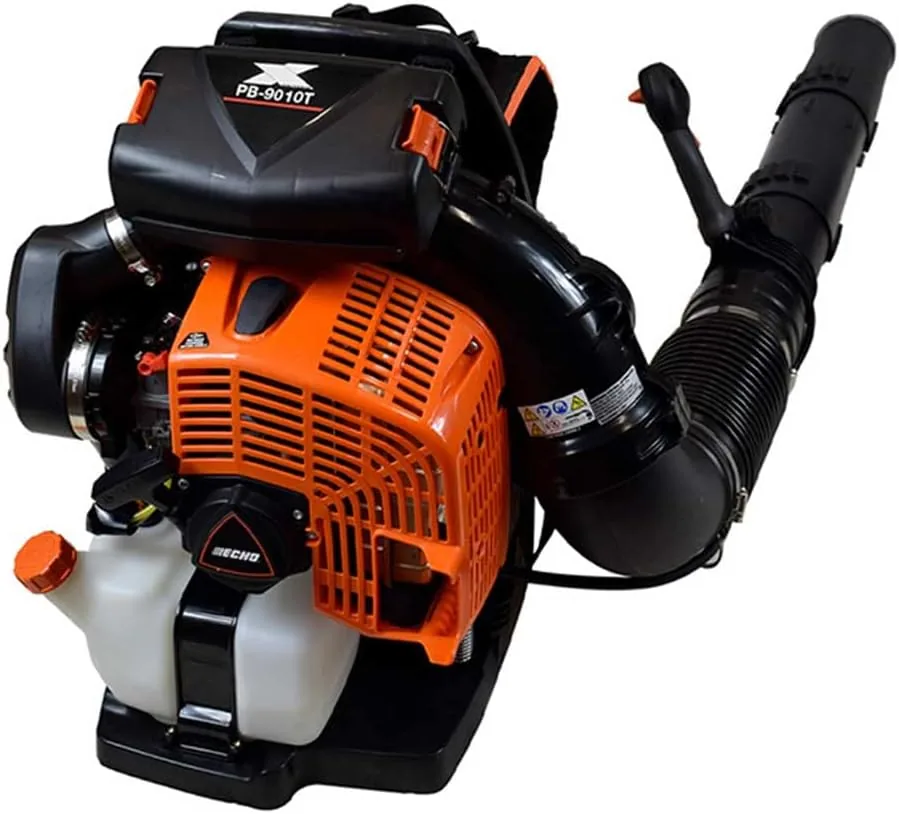
ECHO PB-9010T Gas Backpack Leaf Blower Specs
Key Features:
- Tube-mounted throttle: Speed and aim live in one hand, so the other hand holds the pipe low over the grass.
- Position lever: It holds a steady speed for a long pass down an alley, with no cramped trigger finger.
- Swivel pipe: The nozzle end turns, so you set a shallow jet angle without twisting your wrist.
- See-through tank: You read the fuel level from the side and refill between rows.
- Two-stage air filter: A paper element and a foam pre-filter sit under a cover that opens fast for a check after dusty ground.
- Padded straps and vented back pad: They spread the load across the back over a long session.
- Purge bulb: You prime until fuel shows, so a cold start does not mean a string of blind pulls.
Acorns are dense, so a soft stream rolls them a few inches and leaves them, and a strong stream carries them. The PB-9010T carries them because it pairs a high force rating with a very large volume of air, and that volume keeps a whole row of nuts travelling as one mass. Beside my old gas handheld, which sprayed plum stones sideways across the alley, the backpack kept them together in one line. ECHO lists 1,110 CFM and 220 mph with the pipes it ships with, so its push comes from force and volume.
The tank sets how long the push lasts. The 83.8 fl oz tank gives about 68 minutes with the throttle wide open at ECHO’s fuel rate, and it lasts longer at part throttle. The trigger overrides the position lever, so you can ease off over fine ground and snap back to the set speed.
The tilled strips under the plum rows are the second job, and the plum stones lying there are my nearest guide to acorns on loose ground. A plum stone is not an acorn, so I read the result as a rough guide. At full lever the jet lifted the dry soil into a haze before it had moved a single stone, because the volume that herds a row across grass also digs into loose earth. ECHO’s manual says to loosen debris with a rake or broom before blowing, and on those strips I now start with the rake and wear a dust mask, then use the blower on the firm ground at the edge, where the stones sit on top and leave in one line.
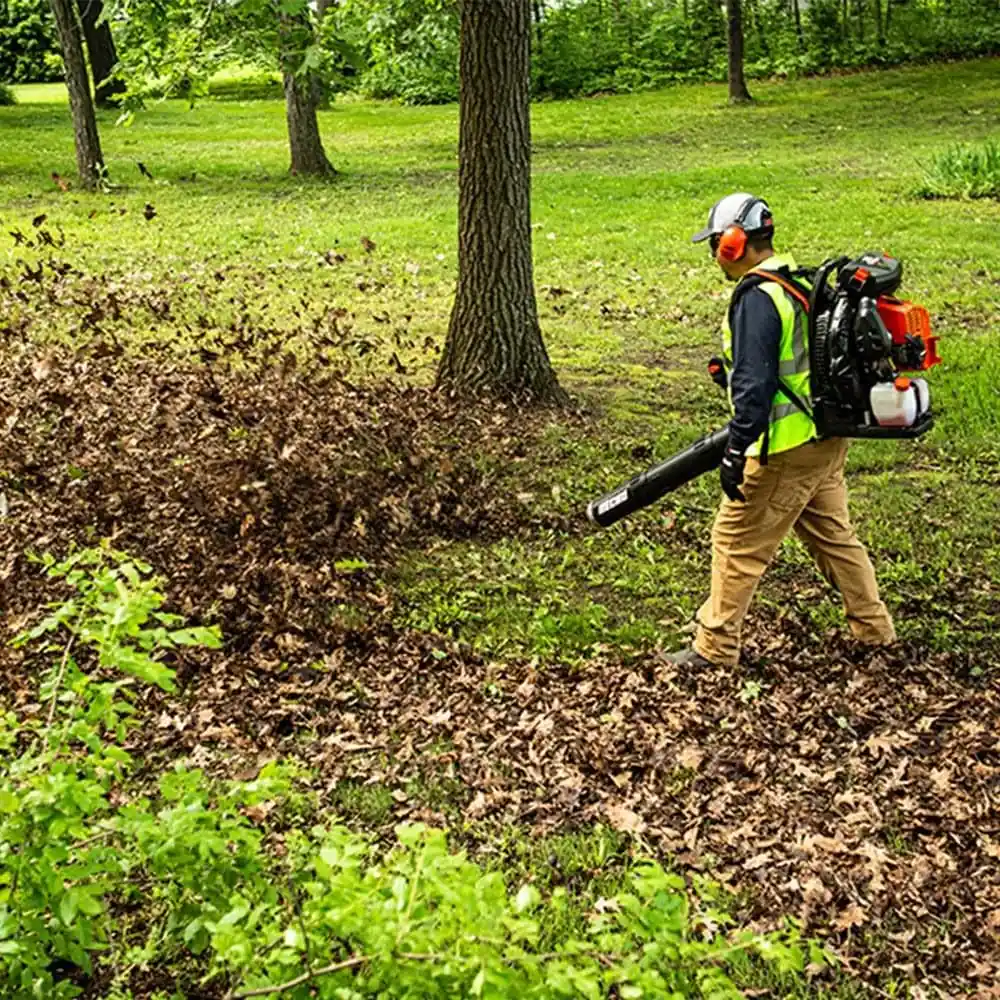
Walk with the wind at your back and the nozzle low, and the nuts leave in a single line toward the end of the row.

WHY I CHOSE THIS
Mirko Lekić, Agricultural Engineer & Farm Owner
Acorns reward force more than anything else, and the PB-9010T has the top maker force figure and the largest airflow rating on this page. The force figures of the two top backpacks sit within a newton of each other, so the extra airflow is what puts it first. It is the blower I recommend for a yard under several oaks.
Wear foam plugs under earmuffs, ANSI Z87.1 goggles or safety glasses and a dust mask from the first pull, because hard debris flies and ECHO’s manual keeps bystanders, children and pets outside a 50 ft radius and says to avoid blowing debris towards people, pets, open windows or vehicles. ECHO’s 79.3 dB(A) rating is a bystander figure at 50 ft, so the level at your own ears is higher.
ECHO’s manual calls for a 50:1 mix, which is 2.6 fl oz of two-stroke oil per US gallon, in fresh gasoline of 89 octane or higher with no more than 10 percent ethanol, and no more mix than you will use in 30 days. Refuel outdoors over bare ground with the engine stopped and cool, then carry the blower 10 feet from the fuelling spot before you pull the cord. The manual asks for a daily check of the air filter and the cooling fins. ECHO’s US box list shows no hip belt, so about 31 lb with a full tank rides on the shoulder straps.
Buy it if the oaks are many, the rows are long and the nuts sit down in the grass, because this is the blower with the force to move them. Skip it for a small lot, a street with close neighbors, a weak back or a dislike of mixing fuel, since a single oak over a deck does not need that much push. ECHO’s warranty runs 5 years residential and 2 years for agricultural or income-producing use, and it applies only to units sold by authorized ECHO dealers, so check the seller on the listing before you order.
FINAL VERDICT
For acorns packed into the grass of a big yard, the PB-9010T brings the most force and the most air on this page. It costs weight, noise and fuel handling, and it pays that back on the long rows. Pick it when the oaks are many and the rows are long.
It is the gas backpack I rank first for push at the nozzle.
2. Husqvarna 580BTS Gas Backpack Leaf Blower Best Premium
The 580BTS is the premium-tier gas backpack on this page, and it ships with a padded hip belt, a waist belt and a chest strap. According to Husqvarna it delivers 47 N at the nozzle, within a newton of the top maker figure here, through a round nozzle that comes in the box. I rank it second for long rows of acorns on a big yard, and it suits the person who walks them for an afternoon.
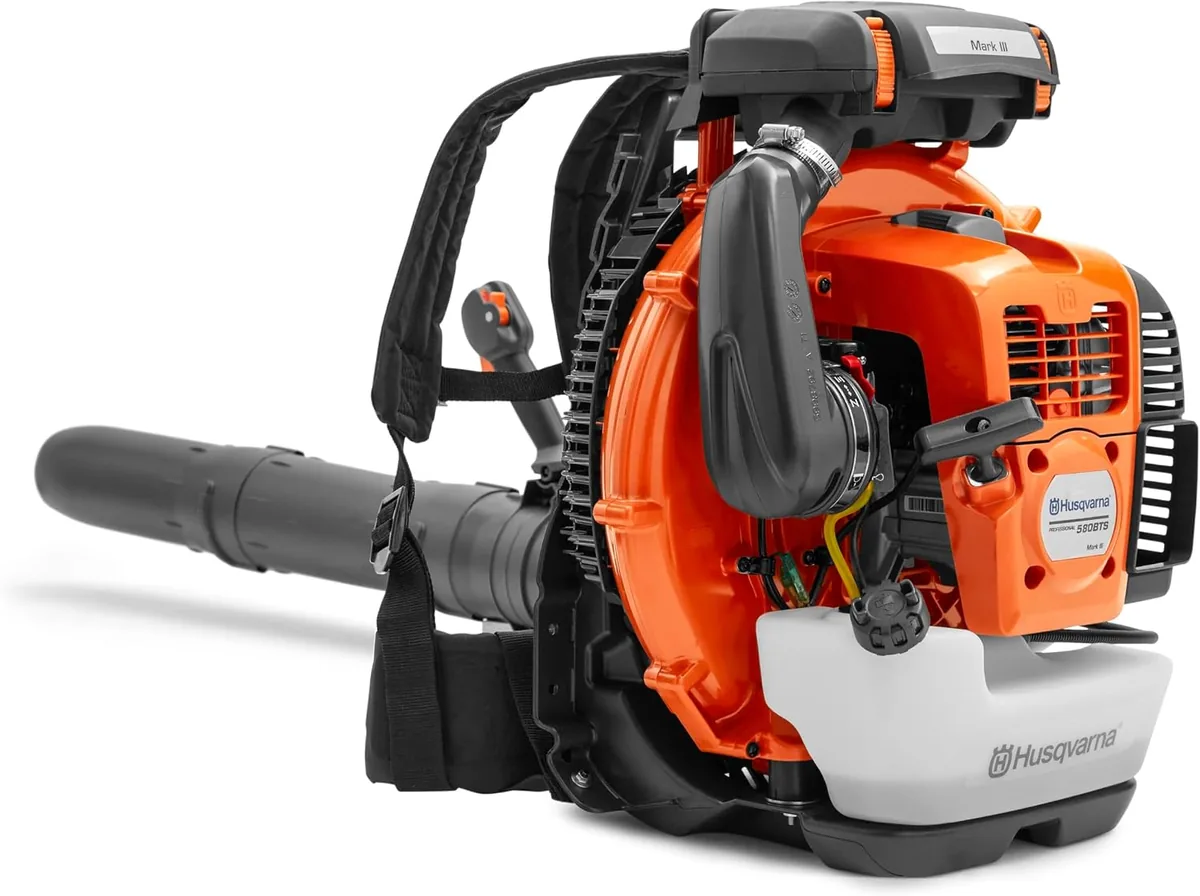
Husqvarna 580BTS Gas Backpack Leaf Blower Specs
Key Features:
- Padded hip belt and wide shoulder straps: The belt, with the waist belt and chest strap, moves part of the weight from the shoulders to the hips.
- Lever with set positions: Full throttle, one-third speed, idle and stop sit on one lever under the right hand, so a speed is a click and never a guess.
- Cruise control option: According to Husqvarna, the throttle has a cruise control option, which suits a long pass down a row.
- Round nozzle in the box: The standard nozzle behind the 220 mph rating gives a wide stream that stays near the ground when you hold it low.
- 87.92 fl oz tank: It is large enough for a long row, with the refill at the end of it.
- Vibration dampers: The manual asks you to check them daily, because they take the buzz out of a long session.
- Foam air filter: It washes in warm soapy water and dries with no oil, so a dusty morning costs a rinse and no new part.
Acorns ask for force first and a low jet second. The round nozzle in the box is the one behind the 220 mph rating, and 1,000 CFM is the airflow with that nozzle. The manual says to hold the nozzle close to the ground, use the whole pipe length to keep the stream low and rake or brush stuck debris loose first. At the full lever the apricot stones under the rows skipped ahead of the jet instead of rolling, which sent them farther than I wanted, and the lowest lever position that still moved them kept the stones in the row.
The manual says to fill the 87.92 fl oz tank to 80 percent, and on that fill Husqvarna’s fuel rate works out to about 58 minutes at maximum power. The weight is 26.8 lb without fuel and about 30 to 31 lb with fuel. The control handle sits under the right hand on the pipe, and the same lever that sets the speed also stops the engine.
The base of the apricot trunks is the second job and the limit of a round nozzle: stones lie against the bark, and the wide stream lifts mulch and soil crumbs with them, so I keep the jet off the tree bases and the young drip lines and rake the last foot by hand. The belt earns its place on the long alley between the rows. In November, with a jacket under the harness, the side straps needed another notch, because the manual says to tighten them until the machine sits tight against the body. An apricot stone is not an acorn, so I take these results as a rough guide.
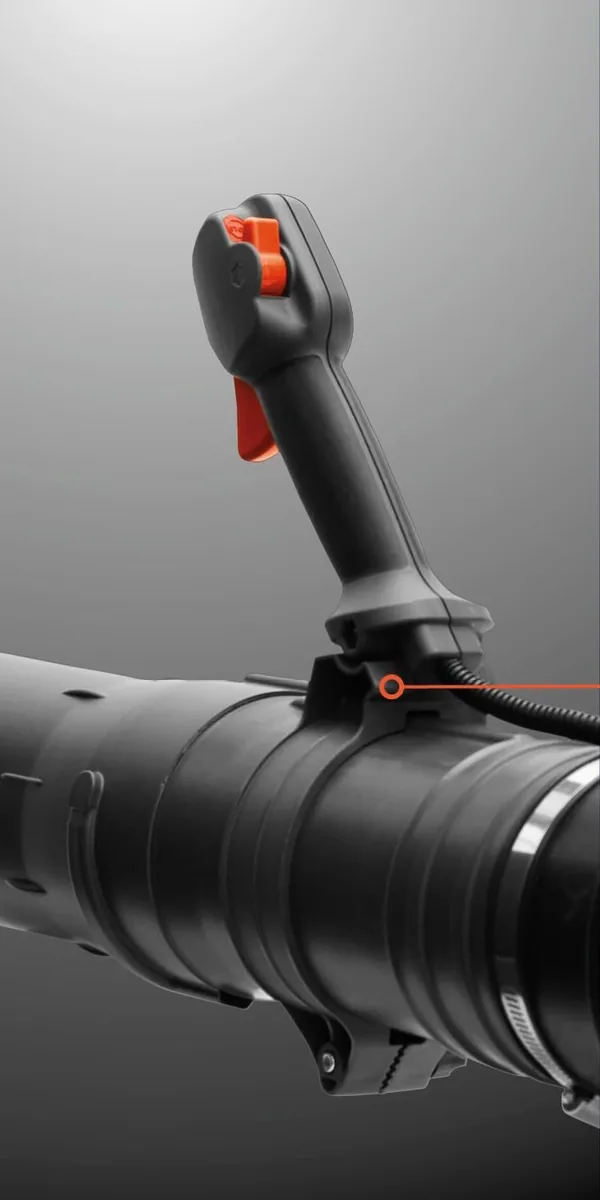
Rake or brush the nuts loose before you blow. Husqvarna’s manual gives that advice for stuck debris, and an acorn pressed into the grass is stuck debris.
WHY I CHOSE THIS
Mirko Lekić, Agricultural Engineer & Farm Owner
I rank the 580BTS second as the premium pick, because its force sits within a newton of the top maker figure on this page and the hip belt is why I can carry it for a whole afternoon. It is the premium blower I recommend when the rows are long.
Husqvarna’s manual for this backpack family warns that the blower can throw objects forcibly, that they can bounce back into the eyes, and that goggles must meet ANSI Z87.1 because a visor alone is not enough. Keep people and animals outside the 15 m (50 ft) zone, and because Husqvarna lists 106 dB(A) at the operator’s ear, wear plugs under earmuffs from the first minute.
Husqvarna’s manual calls for 50:1 unleaded gasoline mix with no more than 10 percent ethanol and no more than 30 days of mixed fuel. Refuel outdoors on flat ground with the engine stopped and cool, fill to 80 percent, then move away from the fuelling spot before you start. Starting means setting the blower on level ground, holding it with your left hand and pulling the rope slowly to resistance and then quickly, up to ten times. The manual asks for a new spark plug monthly and a monthly clean of the spark arrester screen, and the monthly plug is the chore that annoyed me most.
This blower suits someone who walks a big yard for an afternoon and wants the hips to share the weight. Skip it for a small lot, a quiet street, a dislike of mixing fuel and changing plugs, or a plan to chase nuts out of loose soil with a narrow jet. Husqvarna’s 2026 warranty chart lists 2 years for this series and sends service through an authorized servicing dealer, so ask who the seller is before you order.
FINAL VERDICT
The 580BTS takes second place with force within a newton of the top figure on this page and a belt that makes a long session bearable. It asks for monthly upkeep and full ear protection. The buyer it fits walks long rows and wants the hips to share the load.
It is the belted gas backpack I carry for long rows.
3. ECHO PB-2520 Gas Handheld Leaf Blower Best Value
The PB-2520 is the budget way to move acorns with gas: 15.8 N at the nozzle, according to ECHO, from a handheld that weighs 8.6 lb dry with its pipes. That sits at about 15 N, my own working floor for acorns, so it clears nuts lying on paths, decks, beds and short grass and does not dig them out of thick turf. It has the least push of the blowers on this page, and I rank it third for the buyer with one oak and a deck.
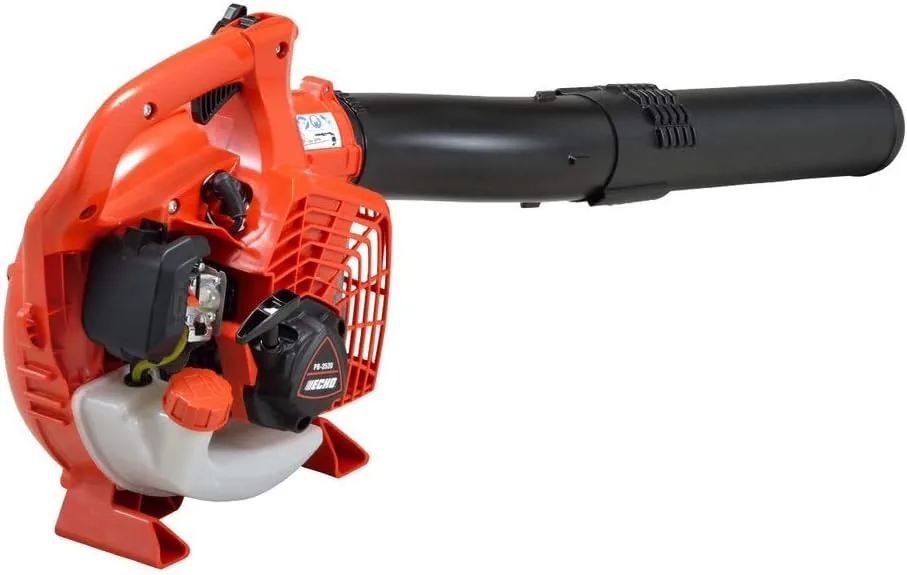
ECHO PB-2520 Gas Handheld Leaf Blower Specs
Key Features:
- Trigger and position lever: The trigger sets the push, and the manual says to set a steady engine speed with the lever for continuous use.
- Curved blower tube: ECHO says the curve gives rotational control and less fatigue, which matters when one arm holds the jet low.
- Double-grid air intake: ECHO says it reduces clogging and keeps clothing from interfering, which helps near brush and leaf litter.
- Tool-less air filter access: The cover opens without a screwdriver, so a dust check takes seconds between jobs.
- See-through tank: You read the fuel level from the side, which matters on a tank this small.
- Posi-Loc pipes: They lock the curved and straight pipes together, and the manual shows how to retighten the joint when use loosens it.
- Harness attachment points: A shoulder harness is sold separately and is not in the box, so you can take weight off the arm if you add one.
At 15.8 N the PB-2520 moves acorns that lie on top of a surface. In grass, acorns sink to the base of the blades, and the apricot stones that had sunk into the mown alley stayed put through the first passes, and only the ones lying on top rolled. I take those stones as a rough stand-in for acorns, which is my judgment and nothing more. ECHO lists 453 CFM and 170 mph with the pipes in the box, and its manual says to use more speed for lawns and flowerbeds, and never a higher setting than necessary.
ECHO lists 8.6 lb dry with the pipes, and a full tank brings that to about 9.5 lb. The tank holds only 18.6 fl oz, so refuelling comes often and you track it through the clear tank. The manual wants the engine run wide open at least five minutes every hour, because all-day low speed builds carbon on the spark arrester screen.
The concrete work pad in front of the machinery shed is the second job, and it is where this little blower works best. Boots and crate bottoms carry chips of crushed stone onto the concrete from the gravel yard. They sit on top the way nuts would, and a steady stream from the position lever rolls them to the edge faster than my rake does. The limit is the edge of the gravel, where the same stream starts moving stones I want to leave, so I stop at the concrete.
Give it the three minutes at idle that ECHO’s manual asks for before you open the trigger. Full power comes only once the engine is warm.
WHY I CHOSE THIS
Mirko Lekić, Agricultural Engineer & Farm Owner
I rank the PB-2520 third as the value pick for acorns on hard surfaces, decks, beds and short grass. It is the lowest-priced blower on this page and the one with the least push, and it sits right at my 15 N working floor, so I use it where nuts lie on top. This is the blower I keep for the pad and the paths.
Wear hearing protection from the first pull and eye protection that meets ANSI Z87.1, which is what ECHO’s manual asks for, and keep bystanders and pets 50 ft (15 m) away. ECHO rates the sound at 70 dB(A) at 50 ft, a bystander figure, so the level at your own ear is higher, and hard nuts fly, so I point the jet away from windows, cars and people and the hot exhaust away from my face.
A can of mix that dribbled once left a rainbow on the shed floor, so I now mix one small can at a time with a screw cap that I check, and I shake it before each use as ECHO’s manual says. The manual calls for a 50:1 mix, which is 2.6 fl oz of two-stroke oil per US gallon, in unleaded gasoline of 89 octane or higher with no more than 10 percent ethanol, and no more mix than you will use in 30 days. Refuel outdoors over bare ground with the engine stopped and cool, then carry the blower 10 feet from the fuelling spot before you start it.
Skip it if the lawn is full of acorns sunk into thick turf, because this is the weakest push on the page and it will not dig them out. It also lacks a harness in the box and needs a warm-up and frequent refuelling. It suits one oak over a deck, the paths, the beds and short grass. ECHO states 5 years consumer and 2 years commercial, and it covers only units sold by authorized ECHO dealers, so confirm the seller is an authorized dealer before you buy.
FINAL VERDICT
The PB-2520 gives you gas push in a light, hand-carried package at the lowest cost on this page. Buy it for one oak over a deck and a path, and skip it for a lawn full of nuts.
It is the budget gas handheld I keep for hard surfaces and paths.
4. Husqvarna 350BT Gas Backpack Leaf Blower Best for Home Use
The Husqvarna 350BT puts a gas engine on your hips at 22.5 lb dry, the lightest of the three backpacks on this page against 26 to 27 lb without fuel for the other two. According to Husqvarna it pushes with up to 21 N, about 4.7 pounds of force, which clears my working floor for acorns of roughly 15 N. That moves acorns lying on short grass, paths and a drive.
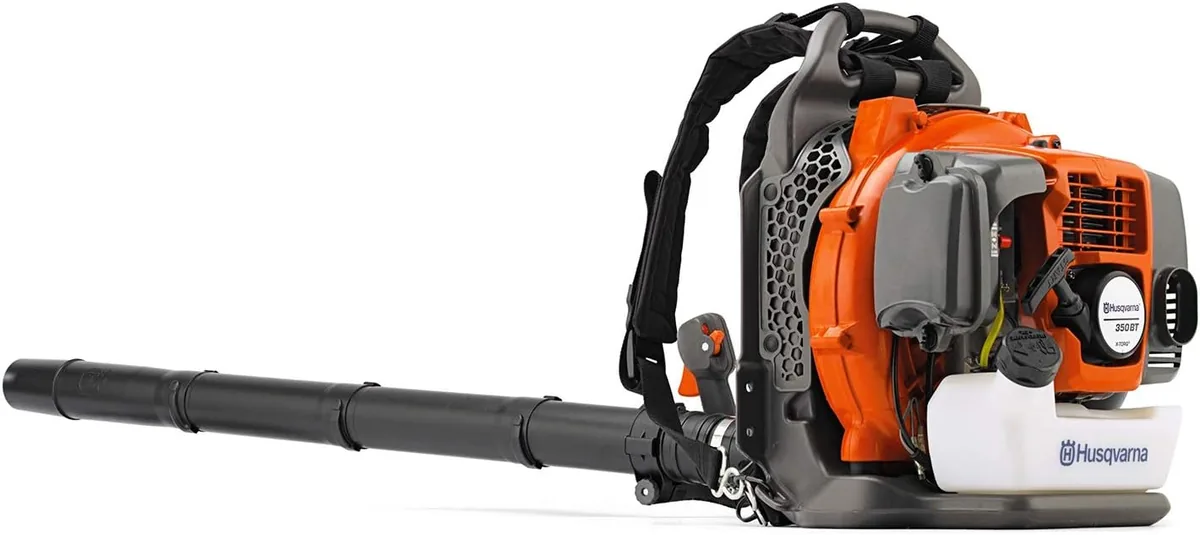
Husqvarna 350BT Gas Backpack Leaf Blower Specs
Key Features:
- Waist belt: Moves the weight from your shoulders to your hips.
- Full tube extension: Keeps the nozzle low while you stand upright.
- Control-handle throttle: Full, one third, idle and stop, all under the aiming hand.
- Round nozzle in the box: A broad 180 mph stream. The flat nozzle is an extra.
- Air purge bulb: Primes the fuel line, so a cold engine starts easily.
At the edge of my gravel yard, where stones crept into the grass, I keep the nozzle low. The round nozzle sends small stones out sideways in a spray instead of rolling them ahead, so the direction of the air matters as much as the push. Stones are not acorns, but they are hard, they roll and they settle into turf the same way, so they are my stand-in. The ones sunk into the grass stay put, and a rake finishes the job.
Husqvarna’s fuel rate works out to about 78 minutes from the 42.27 fl oz tank at full rated power, and a full tank adds only about 2 lb. With a handheld my arm carries the whole machine, and with the backpack it holds only the tube, so my forearm stays fresh far longer.
Husqvarna’s manual says to work with the wind. For hard seeds I also stand so they travel away from me over open lawn, never toward the house.
WHY I CHOSE THIS
Mirko Lekić, Agricultural Engineer & Farm Owner
I call the 350BT the best leaf blower for home use on this page because the hip belt puts the engine’s weight on my hips and its push matches what a home yard drops. It moves acorns on top of the grass, and I do not ask it to dig out nuts packed into the turf.
Stones and hard seeds leave the nozzle fast, so ANSI Z87.1 eye protection stays on and people, cars and windows stay out of the line of the air, with bystanders at least 50 ft away per Husqvarna’s manual. Plugs and earmuffs go on together at Husqvarna’s declared 94 dB(A) at the operator’s ear.
The mix is 50:1, and Husqvarna says to mix no more than a month’s worth. Refuel with the engine stopped and cool, then carry the blower at least 10 ft from the fuelling spot before you start it. The air filter and intake need a check daily, the plug and arrestor screen weekly. What annoyed me is the nozzle: the box holds a round one and the flat nozzle costs extra.
It suits an owner who wants a hip belt at a mid-range price on a quarter acre to an acre with a couple of oaks. Skip it if the nuts pack into thick turf across a large lawn, or if two-stroke mix and engine noise do not fit your yard. Keep your receipt, since Husqvarna handles warranty claims through its dealers.
FINAL VERDICT
Acorns on lawn, paths and a drive move under the 350BT, and nuts packed into thick turf wait for a rake. The buyer is the owner of a home yard with a couple of oaks who wants an engine’s reserve rather than a battery’s clock.
It is the hip-belted gas backpack I carry for a home-size yard.
5. EGO POWER+ LB7654 Cordless Leaf Blower Kit Best Cordless
The LB7654 is the cordless blower for acorns on decks, paths and short grass: no fuel to mix, no cord to pull, and a tapered nozzle in the box for a narrow 195 mph jet. The push is about 26 N on boost and about 16 N on high.
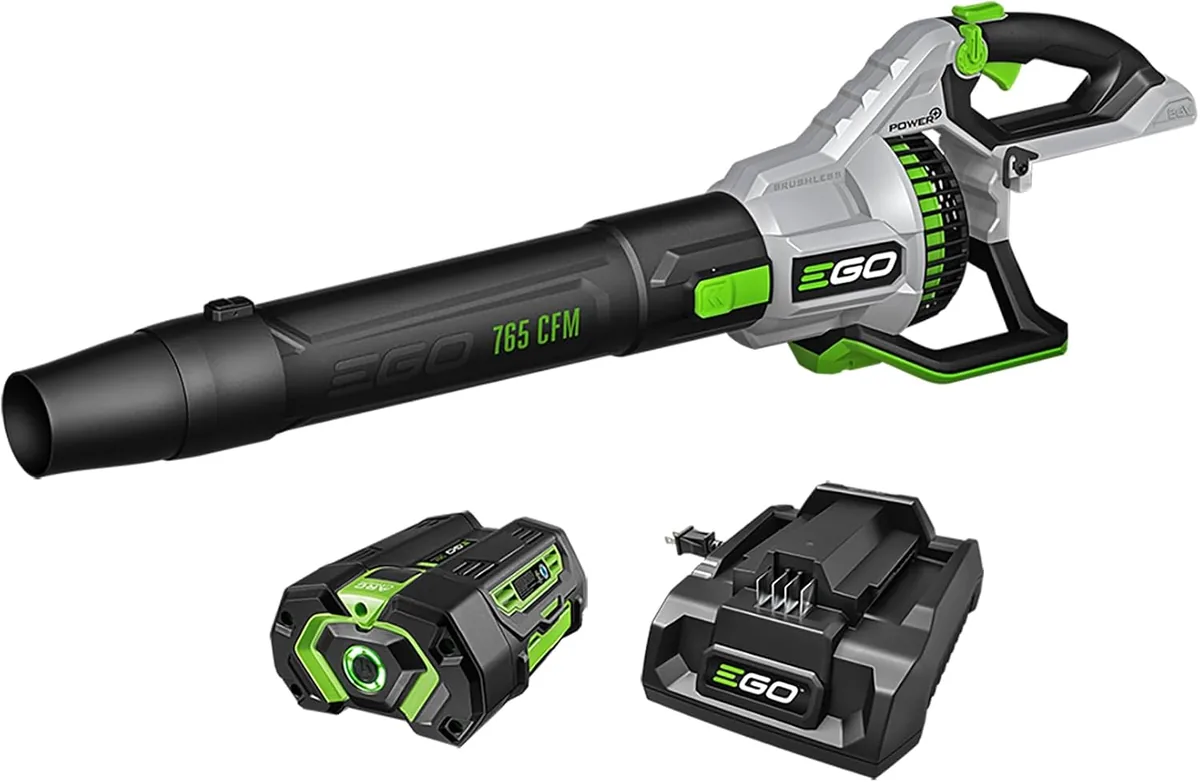
EGO POWER+ LB7654 Cordless Leaf Blower Kit Specs
Key Features:
- Tapered nozzle: Raises air speed from 166 to 195 mph for a narrow jet.
- Locking speed dial: Holds a gentle push near fittings and beds.
- Momentary boost button: Top push while you hold it. It never locks.
- Spread nozzle: A wider, softer stream for light debris.
- Variable-speed trigger: A feathered squeeze handles loose grit.
On high, about 16 N sits just above my own working floor of roughly 15 N, so the jet rolls nuts that lie on top and leaves the ones sunk into the turf. In the pit around the pump head on my irrigation line, grit washes into the hollow beside the disc filter, and I lock the dial low with the tapered nozzle so the grit leaves ahead of the jet and away from the fittings. I read that hollow as acorns in a dip of the lawn: dense things settle in the low spot.
According to EGO, the 5.0 Ah pack gives about 25 minutes on high and 15 on boost. Boost empties the pack fast, so I keep it as a reserve and work on the dial. A long session under big trees is a two-pack job.
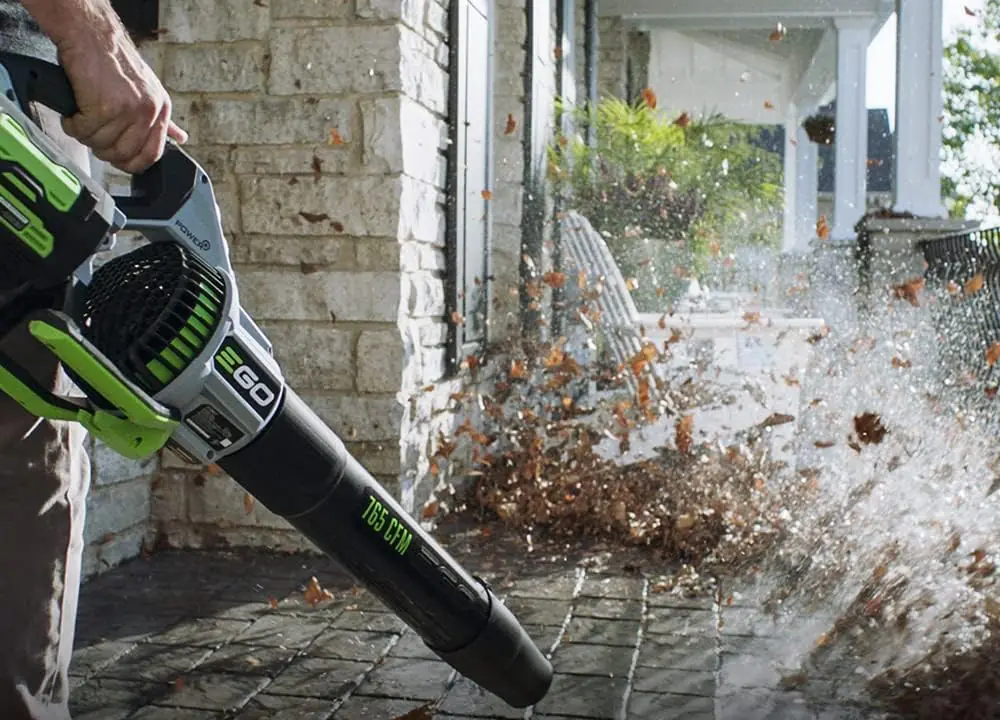
Keep the tube low and the angle shallow so the jet rolls the row ahead of you, since a steep angle digs into the turf and flings seeds sideways.
WHY I CHOSE THIS
Mirko Lekić, Agricultural Engineer & Farm Owner
I call the LB7654 the best cordless leaf blower on this page because it is the only blower here that runs from a battery: no mix to measure, no cord to pull, no exhaust beside the pump pit. The dial drops the push to a gentle level near fittings and raises it on open ground.
Hard seeds and grit leave the tapered nozzle fast, so ANSI Z87.1 eye protection stays on and people, cars and windows stay out of the line of the air, with bystanders 50 ft away per EGO’s manual. Hearing protection goes on whenever the fan runs.
EGO’s manual says never to set the running blower on loose ground, because the intake pulls in gravel and throws it. The weight is the price: about 9.6 lb with the battery, tool plus pack, and more than half is the pack behind my hand, which I feel when I reach down into the pit. Next to a gas engine the fan is a high hiss, and through my earmuffs I still hear the grit skitter ahead of the jet.
A house lot up to about half an acre, with a deck, a drive and a few trees, suits this kit. Skip it if the nuts lie thick across a big lawn, if you plan an all-afternoon session, or if nearly 10 lb in one hand is too much.
FINAL VERDICT
Boost makes the LB7654 strong for a few minutes and the dial makes it gentle for the rest. A thick carpet of nuts across a big lawn outlasts one pack. Pick it when you want a battery in place of an engine on a house lot.
It is the battery blower with the narrow jet in the box.
How to Choose the Best Leaf Blower for Acorns
An acorn is hard, round and heavy for its size, so the checks below start with push and end with protection. Seven checks decide the choice: force, nozzle speed, airflow, weight, run time, power type and what the jet throws.
Force at the Nozzle and Why Acorns Need Push
Force, measured in newtons, is the push of the jet at the nozzle. NASA’s page on thrust gives the principle: a jet’s force comes from how much air it moves each second and how much speed it gives that air (1). Volume and speed work together in that one number, which is why a leaf blower for acorns should be judged on newtons before CFM.
An acorn is dense and round, so it rolls more than it lifts and settles at the base of the grass. Under my plum rows the nearest thing I have to an acorn is a dried plum with its stone, which lies in the alley grass the same way, and the comparison with an acorn is my own judgment.
My working guide for acorns on grass starts at about 15 N. It is my own rule of thumb, no maker or standard sets it, and I use it to sort machines before I read anything else. Near that line a blower clears acorns from a deck, a path or a bed, and acorns settled in thick turf take many passes.
| Figure | What it tells you | What it leaves out |
|---|---|---|
| Force in newtons | The push of the jet at the nozzle, with volume and speed combined | The nozzle, the distance and the angle it was rated at |
| Air speed in mph | How fast the air leaves the nozzle, and so how hard a narrow jet pries | Volume, and whether the speed is for a round or a tapered nozzle |
| Airflow in CFM | How much air moves each minute, which helps a row of freed acorns travel together | Speed, and the pipes or nozzle the airflow was rated with |
Buyers often read a big CFM figure and expect the blower to dig acorns out of the grass, but a wide, gentle stream rolls leaves past them and leaves the acorns where they sit. Before you trust a newton figure, check three things:
- Whose figure it is: a maker’s rating comes from the maker’s own test and its own conditions.
- Which setting it was taken on: a boost button or full throttle is rarely the setting you will hold.
- Which nozzle it used: a round pipe and a tapered nozzle give different jets.
Air Speed Through the Nozzle You Use
Speed is what pries. NASA’s page on dynamic pressure says the force of moving air on an object grows with the square of the air speed (2), so a narrow, fast jet can shift a stubborn acorn that a slower, wider stream rolls past. A narrow nozzle raises speed and cuts volume, and that is the trade you are buying.
Always ask which nozzle a speed belongs to. According to EGO, its tapered nozzle lifts one cordless kit from 166 to 195 mph. Only one of the five kits on this page lists a tapered nozzle, and the others ship a round nozzle or plain pipes, so their makers’ speeds belong to those.
On the lawn by the house, hard seed pods sit in the grass until I drop the nozzle low and narrow the jet. Then they start to roll.
Pro Tip
Read the box for the nozzle before you read the speed. A tapered nozzle in the kit gives you a fast, narrow jet for a stubborn spot, and a kit with one round pipe gives you whatever that pipe does.
Airflow to Keep a Rolling Row Moving
Once the jet frees an acorn, airflow carries it. Airflow is the cubic feet of air leaving the nozzle each minute, and a steady, wide stream herds a row of freed acorns across the grass toward a tarp or the edge of a bed.
Makers rate maximum airflow and maximum speed under their own conditions, sometimes with different pipes or nozzles, so a box that lists both may describe two different setups. Read the CFM as how much air the machine puts behind a broad row, and read the speed and the newtons as what the jet can free. Once the pods on my house lawn start to move, I herd them and the twigs along the lawn to its edge and rake the row up before I mow, and it is volume that keeps that row travelling.
Weight and What You Carry for a Long Session
A long session under a stand of oaks turns weight into the deciding number. Strap forces and contact pressure at the shoulders and hips predict most of the discomfort people report when they carry a pack (3), so how a harness spreads the load matters alongside the pounds.
| Machine type | Weight you carry | What limits a long session |
|---|---|---|
| Gas backpack | About 22 to 27 lb dry, and about 2 to 4 lb more with a full tank | Your back and shoulders, so check for a hip belt |
| Gas handheld | About 8.6 lb dry with the pipes, and about 9.5 lb with a full tank | The wrist and arm, and a small tank |
| Cordless handheld | About 9.6 lb with a 5.0 Ah battery | Minutes on the setting you hold, and a pack that is over half the weight |
Hip belts are where the gas backpacks differ. Of the three here, two come with a hip belt that carries the load on the hips and one carries on shoulder straps alone, so ask what carries the load before you ask about the engine. The best backpack leaf blower for a long session is the one you can fit so that the weight sits on your hips. A blower that feels light at minute five feels heavy at minute forty, so I judge a harness by how it carries at the end of a section.
Run Time at the Setting You Will Hold
Run time changes with the setting, so only the minutes at the setting you hold count. Husqvarna’s manual says to use the lowest throttle that does the job, and the top setting is a reserve for a stubborn patch. I read a run time only for the setting I expect to hold.
According to EGO, a 56V handheld with a 5.0 Ah pack runs about 25 minutes on high and 15 on boost. The push drops when you leave boost: with no accessory nozzle fitted, that kit reads about 25 N on boost and about 16 N on high. A full tank on the three gas backpacks lasts about an hour or a little more at full throttle and longer at part throttle, and Husqvarna’s manual for the 580BTS says to fill to 80 percent, which shortens it.
Ask three questions of any run time before you rely on it:
- Which setting: the minutes at the setting you will hold.
- Which pack or tank: the amp-hours of the pack in the box, or the fluid ounces in the tank.
- What the cold does: a battery can give less on a frosty November morning than it did in October.
Gas, Battery or Backpack for This Job
Gas gives the most force on this page, and the choice follows the size of the job. The two handhelds weigh about the same ready to use, around 9.5 lb with fuel or with the battery, and both carry far lighter than any backpack here. The best gas leaf blower for a yard under several oaks is a backpack, because a tank keeps the push up for a full session, while a handheld kit suits a deck, a drive and a patch of lawn.
Gas machines differ on fuel mix, oil, starting steps and service intervals, so follow the manual of the machine you buy. As one documented example, ECHO’s manual for its backpack blower calls for a 50:1 mix of gasoline to its approved two-stroke oil and says to mix no more than 30 days of fuel at a time. At the end of the season I drain the tank and run the engine dry, so mixed fuel does not sit in the carburetor over winter.
Four habits keep a gas or battery machine safe and healthy:
- Mix: ratios, oils and fuel age limits differ by maker, so mix the way your manual says.
- Refuel: stop the engine and let it cool, fill outdoors, then carry the blower the distance your manual gives away from the fuelling spot before you start it. ECHO’s backpack manual says 10 ft.
- Exhaust: run a gas engine outdoors only, because the exhaust carries carbon monoxide.
- Battery: take the battery out before you clear a clog, and keep packs and chargers dry.
Eye and Ear Protection and What the Jet Throws
A fast jet turns anything hard into a projectile. In a US study of lawnmower eye injuries, about three quarters came from thrown projectiles such as grass, dirt and rocks, and only 2 percent of those cases were documented with eye protection (4). That study looked at lawnmowers, and the same lesson applies to a blower that throws hard seeds.
Blowing lifts dust as well: measurements of leaf blowing on real surfaces found fine-particle emissions from the ground (5), so a dust mask belongs in the kit on dry ground. NIOSH recommends 85 dBA over an eight-hour day and halves the allowed time for every 3 dBA more (6).
Makers print noise at different places, some at the operator’s ear and some as a bystander rating at 50 ft, so I compare each figure only with its own kind. Earplug fit matters too, because a Cochrane review notes that poor fit may limit protection for about 40 percent of users (7).
Gear for every session goes on before the engine starts:
- Eyes: safety glasses or goggles rated ANSI Z87.1, worn before the engine starts.
- Ears: hearing protection for every blower while it runs, and foam plugs under earmuffs together on a gas backpack.
- Lungs: a dust mask on dry ground.
- People: children, pets, parked cars and windows stay out of the line of the air.
I put my glasses on before I start the engine, and I look behind me for people and house windows before I open the throttle.
Safety First
Hard debris flies. Put on eye protection before the engine starts, wear plugs and earmuffs together on a gas backpack, and keep people, pets, parked cars and windows out of the line of the air.
Blower, Picker or Sweeper for Acorns
A blower herds acorns and a picker takes them up, and the right tool depends on how many nuts are down and where they lie. If your lawn is thick with fallen nuts, a rolling picker beats every blower on this page.
When a Picker or Sweeper Beats a Blower
A rolling acorn picker upper works on every nut it rolls over, so it fits a lawn full of fallen nuts, while a blower must herd the nuts into a row first. On short turf it rolls the nuts into a cage and drops them into a bucket, and it saves bending to pick them up by hand.
A lawn sweeper for acorns is pushed or towed and collects into a hopper, so it suits a large, flat lawn that is mown short. Short grass helps every one of these tools, and a blower works best on turf that has been mown low.
I pick up fallen fruit under the plum rows by hand, since a jet only pushes soft fruit deeper into the grass. Hard, dry litter is another matter, and a blower herds it into a row.
| Job | Tool I reach for | Why |
|---|---|---|
| A lawn thick with fallen nuts | Rolling picker | It works on every nut it rolls over |
| A big, flat lawn mown short | Lawn sweeper | It collects as it is pushed or towed |
| Nuts mixed with leaves and twigs | Blower, then a tarp or rake | The jet herds all of it into one row |
| A deck, a path or a drive | Blower on a low setting | They sit on top of a hard surface, so the jet sweeps them off |
| A few nuts in a bed | Hand picking | A jet strips mulch and stirs soil |
When a Blower Is the Right Tool
A blower wins where the nuts share the ground with leaves, twigs and dirt, on a deck, a path or a drive, along a fence line and around beds where a wheeled tool cannot go. It clears the leaves and herds the nuts in one pass, and it works with the wind at your back.
For lighter jobs than acorns, my other leaf blower guides cover dry leaves and small yards.
Best Way to Pick Up Acorns After You Blow Them
Blow with the wind at your back, keep the nozzle low and make one row along the edge of the grass. A tarp laid at the end of the row lets you lift the nuts and carry them, and a nut gatherer rolled over the row finishes what the jet started.
A wide lawn rake sweeps a row on turf when you use it like a broom. Collect often, since nuts left to sit can rot.
Why This Page Lists No Blower Vacuum
No blower vacuum is on this list, and the reason is in the makers’ own manuals: a vacuum impeller is built for leaves and soft litter, and an acorn is neither. Below is what each maker says about hard objects, first in vacuum mode and then in blow mode.
What the Vacuum Manuals Say
- Toro: its manuals for the family that includes the 51609 blower-vacuum say to vacuum only leaves and soft items, and name sticks, rocks, acorns and pine cones as objects that will damage the impeller. They also say never to vacuum nails, bolts, wires, staples or rocks, which can be thrown through the bag fabric.
- WORX: its manual for the WG512 and its sister models says not to vacuum solid objects such as wood blocks, large branches, broken glass, pieces of metal and stones.
- Greenworks: its manual for the 24322 40V blower-vacuum says to avoid large objects that could damage the impeller.
Toro names acorns as damage to the impeller, and WORX and Greenworks warn about solid and large objects. An acorn is a hard object, so my own rule for vacuum mode is leaves and soft litter only.
What the Blower Manuals Say About Thrown Objects
Blow mode throws hard debris instead of swallowing it, and the manuals of these blowers ask for eye protection and a clear zone around the operator.
- ECHO, PB-9010 manual: it carries the symbol ‘Beware of thrown objects’, asks owners to keep children, bystanders and pets outside a 50 ft radius, and says there is still a risk of injury from thrown objects beyond that zone. It also says to avoid blowing debris towards people, pets, open windows or vehicles, and to look over the area for stones and metal objects first.
- Husqvarna, backpack manuals: its manuals for the 350BT and 580BTS families warn that the air can move objects at such a speed that they bounce back and cause serious eye injuries. They ask for goggles rated ANSI Z87.1, because a visor alone is not enough, and keep people and animals outside a 50 ft safety zone.
- EGO, LB7654 manual: it says to keep bystanders and pets 50 ft away, to wear eye protection rated ANSI Z87.1, and never to set a running blower on loose ground, because the intake can pull in gravel and throw it.
- ECHO, PB-2520 manual: it calls for eye protection rated ANSI Z87.1, hearing protection, and bystanders and pets 50 ft away.
Line of the Air
Look past the nuts before you open the throttle. A fast jet over gravel throws stones as readily as it moves acorns, so aim along the ground and away from people, cars and glass.
My Overall Verdict
Force at the nozzle is the first number to compare across these five. The two gas backpacks print 48 and 47 N according to their makers, about three times my 15 N guide, and the other three suit lighter loads: a budget handheld at 15.8 N, a lighter backpack and a cordless kit.
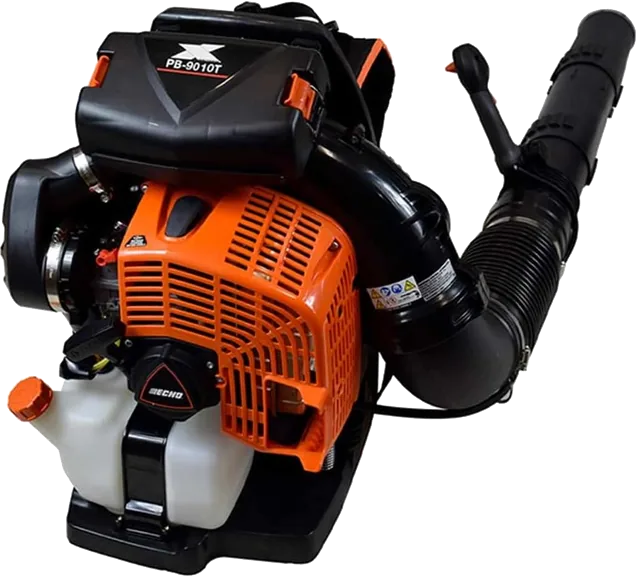
1. ECHO PB-9010T Gas Backpack Leaf Blower Best Overall
Best for a big yard under many oaks, with 48 N and 1,110 CFM according to ECHO, the most push and airflow here.
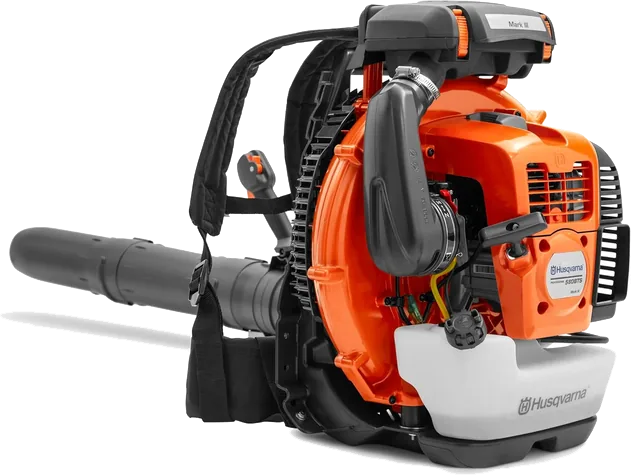
2. Husqvarna 580BTS Gas Backpack Leaf Blower Best Premium
Best for the same heavy work with a padded hip belt to carry the load, with 47 N according to Husqvarna.
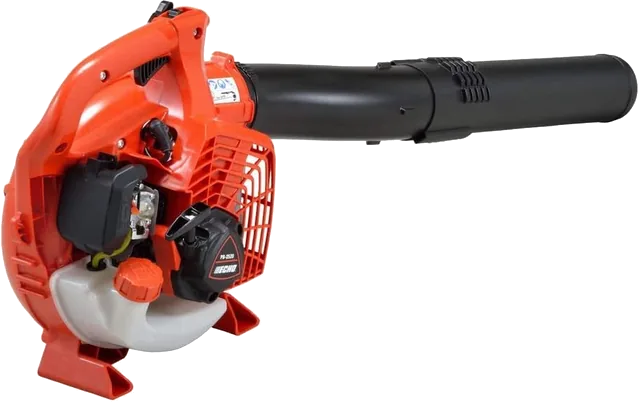
3. ECHO PB-2520 Gas Handheld Leaf Blower Best Value
Best for one oak and a deck: 15.8 N according to ECHO in 8.6 lb, enough for acorns on paths, decks and short grass.
On a big lawn under several oaks, the ECHO PB-9010T Gas Backpack Leaf Blower is the machine I recommend, because it has the most push and the most airflow on this list. Match the force to your grass and the weight to your back, and the machine you land on is the best leaf blower for acorns on your land.
Why ECHO PB-9010T Gas Backpack Leaf Blower Might Be the Best Choice
The ECHO PB-9010T Gas Backpack Leaf Blower is my best overall because it has the most push on this page, 48 N at the nozzle according to ECHO, and the most airflow at 1,110 CFM. A yard under several oaks needs force that carries a whole session.
The trade-off is carry and noise. It weighs about 26 to 27 lb dry depending on production run, and it carries on shoulder straps with no hip belt, and the 220 mph is for the pipes as shipped. I put plugs and earmuffs on together, and glasses with them, before the engine starts.
Here is what puts it first for acorns:
✓ Force: 48 N at the nozzle, according to ECHO, which is about 11 lb of push.
✓ Airflow: 1,110 CFM at the nozzle, according to ECHO, to keep a row moving.
✓ Speed: 220 mph for the pipes it ships with, according to ECHO.
✓ Tank: 83.8 fl oz, which lasts about 68 minutes with the throttle wide open.
✓ Control: a tube-mounted trigger with a cruise lever, so one hand sets the speed and aims.
Frequently Asked Questions
Can a leaf blower move acorns?
A leaf blower can move acorns when they lie on top of short grass and the jet has enough force at the nozzle, roughly 15 N or more by my own guide. Buried or soaked acorns need a low angle and a narrower nozzle, and a rake or roller finishes the job.
What is better for blowing leaves, CFM or mph?
Neither CFM nor mph is better for blowing leaves on its own, because force in newtons combines the volume and the speed of the air in one number. For acorns I choose by newtons first, then by the air speed through the nozzle I will use, and I read the CFM last.
Can a leaf blower also vacuum?
A leaf blower can also vacuum when it is a blower-vacuum or carries a vacuum kit, but the makers’ manuals tell owners to vacuum leaves and soft items only. Toro’s manuals name acorns, sticks and rocks as objects that damage the impeller, so I keep acorns in blow mode and out of the bag.
What is the best leaf blower to buy?
The best leaf blower to buy for acorns is the ECHO PB-9010T, which prints 48 N at the nozzle and 1,110 CFM, the most push and airflow on this page. For a smaller yard with fewer nuts, the EGO LB7654 is my cordless pick, with 26 N at most according to EGO and a battery and charger in the kit.
How to remove acorns from lawn?
To remove acorns from a lawn, blow them into a row with a low angle and a narrow nozzle, then lift the row with a tarp, a rake or a rolling picker. Keep the grass mown short before you start and collect the nuts often, since nuts left to sit on the ground can rot.
References
- NASA Glenn Research Center. Thrust Equation. Beginners Guide to Aeronautics. Updated June 10, 2026.
- NASA Glenn Research Center. Dynamic Pressure. Beginners Guide to Aeronautics. Updated June 28, 2024.
- Wettenschwiler PD, Lorenzetti S, Stämpfli R, Rossi RM, Ferguson SJ, Annaheim S. Mechanical Predictors of Discomfort during Load Carriage. PLoS ONE. 2015;10(11):e0142004.
- Stange NR, Jennissen CA. Lawnmower-Related Eye Injuries in the U.S., 2004 to 2023. Am J Ophthalmol. 2025;277:7-16.
- Fitz D, Pankratz D, Pederson S, Bristow J. A Semi-portable Enclosure to Measure Emission Rates from Small Fugitive Sources: Leaf Blower Dust Example. Aerosol Air Qual. Res. 2021;21(10):200566.
- National Institute for Occupational Safety and Health. Noise-Induced Hearing Loss. Noise and Hearing Loss. Centers for Disease Control and Prevention; 2024.
- Morata TC, Gong W, Tikka C, Samelli AG, Verbeek JH. Hearing protection field attenuation estimation systems and associated training for reducing workers’ exposure to noise. Cochrane Database of Systematic Reviews. 2024;5(5):CD015066.
Safety Note: Leaf blowers throw debris and can damage your hearing. Wear eye and ear protection, read the manufacturer’s manual, and check your local rules on noise and operating hours.