
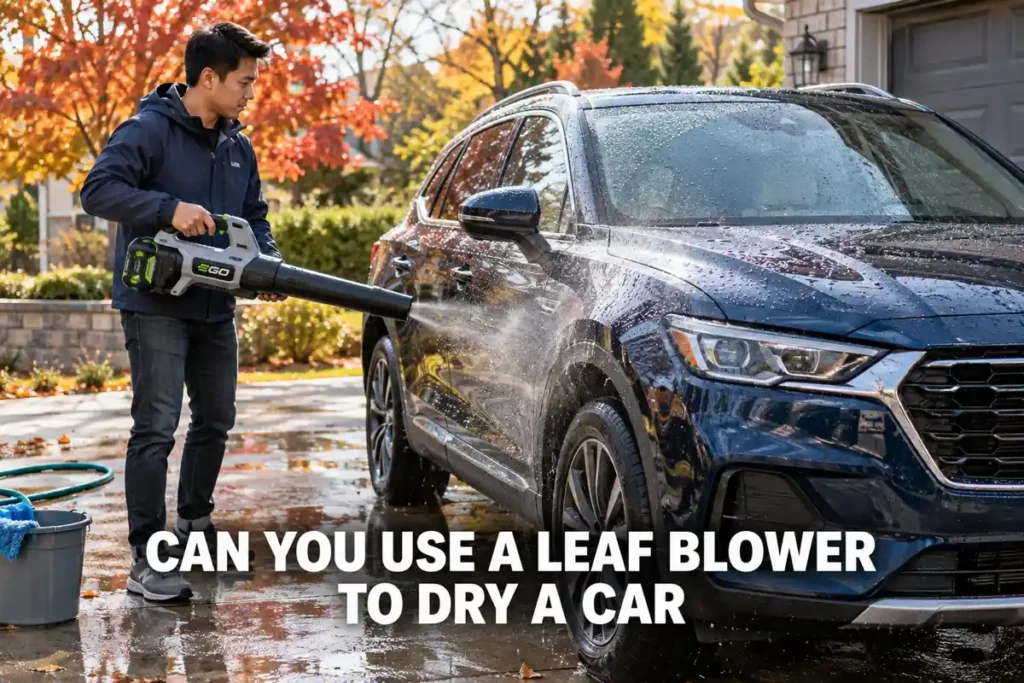
A leaf blower can dry a car without touching the paint: it takes off most of the water, and one clean towel takes the thin film and the last drops. The paint stays safe when the air is clean and the tip stays off the panels. Clean air means no gas exhaust and no dust thrown from the tube or the ground.
I fitted a 150-mesh disc filter at the pump head of my drip irrigation because grit ruins emitters, and I judge a blower near paint the same way, by what the air carries. Below: what drying without a towel does to the finish, what the blower adds to the air, which type fits, the steps and where water hides.
Can You Use a Leaf Blower to Dry a Car?
A leaf blower can take most of the water off a car with no towel on the paint, and that is its main advantage. A towel drags any grit left on the clear coat across the surface, while the air never touches it. Three conditions keep the method safe:
- Clean air: the tube mouth, the motor housing and the ground within reach all hold dust that moving air lifts onto wet paint.
- No gas exhaust: a two-stroke engine puts out exhaust with unburned oil, the wrong thing to blow at clean paint.
- A tip that stays off the panels: a nozzle that touches the paint, or knocks a mirror or trim, does more harm than the air.
I dry vehicles on the concrete work pad in front of my machinery shed and never on the gravel yard, because the yard dust is the first thing moving air would lift.
How Much Push Fast Air Really Has
The air itself is gentle on paint. Moving air presses on a surface with a pressure of half its density times its speed squared, so doubling the speed quadruples the push (1).
Take a blower with a 150 mph tip, about 67 meters per second. Half the density of air (1.2 kilograms per cubic meter) times 67 squared comes to about 2,700 pascals, or about 0.4 psi head-on at the tip. The push at a panel is smaller, because the jet slows with distance and meets the paint at an angle.
That is why the risk to paint sits in what the air carries and where the tip goes. My guide to what MPH means on a leaf blower explains the speed rating itself.
What Touch-Free Drying Does to Your Paint
Swirl marks are fine scratches in the clear coat, and towel drying is a common way they get there. A towel drags whatever grit is left on the panel across the surface, so the blower’s gain is the contact it removes. Coating researchers separate scratch damage from mar damage on clear coats (2). The industry-standard lab method for judging clear coat scratching includes a simulated car wash (3), so contact during washing counts as a scratch risk.
A blower does not remove grit that is already on the paint, because air only moves it around. The blower removes the contact, and the rinse before it removes the grit.
Why Water Spots Form and What a Blower Changes
USGS defines water hardness as the amount of dissolved calcium and magnesium, and it notes that hard water leaves spots and film on glassware (4). A bead on a door does the same thing: the water evaporates and the minerals stay behind as a spot. A blower takes the beads off before they dry, and that is its real gain against spotting.
| Class | Dissolved minerals |
|---|---|
| Soft | 0 to 60 mg/L |
| Moderately hard | 61 to 120 mg/L |
| Hard | 121 to 180 mg/L |
| Very hard | More than 180 mg/L |
Hardness varies across the United States, so ask your water utility for your number. A blower cannot remove minerals already on the paint, and a spot that has dried needs a spot remover or a polish.
What Your Blower Throws at the Paint
A blower moves whatever sits in its path, and dust reaches wet paint from three places: the tube, the housing and the ground. Gas exhaust adds a fourth. I check the tube and the housing before the air goes anywhere near the car.
Dust in the Tube and the Housing
After a season on the shelf in my tool shed, a blower tube holds chaff, dust and bits of dried leaf. Whatever sits in the tube leaves with the first seconds of airflow. The air enters through vents in the motor housing, and where those vents sit differs by model, so read your manual before you set a running blower on any surface.
Before the first pass I do this, and it lowers the dust risk without removing it:
- Run the blower for about ten seconds, pointed away from the car.
- Wipe the mouth of the tube with a clean cloth.
- Hold the blower in your hand from then on, and never set it down while it runs, because the vents can draw in whatever lies under the housing.
Dust From the Ground
Air that hits the ground beside a wet car lifts dust onto the panels. Researchers built an enclosure to measure the dust that leaf blowing raises from in-use surfaces, and they could measure it (5). I aim the air across the car, never down at the ground. Tires and wheel wells hold the most grit, so I blow them last and away from the dry panels.
Gas Exhaust and Noise
A gas blower is the wrong tool near clean paint. Two-stroke engines burn oil mixed into the fuel, and in a bench test of a portable two-stroke engine, carbon-based matter made up 85 percent of the particle mass, while the choice of oil changed what else came out (6). That test was not a blower on a car, but it shows what the exhaust carries. A gas engine also fills a closed garage with carbon monoxide, so a gas blower never runs indoors.
Noise is the other cost. In a community field test, two leaf blowers and a hose vacuum each measured 85 to 101 dB(A) at the point of operation (7). If you ever run a gas backpack, wear plugs and earmuffs together from the first minute.
Eyes and Ears
Wear safety glasses and ear protection with any blower, even for a quick dry. In U.S. lawnmower eye injuries, 77 percent came from thrown objects such as grass, dirt and rocks, and eye protection was documented in only 2 percent of those cases (8). I wear both whenever a blower runs, and my guide to using a leaf blower covers the full gear list.
Cordless, Corded or Gas for Drying a Car
For this job I rank the types in this order: cordless, corded, gas. The two electric types have no engine exhaust, but they can still throw dust from the intake, the tube and the ground. The table shows where each one runs short.
| Type | Exhaust | Weight | Main limit for this job |
|---|---|---|---|
| Cordless handheld | None | A few pounds to about 10 lb with the battery | Weight at arm’s length; a cold pack gives less runtime |
| Corded handheld | None | No battery to carry | Cord reach and cord drag; wet ground |
| Gas handheld | Yes, with oil | About 10 lb dry in the small class | Exhaust, oil film risk and noise |
| Gas backpack | Yes, with oil | About 22 to 27 lb | Too heavy and too loud to swing around a car |
Cordless
A cordless leaf blower has no exhaust, no cord to drag over the paint and no fuel to spill near it. Its limit is weight: a handheld that feels light at minute five feels heavy at minute forty, and holding it at arm’s length over a roof is a slow strain. Check the weight with the battery on before you buy.
Corded
A corded blower gives unlimited runtime, no fuel and no engine exhaust. The cord is the hazard, because it drags across dry panels and lies in puddles. Use an outlet with ground-fault protection, and read your manual before you use any plug-in tool on a wet driveway.
I hang the cord of the corded blower from my workshop over my shoulder and work away from the outlet, so it never touches the paint.
Gas
Gas loses on every count for a car. Exhaust with oil, noise, and a weight that makes even a small handheld awkward around a car body all point the same way. My old gas handheld stays in the shed for this job.
What to Look For in a Leaf Blower for Car Drying
A car needs control more than power. These are the features to check first, in this order:
- A variable speed dial or a low setting: you start gently and raise the speed only where water clings.
- A tube that comes off, or a short nozzle: easier to steer around mirrors and wheel arches.
- A soft or rubber tip: if the tip does touch, soft material marks the paint less than hard plastic.
- Light weight with the battery on: a lighter tool stays steady for the whole car.
- The air intake position: the manual shows where the air enters, and that side must stay clear of the ground.
- Lower noise: a quieter blower is easier to run for a whole car.
For a car, a blower you can slow down beats one you cannot. Power matters less here, and my guide on how powerful a leaf blower should be covers the sizing question for a yard.
How to Dry a Car With a Leaf Blower, Step by Step
This is the order I follow on the concrete pad, with one reason for each step.
- Move to shade. Sun and a hot panel dry the beads before you reach them, and dried beads leave spots.
- Finish with a free-flowing rinse. Take the nozzle off the hose so the water sheets off the panels and leaves fewer beads to blow.
- Run the blower check. Ten seconds away from the car and a wipe of the tube mouth clear loose debris out of the tube before the air meets the paint.
- Start with the roof and glass. Water runs down, so working from the top keeps drips off dry panels.
- Sweep in long, overlapping passes. Push the sheet of water toward the panel edge and off, one strip beside the last.
- Keep the tip off the paint. A hand’s width or more leaves room for a slip of the hand.
- Clear the mirrors, badges, grille, handles, jambs and gaps, then the wheels. Wheels and arches hold grit, so they go last, with the air pointed away from the dry panels.
- Wipe the leftovers. One clean, dry microfiber towel on the film and the drips that remain, with no pressure, finishes the job.
Dry Car With Leaf Blower: The Short Version
Shade, free-flowing rinse, blower check, roof first, tip off the paint, wheels last, one dry towel.
Distance and Angle on the Panels
I hold the tip at least a hand’s width from the paint, about 4 to 6 inches, and I tilt the air so it pushes the water toward the panel edge. With a stronger blower I back off further.
Where Water Hides on a Car
Water hides in the seams, and it drips out after you think the car is dry. On my car the mirror housings drip longest, so I clear the places in this table before the towel comes out.
| Place | Why water collects | How to clear it |
|---|---|---|
| Mirror housings | The housing and the gap behind the glass hold a pool | Aim along the gap, then repeat after a minute |
| Badges and emblems | Raised edges trap beads | Short bursts from the side |
| Grille | Slats and mesh hold water | Sweep slowly across, away from the car |
| Door handles | The cup behind the handle fills | Aim into the cup from the side |
| Door, hood and trunk jambs | Seals and channels collect runoff | Open the panel and blow along the seal, top down |
| Fuel door | The recess holds a pool | A short blast into the recess |
| Panel gaps | Narrow seams draw water in | Sweep along the seam |
| Lug nuts and wheels | Spokes and nut holes hold water | Do these last |
What a Leaf Blower Cannot Do
A blower is a drying tool with limits, and knowing them saves paint. It moves water, and it moves whatever dust the air carries, but it does not wash anything off the surface.
- Dried spots: minerals and etched rings stay until a spot remover or a polish takes them off.
- Road film and wax residue: air moves water and dust, and film needs a wash.
- Interior dust: a blower pushes dust into vents, electronics and sensors, so keep it out of the cabin.
- Warm air: a leaf blower gives no warmth to speed up evaporation.
- Lubrication: a drying aid leaves a slick surface for the towel, and air leaves nothing.
- Filtered air: most leaf blowers have no filter, which is why the tube check matters.
A dedicated car dryer blower gives filtered intake air at an adjustable speed, and it suits someone who dries cars often. It needs the same clean spot and the same tip distance. For a weekend wash on a clean pad, a cordless blower and one dry towel do most of the same work with tools you already own.
Dry the Car Without Touching It
Pick a clean, level spot, run the blower away from the car for ten seconds, wipe the tube mouth and keep the tip a hand’s width off the paint. Work from the roof down, clear the seams and mirrors, and leave the wheels for last.
My own tip is a folded dry microfiber towel in my back pocket, kept only for the drips that remain. For other jobs where a blower earns its place, see the leaf blower guides on this site. Used with clean air and the tip off the panels, a leaf blower takes most of the water off a car without a towel dragging across the paint.
Frequently Asked Questions
How to dry a car faster?
To dry a car faster, sheet the water off first with a free-flowing rinse, work in the shade and blow from the roof down. Use the blower for the bulk of the water and one dry microfiber towel for the drips that remain.
Which cordless blower is best for car drying?
The best cordless blower for car drying has a variable speed dial, a tube that comes off or a short nozzle, a weight you can hold steady and an intake you can keep off the ground. Match those features to your hands first and the brand second.
What is a good handheld blower for drying a car?
A good handheld blower for drying a car is an electric one: a cordless model moves freely around the car, and a corded model gives unlimited runtime when the cord reaches. Skip gas handhelds, because their exhaust carries oil and they run loud.
Can I use a leaf blower to dry my car?
You can use a leaf blower to dry your car when the air is clean, the engine is electric and the tip stays off the paint. Check the tube first, keep the blower off the ground and leave any gas model in the shed.
Is a leaf blower good for drying a car?
A leaf blower is good for drying a car when you want most of the water gone without touching the paint, and it reaches mirrors, badges and seams that a towel cannot. It leaves a thin film and a few drops, so finish with one dry towel.
References
- NASA Glenn Research Center. Dynamic Pressure. Beginners Guide to Aeronautics. Updated June 28, 2024.
- Seubert C, Nietering K, Nichols M, Wykoff R, Bollin S. An Overview of the Scratch Resistance of Automotive Coatings: Exterior Clearcoats and Polycarbonate Hardcoats. Coatings. 2012;2(4):221-234.
- Feng L, Benhamida BN, Lu CY, et al. Fundamentals and characterizations of scratch resistance on automotive clearcoats. Prog Org Coat. 2018;125:339-347.
- U.S. Geological Survey. Hardness of Water. Water Science School. Accessed October 12, 2026.
- Fitz D, Pankratz D, Pederson S, Bristow J. A Semi-portable Enclosure to Measure Emission Rates from Small Fugitive Sources: Leaf Blower Dust Example. Aerosol Air Qual. Res. 2021;21(10):200566.
- Tsai JH, Chen YR, Chen SJ, et al. Characteristics of Emissions from a Portable Two-stroke Gasoline Engine. Aerosol Air Qual. Res. 2020;20(3):630-642.
- Walker E, Banks JL. Characteristics of Lawn and Garden Equipment Sound: A Community Pilot Study. J Environ Toxicol Stud. 2017;1(1).
- Stange NR, Jennissen CA. Lawnmower-Related Eye Injuries in the U.S., 2004 to 2023. Am J Ophthalmol. 2025;277:7-16.
Safety Note: Leaf blowers throw debris and can damage your hearing. Wear eye and ear protection, read the manufacturer’s manual, and check your local rules on noise and operating hours.