
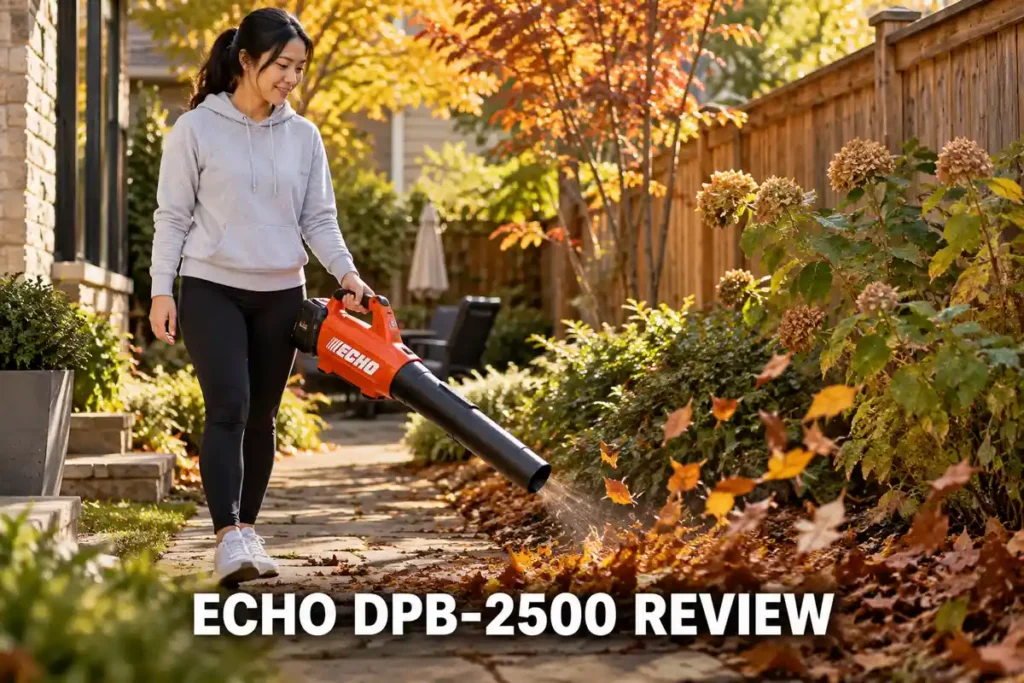
My Echo DPB-2500 verdict is short: buy the R2 kit for dry leaves, decks and small yards, and skip it for wet, matted leaves or a yard too big for one pack. It is a 56V handheld with a rated 17 N of blowing force and a pack that lasts about 30 minutes on high. Near the house I blow the 2,000-square-foot vegetable plot and the work pad in front of my machinery shed, and those short, dusty jobs are where this blower fits. Below I cover kits, setup, real jobs, battery, noise, warranty and the alternatives.
Affiliate Disclosure: Garden Power Scout is a proud participant in the Amazon Services LLC Associates Program. As an Amazon Associate, we earn from qualifying purchases, at no extra cost to you.
Echo DPB-2500 Review and My Verdict in Brief
I recommend the ECHO eFORCE DPB-2500R2 56V Blower Kit for dry leaves, clippings, dust and a swept deck, and I steer anyone with wet, matted leaves or packed gravel to a stronger blower. According to ECHO, it pushes with up to 17 N, about 3.8 pounds of force at the nozzle, and the 5.0 Ah pack runs about 30 minutes on high. You pay for that long, mild run with a stream too mild for a soaked mat and a tool that must stay out of the rain.
- Who it is for: homeowners with a deck, patio, garage or small lawn, and anyone who owns ECHO 56V batteries.
- What it does best: long, steady sweeping on a locked low speed, with a trigger start and no fuel to mix.
- Main trade-off: 17 N of force and no rain rating, so wet leaves and loose gravel are not its job.
Specs and What the Numbers Mean
Two rows decide most purchases: the force row and the run time row.
| Spec | Value |
|---|---|
| Airflow, maker’s figure | 549 CFM |
| Air speed, maker’s figure | 158 mph |
| Blowing force, maker’s figure | 17 N maximum (about 3.8 lb) |
| Battery in the R2 kit | 5.0 Ah, about 252 Wh |
| Run time on high, maker’s figure | About 30 min |
| Charge time, maker’s figures | 75 min on the Rapid Charger, 150 min on the standard charger |
| Weight with the 5.0 Ah pack | 9.5 lb |
| Weight, bare tool | 6.66 lb |
Makers rate CFM and mph separately, so read 549 CFM and 158 mph as two ceilings and not as one stream. Newtons measure the combined push, because the force of a jet depends on how much air moves and how much its speed changes (1).
Which Echo DPB-2500 Kit to Buy
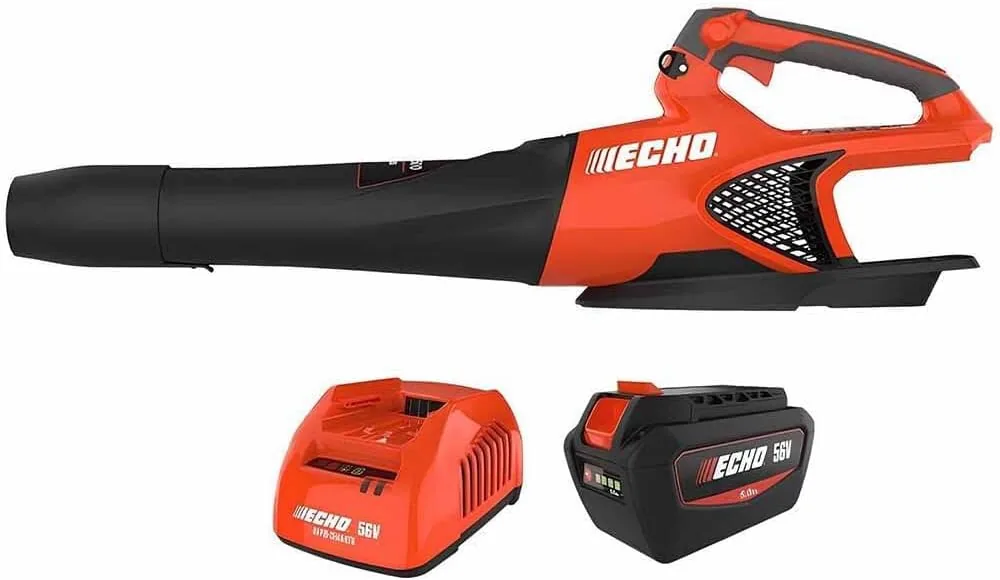
ECHO sells the tool in three versions: the DPB-2500BT bare tool, the C1 kit with a 2.5 Ah pack at 7.7 lb, and the R2 kit with a 5.0 Ah pack at 9.5 lb. The Echo DPB-2500 blower is the same in every version, so I mean the R2 here. I pick the R2, because 1.8 extra pounds buy double the minutes.
The R2 holds the blower, one pipe, one concentrator nozzle, the 5.0 Ah pack and a charger, with no strap and no wide nozzle in the box. As an Echo battery leaf blower this is the light-duty 56V handheld.
Owners with an ECHO 56V pack can buy the ECHO DPB-2500BT eFORCE 56V Handheld Blower (Tool Only) and skip the battery. Read the words tool only on that listing, since a bare tool arrives with no pack and no charger. The R2 listing sells through a third-party store and not ECHO’s own, so check the seller before you order, register the pack with ECHO and keep the receipt.
Setup and First Use
Setup needs no tools. I put the pack on the charger first and build the pipe while it fills, because the manual wants a full charge before first use.
- Charge the pack. The charger light blinks green while charging and stays green when done. Solid red means the pack is too hot or too cold, and charging works only between 39 and 104 F.
- Build the pipe. Slide the pipe on until the release button clicks, then lock the concentrator nozzle onto it.
- Check the gauge. Press the pack button: four green lights mean 80 to 100 percent, three mean 55 to 79, two mean 25 to 54 and one means 1 to 24.
- Seat the pack. Push it in until it clicks, with your finger off the trigger and the pipe pointed away from people. The blower starts only when you pull the trigger.
- Learn the controls. Pull the trigger to start the blower and raise speed, and release it to lower speed or stop. The cruise lever locks a speed, and the turbo button jumps to top speed until you press it again.
On the packed-soil paths between the raised beds of my vegetable plot, I pull the cruise lever clockwise to lock a low speed and my trigger finger relaxes. Turning the lever back by hand feels deliberate and not loose.
How the Echo DPB-2500 Performs in Real Work
ECHO’s guidance sets the range: low speed for dry leaves on walks, patios and drives, more for lawn and flower bed debris, and the highest speed for gravel, dirt and snow. With 17 N at the top, the jobs sort themselves by how much the debris weighs.
Dry Leaves, Decks and Paths
Dry leaves weigh almost nothing, so this is where the blower shines. On the work pad I run it on a low locked speed, which saves the pack and keeps dust down.
Lawn Clippings and Flower Beds
Clippings after a mow and spent plant litter on a bed need a little more speed, and the cruise lever holds it. I keep the stream low and away from young plants and mulched bases, because air strips mulch.
Dusty Shed Floors
The machinery shed floor is my dustiest job. I run a low speed to keep the dust down, and safety glasses, ear protection and a face filter mask go on before the first pull. The doors stay open.
Light Snow and Gravel Edges
The manual lists snow and gravel as jobs for higher speed, and this is where 17 N runs short. On my yard gravel the concentrator nozzle flicked a few stones off the crown and could not shift the packed crust at the edge. Keep the pipe low and away from windows and car paint.
Wet Leaves
Wet leaves are the job I hand to a stronger blower. Leaf litter from three tree species held about 2.4 to 4.2 times its dry weight in water in lab tests (2). Against that weight 17 N is a light push, so I pick a stronger blower for soaked mats.
Echo DPB-2500 Battery, Runtime and Charging
The Echo DPB-2500 battery in the R2 kit is a 5.0 Ah pack with about 252 Wh on its label. Turbo shortens the run, and the manual warns that the button drains the pack faster, so I tap it for one stubborn patch, like dried mud and chaff at the shed door, and tap it off again.
ECHO lists 75 minutes for a full charge on its Rapid Charger and 150 minutes on the standard Echo DPB-2500 charger, and the kit holds a charger, so confirm which one is in your box. A hot pack needs about 30 minutes to cool before it charges, and fast charging adds thermal stress that shortens cycle life (3).
A modeling study of lithium-ion cells held 36 months at 131 F and 90 percent charge found heavy degradation inside the cell (4). ECHO says to store a pack for over three months at three green lights, in 60 to 80 F and out of sunlight.
Noise, Weight and Care in Daily Use
Noise, weight and upkeep shape daily use.
Noise and Hearing Protection
ECHO gives no sound figure for the US model. The manual requires hearing protection and notes that noise rises with speed. A NIOSH study of 80 landscaping workers found 94 of 119 shift-long noise results at or above 85 dBA, with fuel-powered blowers giving significantly more noise than battery versions (5). Earplugs only work when they fit, and a Cochrane review notes that poor fit may limit protection for about 40 percent of users (6).
Protect Eyes, Ears and Bystanders
Wear safety glasses, hearing protection and, in dust, a face filter mask. Point the pipe away from people, pets and windows, and remove the pack before you clean the blower or clear a jam.
Weight and Comfort
The kit weighs 9.5 pounds with the 5.0 Ah pack against 6.66 for the bare tool, so by the end of a plot-and-pad session my forearm notices the pack. The dual air intakes let either hand hold the grip, so I swap hands when one forearm tires. Vibration is a separate matter: in one study of groundskeepers, the lifetime hand-arm vibration dose across all their tools ran about 30 times that of office workers (7), so short breaks on long jobs are sensible.
Care, Storage and the 56V Platform
Maintenance is close to nothing. Before each use I check the screws and nuts and look over the pack and its compartment. The air vent gets a vacuum cleaner and the plastics a moist soft cloth, with no filter, fuel or plug to service. This ECHO eFORCE 56V leaf blower takes only eFORCE 56V series packs, so it shares batteries with ECHO’s 56V tools, and a spare 5.0 Ah pack costs a large share of the kit.
Warranty
For home use ECHO covers the tool for 5 years and the battery and charger for 2, and commercial use gets 2 years on all three. Water, rain and snow damage is excluded. The label says household use only, so I read this as a homeowner blower.
Who the Echo DPB-2500 Suits and Who Should Skip It
It suits you if your work is dry and light, and you want a tool that stays out of your way:
- You clear dry leaves, clippings and dust from a deck, patio, walkway or garage floor.
- You want a trigger start with no fuel mix, or you already own ECHO 56V tools.
- Your yard is small enough that one pack of about 30 minutes at a mild 17 N covers the job.
Skip it if the job is heavy or the weather is wet:
- Your leaves are wet or matted, or your gravel is packed.
- Your yard needs more than one pack of about 30 minutes, or you work in drizzle.
Drawbacks and Trade-Offs
These are the real limits.
- Limited force. 17 N is a light push for wet piles, so rake them loose or pick a stronger blower for wet seasons.
- No rain rating. ECHO says to keep the tool away from moisture, water and rain and to store it indoors only, so a rainy day means putting it away.
- One narrow nozzle. The concentrator nozzle throws a narrow stream, so a wide strip takes more passes.
How the Echo DPB-2500 Compares With Alternatives
Four blowers sit around this one, and my leaf blower guides go deeper on each class. ECHO also sells a newer, pricier Echo DPB-2610 with the same 549 CFM and 158 mph rating on its page.
| Blower | Power | What sets it apart |
|---|---|---|
| EGO LB7654 kit | 56V battery | Second nozzle and an IPX4 splash rating |
| EGO LB6504 kit | 56V battery | 30 minutes on high from a 5.0 Ah pack |
| ECHO PB-2620 | Gas, 25.4 cc | Runs as long as the tank holds fuel |
| Greenworks 40V 500 CFM | 40V battery, tool only | Needs a Greenworks 40V pack |
The EGO LB7654 rates 26 N against the ECHO’s 17 N, so it is my pick when wet leaves or gravel are your hardest job. The LB6504 fits you if you want more push without a big jump in weight. The PB-2620 suits all-day run time if you accept the fuel mixing, and the Greenworks only fits owners who already have its 40V packs.
Common Problems and How to Avoid Them
Three things go wrong most often, and each has a quick remedy.
- Short run on the C1 kit. The 2.5 Ah pack lasts about half as long as the 5.0 Ah pack.
- Blowing without the pipe. ECHO’s manual calls for the full pipe configuration when blowing, so keep the pipe and nozzle on.
- No start or weak airflow. Seat the pack firmly or charge it, or remove the pack and clear the air inlet and pipe outlet.
My Recommendation on the Echo DPB-2500
I recommend the R2 kit to anyone whose hardest job is dry leaves, clippings, dust and a swept deck, and I send everyone with wet, matted leaves, packed gravel or a yard too big for one pack to a stronger tool. Wear eye and ear protection from the first pull. For a small, dry yard, the Echo DPB-2500 is the light-duty blower I recommend.
Frequently Asked Questions
Is ECHO a good blower?
ECHO makes a good blower in the Echo DPB-2500 for dry leaves, clippings, decks and small yards, where 17 N of rated force and about 30 minutes on high from the 5.0 Ah pack are enough. It falls short on wet, matted leaves and big lots, where a stronger 56V or gas blower finishes sooner.
Who manufactures ECHO leaf blowers?
ECHO Incorporated, based in Lake Zurich, Illinois, manufactures ECHO leaf blowers under the ECHO brand. The DPB-2500 itself is marked made in Vietnam in its manual, and ECHO backs it with a 5-year tool warranty and a 2-year battery and charger warranty for home use, with repairs through authorized ECHO dealers.
How loud is an electric leaf blower in decibels?
An electric leaf blower is loud enough to need hearing protection, and ECHO gives no sound figure for the US DPB-2500. The manual requires ear protection and says noise rises with speed, so wear earplugs or earmuffs from the first pull and keep bystanders well away from the debris path.
Which is better, a gas or an electric leaf blower?
An electric leaf blower is better for most small yards, because it starts with a trigger and needs no fuel mix. A gas handheld like the ECHO PB-2620, rated at 15.8 N, runs as long as its tank, while the DPB-2500 gives about 30 minutes on high per pack and needs no fuel.
Is it better to have more mph or cfm in a leaf blower?
Neither number wins alone, because newtons combine air volume and air speed into the push you actually feel at the nozzle. The DPB-2500’s 17 N rating is a better guide to what it can lift on a real yard than its 549 CFM or its 158 mph, which ECHO rates separately.
References
- NASA Glenn Research Center. Thrust Equation. Beginners Guide to Aeronautics. Updated June 10, 2026.
- Li Q, Choi H, Lee EJ, Im S. Experimental Analysis of Water Retention Characteristics in the Litter of Different Deciduous Trees. J Korea Soc Environ Restor Technol. 2016;19(2):83-93.
- Koo B, Yi J, Lee D, Shin CB, Park S. Modeling the Effect of Fast Charge Scenario on the Cycle Life of a Lithium-Ion Battery. J. Electrochem. Soc. 2018;165(16):A3674-A3683.
- Asiri M, Kedhim M, Jain V, et al. Impact of temperature and state-of-charge on long-term storage degradation in lithium-ion batteries: an integrated P2D-based degradation analysis. RSC Adv. 2025;15(28):22576-22586.
- Alexander BM, Graydon PS, Pena M, Feng HA, Beamer BR. Hazardous exposures and engineering controls in the landscaping services industry. Journal of Occupational and Environmental Hygiene. 2025;22(3):189-202.
- Morata TC, Gong W, Tikka C, Samelli AG, Verbeek JH. Hearing protection field attenuation estimation systems and associated training for reducing workers’ exposure to noise. Cochrane Database of Systematic Reviews. 2024;5(5):CD015066.
- Chen N, Yang S, Oh J. Evaluation of hand-arm vibration (HAV) exposure among groundskeepers in the southeastern United States. Annals of Work Exposures and Health. 2025;69(1):81-95.
Safety Note: Leaf blowers throw debris and can damage your hearing. Wear eye and ear protection, read the manufacturer’s manual, and check your local rules on noise and operating hours.