
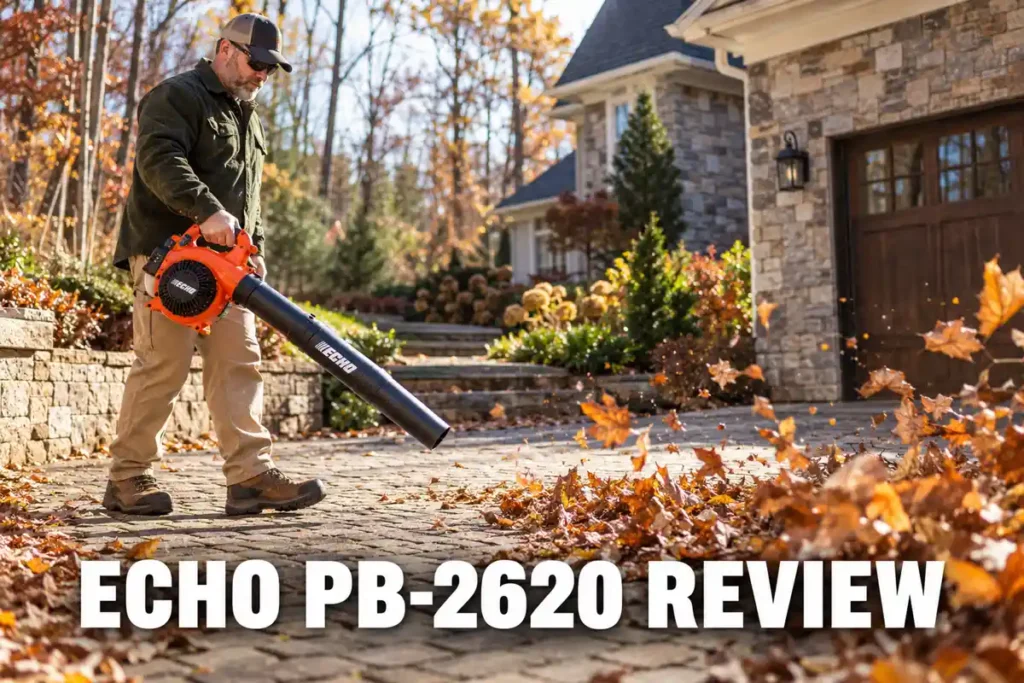
My Echo PB-2620 review comes down to one verdict: buy it for a house yard, paths and orchard strips that need more than a quick sweep, and skip it for soaked leaf mats and lots over an acre. Every autumn I clear the lawn around the family house and the paths to the sheds with a gas handheld, so I judge this one by its second handle, its two pipe ends and its upkeep. ECHO rates the 25.4 cc X Series blower at 456 CFM, 15.8 N of force and 9.8 lb dry.
Affiliate Disclosure: Garden Power Scout is a proud participant in the Amazon Services LLC Associates Program. As an Amazon Associate, we earn from qualifying purchases, at no extra cost to you.
Echo PB-2620 Review and My Verdict in Brief
I recommend the ECHO PB-2620 X Series Gas Handheld Leaf Blower for a quarter acre to about an acre of lawn, yard, paths and orchard strips. According to ECHO, the second handle, the rubber grip and the flat pipe are what its higher tier buys over the lighter PB-2520. It is a dry-debris machine that starts on a pull cord and runs on a measured 50:1 mix.
- Who it suits: owners of a quarter acre to about an acre who clear dry leaves, clippings, twigs and dry pods.
- The main trade-off: 9.8 lb dry, and 15.8 N that leaves deep wet mats to a backpack.
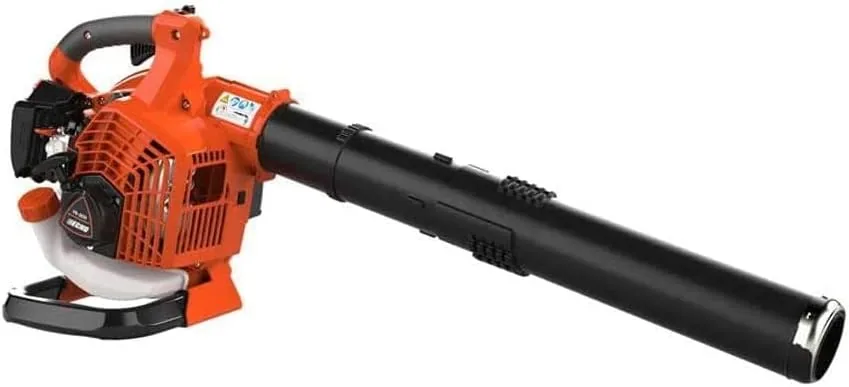
What the Echo PB-2620 X Series Handheld Leaf Blower Is and What Comes in the Box
X Series is ECHO’s product line name, not a spec. Over the lighter PB-2520, the Echo PB-2620 leaf blower adds a second handle, a rubber grip, a pleated paper filter with a foam prefilter, a chrome-plated cylinder and a third pipe.
The box holds the power head, three blower pipes, the warranty statement and a Quick Start Guide, according to ECHO’s manual. It holds no harness, fuel or hearing protection.
Echo PB-2620 Specs at a Glance
Force and weight decide the fit, and each pipe has its own line.
| Spec | Figure |
|---|---|
| Engine | 25.4 cc air-cooled two-stroke |
| Round pipe, maker’s figure | 456 CFM at 172 mph |
| Flat pipe, maker’s figure | 428 CFM at 180 mph |
| Blowing force, maker’s figure | 15.8 N, about 3.6 lb of push |
| Fuel tank | 20.3 fl oz, see-through |
| Weight with pipes | 9.8 lb dry, about 10.8 lb fuelled |
| Sound, maker’s figure | 70 dB(A) at 50 ft |
| Warranty, maker’s figure | 5 years consumer, 2 years commercial |
Setup, Break-In, Fuel Mix and Starting
Slide the upper pipe into the fan case until it clicks, slide the lower pipe over it, then hold the upper pipe and turn the lower pipe clockwise until it is firm, as the Echo PB-2620 manual shows. The pipes loosen with use, so turn the lower one clockwise again when it wobbles.
Fuel is unleaded gasoline of 89 octane or higher, mixed 50:1 with a two-stroke oil that carries both ISO-L-EGD and J.A.S.O. M345-FD certification. That is 2.6 fl oz of oil per US gallon, and ECHO says oil without both certifications voids the engine warranty. Up to 10 percent ethanol is approved, while E15 made small engines, a leaf blower among them, run leaner and hotter in a US Department of Energy test (1).
Mix only what you burn in 30 days, or 90 with a stabilizer. Refuel outdoors over bare ground with the engine stopped and cooled, and walk 10 ft from the fuelling spot before you start it.
New engines need two tanks of fuel before any carburetor adjustment, according to ECHO. I run those two tanks on the house lawn, where nothing is at stake, and afterwards I touch only the idle speed screw. Every other Echo PB-2620 carburetor adjustment belongs to an authorized dealer.
A cold start takes six steps:
- Move the stop switch away from STOP and set the throttle lever midway.
- Set the choke to COLD START.
- Press the purge bulb until fuel flows in the clear return line.
- On flat ground, pull the starter in short pulls of half to two thirds of the rope, up to 5 times.
- Move the choke to RUN and pull again if the engine has not caught.
- Warm up for 3 minutes, then squeeze the trigger gradually.
A warm start skips the choke. The stop switch never resets itself, so move it off STOP before the next pull.
Round Pipe or Flat Pipe, and What Cruise Control Means
According to ECHO’s manual, the round pipe gives 456 CFM at 172 mph and the flat pipe, which ECHO’s US page calls flared, gives 428 CFM at 180 mph. The flat end trades 28 CFM of air for 8 mph of speed, as a narrower opening does.
Force comes from how much air leaves the nozzle each second and how much it speeds up (2). ECHO rates the blower at 15.8 N, about 3.6 lb of push (3).
I use the round pipe on open lawn and paths, and the flat pipe along the outside wall of the tool shed, where pods and leaves pack into the corner between the wall and the concrete. ECHO’s page calls the throttle position lever cruise control: it holds an engine speed, and the trigger gives speed on demand.
Performance in Real Work, Job by Job
ECHO’s manual says to run the lowest speed that does the job, and these are all dry-debris jobs.
Lawns and the Pump Head
Before the first mow of spring I walk the house lawn with the PB-2620 and clear twigs and dry pods, so the mower does not throw them at my ankles. The wind at my back does half the work of carrying the debris to the edge.
Out in the open around the irrigation pump head, leaves and twigs collect against the 150-mesh disc filter, and there I run the flat pipe low at part throttle so grit does not fly at the filter.
Where It Runs Out of Push
A mat of soaked leaves needs more air under its leading edge than 15.8 N delivers, so I keep this blower off deep wet mats. Along a gravel edge I clear light debris at a low throttle and a shallow nozzle angle, because a steep angle throws stones. I keep people and windows out of the debris path on every job.
Fuel Use and Run Time per Tank
ECHO lists the tank at 20.3 fl oz, and it is see-through, so you can watch the level. The lowest throttle that does the job makes a tank last longest.
Run the engine at wide open throttle for at least 5 minutes every hour, because steady low speed builds carbon on the spark arrester screen, and inspect the screen after about 40 hours.
Noise, Weight and Vibration
ECHO rates the sound at 70 dB(A) at 50 ft, which is a bystander rating, and your ears sit at the engine. In a community field test, sound at 50 ft matched the makers’ ratings, while individual machines measured 85 to 101 dB(A) at the center of the work area (4). NIOSH recommends 85 dBA averaged over eight hours and half the time for every 3 dBA more (5).
Wear earplugs and earmuffs together from the first minute. Earplugs go in first and earmuffs go over them before I touch the choke, and I put on safety glasses and, on dusty ground, a dust mask. The exhaust is hot and holds carbon monoxide, so aim it away from your face and never run the blower indoors. That includes a shed or garage with the door open.
At about 10.8 lb fuelled, the Echo PB-2620 is a tool you hold for minutes at a time. ECHO’s manual warns of Raynaud’s syndrome and tells you to limit your hours. A study of 17 groundskeepers found lifetime hand-arm vibration doses 28 to 33 times those of office workers (6), so take breaks and change hands.
Maintenance Schedule and Winter Storage
- Before each use: inspect and clean the air filter, inspect the fuel system, clean the cooling fins, and check the rope, screws, nuts and bolts.
- At every refuel: inspect the fuel system for leaks.
- Every 3 months: replace a worn air filter, inspect the fuel filter and the plug (NGK BPMR8Y, 0.65 mm gap), and have a dealer inspect the muffler spark arrester.
- Every year: replace the fuel filter and the fuel cap gasket.
Clean a reusable filter with neutral detergent, never solvent. Dust on the cylinder fins causes overheating, and ECHO does not warrant that damage.
In December, before the blower goes on the shelf, I drain the tank and run the engine dry, following ECHO’s steps for storage over 30 days. That includes 7 cc (0.25 oz) of fresh two-stroke oil through the plug hole and a dry shelf with the pipes off.
Who Should Buy It and Who Should Skip It
Match the blower to the ground you clear.
Buy It If
- You clear a quarter acre to about an acre of lawn, paths and yard.
- You work around dusty ground and long sessions, where the filter and second handle pay off.
- You need a flat pipe for edges, corners and the edge of a gravel path.
Skip It If
- You face deep wet leaf mats, debris packed into gravel or lots over an acre.
- You dislike a pull cord, a warm-up and a measured fuel mix.
- Your town limits gas blowers, as a few cities do near 65 dBA.
Drawbacks to Know About
- Weight: 9.8 lb dry is a lot at arm’s length, and the harness is an add-on.
- Modest force: 15.8 N moves dry debris, and wet mats take many passes.
- Starting: a warm-up, a pull cord and a fresh 50:1 mix.
- Tier: it sits a step above the PB-2520 for the same engine.
How It Compares With Alternatives
My leaf blower guides cover the wider field.
| Blower | Force | Weight | Power | Consumer warranty |
|---|---|---|---|---|
| ECHO PB-2620 | 15.8 N | 9.8 lb dry | 25.4 cc gas | 5 years |
| Husqvarna 125B | 12.5 N | About 9.5 lb dry | 28 cc gas | 2 years |
| ECHO PB-580T | 22 N | 22.7 lb dry | Gas backpack | 5 years |
| EGO LB6504 | 21 N | About 9.7 lb with battery | 56V cordless | 5 years on the tool |
The ECHO PB-2520 Gas Handheld Leaf Blower has the same engine and 15.8 N and weighs 1.2 lb less, but it has no second handle or flat pipe, so pick it for short jobs and a lighter hold. Husqvarna rates the Husqvarna 125B Gas Handheld Leaf Blower at 12.5 N, so pick it only if you want an inline grip.
The ECHO PB-580T backpack gives 22 N and 517 CFM, so pick it for an acre or more. The EGO Power+ LB6504 650 CFM Blower Kit rates 21 N and needs no mixed fuel, so pick it for a small area and less noise.
Common Echo PB-2620 Problems and How to Fix Them
Fuel, air and heat cause most of the trouble, and ECHO’s troubleshooting chart names a cause for each symptom.
- Hard to start: an obstructed fuel strainer or line, a stop switch left on STOP, or a fouled plug. A muffler wet with fuel means the mix is too rich, so open the choke and clean the air filter.
- Starts, then dies: a dirty air or fuel filter, a plugged fuel vent from contaminated fuel, or a worn plug.
- Will not blow hard: dirty cooling fins, a plugged spark arrester screen, a dirty air filter or a throttle lever set low.
- Old or wrong fuel: mix older than 30 days, E15 or E85 causes poor running and power loss, so drain it and refill with fresh 50:1 mix.
Warranty for Home and Commercial Use
According to ECHO, the PB-2620 carries 5 years of consumer cover and 2 years of commercial cover, and the commercial wording covers agricultural and income-producing work. My orchard sells its fruit, so on my own land I assume the 2-year term.
The manual says warranty service must come from an authorized ECHO dealer with proof of purchase. Before you order, confirm that the seller on the listing is authorized, and register the blower.
Is the Echo PB-2620 Worth Buying?
Buy the Echo PB-2620 if you clear dry debris from a quarter acre to an acre and want a second handle, a flat pipe and a dust filter on a gas handheld. Skip it for deep wet mats and big lots. I reach for it on lawn, paths and orchard strips, and I accept the weight, the 50:1 mix and the noise as the price.
ECHO gives home users 5 years and agricultural or income-producing use 2 years, and my orchard sells its fruit, so I plan on 2. Buy from an authorized ECHO seller so the warranty applies. My Echo PB-2620 review verdict is a buy for a quarter acre to an acre of dry debris, and a pass for deep wet mats.
Frequently Asked Questions
What are the key differences between the Echo PB-2620 and PB-2520 models?
The key differences between the Echo PB-2620 and PB-2520 are a second handle, a rubber grip, a paper filter with a foam prefilter, a chrome-plated cylinder, a third pipe and a 20.3 fl oz tank against 18.6 fl oz. Both share the 25.4 cc engine and 15.8 N, and the PB-2620 weighs 9.8 lb dry against 8.6 lb.
Why does my Echo leaf blower only run with the choke on?
An Echo leaf blower that only runs with the choke on needs its fuel and air path checked first: the fuel strainer and line, the fuel filter, the fuel vent, the spark plug and the air filter. ECHO’s manual lists those causes for hard starting, and it sends other carburetor work to an authorized dealer.
How to adjust a carburetor on an Echo leaf blower?
To adjust the carburetor on an Echo leaf blower like the PB-2620, finish two full tanks of break-in, then turn the idle screw clockwise to raise idle toward 3,000 rpm, with a clean air filter and spark arrester screen. ECHO allows an owner no other adjustment, so a dealer handles everything else, including changes above 1,100 ft.
How do you turn on a gas leaf blower?
To turn on a gas leaf blower like the PB-2620, move the stop switch off STOP, set the throttle lever midway and the choke to COLD START, press the purge bulb until fuel flows and pull the starter up to 5 times. Move the choke to RUN, pull again if the engine has not caught, and warm up 3 minutes.
Why isn’t my leaf blower blowing hard?
A leaf blower that is not blowing hard usually has a dirty air filter, a plugged spark arrester screen, dirty cooling fins, a fouled plug, old fuel, a blocked pipe or a throttle lever set low. On the PB-2620, clean the air filter and fins first, then inspect the screen, which ECHO checks after about 40 hours.
References
- Knoll K, West B, Clark W, et al. Effects of Intermediate Ethanol Blends on Legacy Vehicles and Small Non-Road Engines, Report 1 – Updated. NREL/TP-540-43543; ORNL/TM-2008/117. National Renewable Energy Laboratory; 2009.
- NASA Glenn Research Center. Thrust Equation. Beginners Guide to Aeronautics. Updated June 10, 2026.
- Thompson A, Taylor BN. Guide for the Use of the International System of Units (SI). NIST Special Publication 811, 2008 Edition. National Institute of Standards and Technology; 2008.
- Walker E, Banks JL. Characteristics of Lawn and Garden Equipment Sound: A Community Pilot Study. J Environ Toxicol Stud. 2017;1(1).
- National Institute for Occupational Safety and Health. Noise-Induced Hearing Loss. Noise and Hearing Loss. Centers for Disease Control and Prevention; 2024.
- Chen N, Yang S, Oh J. Evaluation of hand-arm vibration (HAV) exposure among groundskeepers in the southeastern United States. Annals of Work Exposures and Health. 2025;69(1):81-95.
Safety Note: Leaf blowers throw debris and can damage your hearing. Wear eye and ear protection, read the manufacturer’s manual, and check your local rules on noise and operating hours.