
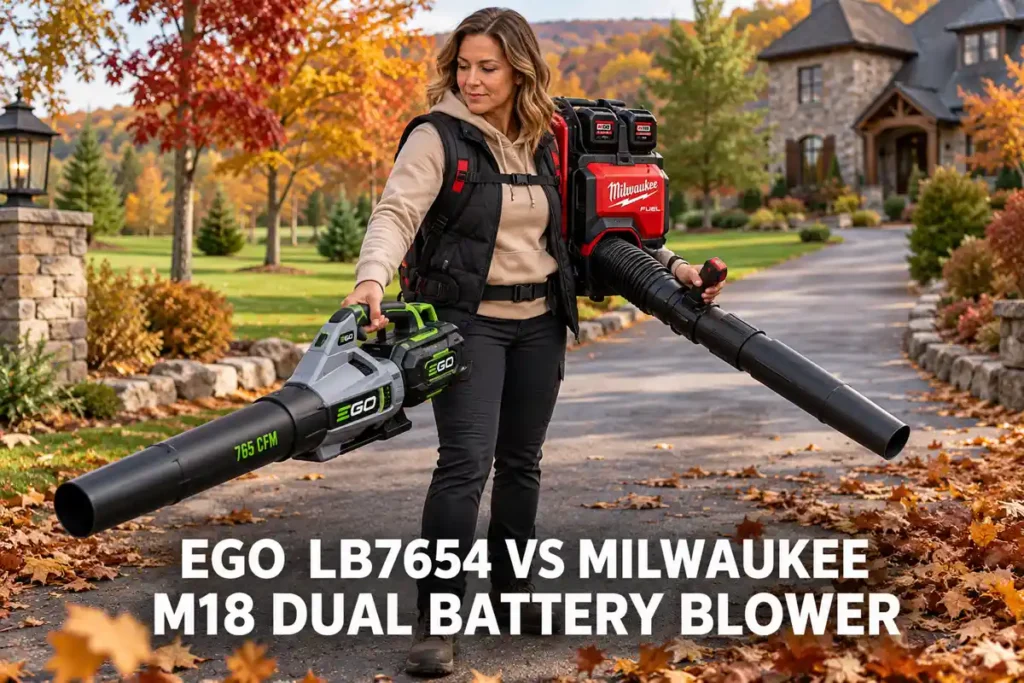
EGO LB7654 vs Milwaukee M18 Dual Battery Blower comes down to the box: the EGO is a working kit, and the Milwaukee 2824-20 is a bare tool that needs two batteries and a charger before it moves any air. For most buyers I pick the EGO, and the Milwaukee wins for a shed that already holds two High Output M18 packs and sweeps dry, hard ground. I keep a workshop and a machinery yard that already run on cordless tools, so I ask of every blower what the box leaves me to buy. I used both around the machinery shed and the farm yard, and below I compare force, runtime, weight and noise.
Affiliate Disclosure: Garden Power Scout is a proud participant in the Amazon Services LLC Associates Program. As an Amazon Associate, we earn from qualifying purchases, at no extra cost to you.
EGO LB7654 vs Milwaukee M18 Dual Battery Blower Short Answer
Buy the EGO LB7654 if you are starting without a battery platform. The kit holds the blower, one 5.0 Ah battery, a charger and two nozzles, and according to the makers it pushes up to 26 N where the Milwaukee tops out at 17.7 N. It also weighs about 1 to 3 lb less in your hand than the Milwaukee with its two packs fitted. Buy the Milwaukee 2824-20, the two-battery model, if you already own two High Output M18 packs and sweep dry, hard ground, because then the tool is the only thing you pay for.
Here is the EGO LB7654 vs Milwaukee M18 Dual Battery Blower spec sheet, with the battery or kit behind every figure named. Every Milwaukee figure belongs to the 2824-20, not to Milwaukee’s single-battery blower.
| Spec | EGO LB7654 kit | Milwaukee 2824-20 |
|---|---|---|
| In the box | LB7650 blower, one 5.0 Ah battery, CH3200 charger, tapered and spread nozzles | The 2824-20 blower; no batteries, no charger |
| Batteries behind the figures | The 5.0 Ah kit pack, about 280 Wh | Two 8.0 Ah High Output packs, about 288 Wh; two 12.0 Ah packs hold about 432 Wh |
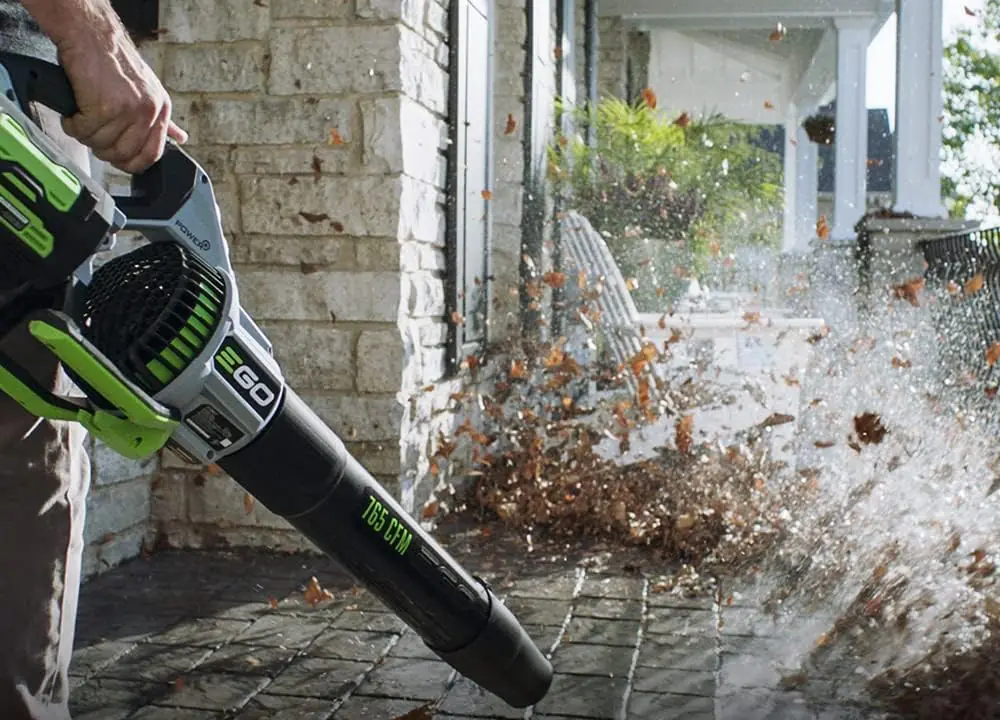
| Maximum airflow, maker’s figure | 765 CFM on boost | 600 CFM at full throttle |
| Air speed, maker’s figure | 195 mph with the tapered nozzle | 145 mph |
| Blowing force, maker’s figure | 26 N | 17.7 N |
| Push at the top steady setting | About 16 N on high (kit pack) | About 18 N at full throttle (two 8.0 Ah packs) |
| Push on boost | About 25 N (kit pack) | No boost |
| Runtime at the top steady setting | About 22 min on high (kit pack) | About 15 min at full throttle (two 8.0 Ah packs) |
| Runtime on boost | About 13 min per pack | No boost |
| Weight, tool only, maker’s figure | 4.6 lb | 6 lb |
| Weight with batteries fitted | About 9.6 lb with the kit pack | About 10.7 lb with two 8.0 Ah packs; about 13 lb with two 12.0 Ah packs |
| Rain and temperature, maker’s rating | IPX4 splash rating, 5 to 104 F | No use in rain, 0 to 125 F |
| Warranty, maker’s terms | 5 years on the tool, 3 on the battery | 3 years on the tool, packs under their own terms |
Two things decide it: the box, because a kit and a bare tool are different purchases, and the push on boost, where the EGO reaches about 25 N against the Milwaukee’s 18.
What Each Box Holds and What It Costs to Start
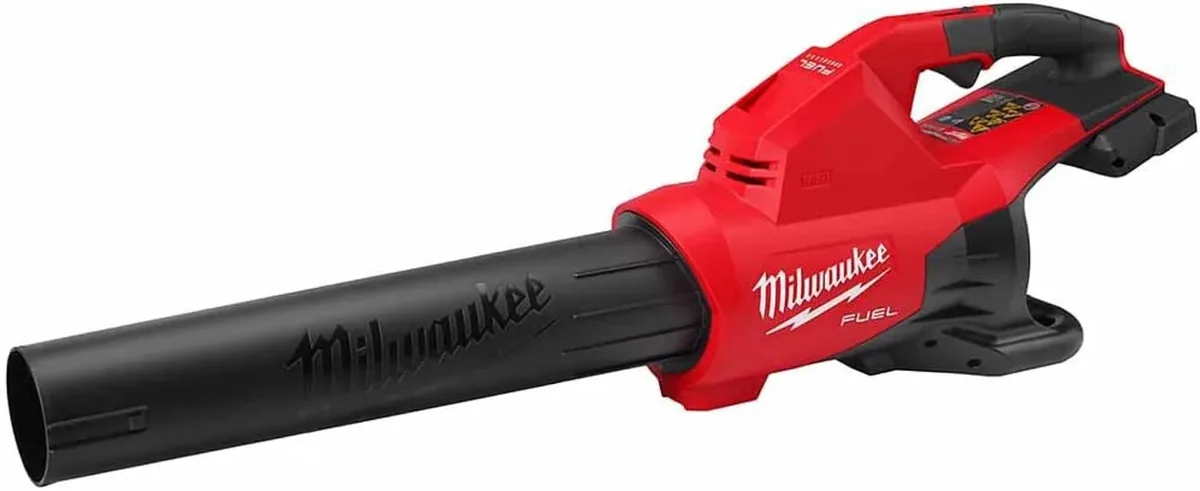
The Milwaukee M18 FUEL Dual Battery Blower 2824-20 is sold as a tool alone. The “-20” in the model number means no batteries and no charger. The blower will not run on one pack, and Milwaukee’s manual asks for two High Output packs of 8.0 Ah or more for best results.
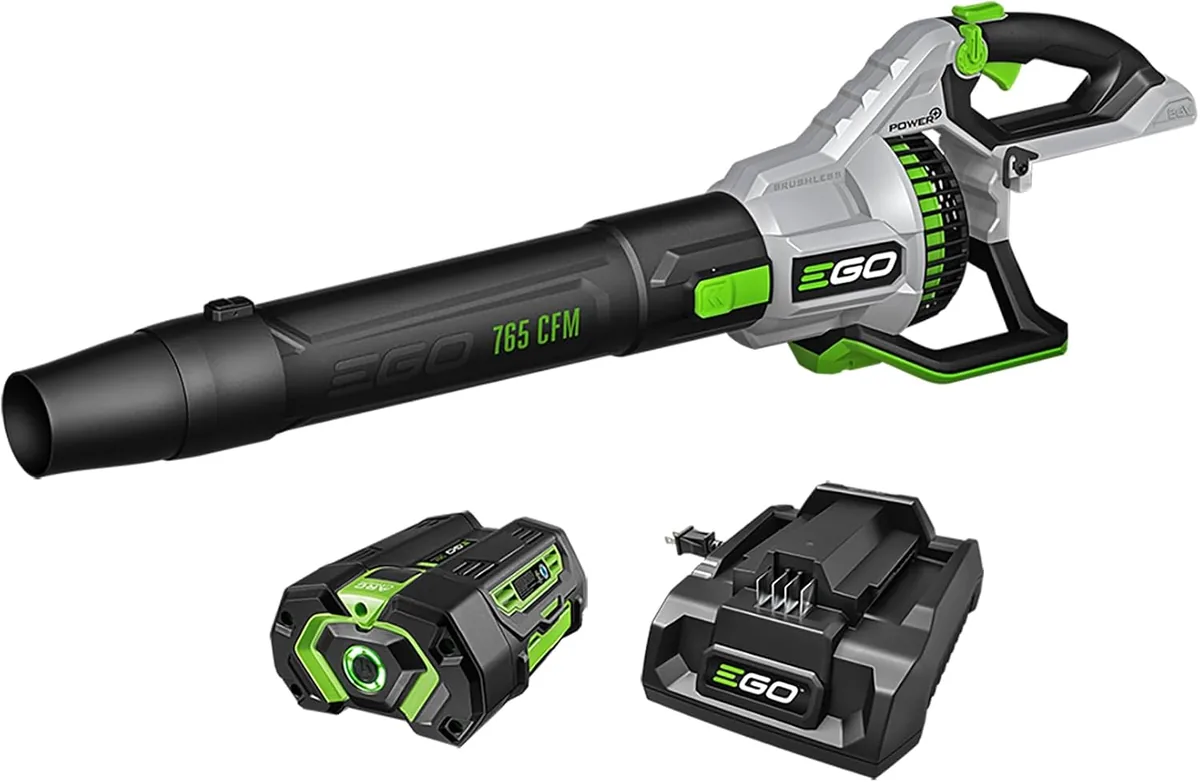
The EGO Power+ LB7654 765 CFM Blower Kit is the opposite: the LB7650 blower, one 5.0 Ah battery with a fuel gauge, the 320 W CH3200 charger, a tapered nozzle and a spread nozzle. EGO also sells the blower alone as the LB7650, which suits a buyer who already owns a 4.0 Ah or larger 56V battery.
The bare tool and the EGO kit sit in the same mid-range price tier, so on the page they look like the same money. The difference arrives with the packs. Two High Output M18 packs and a charger push the Milwaukee into the premium tier, while the EGO needs nothing more. A buyer who already owns two such packs pays only for the tool, and then the Milwaukee costs less.
My workshop drill and grinder run on one cordless battery family, and every tool I add to that family costs me the tool and nothing else. That is the whole case for a bare-tool blower.
Winner: the EGO LB7654 for a buyer with no battery platform, and the Milwaukee 2824-20 for an owner of two High Output M18 packs.
Airflow, Air Speed and Blowing Force
In the EGO 765 vs Milwaukee dual battery blower matchup, the box numbers favor the EGO on every line: 765 against 600 CFM, 195 against 145 mph and 26 against 17.7 N of rated force. One newton is about 0.225 lb of push, so 26 N is about 5.8 lb and 17.7 N about 4 lb.
In use, the picture is closer: the Milwaukee holds about 18 N at full throttle, which beats the EGO’s 16 N on high, and the EGO reaches about 25 N only on boost. CFM and top mph come from different nozzle set-ups and never occur together. Newtons match what the stream does.
That gap showed on the machinery shed wall. After rain the wind packs leaves into a drift along the foot of the wall, and on high the EGO only skated over the top layer. A press on boost lifted the drift’s edge and rolled it out, and that is the job boost is for.
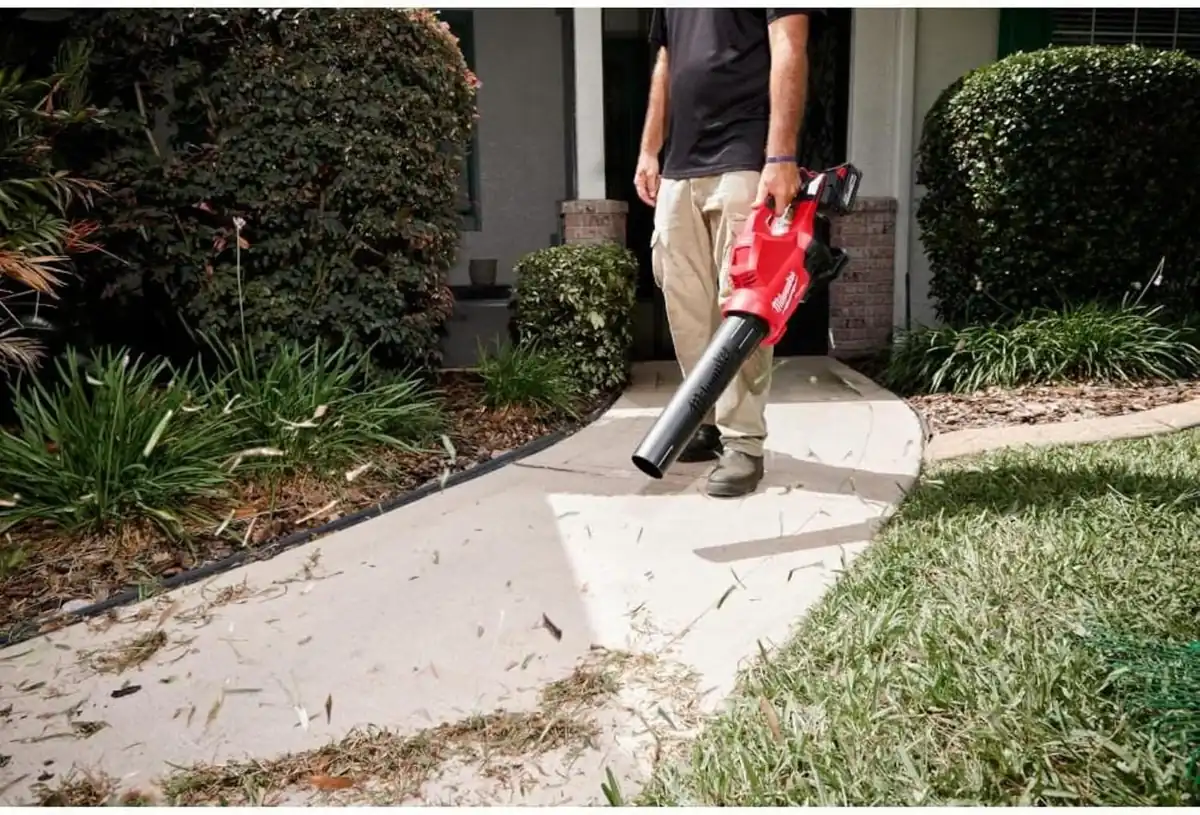
The Milwaukee earned its place on dry work. Chaff and dried mud on the concrete pad in front of the machinery shed went off at full throttle with no boost to reach for. The push stayed even to the end of the pad.
Winner: EGO LB7654, because boost reaches about 25 N against the Milwaukee’s 18, though the Milwaukee is stronger on high.
EGO vs Milwaukee Battery, Runtime and Charging
Judged by energy, the packs are close: the EGO kit pack holds about 280 Wh, and two 8.0 Ah M18 packs hold about 288 Wh. Two 12.0 Ah packs hold about 432 Wh, and that is where the Milwaukee pulls ahead.
At the top steady setting the EGO ran about 22 minutes on high, against about 15 minutes for the Milwaukee at full throttle on two 8.0 Ah packs. The Milwaukee pushes harder at that setting, about 18 N against about 16 N, so the longer EGO run is a note and not a win. According to Milwaukee’s chart, full throttle lasts 17.5 minutes on two XC8.0 packs and 26 minutes on two HD12.0 packs.
Boost eats the EGO pack: about 13 minutes of boost against about 22 of high, because the fan draws far more power at the top. Lower on the dial, the Milwaukee stretches to about two hours at the middle setting on two 8.0 Ah packs, and EGO lists 150 minutes on low. Those settings push very differently, so I compare the two blowers only at the top steady setting.
- Flat pack: the Milwaukee stops when either pack runs flat, even if the other still holds charge, and its gauge shows the weaker pack. Milwaukee says to pair two packs of the same type and charge both first. I charge both packs before the job and keep them as a matched pair.
- Cold: EGO says to use its blower between 5 and 104 F. A pack below about 50 F may pulse for its first minute while it warms, so on frost mornings I carry the pack in from the workshop and fit it at the door. Milwaukee’s range runs from 0 to 125 F.
- Charging: the EGO kit charges in about 70 minutes on its CH3200, according to EGO. The Milwaukee box has no charger, so the wait depends on the one you buy. A one-port charger fills the packs one after the other.
Pack care matters more with two big packs. In cell-ageing tests, the depth of each discharge and the charge window both changed how fast capacity faded (1). A model of 36 months of storage at 131 F and 90 percent charge found the electrolyte’s conductivity fell by more than 20 percent (2). I store packs part charged in the workshop.
Winner: one-pack jobs go to the EGO LB7654, and long steady sweeping goes to the Milwaukee 2824-20 with two 12.0 Ah packs.
Weight and Balance in the Hand
The EGO is lighter in every pairing. The bare tools weigh 4.6 lb against 6 lb. With batteries fitted, the EGO kit comes to about 9.6 lb. The Milwaukee reaches about 10.7 lb on two 8.0 Ah packs and about 13 lb on two 12.0 Ah packs.
About half of the EGO’s weight sits in the pack behind the grip. On a long pass along the shed wall I rested the tool against my hip between runs. On the Milwaukee with 8.0 Ah packs, the extra pound showed in my forearm along the shed wall.
Hand-arm vibration is low on handheld blowers. In a study of 17 groundskeepers, handheld blowers measured about 1.9 m/s2 at the right hand, yet the group’s lifetime vibration dose was 33 times that of office workers (3). Low vibration does not make ten pounds held out in front of you easy.
Winner: the EGO LB7654, by about 1 lb against two 8.0 Ah packs on the Milwaukee and about 3 lb against two 12.0 Ah packs.
Controls and Weather
The EGO has a variable trigger, a lock-on dial and a boost button you hold. The Milwaukee has a variable trigger and a center slider that sets a speed with either hand, and Milwaukee says it reaches full throttle in under a second.
I set the Milwaukee’s slider once for the shed floor and then worked the trigger with either hand. When I switched hands halfway down the wall, the slider stayed where it was. On the EGO the dial sits on the left, and the boost button needs the thumb for as long as it is held.
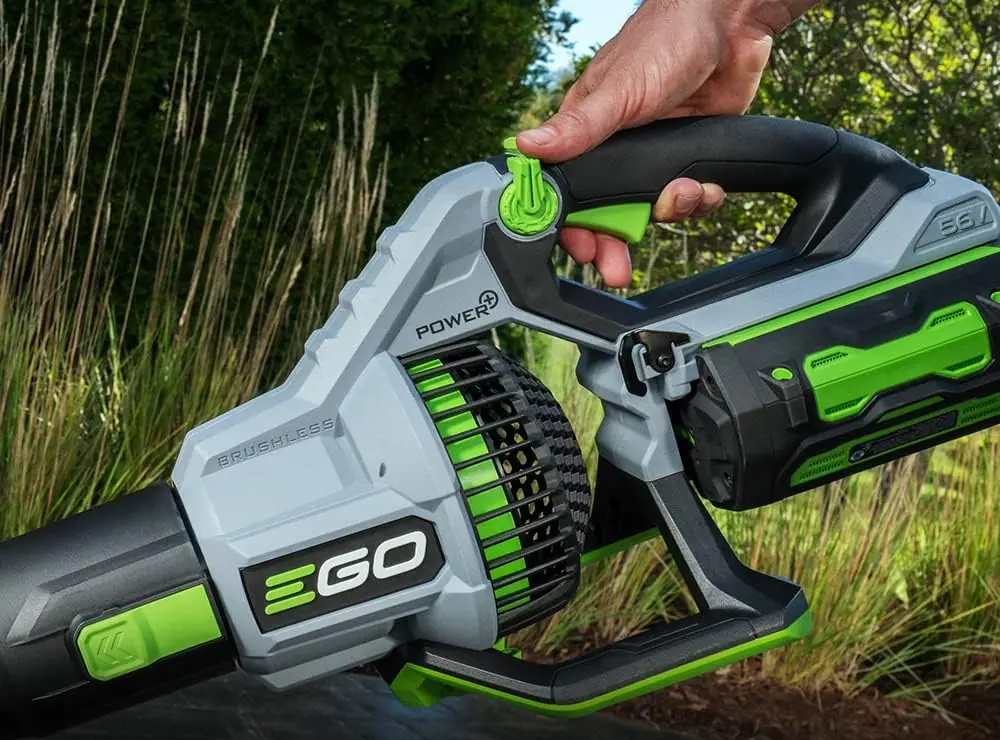
Weather splits them. EGO rates its blower IPX4, which covers splashes, and the Milwaukee manual forbids use in rain or wet locations. On a drizzly morning I finished the yard with the EGO, and the Milwaukee stayed on the shelf until the pad dried.
Winner: a split, with the EGO LB7654 ahead on wet mornings and the Milwaukee 2824-20 ahead on the ambidextrous slider and the wider temperature range.
Noise and Hearing Protection
Neither maker gives a fair noise comparison. Milwaukee rates the 2824-20 at 64 dB(A) measured 50 ft away, and EGO publishes no rating at all. At full throttle the Milwaukee reads about 81 dB(A) at the operator’s ear, and EGO gives no figure to set beside it. In a field test of two leaf blowers and a hose vacuum running together, sound measured about 102 dB(A) at the center of the group and about 57 dB(A) at 800 ft (4).
In a study at North Carolina public universities, about 77 percent of groundskeepers’ shift averages by the NIOSH method exceeded 85 dBA (5).
I wear ear protection from the first trigger pull, with foam plugs pressed in until they seal or with muffs. A Cochrane review notes that a poor fit may limit protection for about 40 percent of earplug users (6).
Protect Eyes and Ears
Wear ANSI Z87.1 eye protection and hearing protection every time, keep bystanders 50 ft away, and clear rocks, glass and wire from the ground first. Take the battery or both packs out before you change an accessory.
Winner: none named, and both blowers need hearing protection at full output.
Which Yard Needs Which Blower
I choose by the hardest job the machine has to win, and on my farm that is wind-packed wet leaves, not dry dust. Platform and weather decide the rest, and neither blower suits a full afternoon on acreage.
| Job | Better fit | Why |
|---|---|---|
| You own no cordless battery platform | EGO LB7654 | One box works; the Milwaukee needs two packs and a charger first |
| Wind-packed wet leaves along a wall or fence | EGO LB7654 | Boost reaches about 25 N against the Milwaukee’s 18 |
| Dry chaff, dried mud and dust on concrete | Milwaukee 2824-20 | A steady 18 N at full throttle needs no boost |
| Long steady sweeping of a drive or yard | Milwaukee 2824-20 | Two 12.0 Ah packs give 26 minutes at full throttle, at about 13 lb |
| Drizzle or wet mornings | EGO LB7654 | IPX4 against a no-rain rule |
| Frost below 5 F or heat above 104 F | Milwaukee 2824-20 | A 0 to 125 F range |
| A shed that already runs on M18 packs and dry ground | Milwaukee 2824-20 | The tool is the only cost |
Choose the EGO LB7654 If
Choose the EGO LB7654 if you are starting from nothing and want a blower that works the day it arrives.
- You own no cordless battery platform, or you already own EGO 56V packs.
- The leaves are wet or packed, and you want the boost button for the stubborn spot.
- You carry the blower for a full pass, and every pound counts.
Skip it if your work is dry, hard ground and you already own two High Output M18 packs. Another reason to skip it: one 5.0 Ah pack, at about 22 minutes on high and about 13 on boost, ends before your job does.
Choose the Milwaukee 2824-20 If
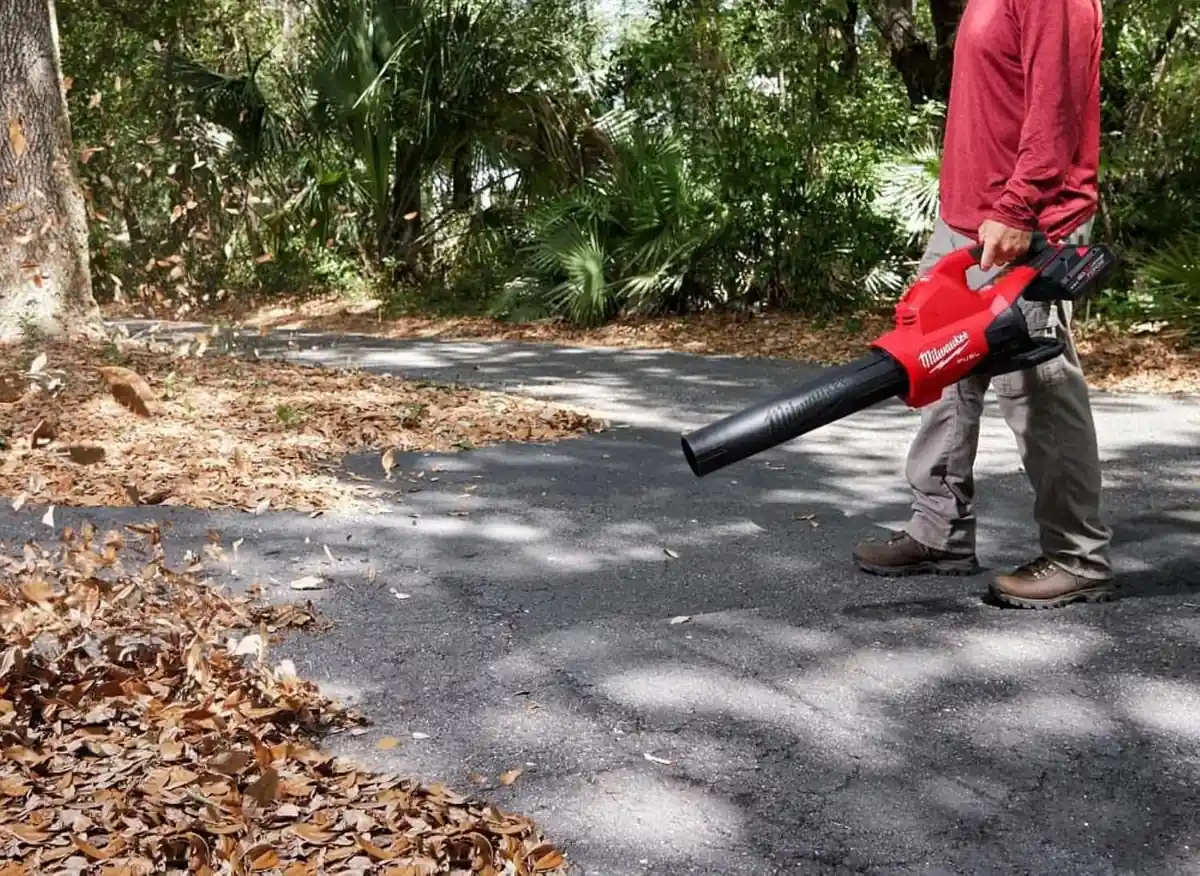
The Milwaukee dual battery blower suits a buyer who already runs a cordless platform and sweeps hard, dry ground.
- You already own two High Output M18 packs of 8.0 Ah or more, so the tool is your only cost.
- Your work is dry hard surfaces: driveways, decks, shop floors and yards.
- You want a slider that works the same in either hand, or you blow in temperatures from 0 to 125 F.
Skip it if you own no M18 packs, because two packs and a charger turn a mid-range tool into a premium-tier purchase. Wet, packed leaves or rain as your hardest job are another reason to skip it, since the manual rules out wet locations and the Milwaukee has no boost.
My Pick Between the Two
My verdict in this EGO 765 vs Milwaukee dual battery blower review is the EGO LB7654 for most buyers. It works out of the box, reaches about 25 N on boost against 18 N, carries lighter and takes a splash of rain. The Milwaukee 2824-20 is the pick for one buyer: the one who already owns two High Output M18 packs and sweeps dry, hard ground.
The platform decides it, because a blower that runs on batteries you own costs you the tool, and one that does not costs you the whole system. For other sizes and budgets, my leaf blower guides go through the rest of the range. In the EGO LB7654 vs Milwaukee M18 Dual Battery Blower choice, I take the EGO kit unless my shed already holds the Milwaukee’s batteries and the ground is dry.
Frequently Asked Questions
Is the Milwaukee dual battery blower worth it?
The Milwaukee dual battery blower is worth it when you already own two High Output M18 packs, because then you pay only for the tool and get a steady 18 N of push. A new buyer who buys two packs and a charger spends far more than the EGO kit costs, and the EGO works out of the box.
How long does the battery last on a Milwaukee leaf blower?
The battery on a Milwaukee leaf blower lasts about 15 minutes at full throttle on two 8.0 Ah packs, and Milwaukee’s chart gives 26 minutes on two 12.0 Ah packs. The EGO kit pack runs about 22 minutes on high, but the Milwaukee pushes harder at its top setting, about 18 N against about 16 N.
Are EGO blowers better than Milwaukee?
The EGO LB7654 is better than the Milwaukee 2824-20 for most buyers, with about 25 N of force on boost against 18 N, a lighter carry and a working kit in the box. The Milwaukee wins when you already own its M18 packs and sweep dry, hard ground, because the packs are the expensive part.
Is the Milwaukee M18 blower any good?
The Milwaukee M18 FUEL 2824-20 is a good blower for hard surfaces, with a steady 18 N of force, 600 CFM and a slider that works in either hand. It has no boost mode and no rain rating, and its two packs add cost and weight that a new buyer has to count.
Which battery operated leaf blower has the most power?
Of these two, the EGO LB7654 has the most power, reaching about 25 N on boost against about 18 N for the Milwaukee at full throttle. EGO rates it at 26 N and Milwaukee rates its blower at 17.7 N, though the EGO holds that push for only about 13 minutes per pack.
References
- Gauthier R, Luscombe A, Bond T, et al. How do Depth of Discharge, C-rate and Calendar Age Affect Capacity Retention, Impedance Growth, the Electrodes, and the Electrolyte in Li-Ion Cells?. J. Electrochem. Soc. 2022;169(2):020518.
- Asiri M, Kedhim M, Jain V, et al. Impact of temperature and state-of-charge on long-term storage degradation in lithium-ion batteries: an integrated P2D-based degradation analysis. RSC Adv. 2025;15(28):22576-22586.
- Chen N, Yang S, Oh J. Evaluation of hand-arm vibration (HAV) exposure among groundskeepers in the southeastern United States. Annals of Work Exposures and Health. 2025;69(1):81-95.
- Walker E, Banks JL. Characteristics of Lawn and Garden Equipment Sound: A Community Pilot Study. J Environ Toxicol Stud. 2017;1(1).
- Balanay JAG, Kearney GD, Mannarino AJ. Assessment of Occupational Noise Exposure among Groundskeepers in North Carolina Public Universities. Environ Health Insights. 2016;10:EHI.S39682.
- Morata TC, Gong W, Tikka C, Samelli AG, Verbeek JH. Hearing protection field attenuation estimation systems and associated training for reducing workers’ exposure to noise. Cochrane Database of Systematic Reviews. 2024;5(5):CD015066.
Safety Note: Leaf blowers throw debris and can damage your hearing. Wear eye and ear protection, read the manufacturer’s manual, and check your local rules on noise and operating hours.