
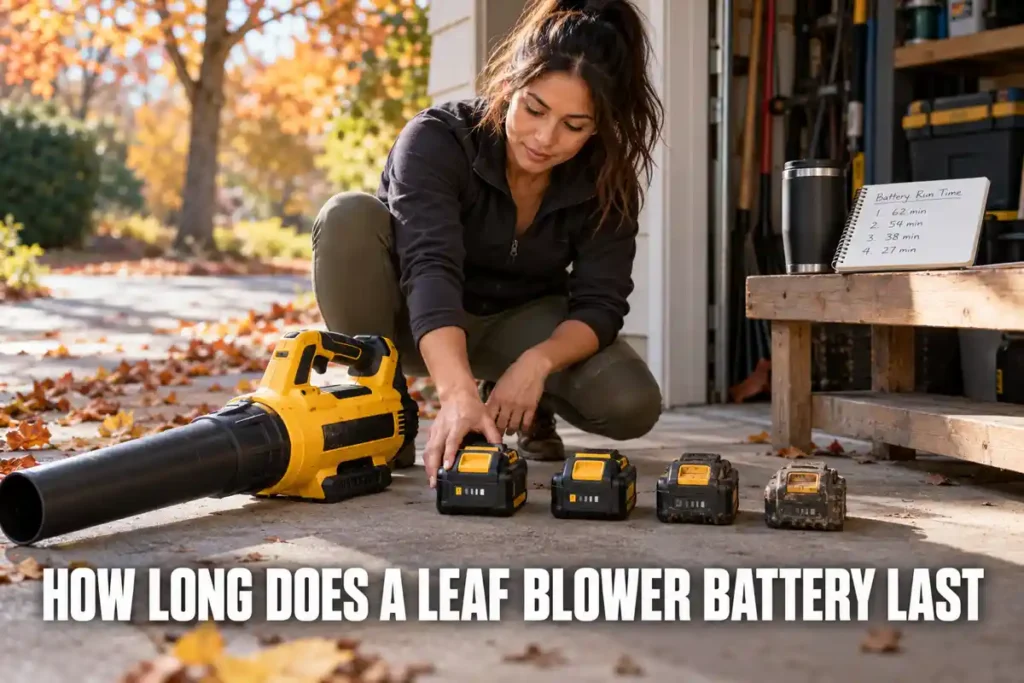
A cordless leaf blower battery runs about 15 to 30 minutes per charge on high speed, and my rule of thumb for a home-use pack is 3 to 5 years of service. The minutes come from pack size and power setting. The years come from heat, age and how you treat the pack.
Leaf season on my 3.7-acre orchard and the yard around the house lasts about eight weeks, so my packs sit idle for most of the year and I watch their age as closely as their minutes. Below you get runtime by pack size, the sum that turns charge cycles into years, and the habits that wear a pack out.
How Long Does a Leaf Blower Battery Last? The Short Answer
Two numbers answer the question, and each has its own cause. Minutes per charge depend on the pack’s energy and the power setting. Years of service depend on heat, age and how deeply you drain the pack.
| Measure | Typical answer | What decides it |
|---|---|---|
| Minutes on high | About 15 to 30 | Pack size in watt-hours |
| Minutes on turbo | About 13 to 17 | Turbo draws roughly 1.4 to 1.7 times the power of high |
| Minutes on low or medium | About 110 to 200 | Pack size and how light the debris is |
| Years of home use (my rule of thumb) | 3 to 5 | Age and heat more than the charge count |
| Years to reach 500 full charges, home use (about 30 charges a year) | About 16 | The charge count |
| Years to reach 500 full charges, daily crew use (about 250 charges a year) | About 2 | The charge count |
Read the minutes as figures for a new pack in the box. A bigger pack, a lower setting and a newer pack add minutes, while a small pack, turbo and a worn pack take them away. The 500-charge rows are a planning sum, and the years section below shows how it works.
Leaf Blower Battery Life Per Charge by Pack Size and Setting
A pack is a fuel tank measured in watt-hours, and the power setting decides how fast the fan empties it. Watt-hours equal volts times amp-hours: an EGO 56V pack of 5.0 Ah holds 280 Wh, and two Milwaukee 18V packs of 8.0 Ah hold 288 Wh together. Because pack energy scales with amp-hours, a 2.0 Ah pack holds only 40 percent of what a 5.0 Ah pack of the same voltage holds.
Minutes by Kit and Setting
The EGO rows show the kit with the pack that comes in the box. The Milwaukee 2824-20 ships as a bare tool, so its row is a setup with two 8.0 Ah packs bought separately. On high, which is the setting to plan a job around, the makers’ figures and the in-practice ones land within a few minutes of each other.
| Kit and pack | Low or medium | High | Turbo |
|---|---|---|---|
| EGO LB6504, 5.0 Ah, maker’s figure | About 200 | About 30 | About 15 |
| EGO LB6504, 5.0 Ah, in practice | Not listed | About 27 | About 17 |
| EGO LB7654, 5.0 Ah, maker’s figure | About 150 | About 25 | About 15 |
| EGO LB7654, 5.0 Ah, in practice | Not listed | About 22 | About 13 |
| Milwaukee M18 FUEL 2824-20 with two 8.0 Ah packs, in practice | About 110 on medium | About 15 to 18 | No turbo mode |
Minutes Equal Watt-Hours Divided by Watts Times 60
Runtime in minutes is the pack’s watt-hours divided by the watts the fan draws, times 60. The in-practice minutes on the LB7654 imply an average draw of about 760 W on high and about 1,280 W on turbo. So 280 Wh divided by 760 W, times 60, gives about 22 minutes on high, and the same pack on turbo gives about 13. Fan power climbs roughly with the cube of fan speed, so the last bit of speed costs the most minutes: on both EGO kits turbo cost about 40 percent of the minutes that high gave.
That cost is why I keep turbo for the packed leaves against the hedgerow and work the open lawn on high.
What Cuts Minutes From a Single Charge
Four things take minutes off the table above, and you control three of them. Each one shows up in the same way: the pack runs out before the job does.
Turbo and the Box Number
The runtime printed on the box is usually the low setting, or an average, and wet leaves ask for high. Plan a job on the high-setting minutes, and treat turbo as a short burst for the pile that will not move.
Wet Debris and Cold Mornings
Wet leaves and packed piles keep the fan on high or turbo, and the pack drains with it. Cold costs minutes too: in a lab study of 2.2 Ah cells run from -4 F to 113 F, the energy and power a cell could deliver fell substantially at low temperatures (1).
EGO’s battery manual gives 50 to 80 F as the best range for its packs, and the charger waits until a cold pack warms to 41 F. On a frost morning in November my pack ran out before the lawn was done, so now I warm the pack in the house before I start.
Counting Packs for a Whole Job
A two-hour leaf job at 22 minutes a pack takes five or six charges, not one, and the 27 minutes of the LB6504 still means four or five. I plan leaf season in minutes and packs, never in acres. A cordless leaf blower with long battery life comes down to a big pack, a low setting where the debris allows it and a spare pack on the charger.
The fourth thing is a worn pack, which takes minutes off every row of the table at once. The section on wear signs works through an example.
How Many Years a Leaf Blower Battery Lasts
My rule of thumb is that a home-use pack lasts 3 to 5 years before the minutes clearly fall. According to EGO, its packs carry a 3-year warranty for home use, and the warranty drops to 1 year for professional use. A crew that charges every working day uses a pack far harder than a homeowner does, and the sum below shows how fast that adds up.
Turning Charge Cycles Into Years
A charge cycle is one full drain and refill, and two half-drained charges add up to one. No single cycle count fits every blower pack, because commercial cells in a multi-year lab test took thousands of hours longer or shorter to fall to 80 percent of their starting capacity, depending on discharge rate, depth of discharge and temperature (2). For the sum below I use 500 full charges as a round planning figure.
- Home use: assume 30 charges a year, about 20 leaf sessions plus the spring and summer jobs on my land. 500 charges would take about 16 years, and even 250 charges would take about 8.
- Daily crew use: a crew that charges a pack on 250 working days a year reaches 500 charges in about 2 years and 250 charges in about 1.
At 30 charges a year a homeowner stays far from any cycle limit, which is why I look at age and heat first when I think about the years. In a test of pouch cells run for about two and a half years, capacity loss rose with both the calendar age and the charge range the cells worked in (3).
What Shortens a Battery’s Life
Three habits do most of the damage in the lab studies: storing a pack hot and full, draining it flat every time, and fast-charging it while hot. Each one is a habit you control. The studies tested cells, not blower packs, so they show the direction of the damage and not what your pack will lose.
Heat Plus a Full Charge
In one lab test, pouch cells held at full charge for nine months lost about 10 percent of their capacity at 95 F and about 43 percent at 140 F, while cells held empty showed almost no loss (4). A separate study of 18650 cells stored at 16 charge levels named high storage charge as the main driver of fade and advised avoiding it (5).
My machinery shed gets hot in summer, so I never leave a full pack out there, and a parked car is no better. Time alone also ages a pack, which is why one that sat unused all summer is older than its charge count suggests.
Draining the Pack Flat Every Time
In that multi-year cell test, depth of discharge changed battery life by a large margin (2). For a blower this means swapping packs when the gauge is down to its last light, not running one to the cutout. The stop is abrupt, and I change packs at the end of a row rather than leave a pile in the alley.
Fast Charging a Hot Pack
A modeling study checked against measurements on five charge scenarios found that fast charging adds thermal stress that shortens cycle life (6). After a hard run on turbo the pack is warm to the touch, so I let it cool before it goes on the fast charger.
Signs Your Leaf Blower Battery Is Wearing Out
A worn pack shows up in minutes before it fails outright. Watch for these:
- More packs for the same job: two packs used to clear the lawn and the yard, and now you reach for a third.
- High-setting minutes down by a quarter or more: a pack that gave 22 minutes new and now gives 16 or less is the clearest sign.
- Warm sooner: the pack feels warm after a short run on high.
- Fast-falling bars and an abrupt cutout: the gauge drops quickly and the tool stops without a taper.
The arithmetic explains why you notice it. A pack at 80 percent of its original capacity gives about 80 percent of the minutes: 22 minutes on high becomes about 18, and at 70 percent about 15. Real packs do not always fade in a straight line, but a missing 4 to 6 minutes is something you feel on the job long before any fault appears.
Pro Tip
Each October I time one fresh pack on high on the same stretch of alley and write the minutes on the pack with a marker. A year later the comparison is one glance at the marker.
Safety
Take a swollen, cracked or unusually hot pack out of use, and charge only with the maker’s charger on a hard surface.
How to Get More Minutes and More Years From Your Packs
Three habits carry most of it: plan the job on the high-setting minutes and count packs, keep packs out of the heat, and swap to a fresh pack when the gauge runs low. This season, time one pack on high and keep the number as your baseline, and look through the leaf blower guides on this site for kits that fit your yard. Size the pack for the minutes your job needs, treat it gently, and a leaf blower battery will cover many seasons of work.
Frequently Asked Questions
How long does the battery last on a Stihl leaf blower?
How long the battery lasts on a Stihl leaf blower depends on the AP pack you fit and the setting you run. A bigger pack in watt-hours runs longer, and high drains it far faster than low, so size the pack in watt-hours to the minutes your job needs.
How long do leaf blower batteries last?
Leaf blower batteries last about 3 to 5 years of home use before the runtime clearly drops, by my rule of thumb. At about 30 charges a year, age and heat matter more to a homeowner’s pack than the charge count, and according to EGO its home-use packs carry a 3-year warranty.
Which cordless leaf blower has the longest battery life?
The cordless leaf blower with the longest battery life is the one whose pack holds the most watt-hours and runs on the lowest setting that still moves the debris. According to EGO, its 5.0 Ah kits run about 150 to 200 minutes on low, and a Milwaukee M18 FUEL 2824-20 with two 8.0 Ah packs runs about 110 minutes on medium.
How long does the battery last on lower speeds?
The battery lasts several times longer on lower speeds than on high. According to EGO, its 5.0 Ah kits run about 150 to 200 minutes on low against about 25 to 30 on high. Low suits dry, light debris, so plan heavy jobs on high.
How long does a battery powered leaf blower last?
A battery powered leaf blower is meant to outlast its first battery pack. According to EGO, the tool carries a 5-year warranty and the pack a 3-year warranty for home use, so the pack is the part the maker expects to age first.
References
- Ji Y, Zhang Y, Wang C-Y. Li-Ion Cell Operation at Low Temperatures. J Electrochem Soc. 2013;160(4):A636-A649.
- Preger Y, Barkholtz HM, Fresquez A, et al. Degradation of Commercial Lithium-Ion Cells as a Function of Chemistry and Cycling Conditions. J. Electrochem. Soc. 2020;167(12):120532.
- Gauthier R, Luscombe A, Bond T, et al. How do Depth of Discharge, C-rate and Calendar Age Affect Capacity Retention, Impedance Growth, the Electrodes, and the Electrolyte in Li-Ion Cells?. J. Electrochem. Soc. 2022;169(2):020518.
- Mao Z, Farkhondeh M, Pritzker M, Fowler M, Chen Z. Calendar Aging and Gas Generation in Commercial Graphite/NMC-LMO Lithium-Ion Pouch Cell. J. Electrochem. Soc. 2017;164(14):A3469-A3483.
- Keil P, Schuster SF, Wilhelm J, et al. Calendar Aging of Lithium-Ion Batteries. J Electrochem Soc. 2016;163(9):A1872-A1880.
- Koo B, Yi J, Lee D, Shin CB, Park S. Modeling the Effect of Fast Charge Scenario on the Cycle Life of a Lithium-Ion Battery. J. Electrochem. Soc. 2018;165(16):A3674-A3683.
Safety Note: Leaf blowers throw debris and can damage your hearing. Wear eye and ear protection, read the manufacturer’s manual, and check your local rules on noise and operating hours.