
My Milwaukee 2824-20 review is a conditional yes: I recommend it for a house lot, a drive and a farm yard when two High Output M18 packs already sit on your shelf, and I skip it as a first M18 purchase. The listing sells the blower alone, with no batteries and no charger. I ran it on two 8.0 Ah packs through leaf drop around the machinery shed, the concrete pad and the first alley of our orchard, and the pack count settled my verdict more than the 600 CFM on the box. Below are the real cost, runtime, weight, noise and the single-battery question.
Affiliate Disclosure: Garden Power Scout is a proud participant in the Amazon Services LLC Associates Program. As an Amazon Associate, we earn from qualifying purchases, at no extra cost to you.
Milwaukee 2824-20 Review and My Verdict in Brief
The Milwaukee M18 FUEL Dual Battery Blower pushes with about 17 N of steady force and has no turbo. That clears dry leaves, pruning twigs and gravel dust, and it falls short on soaked leaf mats. The listing is the bare tool, so the real cost of entry is the blower plus two High Output M18 packs and a charger, unless you own them already. The tool sits in the mid-range tier, and the packs push the full setup toward premium.
- Who it is for: owners who already have two High Output M18 packs and a house lot, drive or farm yard.
- What it does best: a steady push on dry leaves, twigs and gravel dust, at a low bystander noise level.
- The main trade-off: about 10.7 lb in one hand with two 8.0 Ah packs, and about 18 minutes on high.
What the Milwaukee M18 FUEL Dual Battery Blower 2824-20 Is and What You Must Buy With It
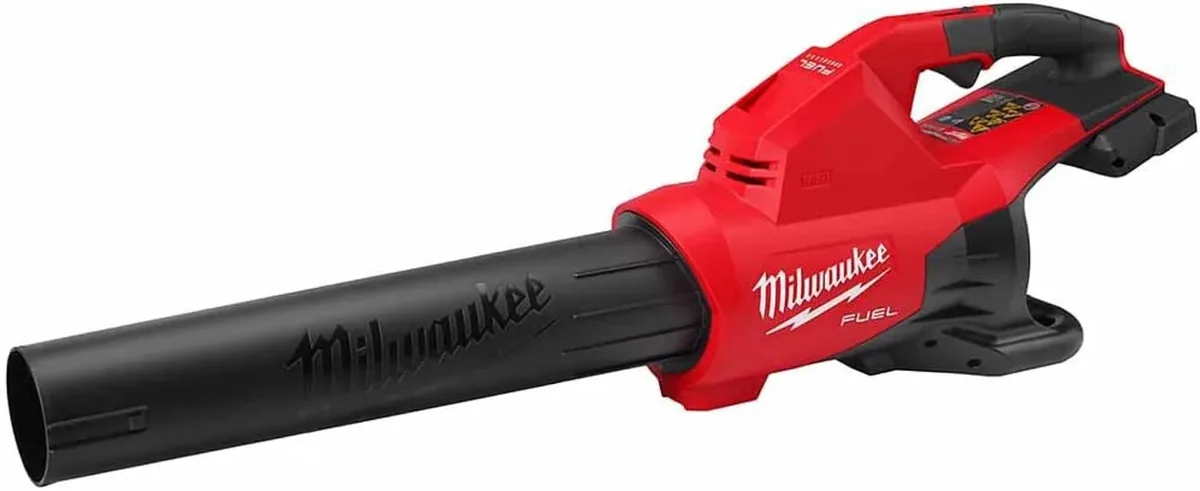
The Milwaukee 2824-20 is a cordless handheld with one 34-inch tube, a rear handle with a second grip and a brushless motor, and it weighs 6.01 lb without packs. The -20 in the name means tool only. A working setup needs three things:
- Two M18 REDLITHIUM packs. Both are required, and the blower will not run on one.
- High Output capacity. According to Milwaukee, it works best with two High Output HD8.0 packs or larger, and it names no smaller pack as supported.
- One M18 charger. Milwaukee says to recharge only with the charger specified for the pack.
A buyer with no M18 packs pays for the platform, not only the blower, and that is the figure to set beside a kit that includes its battery. The manual lists nozzles as an accessory, so check your carton for them.
Milwaukee 2824-20 Specs at a Glance
Two rows decide the fit: force and run time, and both depend on the packs. A newton is the push of the air against a surface, and 17 N is about 3.8 lb.
| Spec | Figure |
|---|---|
| Airflow, maker’s figure | 600 CFM maximum |
| Air speed, maker’s figure | 145 mph maximum |
| Blowing force | 17.7 N by Milwaukee’s rating; about 17 to 18 N in use |
| Run time on high | About 15 to 18 minutes on two 8.0 Ah packs |
| Weight | 6.01 lb bare; about 10.7 lb with two 8.0 Ah packs |
| Noise | 64 dB(A) at 50 ft by Milwaukee’s rating; about 81 dB(A) at the ear |
Which M18 Batteries to Use and How Long They Run
The Milwaukee dual battery blower stops the moment either pack reaches zero, so the weaker pack sets the run time. Runtime then follows the throttle, as Milwaukee’s own chart shows.
| Throttle | Two HD12.0 packs | Two XC8.0 packs |
|---|---|---|
| Half | 65 | 45 |
| Three quarter | 45 | 30 |
| Full | 26 | 17.5 |
With two 8.0 Ah High Output packs I plan on about 18 minutes on high and about 32 minutes with the cruise set near 12 N.
For a Saturday of leaf drop I charge two pairs. About 36 minutes at full throttle is the working budget, and at mixed throttle it covers the yard, the concrete pad and two orchard alleys.
Trigger, Lock-On Slider and Fuel Gauge Controls
The trigger is variable, and an ambidextrous sliding lever locks any speed for a left or right hand. With the lever set, a pull on the trigger gives full power and letting go returns the blower to the set level. There is no turbo, so these two controls carry everything, and full throttle arrives in under a second.
I set the lever about three quarters of the way along the first alley and left my trigger finger off for the whole row. That is the use the lock-on exists for, and my finger never cramped.
A four-light gauge reads the weaker of the two packs. One light flashes four times under 10 percent, and eight times at zero. The cells recover a little at rest, so the gauge reads low right after a job.
Performance on Leaves, Wet Mats and Gravel
Of the handhelds Milwaukee sells, this one pushes hardest, at about 17 to 18 N. That sits above the 12 to 15 N range of a typical gas handheld, and with no boost to call on, what the trigger gives is all there is.
Dry Leaves, Twigs and Gravel Dust
In late winter I clear pruning twigs and sawdust from the tree-row strips into the alley with the lever near the middle. One pass cleared a 20-foot stretch of row, and the fan stayed quiet enough that I could hear the twigs skip.
Wet Mats in the Orchard Alleys
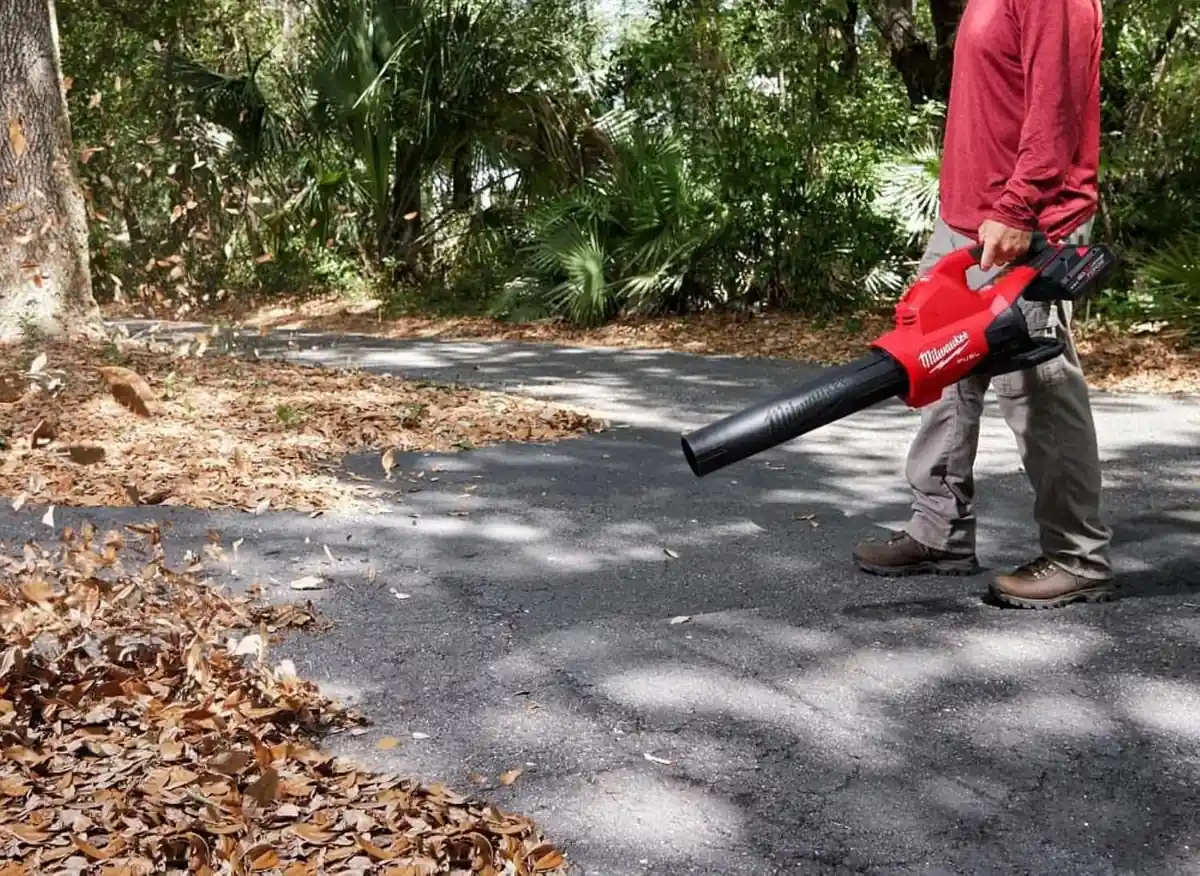
After rain, the leaf mat on the first alley is where this blower runs out of argument. Wet leaves cling by water film and weight, so 17 N with no boost only shivers the mat if I blow across the top. A low sweep under the leading edge, with the tube 5 to 6 inches above the ground, peeled it back in strips, and the thickest part by the drainage ditch still needed a rake.
Gravel and Drip Lines
On the gravel yard edge I hold the tube low and drop the throttle, because objects can be thrown and the manual keeps bystanders 50 feet away. Near the drip lines and the flowering strips I keep the air low and slow, since fast air strips mulch and packs grit into emitter ends.
Weight, Vibration and Noise
Weight and noise decide how this blower feels over an hour of work.
Weight and Vibration
The blower is 6.01 lb bare and about 10.7 lb with two 8.0 Ah packs. The packs add roughly 4.7 lb, 44 percent of the weight in your hand, and no shoulder strap comes with the tool. Next to a rake it spares my back, but my shoulder tires before my wrist after the second pair of packs.
Milwaukee publishes no vibration figure for this blower. In a study of 17 groundskeepers, handheld blowers measured about 1.9 m/s2 at the right hand, the low end of the tools tested, yet three workers’ full-day exposure still reached the 2.5 m/s2 action limit (1). Hours add up, so I take a break at each pack swap and change hands between rows.
Noise and Hearing Protection
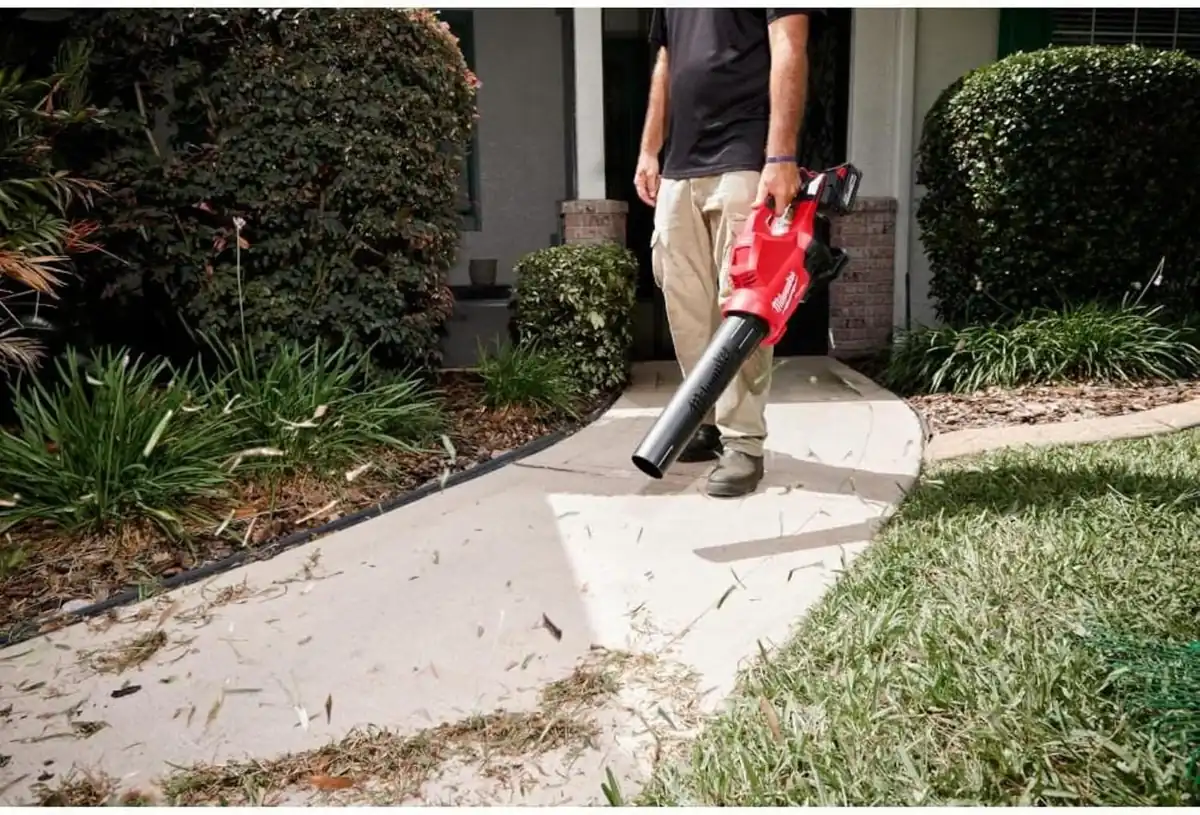
According to Milwaukee, the blower makes 64 dB(A) at 50 feet, which is what a bystander hears. At the operator’s ear it is about 81 dB(A) at full throttle, so the 50-foot number says little about your own exposure.
Battery blowers run quieter than gas: NIOSH sampling of 80 landscaping workers found significantly more noise and carbon monoxide with fuel-powered blowers than with battery versions, yet 94 of 119 shift readings sat at or above 85 dBA (2). I wear ear protection from the first minute and press the plugs in until they seal, since a Cochrane review notes that poor earplug fit may limit protection for about 40 percent of users (3).
Milwaukee Dual Battery Blower vs Single Battery Models by Force and Weight
Milwaukee also sells single-battery blowers on the same M18 packs.
| Spec | 2824-20, two packs | 2724-20, one pack | 3017-20, one pack |
|---|---|---|---|
| Airflow | 600 CFM | 450 CFM | 500 CFM |
| Blowing force | 17.7 N | 11.2 N | 12.2 N |
| Weight, bare | 6.01 lb | 4.9 lb | 5.1 lb |
The dual model gives 45 to 58 percent more force than either single-battery blower, and the second pack adds roughly 2.3 lb to what you hold. That weight earns its place on twigs, gravel dust and damp leaves, where 17 N moves what 11 or 12 N only nudges.
Care, Charging, Storage and Warranty
Care for a Milwaukee M18 dual battery blower is mostly care for the packs. Take both packs off before cleaning, brush dust from the vents and wipe the body with a damp cloth and mild soap. Solvents harm the plastic, and the tool never goes in water or out in rain.
A full charge held warm ages cells fastest. In one cell study, pouch cells held full for nine months lost about 10 percent of capacity at 95 F and about 43 percent at 140 F, against almost nothing when stored empty (4). Charge window and calendar age both drive fade (5), so my packs live indoors at about half charge, never full in a hot shed.
Milwaukee covers the tool for three years for the original purchaser who bought from an authorized distributor, while packs have their own warranty.
Common Problems and How to Avoid Them
- The tool stops at the weaker pack. I learned this at the end of an alley with half a pile still in front of me. Now I read the gauge before each row and pair packs of one capacity and similar age.
- Full throttle drains the packs. Three quarter throttle gives about 30 minutes against 17.5 on two XC8.0 packs, by Milwaukee’s chart.
- Cold costs minutes. Milwaukee publishes no cold runtime, so on frost mornings I keep both packs indoors until I start.
Who Should Buy It and Who Should Skip It
The fit depends on your packs and your job.
Buy It If
- You already own two High Output M18 packs.
- You clear a house lot, drive, deck or farm yard in sessions under 20 minutes at full throttle.
Skip It If
- You are buying your first M18 tool.
- Your main job is soaked leaf mats or long orchard alleys.
- You want a boost button.
- 10.7 lb in one hand is too much for your wrist.
Drawbacks to Know About
- Bare tool: two packs and a charger come on top.
- Weight: 10.7 lb in one hand with no strap.
- Run time: about 18 minutes at full throttle.
How It Compares With Alternatives
Three blowers come up when buyers weigh a bare tool and two packs against a kit. More models are in our leaf blower guides.
| Model | Force | In the Amazon box | Weight with battery |
|---|---|---|---|
| Milwaukee 2824-20 | About 17 N steady | Blower only | 10.7 lb with two 8.0 Ah packs |
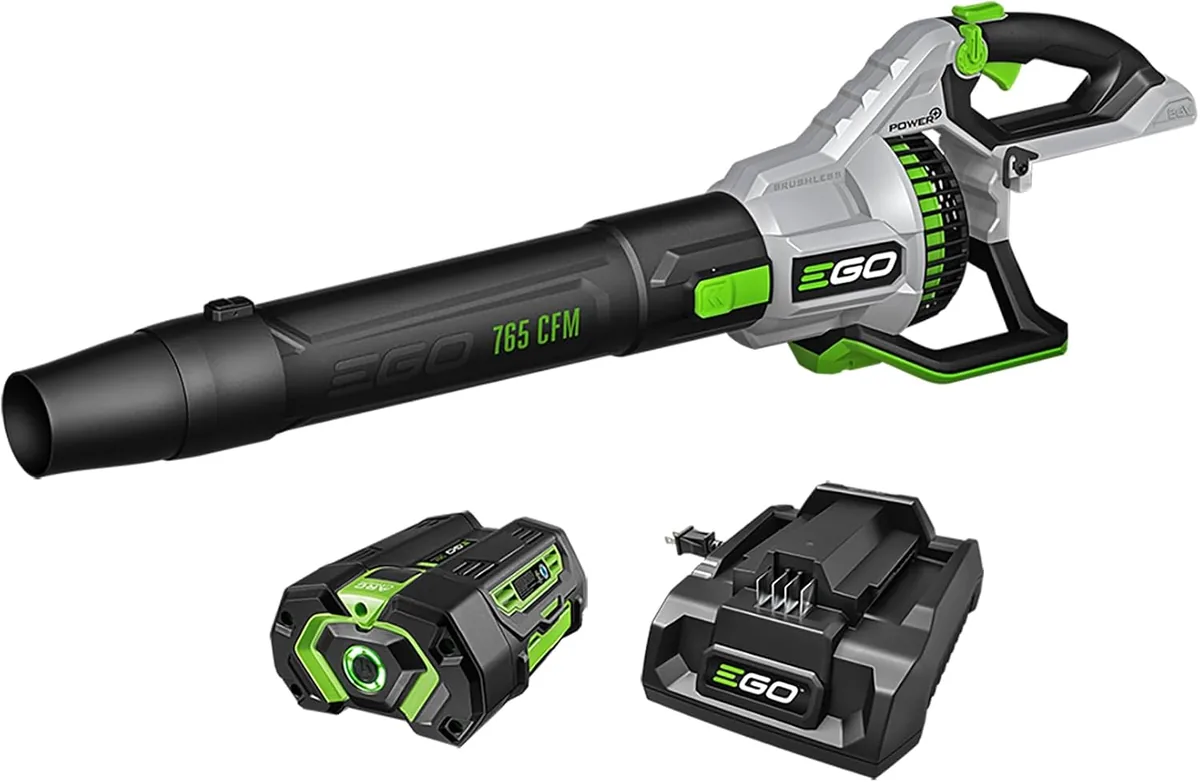
| EGO LB7654 | About 25 N on turbo | Blower, 5.0 Ah pack, charger | About 9.6 lb |
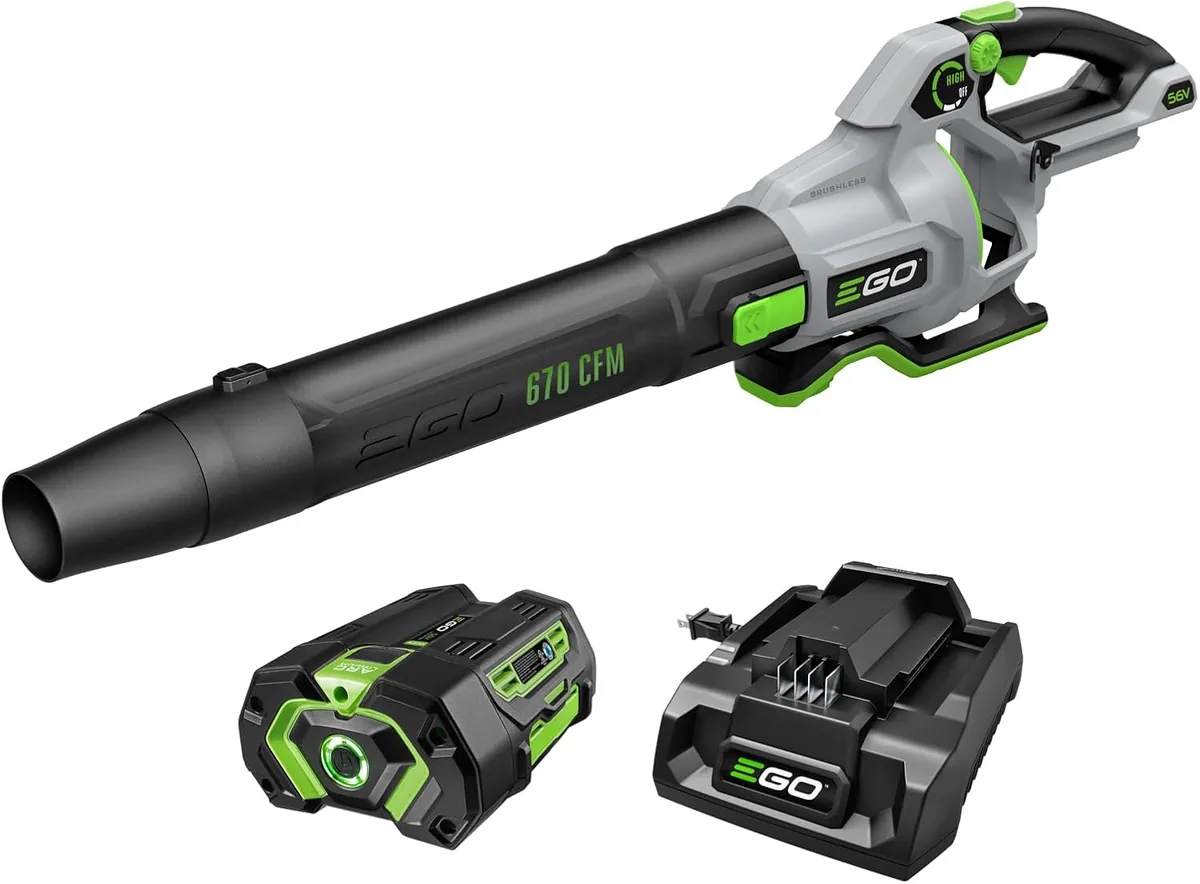
| EGO LB6703 | 21 N on boost | Blower, 4.0 Ah pack, charger | About 9.65 lb |
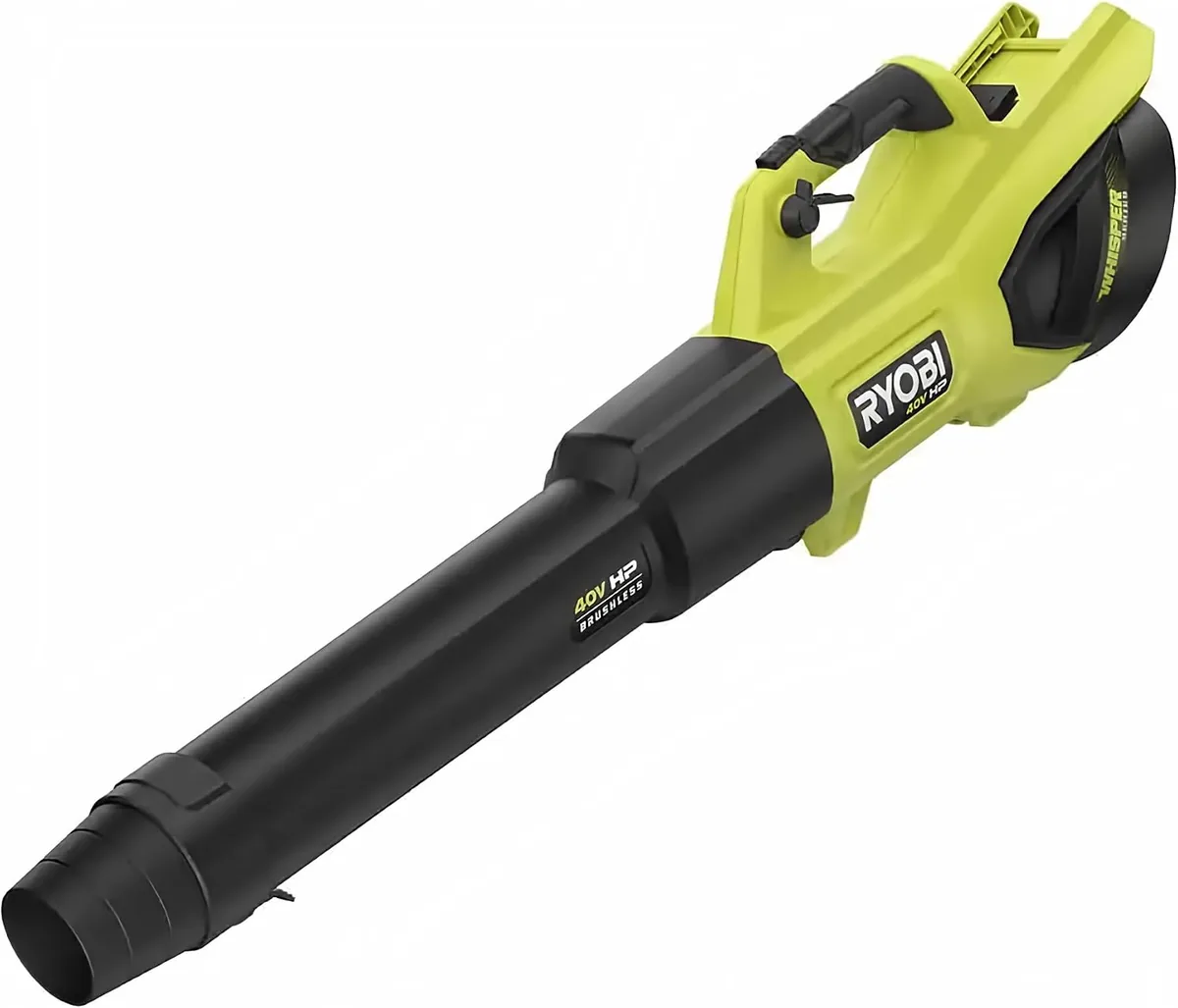
| Ryobi 40V HP Whisper 730 | About 20 N on turbo | Blower only | About 9.7 lb with a 4.0 Ah pack |
EGO LB7654 for a Kit With Boost
The EGO LB7654 puts a 5.0 Ah pack and a charger in the box, so the entry cost is one purchase. Its turbo reaches about 25 N, and it is about a pound lighter in the hand. It suits a buyer who wants one box and a boost button.
EGO LB6703 for a Smaller Kit
According to EGO, the LB6703 gives 670 CFM and 21 N on boost, with a 4.0 Ah pack and a charger in the box. On a house lot, a single purchase counts for more than steady push, and this kit fits that.
Ryobi 40V HP Whisper 730 for Another Pack Platform
The Ryobi is tool only too, so the same pack math applies on the Ryobi 40V platform. It moves 730 CFM and reaches about 20 N on turbo. With a 4.0 Ah pack it weighs about 9.7 lb, which makes it the lighter choice for anyone who already owns Ryobi 40V packs.
My Final Verdict on the Milwaukee 2824-20
I recommend this blower to owners who already hold two High Output M18 packs and want steady, quiet force for a house lot, a drive and a farm yard. It gives about 17 N of push with no boost, about 18 minutes on high from two 8.0 Ah packs and a three-year tool warranty, at the cost of 10.7 lb in one hand. Skip it for wet leaf mats, long orchard alleys and a first M18 purchase. My Milwaukee 2824-20 review verdict is plain: buy the blower only if two High Output packs already sit on your shelf.
Frequently Asked Questions
Is the Milwaukee dual battery blower worth it?
The Milwaukee dual battery blower is worth it when you already own two High Output M18 packs and want a quiet blower with steady force for a house lot, drive and yard. It is a poor fit as a first M18 purchase or for wet leaf mats, where about 17 N of push with no turbo falls short.
What are the differences between the Milwaukee dual battery and single battery blowers?
The differences between the Milwaukee dual battery and single battery blowers are force, weight and pack count: the 2824-20 is rated at 600 CFM, 145 mph and 17.7 N on two packs, while the single-battery 2724-20 is rated at 450 CFM, 120 mph and 11.2 N on one. The dual model also weighs 6.01 lb bare against 4.9 lb.
Which leaf blower is better, Milwaukee or DeWalt?
The Milwaukee 2824-20 and the DeWalt DCBL777 come out close, with about 17 N of force and about 18 minutes on high from each. The Milwaukee needs two packs and weighs about 10.7 lb, while the DeWalt runs on a single 9.0 Ah pack and weighs about 10.3 lb with it.
Which Milwaukee battery leaf blower is the strongest?
The strongest Milwaukee battery leaf blower is the M18 FUEL Dual Battery Backpack Blower 3009-20, rated at 20.5 N, 650 CFM and 155 mph on two packs. Among handhelds the strongest is the 2824-20 at 17.7 N, while the backpack weighs 18.4 lb without packs, against 6.01 lb for the handheld.
Which Milwaukee blower uses two batteries?
The Milwaukee blowers that use two batteries are the 2824-20 handheld and the 3009-20 backpack, both running on M18 packs. Neither works on one pack, and each stops as soon as either pack is empty, so the weaker pack sets the run time and a mismatched pair of packs wastes capacity.
References
- Chen N, Yang S, Oh J. Evaluation of hand-arm vibration (HAV) exposure among groundskeepers in the southeastern United States. Annals of Work Exposures and Health. 2025;69(1):81-95.
- Alexander BM, Graydon PS, Pena M, Feng HA, Beamer BR. Hazardous exposures and engineering controls in the landscaping services industry. Journal of Occupational and Environmental Hygiene. 2025;22(3):189-202.
- Morata TC, Gong W, Tikka C, Samelli AG, Verbeek JH. Hearing protection field attenuation estimation systems and associated training for reducing workers’ exposure to noise. Cochrane Database of Systematic Reviews. 2024;5(5):CD015066.
- Mao Z, Farkhondeh M, Pritzker M, Fowler M, Chen Z. Calendar Aging and Gas Generation in Commercial Graphite/NMC-LMO Lithium-Ion Pouch Cell. J. Electrochem. Soc. 2017;164(14):A3469-A3483.
- Gauthier R, Luscombe A, Bond T, et al. How do Depth of Discharge, C-rate and Calendar Age Affect Capacity Retention, Impedance Growth, the Electrodes, and the Electrolyte in Li-Ion Cells?. J. Electrochem. Soc. 2022;169(2):020518.
Safety Note: Leaf blowers throw debris and can damage your hearing. Wear eye and ear protection, read the manufacturer’s manual, and check your local rules on noise and operating hours.