
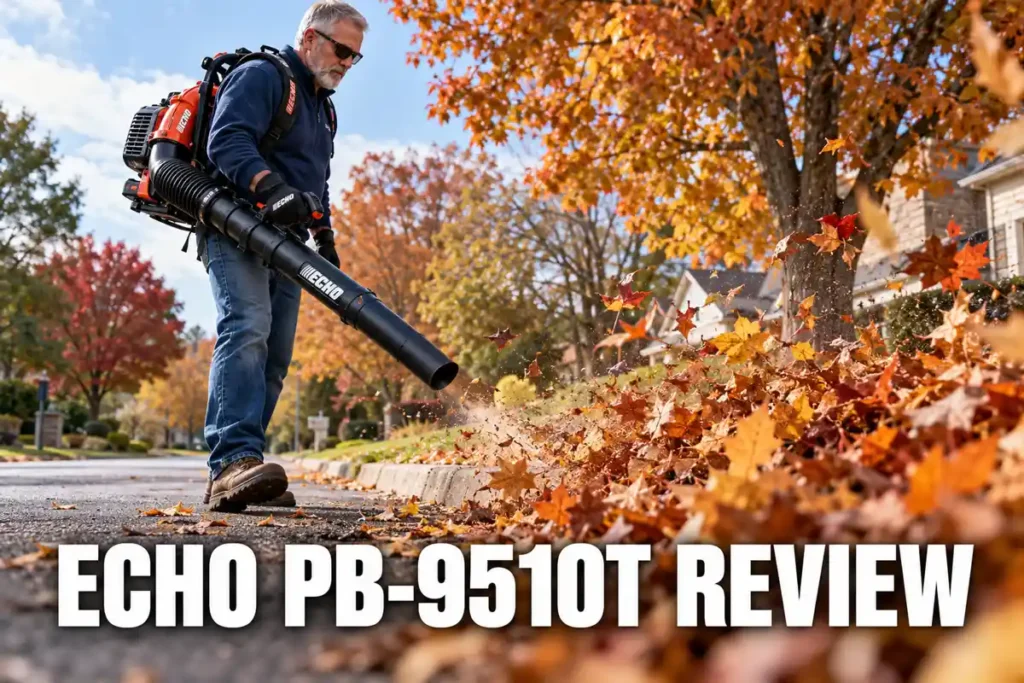
This Echo PB-9510T backpack blower review has a short verdict: it is the strongest backpack blower ECHO sells, and it belongs on acreage, not on a town lot. I ran it across my 3.7-acre apricot and plum orchard, down the long alleys, over the gravel yard and around the sheds. At 56 N of force it moves wet leaf mats that stall a handheld, but at 27.8 lb dry it is more machine than a lot under an acre needs, even in heavy wet leaves.
Affiliate Disclosure: Garden Power Scout is a proud participant in the Amazon Services LLC Associates Program. As an Amazon Associate, we earn from qualifying purchases, at no extra cost to you.
Echo PB-9510T Backpack Blower Review and My Quick Verdict
Buy the PB-9510T if you clear an acre or more, work long sessions or run a crew. Skip it on a suburban lot, even when the leaves are heavy and wet. By blowing force it is the biggest Echo backpack blower, and the hip belt and 100.1 fl oz tank make a long session bearable. ECHO sells it through its dealers.
- Who it is for: owners of orchards, large lots and gravel yards, and crews on long jobs.
- What it does best: it rolls wet, packed leaf mats in one low pass.
- The main trade-off: weight, 27.8 lb empty and about 32 lb full, plus noise that calls for hearing protection.
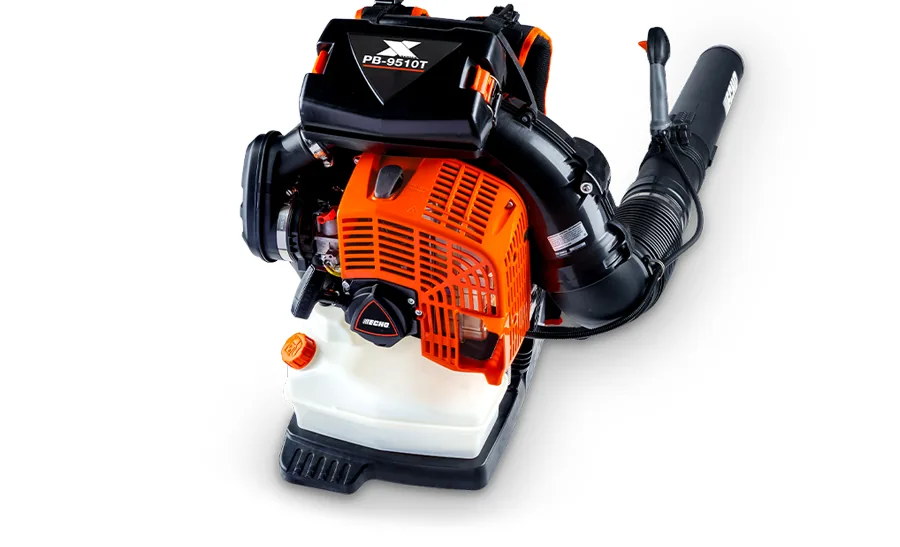
PB-9510T Specifications at a Glance
Two rows decide the fit: blowing force and weight. ECHO rates the force at 56 N, about 12.6 lb of push at the nozzle, and the Echo 9510 weight is 27.8 lb dry with the standard pipes.
| Spec | Figure |
|---|---|
| Engine | 79.9 cc air-cooled two-stroke |
| Blowing force | 56 N (about 12.6 lb) |
| Air volume | 1,200 CFM |
| Air speed | 230 mph with pipes |
| Dry weight | 27.8 lb, standard pipes, no fuel |
| Fuel tank | 100.1 fl oz |
| Fuel mix | 50:1, 89 octane, E10 at most |
| Sound | 81.7 dB(A) at 50 ft |
| Warranty | 5 years consumer, 2 years commercial |
This Echo gas backpack blower keeps the PB-9010T’s displacement. According to ECHO, a reshaped piston, new port angles and a bigger fan lift output about 18 percent, and the rated force rises from 48 N to 56 N.
How the PB-9510T Performs in Real Orchard Work
I judge a blower the way I once judged a sprayer nozzle, by what arrives at the target and not by the label.
Force, Air Volume and Wet Leaves
Wet leaves stick by surface tension and weight, so you need volume under the leading edge, not speed on top. After a night of rain, the plum leaves on my concrete work pad rolled up in one low pass at about three-quarter throttle, and the whole 40 by 30 foot pad took one pass down and one back. My old gas handheld only combed the top layer of that same mat.
The limit is fine work. At full throttle the stream strips the mulch off the paths by the vegetable plot, so there I drop to a third throttle or pick up a rake. Keep the pipe low and sweep under the leading edge; a steep angle scatters the mat.
Long Alleys and Windrowing Under the Trees
Between the tree rows I push debris ahead in a windrow and let the mower shred it later. A tank gave me a little over an hour at full throttle. The 100.1 fl oz tank holds almost 20 percent more mix than the PB-9010T’s 83.8 fl oz.
Gravel and the Yard
According to ECHO, gravel needs higher speed, loose debris needs low speed, and thrown objects stay a risk beyond 50 feet. On the gravel yard I keep the nozzle low and the angle shallow. At full throttle with the tube held high, stones flew against the shed wall.
Tube Throttle Versus Hip Throttle
The T in PB-9510T means the throttle sits on the tube, while the PB-9510H uses a hip-mounted arm and a stick handle. According to ECHO, throttle type has no effect on performance, and the H weighs 0.4 lb more.
I chose the T because I reach under low branches and change speed often. On a long alley I set the position lever to about two-thirds and used the trigger only for bursts, which kept my right hand relaxed over a full tank. Pick the H if you run steady for hours and want a two-handed hold.
Living With the PB-9510T Day to Day
Three habits keep this machine easy to live with: fresh mix, a clean foam filter and a hip belt cinched before the first pass.
How to Start an Echo Backpack Blower
For a cold start, set the choke to COLD START, press the purge bulb until fuel shows, give it five more pumps, then pull in short strokes. Pulling the trigger releases the choke, and a warm engine skips it. It caught within five pulls cold, and I let it idle several minutes before opening it up.
ECHO calls for 50:1 gasoline to two-stroke oil, about 2.6 fl oz per gallon, with 89 octane unleaded and no more than 10 percent ethanol. I mix in a measured bottle and only what I will burn in a month, since ECHO wants fresh mix bought within 30 days.
Use the rated oil, ISO-L-EGD and J.A.S.O. M345-FD, or the engine warranty is void. I buy only the rated oil so the warranty stays intact.
Harness, Weight and Heat on the Back
A full tank puts the machine near 32 lb, which is 27.8 lb dry plus roughly 5 lb of mix. After I cinched the hip belt and loosened the shoulder straps, most of the weight moved to my hips, and the chest strap kept the shoulder straps in place on the long alley. Fit matters: in a lab study of twelve load-carriage setups, mechanical factors such as load position explained at least 85 percent of the variation in discomfort at the shoulders and hips (1).
The back pad is vented, and on warm early-October afternoons it kept air moving behind my shirt. A cold-weather insert blocks the vent in late fall.
Noise and Hearing Protection
According to ECHO, the PB-9510T measures 81.7 dB(A) at 50 feet under ANSI B175.2, about 2 dB above the PB-9010T. That is a bystander figure, and sound drops roughly 6 dB each time the distance doubles, so the operator hears far more. It is far louder than any cordless blower I have run.
In a study of North Carolina university groundskeepers, about 77 percent of daily noise averages calculated by the NIOSH method exceeded 85 dBA, and equipment maximums ran from 76 to 109 dBA (2). I wear hearing protection from the first pull, every time, and I choose muffs over foam plugs because a Cochrane review notes that poor earplug fit may limit protection for about 40 percent of users (3).
Upkeep and Storage
Each day I check the Echo backpack blower air filter: wash the foam in detergent and water, squeeze it dry and do not oil it. ECHO says to replace the main filter at three months.
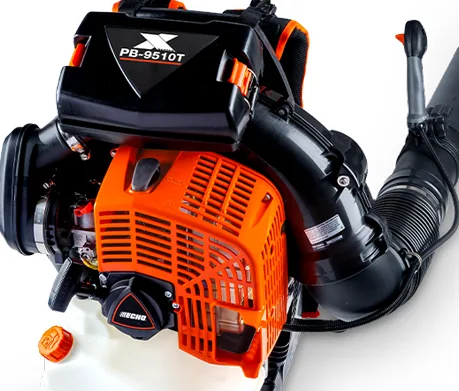
Order Echo backpack blower parts before leaf season: the Tune-Up Kit supplies the air filters, and ECHO calls for a new fuel filter and cap gasket every year.
For storage past 30 days, ECHO says to drain the tank, run the engine dry and add 0.25 fl oz of oil to the cylinder. Follow the manual’s full storage procedure, not only the empty tank.
Never run it in a closed shed. In a bench test of a portable two-stroke engine, carbonaceous matter made up 85 percent of the fine particle mass (4), and NIOSH sampling of 80 landscaping workers found significantly more carbon monoxide exposure with fuel-powered leaf blowers than with battery versions (5). I open the shed doors before I start it.
Who Should Buy the PB-9510T and Who Should Skip It
The PB-9510T is a tool for acreage, long sessions and crews. On a lot under an acre it is too much machine, and heavy wet leaves alone do not change that.
Buy it if you:
- clear an acre or more, like the alleys in my orchard.
- work an hour or more at a time and want a hip belt to carry the load.
- run a crew that clears heavy wet leaves, storm debris or gravel lots across big properties.
Skip it if you:
- have a lot under an acre, even if the leaves are heavy and wet. A lighter ECHO such as the PB-770 (33 N, 24.3 lb) fits a quarter to half acre, and the leaf blower guides cover cordless options.
- already own an Echo 9010 backpack blower that runs well. Fix a worn fuel filter before you buy a new machine.
- work early in the morning near neighbors, or dislike loud, heavy gas machines.
Drawbacks to Know Before You Buy
The PB-9510T weighs 27.8 lb dry, only 0.4 to 1.1 lb more than the PB-9010T. The hip belt helps, but a full tank still rides on your back, so I refuel at the end of an alley and rest while it fills.
- Noise: hearing protection is a must, and early-morning work near houses is out.
- Cold limit: ECHO says not to run it below 15 F, or the fuel lines may be damaged.
- Gas upkeep: you mix fuel and change filters, and a battery blower needs neither.
- Premium and new: it launched this fall in the premium tier and has no long service record, with a 5-year consumer warranty as the cushion.
How It Compares With the PB-9010T and Other Backpack Blowers
Four machines sit near the PB-9510T: the PB-9010T it replaces and three rivals. Where a maker states a weight basis, it is without fuel.
| Model | Force | Air volume | Dry weight | Tank |
|---|---|---|---|---|
| ECHO PB-9510T | 56 N | 1,200 CFM | 27.8 lb | 100.1 fl oz |
| ECHO PB-9010T | 48 N | 1,110 CFM | 26.7 to 27.2 lb | 83.8 fl oz |
| RedMax EBZ9000-RH | 56 N | 1,245 CFM | Not published on the same basis | 91.3 fl oz |
| STIHL BR 800 C-E | 41 N | 912 CFM | 25.9 lb | 67.6 fl oz |
| Husqvarna 580BTS Mark III | 47 N | 1,000 CFM | 26.8 lb | 87.9 fl oz |
Keep or Upgrade From the ECHO PB-9010T Backpack Blower
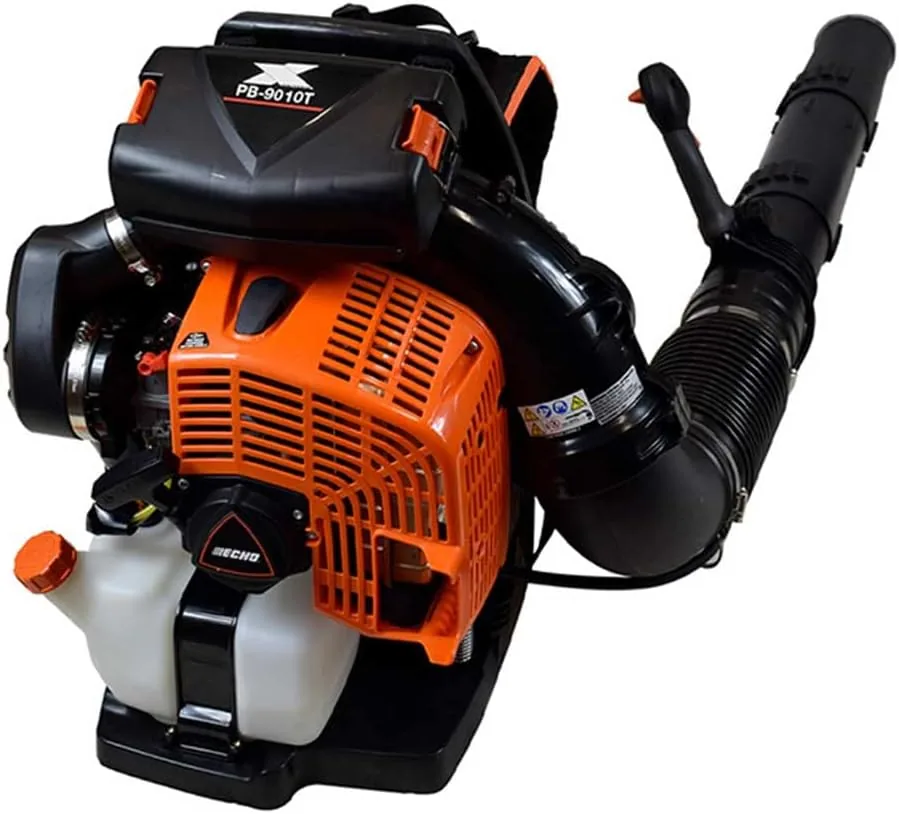
The ECHO PB-9010T Gas Backpack Leaf Blower shares the engine size and fuel routine. Moving up buys 8 N, 90 CFM, 10 mph, a bigger tank and a hip belt, for up to 1 lb more weight.
Keep your PB-9010T if it runs well, and replace its fuel filter before leaf season. Buy the PB-9010T new if your ground is up to about an acre and you can live without a hip belt. Upgrade only when wet leaves slow you down today on a big property; skip the upgrade on a house lot, where 48 N is still strong.
RedMax EBZ9000-RH for the Closest Match
The RedMax EBZ9000-RH is the closest match: the same 56 N, slightly more air at 1,245 CFM, and a listed weight near 26 lb with no stated fuel basis. Its air is slower at 216 mph and its tank smaller at 91.3 fl oz, and RedMax gives no sound figure on its page. Look at it if you are cross-shopping dealers for a 56 N machine; skip it if you want a published noise rating or a tank above 100 fl oz.
STIHL BR 800 C-E for a Lighter, Cleaner Pack
The Echo vs Stihl backpack blower question comes down to force against weight. The STIHL BR 800 C-E has a 4-MIX engine, 41 N of force and a 25.9 lb dry weight, and according to STIHL’s US listing it measures 78 dB(A) at 50 feet. Choose it for a lighter carry and a cleaner engine on shorter jobs; skip it when wet leaves are the work, since its 41 N and 67.6 fl oz tank are the smallest here. With wet plum leaves on gravel in November, I take the extra 15 N.
Husqvarna 580BTS Mark III for a Smaller Engine
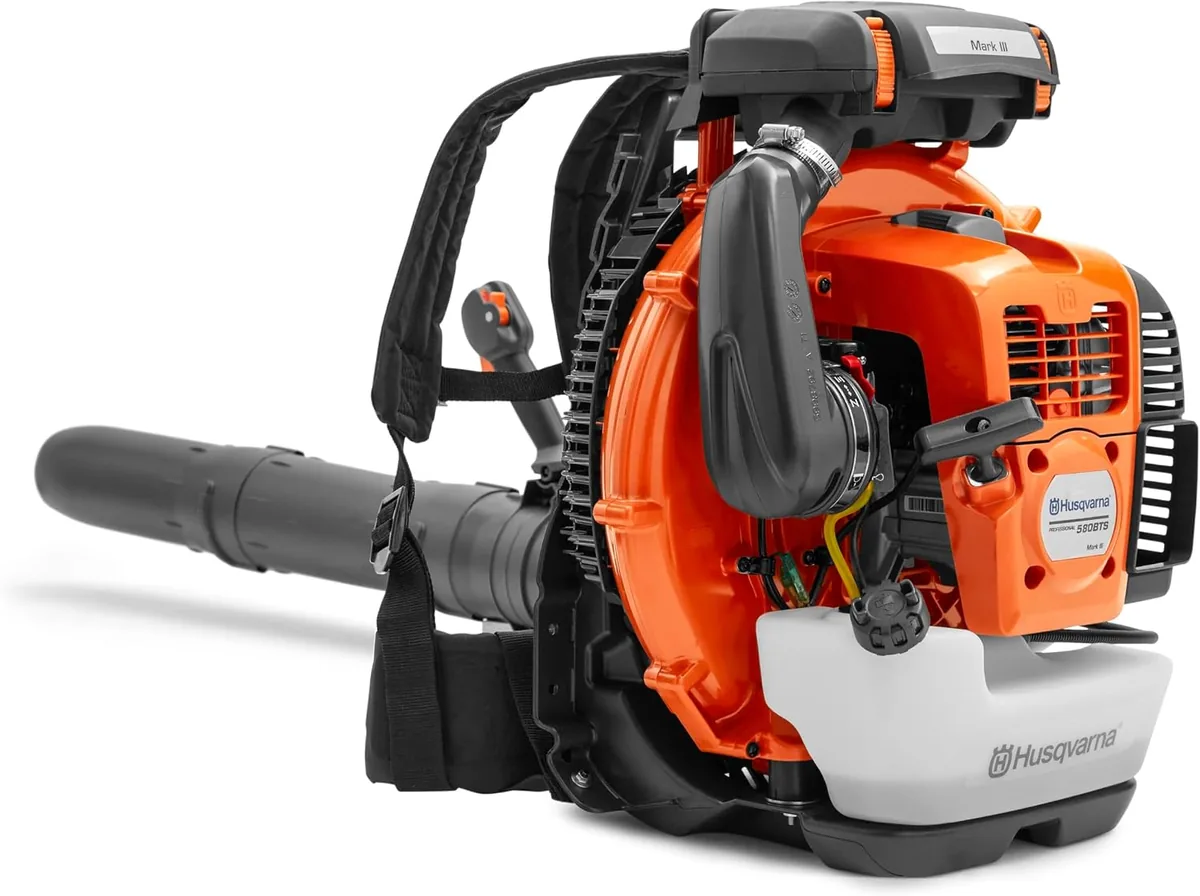
The Husqvarna 580BTS Gas Backpack Leaf Blower runs a 75.6 cc engine and rates 47 N, with a padded hip belt and 26.8 lb without fuel. Choose it if 47 N is enough for your leaves and you want a pound less to carry; skip it for big ground and wet leaves, where I take the PB-9510T.
Common Problems and How to Avoid Them
Some PB-9010T owners reported the engine bogging after 15 to 20 minutes, and three said a new fuel filter or tune-up kit fixed it. If your PB-9510T bogs down or loses power, check these in order.
- Fuel: drain stale mix and refill with fresh 50:1 made from 89 octane gasoline and the rated oil. ECHO wants mix bought within 30 days.
- Air filter: wash the foam, squeeze it dry and do not oil it. Replace the main filter at three months, and close the choke before you remove it.
- Spark plug: the Echo backpack blower spark plug is an NGK CMR7H with a 0.65 mm gap. Inspect it at three months.
- Fuel filter: inspect it at three months and replace it every year.
- Carbon and airflow: check the spark arrester screen about every 40 hours, and run the engine wide open for 5 minutes each hour after long low-speed work.
A swing in engine speed at full throttle is a warning, not a fault. RevShield ignition moves the engine between about 8,350 and 6,000 rpm when airflow is blocked, so clear the leaf guard and the pipe.
My Recommendation for Large Yards and Orchards
On a lot under an acre, heavy wet leaves do not justify 32 lb on your back: the best Echo backpack blower for a quarter to half acre is a lighter one such as the PB-770, and the PB-9010T covers the sizes up to an acre. Buy the PB-9510T for acreage, long sessions and crew work, because its 56 N, bigger tank and hip belt are what the PB-9010T lacks on a long job. My Echo PB-9510T backpack blower review ends on one decision: buy it for an acre or more, and take a lighter machine for anything smaller.
Frequently Asked Questions
Which Echo backpack blower is the most powerful?
The most powerful backpack blower ECHO makes is the PB-9510T, rated at 56 N of force, 1,200 CFM and 230 mph. That is 8 N more than the PB-9010T’s 48 N, and in an Echo PB-9510T backpack blower review it is the number that matters most on acreage and long sessions.
Is ECHO backpack blower better than Stihl?
An ECHO backpack blower is better than Stihl when you need force on a large property, because the PB-9510T rates 56 N against 41 N for the STIHL BR 800 C-E model. The STIHL wins on weight at 25.9 lb dry and on a cleaner 4-MIX engine, so it suits shorter jobs on smaller yards.
Are ECHO backpack blowers any good?
ECHO backpack blowers are good when you match the model to the yard, and the PB-9510T is the one I trust on acreage, with a 5-year consumer warranty and a 100.1 fl oz tank. For a quarter to half acre, a lighter ECHO such as the PB-770 does the job with less weight on your back.
Which ECHO leaf blower is the best?
The best ECHO leaf blower depends on your acreage, and from an acre up it is the PB-9510T with its 56 N, bigger tank and hip belt. A quarter to half acre suits the lighter PB-770 at 33 N and 24.3 lb, and the PB-9010T fits the sizes between those two.
Which is better, ECHO or Ryobi?
The better brand, ECHO or Ryobi, is the one that matches the size of the job. ECHO builds gas backpack machines like the PB-9510T that are sold and serviced through dealers, while Ryobi’s range is built around cordless tools for home yards, so a big property points to ECHO and a small lot to Ryobi.
References
- Wettenschwiler PD, Lorenzetti S, Stämpfli R, Rossi RM, Ferguson SJ, Annaheim S. Mechanical Predictors of Discomfort during Load Carriage. PLoS ONE. 2015;10(11):e0142004.
- Balanay JAG, Kearney GD, Mannarino AJ. Assessment of Occupational Noise Exposure among Groundskeepers in North Carolina Public Universities. Environ Health Insights. 2016;10:EHI.S39682.
- Morata TC, Gong W, Tikka C, Samelli AG, Verbeek JH. Hearing protection field attenuation estimation systems and associated training for reducing workers’ exposure to noise. Cochrane Database of Systematic Reviews. 2024;5(5):CD015066.
- Tsai JH, Chen YR, Chen SJ, et al. Characteristics of Emissions from a Portable Two-stroke Gasoline Engine. Aerosol Air Qual. Res. 2020;20(3):630-642.
- Alexander BM, Graydon PS, Pena M, Feng HA, Beamer BR. Hazardous exposures and engineering controls in the landscaping services industry. Journal of Occupational and Environmental Hygiene. 2025;22(3):189-202.
Safety Note: Leaf blowers throw debris and can damage your hearing. Wear eye and ear protection, read the manufacturer’s manual, and check your local rules on noise and operating hours.