
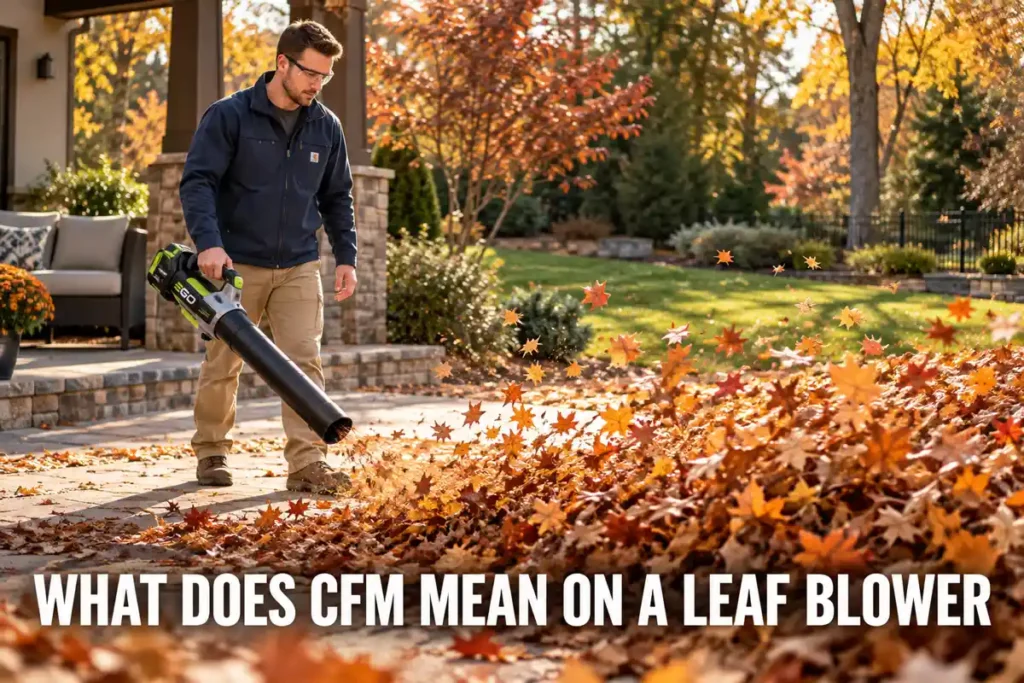
CFM on a leaf blower stands for cubic feet per minute: the volume of air that leaves the tube each minute. More volume clears a bigger or wetter pile, but volume alone does not tell you how hard the air pushes.
I checked sprayer nozzle output with calibration cylinders before every campaign, so I read a blower rating the way I read a nozzle rating, against what really comes out. Below you will find how CFM differs from MPH, how much your yard needs, how makers measure it, and how to turn the numbers into force.
What Does CFM Mean on a Leaf Blower?
CFM is the volume of air a blower moves in one minute. A cubic foot is a box of air one foot wide, one foot deep and one foot tall, so a blower rated at 400 CFM moves 400 of those boxes every minute. The maker reads that volume at a point of its choosing, such as the housing, the pipe or the nozzle.
CFM is not a power rating, a speed or a force. Volume says how much air is on offer, and speed says how fast it travels, so the push on a leaf needs both. A wide outlet delivers a given CFM as a slow stream, and a narrow outlet delivers it as a fast one.
My battery leaf blower picks by voltage class cover nine options across 40V, 56V and 80V platforms.
What Is CFM on a Leaf Blower in Everyday Terms?
Picture a garden shed 8 feet wide, 10 feet long and 8 feet high. It holds 640 cubic feet of air. A 400 CFM blower moves that much air in about 96 seconds, and a 600 CFM blower in about 64.
Volume lifts and rolls a pile, and speed loosens what sticks. On the concrete pad in front of my machinery shed, a thin, fast stream skims soaked plum leaves and leaves the mat shivering in place. Wet leaves stick to concrete by the film of water under them, so the pad clears only when enough air rolls the edge of the mat.
For cordless blower picks with enough volume for wet-surface work, I cover nine models by CFM, runtime and battery platform.
CFM vs MPH Leaf Blower Ratings and What Newtons Add
CFM is volume, MPH is speed, and newtons are the push of both. For most yard work I put volume first, because a pile needs a lot of air moving under it before speed can finish the job, and newtons tell you what the two add up to.
My CFM vs MPH leaf blower guide breaks down when each rating decides the result and which one to check first by debris type.
A newton (N) is the unit of force. One newton is roughly the weight of a small apple in your hand, and 1 N equals about 0.225 pounds of force, so a blower rated at 41 N pushes with about 9 pounds. Leaf blower newtons matter because they blend volume and speed into one number, and according to Husqvarna, blowing force is generally the more reliable indicator when you compare performance.
I cover how that rating is measured across brands and why some makers publish it while others skip it in my guide to how blower force ratings translate to real clearing power.
| Rating | What it measures | What it tells you |
|---|---|---|
| CFM (cubic feet per minute) | Volume of air per minute | How much air is available to lift and roll a pile |
| MPH (miles per hour) | Speed of the air at the nozzle | How well the air loosens stuck debris on a hard surface |
| Newtons (N) | Push of the jet, as the maker measures it | A single number for comparing blowers when the maker lists it |
Leaf blower CFM vs MPH matters most at the extremes. A small 20V sweeper listed at 100 CFM and 130 mph pairs a decent speed with very little air, and push depends on both numbers, so speed cannot make up for a thin stream.
I explain what the air speed rating actually measures on a leaf blower, how makers test it and when it matters more than volume.
What Is a Good CFM for a Leaf Blower?
No standard sets a good CFM, so this is my rule of thumb for typical yards: I look for about 450 to 650 CFM for dry leaves and 600 to 800 or more for wet piles. How much you need depends on how wet the debris is, how big the area is and how long one battery or tank lasts.
My guide on matching leaf blower power to your actual workload covers how those three variables interact.
CFM by Blower Class
No standard defines blower classes, so this table is my reading of maker-rated figures for the models in each group.
My top gas and battery backpack blower picks cover the models in that 517 to 1,110 CFM range.
| Class | Rated CFM | Rated MPH | Newtons where listed |
|---|---|---|---|
| Corded handheld | 155 to 725 | 140 to 260 | Not published |
| Cordless 20V | 100 to 450 | 125 to 130 | Not published |
| Cordless 36V to 40V | 473 to 800 | 120 to 200 | 17 to 26 |
| Cordless 56V to 80V | 549 to 880 | 145 to 200 | 15 to 17 |
| Gas handheld | 392 to 456 | 130 to 172 | 12.5 to 15.8 |
| Gas backpack | 517 to 1,110 | 206 to 239 | 22 to 48 |
The gap between classes shows in the field. One pass down the alley beside my plum rows with a gas backpack replaced three passes with a gas handheld.
My top picks for high-force leaf blowers cover the gas backpack options in that 750 to 1,110 CFM range.
How Much CFM Do I Need for Leaf Blower Work?
These are the CFM figures I look for by job in a typical yard, as guidance and not as limits. Wet leaves ask for the most, and a hard surface is easier than grass.
For a full breakdown by yard size, surface and debris weight, my guide on sizing a leaf blower by airflow for your specific yard covers every scenario.
| Job | CFM I look for (about) | What I also check |
|---|---|---|
| Dry leaves on pavement | 300 to 450 | 120 mph or more |
| Dry leaves on lawn | 450 to 650 | Volume, since grass drags |
| Wet leaves | 600 to 800 or more | 20 N or more, Turbo runtime |
| Half-acre lawn | 600 to 800 | Two batteries or gas, and runtime on high |
| Acre or more | 750 to 1,100 | 33 to 48 N, the gas backpack class |
| Workshop dust | 150 to 450 | Low speed, doors open, a respirator |
Soaked leaves weigh far more than dry ones, so the wet row asks for volume and force together. The dust rows come from my machinery shed: with the door shut, a strong blower raised a cloud that took two days to settle, so now I open the doors, start on low and wear a respirator.
For model picks that handle that wet-pile demand, my best leaf blower for wet leaves roundup covers the CFM, newton and runtime figures that matter most.
Shed Safety
Never run a gas blower in a closed shed or workshop, because the exhaust fills the space with carbon monoxide. Open the doors, or use a battery or corded blower, and wear a respirator-grade mask for the dust.
Expert Tip
Plan for your hardest job, not your average one. I choose by wet leaves on concrete in November, because a blower that clears that also handles dry leaves in October.
Is 450 CFM Good for a Leaf Blower?
In my guidance a 450 CFM rating suits dry leaves on pavement and patios, and it sits at the low end of what I look for on a lawn, where grass drags on the air. The DeWalt DCBL722 lists 450 CFM and 125 mph with its concentrator and no newtons. Wet leaves and wide lots are where I step up to 600 CFM or more.
My DeWalt DCBL722 review covers how that 450 CFM rating holds in practice on dry pavement and light grass.
How Manufacturers Measure CFM
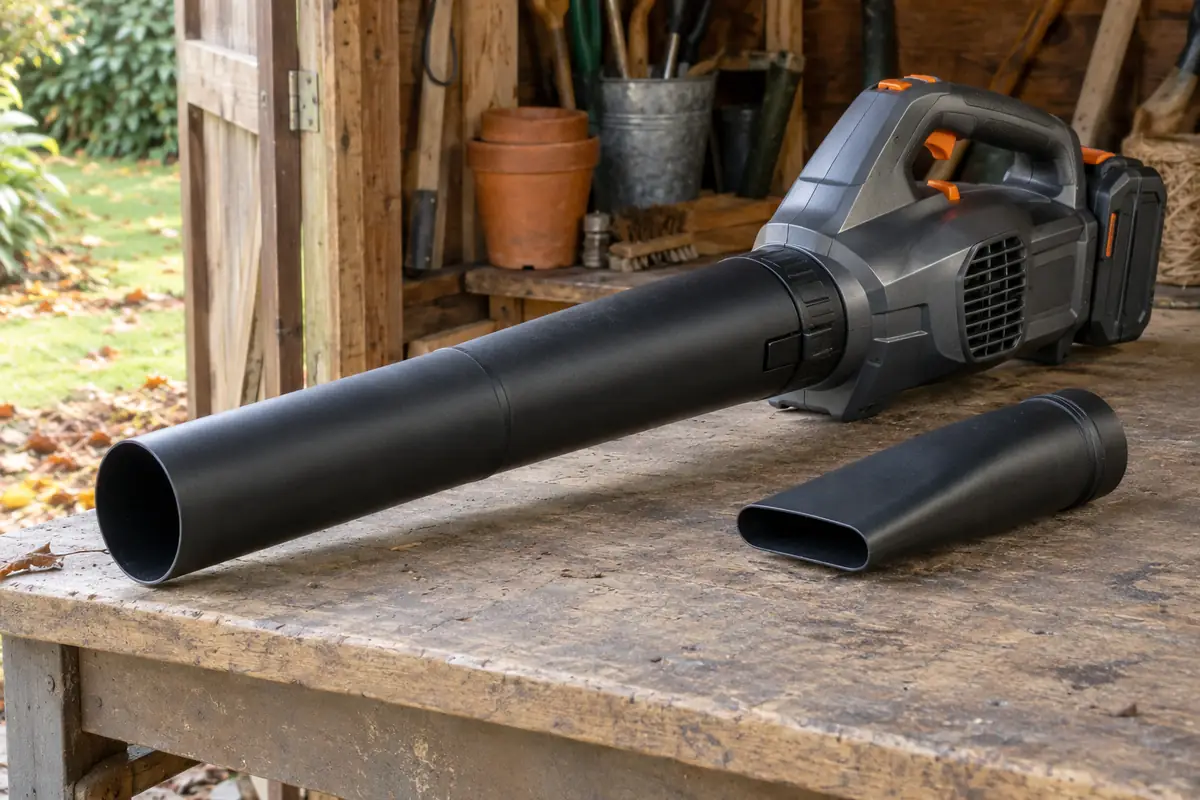
Every CFM figure follows the maker’s own test setup, often ANSI B175.2, so two brands are not directly comparable. That standard covers handheld and backpack blowers with combustion engines, not electric ones. The unit means the same on every box, but the point of measurement, the mode and the nozzle change from maker to maker.
Echo prints “Air Volume at Nozzle,” “Max Air Speed at Nozzle” and “Newton Blowing Force at Nozzle” on its blowers, so the point of measurement is on the label. Husqvarna lists the cordless 350iB at 555 CFM at the pipe and 800 at the nozzle, a gap of 245 CFM on one blower, and the 125BVx at 470 at the housing and 425 at the nozzle. Check which figure the box prints.
My Husqvarna 350iB review goes into how that 245 CFM gap between pipe and nozzle plays out in the yard.
Before I trust a number, I want to know three things: the point it was taken at, the mode and the nozzle. When the box does not say, I treat the figure as a loose guide to the class of blower, not as a spec.
My Echo PB-770T review shows how Echo’s three published figures compare with what the blower delivers across its speed settings.
A Worked Example From CFM and MPH to Newtons
Force equals the mass of air leaving the blower each second times its speed. It is the rule behind a jet engine’s thrust. Here it is for a blower rated at 400 CFM and 150 mph, round figures I picked for teaching:
- Turn CFM into cubic meters per second. 400 × 0.000472 = 0.189 cubic meters per second.
- Turn mph into meters per second. 150 × 0.447 = 67.1 meters per second.
- Find the mass of air per second. Air weighs about 1.2 kilograms per cubic meter, so 0.189 × 1.2 = 0.227 kilograms leave the tube each second.
- Multiply mass by speed. 0.227 × 67.1 = 15.2 newtons.
- Turn newtons into pounds. 15.2 × 0.225 = 3.4 pounds of force.
Checking the Sum Against Real Blowers
That 15.2 N is an upper limit for those two figures, not a push you would measure. I ran the same sum on four blowers whose makers or independent testers give a force, and set each result beside that blower’s own figure.
| Blower | CFM and MPH used | The sum | Force given | The sum runs |
|---|---|---|---|---|
| Stihl BR 800 C-E (gas backpack) | 912 CFM, 199 mph average | 46 N | 41 N rated | 12% high |
| Husqvarna 125BVx (gas handheld) | 425 CFM at nozzle, 130 mph | 14.0 N | 12.5 N rated | 12% high |
| Husqvarna 350iB (cordless) | 800 CFM at nozzle, 200 mph | 40.5 N | 23.5 N rated | 72% high |
| EGO LB7654 (cordless, Turbo) | 765 CFM, 200 mph with nozzle | 38.7 N | 25.3 N measured by an independent tester | 53% high |
When the CFM and the speed are rated consistently, the sum runs roughly 7 to 36 percent above the published force, and most often 12 to 30 percent. The Stihl and the 125BVx both land at 12%, which is two blowers and not a correction factor. For the Stihl, the 199 mph average gives that 12%, and the 239 mph maximum on the box gives 35%, so use the average.
The 350iB and the EGO sit further out. The EGO gap has a documented part: the 200 mph needs the tapered nozzle, and the manual gives 166 mph without it, which brings the sum to about 32 N, still 27% above the 25.3 N an independent tester measured in Turbo with no accessory nozzle. Husqvarna does not say why the 350iB lists 555 CFM at the pipe and 800 at the nozzle, and with the pipe figure the sum is 28.1 N, 20% above the rating.
My EGO LB7654 review covers how those nozzle and mode differences show in clearing time and runtime on a real yard.
Why the Sum Runs High
Three reasons are likely. The box speed is a peak at the center of the jet, and the air near the edge moves slower. The CFM and the speed may be rated at different points or with different nozzles, and the jet is not a neat cylinder. Treat CFM × MPH as an upper limit, and trust a published or measured newton figure over your own sum.
My guide on how blowing force combines CFM and speed into one number covers the calculation and where the sum runs high.
Why Two Blowers With the Same CFM Clear Differently
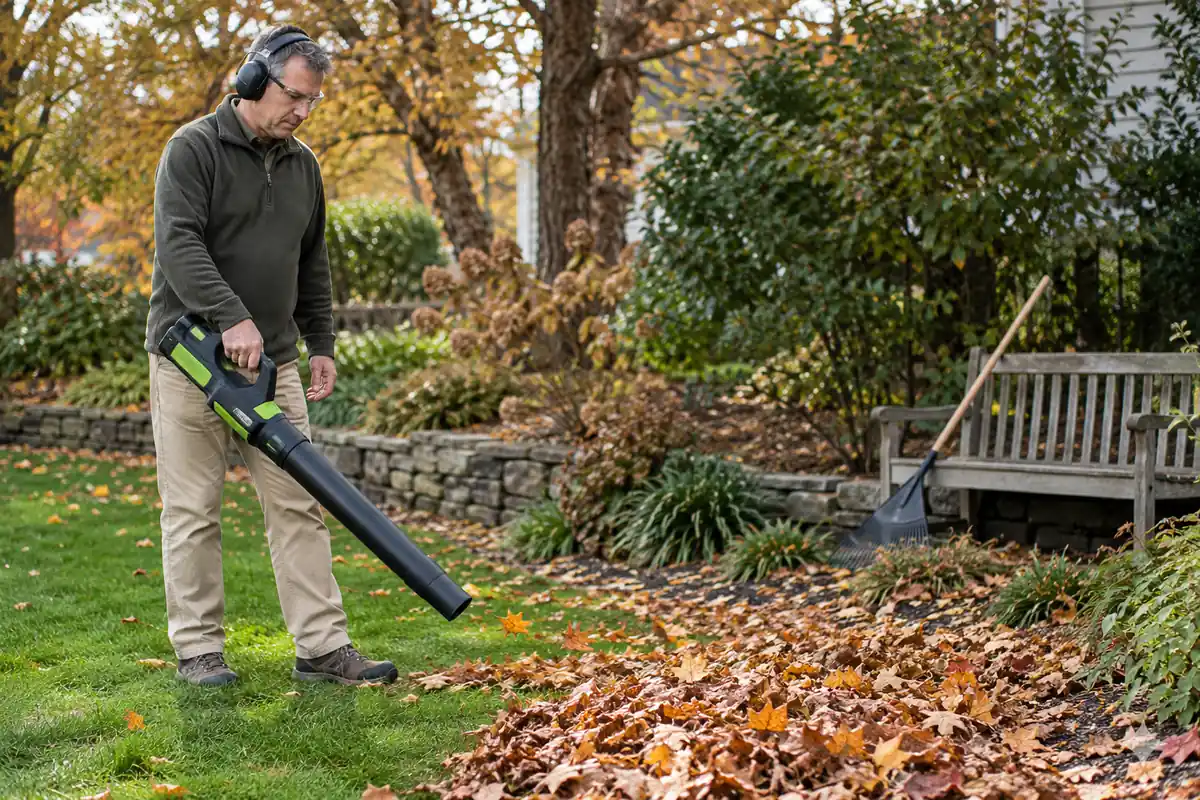
CFM fixes the volume of air. The nozzle, the speed setting, the surface and your technique decide what that air does, so two blowers with the same rating can feel very different in the yard.
My compact leaf blower picks for smaller lots and patios stay in the 300 to 600 CFM range where weight and maneuverability matter more than peak force.
Nozzle Shape Trades Volume for Speed
Airflow equals the outlet area times the air speed, so a smaller outlet gives faster air, and the fan then moves less of it. A tapered nozzle does not add CFM. It trades volume for speed, which is why the same blower lists different speeds with and without one. The same trade shows up in powered sprayers, where nozzle size sets flow and droplet speed.
Put a smaller nozzle on a sprayer and the spray narrows, the speed rises and the output per minute falls. I use the narrow blower nozzle the same way, on the seam between two concrete slabs, and take it off for the open pad.
The Jet Spreads and Slows
A turbulent jet pulls in the air around it, and the amount depends on the jet’s momentum and its distance from the nozzle (1). Models of a round jet use conservation of momentum to predict that intake, and the predictions matched air-jet experiments (2). In the yard, I keep the tip low and near the leaves for wet work, because the air is most concentrated close to the nozzle and spreads wider and slower with distance.
Surface, Moisture and Technique
Wet leaves stick by surface tension and weight, so they need volume under the edge rather than speed on top. Keep the tip low at a shallow angle, around 15 to 30 degrees, and lift the edge first.
My guide on the sweep pattern and angle for moving a soaked leaf mat covers the full technique for wet-surface work.
A low, steady sweep under the leading edge finally lifted the mat on my pad that the thin stream had only shivered. On the tilled strips under my plum trees the surface changes the job: a steep or close stream strips mulch and dries the soil, so I keep the tip low and the air away from the tree bases. I blow downhill with the wind at my back and move the pile in stages.
For the gas leaf blower picks I recommend for wide-area clearing, I cover the top handheld and backpack options by CFM and weight.
How to Read a Leaf Blower Spec Sheet

Six checks cover most of the traps in a spec sheet, and the conditions behind each number come first.
- Mode. The EGO LB7654’s 765 CFM is a Turbo figure, and its speed dial gives 260 to 580 CFM.
- Nozzle. EGO pairs 765 CFM with up to 200 mph with the tapered nozzle attached, and DeWalt pairs 450 CFM with 125 mph with the concentrator.
- Average or maximum speed. Use the average when both are listed, as Echo does for the PB-770T at 196 and 234 mph.
- Newtons. The EGO, DeWalt and Makita pages I read list none, while Echo, Stihl and Husqvarna publish them.
- Runtime. EGO lists about 15 minutes on Turbo and 150 on low for the LB7654 with a 5.0 Ah pack.
- Same name, different numbers. Husqvarna lists the 580BTS at 47 N and 1,000 CFM in one place and at 40 N and 908 CFM under another article number.
Two mistakes cause most bad buys: comparing a Turbo peak on one blower with a dial figure on another, and buying on CFM alone, which gets you a big breeze with no bite. I read the CFM number last, after I know the mode, the nozzle and the point where it was taken.
My best leaf blower guide applies those checks across 13 models, from light cordless tools to full gas backpacks.
Read the Noise Rating the Same Way
Echo lists noise at 50 feet and Husqvarna lists it at the operator’s ear, so the two are not the same number. A community field test found sound at 50 feet consistent with the manufacturer ratings (3), so read a 50 foot rating as what the neighbor’s fence hears and wear protection for your own ears regardless.
For models that minimize that figure without sacrificing CFM, my low-noise leaf blower picks ranked by decibel and airflow cover five options tested at both distances.
Hearing Protection
Wear hearing and eye protection every time. NIOSH sets its recommended exposure limit at 85 dBA averaged over eight hours, and 94 of 119 eight-hour results from 80 sampled landscaping workers were at or above it, with fuel-powered leaf blowers giving significantly more noise and carbon monoxide than battery versions (4). Poor earplug fit may limit protection for about 40% of users (5).
Pick the Airflow That Fits Your Leaves
Pick by your hardest job. I look for about 450 to 650 CFM on dry leaves and 600 to 800 or more on wet piles, then I check the newtons where a maker lists them and the Turbo runtime on the pack I will really use. Every rating depends on the point, the mode and the nozzle behind it, and the simple sum of CFM and speed ran above the published force on every blower I checked.
For large-property picks where runtime on high matters as much as CFM, my leaf blower picks for acre-plus properties cover gas and battery options side by side.
My tip: run the blower with the nozzle and battery you will really use over wet leaves on the concrete pad before the season, and time a clean pad. That tells me more than any box. To compare models, start with the leaf blower guides. Run that test once and you will know what the CFM on your leaf blower is worth in your own yard.
Frequently Asked Questions
What is a good CFM leaf blower?
A good CFM leaf blower for a typical yard moves about 450 to 650 CFM on dry leaves and 600 to 800 or more on wet piles, the range I look for. Volume is half the picture, because CFM counts the air a blower moves each minute and says nothing about how fast that air travels.
What is more important for leaf blower, MPH or CFM?
For most leaf blower work I put CFM ahead of MPH, because the volume of air is what lifts and rolls a pile. MPH matters when you must loosen stuck debris on a hard surface, and newtons, which combine both, are the best single comparison when a maker lists them.
Is 550 cfm good for leaf blower?
A 550 CFM rating is good for a leaf blower on dry leaves in a typical yard, inside the 450 to 650 CFM range I look for there. For deep wet piles I look for 600 to 800 CFM, and on a larger lot the runtime on the high setting matters as much as the number.
Is a 450 cfm blower enough?
A 450 CFM blower is enough for dry leaves on pavement and patios, and it sits at the low end of what I look for on a lawn. For wet leaves or a wide lot I look for 600 CFM or more and plan the battery runtime on the high setting.
How big of a leaf blower do I need?
How big a leaf blower you need depends on the surface and the wetness, and I look for about 300 to 450 CFM on pavement, 450 to 650 on a lawn and 600 to 800 or more on wet leaves. A half-acre lawn is a runtime question as much as a CFM one, so plan two batteries or a gas engine, and for an acre or more I move to a gas backpack.
References
- Ricou FP, Spalding DB. Measurements of entrainment by axisymmetrical turbulent jets. J. Fluid Mech. 1961;11(1):21-32.
- Franco Medrano F, Fukumoto Y, Velte CM, Hodžić A. Mass Entrainment Rate of an Ideal Momentum Turbulent Round Jet. J. Phys. Soc. Jpn. 2017;86(3):034401.
- Walker E, Banks JL. Characteristics of Lawn and Garden Equipment Sound: A Community Pilot Study. J Environ Toxicol Stud. 2017;1(1).
- Alexander BM, Graydon PS, Pena M, Feng HA, Beamer BR. Hazardous exposures and engineering controls in the landscaping services industry. Journal of Occupational and Environmental Hygiene. 2025;22(3):189-202.
- Morata TC, Gong W, Tikka C, Samelli AG, Verbeek JH. Hearing protection field attenuation estimation systems and associated training for reducing workers’ exposure to noise. Cochrane Database of Systematic Reviews. 2024;5(5):CD015066.
Safety Note: Leaf blowers throw debris and can damage your hearing. Wear eye and ear protection, read the manufacturer’s manual, and check your local rules on noise and operating hours.