
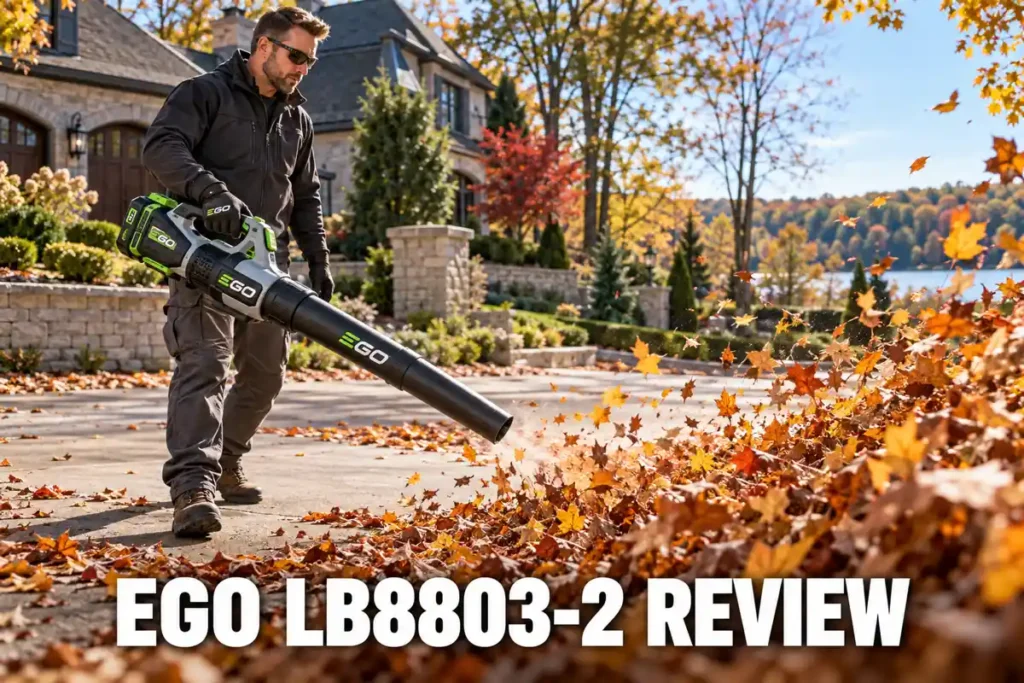
This EGO LB8803-2 review gives one answer: buy the kit when a long session needs a spare battery, a live display and a speed lock, and skip it for porch jobs. The number behind that answer is 8 minutes of turbo per battery, from the two 4.0 Ah packs in the box. I used the kit on the leaves, pruning litter and gravel yard around my apricot and plum orchard, and below I cover runtime, real force, controls, setup, upkeep and fixes.
Affiliate Disclosure: Garden Power Scout is a proud participant in the Amazon Services LLC Associates Program. As an Amazon Associate, we earn from qualifying purchases, at no extra cost to you.
My Verdict in This EGO LB8803-2 Review
I recommend the EGO POWER+ LB8803-2 Two-Battery Leaf Blower Kit for a quarter-acre to half-acre property where high-speed work runs past 12 minutes and you want a spare pack, a display and a speed lock. Skip it for a porch, a deck and a short driveway, because a lighter one-battery blower does that for less. EGO’s up to 90 minutes is an average across both batteries with an unstated mix of modes, and the manual gives 80 minutes on low, 12 on high and 8 on turbo per battery.
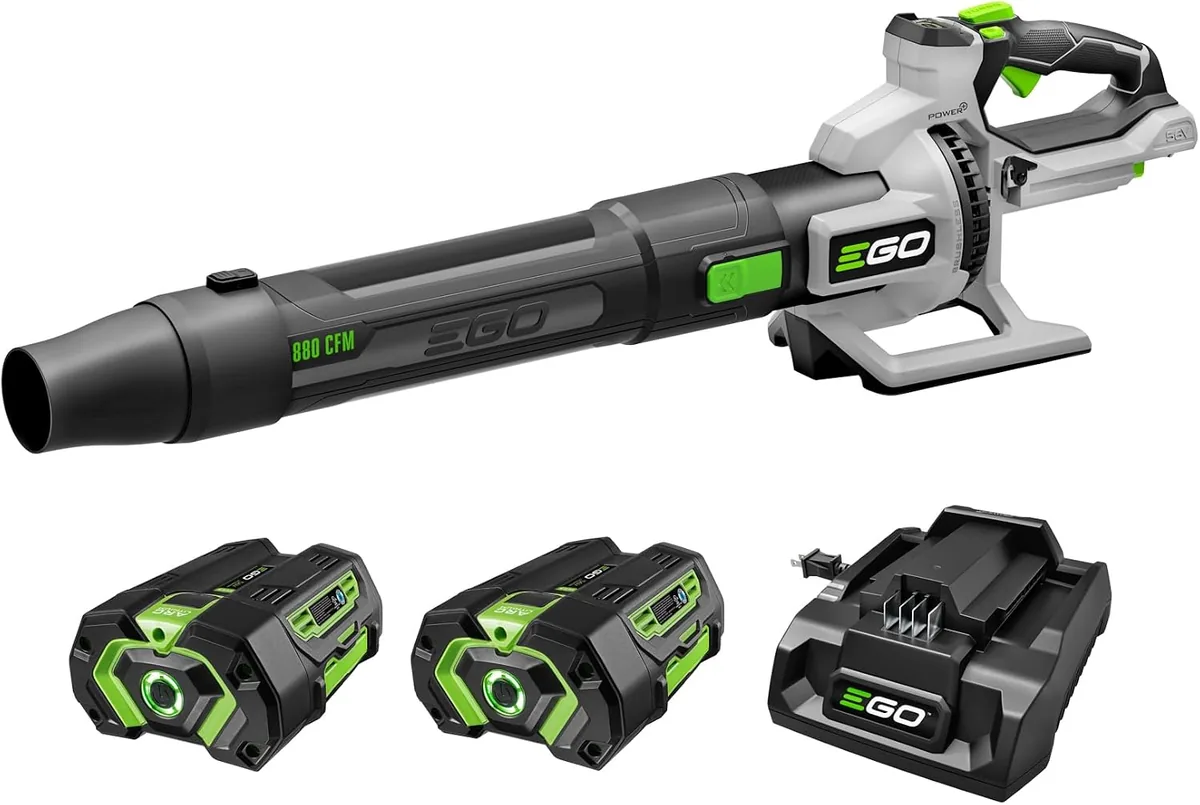
What Is in the Box and How Setup Goes
The EGO LB8800 is the bare tool, and the LB8803-2 is the kit with two 4.0 Ah batteries. According to EGO, the kit adds a 320 W charger, a tapered nozzle, a spread nozzle and a shoulder strap. Assembly takes five steps.
- Take the battery out first.
- Push the tube onto the housing until the latch clicks.
- Push the nozzle onto the tube until it snaps on.
- Clip the strap carabiner to the hanger at the rear.
- Charge both batteries fully before the first use.
Assembly needs no tools, and I had everything on in a few minutes. I charge both batteries the night before every job.
Specifications at a Glance
Two rows matter most for the EGO 880 CFM leaf blower: the run time per battery and the blowing force with the batteries from the box.
| Spec | Figure | Source |
|---|---|---|
| Airflow | 880 CFM on turbo; 270 to 700 CFM on the trigger | EGO |
| Air speed | 200 mph with the tapered nozzle | EGO manual |
| Blowing force | 30 N maximum; about 20 N on turbo with the box battery | EGO; field figure |
| Batteries | 56V, two 4.0 Ah (224 Wh each), used one after the other | EGO |
| Run time per battery | 80 min low, 12 min high, 8 min turbo | EGO manual |
| Weight | About 9.7 lb with one battery (tool plus battery weights added); 4.9 lb bare tool | EGO manual |
| Charge time | About 55 min per battery on the box charger | EGO |
Trigger, Turbo and Speed Lock Controls
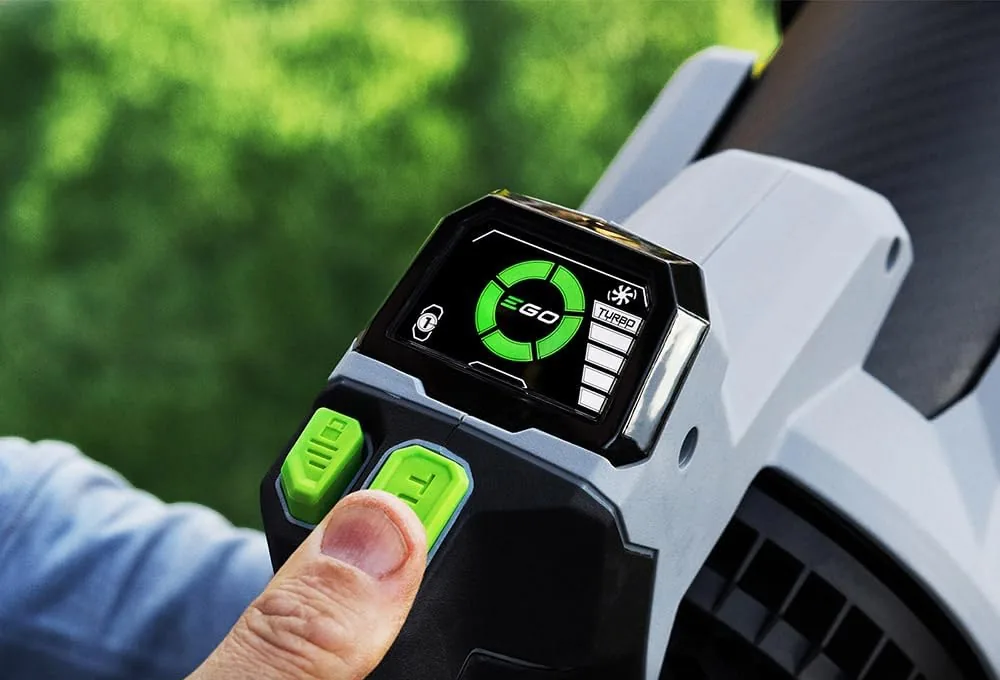
The trigger lights an LCD with a fuel gauge, a battery icon and air-speed bars, and more pressure adds bars. The screen goes dark a minute after you release the trigger. A battery under 4.0 Ah limits the display to two speed bars, so older 2.5 Ah EGO batteries will not give full output.
Turbo works only while you hold the trigger and the turbo button, and there is no turbo lock. The speed lock keeps the speed you squeezed to once you press its button and release the trigger. Pressing the lock button again switches the blower off, and it never hands control back to the trigger.
I learned that on a long pass down the alley, when I pressed the lock to take over and the blower went silent. Now the lock spares my trigger finger, and I set the speed and walk the row.
Performance in Real Leaf and Orchard Cleanup
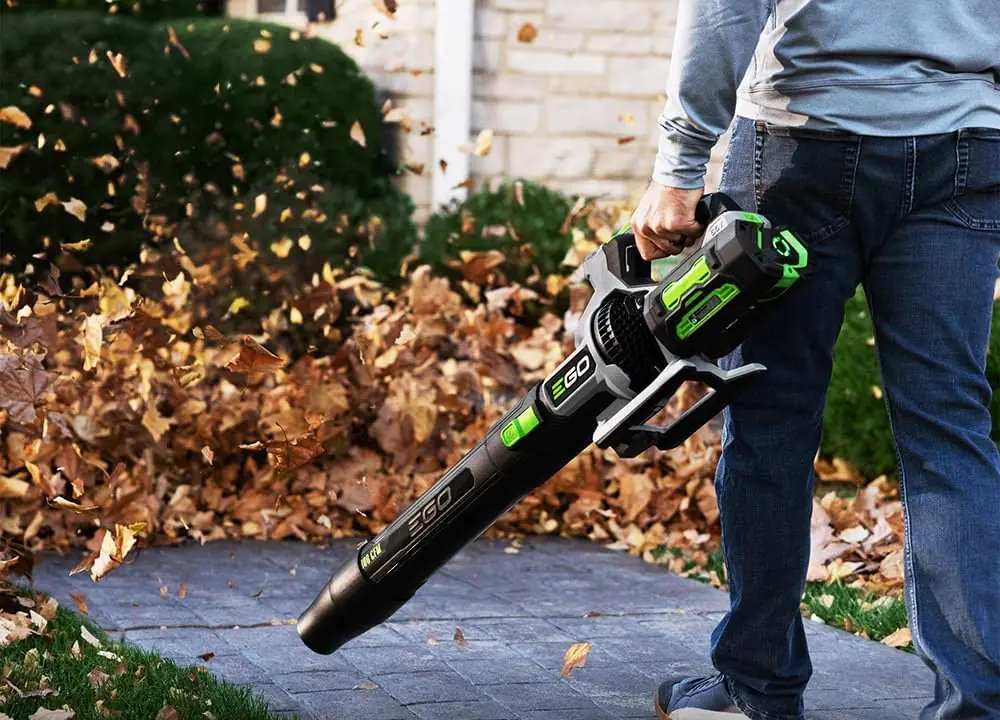
The EGO 880 blower is a volume tool first. Dry leaves and litter need a wide, steady stream, and the trigger range of 270 to 700 CFM covers most of that without touching turbo.
Air Volume and Force
EGO rates the blower at 30 N, roughly 6.7 pounds of push at the nozzle. With the kit’s 4.0 Ah battery the force on turbo comes to about 20 N, roughly two thirds of the claim, while a 7.5 Ah EGO battery gives about 24 N and a 12.0 Ah one about 29 N. The battery limits the force more than the blower does.
Wet Leaves, Gravel and Pruning Litter
Wet plum leaves on the concrete pad in front of the machinery shed only slid under the spread nozzle on trigger power. A low pass under the edge with turbo held down lifted the mat, and I let go the moment it moved, because 8 minutes goes fast.
At the gravel edge I ease the trigger and keep the tapered nozzle low, because at 200 mph the stones scatter. In late winter, turbo cleared pruning sawdust and twigs from a 20-foot stretch of row in one pass, and the speed lock with the spread nozzle moved twigs and seed pods off the lawn before the mower.
Pro Tip
Blow around the outer edges of a pile and never straight into its center, as EGO’s manual advises. On a matted wet pile, loosen it with a rake first.
Runtime and Charging in My EGO LB8803-2 Review
The table gives EGO’s manual minutes for each 4.0 Ah battery. The second battery doubles those totals and leaves the peak unchanged, and EGO’s up to 90 minutes is an average across both batteries, with the mix of modes unstated.
| Mode | One battery | Two batteries (one mode throughout) |
|---|---|---|
| Low | 80 | 160 |
| High | 12 | 24 |
| Turbo | 8 | 16 |
Real jobs mix modes: by my arithmetic from EGO’s figures, 6 minutes of high plus 4 of turbo uses one battery up, so two batteries give 12 minutes of high and 8 of turbo in total.
Charging takes about 55 minutes per battery, according to EGO. On low, work and charging keep pace, but on high or turbo you outrun the charger. So I plan a leaf season in total minutes across all the jobs.
On a mid-November Saturday, two batteries took me through the lawn around the house and the gravel yard, and I swapped when one LED on the gauge started flashing. Another time I ignored that flashing LED until the pack ran flat at the end of a plum row with a pile still in the alley.
Weight, Balance and Comfort
The tool weighs 4.9 lb bare and a 4.0 Ah battery adds 4.85 lb, so you carry about 9.7 lb, and the battery is nearly half of it. The battery sits at the rear and balances the tube, and a secondary grip zone lets you use two hands. On a long pass my shoulder tires before my wrist does, so I clip the strap on for every job.
A groundskeeper study measured about 1.9 m/s2 at the right hand for handheld blowers, and three of its 17 groundskeepers reached the 2.5 m/s2 action limit as a daily average across all their tools (1). That limit works on daily exposure, so both how hard the tool vibrates and how long you hold it count.
Noise and Hearing Protection
EGO publishes no decibel rating for this blower. NIOSH sampling of 80 landscaping workers found significantly more noise and carbon monoxide exposure with fuel-powered leaf blowers than with battery versions, and 94 of 119 eight-hour results were at or above the 85 dBA limit (2).
A battery blower is the quieter choice and still calls for hearing protection, which EGO’s manual requires along with eye protection marked ANSI Z87.1. Earplugs only work when they fit, and a Cochrane review notes that poor fit may limit protection for about 40 percent of users (3). I seat mine properly before I pull the trigger.
Maintenance, Storage and Cold Weather
Upkeep is light. Take the battery out first, wipe the housing with a clean cloth, keep solvents, gasoline and penetrating oils off the plastic, and clear leaf bits from the air inlets after a dusty job. Store the tool on its wall-mount slot, away from garden chemicals and de-icing salts.
Heat and a full charge age a stored battery. Lab pouch cells held fully charged for nine months lost about 10 percent of capacity at 95 F and about 43 percent at 140 F, while empty cells showed almost no loss (4). A multi-year study of commercial cells also tied battery life to depth of discharge and temperature (5). I keep my batteries indoors, off the tool, and never leave full ones in the hot shed.
The operating range is 5 to 104 F. On a hard frost I bring the blower and both batteries into the house for 10 minutes or longer before work, as the manual says, then start at low speed without turbo.
Common Problems and How to Fix Them
Most faults trace to the battery, the cold or a blocked air inlet, and EGO’s troubleshooting table gives the fix for each.
| Symptom | Likely cause | Fix |
|---|---|---|
| Blower does not start | Battery not seated, flat, too cold, or the battery or blower overheated | Reseat it, charge it, warm it indoors, or let it cool below 152 F before it works again |
| Only two speed bars show | Battery under 4.0 Ah | Use a 4.0 Ah or larger battery |
| Speed drops noticeably | Low charge, blocked air inlet or worn fan | Charge it, clear the inlet with the battery out, or call EGO service |
| Speed lock or display faults | Damaged button, screen or wire | EGO service |
| One gauge LED flashes | Low charge | Charge the battery |
According to EGO, the tool carries a 5-year limited warranty and the battery 3 years, for the original buyer with the dated receipt. The manual calls the blower intended for household use and does not say whether farm or business use is covered, so ask EGO before you count on it for a working orchard.
Who Should Buy It and Who Should Skip It
I recommend the kit in these cases.
- You clear a quarter to half an acre, and your high-speed work runs past 12 minutes at a stretch.
- You already own EGO 56V tools and batteries, or you want a display and a speed lock.
- You can swap batteries halfway and charge them between jobs.
Skip it in these cases.
- You only do porch, deck and car jobs, where a lighter one-battery blower is enough.
- You expect 880 CFM and 30 N out of the box, or you need sustained turbo.
- You work an acre or more all day, or your budget is tight, because this kit sits in the premium tier.
Drawbacks to Know Before You Buy
The drawbacks are real, and each has a workaround.
- Turbo is short: 8 minutes per battery suits the stubborn corner, not the lawn.
- Force sits below the claim: the box batteries give about two thirds of 30 N.
- The controls bite once: turbo needs the button held, and a second press of the speed lock button switches the blower off.
- Premium tier: you pay for the second battery, the display and the lock.
How the EGO LB8803-2 Compares With Alternatives
Three other blowers are worth a look, depending on your yard, and each gets one reason here. For the rest of the field, see my leaf blower guides.
| Spec | EGO LB8803-2 | EGO LB7654 | Greenworks BL80L414 | ECHO PB-9010T |
|---|---|---|---|---|
| Power | 56V, two 4.0 Ah | 56V, one 5.0 Ah | 80V, one 4.0 Ah | Gas, 79.9 cc |
| Airflow | 880 CFM turbo | 765 CFM boost | 770 CFM | 1,110 CFM |
| Weight | 9.7 lb with battery | 9.6 lb with battery | 10.6 lb with battery | 26.7 lb dry |
| Run time or tank | 12 min high, 8 turbo | 22 min high, 13 boost | 80 min at half load | 83.8 fl oz tank |
EGO LB7654 for One-Battery Jobs
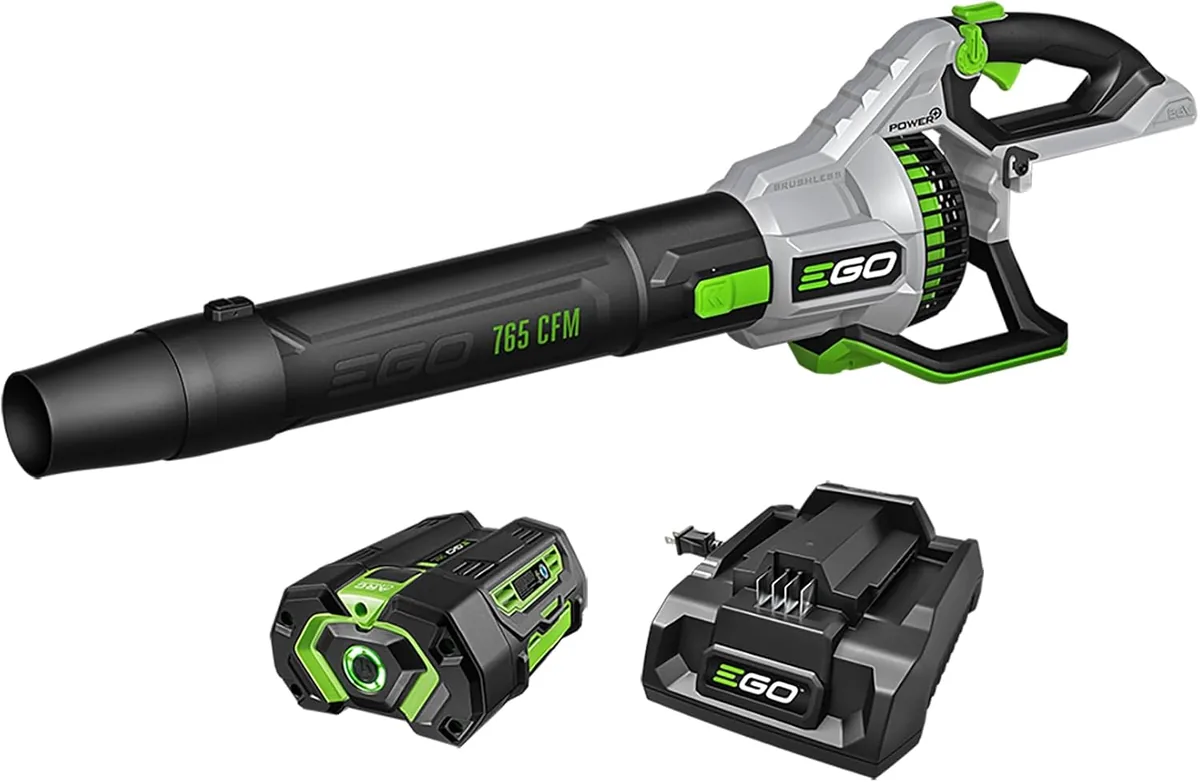
Pick the EGO POWER+ LB7654 Cordless Leaf Blower Kit when your jobs fit inside one battery. One 5.0 Ah battery runs about 22 minutes on high, against 12 minutes from each 4.0 Ah battery in the LB8803-2 kit, and it has a mechanical speed dial. Skip it if you want a second battery in the box, a display or the 880 CFM turbo.
Greenworks BL80L414 for 80V Owners
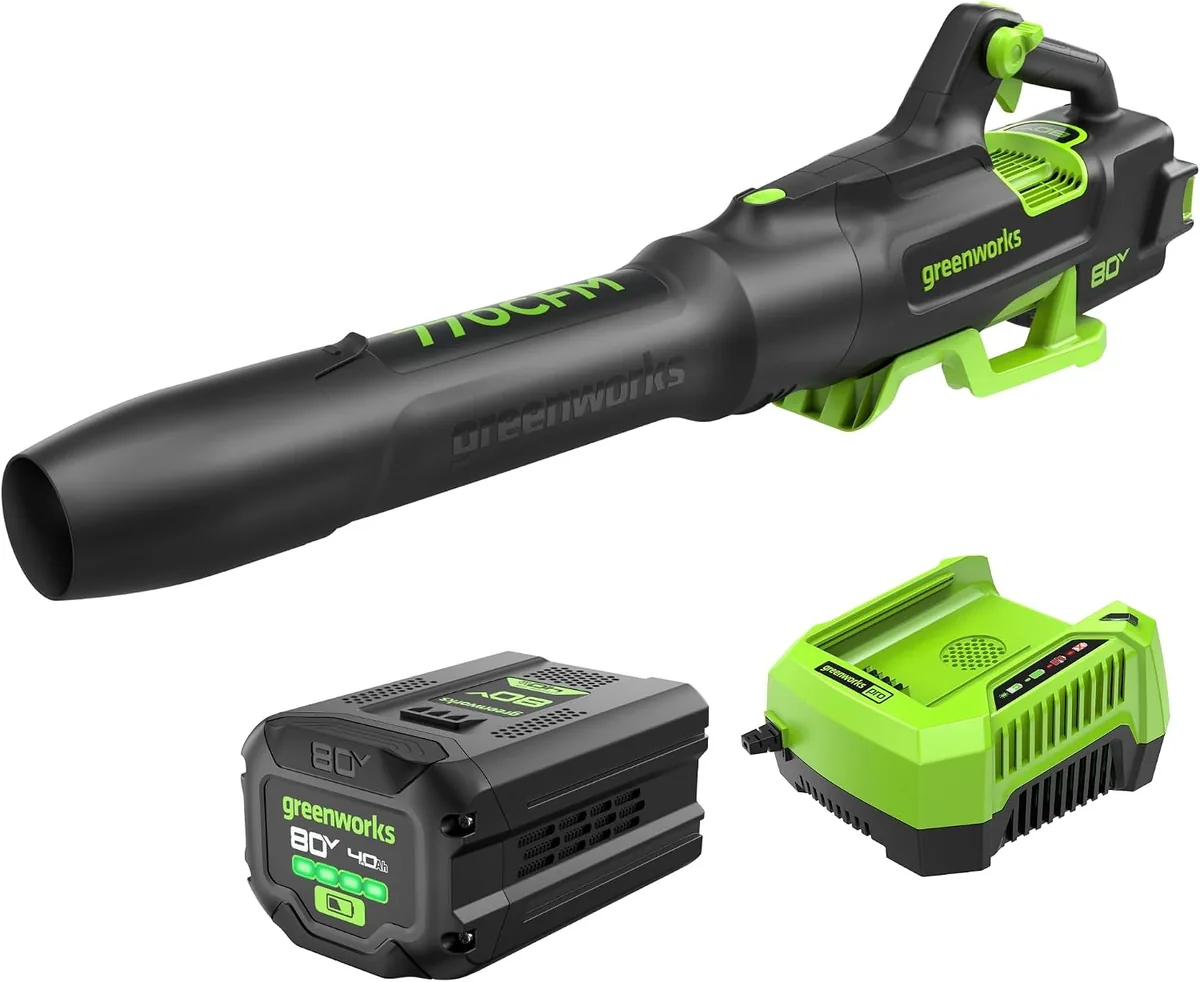
Pick the Greenworks 80V BL80L414 Cordless Leaf Blower Kit if you already own Greenworks 80V tools, since one 80V battery runs a long list of them and the tool and battery carry a 4-year warranty. It weighs about 10.6 lb with its battery, and its 32 F operating floor rules out frosty mornings.
ECHO PB-9010T for Acre-Plus Ground
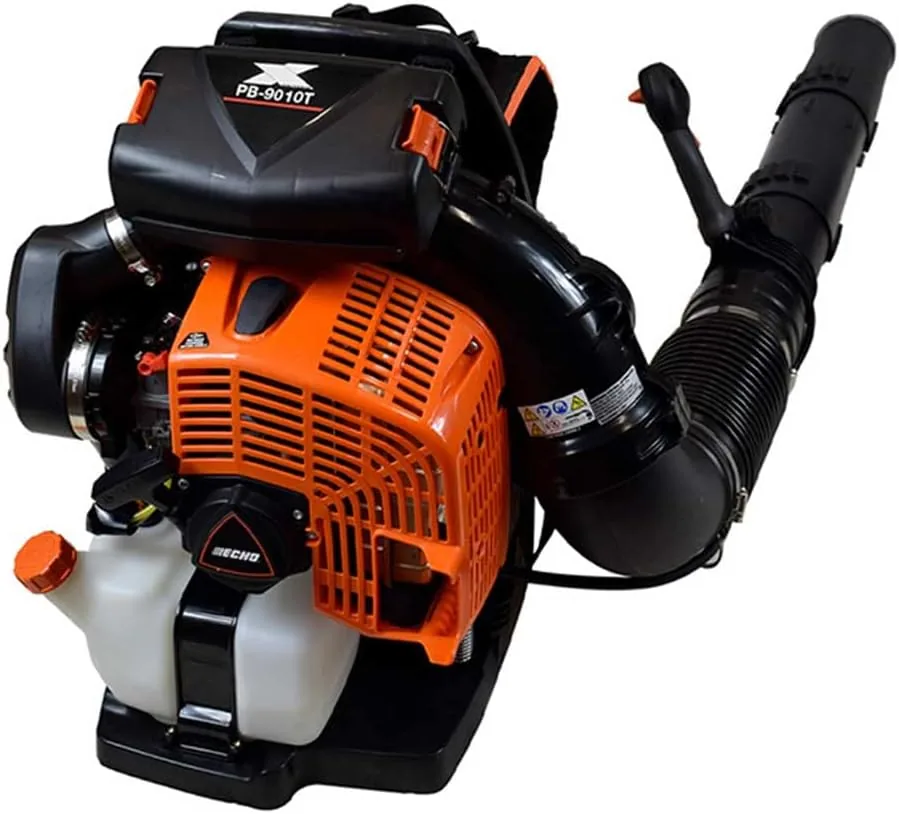
Pick the ECHO PB-9010T Gas Backpack Leaf Blower when your property runs to an acre or more, the job lasts for hours or the leaves lie in wet mats. ECHO rates its gas backpack at 48 N, against EGO’s 30 N, and a tank refills in a minute instead of a 55-minute recharge. It needs mixed fuel and is the loudest option here.
My Final Verdict on the EGO LB8803-2
I recommend the EGO POWER+ LB8803-2 Two-Battery Leaf Blower Kit for yards where a long session needs a spare battery, a display and a speed lock, because that is what the premium tier buys. Do not buy it for the 880 CFM headline alone, because the box batteries give 8 minutes of turbo and about two thirds of the claimed force. Charge both batteries the night before and keep the strap on: that is my EGO LB8803-2 review in one line for anyone with long sessions ahead.
Frequently Asked Questions
What are people saying about the EGO 880 blower?
Owners mention three traits: the high and turbo runs per battery are short, the force depends on battery size, and a second press of the speed lock button switches the blower off. A fair EGO LB8803-2 review credits the second battery and the display, which offset those short runs on long jobs.
How long does an EGO 880 battery last?
An EGO 880 battery from the kit lasts about 80 minutes on low, 12 minutes on high and 8 minutes on turbo, according to EGO’s manual for one 4.0 Ah battery. EGO’s up to 90 minutes is an average across both batteries with an unstated mix of modes, so use the per-mode numbers to plan a job.
Which EGO blower is considered the best?
The best EGO blower depends on the yard, because the LB8803-2 brings two batteries, a display and a speed lock, while the LB7654 is a mid-range kit with one battery. Choose the LB8803-2 for sessions that need a spare battery, and the LB7654 if its 22 minutes on high covers your job.
What are the common problems with battery operated leaf blowers?
The common problems with battery operated leaf blowers are short runs at high speed, weaker output from small batteries, slow starts in the cold and heavy battery weight. On this kit that means 8 minutes of turbo, two speed bars under 4.0 Ah, a warm-up indoors on frost mornings and 4.85 lb in the battery.
Which is better, a gas or an electric leaf blower?
A gas leaf blower is better for acre-plus ground, wet mats and all-day work, while an electric leaf blower is better for quiet, easy starts and yards under about half an acre. The EGO kit handles my lawn and gravel yard, but a gas backpack like the ECHO PB-9010T suits bigger ground.
References
- Chen N, Yang S, Oh J. Evaluation of hand-arm vibration (HAV) exposure among groundskeepers in the southeastern United States. Annals of Work Exposures and Health. 2025;69(1):81-95.
- Alexander BM, Graydon PS, Pena M, Feng HA, Beamer BR. Hazardous exposures and engineering controls in the landscaping services industry. Journal of Occupational and Environmental Hygiene. 2025;22(3):189-202.
- Morata TC, Gong W, Tikka C, Samelli AG, Verbeek JH. Hearing protection field attenuation estimation systems and associated training for reducing workers’ exposure to noise. Cochrane Database of Systematic Reviews. 2024;5(5):CD015066.
- Mao Z, Farkhondeh M, Pritzker M, Fowler M, Chen Z. Calendar Aging and Gas Generation in Commercial Graphite/NMC-LMO Lithium-Ion Pouch Cell. J. Electrochem. Soc. 2017;164(14):A3469-A3483.
- Preger Y, Barkholtz HM, Fresquez A, et al. Degradation of Commercial Lithium-Ion Cells as a Function of Chemistry and Cycling Conditions. J. Electrochem. Soc. 2020;167(12):120532.
Safety Note: Leaf blowers throw debris and can damage your hearing. Wear eye and ear protection, read the manufacturer’s manual, and check your local rules on noise and operating hours.