
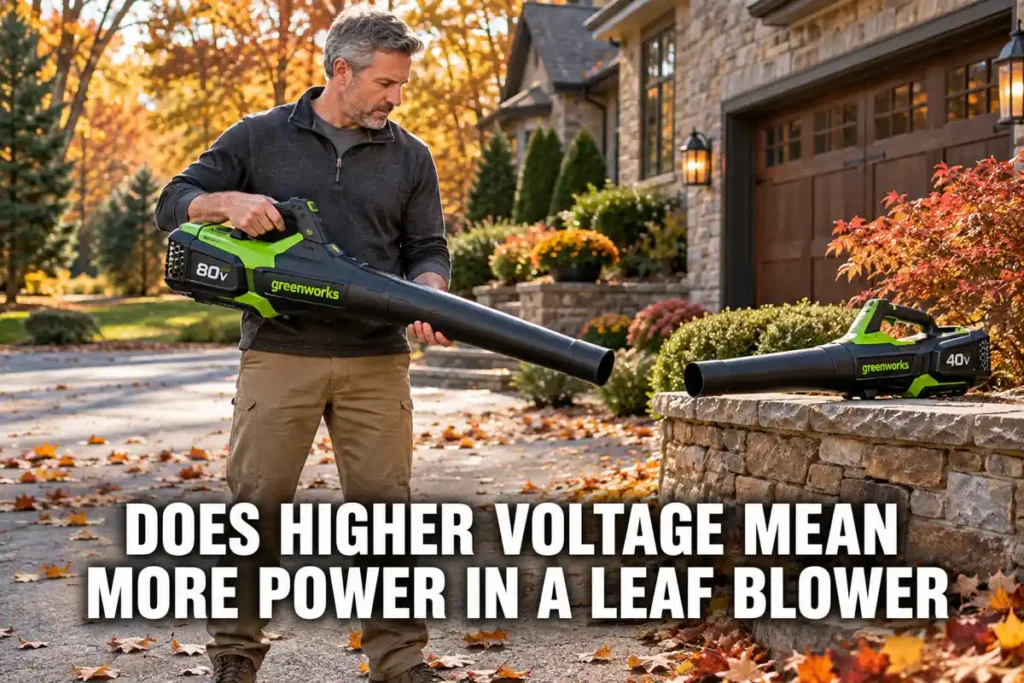
Higher voltage does not give a leaf blower more power by itself. Power is volts times amps, and the motor, the fan and the nozzle decide how much of it reaches the air. According to Husqvarna, its 36V 350iB blows 800 CFM, more air than the 56V EGO LB7654 at 765 CFM or the 80V Greenworks at up to 730 CFM.
The house lawn, the gravel yard and the plum rows on our farm add up to several hours of blowing each autumn, and a volt badge never told me how many of those hours one pack would cover. Below I explain what a volt badge measures, why the motor and fan matter more, and which numbers to compare instead.
Does Higher Voltage Mean More Power in a Leaf Blower?
Voltage is the electrical push of the pack, and power is that push multiplied by the current the pack delivers. A blower turns part of that power into moving air, and the motor, the fan size, the nozzle and the maker’s current limit decide how much. Two blowers with the same badge can move very different amounts of air.
The badge still tells you three useful things:
- Platform: the voltage and the maker’s connector decide which packs and chargers fit the tool.
- Class: 18V and 20V MAX tools are light-duty sweepers, and most of the strongest battery handhelds run at 54V and above.
- Headroom: for the same watts, a higher-voltage tool draws fewer amps, which puts less current through the wiring and leaves room for a turbo mode.
None of the three ranks one blower against another. The hardest job I give a blower is wet plum leaves on the gravel yard in November, and minutes on high plus the push at the nozzle tell me whether it can do that job.
What Leaf Blower Voltage Actually Measures
A battery’s voltage is the electrical pressure of the pack, and it comes from stacking lithium-ion cells in series. A lithium-ion cell averages roughly 3.6 to 3.7 volts in use and sits near 4.0 volts or a little above when freshly charged. Each cell in a series string adds its voltage to the total, so five cells give 18 volts at the working average and about 20 volts right off the charger.
Nominal Voltage and the MAX Badge
The working average is the nominal voltage. A MAX badge quotes the higher figure a fresh pack shows before any load pulls on it. DeWalt prints the split in a footnote on its 20V MAX blower page: 20 volts measured without a workload, 18 volts nominal. That makes a 20V MAX label a different way of writing an 18 volt nominal pack, with no extra volts behind it.
How Makers Label Their Packs
Makers do not label packs the same way, so a badge is a name and not a measurement. The table lists the nominal figures that the makers print themselves.
| Badge | Nominal voltage | What the maker says |
|---|---|---|
| 20V MAX (DeWalt DCBL722P1) | 18 V | 20 V measured without a workload; 18 V nominal. |
| 60V MAX FlexVolt (DeWalt DCBL772X1) | 54 V | One pack, two names: 20V MAX in small tools, 60V MAX here; 18 V and 54 V nominal. |
| 36 V (Husqvarna 350iB) | 36 V | The BLi30 pack is listed at 36 V. |
EGO and Greenworks print only 56V and 80V on their pages, so for those blowers I compare watt-hours and rated output. Voltage is also the first check on whether a pack fits a tool, and the connector is the second. Use only the maker’s own pack and charger, and never force a pack of another voltage into a tool.
How Volts, Amps and Watts Work Together
Three units describe a battery blower. Volts are the push, amps are the flow, and watts measure how fast the work gets done, found by multiplying volts by amps. Watt-hours are volts times amp-hours and measure the size of the tank.
A Pump Picture of Volts and Amps
I picture volts and amps with the pump on our drip system. Pressure at the pump head moves nothing until water flows through the emitters, and the power the pump puts into the water is pressure times flow. A battery pack follows the same logic: volts with no current deliver no power, and the same power at low volts needs far more current through the wires. It is only a picture, and the real calculation is watts equal volts times amps.
A Worked Example With Real Numbers
The EGO LB7654 with its 5.0 Ah pack makes a clean example. The label says 56 volts, so the pack holds 56 times 5.0, or 280 watt-hours. According to EGO, the pack runs about 25 minutes on high and about 15 minutes on turbo.
- Divide 280 watt-hours by 25 minutes (0.42 hours) and the average draw on high is about 670 watts.
- Divide 280 watt-hours by 15 minutes (0.25 hours) and the average draw on turbo is about 1,120 watts.
- Divide 1,120 watts by 56 volts and turbo pulls about 20 amps from the pack.
These are averages that assume the pack gives up all its rated energy, but they show the point. The minutes come from the watts, and the volt label says nothing about them.
Why Higher Voltage Gives Headroom
Run the same 1,120 watts at 18 volts and the current rises to about 62 amps, roughly three times the 20 amps at 56 volts. In any one wire or connector, heat rises with the square of the current, so the same wire would carry close to ten times the heat. Research on lithium-ion cells names internal resistance as the key parameter for a cell’s power, efficiency and lost heat (1). That is the real benefit of higher voltage: the same watts for fewer amps, which leaves the maker room for a bigger motor and a turbo mode.
Key Takeaway
Higher voltage lowers the current needed for a given amount of power. It does not add power on its own.
Why a Cold Pack Gives Less
A lithium-ion pack’s power capability is governed by its internal resistance (2). In lab tests that resistance climbed in the cold, which lowered the capacity and power available (3). The label voltage does not change on a frost morning, but the pack does.
According to EGO, its pack performs best between 50 and 80 F, so on frost mornings I keep my packs in the house until the job starts.
Charging Safety
Never charge a lithium-ion pack below freezing. Bring it indoors and let it reach room temperature first.
Why the Motor and Fan Decide the Blowing Power
A battery blower is a chain of pack, controller, motor, fan and nozzle, and voltage describes only the first link. In a DC motor, speed rises with voltage and torque rises with current, and mechanical power is torque times speed. The fan then turns that power into moving air, and it is hungry: fan power climbs much faster than fan speed.
The US Department of Energy’s fan sourcebook states that airflow follows fan speed in a straight line while power use follows the cube of the speed, and that a fan running 20 percent slower uses about 50 percent less power (4). These laws describe industrial fans, so I take only the shape of the curve from them and no blower figures.
Inside one design, more volts into the same motor would spin the fan faster and blow much harder, and it would also overheat the motor. That is why each blower is built around one voltage and the controller limits the current. Between designs, the maker picks the winding, the fan diameter, the nozzle and the current limit to suit a price and a job, which is why a badge cannot rank blowers.
One Setting and One Nozzle
Maker ratings add one more trap. According to EGO, the LB7654 moves 765 CFM on turbo and reaches 195 mph with the tapered nozzle, or 166 mph without it. Every rating belongs to one setting with one nozzle fitted, so I read CFM and mph as a pair of clues.
My guide on what the CFM number on a leaf blower actually measures covers how those clues are tested and how to compare them across brands.
The number that combines both is the force at the nozzle, measured in newtons, and one newton is about a quarter pound of force. The push of an air jet depends on how much air leaves each second and how much that air speeds up, the same principle that gives a jet engine its thrust (5).
Real Blowers Where Lower Voltage Wins
Maker ratings show the point better than any argument. The table lists current handhelds by airflow, with the nominal voltage where the maker prints one.
| Blower and badge | Nominal voltage | Airflow, maker’s rating (CFM) | Air speed, maker’s rating (mph) | Force, maker’s rating (N) |
|---|---|---|---|---|
| EGO LB8803-2 (56V) | Not listed | 880 | 200 | 30, about 20 with the kit’s 4.0 Ah packs |
| Husqvarna 350iB (36V) | 36 V | 800 | 200 | 23.5 |
| EGO LB7654 (56V) | Not listed | 765 | 195 with tapered nozzle | 26 |
| Greenworks 80V 730 CFM handheld | Not listed | 650 with a 2.0 Ah pack, 730 with 4.0 Ah or larger | 170 with 4.0 Ah or larger | Not listed |
| EGO LB6504 (56V) | Not listed | 650 | 180 | 21 |
| Milwaukee M18 FUEL dual-battery 2824-20 | Not listed (two packs) | 600 | 145 | 17.7 |
| DeWalt DCBL772 FlexVolt (60V MAX) | 54 V | Up to 600 | 125 | Not listed |
| DeWalt DCBL722P1 (20V MAX) | 18 V | Up to 450 | Up to 125 with concentrator | Not listed |
What the Table Shows
- The 36V Husqvarna lists more air than the 56V EGO LB7654, the 80V Greenworks and the DeWalt FlexVolt 60V MAX, and ranks second of the eight on airflow.
- The same 56V badge covers 650 to 880 CFM across three EGO models, about 35 percent more air at the top of the range.
The class pattern is real. The 18 volt nominal DeWalt lists 450 CFM, while the 54V and 56V blowers in the table list 600 to 880. Makers spend the headroom of a higher voltage on bigger motors and larger current, so the badge follows the class.
The pack matters inside one model as well. Greenworks lists 650 CFM for its 80V blower with a 2.0 Ah pack and up to 730 CFM with a 4.0 Ah or larger pack. The volts are identical, and the current the pack can supply is what differs.
What Higher Voltage Does Change
Voltage shapes the tool you live with, even though it does not rank blowers. These are the effects I notice:
- Platform: the packs you already own decide the cheapest strong blower, and a second platform doubles the chargers.
- Weight: more cells in series make a bigger pack, and the EGO LB7654 weighs about 9.6 lb with its battery while the Husqvarna 350iB weighs 10 lb according to Husqvarna.
Late in a long job I notice the weight in my hand long before I think about volts, so I judge weight with the battery fitted.
Voltage alone cannot predict four things. Runtime depends on watt-hours and the watts a blower draws, charge time depends on the pack’s energy and the charger’s watts, noise depends mostly on the fan and its speed, and turbo calls for ear protection whatever the badge says.
Protect Your Ears and Eyes
Turbo on a battery blower is still loud, so wear ear protection from the first minute and eye protection all the time. Keep people, pets and windows out of the debris path before you squeeze the trigger.
What to Compare Instead of Volts
A fair comparison takes five checks in this order, and the volt badge comes last.
- Force in newtons, where the maker lists it. It blends airflow and speed into one number.
- CFM and mph, with the nozzle named, when newtons are missing.
- Watt-hours and the maker’s minutes on high, because wet leaves demand the high setting.
- Weight with the battery fitted, since you carry it for the whole job.
- The maker’s rating for your own pack size, and then the platform.
There is no single best voltage for leaf blower work, because the job sets the force you need and the pack sets how long you can keep it up. Voltage classes are only a rough guide: 18V and 20V MAX tools suit patios and dry leaves, and most of the strongest handhelds run at 54V and above, yet the 36V Husqvarna lists more air than several higher-voltage models. For wet piles and larger lots I pick the blower with the most newtons I can carry and enough minutes on high to finish the job.
Pro Tip
Write down your pack’s watt-hours (volts times amp-hours). That figure follows the pack to any blower on the same platform, while the minutes on high belong to one blower, so check them again on each model.
Choose by Newtons and Minutes on High
Three points are worth keeping. Volts and amps together make watts, the motor and fan turn watts into push, and the voltage label says little about either. I start with the platform I already own, then compare newtons, then minutes on high.
My tip for November is to charge two packs the night before a leaf day and keep them indoors until you start. When you are ready to shortlist, my leaf blower guides cover the models that suit each yard. Higher voltage raises the ceiling on a leaf blower’s power, and the motor, the fan and the pack decide how much of it reaches the leaves.
Frequently Asked Questions
What is a good volt for a leaf blower?
A good voltage for a leaf blower is the one that matches your yard and the battery platform you already own. The 18V and 20V MAX class suits patios and dry leaves, 36V to 40V suits small yards, and 54V and above covers the strongest handhelds.
How much power does a leaf blower use?
A leaf blower uses watts, which are volts times amps. A corded model with a 12 amp motor on a 120 volt outlet draws up to 1,440 watts, and a 56V EGO LB7654 with a 5.0 Ah pack averages about 670 watts on high and about 1,120 watts on turbo at EGO’s rated minutes. Those are input watts and not the power in the air jet.
How do I make my leaf blower more powerful?
To make a leaf blower more powerful, start with a fully charged, warm pack and a clear intake, because you cannot add voltage to a blower. A tapered nozzle raises air speed at the cost of airflow, and a larger pack from the same platform can lift output where the maker lists higher ratings for bigger packs, as Greenworks does for its 80V blower.
Which type of leaf blower is better, battery or corded?
Neither type is better in every yard: a corded blower never runs out of charge but stops where the cord ends, and a battery blower goes anywhere until the pack empties. A 120 volt cord does not make the corded blower stronger, so compare newtons or CFM and mph before you decide.
Does higher voltage mean more power?
Higher voltage means more available power only when the motor, fan and pack are built to use it. The DeWalt 60V MAX FlexVolt lists up to 600 CFM while the 56V EGO LB7654 lists 765 CFM, so the badge alone cannot rank two blowers.
References
- Schweiger H-G, Obeidi O, Komesker O, et al. Comparison of Several Methods for Determining the Internal Resistance of Lithium Ion Cells. Sensors. 2010;10(6):5604-5625.
- Barai A, Uddin K, Widanage WD, McGordon A, Jennings P. A study of the influence of measurement timescale on internal resistance characterisation methodologies for lithium-ion cells. Sci Rep. 2018;8:21.
- Hossain Ahmed S, Kang X, Bade Shrestha SO. Effects of Temperature on Internal Resistances of Lithium-Ion Batteries. J Energy Resour Technol. 2015;137(3):031901.
- US Department of Energy, Industrial Technologies Program; Air Movement and Control Association International. Improving Fan System Performance: A Sourcebook for Industry. DOE/GO-102003-1294. US Department of Energy; 2003.
- NASA Glenn Research Center. Thrust Equation. Beginners Guide to Aeronautics. Updated June 10, 2026.
Safety Note: Leaf blowers throw debris and can damage your hearing. Wear eye and ear protection, read the manufacturer’s manual, and check your local rules on noise and operating hours.