
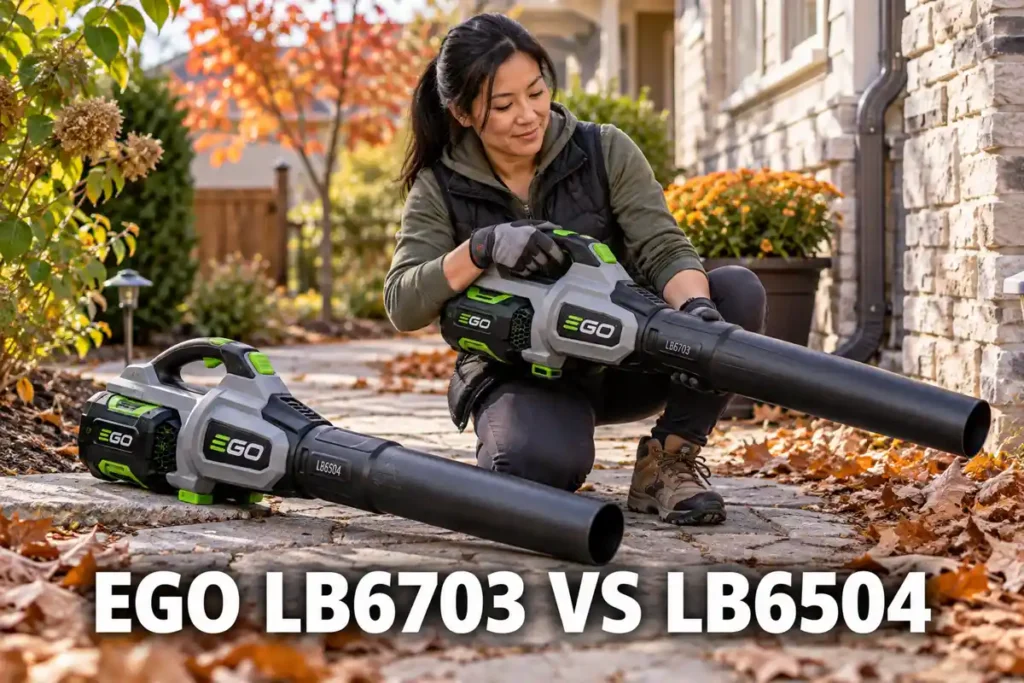
In the EGO LB6703 vs LB6504 choice, I pick the LB6703 for most buyers, because it is the slightly stronger blower, it costs a tier less and its charger refills a pack in 55 minutes. The LB6504 wins when one pack has to finish the whole job, since its 5.0 Ah battery runs 30 minutes on high against 24. I have cleared leaves with both on my lawn, my gravel yard and my 3.7-acre apricot and plum orchard. Below I set the two side by side on power, runtime, charging, weight and controls.
Affiliate Disclosure: Garden Power Scout is a proud participant in the Amazon Services LLC Associates Program. As an Amazon Associate, we earn from qualifying purchases, at no extra cost to you.
My Quick Answer on EGO LB6703 vs LB6504
Buy the LB6703 if you want the stronger blower for the money, a pack that is full again in under an hour, or a plan to add a second battery. Take the LB6504 if you run one pack for the whole job, charge overnight and want the longest single run. EGO’s own minutes per mode point to nearly the same power draw on low and high, so the battery in each box accounts for most of the gap in minutes.
LB6703 and LB6504 are EGO’s kit numbers: the LB6703 is the 670 CFM LB6700 blower with one 4.0 Ah battery and a 320 W charger, and the LB6504 is the 650 CFM LB6500 blower with one 5.0 Ah battery and a standard charger. Every figure in the table below sits next to the battery and nozzle it belongs to.
| Spec | LB6703 kit | LB6504 kit |
|---|---|---|
| In the box | LB6700 blower, one 4.0 Ah battery, CH3200 charger, tapered and spread nozzles | LB6500 blower, one 5.0 Ah battery, CH2100 standard charger, flat and tapered nozzles |
| Shoulder strap | Not in the box | Not in the box |
| Airflow on boost | 670 CFM | 650 CFM |
| Airflow at the top of the dial, per EGO’s technical specifications | 530 CFM | 470 CFM |
| Air speed | 180 mph with the tapered nozzle, 160 mph without it | 180 mph with the tapered nozzle, 160 mph without it |
| Rated force | 21 N (about 4.7 pounds of push) | 21 N (about 4.7 pounds of push) |
| Battery in the kit | 4.0 Ah, 224 Wh | 5.0 Ah, 280 Wh |
| Run time per pack | About 160 min low, 24 min high, 13 min boost | About 200 min low, 30 min high, 15 min boost |
| Charge time, empty to full | 55 min on the CH3200 | 100 min on the CH2100 |
| Weight, tool only | 4.8 lb, no battery | 4.77 lb, no battery |
| Weight with the kit battery | About 9.65 lb (4.8 lb tool plus 4.85 lb battery) | About 9.73 lb (4.77 lb tool plus 4.96 lb battery) |
| Controls | Variable trigger, lock-on speed dial, boost button | Variable trigger, lock-on speed dial, boost button |
| Warranty | 5 years on the tool, 3 years on the battery and charger; 1 year for professional or commercial use | 5 years on the tool, 3 years on the battery and charger; 1 year for professional or commercial use |
Two rows decide it: the run time per pack favors the LB6504, and the charge time favors the LB6703.
What Is Different in the EGO LB6703 vs LB6504 Kits
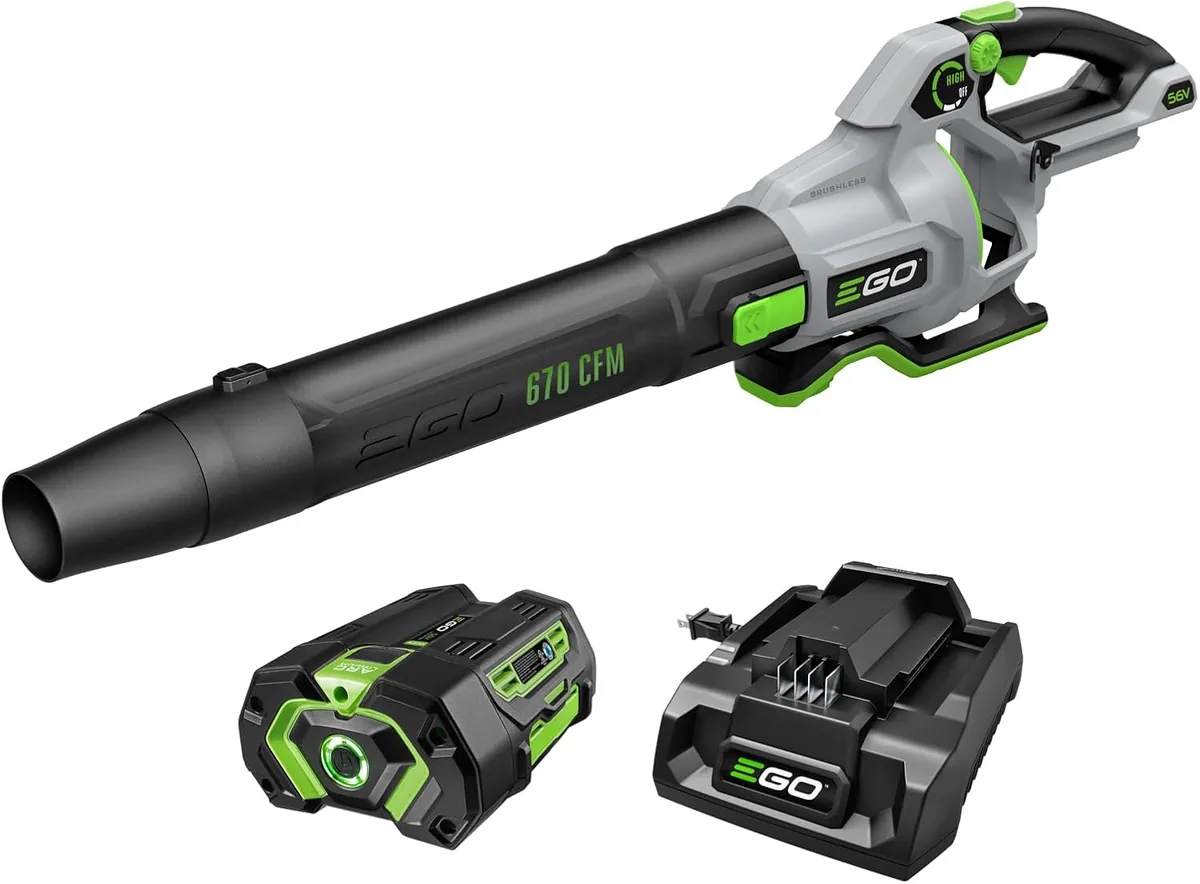
The LB6703 is the 670 CFM kit. Sold as the EGO 670 CFM Blower with Battery and Charger, it holds the LB6700 blower, one 4.0 Ah battery with a fuel gauge, the 320 W CH3200 charger, and a tapered and a spread nozzle.
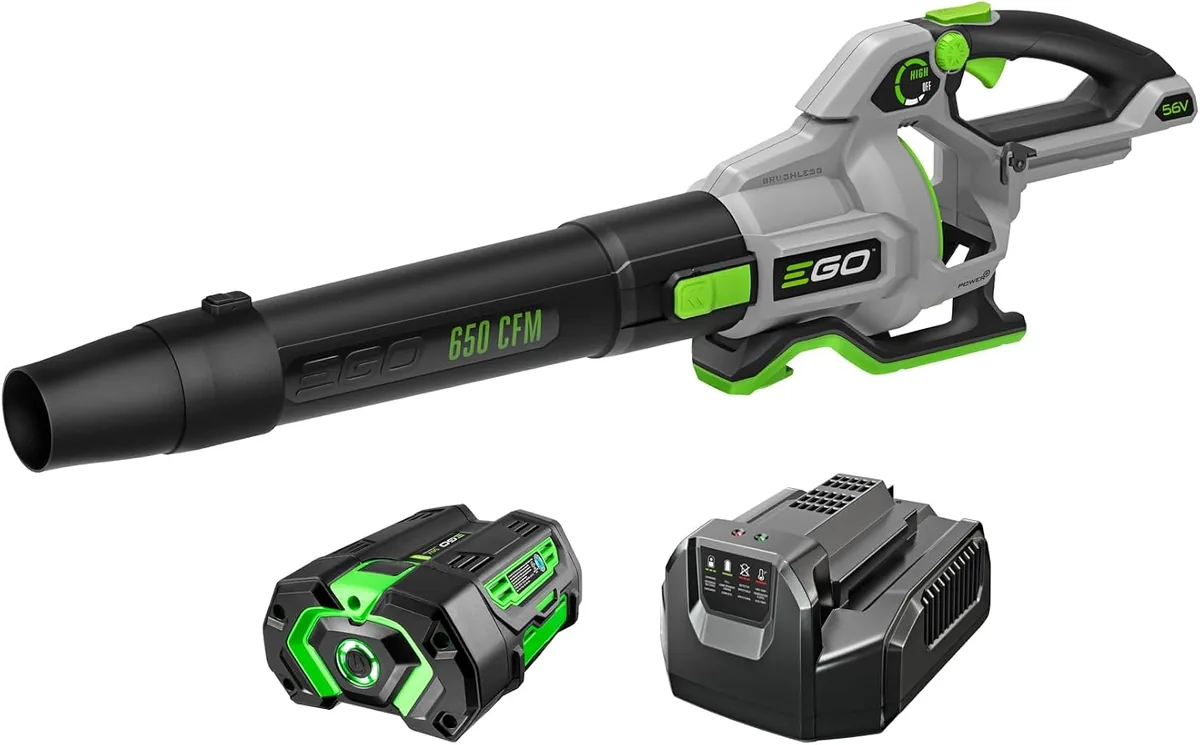
The LB6504 is the 650 CFM kit. It holds the LB6500 blower, one 5.0 Ah battery with a fuel gauge, EGO’s standard CH2100 charger, and a flat and a tapered nozzle.
Neither box includes a shoulder strap, and each manual lists one as an accessory. The bare tools are the LB6700 and the LB6500, which suit anyone who already owns 56V batteries, since every EGO 56V battery fits both blowers. EGO also lists an LB6503 kit, the 650 CFM blower with a 4.0 Ah battery, which is the closest match to the LB6703’s battery.
How 670 CFM and 650 CFM Perform in Real Work
CFM is the volume of air, mph is its speed, and newtons (N) are the push you feel at the nozzle. The LB6703 moves 670 CFM on boost and the LB6504 moves 650, a lead of 20 CFM or about 3 percent. Both are rated 21 N at 180 mph with the tapered nozzle, so EGO itself claims no gain in push, and the EGO 670 vs 650 gap stays small.
On its own 5.0 Ah pack the LB6504 delivers about 20 N on boost and about 11 N on high, close to the 21 N rating. For the LB6703, EGO’s 21 N rating is the figure to go by.
On the wet mat of apricot leaves in front of the machinery shed, both blowers asked for the same technique: boost, held low, sweeping under the leading edge. I could not feel the 20 CFM between them. The nozzles made the visible difference. The spread nozzle on the LB6703 swept mown clippings off the gravel in a wide band, and the flat nozzle on the LB6504 stayed low on the concrete pad and kept pushing the mat ahead of it.
Without boost, EGO’s technical specifications give the LB6703 up to 530 CFM at the top of the dial and the LB6504 up to 470, so the 670 leads more clearly at steady speeds than it does on boost. If you want a clearly harder push, step up to EGO’s 765 or 880 CFM blowers.
Winner: LB6703, because it moves 20 CFM more on boost and about 60 CFM more at the top of the dial, at the same rated push.
Runtime on the Battery in the Box
EGO’s manuals give minutes per mode for each pack. The LB6703 runs about 160 minutes on low, 24 on high and 13 on boost with its 4.0 Ah battery, and the LB6504 runs about 200, 30 and 15 with its 5.0 Ah battery.
On low and high the 650 runs 25 percent longer, which matches the 25 percent more energy in its pack, 280 watt-hours against 224. On boost the edge shrinks to about 15 percent, 15 minutes against 13. Divide each pack’s watt-hours by its minutes and both blowers come out at about 84 W on low and 560 W on high. These are rough averages from EGO’s rounded minutes, and label watt-hours are not usable energy, but they point to the battery as the main reason for the gap.
The Battery Sets the Minutes
A 5.0 Ah pack fitted to the LB6703 should run about as long as the LB6504 does, close to 30 minutes on high. A 4.0 Ah pack on the LB6504 would do what the LB6703 does.
The LB6504’s pack comes in at about 27 minutes on high and about 17 minutes on boost, a little under EGO’s 30 on high and a little over its 15 on boost, and for the 670 I plan around EGO’s 24 and 13 minutes.
The fuel gauge on the LB6703 pack falls in 20 percent steps, so a glance shows how much is left. How hard a pack is worked affects its life as well: a multi-year cycling study of commercial lithium-ion cells found that the time to fall to 80 percent of capacity varied by thousands of hours with discharge rate, depth of discharge and temperature (1). I keep boost for the stubborn corner and use high for the lawn.
Winner: LB6504, because its pack gives 30 minutes on high and 15 on boost against 24 and 13.
Charging Speed and Battery Care
This is where the LB6703 kit earns its place. Its CH3200 charger refills the 4.0 Ah pack in 55 minutes, while the LB6504’s standard CH2100 takes 100 minutes for the 5.0 Ah pack. Put the 650’s pack on a CH3200, sold separately, and it fills in 70 minutes.
Faster charging closes most of the runtime gap on a long job. The table counts minutes of blowing on high with one pack per kit, the box charger and no work while a pack charges, using EGO’s manual minutes.
| Time elapsed | LB6703 kit | LB6504 kit |
|---|---|---|
| 1 hour | About 24 | About 30 |
| 2 hours | About 48 | About 30 |
| 3 hours | About 70 | About 60 |
The lead changes hands. The 650 kit is ahead for the first 85 minutes, the 670 kit from about 85 to 150, the 650 kit briefly after that, and the 670 kit again from about 170 minutes, and the gap never passes about 20 minutes. The faster charger cancels the bigger pack and does not beat it, and a second pack roughly doubles your blowing time before any wait on either kit, though a long non-stop job still ends in a recharge.
I put the empty LB6703 pack on the charger when I stopped for lunch, and it was full again before I had checked the drip filter and finished eating.
Charging works between 41 F and 104 F, and the blowers run from 5 F to 104 F, so on a frost morning a cold pack should warm up before it goes on the charger. Storage matters as much. In one lab study of commercial pouch cells held fully charged for nine months, the cells lost about 10 percent of capacity at 95 F and about 43 percent at 140 F, while cells stored at zero charge showed virtually no loss (2). My spare packs sit on a shelf in the house, never in the machinery shed in July.
A modeling study of fast-charge scenarios linked the heat built up during fast charging to a shorter cycle life (3). It models charging in general and says nothing about EGO’s charger, so I read the 55 minutes as a convenience and let a hot pack cool before it goes on the charger.
Winner: LB6703, because 55 minutes beats 100 and the quick charger narrows the gap over a long job.
Weight, Balance and Controls
On weight, the two blowers sit within a tenth of a pound: the bare LB6700 weighs 4.8 lb and the bare LB6500 weighs 4.77 lb. With their kit batteries, 4.85 lb for the 4.0 Ah pack and 4.96 lb for the 5.0 Ah pack, you hold about 9.65 lb against about 9.73 lb. Eight hundredths of a pound is not a difference a hand can find.
Neither box includes a shoulder strap, so on the long alley between the plum rows I carried each blower by the grip alone. The pack sits at the rear, which keeps the tube from diving, and after about 20 minutes my forearm tired before my shoulder did.
The controls match. Both have a variable trigger, a speed dial that locks any setting so the trigger can rest, and a boost button that works only while you hold it and drops back to the dial speed when you let go. That suited the wet corner by the shed, where I wanted a short push and then a soft stream. On the LB6703 the dial and boost button share the handle, so my hand never left the grip.
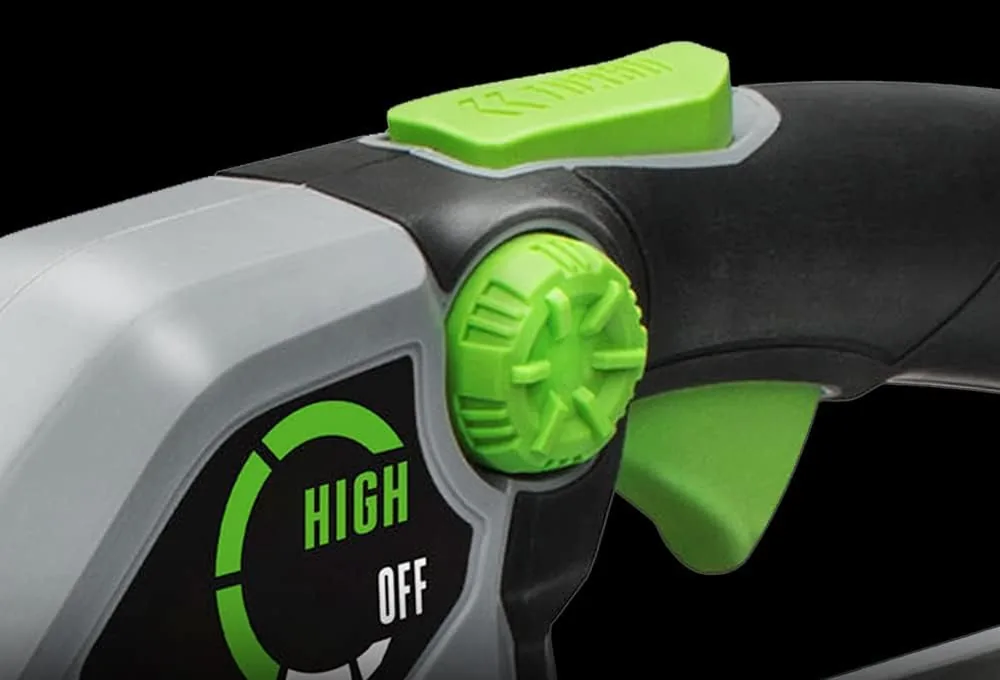
The LB6504 carries its green boost button above the dial. On both blowers, turn the dial to off before you pull the battery, or the next pack will not start the blower until you pull the trigger once. The first time, I thought the new pack was dead.
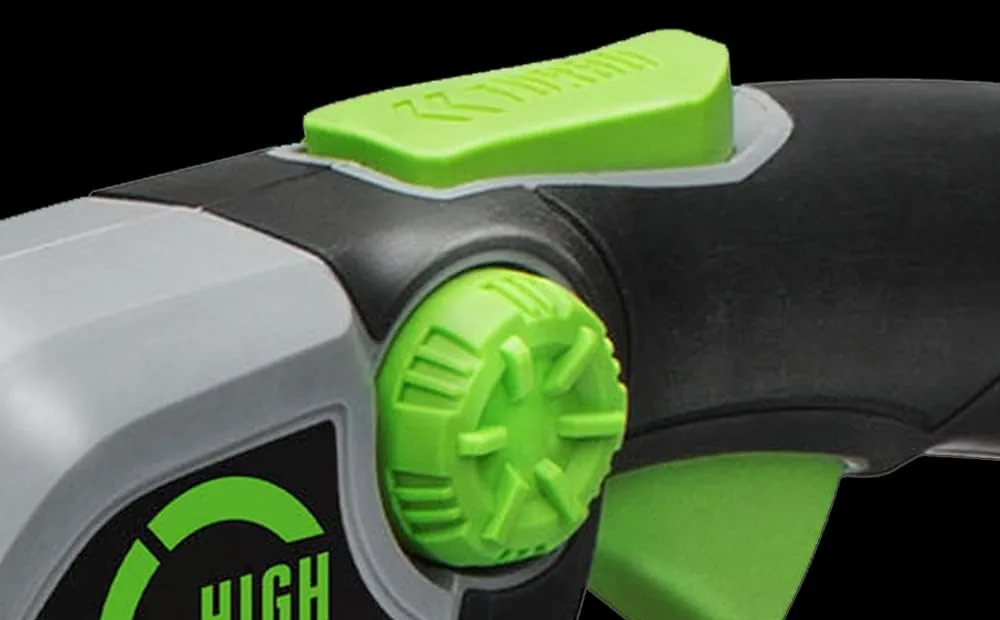
Winner: tie, because the weights differ by less than a tenth of a pound and the controls are identical.
Noise and Hearing Protection
EGO publishes no noise rating for the LB6703. The LB6504 reads about 88 dB(A) at the operator’s ear on boost, 84 on high and 68 on low, so I wear the same protection on both blowers.
NIOSH recommends an exposure limit of 85 dBA averaged over eight hours: the boost reading sits above that limit, high sits just under it, and low sits well under it. NIOSH sampling of 80 landscaping workers found 94 of 119 full-shift noise results at or above that limit, and workers using fuel-powered leaf blowers had more noise exposure than workers using battery versions (4). A battery blower starts ahead of a gas one and is still loud.
I put on ear protection before I pull the trigger. A Cochrane review reports that poor earplug fit may limit protection for about 40 percent of users (5), so I push plugs in until they seal, or I wear muffs.
Protect Eyes and Ears
Wear eye and ear protection from the first second. Never aim at people, pets, windows or cars, and never pull the battery while you stand on a ladder.
Winner: neither, because both are loud on boost and the LB6703’s level is unpublished.
Jobs in My Orchard and Yard
Three jobs on my property showed me where the two kits part ways, and each one comes down to minutes per pack.
- Pruning twigs on the tree-row strips: the LB6703 recharged while I cut the next row, so the blower was ready when the brush pile was.
- Wet plum leaves in November: either blower lifted a thin mat on boost, and a thick soaked clump needed a rake first.
- Gravel yard edge: on either blower I dropped the dial speed and kept the tube low, because high speed throws stones.
The one day I added the plum strips to the lawn and yard, the LB6504 pack ran out before the last alley and I raked while the charger worked through its 100 minutes.
Value Over Three Seasons
The LB6703 kit sits in the mid-range tier and the LB6504 kit one step above it, in the upper mid-range. The battery and charger warranty runs 3 years on both kits, so over those three seasons the question is what the pack in the box is worth to you.
- LB6703 as boxed: the lower cost, 24 minutes on high, and a pack back in 55 minutes.
- LB6703 plus a second pack: one pack charges while the other works, and a 5.0 Ah spare gives you the LB6504’s minutes.
- LB6504 as boxed: the longest single run, with a 100-minute wait when it empties.
- Bare LB6700 or LB6500: the right buy when you already own EGO 56V batteries.
The warranty is the same on both kits. According to EGO, it is 5 years on the tool and 3 years on the battery and charger, cut to 1 year for professional or commercial use, and a pack from either kit runs EGO’s other 56V tools. My leaf blower guides cover the wider field of blowers.
Winner: LB6703, because it costs a tier less, charges faster, and a second pack closes the runtime gap.
Choose the LB6703 If
Choose the LB6703 if you want the stronger blower at the lower cost and can live with 24 minutes on high per pack.
- You already own an EGO 56V battery, or you plan to buy a second pack.
- You blow in bursts and want the pack back in under an hour.
- The cost of the kit matters more than six extra minutes on high.
- You want the wider stream of the spread nozzle for lawn edges and paths.
Skip it if one pack has to cover a job longer than about 20 minutes on high and you have no spare.
In October I clear the wood-chip paths around the vegetable plot in short sessions between farm jobs, and the LB6703 fits that rhythm: a quarter-hour of blowing, then the pack goes back on the charger while I work on something else.

Choose the LB6504 If
Choose the LB6504 if one pack has to carry the whole job and you want 30 minutes on high to do it.
- You blow in one stretch of 25 to 30 minutes on high, such as a lawn and yard of up to about half an acre.
- You charge overnight, so a 100-minute recharge costs you nothing.
- You work on concrete pads and paths, where the flat nozzle stays low.
Skip it if you work back to back on one pack and cannot wait out the recharge.
I charge overnight, so for a job one pack can finish the slow charger costs me nothing. On the afternoon I did the house lawn and the gravel yard, the LB6504 pack finished both with no swap and no waiting.
My Pick in the EGO LB6703 vs LB6504 Decision
The LB6703 is the better blower by a small margin, and the LB6504 is the better kit for a one-pack job. The two blowers are close, so the pack and charger in the box should decide it.
I pick the LB6703 for most buyers: it moves more air, costs a tier less, and a pack that refills in 55 minutes keeps a long job moving. Pick the LB6504 when you run a single pack, charge overnight and want 30 minutes on high. Neither suits acre-size piles, where EGO’s 765 or 880 CFM models or a gas backpack do better. Buy the LB6703 and add a second battery once your jobs outgrow one pack, and the EGO LB6703 vs LB6504 question is settled for most yards.
Frequently Asked Questions
Is the Ego 670 a good blower?
In the EGO LB6703 vs LB6504 comparison, the EGO 670 is a good blower: it moves 670 CFM on boost, locks any speed on its dial and refills its 4.0 Ah pack in 55 minutes. Its weak spot is runtime, about 24 minutes on high per pack, and it weighs about 9.65 lb with the battery fitted.
Is 650 cfm good for a leaf blower?
A 650 CFM rating is good for a leaf blower on a lawn and yard of up to about half an acre. The LB6504 pairs it with 180 mph and a 21 N rating, and it delivers about 20 N on boost, so plan on about 30 minutes of high per 5.0 Ah pack.
What are people saying about the Ego 670 blower?
Owners describe the EGO 670 blower as strong on boost and a little heavy with the 56V battery fitted, about 9.65 lb in all. Runtime is the usual limit, about 24 minutes on high from the 4.0 Ah pack, so a second battery helps on any job past a quarter-hour of hard blowing.
Which EGO blower is considered the best?
The best EGO blower depends on the yard, and for most homeowners I rate the 670 CFM LB6703 and the 650 CFM LB6504 as the sensible middle of EGO’s handheld range, above the 530 and 615 CFM models. For bigger properties, the 765 and 880 CFM models move more air.
What are the key differences between the Ego 650 and 765 leaf blowers?
The key differences between the EGO 650 and 765 leaf blowers are airflow and push: the 765 moves 765 CFM and is rated 26 N, against 650 CFM and 21 N for the 650. The 765 kit also ships with a 5.0 Ah battery, while the 650 kit gives the same pack with a slower charger.
References
- Preger Y, Barkholtz HM, Fresquez A, et al. Degradation of Commercial Lithium-Ion Cells as a Function of Chemistry and Cycling Conditions. J. Electrochem. Soc. 2020;167(12):120532.
- Mao Z, Farkhondeh M, Pritzker M, Fowler M, Chen Z. Calendar Aging and Gas Generation in Commercial Graphite/NMC-LMO Lithium-Ion Pouch Cell. J. Electrochem. Soc. 2017;164(14):A3469-A3483.
- Koo B, Yi J, Lee D, Shin CB, Park S. Modeling the Effect of Fast Charge Scenario on the Cycle Life of a Lithium-Ion Battery. J. Electrochem. Soc. 2018;165(16):A3674-A3683.
- Alexander BM, Graydon PS, Pena M, Feng HA, Beamer BR. Hazardous exposures and engineering controls in the landscaping services industry. Journal of Occupational and Environmental Hygiene. 2025;22(3):189-202.
- Morata TC, Gong W, Tikka C, Samelli AG, Verbeek JH. Hearing protection field attenuation estimation systems and associated training for reducing workers’ exposure to noise. Cochrane Database of Systematic Reviews. 2024;5(5):CD015066.
Safety Note: Leaf blowers throw debris and can damage your hearing. Wear eye and ear protection, read the manufacturer’s manual, and check your local rules on noise and operating hours.