
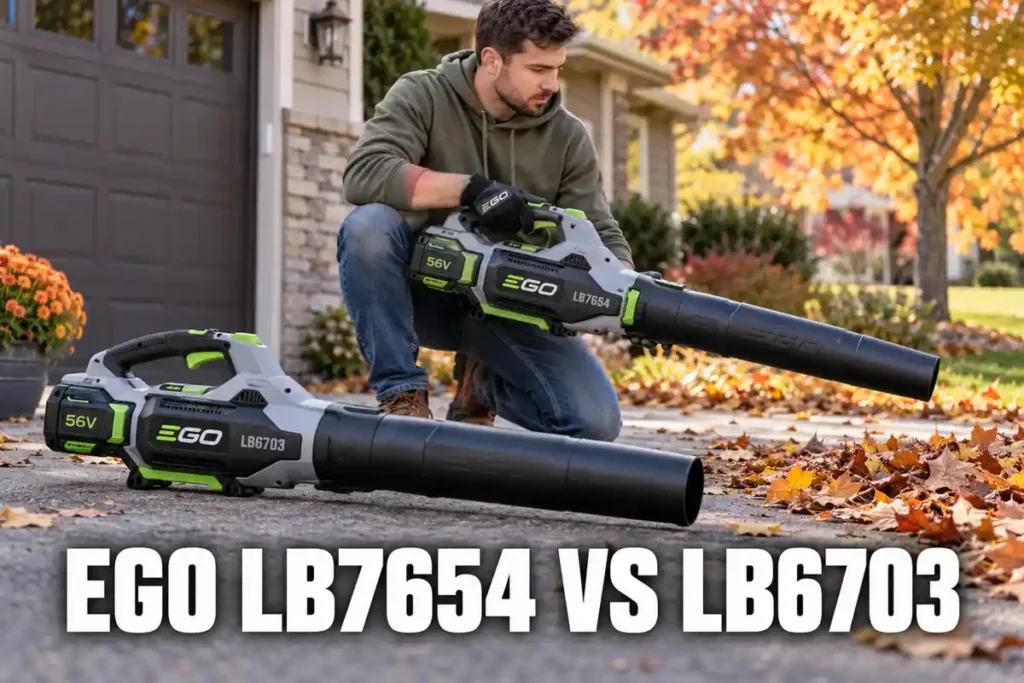
In the EGO LB7654 vs LB6703 choice, I pick the LB7654 for most yards, because its 765 CFM kit pushes up to 26 N against 21 N and weighs about the same in the hand. The LB6703 wins on small, dry jobs, where 21 N is enough and the kit costs less. I used both on the lawns and yard around my 3.7-acre orchard, and a wet mat of leaves under the shade trees showed the gap fastest. Below I compare the kit contents, force, runtime, weight and controls, then name the better fit for your yard.
Affiliate Disclosure: Garden Power Scout is a proud participant in the Amazon Services LLC Associates Program. As an Amazon Associate, we earn from qualifying purchases, at no extra cost to you.
EGO LB7654 vs LB6703 Short Answer
Buy the LB7654 if the leaves are wet or matted, if the debris is heavy, or if you want the stronger stream. The LB6703 fits yards where you mostly move dry leaves, clippings and light debris off hard surfaces. According to EGO’s manuals, each kit weighs about 9.6 lb with its battery fitted, so the choice is about air and runtime, not weight. Every figure in the table names the battery or nozzle behind it.
| Spec | LB7654 kit (765 CFM) | LB6703 kit (670 CFM) | Basis |
|---|---|---|---|
| In the box | LB7650 blower, one 5.0 Ah battery, CH3200 charger, tapered and spread nozzles | LB6700 blower, one 4.0 Ah battery, CH3200 charger, tapered and spread nozzles | EGO manuals and kit listings |
| Maximum airflow, boost | 765 CFM | 670 CFM | EGO manuals |
| Top of the dial, no boost | 580 CFM | 530 CFM | EGO product pages |
| Air speed, tapered nozzle | 195 mph | 180 mph | EGO manuals |
| Air speed, no tapered nozzle | 166 mph | 160 mph | EGO manuals |
| Maximum blowing force | 26 N | 21 N | EGO manuals |
| Battery in the kit | 5.0 Ah, 280 Wh | 4.0 Ah, 224 Wh | EGO manuals and battery data |
| Run time on the kit battery (low, high, boost) | 150, 25 and 15 min | 160, 24 and 13 min | EGO manuals |
| Weight, tool only | 4.6 lb | 4.8 lb | EGO manuals |
| Weight, tool with the kit battery fitted | About 9.56 lb | About 9.65 lb | Tool plus battery weights from the manuals |
| Charge time on the CH3200 | 70 min | 55 min | According to EGO |
| Warranty | 5 years on the tool, 3 years on the battery | 5 years on the tool, 3 years on the battery | EGO product pages |
Two rows decide it: the force row, where the LB7654 leads by 5 N, and the run-time row, where its larger pack adds only a minute or two on high.
What Comes in Each Kit
In the EGO LB7654 vs LB6703 comparison both names are kits, and the difference between them starts with the battery. EGO’s US site lists no 670 kit with a 5.0 Ah pack, so a 670 buyer who wants a bigger pack buys the tool and the battery separately. A two-battery version of the 765 exists as the LB7654-2, but this comparison uses the single-battery kits.
The LB7654 Kit
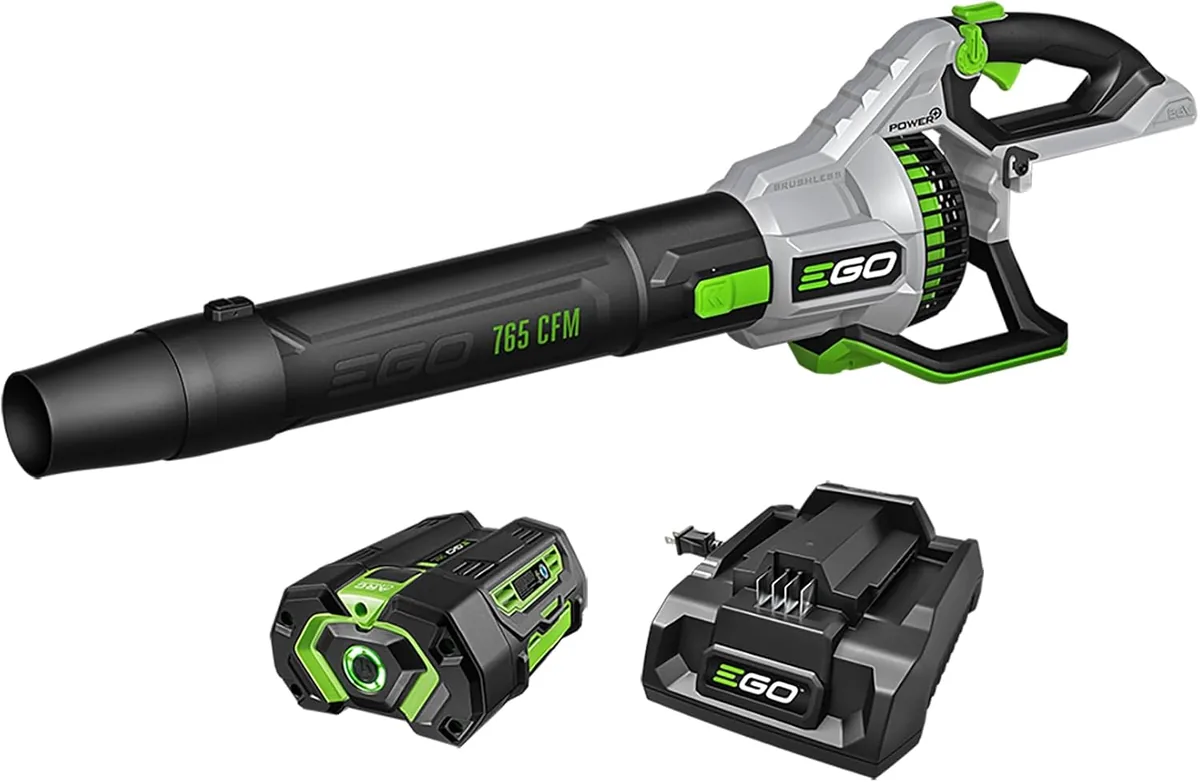
The EGO Power+ LB7654 765 CFM Blower Kit is the LB7650 blower with one 5.0 Ah battery that carries a fuel gauge, the 320 W CH3200 charger, a tapered nozzle and a spread nozzle. EGO sells the blower alone as the LB7650, which makes sense only if you already own a 4.0 Ah or larger 56V battery.
The LB6703 Kit
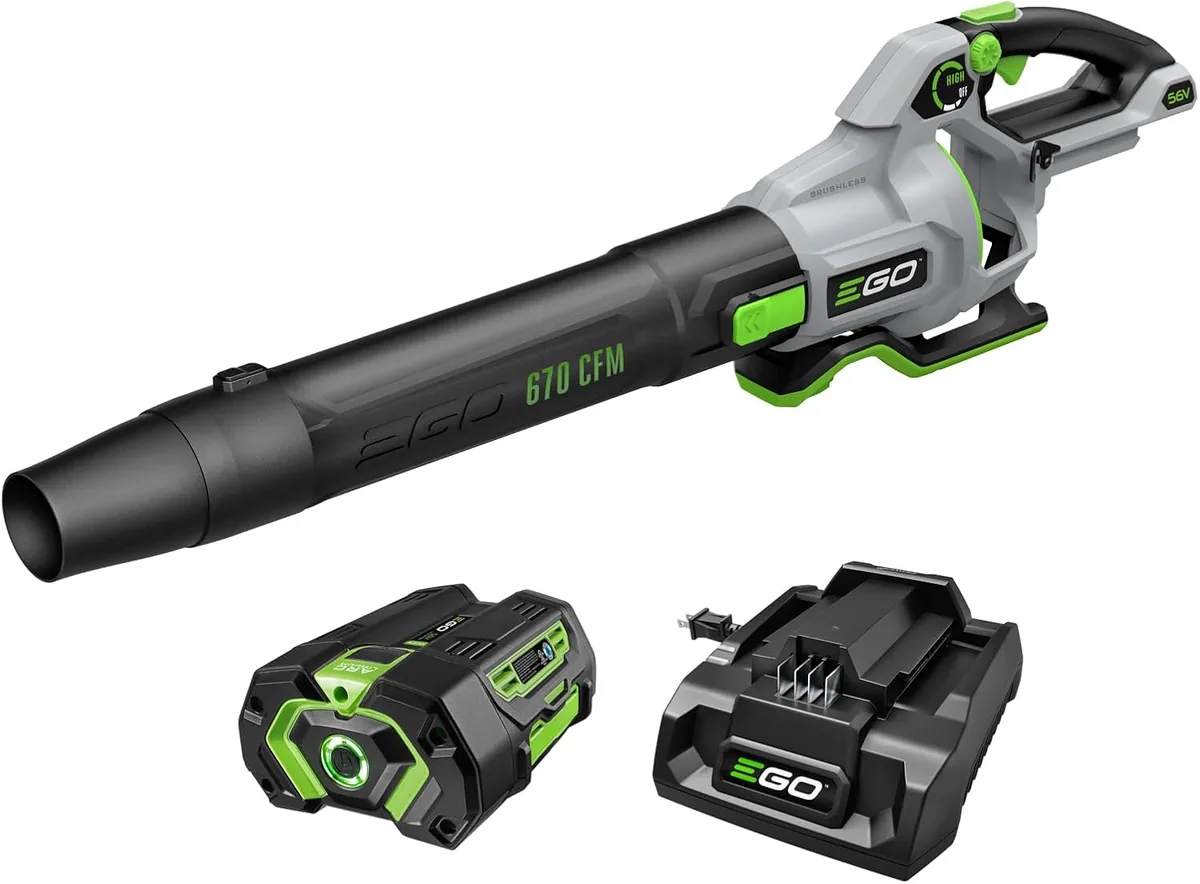
The EGO Power+ LB6703 670 CFM Blower Kit is the EGO 670 CFM Blower with Battery and Charger: the LB6700 blower, one 4.0 Ah battery, the same CH3200 charger and the same two nozzles. The packing list in EGO’s manual for the LB6700 names no strap, and the AP1500 shoulder strap is a separate accessory.
Airflow, Air Speed and Blowing Force
Air volume (CFM) is how much air leaves the tube, air speed (mph) is how fast it leaves, and force in newtons (N) combines the two into the push you feel at the nozzle. One newton is about 0.225 pounds, so 26 N is about 5.8 pounds of push and 21 N is about 4.7.
In the EGO 670 vs 765 matchup the 765 leads on every airflow number: 765 against 670 CFM at maximum, 580 against 530 CFM at the top of the dial before boost, 195 against 180 mph with the tapered nozzle, and 26 against 21 N. Take the tapered nozzle off and the speeds fall to 166 and 160 mph, so I never compare a speed figure without naming the nozzle.
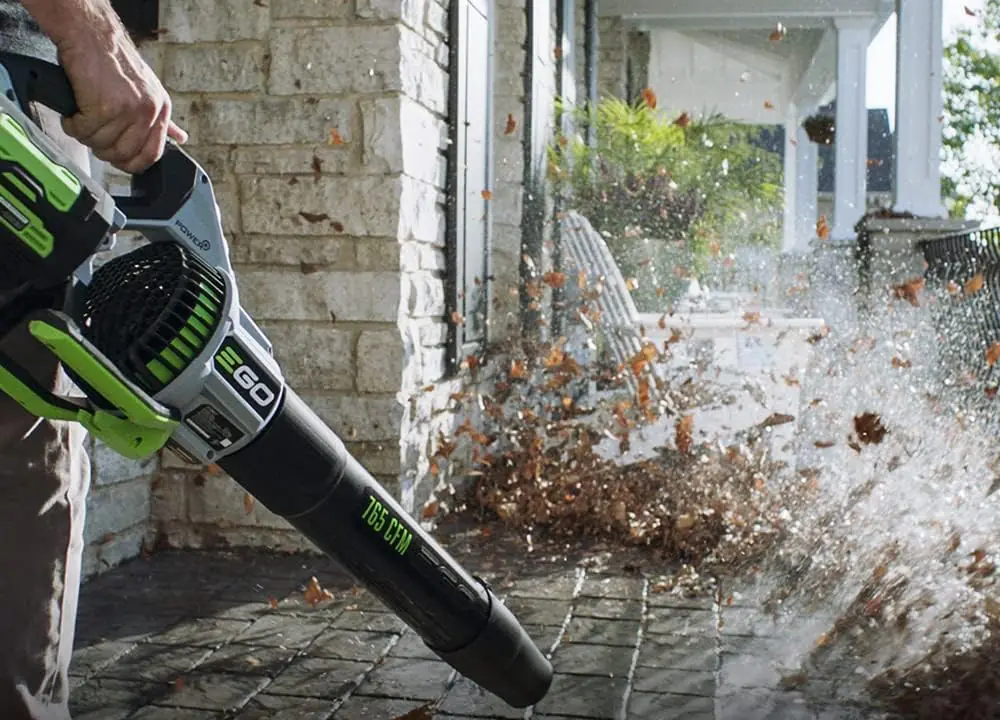
Those 5 N show up on wet leaves. Wet leaves stick by weight and surface tension, so volume under the leading edge lifts them better than speed on top. After three days of rain I started at the ditch side of the house lawn and worked a soaked mat toward the alley: the 765 rolled the whole mat forward, and the 670 slid the top layer and left the soaked underside behind.
The 670 has enough for dry work. After I mow the alley edge in May, the clippings lie on the crushed-stone yard, and at the low end of the dial the 670 moves them off the stone without shifting it.
Winner: LB7654, on every airflow number.
Battery, Runtime and Charge Time
The kit packs differ in size. The LB7654 ships a 5.0 Ah battery with 280 Wh of rated energy, and the LB6703 a 4.0 Ah battery with 224 Wh, 20 percent less. EGO’s manuals give run times for the kit pack in three modes: the 765 runs 150 minutes on low, 25 on high and 15 on boost, and the 670 runs 160, 24 and 13.
The kits are near a tie on high and boost, so the bigger pack buys the 765 one or two minutes, and on low the 670 runs 10 minutes longer. By my arithmetic from rated watt-hours and the manual minutes, the 765 draws about 20 percent more power on high, about 670 W against 560 W, so its larger pack mostly pays for the stronger stream and not for extra time.
EGO’s pages also print up to 90 minutes for the 765 and up to 80 for the 670. Neither number names a speed, so I ignore both and plan in minutes on high: 25 and 24.
Plan in Minutes, Not Acres
On either kit a pack lasts 24 to 25 minutes on high, then needs 55 minutes (LB6703) or 70 minutes (LB7654) on the CH3200 charger, according to EGO. A second pack moves the break later and does not remove it.
The 670 pack stopped at the end of a plum row with a small pile still lying in the alley, and the stop is abrupt, with no taper. Now I count minutes on high and finish the pile before the clock runs out.
Pack life depends on how you store and drain it. In a lab study, pouch cells held at full charge for nine months lost about 10 percent of capacity at 95 F and about 43 percent at 140 F, while cells held at zero charge lost almost none (1). A separate cell-ageing study found that depth of discharge and the charge window both change how fast capacity fades (2). Store a pack at part charge in a cool room, and keep it out of a shed in summer.
Winner: LB7654 by a small margin, with the LB6703 ahead only on low-speed time and recharge.
Weight and Balance in the Hand
The smaller 670 kit does not weigh less in the hand. According to EGO’s manuals, the LB7650 tool weighs 4.6 lb and its 5.0 Ah battery 4.96 lb, which adds up to about 9.56 lb. The LB6700 tool weighs 4.8 lb and its 4.0 Ah battery 4.85 lb, which adds up to about 9.65 lb. The 765 tool is 0.2 lb lighter, the 670 battery is 0.11 lb lighter, and the two differences nearly cancel.
After a long pass I feel the 765 in my shoulder before my wrist, because the pack sits behind the grip. The 670 kit comes without a strap, so its 9.65 lb hangs from one hand, and I swap hands between passes.
Handheld blowers sat at the low end of the tools in a study of 17 groundskeepers, at about 1.9 m/s2, yet the group’s lifetime hand-arm vibration dose in the right hand was 33 times that of office workers (3). A tool near 10 lb held out for 25 minutes is still work for the forearm, whatever the vibration reading says.
Winner: tie, with 9.56 lb against 9.65 lb on the scale.
Controls and Handling
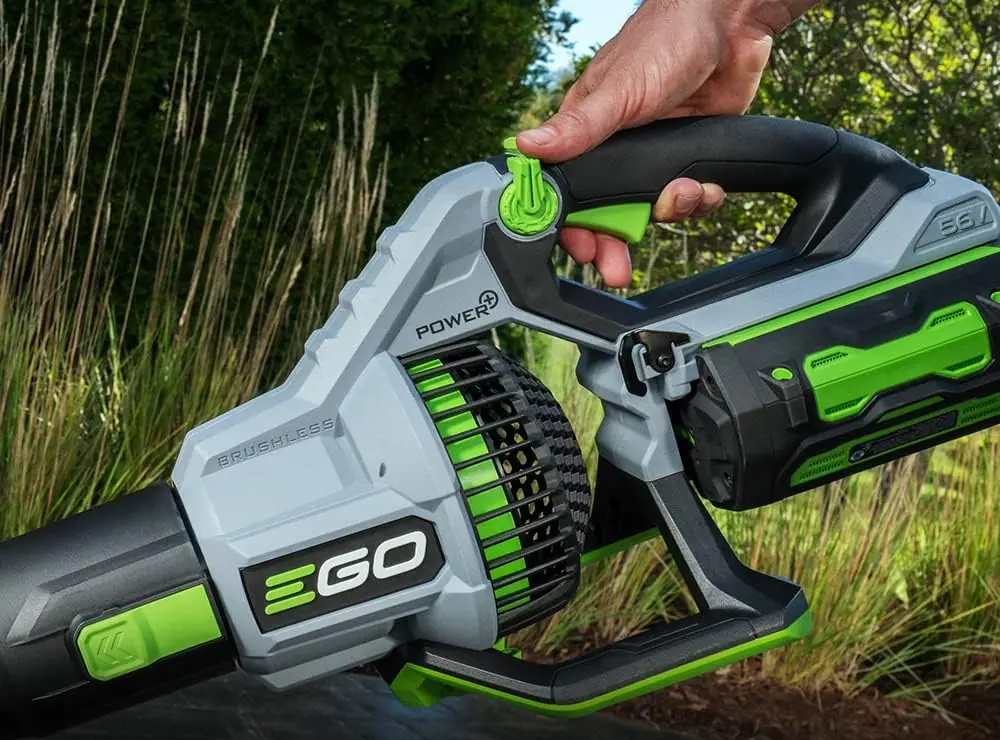
Both blowers share one layout: a variable-speed trigger, a dial that locks any speed, a boost button you hold, a brushless motor and an IPX4 rating. Boost drops back to the set speed when you let go, on both. Because the controls match, nothing here changes the choice.
Pro Tip
Turn the dial to off before you take the battery out. If the dial stays on, the blower will not start with a fresh pack until you pull the trigger once, which looks like a fault the first time. EGO’s manuals describe this on both blowers.
Beside the vegetable plot the wood-chip paths lose mulch fast, so I set the 765 dial low and let it lock, and the trigger finger got a rest for the whole pass. Boost does not lock on either blower, so my thumb carries it.
On the 670 I press boost in short bursts for a stubborn corner, because 13 minutes of boost per pack is not much to spend.
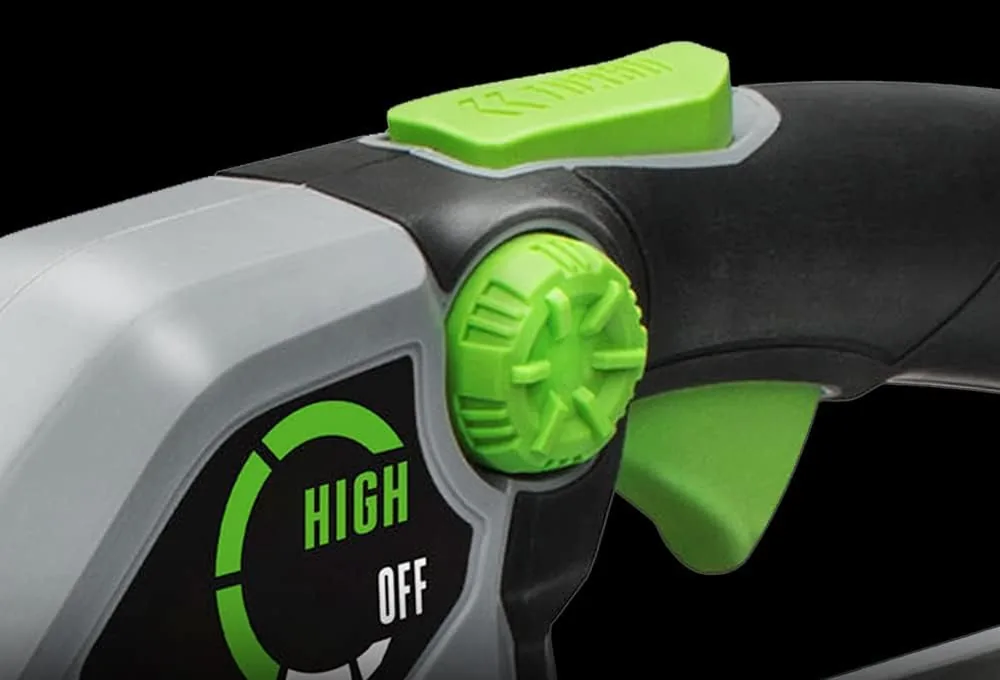
Winner: tie, since the controls work the same way on both.
Noise and Hearing Protection
EGO publishes no noise rating for either blower, so the table has no noise row and this section has no winner.
That does not make either one quiet. A study of groundskeepers at North Carolina public universities found that about 77 percent of shift averages by the NIOSH method exceeded 85 dBA (4), and NIOSH sampling of landscaping workers found more noise exposure with fuel-powered leaf blowers than with battery versions (5). Battery blowers start ahead of gas, and a fan at full speed is still loud at the ear.
I put ear protection on before I pull the trigger. A Cochrane review notes that a poor fit may limit protection for about 40 percent of earplug users (6), so press foam plugs in until they seal, or wear muffs.
Protect Eyes and Ears
Wear ANSI Z87.1 eye protection and hearing protection every time. Never aim the stream at people, pets, windows or cars, and never take the battery out while you stand on a ladder.
Winner: none, as EGO gives no rating for either.
What Each Box Leaves You to Buy
Both kits sit in the mid-range tier, with the LB6703 at the low end of it, and the gap between them is small. The useful question is what each box leaves you to buy.
- LB6703 as boxed: the lowest entry cost, 21 N, a 4.0 Ah pack and no strap. The AP1500 strap is an extra purchase and narrows the saving.
- LB7654 as boxed: more force and a pack with 25 percent more energy, for a slightly higher cost.
- A battery you already own: EGO’s manual for the 765 asks for a 4.0 Ah or larger pack for best performance. If you own one, the LB6700, sold as the EGO 670 CFM Blower tool only, is the cheapest way into the 670, and the LB7650 is the cheapest way into the stronger 765.
- A second pack: either kit needs one for jobs longer than 25 minutes on high. The warranty is the same, 5 years on the tool and 3 years on the battery, so it does not tip the choice.
Winner: LB7654, unless the lowest entry cost or a battery you already own decides.
Which Yard Needs Which Blower
My 3.7-acre orchard is more than a one-pack job for either blower, so I use them on the house lawn, the yard and the strips beside the sheds. The debris decides more than the acreage, and I choose by wet leaves in November, not dry leaves in October.
| Job | Better fit | Why |
|---|---|---|
| Dry leaves and light debris in short sessions | LB6703 | 21 N and 24 minutes on high cover light, dry work |
| Wet or matted leaves under trees | LB7654 | 26 N gives more push under the leading edge of a mat |
| Heavy debris that needs high or boost | LB7654 | 26 N and 15 minutes of boost per pack against 21 N and 13 |
| Decks, patios and walkways | LB6703 | Light, dry work that 21 N handles; EGO’s manual names decks and walkways |
| Loose, dry debris on gravel | Either | Keep the dial low and the tube low on both, because high speed throws stones |
| Wet or packed debris on gravel | LB7654 | 26 N lifts it without the steep nozzle angle that digs stones |
Choose the LB7654 If
Choose the LB7654 if you want the extra push and the larger pack for the same carried weight.
- The leaves sit wet and matted under trees, or the debris is heavy.
- You want the 5.0 Ah pack, which also runs your other EGO 56V tools.
- You can spare 70 minutes for a recharge, or you own a second pack to swap in.
Skip it if 9.6 lb in one hand already bothers you, or if your jobs run far past one pack, since 25 minutes on high ends and the recharge takes 70 minutes.
The first week of November, when frost brings the plum leaves down in one night, is when I reach for the 765. Wet leaves across the yard and the first alley feet are the job its 26 N is for.
Choose the LB6703 If
Choose the LB6703 if your yard is small and dry and you do not need the extra force.
- Your yard is small, and the work is dry leaves, clippings and light debris.
- You blow mostly on driveways, walkways, decks and patios.
- You want the lower entry cost and a pack that recharges in 55 minutes.
- You want 160 minutes on low for long, gentle sweeping.
Skip it if you clear wet, matted leaves or any lot where 24 minutes on high and 13 on boost would end before the job does.
Before the first spring mow I run the 670 over the house lawn to clear twigs and seed pods, so the mower does not throw them. That is a low-dial job, and 160 minutes on low is more time than the lawn needs.

My Pick in the EGO LB7654 vs LB6703 Choice
I pick the LB7654 for most yards. It carries the same 9.6 lb as the LB6703 and adds 5 N of force and 25 percent more battery energy, for a slightly higher cost. The LB6703 is the right choice when the debris is light and dry and the lower entry cost matters. Both blowers share one layout, one charger and one 56V battery family, so the packs are interchangeable if you change your mind.
My leaf blower guides cover the wider range of blowers. That settles the EGO LB7654 vs LB6703 choice: buy the LB7654 unless your yard is small, dry and close to the house.
Frequently Asked Questions
Is the Ego 670 a good blower?
The EGO 670 is a good blower for a small, dry yard: 670 CFM, 180 mph, 21 N of force and 24 minutes on high from its 4.0 Ah pack. In the EGO LB7654 vs LB6703 pair it is the one for dry leaves and light debris, and the one to skip for soaked mats.
How long does the Ego 765 battery last?
The EGO 765 battery lasts 150 minutes on low, 25 on high and 15 on boost, according to EGO’s manual for the 5.0 Ah pack. The 670’s 4.0 Ah pack gives 160, 24 and 13 minutes in the same modes, so the kits are close on high and the 765 gains only a couple of minutes on boost.
Which EGO blower is considered the best?
The EGO blower I consider best for most homeowners is the 765 CFM LB7654, with the 670 CFM LB6703 as the pick for small, dry yards. Both models use the same 56V batteries and layout, and EGO’s 880 CFM model sits above them for owners who want two packs in the box.
Why does my Ego leaf blower keep shutting off?
Your EGO leaf blower shuts off when the pack or the blower rises above 152 F or the battery runs flat, so let it cool or fit a charged pack. A weak stream points to a clogged air intake, and a blower that will not start after a pack swap needs one pull of the trigger.
Which is better, a gas or an electric leaf blower?
An electric leaf blower is better for most homes, because it starts without a pull cord, needs no fuel mix and runs quieter than a gas model. A gas blower is better only for hours of continuous work, which a 56V pack at 24 to 25 minutes on high cannot give.
References
- Mao Z, Farkhondeh M, Pritzker M, Fowler M, Chen Z. Calendar Aging and Gas Generation in Commercial Graphite/NMC-LMO Lithium-Ion Pouch Cell. J. Electrochem. Soc. 2017;164(14):A3469-A3483.
- Gauthier R, Luscombe A, Bond T, et al. How do Depth of Discharge, C-rate and Calendar Age Affect Capacity Retention, Impedance Growth, the Electrodes, and the Electrolyte in Li-Ion Cells?. J. Electrochem. Soc. 2022;169(2):020518.
- Chen N, Yang S, Oh J. Evaluation of hand-arm vibration (HAV) exposure among groundskeepers in the southeastern United States. Annals of Work Exposures and Health. 2025;69(1):81-95.
- Balanay JAG, Kearney GD, Mannarino AJ. Assessment of Occupational Noise Exposure among Groundskeepers in North Carolina Public Universities. Environ Health Insights. 2016;10:EHI.S39682.
- Alexander BM, Graydon PS, Pena M, Feng HA, Beamer BR. Hazardous exposures and engineering controls in the landscaping services industry. Journal of Occupational and Environmental Hygiene. 2025;22(3):189-202.
- Morata TC, Gong W, Tikka C, Samelli AG, Verbeek JH. Hearing protection field attenuation estimation systems and associated training for reducing workers’ exposure to noise. Cochrane Database of Systematic Reviews. 2024;5(5):CD015066.
Safety Note: Leaf blowers throw debris and can damage your hearing. Wear eye and ear protection, read the manufacturer’s manual, and check your local rules on noise and operating hours.