
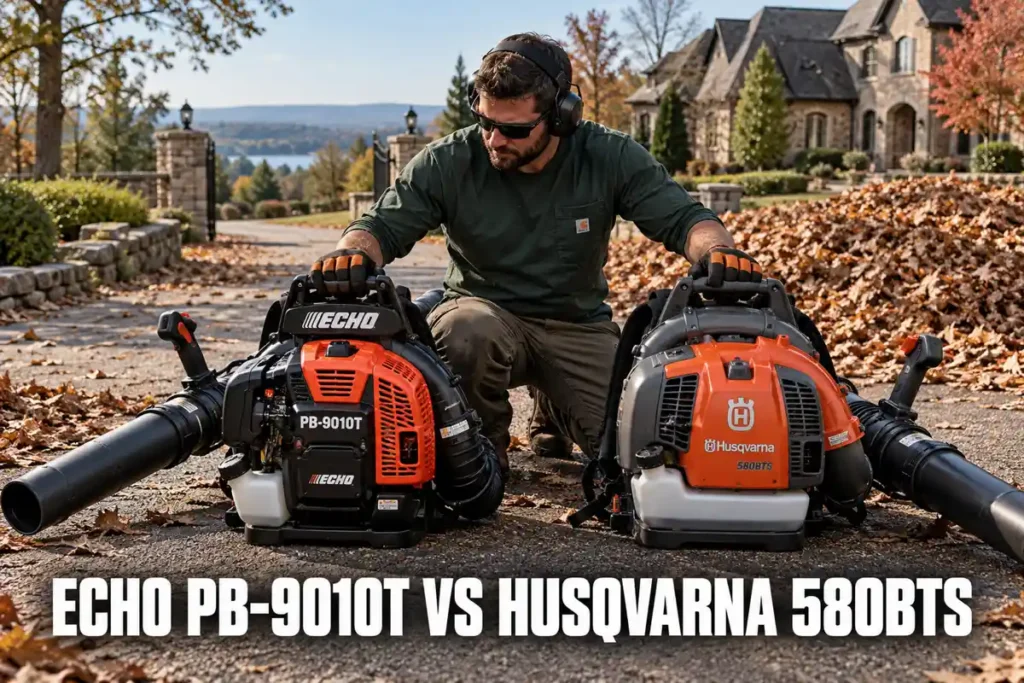
My pick in the Echo PB-9010T vs Husqvarna 580BTS choice is the Husqvarna for most buyers, because its hip belt moves part of the same 26 to 27 lb that the ECHO rests on your shoulders alone. The ECHO wins when the job is heavy, wet leaves and storm debris in short bursts, since it is rated for 110 more CFM. On paper the two look like twins, with 220 mph on both and 48 N against 47 N. I wore both across the orchard strips and the yard, and I judge a backpack blower by hour two, because that is when a harness shows its faults.
Affiliate Disclosure: Garden Power Scout is a proud participant in the Amazon Services LLC Associates Program. As an Amazon Associate, we earn from qualifying purchases, at no extra cost to you.
My Short Answer on Echo PB-9010T vs Husqvarna 580BTS
I recommend the Husqvarna 580BTS Gas Backpack Leaf Blower for most buyers and the ECHO PB-9010T Gas Backpack Leaf Blower for short, heavy jobs such as wet leaves and storm debris. The ECHO is rated for 110 more CFM, 1,110 against 1,000, and its tube trigger has a cruise lever. The Husqvarna comes with a padded hip belt, a waist belt and a chest strap, while the US ECHO has shoulder straps only. Force, speed, weight and tank size are all within a few percent.
In this Echo PB-9010T vs Husqvarna 580BTS specs table each figure is the maker’s own rating, and the last column says what it belongs to.
| Spec | ECHO PB-9010T | Husqvarna 580BTS |
|---|---|---|
| Engine | 79.9 cc two-stroke | 75.6 cc two-stroke |
| Air volume, maker’s figure | 1,110 CFM, nozzle not stated | 1,000 CFM with the standard nozzle |
| Air speed, maker’s figure | 220 mph with pipes | 220 mph with the standard nozzle |
| Blowing force, maker’s figure | 48 N at the nozzle | 47 N maximum |
| Dry weight | About 26 to 27 lb with pipes | 26.8 lb without fuel |
| Weight with a full tank | About 31 lb | About 31 lb |
| Fuel tank | 83.8 fl oz | 87.92 fl oz |
| Fuel mix | 50:1 | 50:1 |
| Sound, as each maker states it | 79.3 dB(A) at 50 ft | 106 dB(A) at the operator’s ear |
| Throttle | Tube trigger plus cruise lever, right hand | Tube lever with full, 1/3, idle and stop positions, right hand |
| Harness | Padded shoulder straps, vented back pad | Padded hip belt, wide shoulder straps, waist belt, chest strap |
Two rows decide it, the harness row, where only the Husqvarna has a hip belt, and the air volume row, where the ECHO leads by 110 CFM. The 1 N force gap and the weight gap are too small to steer a purchase.
What Comes With Each Blower
The PB-9010T is the tube-throttle model of ECHO’s 79.9 cc X Series, and the PB-9010H moves the throttle to a hip arm with a stick handle. The Husqvarna 580BTS Mark III is the version sold in the US, and the 580BFS puts its throttle on the frame under the left hand.
The PB-9010T Kit
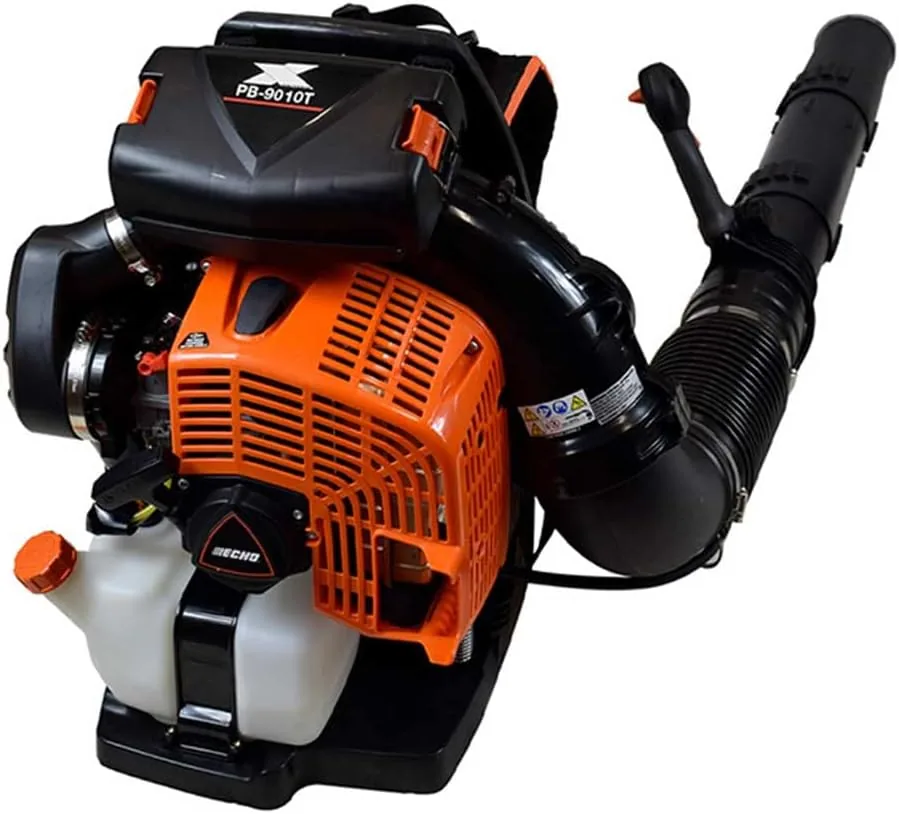
According to ECHO’s manual, the ECHO PB-9010T Gas Backpack Leaf Blower comes as the power head with four pipes, two clamps with screws, a quick start guide, the warranty statement and a cold weather insert. The manual lists no hip belt, chest strap or stick handle, and the box holds no fuel, oil or protective gear, so buy those before the first start.
The 580BTS Mark III Kit
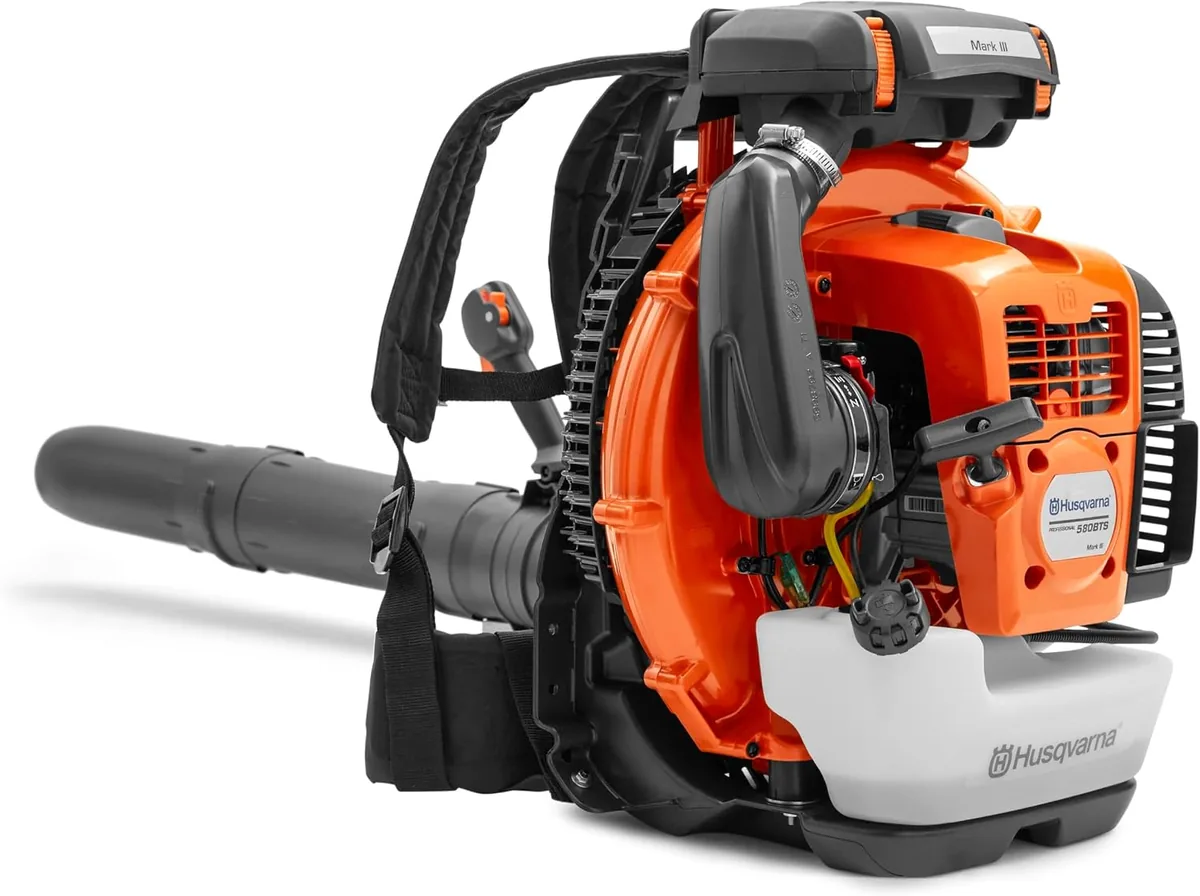
According to Husqvarna, the Husqvarna 580BTS Gas Backpack Leaf Blower comes as the blower on its frame with the harness, a flexible hose, a control pipe with the handle, an intermediate pipe and the standard round nozzle. Ignore the noise and throttle rows in the Amazon listings, which show 48 dB for the ECHO and a hip throttle for the Husqvarna. Both are wrong.
Airflow, Air Speed and Blowing Force
Air volume in CFM is how much air leaves the tube, air speed in mph is how fast it leaves, and force in newtons (N) is how hard the stream pushes back at the nozzle. According to ECHO, the PB-9010T makes 1,110 CFM at 220 mph and 48 N. According to Husqvarna, the 580BTS makes 1,000 CFM at 220 mph through its standard round nozzle, with 47 N at maximum.
Speed is a tie, and a 1 N gap is smaller than the gap between how makers test. The 110 CFM is the number to weigh. Wet leaves stick by weight and surface tension, so volume under the leading edge lifts them better than speed on top, and the ECHO has 11 percent more of it on paper. Each rating comes from its maker’s own test, so treat the gap as a lean toward the ECHO.
Beside the machinery shed, on dry gravel and dust, I could not tell 47 N from 48 N by the way the stones moved. The ditch bank after rain is different, because the wet leaves packed against the hedgerow there are the one job where I want the extra air, and I reach for the ECHO.
Winner: PB-9010T, because it is rated for 110 more CFM, while speed and force are a tie.
Echo PB-9010T vs Husqvarna 580BTS Harness and Weight
Weight is nearly a tie, so the harness decides this comparison. ECHO’s manual lists 26.4 lb dry for earlier serial numbers and 27.2 lb for later ones. The Husqvarna 580BTS weight is 26.8 lb without fuel, and Husqvarna does not say whether the pipes are counted. A full tank adds about 4 lb to either machine, so each carries about 31 lb ready to work.
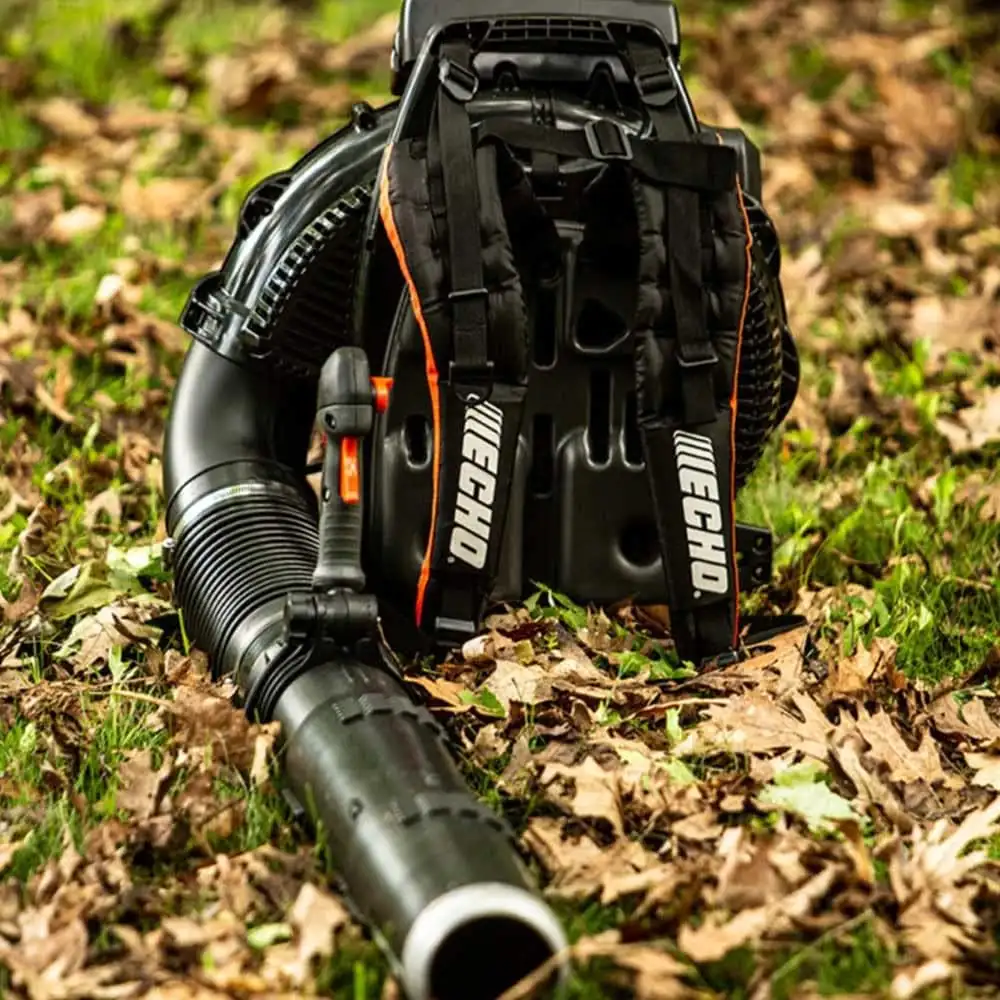
Where that weight sits is the real difference. According to Husqvarna, the 580BTS has a padded hip belt, wide shoulder straps, a waist belt and a chest strap. The ECHO PB-9010T has padded shoulder straps and a vented back pad, and its manual shows only the shoulder straps and a harness limiter strap. The same 31 lb rides on your hips and shoulders on the Husqvarna, and on your shoulders alone on the ECHO.
A load-carriage study found that strap force and contact pressure at the shoulders and hips predicted how uncomfortable carriers felt (1), which is why two machines of equal weight can carry very differently. In a survey of 55 landscape workers, 65.5 percent reported shoulder symptoms (2).
On the ECHO, after the first tank I kept hooking my thumbs under the straps to lift the load off my collarbones.
On the Husqvarna I tighten the side straps until the frame sits flat against my back, close the chest strap, and the weight settles onto my hips. After the same stretch of orchard strips my shoulders have nothing to report.
A hip belt adds two habits: check that the round pin in the strap clamp is seated, as Husqvarna’s manual warns, and learn to open the waist and chest belts fast, which is how you shed the machine in an emergency.
Winner: Husqvarna 580BTS, because the hip belt and chest strap come in the box.
Throttle and Controls
Both throttles sit on the tube under your right hand, so neither is the hip-throttle layout of the PB-9010H. The ECHO has a trigger and a cruise lever: the trigger overrides the lever, the lever holds a steady speed, and the stop is the last stretch of lever travel. The Husqvarna has one lever on the control-pipe handle with four positions: full, one third, idle and stop.
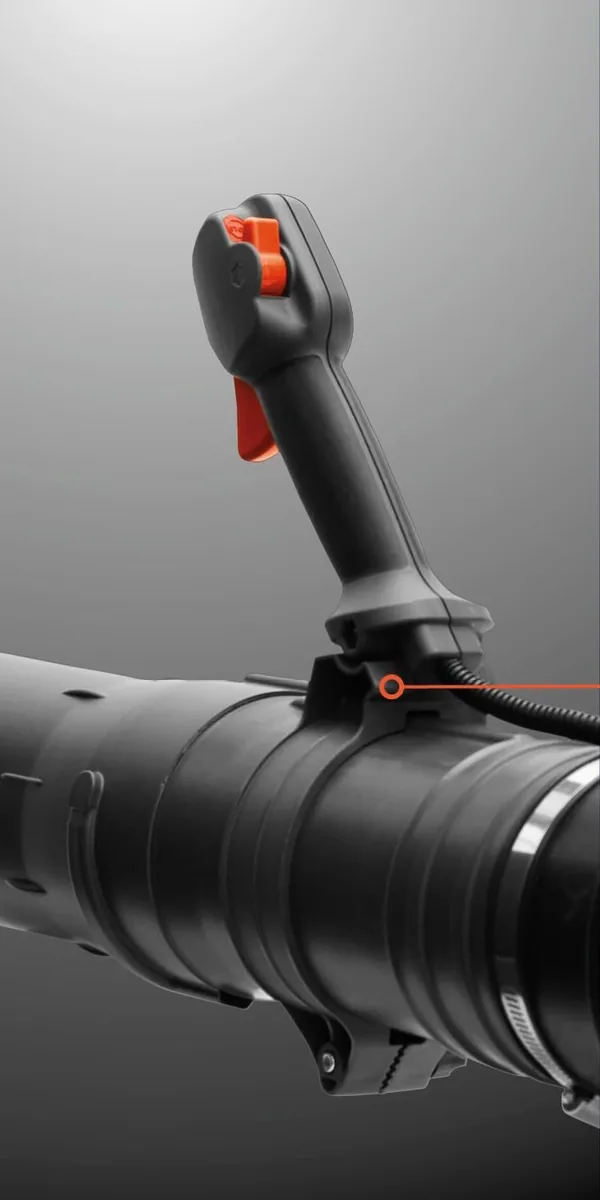
The Husqvarna 580BFS vs 580BTS split is mainly the throttle: the BFS carries it on the frame under the left hand and has a stop switch, while the BTS carries it on the tube under the right. The BFS also weighs 27.1 lb against 26.8 lb.
On the Husqvarna I park the lever on the one-third notch along the vegetable plot paths and move it to full only on the gravel. With the ECHO I use the trigger alone for corners and the gravel edge, and I save the cruise lever for a long straight run.
Winner: tie, because both put a right-hand throttle on the tube and the choice is a trigger or a notched lever.
Echo PB-9010T vs Husqvarna 580BTS Noise and Hearing Protection
The two makers publish noise on different bases, so the numbers cannot be compared. According to ECHO, the PB-9010T measures 79.3 dB(A) at 50 ft under ANSI B175.2, which is a bystander rating. Husqvarna rates the 580BTS at 106 dB(A) at the operator’s ear, with no distance or standard stated.
In a field test of two leaf blowers and a hose vacuum, individual machines measured 85 to 101 dB(A) at the center of the work area, while the levels at 50 ft matched the makers’ ratings (3). I name no winner, because the figures do not measure the same thing.
Plan on both being loud. In a study of groundskeepers at North Carolina public universities, about 77 percent of shift averages by the NIOSH method were above 85 dBA (4). Earplugs only help when they seal, and a Cochrane review notes that poor fit may limit protection for about 40 percent of users (5).
After about an hour and a half with either engine at my back, my ears rang once the muffs came off. Ringing means the protection was not enough or not seated right, so I now wear foam plugs under the muffs, work in shorter sessions with breaks, and the exhaust smell still stays in my jacket until I wash it.
Neither maker gives a hand vibration value for its US model. Field measurements on backpack blowers ran from about 1.7 to 2.9 m/s2, and the authors estimated that the leaf blower could pass the EU daily exposure action value after 5 hours of use (6).
Hearing and Eye Protection
Wear hearing protection and ANSI Z87.1 eye protection every time you start either blower, keep people and pets about 50 ft away, and never run them in a closed shed, where the exhaust builds up carbon monoxide.
Winner: none, because the two makers measure noise in different places.
Engine, Fuel and Tank Size
The ECHO’s 79.9 cc engine is about 6 percent larger than the Husqvarna’s 75.6 cc, while the Husqvarna’s tank holds 87.92 fl oz against 83.8 fl oz. Neither maker publishes minutes per tank, so I plan both by tanks, not by the clock.
The Husqvarna 580BTS fuel mixture is 50:1, and so is the ECHO’s. Both manuals call for unleaded fuel with no more than 10 percent ethanol and set a 30-day limit on mixed fuel.
Upkeep reads lighter on the ECHO. Its manual asks you to replace the air filter and inspect the spark plug every 3 months, while Husqvarna’s manual asks for a new spark plug and a clean spark arrester screen every month. I write the mixing date on the can in marker, because the gap between pruning cleanup in March and leaf fall in November is far longer than 30 days.
Winner: tie, with the Husqvarna ahead on tank size and the ECHO ahead on lighter upkeep on paper.
Warranty and Where You Buy
According to ECHO, the PB-9010T carries a 5-year warranty for residential use and 2 years for backpack blowers in commercial, agricultural or income-producing use. ECHO covers only units sold by authorized ECHO dealers, and a unit sold through an unauthorized dealer is sold without that coverage. According to Husqvarna’s warranty statement, the 580BTS carries 2 years for home use.
According to Husqvarna, service goes through an authorized servicing dealer for the original retail purchaser. Farm and commercial use fall under their own terms, so read those before you buy. Before you order either blower, confirm the seller is an authorized dealer for that brand.
ECHO’s wording lists agricultural use, so on a working orchard like mine I plan around the 2-year term, not the 5 years.
Which Yard Needs Which Blower
My 3.7-acre orchard suits both blowers, but the jobs split by session length and by how wet the leaves are.
| Job | Better fit | Why |
|---|---|---|
| Wet leaf mats, storm debris and big piles, in short bursts | PB-9010T | 1,110 CFM against 1,000 CFM |
| Orchard rows or a wooded edge, worked for an hour or more | 580BTS | Hip belt and chest strap share the load |
| Gravel yard and shed pad | Either | Both are 220 mph, and 48 N against 47 N is a tie |
| Under half an acre, or a noise-sensitive street | Neither | Both are loud, heavy gas machines |
Choose the PB-9010T If
Choose the PB-9010T if the job is heavy wet leaves in short bursts, because it is the stronger air mover of the pair.
- Your work is wet leaf mats, storm debris or big piles, where the extra 110 CFM counts.
- You work in sessions of about a tank and rest between them, so shoulder straps are enough.
- You buy from an authorized ECHO dealer and want the 5-year home warranty.
Skip it if you carry a blower for an hour or more at a time, because nothing in the box takes weight off your shoulders.
After a storm, the seed pods and small branches across the yard are the other job I hand to the ECHO.
Choose the 580BTS If
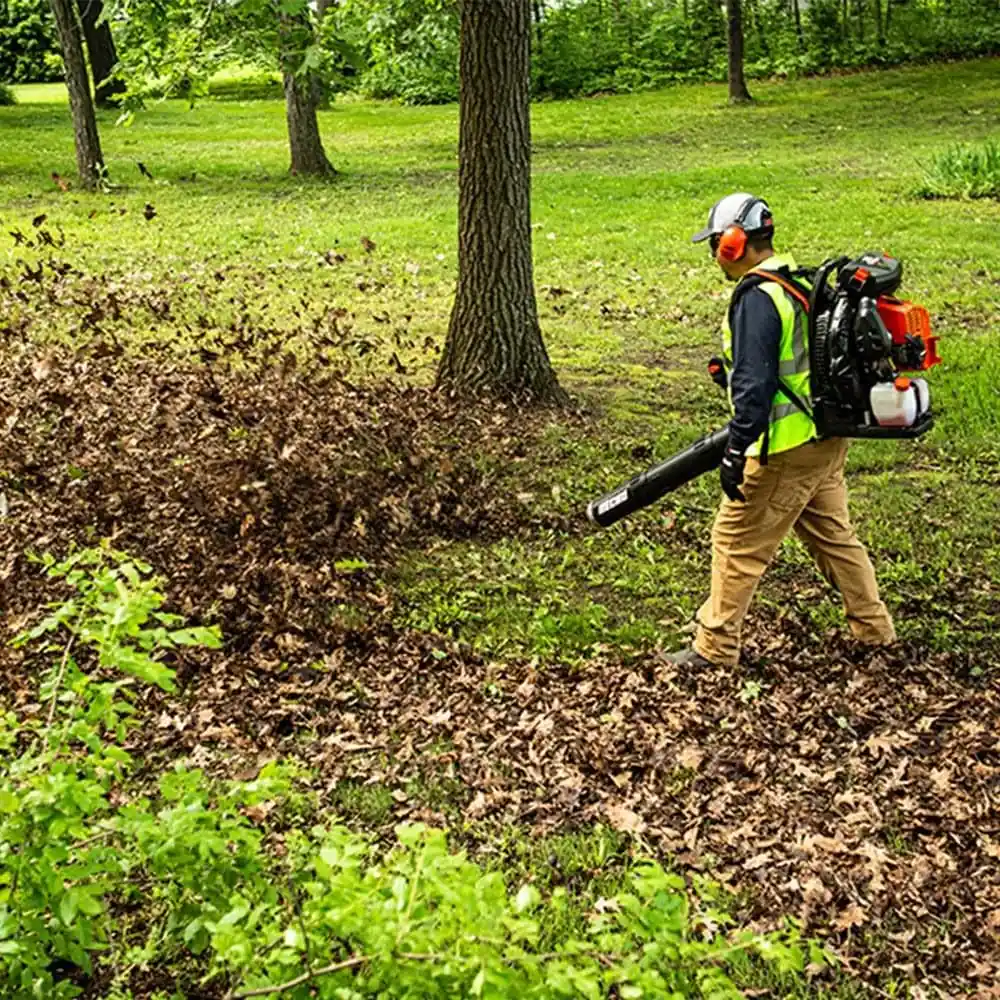
Choose the 580BTS if you wear the blower for an hour or more at a stretch, because the hip belt is the one thing the ECHO cannot match.
- You work long orchard rows, wooded edges or several acres in one session.
- You want the weight on your hips and a chest strap holding the frame still.
Skip it if wet, packed leaves are most of your work and airflow is your first concern, or if you want a vacuum kit, since Husqvarna makes none for this model.
Around the sheds in summer, with dust and chaff on the floor, the Husqvarna is the one I wear with a dust mask, because that cleanup runs long and the belt keeps my back quiet.
My Pick Between the Two
In the Husqvarna 580BTS vs Echo PB-9010 decision, I pick the Husqvarna 580BTS for most buyers, because the hip belt and chest strap turn a 31 lb backpack into something you can wear for an hour. I keep the ECHO for two kinds of day, wet leaf mats and storm debris, where 110 more CFM counts and the session ends in minutes. The harness settles it for me, and my leaf blower guides cover the wider range if a small yard needs less than a gas backpack. On wearing time alone, the Husqvarna wins the Echo PB-9010T vs Husqvarna 580BTS choice, and the ECHO wins it only when wet leaf mats and storm debris in short sessions are all you have.
Frequently Asked Questions
Which ECHO backpack blower is the most powerful?
The most powerful ECHO backpack blower sold on Amazon.com is the PB-9010T, rated by ECHO at 48 N and 1,110 CFM from its 79.9 cc engine. The PB-770T is rated at about 33 N and the PB-580T at 22 N, so the PB-9010T leads the range by a wide margin.
What are the key differences between the Husqvarna 580BTS and 590BTS air blowers?
The 590BTS is the stronger Husqvarna, with a 79.4 cc engine, 1,245 CFM at the round nozzle and 56 N of force, against 75.6 cc, 1,000 CFM and 47 N for the 580BTS. The 590BTS also weighs 26.2 lb dry against 26.8 lb, and its tank holds 91.3 fl oz against 87.92.
Is the Echo 9010 a good blower?
The Echo 9010 is a good blower for big leaf jobs in short sessions, because it moves 1,110 CFM and pushes 48 N, the most air of this pair. It is loud, it puts about 31 lb fueled on your shoulders with no hip belt, and it is overkill for a small lot.
Are Husqvarna backpack blowers any good?
Husqvarna backpack blowers such as the 580BTS are good machines for long sessions, because the padded hip belt, waist belt and chest strap carry the load on your hips, and 47 N stands level with the ECHO. According to Husqvarna they are built primarily for commercial landscaping professionals, and the 580BTS is loud at 106 dB(A) at the ear.
What does BT stand for in Husqvarna?
The letters BT on a Husqvarna blower tell you where the throttle handle sits: on BT and BTS models such as the 580BTS it sits on the blower tube under your right hand. On BFS models such as the 580BFS it sits on the frame at your hip, under the left hand.
References
- Wettenschwiler PD, Lorenzetti S, Stämpfli R, Rossi RM, Ferguson SJ, Annaheim S. Mechanical Predictors of Discomfort during Load Carriage. PLoS ONE. 2015;10(11):e0142004.
- Lim MC, Awang Lukman K, Giloi N, et al. Landscaping Work: Work-related Musculoskeletal Problems and Ergonomic Risk Factors. RMHP. 2021;Volume 14:3411-3421.
- Walker E, Banks JL. Characteristics of Lawn and Garden Equipment Sound: A Community Pilot Study. J Environ Toxicol Stud. 2017;1(1).
- Balanay JAG, Kearney GD, Mannarino AJ. Assessment of Occupational Noise Exposure among Groundskeepers in North Carolina Public Universities. Environ Health Insights. 2016;10:EHI.S39682.
- Morata TC, Gong W, Tikka C, Samelli AG, Verbeek JH. Hearing protection field attenuation estimation systems and associated training for reducing workers’ exposure to noise. Cochrane Database of Systematic Reviews. 2024;5(5):CD015066.
- Alamin Gabasa SA, Md Razali KA, As’arry A, Abdul Jalil NA. Vibration Transmitted to the Hand by Backpack Blowers. IJAME. 2019;16(2):6697-6705.
Safety Note: Leaf blowers throw debris and can damage your hearing. Wear eye and ear protection, read the manufacturer’s manual, and check your local rules on noise and operating hours.