
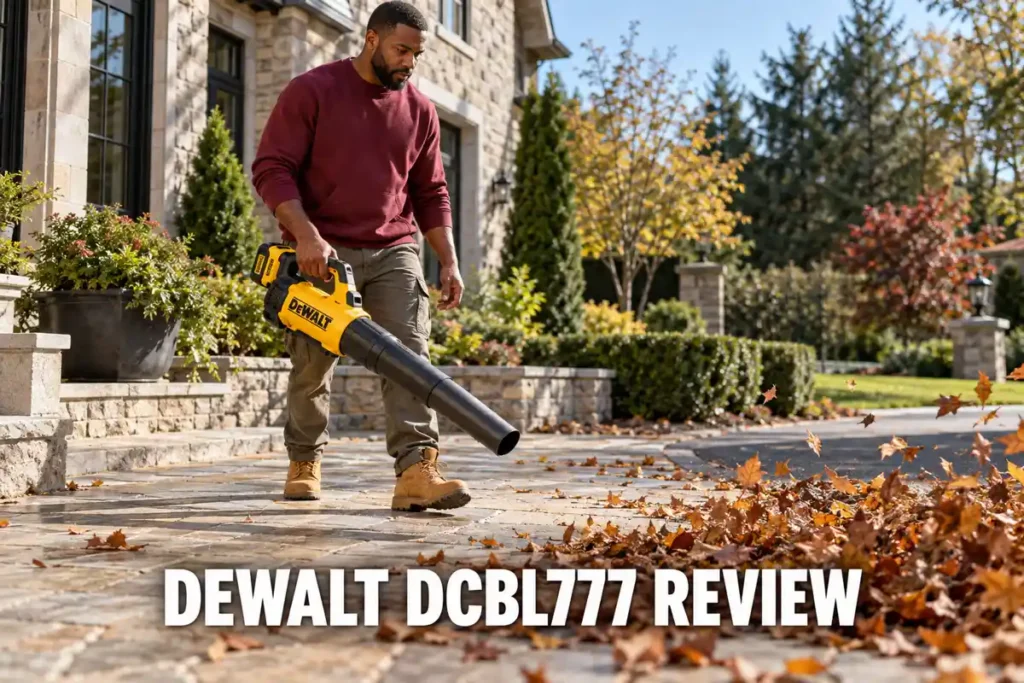
My DeWalt DCBL777 review is a yes for house lots, gravel yards and farm drives, and a no for soaked leaf mats. The blower comes as the DCBL777B bare tool, with no battery or charger, and as the DCBL777Y1 kit, with one FlexVolt battery and a charger. I keep the lawn, the gravel yard and a 3.7-acre plum and apricot orchard clear every autumn, so I ran it on all three, down to the fallen plum leaves under the canopy. Below are the force, run time, noise and weight, and which version to buy.
Affiliate Disclosure: Garden Power Scout is a proud participant in the Amazon Services LLC Associates Program. As an Amazon Associate, we earn from qualifying purchases, at no extra cost to you.
DeWalt DCBL777 Review and My Verdict in Brief
I recommend this DeWalt 60V leaf blower as DeWalt’s strongest 60V handheld, with about 19 N of push on turbo and about 79 dB at the ear, against about 17 N and about 91 dB for the older DCBL772. That is enough for dry leaves, gravel dust and a farm drive, and it falls short on soaked leaf mats. The catch is the pack, which gives about 18 minutes on Normal and about 14 on turbo.
- Who it is for: a house lot, gravel yard or farm drive, especially if you already hold FlexVolt packs.
- What it does best: a wide spread from gentle ECO to a turbo mode that works like a different tool.
- The main trade-off: about 10 lb in hand and 14 to 18 minutes of run on the strong modes.
What the DeWalt DCBL777Y1 Kit and the DCBL777B Bare Tool Include
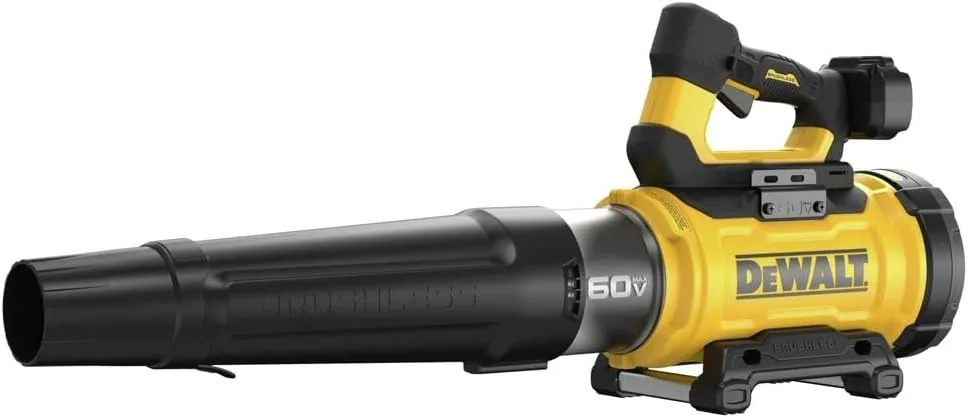
The DeWalt 60V MAX Premium Blower DCBL777B comes with a concentrator nozzle, a sweeper (flat) nozzle and a shoulder strap, according to DeWalt. It has no battery and no charger. Owners who already hold FlexVolt packs can buy it as a DeWalt 60V blower tool only and put those packs to work.
According to DeWalt, the DCBL777Y1 kit adds a DCB612 FlexVolt battery and a charger to the same blower. For a buyer with no DeWalt packs, the DeWalt 60V blower with battery is this kit. Check the model on the battery label when it arrives, because the run times below belong to the DCB612.
The DCB612 carries two ratings: 12.0 Ah when it powers a 20V tool and 4.0 Ah when it powers a 60V tool, the same battery under two labels. I use 12.0 Ah from here on, as DeWalt does.
DeWalt DCBL777 Specs at a Glance
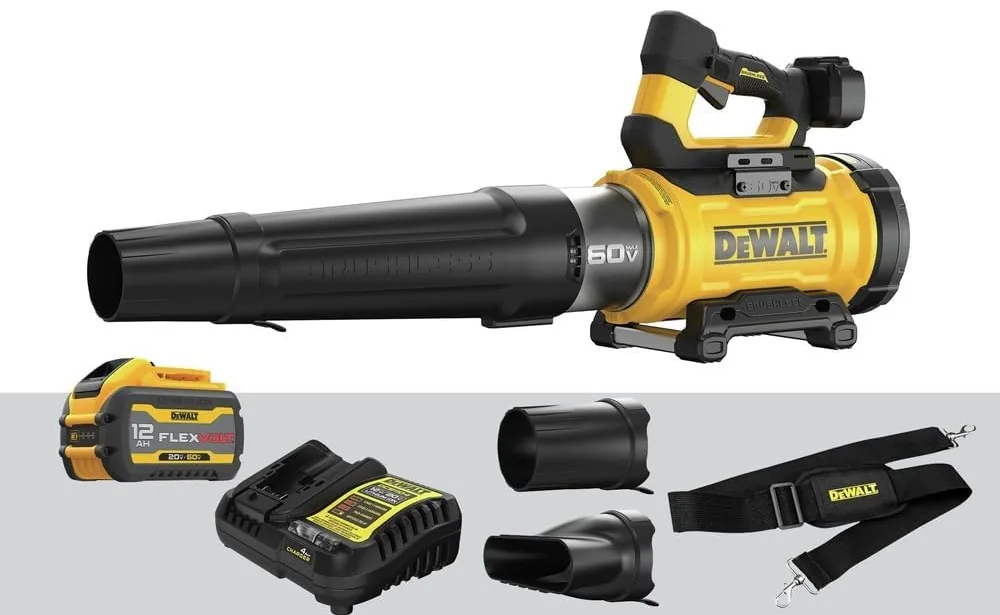
Two rows decide the fit: blowing force and run time, and both depend on the mode and the 12.0 Ah pack. A newton is the push of the air against a surface, and 19 N is about 4 lb.
| Spec | Figure |
|---|---|
| Airflow, maker’s figure | Up to 760 CFM |
| Air speed, maker’s figure | Up to 160 mph |
| Blowing force | About 11 N on ECO, 14 N on Normal, 19 N on turbo |
| Run time on the 12.0 Ah pack | About 18 minutes on Normal, about 14 on turbo; up to 20 on ECO, according to DeWalt |
| Weight | Just over 7 lb bare; about 10 lb with the 12.0 Ah pack |
| Noise at the ear | About 75 dB on ECO, 77 on Normal, 79 on turbo |
How the DeWalt DCBL777 Performs on Leaves, Gravel and Concrete
DeWalt prints up to 760 CFM and up to 160 mph without naming a mode or a nozzle, so the push in newtons is the number I plan with.
Force by Mode and the Nozzle Trade
The push is about 11 N on ECO, about 14 N on Normal and about 19 N on turbo. Normal already passes a typical residential gas handheld, which peaks near 12 N, and turbo is a different tool from ECO.
The concentrator nozzle costs about 2 N across the modes, so I keep it for seams and stuck debris and not for raw push. The blower starts in ECO every time, and on my first pass at the muddy corner by the shed door the leaves barely moved because I had not pressed the speed button. Now I press it before I squeeze the trigger.
Wet Leaves on the Concrete Pad
Wet leaves cling by water film and weight, so they need volume under the leading edge. On the concrete pad in front of the machinery shed, Normal slid the wet mat along without lifting it, and turbo rolled it off the edge in strips, at the price of a pack that drains faster. A thick soaked mat by the drainage ditch is where I put the blower down and pick up a rake.
Gravel Yard and Orchard Leaves
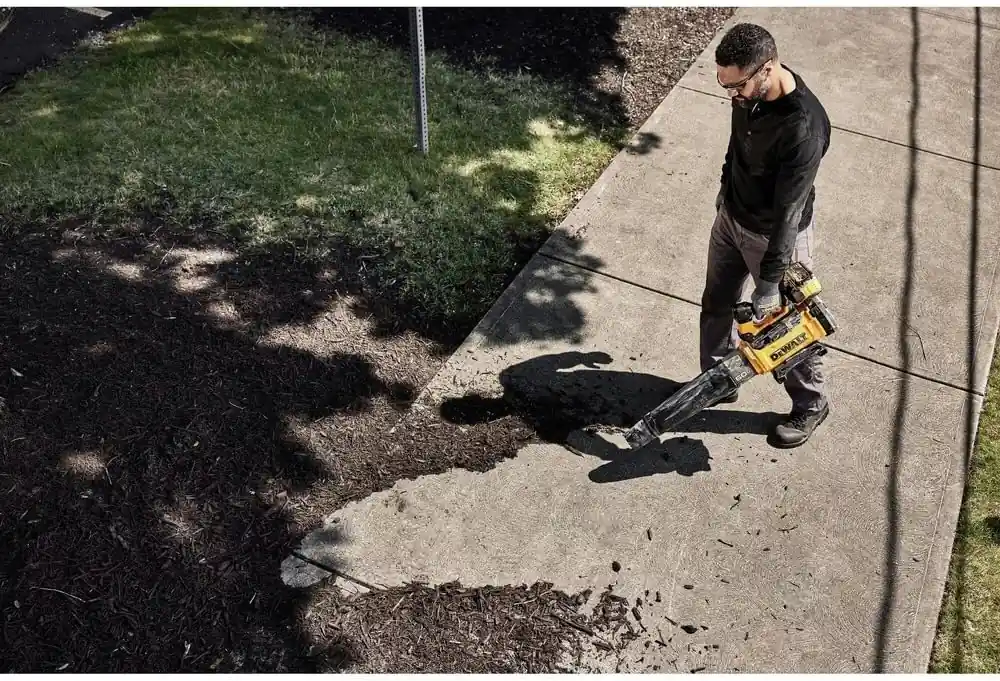
On the gravel yard I run ECO with the concentrator on and the tube tilted low, a few feet from the stones. Stones fly at ankles, windows and car paint, so I wear safety glasses, ear protection and sturdy shoes, and I keep people, pets and parked cars out of the debris path.
In November the plum leaves lie under the canopy, and I move the dry ones into the alley on Normal so the mower can shred them. In apple orchards, shredding the leaf litter cut the next season’s scab risk by 80 to 90 percent when all of it was shredded (1). Plum is not apple, but the job is the same.
Runtime and the FlexVolt Battery the DCBL777 Needs
According to DeWalt, a DCB612 pack runs up to 20 minutes in ECO. On a 12.0 Ah pack with the trigger held on full, Normal gives about 18 minutes and turbo about 14. Plan around those two for stubborn leaves, and keep gravel and light jobs on ECO.
The DeWalt 60V blower battery is a FlexVolt pack, and the blower needs one. A plain 20V MAX pack is not a FlexVolt pack, so read the label before you buy a second. According to DeWalt the DCB612 weighs about 3.4 lb, about a third of what you hold.
On a Saturday of leaf drop I plan the house lawn and the yard on one pack and the tree-row strips on a second, with a charge in between. A blinking white LED means a low-battery shutdown, and at the end of the first alley it cut out with a pile still in front of me, so I now read the four charge LEDs before each row.
Charge between 40 and 104 F, and let a cold pack warm first. DeWalt says never to store a pack where it may reach 104 F. A model study found that 36 months of storage at 131 F and 90 percent charge cut electrolyte conductivity by more than 20 percent (2), so my spare pack waits on a shelf in the house, not in the metal machinery shed in July.
Noise at the Ear and Hearing Protection
According to DeWalt, the blower is rated 63 dB for quiet operation, with no distance named, so I do not use that number to judge my own ears. At the operator’s ear it runs about 75 dB on ECO, 77 on Normal and 79 on turbo, against about 91 dB for the older DCBL772. DeWalt added a foam liner to the air intake to cut noise.
Quieter than gas still means loud over a shift. In a study of North Carolina university groundskeepers, 77 percent of shift averages by the NIOSH method exceeded 85 dBA, and equipment peaked as high as 109 dBA (3). Battery tools gave landscaping workers significantly less noise than fuel-powered blowers in NIOSH sampling (4).
I wear ear protection from the first minute, even on ECO. A Cochrane review reports that poor fit may limit earplug protection for about 40 percent of users (5), so I check the seal before I squeeze the trigger.
Where the DeWalt 60V Blower Sits in the 60V Line
The older DCBL772 and the DCBL777 share the same FlexVolt packs, which also fit DeWalt’s 20V tools. The newer blower adds about 2 N of push on turbo and takes about 12 dB off the noise at the ear. On a long Saturday that noise drop is the change I care about most.
Living With It, From Controls to Care
With the battery off, line up the tab on the power head with the notch on the tube and push until the two locks click. The nozzles slide on and lock the same way, and the strap is in the box.
- Speed button: cycles ECO (white light), Normal (orange) and turbo (red), and returns to ECO at every start.
- Speed lock: holds the trigger once it is fully pressed, and it is not a lock-off.
- Switching off: press and hold the speed button. The blower also shuts off after 20 seconds idle, and the fan needs 10 seconds to stop before you take the tube off.
The strap goes over one shoulder only, never across the body. With the strap on, the weight moved from my wrist to my shoulder, which matters because the pack is about a third of the working weight. In a study of 17 groundskeepers, lifetime hand-arm vibration dose from all their tools ran about 33 times that of office workers at the right hand (6), so I keep sessions to one pack and then change jobs.
Care is short. Blow dirt out of the air vents with clean dry air once a week, and keep the blower out of rain.
Protection Every Time
Wear safety glasses with side shields, ear protection and sturdy shoes, add a dust mask for dry dust, keep people, pets, windows and cars out of the debris path, and take the battery off before changing the tube or clearing a blockage.
Who Should Buy the DeWalt DCBL777 and Who Should Skip It
The fit depends on your packs, your yard and your main job.
Buy It If
- You already own FlexVolt packs, and the bare tool is the whole purchase.
- You clear a house lot, a gravel yard or a farm pad in sessions of 15 to 20 minutes.
Skip It If
- Soaked leaf mats or deep drifts are your daily job.
- You own no FlexVolt packs and want the smallest first purchase, since the pack is the largest cost.
- You need one long run, since the strong modes empty a pack in under 20 minutes.
DeWalt DCBL777 Problems and Drawbacks
- Short run on the strong modes: about 14 minutes on turbo and 18 on Normal. Use ECO for light jobs and carry a second pack for bigger yards.
- Pack weight: about 10 lb with the 12.0 Ah pack.
- No hang hole: it is hard to hang from a hook, so it needs a shelf or a rack in the shed.
- Mid-pack force: the strongest cordless handhelds reach about 25 N on turbo, so soaked mats stay a rake job.
How the DeWalt DCBL777 Compares With Alternatives
A DeWalt buyer usually weighs the older DCBL772B, the EGO LB7654 and the Milwaukee 2824-20, and the table shows what each one puts in the box. More handhelds are in our leaf blower guides.
| Model | Pack platform | In the box |
|---|---|---|
| DeWalt DCBL777Y1 kit | FlexVolt | Blower, one FlexVolt pack (12.0 Ah), charger |
| DeWalt DCBL777B | FlexVolt | Blower only |
| DeWalt DCBL772B | FlexVolt | Blower only |
| EGO LB7654 | EGO 56V | Blower, 5.0 Ah pack, charger |
| Milwaukee 2824-20 | M18, two packs | Blower only |
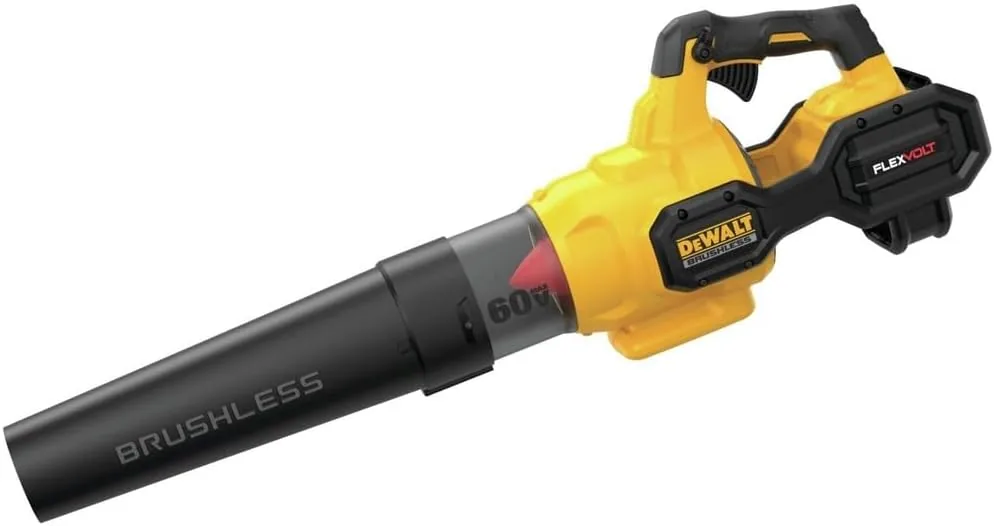
DeWalt DCBL772B for Owners of the Older 60V Model
The DeWalt DCBL772B is the tool-only older 60V handheld, and it runs on the same FlexVolt packs. If you already own one, the upgrade buys quiet more than capability.
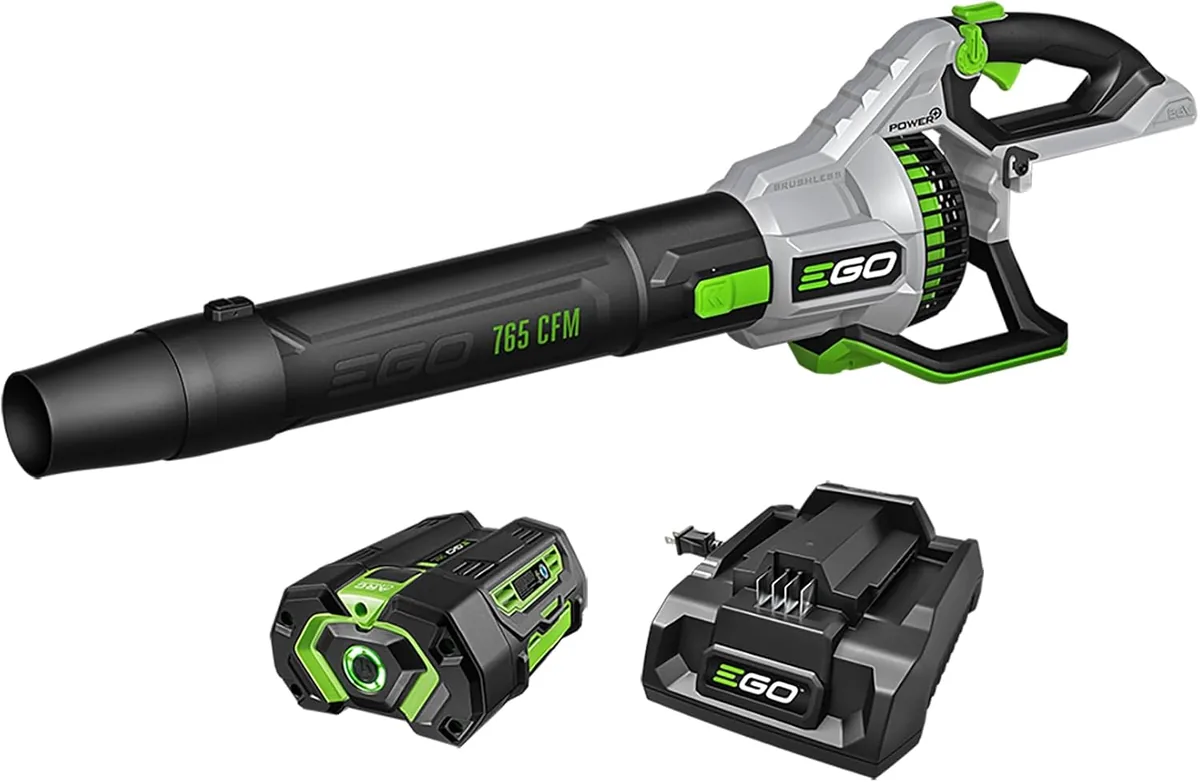
EGO LB7654 for a Kit With Its Own Pack
The EGO LB7654 kit puts a 5.0 Ah pack and a charger in the box. Its turbo pushes about 25 N for about 13 minutes, and it weighs about 9.6 lb with the pack. A DeWalt owner would buy new packs for it.
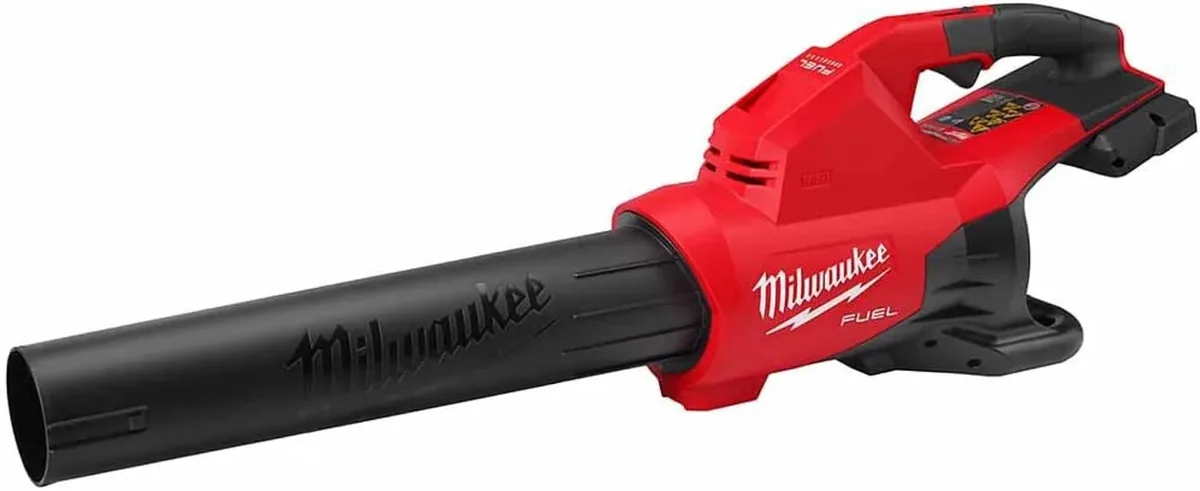
Milwaukee 2824-20 for Two Packs and Steady Force
The Milwaukee 2824-20 is a bare tool like the DCBL777B, but it needs two M18 packs and a charger. It holds a steady push of about 17 N with no turbo, and two 8.0 Ah packs run it about 15 to 18 minutes at full throttle.
My Recommendation on the DeWalt DCBL777
I recommend the DeWalt DCBL777 for a house lot, a gravel yard and a farm drive. It moves dry leaves and gravel dust well, pushes about 19 N on turbo, stays near 79 dB at the ear and weighs about 10 lb in hand with a 12.0 Ah pack. Skip it for soaked leaf mats and for jobs that need one long run, because the strong modes empty a pack in under 20 minutes. My DeWalt DCBL777 review verdict is to buy the bare tool when FlexVolt packs are on your shelf and the kit when they are not.
Frequently Asked Questions
Which DeWalt cordless blower is the best?
The best DeWalt cordless handheld blower for most yards is the DCBL777, DeWalt’s strongest 60V handheld at about 19 N on turbo and about 79 dB at the ear. The 20V DCBL722 suits small lots, while the older 60V DCBL772 runs about 17 N and about 91 dB at the ear.
What are the common problems with DeWalt blowers?
The common problems with DeWalt blowers like the DCBL777 are short run time on strong modes, pack weight and no hang hole, with about 14 minutes on turbo and about 18 on Normal. The bare tool also needs a FlexVolt pack bought separately, and the pack is the largest cost.
Are cordless blowers worth it?
Cordless blowers are worth it for a house lot or farm yard, because the DeWalt DCBL777 pushes about 19 N on turbo against a peak near 12 N for a gas handheld, and it is quieter. The trade-off is about 14 to 18 minutes of run per 12.0 Ah pack on strong modes, so long jobs need spare packs.
Is it better to have more mph or cfm in a leaf blower?
It is better to have more CFM than mph in a leaf blower for most yard work, and force in newtons settles the tie. DeWalt lists the DCBL777 at up to 760 CFM and up to 160 mph, yet it pushes about 19 N on turbo, and that figure shows how hard the air hits.
What’s the most powerful blower on the market?
The most powerful blowers on the market are gas backpacks at about 40 to 52 N, while the strongest cordless handhelds reach about 20 to 26 N on turbo. The DeWalt DCBL777 sits mid-pack among cordless handhelds, at about 19 N on turbo and about 79 dB at the ear.
References
- Sutton DK, MacHardy WE, Lord WG. Effects of Shredding or Treating Apple Leaf Litter with Urea on Ascospore Dose of Venturia inaequalis and Disease Buildup. Plant Disease. 2000;84(12):1319-1326.
- Asiri M, Kedhim M, Jain V, et al. Impact of temperature and state-of-charge on long-term storage degradation in lithium-ion batteries: an integrated P2D-based degradation analysis. RSC Adv. 2025;15(28):22576-22586.
- Balanay JAG, Kearney GD, Mannarino AJ. Assessment of Occupational Noise Exposure among Groundskeepers in North Carolina Public Universities. Environ Health Insights. 2016;10:83-92.
- Alexander BM, Graydon PS, Pena M, Feng HA, Beamer BR. Hazardous exposures and engineering controls in the landscaping services industry. Journal of Occupational and Environmental Hygiene. 2025;22(3):189-202.
- Morata TC, Gong W, Tikka C, Samelli AG, Verbeek JH. Hearing protection field attenuation estimation systems and associated training for reducing workers’ exposure to noise. Cochrane Database of Systematic Reviews. 2024;5(5):CD015066.
- Chen N, Yang S, Oh J. Evaluation of hand-arm vibration (HAV) exposure among groundskeepers in the southeastern United States. Annals of Work Exposures and Health. 2025;69(1):81-95.
Safety Note: Leaf blowers throw debris and can damage your hearing. Wear eye and ear protection, read the manufacturer’s manual, and check your local rules on noise and operating hours.