
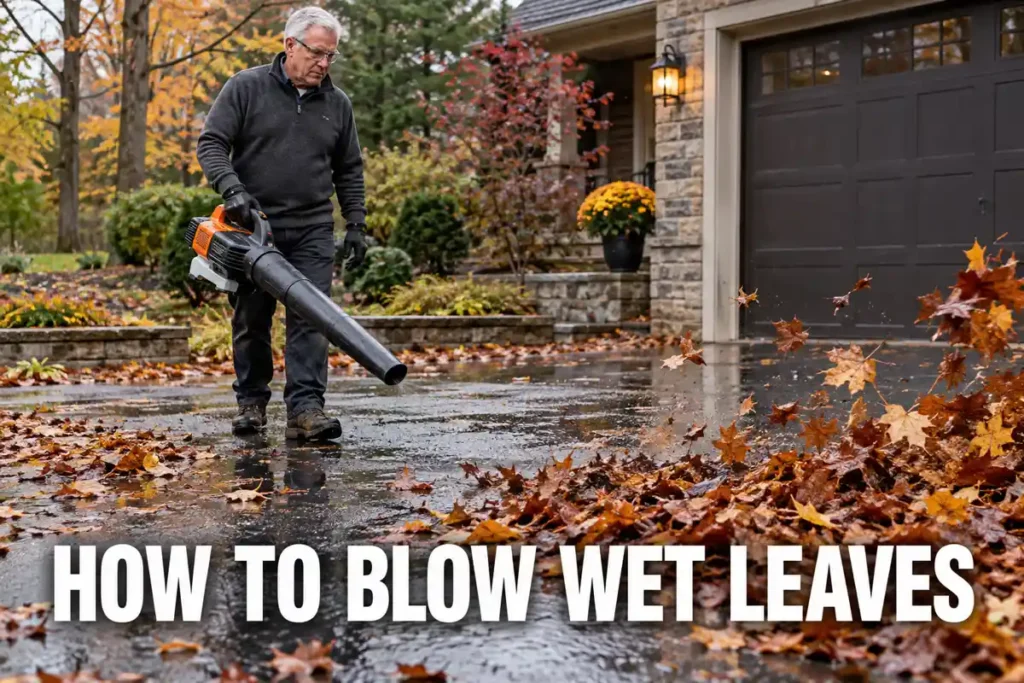
Here is how to blow wet leaves: hold the nozzle low at a shallow angle, slide the jet under the leading edge of the mat, and work in short bursts across small sections. A blower with enough push peels a wet mat, and a weak one only slides it around.
Most of my leaf work on the orchard strips and the farm yard happens on wet mornings, so I know what a soaked mat does to a blower and a battery. Below you get the reasons wet leaves resist, the force the job needs, what the manuals say about wet ground, the steps, each surface, and when a rake or mower is faster.
How to Blow Wet Leaves by Matching the Method to the Mat
A leaf blower moves wet leaves when the jet is strong enough, the nozzle stays low and you take the mat in small sections. When the mat is soaked and deep, or rain is still falling, the right move is to wait or reach for another tool. The depth and wetness of the mat decide the method.
| The mat | Method | Limit |
|---|---|---|
| Damp single layer | Low angle, steady stream, wide passes | A mid-power blower handles it; a small sweeper only slides it |
| Wet single layer on a hard surface | Lift the leading edge, short bursts, push downhill | Slow on smooth paving, and the footing turns slick |
| Soaked mat, several layers deep | Rake or brush the bottom layer loose, then blow what is free | Wait for a dry spell if the mat is deeper than a few inches |
| Rain or standing water | Stop and wait | Never run an electric blower in rain or in puddles |
Key Takeaway
A wet mat peels from its edge. Aim the jet under the leading edge, not at the middle of the pile.
Can You Blow Wet Leaves With a Leaf Blower?
A leaf blower can move wet leaves, but only when its jet breaks the bond between the leaves and the ground first. Dry leaves ride on a stream of air. Wet leaves have to be pried loose.
Wet Leaves Weigh Two to Three Times as Much
Rain turns a light layer into a heavy one. In a lab study of oak and alder leaf litter after simulated rain, the layer held water equal to about 1.4 to 2.4 times its dry weight (1). That puts 10 pounds of dry leaves at roughly 24 to 34 pounds once wet.
A tarp load I can drag alone when it is dry takes two people when it is wet. Forest-floor litter in a lab is not a suburban lawn, so read the figures as the size of the effect, not a promise for your yard.
Water Glues the Mat Together
A thin film of water holds each leaf to the surface below it and to the leaf beside it. Leave the layer for a day or two and it presses into a mat, with the bottom layer sticking hardest. A jet that clears dry leaves has to break that bond before it can move anything.
Wide, soft air glances off the top of a mat, and a thin, fast jet digs one spot and leaves the rest. On the concrete pad in front of my machinery shed, my small cordless handheld only slid a wet mat of plum leaves across the surface. The air was fast, but the push was not enough to lift it.
How Much Force a Leaf Blower Needs for Wet Leaves
A leaf blower on wet leaves works on force, the push of the air jet at the nozzle, measured in newtons. One newton is about a quarter pound of push, so 20 N is roughly 4.5 pounds. Airflow alone moves a breeze, and force is what peels a mat.
| Blower class | Force at the nozzle | What it does with wet leaves |
|---|---|---|
| Small 20-volt sweeper | About 3 N | A dust-off tool. It does not move wet leaves. |
| Cordless handheld on high | About 11 to 14 N | Damp leaves and thin wet layers on hard surfaces. It slides a mat. |
| Cordless handheld on turbo | About 20 to 25 N | A wet single layer, with a low angle and short bursts. It peels a mat edge by edge. |
| Cordless backpack | About 26 N | Wet leaves on a lawn in sections. Heavier mats need patience. |
| Gas backpack, strong units | About 40 N and up | Soaked, multi-layer mats. This is the class crews use after rain. |
I use these thresholds as my working guide, built on the force figures I trust for these classes and rounded. No standard defines a pass or fail value for wet leaves, so use the table to compare classes, not as a guarantee. Under about 12 N, I rake a soaked mat instead of blowing it.
A narrower outlet squeezes about the same push through a smaller opening, so the air moves faster over less width. That peels a stuck edge, while a round or wide nozzle moves what is already loose. When the kit has a narrow nozzle, I fit it to start a stuck edge and take it off to move the loose pile.
Turbo costs minutes. A 56-volt handheld with a 5.0 Ah pack runs about 22 minutes on high and about 13 on turbo, and cold weather shortens both.
| Setting | Minutes per pack | Packs needed |
|---|---|---|
| High | About 22 | About 5 |
| Turbo | About 13 | About 7 |
Turbo is for the stubborn edge of a mat, not for whole rows. On a wet morning in the orchard alleys, my first pack was empty before I finished the third alley, and that is when I started keeping turbo for the stubborn edges. Warm the packs indoors before a cold job.
Electrical Safety When the Leaves Are Wet
Makers draw a hard line on water. Husqvarna’s manual for its cordless handheld blower says not to leave, store or use the machine in the rain or in wet conditions, and that water entering the machine raises the risk of electric shock. Toro’s manual for its battery hand-held blower says not to use it on wet surfaces, not to expose it to rain and to store it indoors.
The battery gets the same warning. Husqvarna says to keep it away from rain and wet conditions and to charge it only indoors, never in wet conditions, and Toro says not to charge it in rain or in wet locations. Husqvarna adds that if work in a damp location cannot be avoided, the supply should be protected by a ground fault circuit interrupter (GFCI), a device that cuts the power when current leaks.
Wet leaves usually mean wet ground, which is the condition those lines describe. I treat my model’s manual as the limit. If it says no wet conditions, a soaked lawn stays a rake job until the ground dries.
I start only after the rain has stopped, stay out of puddles, keep plugs and cord joints off wet ground, and stop and dry the tool if it gets wet. A gas blower has no battery or cord to keep dry, but slips and noise matter just as much.
Blowing Wet Leaves Step by Step
These seven steps show how to blow wet leaves from the first look at the sky to the last tarp load.
- Pick the window. Start after the rain stops, never on standing water or frost, and only where your manual allows use on wet ground.
- Gear up. Wear glasses, hearing protection and non-slip boots.
- Set your position. Keep the wind at your back or across you, and work downhill.
- Drop the nozzle. Hold the tip a few inches off the surface at about 15 to 30 degrees.
- Lift the edge, then burst. Slide the jet under the leading edge and fire short bursts.
- Peel in layers. Take sections a few feet wide, one layer at a time.
- Stage and collect. Blow onto a tarp or into one corner and move the load.
Pick the Window and Gear Up
Wait until the rain has stopped. Do not start on standing water or frost, and let a soaked, deep mat wait for a dry spell. If your manual forbids use on wet ground, rake instead. The top of the mat lightens first, and the bottom layer, which sits against the surface, dries last.
Wear safety glasses and hearing protection from the first minute. With a gas blower I wear earplugs and earmuffs together. Add non-slip, protective footwear, because Husqvarna’s manual calls for it and wet leaves are slick underfoot.
Before You Start
Keep people, pets, cars and windows out of the debris path, since wet leaves carry grit and mud. Stop the engine and let it cool before refueling. A rotting mat can throw up mold and mud, so I wear a dust mask when I disturb one.
Position, Angle and Short Bursts
Stand with the wind at your back or across your body, and work downhill so the leaves do not drift back when you stop. Husqvarna’s manual says to hold the opening of the blower as close to the ground as possible. For wet leaves I go lower than for dry ones.
A shallow angle of about 15 to 30 degrees rolls leaves forward. A steep angle digs into the surface and throws wet leaves and mud, so keep the tip a few inches off the ground.
Start at the edge of the mat, slide the jet under the leading edge and lift it. I fire bursts of two to three seconds, then re-aim, instead of holding the trigger on one spot. A low sweep under the edge worked on my farm yard when a high sweep across the top failed.
Peel in Layers and Stage the Leaves
Take the mat in sections a few feet wide and peel the top layer before the next. If the bottom layer stays stuck, a rake or brush releases it, as Husqvarna’s manual advises for debris stuck to the ground. On the tree-row strips, where wet leaves mix with soil and smear, I peel from the tree side toward the alley and finish with a rake near the trunks.
Then blow the loosened leaves onto a tarp or into one corner. Wet leaves weigh so much that fewer, bigger bundles beat many small trips.
These mistakes cost the most time:
- Full throttle from the first second: it drains the pack and raises the noise.
- A steep angle: it digs turf and throws mud.
- Blowing a thin film into a thick mat: you build the deep layer you then have to peel.
- Blowing leaves back onto a wet deck or step: they leave the surface slick again.
- Skipping the rake on a soaked pile: the blower only slides it around.
Wet Leaves on Lawns, Pavement, Decks and Beds
Each surface fails in its own way, so the same blower needs a different touch on each. The common rule is a low angle and the lowest throttle that still lifts the edge. Gravel is a separate job with its own rules, because loose stone turns into projectiles, so keep the tip away from it.
Lawn
Wet turf is soft, so a steep angle tears it. Lower the throttle, keep the tip low and push the leaves toward a tarp or a mowing line. A thin leftover layer can be mowed in.
Driveways and Paving
Paving is the easiest surface, since the leaves have nothing to grip except the water film. Push downhill, and remember that wet paving is slick under your boots.
Decks and Steps
Wet wood is slick, so footing comes before speed. Blow along the boards, not across the gaps, and stay away from the edge. Do not blow the leaves back onto a deck you just cleared, because they turn the boards slick again.
Beds and Mulch
Wet mulch lifts in clumps and lands on the lawn. Use the lowest throttle and a low angle, or pull the leaves out by hand. Around my young drip lines I keep the jet above the line and finish by hand, because air can shift the line and fill emitter ends with grit.
When to Wait, and When a Rake, Tarp or Mower Is Faster
A blower is not always the fastest tool for a wet mat. Rain that is still falling, standing water and frost under the leaves all mean waiting.
- Wait when rain is falling, water stands on the area or ice sits under the leaves.
- Rake or scoop when the mat is deep and soaked and your blower sits under about 12 N. The rake frees the stuck bottom layer, and the blower gathers what comes loose.
- Tarp when the pile is heavy. Drag it instead of blowing it, since wet leaves weigh two to three times what dry ones do.
- Mulching mower when the cover on turf is thin.
For thin cover on turf, one of the lawn mowers in your shed is often the quickest tool. Nebraska Extension’s general advice for leaves on turf is a mulching mower or 2 to 3 passes with a regular mower (2).
Slips, Hidden Hazards and Your Hearing
The mat hides what lies under it, and wet leaves tempt you to push harder than you should.
Wet leaves on paving, steps and decks are slick, and a mat can cover holes, roots, stones, irrigation heads and drip lines. Walk the area before you blow it. On my place the drainage ditch along one border fills with wet leaves, and I clear it by hand, because blowing leaves into a ditch only moves the clog. Leaf litter can also hold ticks, so wear long sleeves and check yourself when the job is done.
Wet leaves tempt me to hold the trigger down, and full throttle is louder. In a NIOSH study of landscaping crews, 94 of 119 eight-hour noise results were at or above 85 dBA, the recommended limit, and workers had significantly more noise and carbon monoxide exposure with fuel-powered blowers than with battery versions (3). Wear hearing protection with any blower on full power, and plugs plus earmuffs with gas.
Collect the leaves instead of pushing them to the curb or into a storm drain. In paired residential catchments in Madison, Wisconsin, removing leaves before rain cut total phosphorus loads in stormwater by 84 percent (4).
What Wet Leaves Do to Your Lawn if You Leave Them
A thick mat of leaves shades the grass and can smother it, so leaving it all winter costs you turf. Remove the mat, not every leaf.
Purdue turf specialists write that heavy layers of tree leaves shade grass and can smother and kill it, and that leaf cover favors snow mold, a damaging winter turf disease (5). In one field study, thick leaf litter left on turf over winter led to turf death, and weeds moved in (6). Purdue also notes that pink snow mold is active from about 30 to 60°F and needs no snow cover (7). That is why I do not leave a wet mat on turf through a cool fall.
A thin layer chopped into the grass does no harm. Purdue says research found no detrimental effects from mulching tree leaves into turf (5), and in a Kentucky bluegrass trial, mulched maple and oak leaves cut dandelion counts by up to 80 percent after one application (8). Leaves under my plum and apricot rows are a separate job. There I blow them from under the canopy into the alley, where the mower shreds them.
A Dry Afternoon Beats a Hard Pass
Three points carry the job: wait for the rain to stop, keep the nozzle low with the jet under the edge, and match the tool to the depth of the mat. Read the manual for your own model before you plug in or charge anything. My tip is to keep a rake next to the blower, so a soaked bottom layer never becomes a reason to push harder.
For help matching a blower to the force your yard needs, read the leaf blower guides. Knowing how to blow wet leaves comes down to timing and a low nozzle, and the rake and tarp cover what the blower cannot.
Frequently Asked Questions
Do leaf blowers work on wet leaves?
Leaf blowers work on wet leaves when the jet has enough force, the nozzle stays low and you work in short bursts across small sections. A weak or sweeper-class blower only slides a wet mat across the surface.
How to remove wet leaves from lawn?
To remove wet leaves from a lawn, push them with low-angle passes toward a tarp, or rake them, and leave only a thin layer for the mower to mulch in. A thick wet mat left on turf can smother it, so the mat has to go.
How to remove wet leaves from driveway?
To remove wet leaves from a paved driveway, hold the nozzle low at a shallow angle, work downhill with the wind and peel the mat from its leading edge. Keep the tip away from loose stone, and wear non-slip boots because wet pavement is slick.
What is the best way to remove wet leaves?
The best way to remove wet leaves is the tool that matches the depth: a blower for a single wet layer, a rake or tarp for a soaked mat, and a mulching mower for thin cover on turf. Waiting for a dry afternoon makes each of them easier.
How to efficiently blow leaves?
To blow leaves efficiently when they are wet, work in small sections with the wind at your back and push each section toward a tarp so you move the load once. Short bursts at a low angle save more time and battery than holding full throttle on one spot.
References
- Li Q, Choi H, Lee EJ, Im S. Experimental Analysis of Water Retention Characteristics in the Litter of Different Deciduous Trees. J Korea Soc Environ Restor Technol. 2016;19(2):83-93.
- Exstrom E. Don’t Let Leaves Smother the Turf. University of Nebraska-Lincoln, Nebraska Extension (UNL Water). November 29, 2023.
- Alexander BM, Graydon PS, Pena M, Feng HA, Beamer BR. Hazardous exposures and engineering controls in the landscaping services industry. Journal of Occupational and Environmental Hygiene. 2025;22(3):189-202.
- Selbig WR. Evaluation of leaf removal as a means to reduce nutrient concentrations and loads in urban stormwater. Science of The Total Environment. 2016;571:124-133.
- Reicher Z. Keep Mowing to Mulch Those Tree Leaves! Turfgrass Science at Purdue University (extension article). October 27, 2006.
- Stricker SM, Jordan K, Watson JR, Lyons E. No Mow May and Leave The Leaves: The impact of social campaigns on turf quality. Int Turfgrass Soc Res J. 2025;15(1):172-181.
- Latin R. Snow Molds in the Winter of 2013-14. Turfgrass Science at Purdue University (extension article). 2014.
- Kowalewski AR, Buhler DD, Lang NS, Nair MG, Rogers JN. Mulched Maple and Oak Leaves Associated with a Reduction in Common Dandelion Populations in Established Kentucky Bluegrass. HortTechnology. 2009;19(2):297-304.
Safety Note: Leaf blowers throw debris and can damage your hearing. Wear eye and ear protection, read the manufacturer’s manual, and check your local rules on noise and operating hours.