
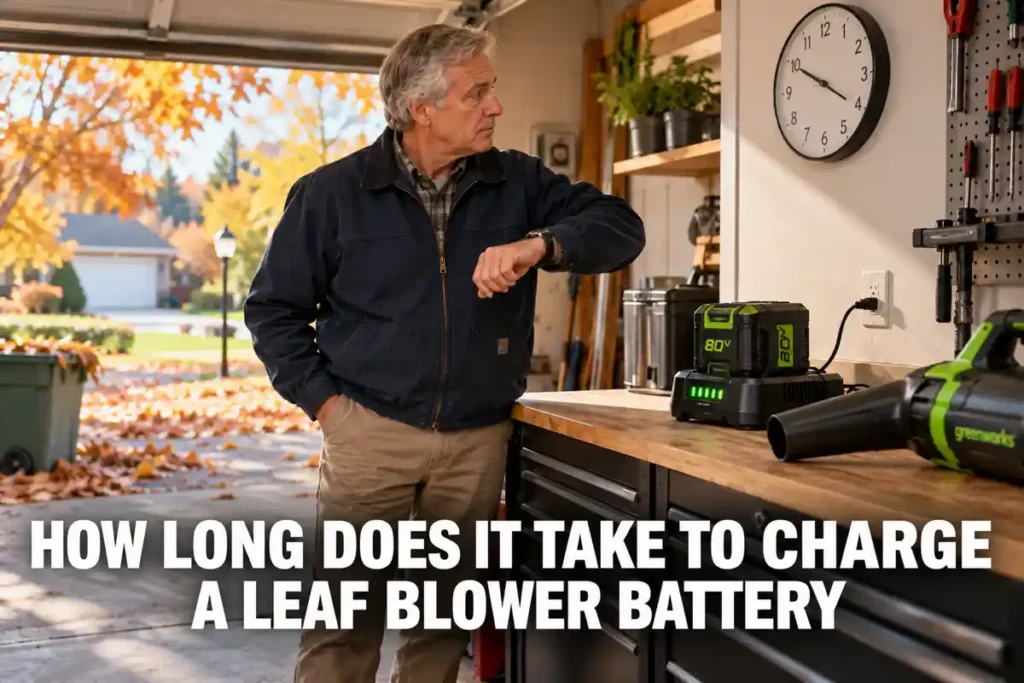
A 4.0 to 5.0 Ah leaf blower battery takes about 25 to 100 minutes to charge on the EGO and DeWalt chargers covered below, and the charger decides more of that spread than the pack does. According to EGO, the same 5.0 Ah pack needs 30 minutes on its Turbo charger and 100 minutes on its Standard one. On leaf Saturdays at our family farm I plan the day in charging minutes as well as blowing minutes, because a pack on the charger is a tool that is not working. Below you get the times by brand, the sum behind them, why a hot or cold pack waits, and how to plan a cleanup around the clock.
How Long Does It Take to Charge a Leaf Blower Battery? The Short Answer
A 4.0 to 5.0 Ah pack fills in about 25 to 100 minutes on those chargers. The short end belongs to the fastest EGO charger and the long end to the standard charger that ships in many kits. By the sum explained below, a basic 2 A charger would need 2 hours for a 4.0 Ah pack and 2.5 hours for a 5.0 Ah one. The same 5.0 Ah pack can take more than three times as long on one charger as on another, so I read the charger’s model number off its case before I trust any chart.
Three things set the time. Amp-hours (Ah) is the size of the tank, charger amps is how fast the charger fills it, and the last stretch of the fill is slower than the rest. Voltage does not set the time: a 40V pack and a 56V pack with the same Ah on the same amps charge for about as long.
EGO Charge Times by Pack and Charger
EGO publishes a full grid of pack sizes against chargers. According to EGO, the 5.0 Ah pack takes 100 minutes on the Standard charger (CH2100), 70 on the 320W charger (CH3200), 40 on the Rapid Charger (CH5500) and 30 on the Turbo Charger (CH7000).
| Pack | Turbo (CH7000) | Rapid (CH5500) | 320W (CH3200) | Standard (CH2100) |
|---|---|---|---|---|
| 2.5 Ah | 30 | 30 | 35 | 50 |
| 4.0 Ah | 25 | 30 | 55 | 80 |
| 5.0 Ah | 30 | 40 | 70 | 100 |
| 6.0 Ah | 35 | 45 | 80 | 120 |
| 7.5 Ah | 45 | 60 | 100 | 145 |
| 10.0 Ah | 60 | 75 | 130 | 190 |
| 12.0 Ah | 75 | 90 | 160 | 230 |
Read across a row for the pack and down a column for the charger. The 2.5 Ah pack takes 30 minutes on both the Turbo and the Rapid chargers, so the Turbo saves that small pack 20 minutes over the Standard charger and saves the 12.0 Ah pack 155.
Charge Times by Brand for Leaf Blower Batteries
Makers call their times approximate, and most count from an empty pack. Where a maker prints only a range, the table shows the range.
| Platform and charger | Pack | Maker’s time |
|---|---|---|
| EGO 56V, four chargers | 2.5 to 12.0 Ah | 25 to 230 minutes (grid above) |
| DeWalt, 4 A charger (DCB115) | 3.0 Ah | 45 minutes |
| DeWalt, 4 A charger (DCB115) | 5.0 Ah | 75 minutes |
| DeWalt, 4 A charger (DCB115) | FLEXVOLT 9.0/3.0 Ah | 135 minutes |
| Milwaukee M18 and M12 Rapid Charger (48-59-1808) | Any M18 pack | 30 to 185 minutes, depending on the pack |
| Ryobi 40V Rapid Charger (OP406A) | Any 40V pack | 1 hour or less on average |
EGO covers the whole range inside one family. The EGO Rapid Charger (CH5500) charges every 56V pack in the grid, and the 320W charger that comes in many kits sits in the middle. A kit that ships with the Standard charger is the slow route for the same pack.
DeWalt prints a table by pack. The DeWalt battery charge time table in the manual for its 4 A charger runs from 45 minutes for a 3.0 Ah pack to 135 for the 9.0/3.0 Ah FLEXVOLT pack. DeWalt also sells a 6 A charger, which finishes sooner.
Milwaukee gives a range. Its manual for the M18 and M12 Rapid Charger says a fully discharged pack in the normal temperature range charges in about 30 to 185 minutes, depending on the pack. That two-bay charger, the 48-59-1808, starts the second pack only when the first is full, while Milwaukee’s 48-59-1815 dual-bay charger charges both packs at once.
Ryobi gives one average instead of a grid. For Ryobi 40V battery charge time, the maker says its 40V Rapid Charger charges 40V packs in an hour or less on average, and the manual adds that the time depends on the pack’s amp-hours.
Greenworks and Makita tie the time to the exact pack and charger pair, so look up your pair on the maker’s page and check it against the sum in the next section.
Why the Leaf Blower Battery Charger Sets the Time
Charge time is roughly amp-hours divided by charger amps, times 60. A bigger tank or a weaker flow means a longer wait. Maker times follow that sum closely, and I run it on paper before I buy a spare pack. Treat it as an estimate and plan with the maker’s own time for your pack and charger.
A Worked Example With Real Numbers
DeWalt prints the amps of its charger, which makes the cleanest check. A 5.0 Ah pack on the 4 A charger works out to 5.0 divided by 4, which is 1.25 hours, or 75 minutes. DeWalt’s own table says 75 minutes.
EGO does not print its charger amps, so work them back from its times. A 5.0 Ah pack that fills in 100 minutes implies a charger averaging about 3 A across the whole charge, and the table shows the other three; these are inferred averages, not ratings EGO publishes. The pack is the same 280 watt-hours on the label in every row, and the wait differs by a factor of 3.3.
| Charger | 5.0 Ah time, maker’s figure | Implied average amps |
|---|---|---|
| Standard (CH2100) | 100 minutes | 3.0 A |
| 320W (CH3200) | 70 minutes | 4.3 A |
| Rapid (CH5500) | 40 minutes | 7.5 A |
| Turbo (CH7000) | 30 minutes | 10.0 A |
The same sum punishes a big pack on a weak charger: according to EGO, the 12.0 Ah pack takes 230 minutes on the Standard charger and 75 on the Turbo Charger.
Pro Tip
Before you buy a spare pack, divide its amp-hours by your charger’s amps and multiply by 60. If the answer is longer than the gap between your jobs, look at a faster charger before a bigger pack, because a bigger pack blows longer but also charges longer.
Why the Last Stretch Runs Slower
A lithium-ion charger pushes a steady current until the pack reaches its top voltage, then holds that voltage while the current falls away. The first 80 percent goes in fast, and the last 20 percent takes a bigger share of the clock than its size suggests.
Makers build the two stages into their lights. EGO’s CH3200 turns its first light solid green at 80 percent while the second light starts to flash, and both go solid at full. Milwaukee’s charger also signals when a pack reaches 80 percent. Every time in the tables runs to the full light, so a pack reaches 80 percent sooner than the table suggests, and on an old, hot or cold pack a real full charge can run a little longer.
Why a Hot or Cold Battery Waits Before It Charges
Every maker names a temperature range for charging. Outside it the charger waits, and it starts again on its own once the pack comes back into range.
| Maker | Range the maker names | What the charger does |
|---|---|---|
| EGO | Pack at 41 to 104 F | Waits with a solid red light; a pack below about 50 F may pulse for the first minute while it warms itself |
| DeWalt | Air at about 40 to 104 F | Pauses with a blinking red light and a yellow light, then resumes by itself |
| Milwaukee | Room at 40 to 105 F recommended (48-59-1807 and 48-59-1815 manuals) | On the 48-59-1808, a fast flashing red light means no charging until the pack is in range |
| Ryobi | Place at 50 to 100 F | A hot or cold pack waits until it has cooled or warmed, then charging starts |
| Greenworks | Air at 45 to 100 F | Shows a solid red light when the pack is too warm; the manual says to let it cool in the charger |
DeWalt adds a warning for cold packs: a cold pack charges at a slower rate through the entire cycle and does not return to the full rate even after it warms up.
What Cold Charging Does to a Lithium-Ion Pack
The cold limit has a physical reason. According to OSHA, charging a lithium-ion battery below freezing, 32 F, can leave a permanent build-up of metallic lithium on the anode, called plating, which raises the risk of failure (1). In laboratory cells, lithium metal deposited on the anode at 4 F below zero or colder and caused a permanent loss of capacity, even at modest charge rates (2). That test ran far colder than a shed, so read it as an explanation of the risk, not as a forecast for your pack.
A review of fast charging research treats low-temperature charging as a problem of its own, and it names cooling the pack during charging and preheating it in cold weather as critical (3). The makers’ windows all start well above freezing.
On frost mornings I bring the pack into the house and let it reach room temperature before it goes on the charger. After a hard run I set the warm pack in the shed’s shade first, because a pack left in the sun or in a hot truck waits, and heat is hard on it. A mistake I see often is a frozen pack put straight on the charger, with the owner waiting for the charging light to start.
What Leaf Blower Charger Lights Mean
Every maker uses one pattern for charging, another for full, a separate signal for too hot or too cold, and a fourth for a fault. The patterns differ between makers, so read the row for your own charger and never judge one brand by another’s.
| Charger | Charging | Full | Too hot or cold | Fault |
|---|---|---|---|---|
| EGO CH3200 | Light 1 flashes green; at 80 percent light 1 turns solid and light 2 flashes | Both lights solid green; the fan stops | Light 2 solid red | See the manual |
| DeWalt DCB115 | Red blinks | Red stays on | Red blinks with a yellow light | Charger will not light for a faulty pack |
| Milwaukee 48-59-1808 | Solid red; slow flashing green near full | Solid green, then flashing green in maintenance | Fast flashing red | Flashing red and green |
| Ryobi OP406 | Green flashes | Green stays on | Red or orange and green on together | Red and green both flashing |
EGO battery charger lights add a separate 80 percent step, and the manual for your own charger wins over this table.
How Fast Charging Affects a Leaf Blower Battery
Faster charging adds heat, and heat counts against a pack’s cycle life. A modeling study, checked against measurements on five fast-charge scenarios, predicted shorter cycle life as the accumulated heat from charging rose (4). A review of the field adds that high charging currents are known to speed up capacity and power fade (3), and a lab study on a commercial cell describes lithium plating as one of the main reasons for capacity fade in cold and fast charging (5).
These are lab and modeling results, not tests of tool packs, so they show which way the effect runs and not how many seasons it costs you. They are no reason to avoid a rapid charger, because makers sell their rapid chargers for their own packs: EGO’s CH7000, for example, monitors each cell’s charge and temperature and runs a cooling fan. I use the maker’s rapid charger when a pack has to be ready the same day and the standard charger overnight, when speed does not matter.
Charging Safety
Charge the packs of a rechargeable battery leaf blower indoors on a hard, dry surface with the charger’s vents clear. The makers’ manuals ask for a dry, indoor spot and say not to charge a cracked, swollen or heat-damaged pack. Use only the charger the maker names for the pack.
How to Plan a Leaf Cleanup Around Charging
Charging time matters only against blowing time. An EGO LB7654 with a 5.0 Ah pack runs about 22 minutes on high, and according to EGO the figure is about 25, so the sums below use the lower one. On the lower speeds a pack lasts far longer, and charging stops being the limit.
How Many Packs You Need
- Divide the length of the job by the minutes one pack blows at your speed, and round up. One hour on high with the 22-minute pack takes 3 packs.
- Count how many of those packs start the job fully charged.
- Every pack that does not start charged has to come off the charger during the job. Multiply that count by your charger’s time for one pack, because a single-port charger fills one pack at a time.
- If that total is longer than the job, the charger cannot keep up. Start with more charged packs or use a faster charger.
| Charger | Charge time | Charging minutes per blowing minute |
|---|---|---|
| Standard (CH2100) | 100 minutes | 4.5 |
| 320W (CH3200) | 70 minutes | 3.2 |
| Rapid (CH5500) | 40 minutes | 1.8 |
| Turbo (CH7000) | 30 minutes | 1.4 |
On high, even the Turbo charger needs longer to refill a pack than the pack lasts, so a two-pack rotation still waits about 8 minutes at each swap. On the 320W charger one port refills one pack in the time the blower empties about three, so a long job on high runs on the packs that started full, not on the charger.
Why the Charger in the Box Matters
A cordless leaf blower with battery and charger in one box usually brings one pack and one charger, and that charger is often the slow one. A bare tool brings neither pack nor charger, so count both when you count the cost. When I compare kits I look at the charger in the box first.
A bigger pack and a faster charger do different jobs. Added capacity blows longer per swap but charges longer too: on EGO’s 320W charger the 10.0 Ah pack takes 130 minutes against 70 for the 5.0 Ah, so the ratio of charging to blowing barely moves. A faster charger lowers that ratio, which helps most over a long day, while a bigger pack helps most on one finite job. I treat the box charger as part of the tool’s price: a slow one turns a second pack from a luxury into a need.
Blowers that take two packs at once, such as Milwaukee’s dual battery model and Makita’s twin 18V model, need two charges per session, and a single-port charger fills them one after the other. Two 5.0 Ah EGO packs on the 320W charger take about 140 minutes that way.
How I Run a Leaf Saturday
On a leaf Saturday I work with three packs. The spent pack goes straight onto the charger and a charged one goes onto the tool. At lunch the pack I just emptied sits on the charger, and on a 70-minute charger an hour gets it most of the way full. The third pack is what turns charging from waiting into a lunch break.
Charge Every Pack the Night Before
Three things to remember. The charger sets the time, so read its model number before you read any chart. A hot or cold pack waits until it is back in its range, so give it time to reach room temperature. Two packs on one single-port charger take twice as long as one.
My routine is to charge every pack the night before, all three of them. On the 320W charger that comes to about 210 minutes one after the other, which is nothing overnight and far too long to wait out on the morning of a job. The leaf blower guides cover the blowers these packs power. Know how long your leaf blower battery needs on its charger, and you can build the whole cleanup around it.
Frequently Asked Questions
Can you overcharge a leaf blower battery?
You cannot overcharge a leaf blower battery on the charger its maker names, because the charger ends the charge when the pack is full. DeWalt says a pack may stay in the charger once the red light holds steady, and Milwaukee says leaving a pack plugged in causes no damage. EGO asks you to wait for the charger fan to stop before you pull the pack.
How long does a DeWalt battery take to charge?
A DeWalt battery takes about 75 minutes to charge when it is a 5.0 Ah pack on the 4 A charger, according to DeWalt’s manual for that charger. The same table lists 45 minutes for a 3.0 Ah pack and 135 minutes for a 9.0/3.0 Ah FLEXVOLT pack. DeWalt’s 6 A charger finishes sooner.
How long does a Ryobi battery take to charge?
A Ryobi battery takes an hour or less to charge on the Ryobi 40V Rapid Charger, on average, according to Ryobi. The time rises with the pack’s amp-hours, so a small pack finishes sooner than a large one. Ryobi’s manual says not to charge in a place below 50 F or above 100 F, and a hot or cold pack waits until it is back in range.
How long does a Milwaukee battery take to charge?
A Milwaukee battery takes about 30 to 185 minutes to charge on the M18 and M12 Rapid Charger (48-59-1808), depending on the pack, according to Milwaukee’s manual. That two-bay charger starts the second pack only when the first is full, so two packs charge one after the other. Milwaukee adds that hot or cold packs may take longer.
How long does a Makita battery take to charge?
A Makita battery takes the time Makita lists for its pack and charger pair, which comes down to the pack’s amp-hours and the charger’s amps. As a sum, amp-hours divided by amps, times 60, gives the main stretch, so a 4.0 Ah pack on a 4 A charger works out to about 60 minutes before the slower finish. A hot or cold pack waits for its range first, as it does on every other brand.
References
- Occupational Safety and Health Administration. Preventing Fire and/or Explosion Injury from Small and Wearable Lithium Battery Powered Devices. Safety and Health Information Bulletin SHIB 06-20-2019. US Department of Labor; 2019.
- Lin H-p, Chua D, Salomon M, et al. Low-Temperature Behavior of Li-Ion Cells. Electrochem Solid-State Lett. 2001;4(6):A71.
- Tomaszewska A, Chu Z, Feng X, et al. Lithium-ion battery fast charging: A review. eTransportation. 2019;1:100011.
- Koo B, Yi J, Lee D, Shin CB, Park S. Modeling the Effect of Fast Charge Scenario on the Cycle Life of a Lithium-Ion Battery. J. Electrochem. Soc. 2018;165(16):A3674-A3683.
- Koleti UR, Rajan A, Tan C, Moharana S, Dinh TQ, Marco J. A Study on the Influence of Lithium Plating on Battery Degradation. Energies. 2020;13(13):3458.
Safety Note: Leaf blowers throw debris and can damage your hearing. Wear eye and ear protection, read the manufacturer’s manual, and check your local rules on noise and operating hours.