
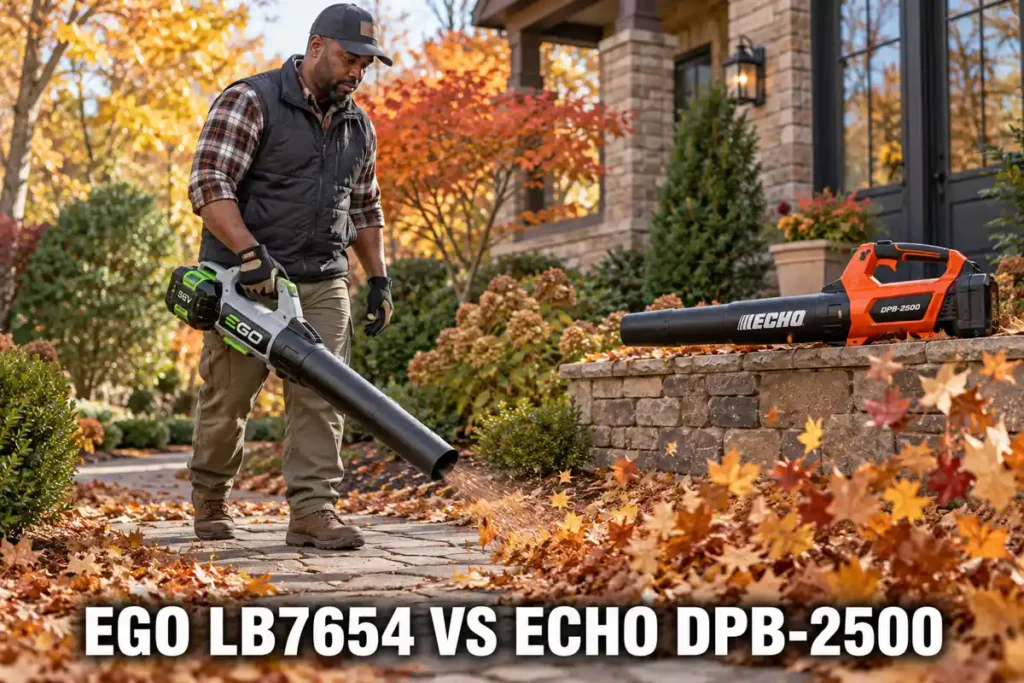
The EGO LB7654 vs Echo DPB-2500 choice has a clear answer for most yards: take the EGO, which is rated at 26 N of blowing force against the ECHO’s 17 N and weighs the same in the hand. The ECHO wins on light, dry work and for buyers who already own ECHO batteries. Most of my own blowing is the quarter-acre house lawn and the paths around it, not orchard rows, so I know how much blower a small yard really needs. Below I compare the two 56V kits on contents, force, runtime, weight and noise, then match each one to a kind of yard.
Affiliate Disclosure: Garden Power Scout is a proud participant in the Amazon Services LLC Associates Program. As an Amazon Associate, we earn from qualifying purchases, at no extra cost to you.
EGO LB7654 vs Echo DPB-2500 Short Answer
Buy the LB7654 if your leaves are wet or matted, or you want the stronger stream. The ECHO fits you if you mostly clear dry leaves, clippings and dust from a deck and walkways, or you already own ECHO 56V batteries. One naming point: the DPB-2500 is the blower and the R2 is the kit with a 5.0 Ah battery, so the R2 is the kit I compare with the LB7654, which also holds one 5.0 Ah battery. Each figure in the table says whose it is.
| Spec | EGO LB7654 kit | ECHO DPB-2500R2 kit |
|---|---|---|
| In the box | LB7650 blower, one 5.0 Ah battery, CH3200 charger, tapered and spread nozzles; EGO also lists a strap | DPB-2500 blower, pipe, one concentrator nozzle, one 5.0 Ah battery; ECHO lists a Rapid Charger for this kit; no strap |
| Maximum airflow, maker’s figure | 765 CFM on boost | 549 CFM |
| Air speed, maker’s figure | 195 mph with the tapered nozzle | 158 mph |
| Maximum blowing force, maker’s figure | 26 N | 17 N |
| Battery in the kit | 5.0 Ah, about 280 Wh | 5.0 Ah, about 252 Wh |
| Run time on the kit battery, maker’s figures: low, high, boost | 150, 25 and 15 min | 180, 30 and 18 min |
| Charge time | About 70 min on the CH3200 | About 75 min with ECHO’s rapid charger |
| Weight with the kit battery fitted | About 9.6 lb | 9.5 lb |
| Controls | Trigger, lock-on dial, boost button held down | Trigger, cruise lever, turbo button that latches |
| Weather | IPX4 splash rating | No rating; the manual says keep it out of rain |
| Homeowner warranty | 5 years on the tool, 3 on the battery and charger | 5 years on the tool, 2 on the battery and charger |
| Noise | No US rating published | No US rating published |
Two rows decide it: the force row, where the EGO leads by 9 N, and the runtime row, where the ECHO’s lighter power draw earns it a few extra minutes.
What Comes in Each Kit
Each blower runs only on its own maker’s 56V batteries, so the kit you buy also picks your battery family for the trimmer, saw or mower you add later. A pack from one brand will not fit the other brand’s tool.
The EGO LB7654 Kit
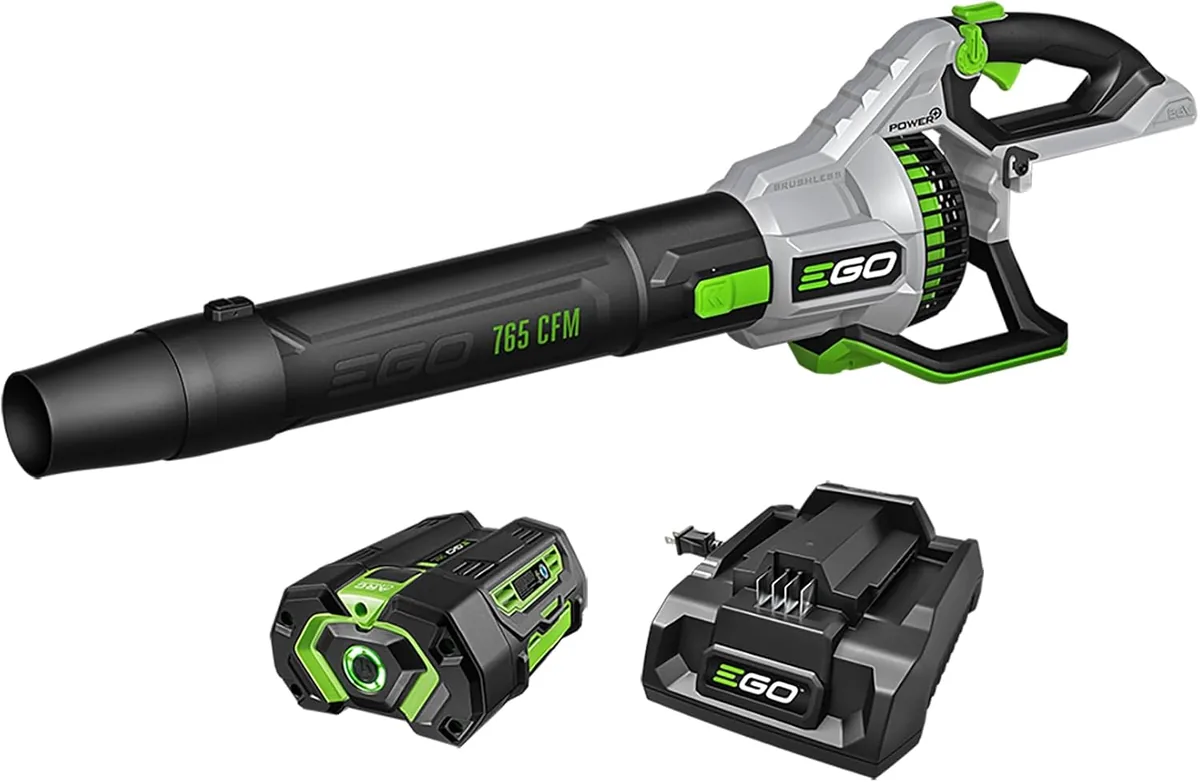
The EGO Power+ LB7654 765 CFM Blower Kit is the EGO 765 blower with battery and charger: the LB7650 blower, one 5.0 Ah battery with a five-light fuel gauge, the 320 W CH3200 charger, a tapered nozzle and a spread nozzle. According to EGO, the kit also includes a shoulder strap.
The Echo DPB-2500 Kit
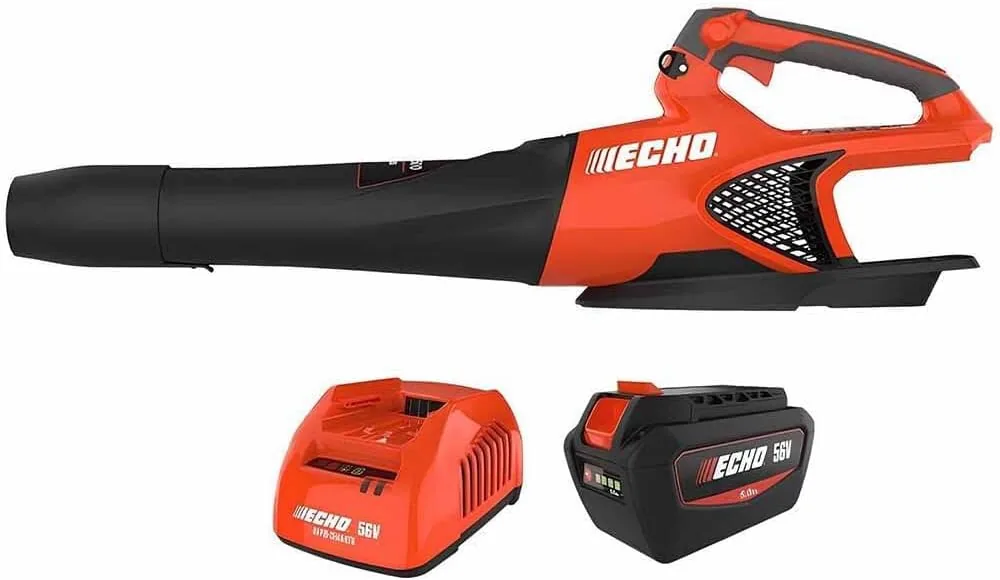
ECHO sells the Echo DPB-2500 in three versions: the DPB-2500BT bare tool, the C1 kit with a 2.5 Ah battery and the R2 kit with a 5.0 Ah battery. The ECHO eFORCE DPB-2500R2 56V Blower Kit is the R2, and it is the fair match for the LB7654, because the C1 weighs 7.7 lb and runs about half as long. According to ECHO, the ECHO DPB-2500 charger in the R2 kit is the Rapid Charger, and the box holds a pipe and one concentrator nozzle but no strap.
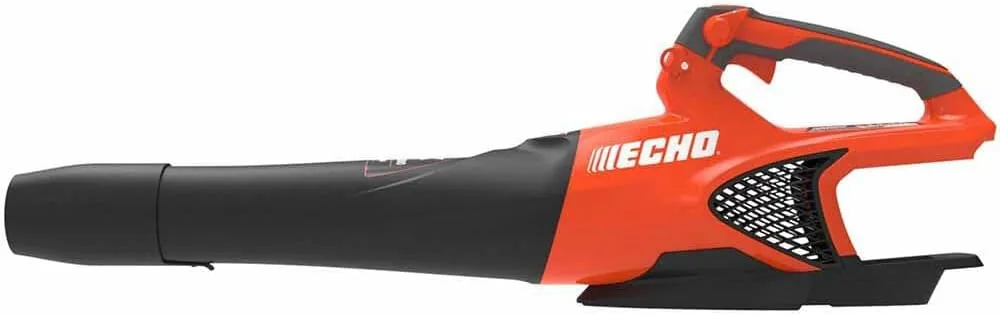
Owners of a 56V battery can skip the kit. The DPB-2500BT is the bare tool for people with ECHO packs, and the LB7650 is the EGO 765 blower tool only, for people with EGO packs. Read the listing for the words tool only, since a bare tool arrives with no battery and no charger.
Airflow, Air Speed and Blowing Force
CFM is the volume of air leaving the tube, mph is how fast it leaves, and newtons combine the two into the push you feel at the nozzle. One newton is about 0.225 pounds, so 26 N is about 5.8 pounds of push and 17 N is about 3.8.
The EGO 765 blower reaches 765 CFM on boost, and its air leaves at 195 mph through the tapered nozzle. According to ECHO, its blower reaches 549 CFM at up to 158 mph. Makers tend to rate CFM with the nozzle off and top speed with it on, so neither column describes one working stream, and force is the fairer comparison.
In force the EGO leads by about 50 percent. With the kit battery, the EGO delivers about 25 N on boost and about 16 N on high, so ECHO’s 17 N maximum is about what the EGO gives on its high setting, and the EGO still has boost in reserve.
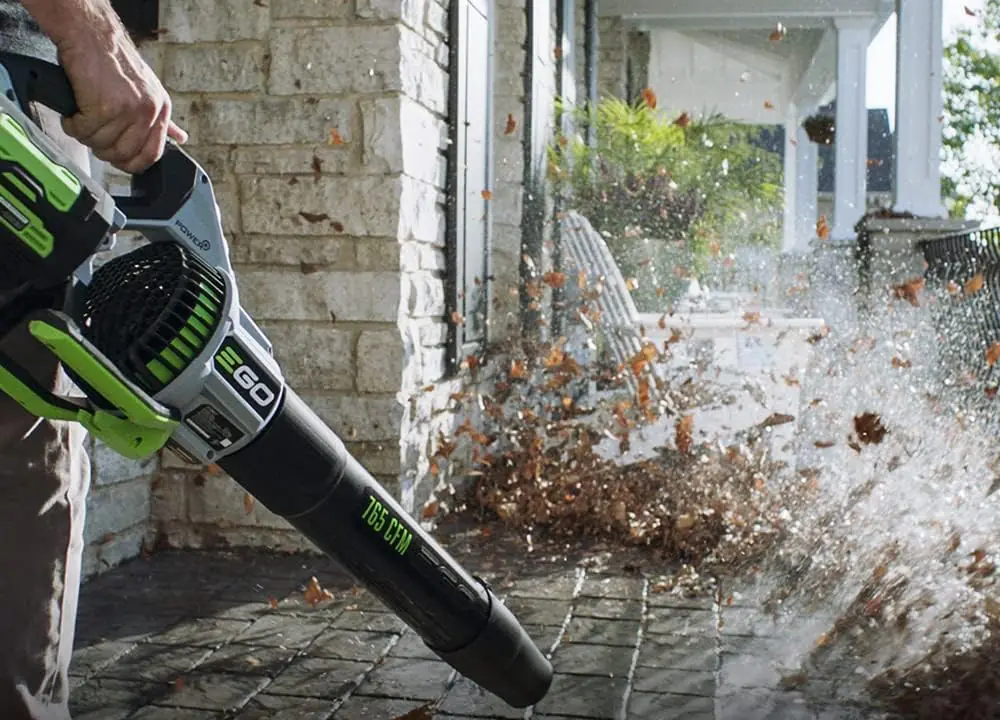
The gap shows on wet leaves. After a rainy week the shade trees leave leaves flat on the strip where my lawn meets the concrete path, and they lie like a wet towel. The EGO on boost, aimed low under the edge of the mat, lifted it and rolled it back, while the ECHO slid the top layer and left the wet underside stuck to the concrete.
Dry work is another story. After a mow, the clippings and dust on the 4-foot path to the house door need little force, and the ECHO at a low locked speed swept them clear. That job never asks for 765 CFM.
Winner: EGO LB7654, because it has the force for wet leaves and packed gravel that the ECHO lacks.
Battery, Runtime and Charging
The Echo DPB-2500 battery in the R2 kit is a 5.0 Ah pack with about 252 Wh on its label, 10 percent less than the EGO’s 280 Wh. Even so, the makers give the ECHO more minutes at every setting: EGO’s manual lists 150 minutes on low, 25 on high and 15 on boost, and according to ECHO its pack runs 180, 30 and 18.
The ECHO lasts longer because it draws less power. On high the ECHO draws less power than the EGO because it moves less air, so its smaller pack stretches further.
Compare One Setting
EGO’s page says up to 90 minutes without naming a speed, and ECHO’s says up to 180 on low. Compare one setting instead: two hours of high-speed blowing takes about four ECHO packs or five EGO packs.
On a long job I press the EGO’s gauge button before the last pass. ECHO’s four-light gauge is coarser, since three lights covers anything from 55 to 79 percent, so I treat it as a fuel warning more than a meter.
Charging is a tie. According to the makers, the CH3200 fills the EGO pack in about 70 minutes, and with ECHO’s rapid charger the R2 pack fills in about 75. Either way you wait over an hour for a refill, so a long job needs a second pack in the plan.
Cold matters in late autumn. According to EGO, its blower runs from 5 F, while ECHO’s manual sets 32 F as the lowest temperature to operate it, so on a frost morning I bring the pack in from the shed before I start.
Heat and charge level age a pack too. A modeling study of lithium-ion cells stored for 36 months at 131 F and a 90 percent charge found heavy degradation inside the cell (1), and cell tests found that depth of discharge and the charge window change how fast capacity fades (2). ECHO’s manual says to store a pack for more than three months at three green lights in 60 to 80 F, and EGO’s battery manual asks for 50 to 80 F, so keep spare packs indoors in summer.
Winner: ECHO DPB-2500, with 5 more minutes on high and 30 more on low from a pack that holds 10 percent less energy.
Weight, Balance and Controls
With the 5.0 Ah pack fitted, the Echo DPB-2500 blower weighs 9.5 lb according to ECHO, and the LB7654 comes to about 9.6 lb by EGO’s manuals, 4.6 lb for the blower plus 4.96 lb for the battery. The stronger EGO is not the heavier kit. Carried side by side, the two felt the same in my hands.
Hands tire from more than weight. In a study of 17 groundskeepers, handheld blowers sat near the low end of tool vibration, about 2 m/s2, yet the workers’ lifetime hand-arm vibration dose ran about 30 times that of office workers (3). A homeowner blows far less, and short sessions with a hand swap cost nothing.
The EGO locks any speed with its dial, so on the path job my trigger finger rests. Its boost works only while you hold the button, so the thumb stays on it for the whole burst. One quirk looks like a fault the first time: if the dial is not back at off when you pull the battery, the blower needs one trigger pull to wake up with a fresh pack.
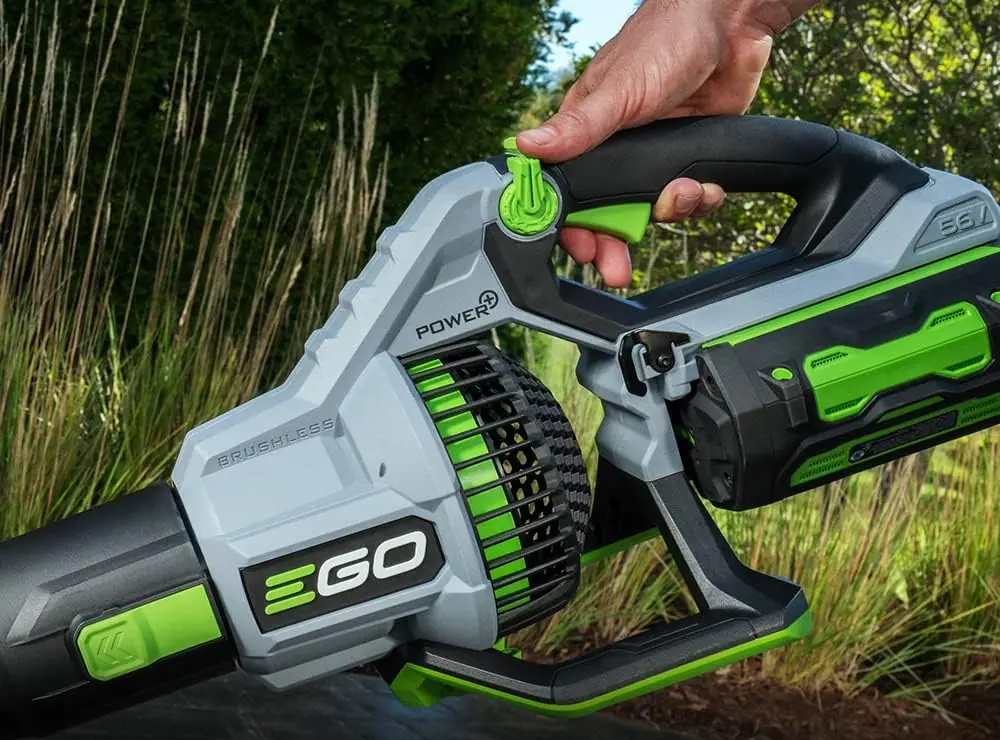
The ECHO’s cruise lever locks a speed too, and its turbo latches on until you press the button again, which spares the thumb on a stubborn clump of dried clippings. Its single concentrator nozzle throws a narrow stream, and I missed the EGO’s spread nozzle when I swept a wide strip of lawn.
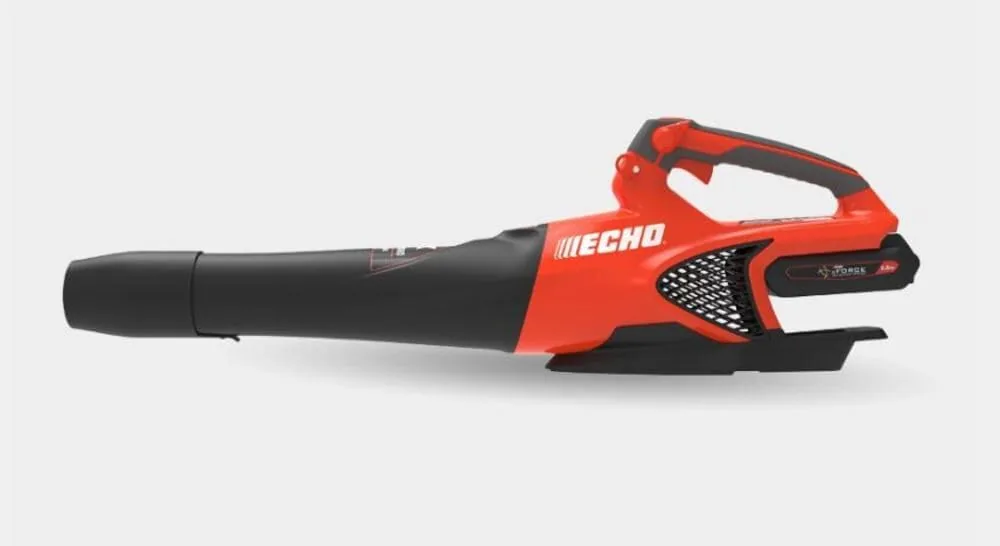
The boxes and weather ratings differ as well. The EGO adds a second nozzle and an IPX4 splash rating, and according to EGO the kit includes a strap. ECHO’s manual says to keep its blower out of rain, so I leave it in the shed on drizzle mornings.
Winner: EGO, narrowly, for the second nozzle and the splash rating, while the ECHO’s latching turbo is the one handling point in its favor.
Noise and Hearing Protection
Neither maker publishes a US noise rating for these kits, so I name no louder or quieter blower here. Both manuals tell you to wear hearing protection, and I put ear defenders on before the first trigger pull with either one, because both whine at the top of the dial.
A battery blower is quieter than a gas one and still needs ear protection. A NIOSH study of 80 landscaping workers found 94 of 119 shift-long noise results at or above the 85 dBA limit, and fuel-powered blowers gave significantly more noise and carbon monoxide than battery versions (4).
Protection only works when it fits. A Cochrane review notes that poor earplug fit may limit protection for about 40 percent of users (5), so seat earplugs as the instructions say or wear muffs.
Protect Your Ears, Eyes and Bystanders
Wear ear and eye protection with either blower. EGO’s manual sets bystanders and pets 50 ft away, and I keep the same distance with the ECHO.
Winner: none, because neither maker publishes a US noise rating.
Which Yard Needs Which Blower
Pick by the hardest job your yard gives you, since that is the job the weaker blower cannot finish.
- A small to medium yard, mostly dry: either blower works, and the ECHO’s longer pack life suits a deck, a patio and walkways.
- Wet or matted leaves: the EGO, because its boost and 26 N lift a wet mat that the ECHO only slides.
- Gravel edges and packed debris: the EGO, since ECHO’s 17 N maximum is what the EGO gives on high.
- Frost mornings: the EGO, which EGO rates from 5 F, while ECHO’s manual sets 32 F as its lowest operating temperature.
- Existing 56V tools: the brand whose batteries you already own, because a spare pack costs a large share of a kit.
If the hardest job on your list is wet leaves or gravel, the ECHO is the wrong tool. If it is dry clippings and dust, the EGO’s extra push goes unused.
Choose the LB7654 If
Choose the LB7654 if you want the extra push at the same carried weight.
- Your leaves lie wet or matted, or you clear gravel edges and packed debris.
- You want boost for stubborn spots and accept its short runtime of 15 minutes.
- You want two nozzles and a splash rating.
- You own EGO 56V tools or work on cold mornings.
Skip it if your work is dry and light, because the ECHO does that job with 30 minutes on high.
Its IPX4 splash rating covers a damp lawn, and its battery carries a 3-year warranty against ECHO’s 2.
Choose the Echo DPB-2500 If
Choose the ECHO if your yard is small and dry and you value a long, mild run.
- Your work is dry leaves, clippings and dust on a deck, patio or walkways.
- You want 30 minutes on high, 180 on low and a turbo button that stays on.
- You already own ECHO eFORCE 56V tools, so one pack serves them all.
Skip it if the leaves are wet, the gravel is packed, you want a strap or a spread nozzle in the box, or you work in drizzle or below freezing.
According to ECHO, one pack runs 180 minutes on low, enough for a deck, a patio and walkways without a recharge.
My Pick Between the Two
The EGO is the stronger tool at the same carried weight, and I recommend it to anyone with wet leaves or gravel. Both kits weigh about 9.5 lb with their packs, so the choice rests on force and runtime, not on carrying comfort.
The ECHO DPB-2500 is a mild, long-running blower for dry decks, paths and lawns, and it earns its place when you already own ECHO batteries. Neither blower is built for hours of work on a big lot, and the leaf blower guides cover larger tools. Pick by the wettest job on your property, and the EGO LB7654 vs Echo DPB-2500 choice settles itself.
Frequently Asked Questions
Is ECHO a good blower?
The ECHO DPB-2500 is a good blower for dry leaves, clippings and hard surfaces, with a mild stream and a long pack life. It is rated at 17 N of force against the EGO LB7654’s 26 N, so it struggles with wet, matted leaves and packed gravel, where the stronger EGO is the better pick.
Is it better to have more mph or cfm in a leaf blower?
Neither number decides it alone, because newtons combine air volume and air speed into the push you feel at the nozzle. For this pair the EGO’s 26 N against the ECHO’s 17 N is the better guide to how each handles wet leaves, gravel and stuck debris on a real yard.
How loud is an electric leaf blower in decibels?
An electric leaf blower is loud enough to need hearing protection, and neither maker of these two publishes a US decibel rating, so I will not quote a number. Both manuals require ear protection, so wear earplugs or muffs from the first trigger pull and keep bystanders and pets well back.
How long does the Ego 765 battery last?
The 5.0 Ah battery in the EGO LB7654 kit lasts about 150 minutes on low, 25 on high and 15 on boost, according to EGO’s manual. ECHO’s 5.0 Ah pack runs 180, 30 and 18 minutes on the same settings, because the ECHO moves less air and draws less power.
Which is better, a gas or an electric leaf blower?
Electric is better than gas for most homeowners with these two 56V kits, because they start with a trigger, need no fuel mix and run quieter than a gas blower. A gas backpack blower makes more sense if you clear large grounds in one long session and need hours of runtime.
References
- Asiri M, Kedhim M, Jain V, et al. Impact of temperature and state-of-charge on long-term storage degradation in lithium-ion batteries: an integrated P2D-based degradation analysis. RSC Adv. 2025;15(28):22576-22586.
- Gauthier R, Luscombe A, Bond T, et al. How do Depth of Discharge, C-rate and Calendar Age Affect Capacity Retention, Impedance Growth, the Electrodes, and the Electrolyte in Li-Ion Cells?. J. Electrochem. Soc. 2022;169(2):020518.
- Chen N, Yang S, Oh J. Evaluation of hand-arm vibration (HAV) exposure among groundskeepers in the southeastern United States. Annals of Work Exposures and Health. 2025;69(1):81-95.
- Alexander BM, Graydon PS, Pena M, Feng HA, Beamer BR. Hazardous exposures and engineering controls in the landscaping services industry. Journal of Occupational and Environmental Hygiene. 2025;22(3):189-202.
- Morata TC, Gong W, Tikka C, Samelli AG, Verbeek JH. Hearing protection field attenuation estimation systems and associated training for reducing workers’ exposure to noise. Cochrane Database of Systematic Reviews. 2024;5(5):CD015066.
Safety Note: Leaf blowers throw debris and can damage your hearing. Wear eye and ear protection, read the manufacturer’s manual, and check your local rules on noise and operating hours.