
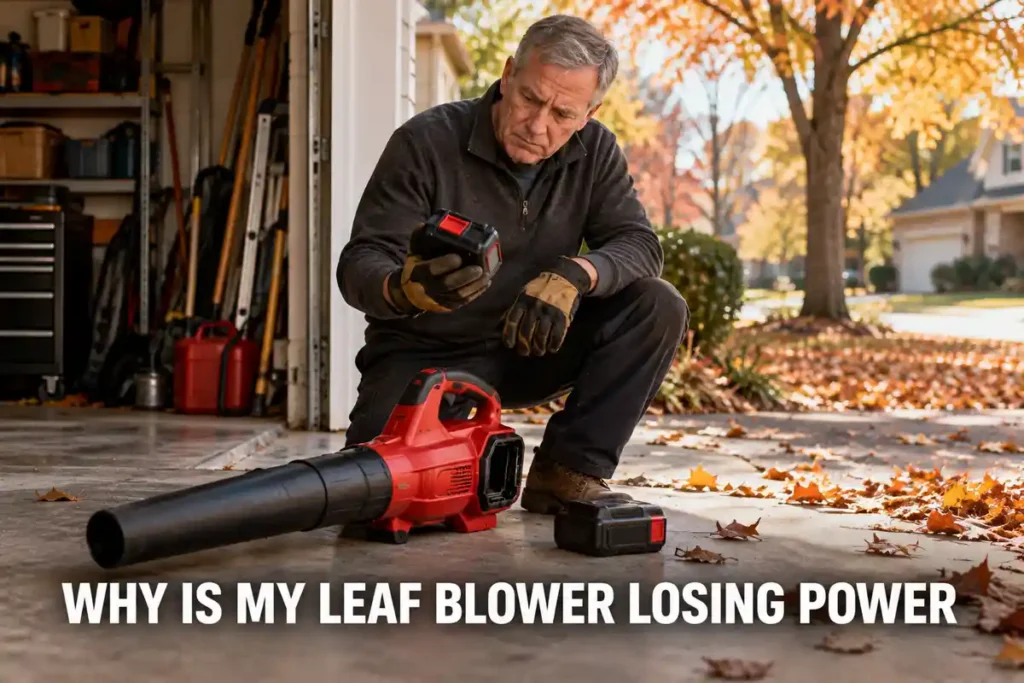
A leaf blower loses power when its fan gets less air, less speed or less energy than it needs. On a gas blower the usual cause is a blocked air, fuel or exhaust path, on a battery blower a cold or worn pack, and on a corded blower a long, thin extension cord.
When flow drops at my irrigation pump head, I look at the 150-mesh disc filter before anything else, and I treat a weak blower the same way: cheapest check first. Below are the checks for gas, battery and corded blowers, the safety steps, and the point where you call a dealer.
Why Is My Leaf Blower Losing Power? The Short Answer by Type
A blower is a fan on a power source, and power loss means the fan gets less air, speed or supply. Gas blowers lose it in the air, exhaust or fuel path, battery blowers in the pack, and corded blowers in the cord.
A leaf blower loses power at full throttle most often on a gas model with a partly blocked air or exhaust path. Full throttle asks the engine for the most air and fuel, so a restriction shows up there first while idle can still sound normal.
Change One Thing at a Time
Work through your type in order and stop at the first fix that works. I change one part per check, because a new filter, a new plug and fresh fuel installed together never tell you which one mattered.
Safety Before You Open Anything
Every check below starts with one rule. Make the blower unable to start before your hands go near the intake, the fan or the muffler.
- Gas: Stop the engine and let it cool, since the muffler stays hot after a run. Disconnect the spark plug lead. Keep fuel away from heat, and never run a gas blower in a closed shed, because the exhaust carries carbon monoxide.
- Battery: Switch off and take the pack out before you touch the intake, the fan or the tube.
- Corded: Unplug at the wall, not only at the tool, and wait for the fan to stop.
I pull the plug lead first even on a blower I use every week, and I carry a gas blower out of the machinery shed for a test run, never the other way round.
Gear for Every Check
Wear safety glasses and gloves for every check. For a gas test run, wear earplugs and earmuffs together from the first second, add a dust mask on dusty ground, refuel only with the engine stopped and cool, and keep people, pets and windows out of the air path.
Check the Intake and the Tube First (All Types)
According to Husqvarna, a blocked air intake is the most common cause when a blower loses power while running, and a clogged spark arrestor is the most common cause when it will not reach full throttle. The intake and the tube cost nothing to check, so they come first.
- Intake screen: Clear leaves, grass and dust by hand or with a soft brush. Husqvarna’s 580BTS manual says a clogged intake reduces blowing force and raises engine temperature, which can end in engine failure.
- Tube and nozzle: Look through the tube for packed twigs or wet leaves, and push the tube and nozzle fully home.
- Speed setting: A dial or lever left low looks like power loss, so check where yours sits.
After pruning week, the sawdust and chaff in my machinery shed load an intake screen faster than anything else, so I look there first. If your gas leaf blower bogs down when hot, suspect airflow around the engine: Husqvarna’s 580BTS manual says the engine runs hot when the cooling fins and the intake screen are dirty, and asks you to brush them clean weekly.
Gas Leaf Blower Losing Power Checks, Cheapest First
A gas blower needs clean air in, a clear way out for the exhaust, fresh fuel and a good spark. Work down the table from the top, because the cheap and safe checks come first.
| Order | Symptom | Likely cause | Fix |
|---|---|---|---|
| 1 | Weak all the time, engine runs hot | Blocked intake screen or packed tube | Clear it by hand or with a soft brush |
| 2 | Sluggish after dusty or sawdust jobs | Dirty air filter | Foam: wash and dry fully, and oil it only if your manual says so. Paper: replace |
| 3 | Bogs when you open the throttle, idles fine | Clogged spark arrestor screen | Brush the screen once the muffler is cool; replace it if damaged |
| 4 | Surging, rough running, hard starting after storage | Old or wrong mix | Drain it and refill with fresh mix at the maker’s ratio |
| 5 | Starves after running a while | Plugged fuel filter or a hardened, cracked fuel line | With the engine off and cool, look at the filter in the tank and the lines. Replace a dirty filter; a cracked or leaking line goes to the dealer |
| 6 | Misfires, weak, hard to start | Worn or fouled spark plug | Fit the plug your manual names |
| 7 | Still weak with fresh fuel and clean filters | Gummed carburetor or a worn engine | Dealer job |
Air Filter and Spark Plug Checks
The Husqvarna 580BTS manual describes a two-stage filter: wash the foam in warm soapy water, make sure it is dry before you refit it, and replace the paper filter. ECHO’s PB-9010T manual says to wash the foam pre-filter in detergent water, squeeze it dry and not oil it. Some other foam filters are oiled as their maker instructs, so follow your own manual. Refit a washed foam filter only when it is fully dry.
On my old gas handheld, a filter loaded with shed dust cost me a wash and a tap on the bench, not a new part. The plug is just as quick to read: the ECHO PB-9010T and the Husqvarna 580BTS both call for an NGK CMR7H with a gap near 0.65 mm (0.026 in). Other blowers use other plugs, so read your manual.
Clean the Spark Arrestor Screen
The spark arrestor is a small screen in the muffler that keeps sparks inside the exhaust. When carbon clogs it, the exhaust cannot leave freely and the engine works against itself. That is why a leaf blower bogs down when throttle is pressed hard and recovers when you ease off.
ECHO’s manual says continuous low speed builds carbon on the screen, and asks for at least 5 minutes wide open every hour. Running on low all day clogs it. On quiet jobs near my young drip lines I keep the throttle low for long stretches, so I open it up for a few minutes every hour, as the manual asks.
- Stop the engine, let the muffler cool fully and disconnect the spark plug lead.
- Remove the exhaust duct and clean the screen with a wire brush, as Husqvarna’s 580BTS manual describes. Replace the screen if it is damaged.
- Refit the screen and the duct before the engine runs again.
Old Fuel, Wrong Mix and Ethanol
Two-stroke mix ages. ECHO’s and Husqvarna’s manuals both say to mix no more than 30 days of fuel, and ECHO allows 90 days with a stabilizer. Old mix is a common reason a leaf blower bogs down at the wrong moment after weeks in the shed, because stale fuel gums the filter and the jets. The worst case I had was an engine that bogged and surged after a long idle on old mix, and the sound changed before the power did.
The ratio is 50:1, roughly 2.5 fl oz of oil per US gallon of gasoline. Too lean wears the engine and too rich fouls the plug, so I measure with a mixing bottle instead of guessing at the can.
Both manuals allow at most 10 percent ethanol (E10), and ECHO adds no E15, no E85 and no methanol. In a US Department of Energy test of 28 small engines, a leaf blower among them, the engines ran leaner and hotter as ethanol went up, and exhaust temperatures were 20 to 70 degrees C (36 to 126 F) higher on E20 than on plain gasoline (1).
When a Leaf Blower Bogs Down at Full Throttle
Idle asks the engine for very little air and fuel, and full throttle asks for the most. A partly blocked filter, screen, fuel filter or jet can let the engine idle cleanly and then starve it when you open up.
ECHO’s manual lists the fuel filter for inspection every three months and replacement every year, so an overdue filter is a cheap suspect. If a fresh filter, a clean screen, fresh mix and a new plug change nothing, the leaf blower carburetor is next. ECHO’s manual lets the owner adjust only the idle speed, so I leave the rest of the carburetor to the dealer.
Battery Leaf Blower Losing Power From Cold, Heat or a Worn Pack
A battery blower blows only as hard as its pack can deliver current. Power loss on a battery blower usually starts in the pack. The sections below cover the worn pack, cold, heat, contacts and the top setting.
Why a Worn or Cold Pack Delivers Less
A lithium-ion pack has internal resistance, and that resistance limits how much current it can hand the motor. One study reports that a battery’s power capability is governed by its resistance, which changes with temperature, state of charge and state of health (2). An aged pack gives less power for that reason, and the gauge can show full bars while the fan sags on High.
Cold does the same from another direction. In lab tests at subzero temperatures, two lithium-ion chemistries delivered less capacity and power because their internal resistance rose (3). Another lab study found substantially reduced energy and power at low temperatures (4). Those were lab cells, not tool packs, but EGO’s pack manual describes the same pattern: below about 50 F a pack may pulse for the first minute while it warms itself.
On cold November mornings the pack spends the night in the house, and my first pass along the hedgerow is a light job while it warms. Never put a frozen pack straight on the charger. EGO’s charger waits until the pack is between 41 and 104 F, and OSHA warns that charging below freezing (32 F) can build permanent metallic lithium on the anode and raise the risk of failure (5).
Heat, Contacts and the Top Setting
Heat is the other limit: a leaf blower loses power when hot, battery or gas. A cell’s internal resistance also decides how much of its energy is lost as heat (6). On the EGO LB7654 pack, five solid red lights mean over temperature.
An intact pack that stopped this way cools down and goes back to work, so take it out, clear the intake as EGO’s troubleshooting chart says, and start again once it has cooled. A pack that is swollen, damaged or leaking, smells, or stays hot at rest is a different case, covered in the dealer list below.
A pack that cuts out when the tool is shaken has a contact problem, and EGO’s chart says to remove the pack, check the contacts and reinstall it.
A pack can also be too small for the top setting, strong for a few seconds and then dropping. Fan power rises with the cube of fan speed, so cutting the speed by 20 percent cuts the fan’s power use by about 50 percent (7). On long alleys I stay on High and keep Turbo for the wet corner by the shed.
Corded Leaf Blower Losing Power From a Long or Thin Cord
A corded blower has no fuel and no pack, so a weak one is usually short of voltage or cooling air. The extension cord is the first suspect. A long or thin cord resists the current, less voltage reaches the motor, and the motor spins slower. Airflow changes in proportion to fan speed (7), so a motor that turns 10 percent slower moves about 10 percent less air.
| Blower | 25 ft | 50 ft | 100 ft | 150 ft |
|---|---|---|---|---|
| BLACK+DECKER LB700 (7 A) | 18 AWG | 16 AWG | 14 AWG | 12 AWG |
| WORX WG520 (12 A) | 18 AWG | 16 AWG | 14 AWG | 12 AWG |
| Toro PowerJet F700 | Not listed | 16 AWG | 14 AWG | 10 AWG |
The makers disagree at 150 ft: Toro asks for 10 AWG where BLACK+DECKER and WORX print 12 AWG. Each table belongs to its own tool, so use the one in your manual, and read the longer column for a length between two. Toro says the cord must never be longer than 150 ft.
The corded blower in my workshop reaches the yard fine, but toward the plum rows the cord runs out before the leaves do, and a thin cord that was just long enough made it feel tired. Use the shortest cord that reaches.
Use an outdoor-rated, polarized cord. Toro’s manual warns that a loose plug can overheat and start a fire, and BLACK+DECKER’s asks you to inspect the cord for bare wire and damaged insulation before every use. BLACK+DECKER says electrical repairs belong to qualified service, and Toro’s manual lists no serviceable parts, so a weak blower with a good cord and a clear intake goes to a dealer.
What Two Popular Manuals Say About Service Intervals
Maker schedules differ, so your own manual’s schedule beats any figure in this guide. These are the service points from two gas backpack blowers’ manuals, with Husqvarna’s support page for the spark arrestor.
| Item | ECHO PB-9010T manual | Husqvarna 580BTS manual |
|---|---|---|
| Spark arrestor screen | Check about every 40 hours | Clean weekly; Husqvarna’s support page says every 50 hours of use |
| Spark plug | Inspect every 3 months | Examined weekly; the manual says to replace it monthly, or more often if necessary |
| Fuel filter | Inspect every 3 months; replace every year | Examine daily; replace if dirty |
| Cooling fins and intake screen | Cooling system inspected and cleaned daily or before use | Cleaned weekly with a brush |
When to Stop and Take It to a Dealer
Some jobs belong on a dealer’s bench, because a wrong move costs more than the visit. Stop when the cheap checks are done and the blower is still weak, or when anything on this list shows up.
- Still weak after the basics: Carburetor cleaning, rebuilds, low compression and a weak ignition coil are dealer work.
- Noise and leaks on a gas blower: Metal-on-metal noise, a pull rope that will not pull, or fuel leaking from the tank, the lines or the carburetor.
- A cracked, bent or damaged fan: Do not run it to find out how bad it is.
- Smoke, a burning smell or a melted cord: Unplug it or remove the pack at once, and do not use it again until a dealer has looked at it.
- A swollen, damaged or leaking battery, one that smells or stays hot at rest, or a charger that misbehaves: Do not charge it and do not use it again. Take it to the dealer or the maker’s recycling route.
OSHA says lithium battery damage can occur from physical impact, temperatures such as above 130 F, or improper charging, and it advises following the manufacturer’s instructions (5). Under warranty, read the terms before you open the tool beyond your manual’s checks.
A Season Routine That Prevents Most Power Loss
Three habits keep a blower strong. Clean the intake and the filter after every dusty job, follow your manual’s schedule for the plug and the spark arrestor screen, and mix only the fuel you will use within 30 days. Keep packs warm on cold mornings and use the shortest, thickest cord that reaches.
For the next step, read the other leaf blower guides on this site. Tape this order to the shed wall, and a leaf blower that has lost power becomes a short check instead of a lost afternoon.
Frequently Asked Questions
Why is my leaf blower not blowing at full power?
A leaf blower that is not blowing at full power is usually short of air, supply or current. Gas models usually have a clogged filter, a clogged spark arrestor screen or old fuel, battery models a worn or cold pack, and corded models a long, thin extension cord. Start with the intake and the tube.
Why does my leaf blower shut off after only 20 minutes of use?
A leaf blower that shuts off after only 20 minutes is usually overheating or running out of supply. Look for a blocked intake or old fuel on a gas engine, over-temperature protection on a battery pack, and the plug seat and cord gauge on a corded model. Let it cool and clear the intake before you restart.
Why does my leaf blower stall when I give it full throttle?
A leaf blower stalls at full throttle when the engine cannot pull in enough air or fuel for that load. According to Husqvarna, a clogged spark arrestor screen is the most common cause of a blower that will not run at full throttle. Check it first, with the engine off and cool and the plug lead disconnected.
Why does my electric leaf blower keep shutting off?
An electric leaf blower that keeps shutting off is usually protecting itself or losing its supply. On a battery model, look at heat or low-charge protection, dirty contacts and a loose pack; on a corded model, the plug, the cord and the intake. Remove the pack or unplug the cord first.
Why is my Echo leaf blower losing power?
Power loss on an ECHO leaf blower such as the PB-9010T points first to three items that ECHO’s manual puts on a schedule: the spark arrestor screen, the fuel and the air filter. ECHO asks you to check the screen about every 40 hours of use, run the engine wide open for at least 5 minutes every hour and mix no more than 30 days of fuel. It also asks for a look at the air filter and the fuel system before each use.
References
- Knoll K, West B, Clark W, et al. Effects of Intermediate Ethanol Blends on Legacy Vehicles and Small Non-Road Engines, Report 1 – Updated. NREL/TP-540-43543; ORNL/TM-2008/117. National Renewable Energy Laboratory; 2009.
- Barai A, Uddin K, Widanage WD, McGordon A, Jennings P. A study of the influence of measurement timescale on internal resistance characterisation methodologies for lithium-ion cells. Sci Rep. 2018;8:21.
- Hossain Ahmed S, Kang X, Bade Shrestha SO. Effects of Temperature on Internal Resistances of Lithium-Ion Batteries. J Energy Resour Technol. 2015;137(3):031901.
- Ji Y, Zhang Y, Wang C-Y. Li-Ion Cell Operation at Low Temperatures. J Electrochem Soc. 2013;160(4):A636-A649.
- Occupational Safety and Health Administration. Preventing Fire and/or Explosion Injury from Small and Wearable Lithium Battery Powered Devices. Safety and Health Information Bulletin SHIB 06-20-2019. US Department of Labor; 2019.
- Schweiger H-G, Obeidi O, Komesker O, et al. Comparison of Several Methods for Determining the Internal Resistance of Lithium Ion Cells. Sensors. 2010;10(6):5604-5625.
- US Department of Energy, Industrial Technologies Program; Air Movement and Control Association International. Improving Fan System Performance: A Sourcebook for Industry. DOE/GO-102003-1294. US Department of Energy; 2003.
Safety Note: Leaf blowers throw debris and can damage your hearing. Wear eye and ear protection, read the manufacturer’s manual, and check your local rules on noise and operating hours.