
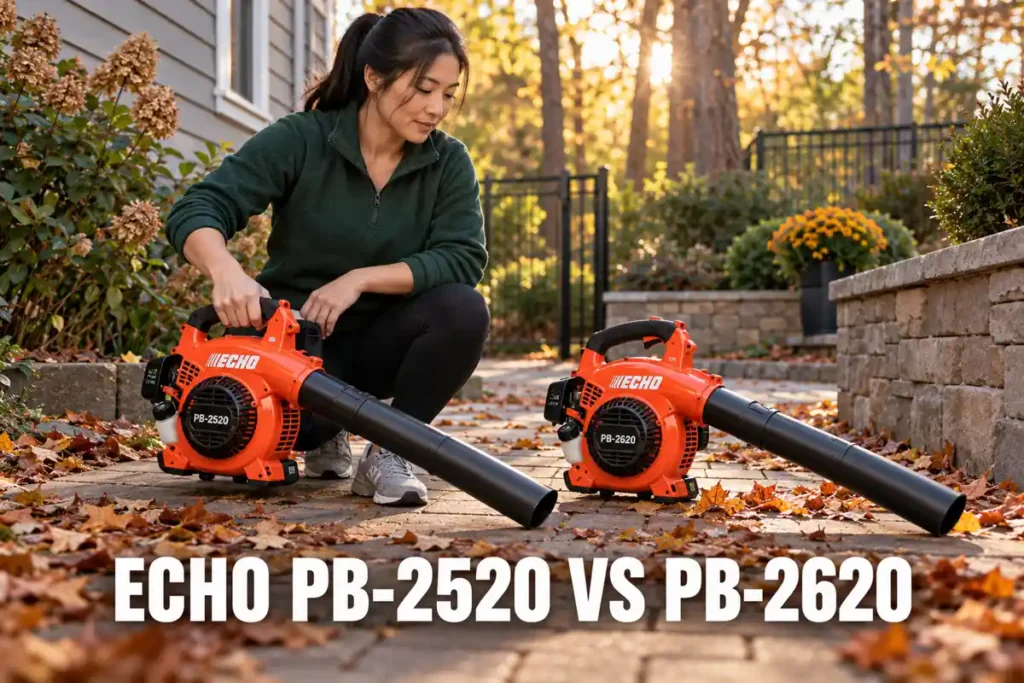
The Echo PB-2520 vs PB-2620 choice comes down to 1.2 lb and a second handle, and for most yards I pick the PB-2520. Both run the same 25.4 cc engine and Echo rates both at 15.8 N of push, so buy the PB-2620 only for long sessions, dusty work and a steadier grip. After every apricot harvest I clear dust and chaff off the concrete work pad in front of my machinery shed with a gas handheld, which is why I judge these two by the filter, the handle and the tank before I look at the engine. Below I list what differs and say plainly where the two are identical.
Affiliate Disclosure: Garden Power Scout is a proud participant in the Amazon Services LLC Associates Program. As an Amazon Associate, we earn from qualifying purchases, at no extra cost to you.
The Short Answer on Echo PB-2520 vs PB-2620
The PB-2520 suits a house yard, paths and a driveway: it is 1.2 lb lighter, sits a tier lower in cost and delivers the same 15.8 N that Echo rates for the PB-2620. The PB-2620 earns its higher tier through hours of work in dust, with a second handle, a rubber grip, a paper filter with a foam prefilter that Echo lists for dusty conditions, and a flat pipe.
The Echo PB-2520 is the simpler tool: a curved pipe and a straight pipe, no second handle, and 8.6 lb dry with its pipes on.
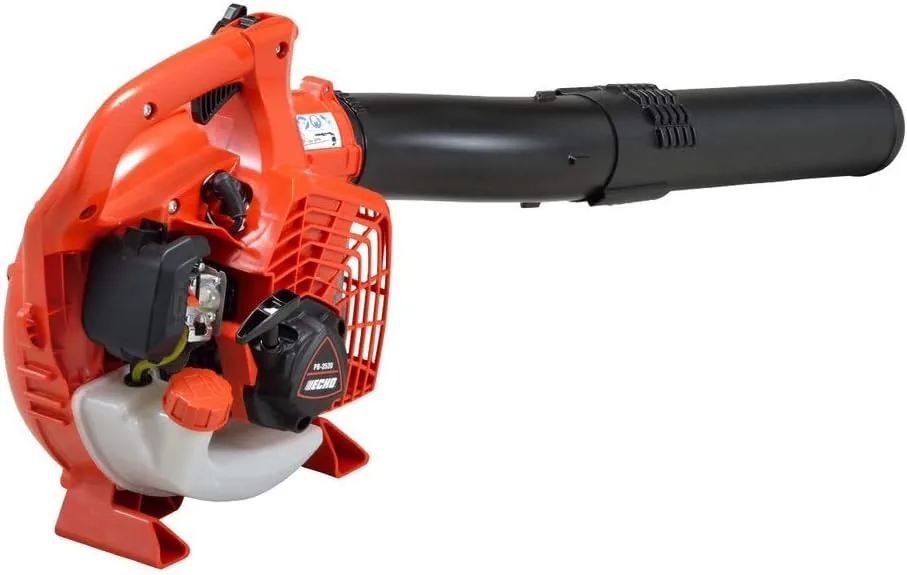
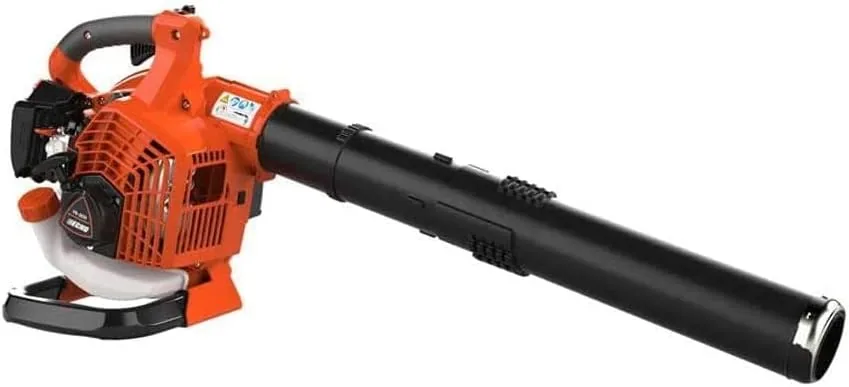
The Echo PB-2620 adds a second handle, a rubber grip and a third pipe, and weighs 9.8 lb dry with its pipes on.
Weight and the second handle decide it for most buyers. The tank, the filter and the pipes are smaller differences, and the engine, the push and the sound rating are the same.
What Each Blower Includes
ECHO PB-2520 Gas Handheld Leaf Blower ships with a curved pipe and a straight pipe, a warranty statement, the operator’s manual and one sample of Echo Power Blend X oil, according to Echo.
ECHO PB-2620 X Series Gas Handheld Leaf Blower comes with three pipes, with round and flat ends (Echo’s US page says flared), a warranty statement and a Quick Start Guide. The Echo PB-2620 X Series name is a line label with no figure of its own.
Neither box holds a shoulder harness. Both blowers have attachment points for one, and Echo sells it separately.
Echo PB-2520 vs PB-2620 Specs
The table gives each figure as Echo publishes it, with the pipe named where a figure depends on it. The Echo PB 2520 vs 2620 gap is small on power and clear on weight.
| Spec | Echo PB-2520 | Echo PB-2620 X Series |
|---|---|---|
| Engine | 25.4 cc two-stroke, 7,500 rpm wide open | 25.4 cc two-stroke, 7,500 rpm wide open |
| Pipes in the box | 2: curved and straight | 3: round and flat ends |
| Airflow, maker’s figure | 453 CFM with its pipes | 456 CFM on the round pipe; 428 CFM on the flat pipe |
| Air speed, maker’s figure | 170 mph with its pipes | 172 mph on the round pipe; 180 mph on the flat pipe |
| Blowing force, maker’s figure | 15.8 N (about 3.6 lb of push) | 15.8 N (about 3.6 lb of push) |
| Weight, dry, with pipes | 8.6 lb | 9.8 lb |
| Weight with a full tank, about | 9.5 lb | 10.8 lb |
| Fuel tank | 18.6 fl oz | 20.3 fl oz |
| Size with pipes, length by width | 37.7 in by 9.2 in | 38.3 in by 11.1 in |
| Sound rating at 50 ft, maker’s figure | 70 dB(A) | 70 dB(A) |
| Second handle | Not applicable, per Echo’s spec sheet | Yes, with a rubber grip |
| Warranty | 5 years consumer, 2 years commercial | 5 years consumer, 2 years commercial |
Fuel adds about 0.9 lb to the PB-2520 and about 1.0 lb to the PB-2620.
Airflow, Air Speed and Blowing Force
On the round pipe the two blowers move the same air. Echo rates the PB-2520 at 453 CFM and 170 mph with its pipes, and the PB-2620 at 456 CFM and 172 mph on the round pipe. Echo does not call the PB-2520’s curved pipe round, so this is the closest match.
The push of an air jet depends on how much air leaves each second and how much faster it moves than the air around it (1). Echo rates both blowers at 15.8 N at the nozzle, about 3.6 lb of push (2).
The PB-2620’s flat pipe trades air for speed, at 428 CFM and 180 mph. Where my gravel drive meets the grass I use it, because the narrower, faster stream lifts grass seed and leaf bits out of the crushed stone. I hold the nozzle low at part throttle, with nobody and no car in the line of the stones.
A soaked leaf mat takes many passes with either blower, so let the leaves dry when you can and save the wet work for the days you cannot wait.
Winner: Tie on air and push, with the flat pipe as a PB-2620 extra.
Weight, Handles and Grip
The Echo PB-2520 vs 2620 weight gap is the biggest difference between them: 8.6 lb against 9.8 lb dry with pipes, and about 9.5 lb against 10.8 lb with a full tank.
The packed-soil paths between my vegetable beds are where I feel it. Clearing them means holding the nozzle out over the beds for the whole length of the path, and the lighter PB-2520 is the one my forearm complains about last. On the PB-2620 my free hand goes to the second handle, which Echo says improves maneuverability and comfort, and that takes some strain off the arm.
Echo says the PB-2620’s rubber grip increases comfort and reduces vibration. Vibration adds up over a season: a study of 17 groundskeepers who use handheld tools such as blowers found them exposed to hand-arm vibration (3), and Echo’s manual tells you to limit your hours. I swap hands and stop for a few minutes at each refill.
Winner: PB-2520 on weight and PB-2620 on handle comfort, so the right pick depends on whether you carry the tool or hold it longer.
Throttle Lever and Cruise Control
Both blowers have a trigger and the same throttle position lever, which holds the speed you set. Echo’s PB-2620 page calls it variable-speed cruise control and its PB-2520 page does not, but the manuals and the Quick Start Guide show one lever on both. It is the same lever on both blowers.
Along a tree-row strip in October leaf fall I set the lever to a low speed and let my trigger finger rest, and it works the same on either blower. Echo’s manual says to use the lowest speed that does the job. The stop switch stays where you leave it on both, so move it off STOP before you pull the cord.
Winner: Tie, because the lever is the same hardware.
Engine, Fuel and Tank Size
Both blowers share one air-cooled 25.4 cc two-stroke, rated by Echo at 7,500 rpm wide open and 3,000 rpm at idle. The fuel is the same, according to Echo: unleaded gasoline rated 89 octane or higher, mixed 50:1 with a two-stroke oil that meets ISO-L-EGD and J.A.S.O. M345-FD, which is 2.6 fl oz of oil per gallon. Up to 10 percent ethanol is approved, while E15, E85 and methanol are not.
In bench tests of a portable two-stroke engine, switching the oil brand cut total PAH concentrations by 46 to 60 percent compared with the baseline oil (4).
The PB-2620 tank holds 20.3 fl oz and the PB-2520 tank 18.6 fl oz, as Echo states them, and the larger PB-2620 tank runs longer between fills.
Warm the engine up for three minutes before you open the trigger, run it wide open for at least five minutes every hour so carbon does not build on the spark arrester screen, and mix no more fuel than you will use in 30 days (90 with a stabilizer, per Echo).
Winner: Tie on engine and fuel, with the PB-2620’s larger tank running longer between fills.
Noise and Hearing Protection
Echo rates both blowers at 70 dB(A) at 50 ft, measured to ANSI OPEI B175.2. That is a bystander rating, and the sound is louder at your ears than 50 ft away. NIOSH recommends 85 dBA averaged over an eight-hour day and cutting the exposure time in half for every 3 dBA more (5). In NIOSH sampling of 80 landscaping workers, 94 of 119 daily noise results reached or passed that limit, and fuel-powered blowers gave significantly more noise than battery versions (6).
Wear earplugs and earmuffs together from the first minute on either blower. Poor fit can limit earplug protection for about 40 percent of users (7), so check the seal. A few cities set leaf blower limits near 65 dBA, so check your local rules.
Protect Ears, Eyes and Lungs
Wear ANSI Z87.1 eye protection every time and a dust mask for dusty work. Stop the engine and let it cool before you refuel, outdoors over bare ground, and keep people, pets and windows out of the debris path, with bystanders 50 ft away.
Winner: Tie, because Echo rates both at 70 dB(A) at 50 ft.
Filter, Pipes and Upkeep
Echo’s PB-2620 page lists a pleated paper filter with a foam prefilter for dusty conditions, plus a chrome-plated cylinder that it says increases engine life. Its PB-2520 page lists tool-less air filter access. Echo gives no hour figure for the cylinder, so I treat it as a bonus and the filter as the part I check.
After a morning on the work pad the dust shows in the filter. On the PB-2520 I open the cover without a screwdriver and tap the filter clean, and on the PB-2620 the foam prefilter takes the first dust, so the paper behind it stays cleaner. I wear a dust mask for that work.
Both manuals call for an NGK BPMR8Y plug with a 0.65 mm gap and a clean spark arrester screen after about 40 hours. The PB-2520 manual also asks for an air filter check before each use and says its Posi-Loc pipes loosen with use, so retighten them as it shows.
Winner: Tie on upkeep, with the PB-2620’s foam prefilter listed by Echo for dusty conditions and the PB-2520’s filter listed as tool-less.
Warranty and Where You Buy
Echo states a 5-year consumer warranty and a 2-year commercial warranty for both blowers, and it does not say what counts as commercial. If you sell what your land grows, ask Echo or a dealer which term covers you. Echo’s manual says warranty service must come from an authorized Echo dealer with proof of purchase, and its limited warranty covers units sold by authorized dealers. Confirm that the seller on the Amazon listing is an authorized Echo dealer before you order either blower.
Winner: Tie, because the terms are the same on both pages.
Choose the PB-2520 If
Choose the Echo PB-2520 if you want the lighter, lower-tier tool and your jobs are dry debris on a house yard:
- Short to medium sessions: a house yard, paths and a driveway, where 8.6 lb dry is easy to hold.
- A lower tier of spending: the same engine and the same 15.8 N cost a tier less, with a tool-less filter cover and two pipes to look after.
For a quick sweep of the ground outside the tool shed door the PB-2520 is the one I take: I carry it in one hand, and the job is over before the weight matters.
Choose the PB-2620 If
In the Echo PB-2620 vs 2520 decision, these are the jobs where the PB-2620 repays its higher tier:
- Hours of work: the second handle and rubber grip give your free hand a job.
- Dusty ground: Echo lists the paper filter with a foam prefilter for dusty conditions, which suits gravel yards and dry alleys.
- Edges and narrow strips: the flat pipe gives 180 mph at 428 CFM for gravel edges and tight spots.
- A slightly bigger tank: 20.3 fl oz against 18.6 fl oz, a small gain.
On a long November day in the plum alleys I reach for the PB-2620, because with my free hand on the second handle the nozzle stays where I aim it.
Which Echo Handheld Fits Your Yard
At 15.8 N both blowers move leaves, clippings, twigs and dust across a house yard, and both take many passes at deep wet mats and big lots. Within that job the PB-2520 saves 1.2 lb and a tier, and the PB-2620 adds the handle and the flat pipe. My leaf blower guides cover battery and backpack options for bigger yards. Pick the weight you can carry through your longest job, and the Echo PB-2520 vs PB-2620 decision follows.
Frequently Asked Questions
Does the Echo PB 2520 take regular gas?
The Echo PB 2520 takes unleaded gas rated 89 octane or higher, mixed 50:1 with certified two-stroke oil, so it must never run on straight pump gas. According to Echo, up to 10 percent ethanol is approved, while E15, E85 and methanol are not, and mixed fuel should be used within 30 days.
How do I start the Echo PB-2520 blower?
Start the PB-2520 with the stop switch off STOP, the throttle position lever midway between idle and full, the choke on cold start and the purge bulb pumped until fuel flows in the clear line, then pull the cord up to five times. Set the choke to run, repeat the steps if five pulls fail, then warm up three minutes.
Is ECHO a good blower?
ECHO is a good blower brand for handheld gas work, and these two show why: a 25.4 cc engine rated at 15.8 N and a 5-year consumer warranty that Echo states on both. The price of that is a pull cord, a 50:1 fuel mix and a three-minute warm-up before full power.
What is the best handheld leaf blower to buy?
The best handheld leaf blower to buy depends on your yard and your fuel habits, and of these two gas models the Echo PB-2520 suits most yards up to a quarter acre. Choose the PB-2620 only if long sessions, dust or a second hand on the tool matter more than its extra 1.2 lb.
What are the different models of ECHO blowers available?
Echo makes gas handheld and backpack blowers. The handhelds compared here are the PB-2520 and the PB-2620 X Series, which share one 25.4 cc engine, 15.8 N of push and a 5-year consumer warranty, and differ in weight, handles, tank and pipes, while Echo’s gas backpack models suit bigger lots.
References
- NASA Glenn Research Center. Thrust Equation. Beginners Guide to Aeronautics. Updated June 10, 2026.
- Thompson A, Taylor BN. Guide for the Use of the International System of Units (SI). NIST Special Publication 811, 2008 Edition. National Institute of Standards and Technology; 2008.
- Chen N, Yang S, Oh J. Evaluation of hand-arm vibration (HAV) exposure among groundskeepers in the southeastern United States. Annals of Work Exposures and Health. 2025;69(1):81-95.
- Tsai JH, Chen YR, Chen SJ, et al. Characteristics of Emissions from a Portable Two-stroke Gasoline Engine. Aerosol Air Qual. Res. 2020;20(3):630-642.
- National Institute for Occupational Safety and Health. Noise-Induced Hearing Loss. Noise and Hearing Loss. Centers for Disease Control and Prevention; 2024.
- Alexander BM, Graydon PS, Pena M, Feng HA, Beamer BR. Hazardous exposures and engineering controls in the landscaping services industry. Journal of Occupational and Environmental Hygiene. 2025;22(3):189-202.
- Morata TC, Gong W, Tikka C, Samelli AG, Verbeek JH. Hearing protection field attenuation estimation systems and associated training for reducing workers’ exposure to noise. Cochrane Database of Systematic Reviews. 2024;5(5):CD015066.
Safety Note: Leaf blowers throw debris and can damage your hearing. Wear eye and ear protection, read the manufacturer’s manual, and check your local rules on noise and operating hours.