

My Makita XBU03Z review is a yes for Makita 18V owners with small, dry areas to clear, and a no for anyone who wants a battery in the box or has wet leaf mats to move. I used the blower on the small chores around our orchard farm: grit around the pump-head filter pit, dried mud and chaff in the crate storage room, and twigs on the lawn before the mower goes out. The XBU03Z is a bare tool, so the packs you already own set how long each job lasts. Below are setup, run time by pack, noise and the limits.
Affiliate Disclosure: Garden Power Scout is a proud participant in the Amazon Services LLC Associates Program. As an Amazon Associate, we earn from qualifying purchases, at no extra cost to you.
Makita XBU03Z Review and My Verdict in Brief
The Makita XBU03Z 18V LXT is a light brushless blower that pushes steadily on dry debris and then runs out of pack. Makita rates it at 459 CFM and up to 116 mph, and it weighs about 6 lb with a pack. One 5.0 Ah pack gives about 10 minutes on high, which suits jobs counted in minutes. I recommend it to LXT owners with short, dry jobs and skip it for everyone else.
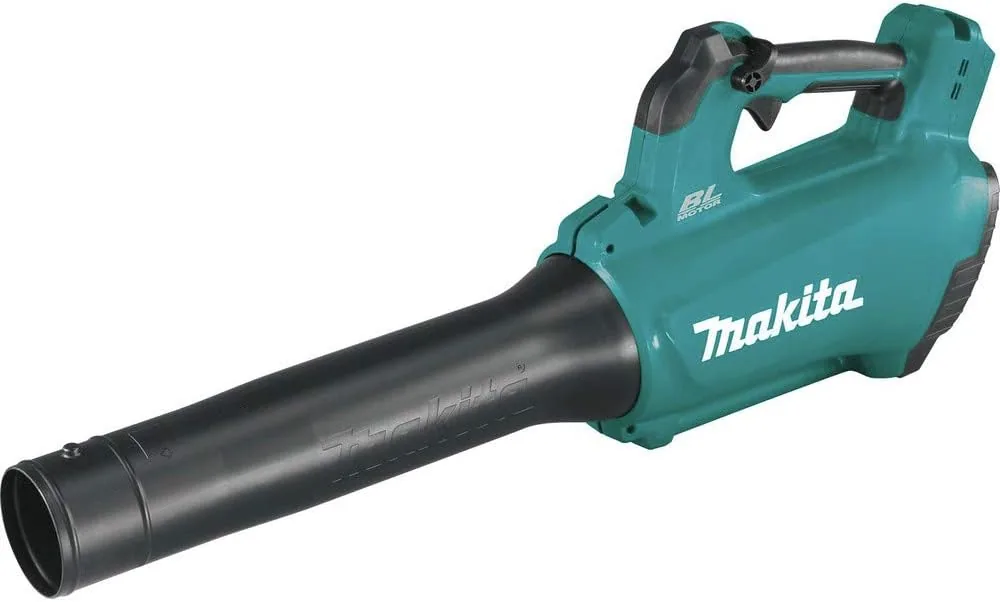
What the Makita 18V Blower Tool Only Listing Includes
The XBU03Z is a Makita 18V LXT brushless blower sold as a bare tool. According to Makita, batteries and charger are not included, so a working setup needs two more things:
- One 18V LXT pack: the manual lists the BL1815N, BL1820B, BL1830, BL1830B, BL1840B, BL1850B and BL1860B, and Makita adds that packs with the Star symbol work.
- One matching charger: the DC18RC, DC18RD, DC18RE, DC18SD, DC18SE or DC18SF.
Anyone shopping for a Makita 18V LXT leaf blower should price the whole setup, and a buyer who owns LXT drills or saws already owns the packs. Makita also sells the XBU03SM1 kit with a 4.0 Ah pack and a DC18SD charger, for a buyer who owns no packs. The flat nozzle, an extension and a gutter kit are separate parts.
Makita XBU03Z Specs at a Glance
Two rows decide the fit: blowing force and run time. A newton is the push of the air against a surface, and 11 N is about 2.5 lb.
| Spec | Figure |
|---|---|
| Airflow and speed, maker’s figures | 459 CFM maximum; 116 mph maximum, 96 mph average |
| Blowing force | About 11 N with a 5.0 Ah pack |
| Run time, 5.0 Ah pack | About 10 minutes on high; 32 minutes at 10,800 RPM, according to Makita, varying with the cruise-control level |
| Weight | 4.6 lb bare; about 6 lb with a pack, according to Makita |
| Noise | 60 dB(A) per ANSI B175.2, maker’s rating |
| Length and warranty | 32-1/2 in with the front nozzle; 3-year limited, according to Makita |
Setup, First Use and Controls
Setup takes a few minutes and follows the manual in this order:
- Take the pack out and fit the front nozzle with its two screws and the hex wrench.
- Check that the trigger is released and the cruise lever is fully back, or the tool will not start once the pack is in.
- Slide the pack in until the red indicator is hidden, and press its check button to light up to four charge lamps.
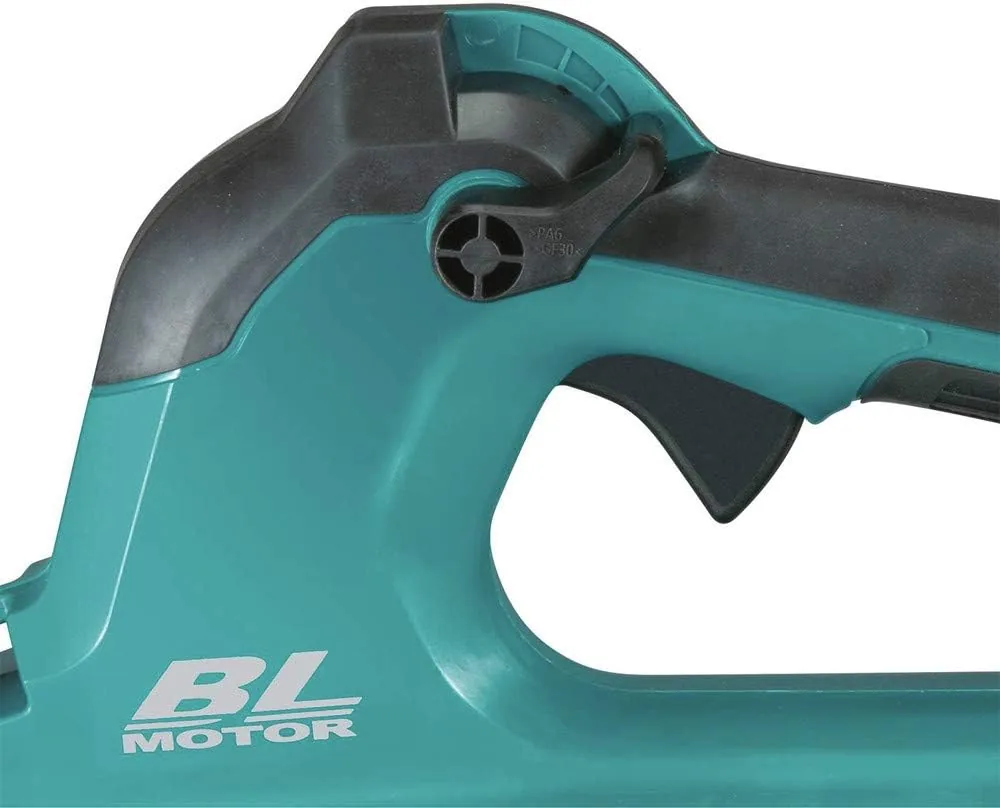
- Pull the trigger for variable speed, or turn the cruise lever forward to hold a steady speed.
The cruise lever is the control I use most. On the wood-chip paths of the vegetable plot I set it low and keep my finger off the trigger, because fast air strips the mulch. A pull on the trigger still raises the speed past the lever setting, so a stubborn corner gets more air.
The in-line fan keeps the front of the tool level when I lower the tube, and at about 6 lb with a pack the rubberized grip never felt like a load in my hand.
How the XBU03Z Performs on Leaves, Twigs and Gravel
The XBU03Z suits light, dry debris: leaves, clippings, sawdust and grit. Wet mats and gravel beds need a stronger tool. Push comes from how much air leaves the tube each second and how much that air speeds up (1), so a high mph from a thin stream can still leave a heavy pile where it lies.
Dry Leaves, Twigs and Lawn Edges
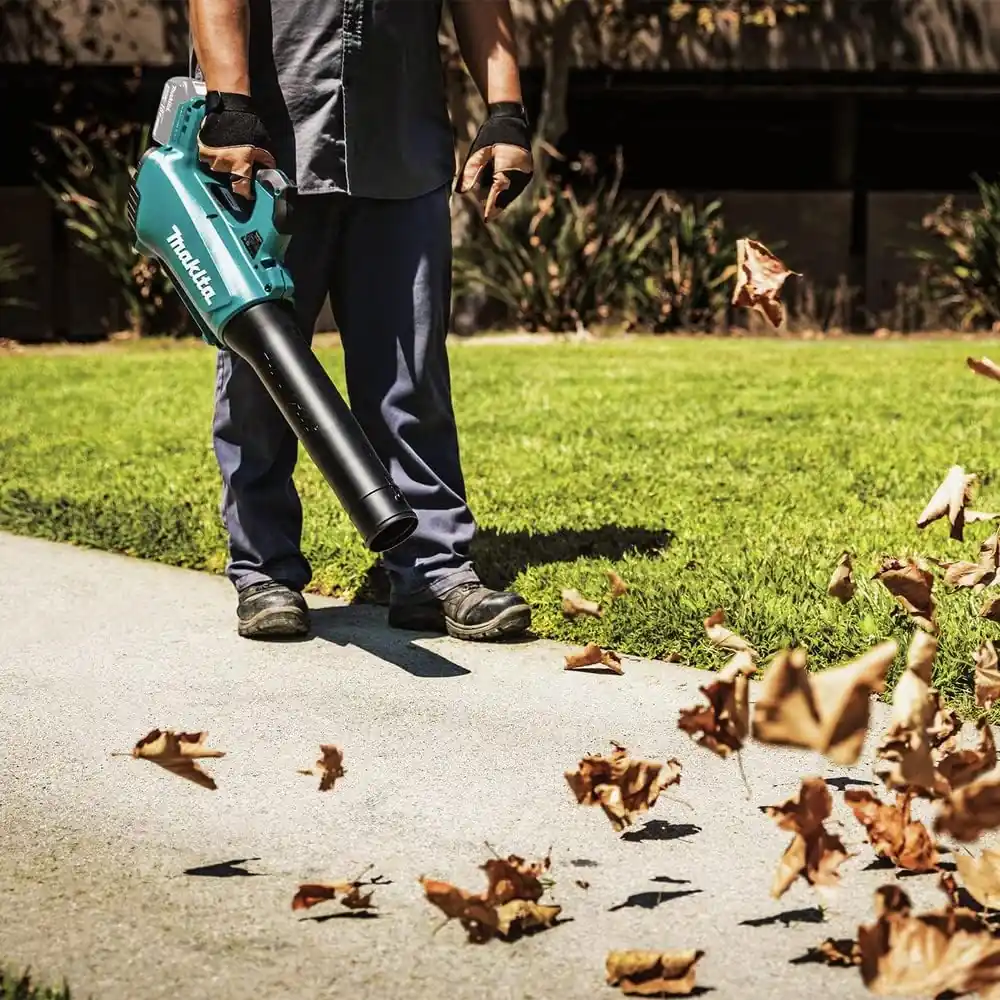
Before the first mow of spring I clear twigs and seed pods off the lawn, so the mower does not pick them up and fling them. The XBU03Z walks them to the edge on a low trigger, and with the cruise lever set I cross the lawn without holding the trigger down.
Shed Floors, Chaff and Dust
The crate storage room collects dried mud and chaff, and the blower lifts both into the air. I open the door first, wear goggles and a dust mask, and blow toward the door, because the manual warns that blown dust can carry chemical residue.
Around the Pump-Head Filter Pit
Leaves and grit collect around the 150-mesh disc filter at the pump head, and fast air at close range drives that grit into the fittings. I set the cruise lever low, stand back and roll the leaves out of the pit with a gentle stream, then take the last handful by hand.
Where It Runs Out of Push
Wet leaf mats and gravel beds need a stronger tool than a blower with about 11 N of push. I rake the wet mats in the orchard alleys and the gravel edge by the yard, because a stone thrown at an ankle or a window costs more than a rake does.
Makita 18V Blower Run Time on 2.0 to 6.0 Ah Packs
According to Makita, a 5.0 Ah pack runs the blower for 32 minutes at 10,800 RPM, and that figure varies with the cruise-control level. The table counts minutes on high instead, where a 5.0 Ah pack gives about 10, and scales that figure to two other sizes.
| Pack | Energy | Minutes on high |
|---|---|---|
| 2.0 Ah (BL1820B) | About 36 Wh | About 4 |
| 5.0 Ah (BL1850B) | About 90 Wh | About 10 |
| 6.0 Ah (BL1860B) | About 108 Wh | About 12 |
The other rows scale from the 5.0 Ah row by amp-hours on high, so read the small pack as an upper limit. A 4.0 Ah pack, the size in Makita’s kit, scales to about 8 minutes.
I count the minutes a job needs first, then divide by the minutes one pack gives. Forty minutes on high takes about four 5.0 Ah packs, and I budget on high because Makita’s 32 minutes varies with the cruise-control level.
Cold costs minutes too, since lithium-ion cells deliver less energy and power at low temperatures (2), so keep spare packs indoors until you need them. I press the check button before each job, because the four lamps sit on the pack and not on the tool.
How Loud It Is at 50 Feet and at the Ear
Makita rates the blower at 60 dB(A) under ANSI B175.2, a bystander rating taken at 50 feet. The person holding the tool stands much closer, at about 83 dBA at full output. Distance explains the gap: the ear is about 17 times closer, which adds roughly 24 dB to 60. A field study found levels at 50 feet in line with manufacturers’ ratings, and in its own test of two leaf blowers and a hose vacuum the individual machines read 85 to 101 dB(A) at the measuring point near them (3).
NIOSH recommends 85 dBA averaged over eight hours and halves the allowed time for every 3 dBA more (4). At 83 dBA that is more than 12 hours of that one noise, but the limit covers the whole day, and Makita’s manual asks only for goggles, a cap and a mask. I wear earmuffs from the first start anyway, because poor fit may limit earplug protection for about 40 percent of users (5).
Against fuel the picture is clear: landscaping workers sampled by NIOSH had significantly more noise and carbon monoxide exposure with fuel-powered blowers than with battery versions (6).
Care, Storage and Safety
Care comes down to a clean rear inlet, a cool pack and air pointed away from people.
- Pack out first. Remove the pack before you fit a nozzle, clean the tool or clear a blockage.
- Eyes, head and lungs. Wear goggles, a cap and a mask, with closed-toe shoes. Ordinary glasses are not safety glasses.
- Aim away. Keep people, pets and open windows out of the path of the air, and run the tool at reasonable hours.
- Never set it down running. Sand and dust enter the rear inlet and cause a malfunction.
- Clean and store dry and cool. Wipe with a dry or wrung-out soapy cloth, never solvents, and keep the tool below 122 F.
Makita puts a hook hole in the housing bottom, so the tool can hang with the rear inlet off the floor.
Makita 18V Blower Problems and Limits
- Short run time. A single pack runs out in minutes on high, and that is the main limit. Own two or three packs and rotate them.
- Modest push. About 11 N suits dry leaves and light debris, while wet mats and gravel beds need a stronger tool or a rake.
- A long tube. At 32-1/2 in with the front nozzle, the tool needs room to swing, and a nozzle change needs a hex wrench.
- A silent stop. The motor stops with no warning when the protection system trips on overload, overheating or a low pack, and it looks like a dead battery. Let the tool cool or swap the pack first.
- Household rating. The manual rates the tool for household use with no IP rating, so keep it out of the rain.
Who Should Buy the Makita XBU03Z and Who Should Skip It
A Makita 18V leaf blower owner who clears small areas gets the most from the XBU03Z, so check both lists.
Buy It If
- You already own LXT packs and a charger.
- Your jobs are a patio, a drive, a workshop floor or clippings along a lawn edge.
- You want a light blower with no fuel and no cord.
Skip It If
- You own no 18V packs and want one box with a battery in it.
- Your leaves are wet mats, or your gravel edge needs real force.
- You mean to blow gutters from a ladder, because the manual says not to use the tool at high places.
Where the XBU03Z Sits in the Makita 18V Blower Range
Among Makita’s 18V blowers, the XBU03Z is the one-pack middle step. The XBU05Z is the sweeper: 113 CFM and 219 mph from a brushed motor at 2.7 lb bare, so it clears hard surfaces with fast air and moves little volume.
The XBU02Z and XBU04Z run on two 18V packs for 473 CFM and weigh 9 to 11.2 lb with them, so the Makita XBU02Z vs XBU03Z question comes down to packs and weight.
How the XBU03Z Compares With Alternatives
The Makita and the Milwaukee are bare tools, and the DEWALT, WORX and EGO come with a pack. My leaf blower guides cover more models.
| Blower | Includes | Airflow and speed, maker’s figures | Push | Weight |
|---|---|---|---|---|
| Makita XBU03Z | Tool only | 459 CFM, 116 mph | About 11 N | About 6 lb with a pack |
| Milwaukee M18 FUEL 2724-20 | Tool only | 450 CFM, 120 mph | About 11 N | 4.9 lb bare |
| DEWALT DCBL722P1 | 5.0 Ah 20V pack and charger | 450 CFM, 125 mph | No figure | Not stated by DEWALT |
| WORX WG543 | 4.0 Ah pack and charger | 410 CFM, 130 mph (two modes) | No figure | 3.8 lb with the kit |
| EGO Power+ LB6504 | 56V 5.0 Ah pack and charger | 650 CFM on turbo | About 11 N on high, about 20 N on turbo | About 9.7 lb with a pack |
- Milwaukee M18 FUEL 2724-20: the same idea for M18 owners.
- DEWALT DCBL722P1: for DEWALT 20V owners who want the pack in the box.
- WORX WG543: one light box for a buyer with no cordless packs.
- EGO Power+ LB6504: the step up when wet leaves matter more than weight, at about 88 dB(A) at the ear on turbo.
Is the Makita XBU03Z Worth Buying?
Count your LXT packs before you order, because that count decides how useful this blower is. With two or three 5.0 Ah packs on the shelf, it clears a patio, a shed floor and a lawn edge at about 6 lb in the hand, with no fuel, no cord and no exhaust. With one small pack, or with wet leaves and gravel to move, choose a stronger tool.
Wear goggles, a dust mask and earmuffs, and keep people and windows out of the path of the air. My Makita XBU03Z review verdict for an owner with packs and short jobs is a buy.
Frequently Asked Questions
Are Makita blowers any good?
Makita blowers are good tools, and the XBU03Z is a good light blower for short jobs on Makita’s 18V packs. It moves 459 CFM and pushes about 11 N at roughly 6 lb with a pack, but a 5.0 Ah pack lasts about 10 minutes on high and wet leaf mats need a stronger tool.
Which Makita 18V blower is the best?
The best Makita 18V blower depends on the job, and for general cleanup on one pack I pick the XBU03Z for its light weight and 459 CFM. The XBU05Z (113 CFM, 219 mph, 2.7 lb bare) suits light sweeping, while the XBU02Z and XBU04Z use two 18V packs for 473 CFM.
How loud is a leaf blower in decibels?
A battery leaf blower such as the Makita XBU03Z reads about 83 dBA at the ear on full output. Makita’s 60 dB(A) rating for the XBU03Z is a bystander figure at 50 feet, so use the ear reading when you choose hearing protection, and wear earmuffs from the first start.
Are cordless blowers worth it?
A cordless blower like the XBU03Z is worth it for short, dry cleanup, because it has no fuel, no cord and no exhaust. The answer depends on the LXT packs you own, since one 5.0 Ah pack lasts about 10 minutes on high and wet leaf mats need a stronger tool.
Is it better to have more mph or cfm in a leaf blower?
It is better to have more CFM than mph for moving piles, but force in newtons tells you more than either number. The XBU03Z shows why: it carries 459 CFM and 116 mph on the label, and about 11 N of actual push, which is what you feel on dry leaves.
References
- NASA Glenn Research Center. Thrust Equation. Beginners Guide to Aeronautics. Updated June 10, 2026.
- Ji Y, Zhang Y, Wang C-Y. Li-Ion Cell Operation at Low Temperatures. J Electrochem Soc. 2013;160(4):A636-A649.
- Walker E, Banks JL. Characteristics of Lawn and Garden Equipment Sound: A Community Pilot Study. J Environ Toxicol Stud. 2017;1(1).
- National Institute for Occupational Safety and Health. Noise-Induced Hearing Loss. Noise and Hearing Loss. Centers for Disease Control and Prevention; 2024.
- Morata TC, Gong W, Tikka C, Samelli AG, Verbeek JH. Hearing protection field attenuation estimation systems and associated training for reducing workers’ exposure to noise. Cochrane Database of Systematic Reviews. 2024;5(5):CD015066.
- Alexander BM, Graydon PS, Pena M, Feng HA, Beamer BR. Hazardous exposures and engineering controls in the landscaping services industry. Journal of Occupational and Environmental Hygiene. 2025;22(3):189-202.
Safety Note: Leaf blowers throw debris and can damage your hearing. Wear eye and ear protection, read the manufacturer’s manual, and check your local rules on noise and operating hours.