
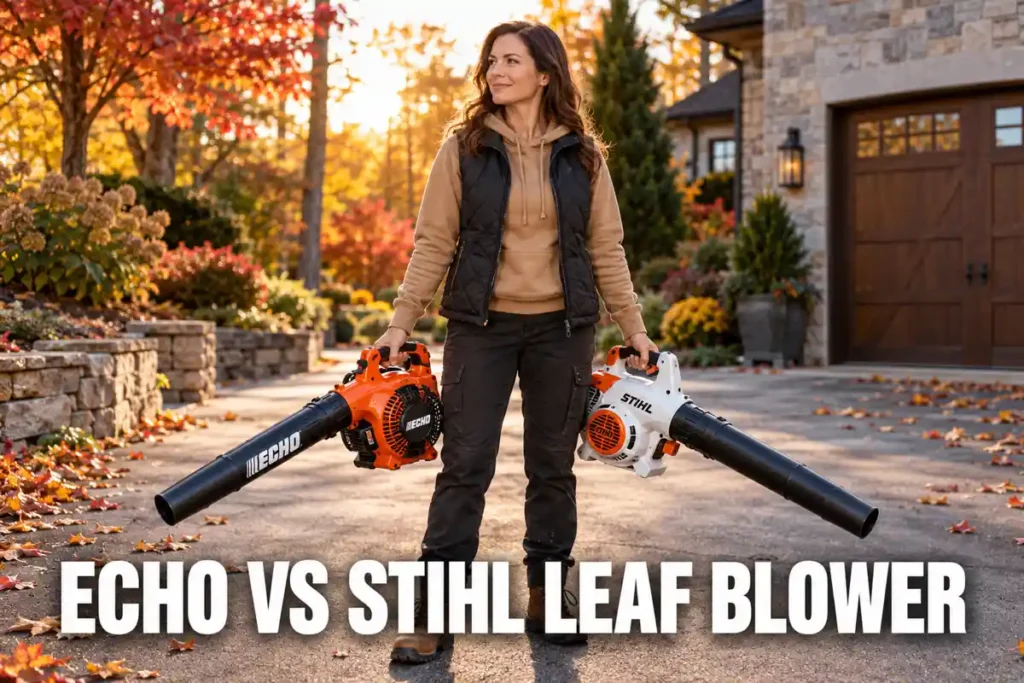
Echo vs Stihl leaf blower comes down to where you can buy and service it, and then to the class you need: buy ECHO for the highest rated force at the top end and a longer home warranty, and buy Stihl if a dealer you trust is close and you want a lighter flagship on paper. My plant protection training taught me to read the conditions on a label before its claims, and I read both warranties the same way. Below, three ECHO blowers meet their Stihl counterparts in the handheld, mid-size and flagship classes.
Affiliate Disclosure: Garden Power Scout is a proud participant in the Amazon Services LLC Associates Program. As an Amazon Associate, we earn from qualifying purchases, at no extra cost to you.
Echo vs Stihl Leaf Blower in Short
At the flagship level ECHO rates the higher force, 48 N for the PB-9010T against 41 N for the Stihl BR 800 C-E, and Stihl rates the higher peak air speed and the lower weight. In the handheld class the two brands’ force figures sit within a newton, and in the mid class the ECHO sits between the two Stihl backpacks. I use newtons as the yardstick because both makers publish them for every blower, and force follows how much air a blower moves and how much it speeds that air up (1). Stihl sells only through authorized Stihl dealers, while ECHO also sells through a home-center chain and authorized online retailers.
| Row | ECHO | STIHL |
|---|---|---|
| Handheld: rated force | PB-2620: 15.8 N | BG 86: 15 N |
| Handheld: maximum air speed | 172 mph | 170 mph |
| Handheld: dry weight | 9.8 lb with pipes | 9.7 lb, no fuel |
| Mid backpack: rated force | PB-770T: 33 N | BR 600: 31.7 N; BR 700: 35 N |
| Mid backpack: maximum air speed | 234 mph | BR 600: 237.6 mph; BR 700: 196 mph |
| Flagship: rated force | PB-9010T: 48 N | BR 800 C-E: 41 N |
| Flagship: maximum air speed | 220 mph | 239 mph |
| Flagship: dry weight | About 26 to 27 lb, by production run | 25.9 lb, no fuel |
| Gas blower warranty, home use | 5 years | 2 years |
| Gas blower warranty, farm or commercial use | 2 years | 2 years |
| Where it is sold | Dealers, a home-center chain, authorized online retailers | Authorized STIHL dealers only |
The Two Brands at a Glance
ECHO and Stihl are separate companies, and each builds a gas range that covers the same three classes. The table lists what each maker says about itself.
| Item | ECHO | STIHL |
|---|---|---|
| US base | ECHO Incorporated, Lake Zurich, Illinois | STIHL Incorporated, Virginia Beach, Virginia |
| Gas handheld blowers | PB-2520 and PB-2620, both 15.8 N | BG 50 at 13 N, BG 56 C-E, BG 86 and BG 86 C-E at 15 N |
| Gas backpack blowers | PB-580T at 22 N, PB-770T at 33 N, PB-9010T at 48 N | BR 200 at 12 N, BR 450 at 28 N, BR 600 at 31.7 N, BR 700 at 35 N, BR 800 C-E at 41 N |
| Fuel mix | 50:1 gasoline to two-stroke oil | 50:1 gasoline to two-stroke oil |
| Battery blowers | A 56V line | Battery blowers on its US page |
Where Each Brand Is Bought and Serviced
Before any newton, I ask who sells the blower and who repairs it. In a Stihl vs Echo leaf blower comparison the buying route decides how a repair goes, so it comes first.
According to Stihl, its US network has more than 10,000 authorized dealers, orders placed on its own website are fulfilled by a dealer, and its warranty covers only products bought from an authorized Stihl dealer in the United States and its territories. Its return policy sends products back to the original selling dealer, and a failed unit goes to any authorized Stihl dealer with the freight paid by you.
According to ECHO, it sells through Signature Elite dealers, independent ECHO dealers, a home-center chain with a smaller selection, and authorized online retailers. Its warranty is limited to products sold by authorized ECHO dealers, and warranty work happens at an authorized servicing dealer.
On a farm the dealer’s distance is a real cost. A blower sitting in a shop in late October misses the leaf fall, so before I read a spec sheet I find out how far the nearest authorized dealer is for the brand I am about to buy.
Echo PB-2620 vs Stihl BG 86 Handheld Blowers
The handheld pair is close on paper. The PB-2620 rates 15.8 N and the BG 86 rates 15 N, and their top air speeds are 172 and 170 mph, so force and speed do not separate them. Stihl’s page lists the BG 86 C-E at 9.9 lb with the same force and speed, so I treat the two Stihl versions as one blower for figures.
| Row | ECHO PB-2620 | STIHL BG 86 |
|---|---|---|
| Engine | 25.4 cc two-stroke | 27.2 cc (1.7 in3) |
| Rated force | 15.8 N | 15 N, round nozzle |
| Maximum air speed | 172 mph, round pipe | 170 mph, round nozzle |
| Air volume, maker’s figure | 456 CFM, round pipe | About 444 CFM (755 m3/h, Stihl’s manual) |
| Dry weight | 9.8 lb with pipes | 9.7 lb, no fuel; BG 86 C-E 9.9 lb |
| Fuel tank | 20.3 fl oz | 14.9 fl oz (Stihl’s manual) |
| Warranty, home use | 5 years | 2 years |
| Warranty, farm or commercial use | 2 years | 2 years |
The ECHO PB-2620 X Series Handheld Gas Leaf Blower comes, according to ECHO, with round and flared end pipes and a helper handle, and it is the heavier, better-equipped sibling of the PB-2520. Its tank is the one visible gap, 20.3 fl oz against 14.9 fl oz in Stihl’s manual, about 5 fl oz more mix per fill. ECHO ties its warranty to authorized dealers, so check the seller on the Amazon listing before you order.
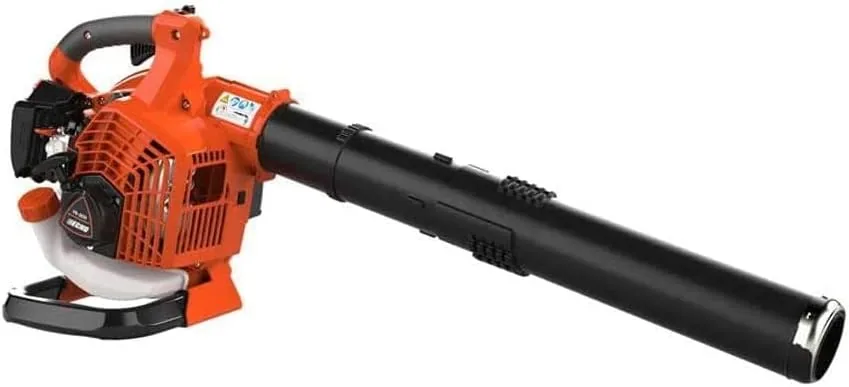
The Stihl BG 50 is Stihl’s lighter handheld and rates 13 N at 8 lb. For lawns, patios and paths the choice is the dealer and the warranty. The lightest ECHO handheld, the ECHO PB-2520, rates 15.8 N at 8.6 lb.
Echo PB-770T vs Stihl BR 600 and BR 700 Mid-Size Backpacks
The Echo vs Stihl backpack blower question starts in the mid class, where the PB-770T faces two Stihl models. ECHO rates the PB-770T at 33 N, and Stihl rates the BR 600 at 31.7 N and the BR 700 at 35 N, so the ECHO sits between them. Stihl’s BR 450 sits below the group at 28 N.
| Row | ECHO PB-770T | STIHL BR 600 | STIHL BR 700 |
|---|---|---|---|
| Engine | 63.3 cc two-stroke | 64.8 cc (4 in3) | 64.8 cc (4 in3), STIHL 4-MIX |
| Rated force | 33 N | 31.7 N | 35 N |
| Maximum air speed | 234 mph | 237.6 mph | 196 mph |
| Air volume, maker’s figure | 756 CFM | About 677 CFM (Stihl’s manual) | About 912 CFM (Stihl’s manual) |
| Dry weight, maker’s figure | 21.6 lb without pipes (ECHO’s manual) | 22.3 lb, no fuel | 23.6 lb, no fuel |
| Fuel tank | 68.3 fl oz | 47.3 fl oz (Stihl’s manual) | 47.3 fl oz (Stihl’s manual) |
| Warranty, home use | 5 years | 2 years | 2 years |
The weights and air volumes in the table have different bases: ECHO’s 21.6 lb is without pipes, Stihl’s 22.3 lb is without fuel, and the two makers state air volume at different points. Newtons are the like-for-like row here.
ECHO says the ECHO PB-770T X Series Gas Backpack Leaf Blower puts its throttle on the tube, and the box holds a flex pipe, a swivel pipe and straight pipes. In March, before the dormant oil goes on at silver tip, I move the pruning twigs from the tree-row strips into the alley, and a mid-size backpack does that stretch at an easy pace. I weigh a backpack with its pipes fitted and the tank full, because that is the load I carry.
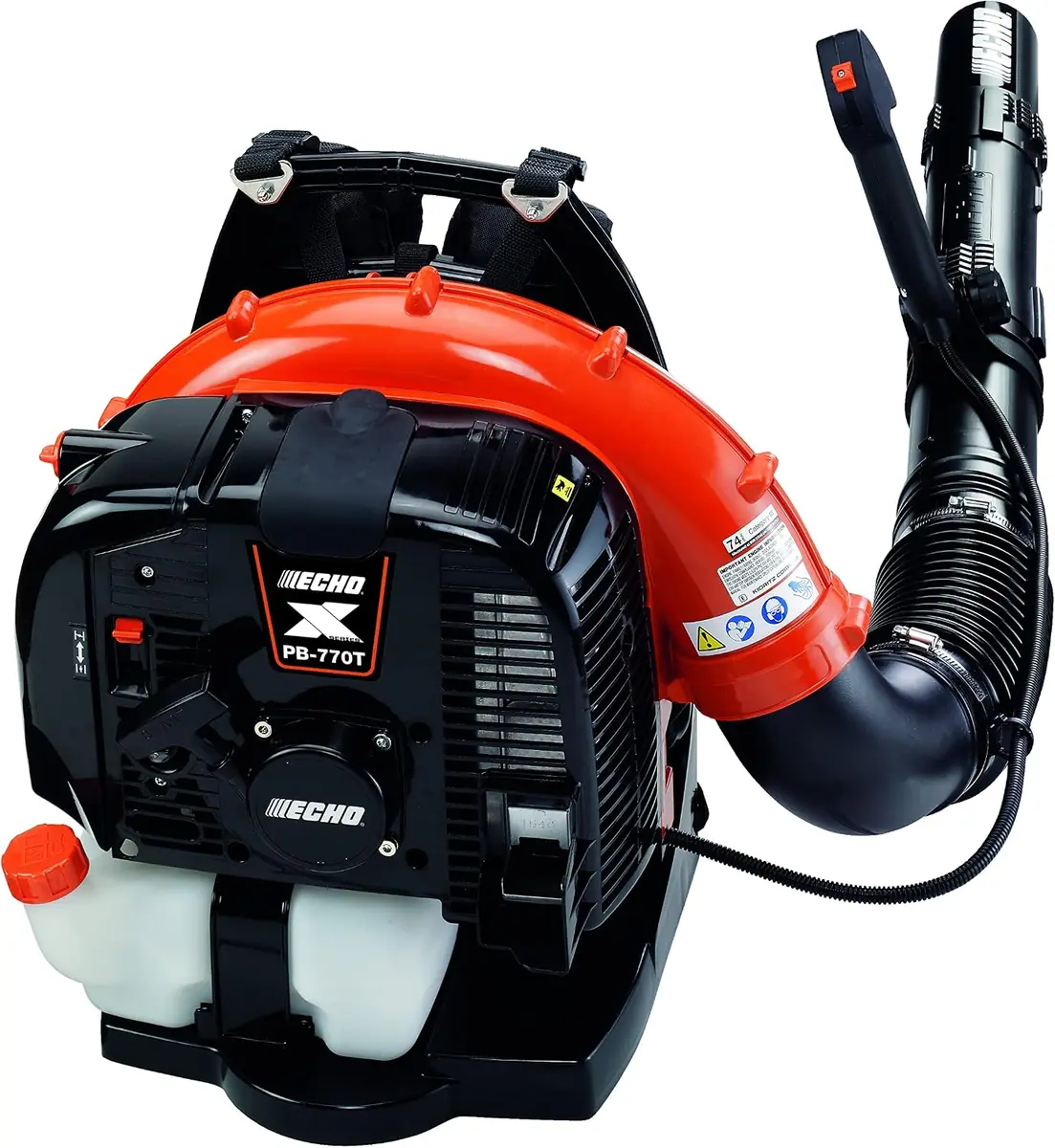
Stihl’s BR 600 rates 31.7 N, close to the PB-770T’s 33 N. The Stihl BR 700 rates 35 N and runs Stihl’s 4-MIX engine, which Stihl’s manual still fuels with a 50:1 mix of gasoline and two-stroke oil.
Echo PB-9010T vs Stihl BR 800 C-E Flagship Backpacks
The flagship pair shares a 79.9 cc engine size, so the gap sits in what each maker built around it. ECHO rates the PB-9010T at 48 N and Stihl rates the BR 800 C-E at 41 N. The two makers state air volume at different points, so newtons carry this pair.
| Row | ECHO PB-9010T | STIHL BR 800 C-E |
|---|---|---|
| Engine | 79.9 cc two-stroke | 79.9 cc (4.9 in3) |
| Rated force | 48 N | 41 N, round nozzle |
| Maximum air speed | 220 mph | 239 mph, round nozzle |
| Air volume, maker’s figure | 1,110 CFM | About 912 CFM (1,550 m3/h, Stihl’s manual) |
| Dry weight | 26.4 or 27.2 lb, by production run | 25.9 lb, no fuel |
| Fuel tank | 83.8 fl oz | 67.6 fl oz (2.0 L, Stihl’s manual) |
| Warranty, home use | 5 years | 2 years |
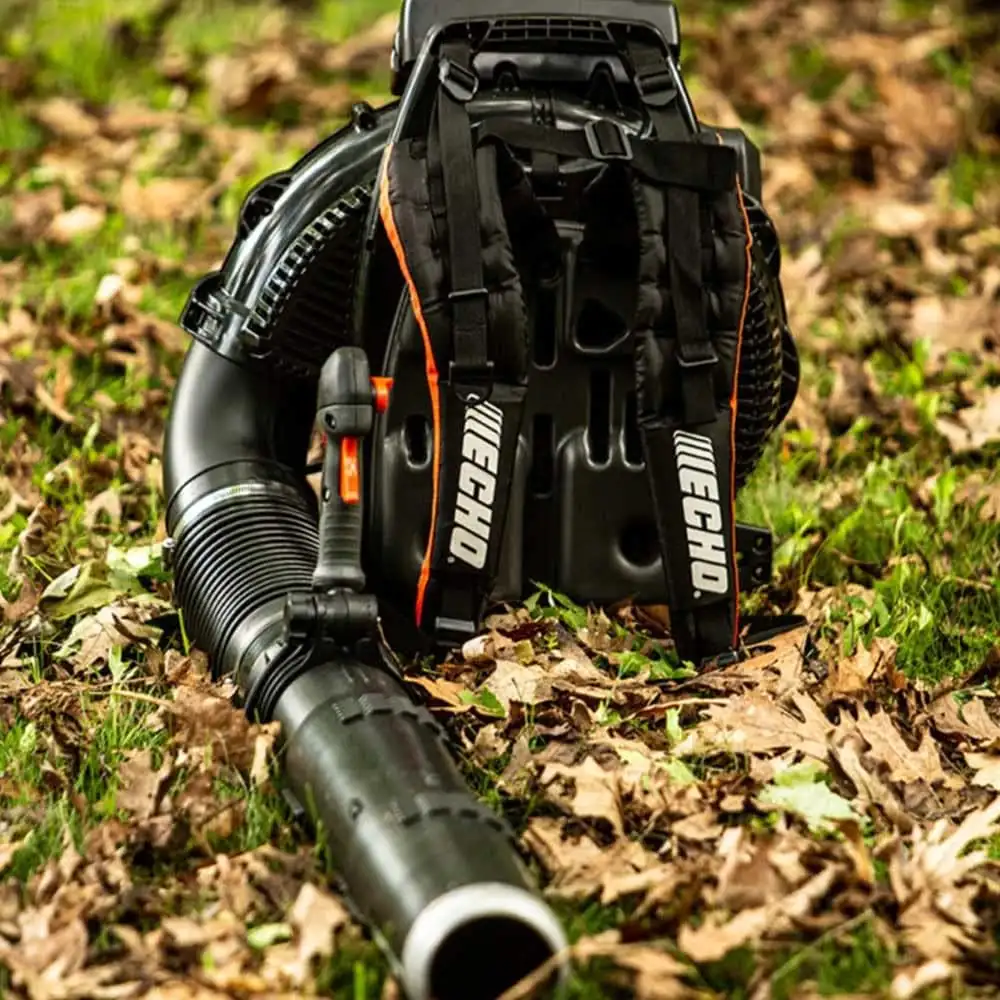
The ECHO PB-9010T X Series Gas Backpack Leaf Blower runs a 79.9 cc engine, puts its throttle on the tube and, ECHO says, holds 83.8 fl oz of mix, about 16 fl oz more than Stihl’s tank. On my 3.7 acres the refuel I mind is the walk back to the shed.
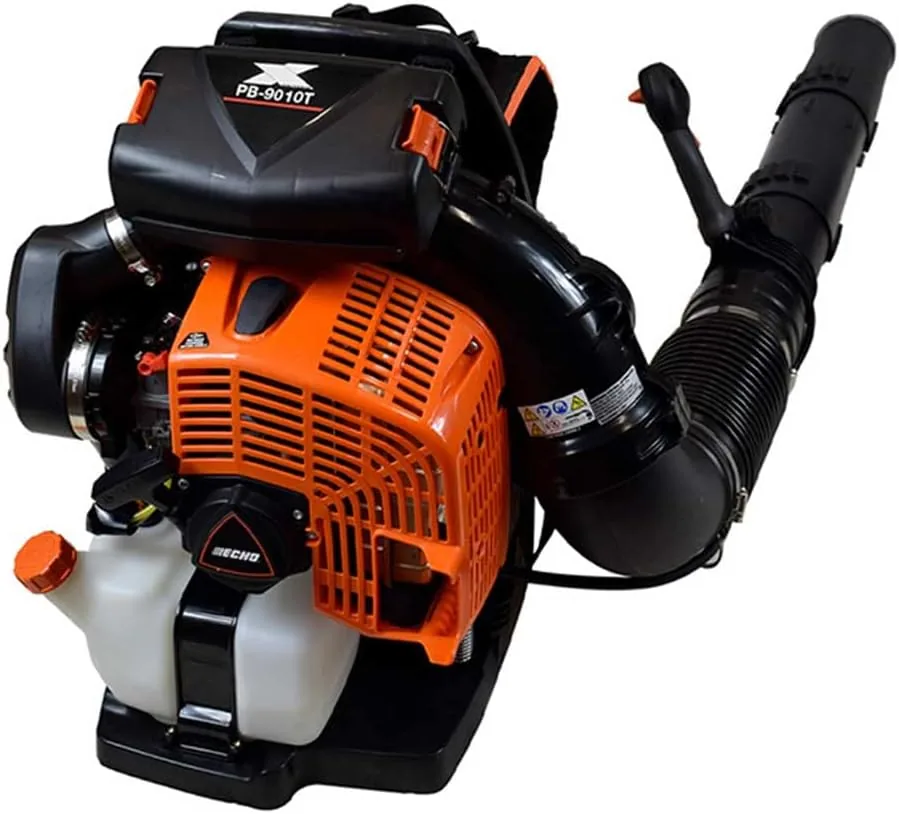
Stihl lists the BR 800 C-E at 25.9 lb without fuel, 0.5 to 1.3 lb under the ECHO, and a peak air speed of 239 mph against 220. Stihl’s page names an adjustable support harness for its backpacks, and ECHO’s page lists padded straps and a vented back pad.
A load-carriage study found that strap force and contact pressure at the shoulders and hips predicted how uncomfortable carriers felt (2). Fuelled, the PB-9010T rides at about 31 lb, and the second alley is where my shoulders start to answer.
Noise, Vibration and Hearing Protection
The two makers publish noise on different bases, so neither brand can be called quieter. ECHO prints a rating for a bystander 50 ft away, and Stihl’s manuals print the sound at the operator’s ear on European standards. The table gives each figure with its basis.
| Model | Figure | Where it is measured |
|---|---|---|
| ECHO PB-2620 | 70 dB(A) | Bystander at 50 ft, ANSI standard |
| ECHO PB-770T | 73 dB(A) | Bystander at 50 ft, ANSI standard |
| ECHO PB-9010T | 79.3 dB(A) | Bystander at 50 ft, ANSI standard |
| STIHL BG 86 | 90 dB(A) | Operator’s ear, European standard, Stihl’s manual |
| STIHL BR 600 | 100 dB(A) | Operator’s ear, European standard, Stihl’s manual |
| STIHL BR 700 | 101 dB(A) | Operator’s ear, European standard, Stihl’s manual |
| STIHL BR 800 | 106 dB(A) | Operator’s ear, European standard, Stihl’s manual |
A rating at 50 ft describes your neighbor, and a reading at the ear describes you. NIOSH recommends an average of 85 dBA over an eight-hour workday and half the time for every 3 dBA above it (3). In a test of agricultural backpack machines, all but one measured above 100 dB(A) (4), so I treat every gas backpack here as a hearing hazard whatever its box says.
Earplugs protect less than their rating when they do not seal, and a Cochrane review notes that poor fit may limit protection for about 40 percent of users (5). Plugs and earmuffs both go on at the shed door, before I carry any gas blower out to the first row.
Stihl prints 2.5 m/s2 at the right handle of the BR 700, and ECHO’s US documents give no vibration value for the PB-770T, so I do not rank the brands on vibration. Field measurements on backpack blowers found median hand vibration of about 1.7 to 2.9 m/s2, with the risk tied to hours of use per day (6). Vibration level and hours on the tool both count toward exposure, so a long day with any gas backpack calls for breaks.
Protect Your Ears, Eyes and Lungs
On every gas blower in this article, wear foam plugs and earmuffs together from the first minute, ANSI Z87.1 eye protection, and a dust mask on dusty work. Keep people and pets at least 50 ft away, aim the nozzle away from windows and cars, and never run a gas engine in a closed shed, where the exhaust builds up carbon monoxide.
Warranty Terms and What an Orchard Changes
ECHO gives the longer home term, and the two brands are level on farm use, which matters to me because my orchard sells fruit. ECHO’s product pages list 5 years for consumer use and 2 years for commercial use, and Stihl’s January 2026 policy lists 2 years for consumer and 2 years for professional use on gas blowers.
| Row | ECHO | STIHL |
|---|---|---|
| Home use | 5 years | 2 years |
| Farm, commercial or professional use | 2 years | 2 years |
| Rental use | 90 days | 3 months |
| Where it must be bought | From an authorized ECHO dealer | From an authorized STIHL dealer in the US or its territories |
| Who repairs it | An authorized servicing dealer | Any authorized STIHL dealer |
| Who pays to get it there | You, to deliver or ship the unit | You, for freight |
| Proof of purchase | Date, model and serial number | The invoice |
| Later owners | Original purchaser only | Not transferable |
Both makers put income-producing work in the shorter line. ECHO’s statement lists commercial, institutional, agricultural, industrial or income-producing use at 2 years for backpack blowers, and Stihl defines professional use as work for profit or for an organization, commercial, professional or income-producing. My orchard sells fruit, so the 2-year line is mine on either brand, and I plan around it for any blower that also works the orchard.
Both policies leave out damage from lack of maintenance and from fuel and oil the maker does not allow. I keep the receipt, since both makers ask for proof of purchase.
Fuel, Engines and Upkeep
Both brands call for a 50:1 mix of gasoline and two-stroke oil. ECHO’s manuals ask for unleaded gasoline of 89 octane on the (R+M)/2 scale, oil that meets ISO-L-EGD and J.A.S.O. M345-FD at 2.6 fl oz per US gallon, and mix no older than 30 days, or 90 days with a stabilizer. They say other oil voids the two-stroke engine warranty.
Stihl’s manuals ask for a minimum of 90 octane on the RON scale and name Stihl HP Ultra oil or an oil to JASO FB, FC or FD, and they say not to store mix longer than 30 days. Both makers cap ethanol at 10 percent, and in a Department of Energy test of 28 small engines, open-loop engines ran leaner and hotter as ethanol rose, with exhaust temperatures about 36 to 126 F higher on E20 than on plain gasoline (7).
For upkeep, ECHO’s PB-2620 and PB-9010T manuals ask for 5 minutes at wide open throttle every hour, so carbon does not build on the spark arrester screen. Stihl’s warranty policy lists spark plugs, filters, starter cords, carburetor adjustments, tune-ups and spark arrestor screen cleaning as normal maintenance that it does not cover. A mix that ran rich fouled the plug on my old gas handheld once, so I read the ratio from the manual each time I mix instead of trusting memory.
Stop the engine and let it cool before you refuel, fill outdoors over bare ground, and carry the machine 10 ft from the fuelling spot before you start it, as ECHO’s manuals say.
Choose Echo If
Choose ECHO if you want the highest rated force at the top end, or if buying close to home matters more to you than one service counter.
- Flagship force: the PB-9010T rates 48 N against 41 N for the Stihl BR 800 C-E, and it carries a larger tank.
- A longer home warranty: 5 years for home use from an authorized dealer, against 2 years for Stihl.
- More ways to buy: according to ECHO, dealers, a home-center chain and authorized online retailers all sell its blowers.
- A mid-size backpack between the BR 600 and BR 700: the PB-770T rates 33 N.
On my 3.7 acres the ECHO I pick is the ECHO PB-770T X Series Gas Backpack Leaf Blower, because its tube-mounted throttle fits the alley work and its smaller tank puts less fuel weight on my back than the PB-9010T carries.
Choose Stihl If
Choose Stihl if a dealer you trust sits within an easy drive, because Stihl puts the purchase, the setup and the warranty repair through that counter.
- A dealer nearby: warranty work goes to any authorized Stihl dealer.
- A lighter flagship on paper: the BR 800 C-E is listed at 25.9 lb without fuel and prints 239 mph peak speed.
- A stronger mid-size backpack on paper: the BR 700 rates 35 N, against 33 N for the PB-770T.
Skip Stihl if you live in California, where Stihl’s US pages say its gas blowers are not available for purchase or delivery, or if no authorized dealer sits within an easy drive.
My Pick Between the Two
For most buyers I pick ECHO, and I pick Stihl only when a trusted dealer sits close by. ECHO rates the higher force at the top end and offers a 5-year home term, while Stihl rates the lower weight and the higher peak speed at the flagship. My orchard sells fruit, so on either brand I plan around the 2-year farm term. If you want to narrow the models first, my leaf blower guides go class by class, and for my orchard the Echo vs Stihl leaf blower choice ends at the nearest authorized servicing dealer.
Frequently Asked Questions
Who makes a better leaf blower, ECHO or Stihl?
Neither brand makes the better leaf blower in every class, because the makers’ ratings split by size. ECHO’s PB-9010T rates 48 N against 41 N for Stihl’s BR 800 C-E, Stihl publishes the lower flagship weight, and the handhelds rate level, so the better choice depends on your class and your nearest dealer.
Is ECHO just as good as Stihl?
ECHO is just as good as Stihl on the published ratings in the handheld class, and it rates higher on force at the top end, with 48 newtons against 41 newtons. It also gives 5 years of home coverage on units sold by authorized dealers against Stihl’s 2, though a working farm gets 2 years from both makers.
Are ECHO and STIHL the same company?
ECHO and STIHL are separate companies: ECHO Incorporated is based in Lake Zurich, Illinois, and STIHL Incorporated is based in Virginia Beach, Virginia. Each company writes its own warranty and sells through its own dealer network, and Stihl’s manuals name ANDREAS STIHL AG & Co. KG of Waiblingen, Germany as the manufacturer.
Is STIHL a good brand leaf blower?
STIHL is a good brand of leaf blower when an authorized dealer sits nearby, because its gas range runs from a 13 N handheld to a 41 N backpack. Stihl backs its gas blowers with a 2-year warranty for home and professional use, and it sells and services them only through authorized dealers.
Who makes the best backpack blower?
Between ECHO and Stihl, the best backpack blower depends on what you rate: ECHO’s PB-9010T leads on rated force at 48 N, while Stihl’s BR 800 C-E is listed about a pound lighter at 25.9 lb. Both makers need hearing protection from you, and both tie their warranties to authorized dealers.
References
- NASA Glenn Research Center. Thrust Equation. Beginners Guide to Aeronautics. Updated June 10, 2026.
- Wettenschwiler PD, Lorenzetti S, Stämpfli R, Rossi RM, Ferguson SJ, Annaheim S. Mechanical Predictors of Discomfort during Load Carriage. PLoS ONE. 2015;10(11):e0142004.
- National Institute for Occupational Safety and Health. Noise-Induced Hearing Loss. Noise and Hearing Loss. Centers for Disease Control and Prevention; 2024.
- Calvo A, Preti C, Caria M, Deboli R. Vibration and Noise Transmitted by Agricultural Backpack Powered Machines Critically Examined Using the Current Standards. IJERPH. 2019;16(12):2210.
- Morata TC, Gong W, Tikka C, Samelli AG, Verbeek JH. Hearing protection field attenuation estimation systems and associated training for reducing workers’ exposure to noise. Cochrane Database of Systematic Reviews. 2024;5(5):CD015066.
- Alamin Gabasa SA, Md Razali KA, As’arry A, Abdul Jalil NA. Vibration Transmitted to the Hand by Backpack Blowers. IJAME. 2019;16(2):6697-6705.
- Knoll K, West B, Clark W, et al. Effects of Intermediate Ethanol Blends on Legacy Vehicles and Small Non-Road Engines, Report 1 – Updated. NREL/TP-540-43543; ORNL/TM-2008/117. National Renewable Energy Laboratory; 2009.
Safety Note: Leaf blowers throw debris and can damage your hearing. Wear eye and ear protection, read the manufacturer’s manual, and check your local rules on noise and operating hours.