
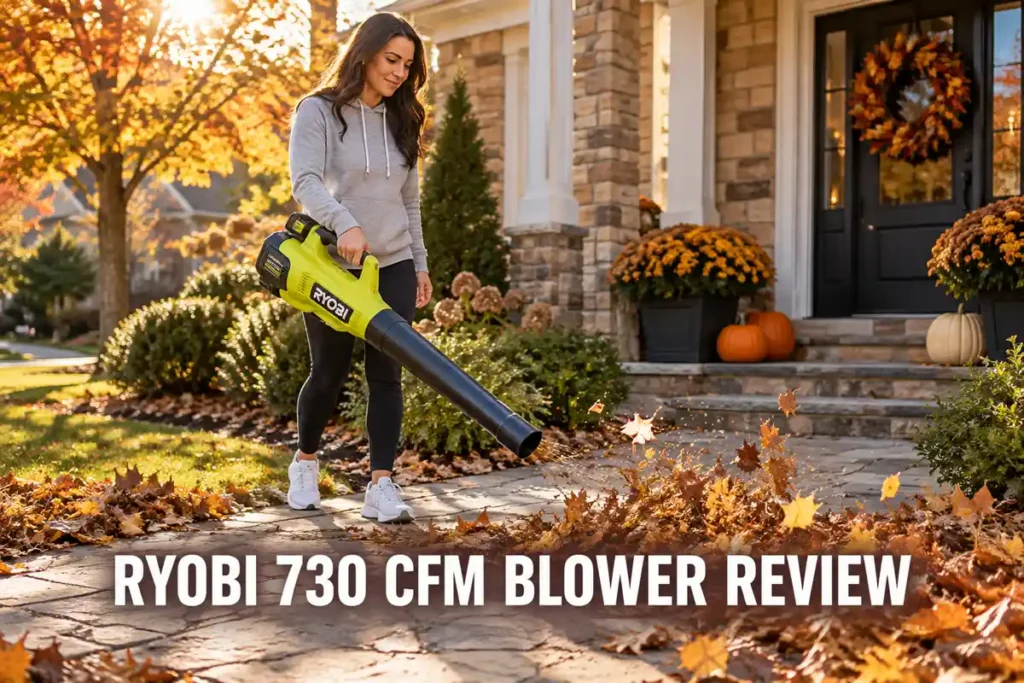
My Ryobi 730 CFM blower review ends in a split verdict: a yes for owners of Ryobi 40V packs and a skip for anyone starting from zero, because this listing is the bare tool with no battery and no charger. The 800 CFM model next to it has the higher airflow rating, so the 730 earns its place through its dedicated turbo button. I used it on the concrete pad in front of the machinery shed, the packed paths of the vegetable plot and the gravel yard. Below are the controls, force, run time, the noise claim and a warranty term that matters on a farm.
Affiliate Disclosure: Garden Power Scout is a proud participant in the Amazon Services LLC Associates Program. As an Amazon Associate, we earn from qualifying purchases, at no extra cost to you.
Ryobi 730 CFM Blower Review: My Verdict in Brief
The blower gives about 11 N of push on high and about 20 N on turbo, enough for dry and damp leaves around a house lot and too little for a soaked mat. A newton is the push of the air against a surface, so 20 N is a little over 4 lb.
The real decision is between this 730 and the 800 CFM model. Both listings are tool only, both take the same 40V packs and both sit in the same price tier. The 800 carries the higher airflow rating, 800 CFM against 730, while the 730 has a dedicated turbo button where the 800 has a mode button. I pick the 730 when I want that turbo button, and the 800 when the airflow rating decides it.
- Who it is for: owners of Ryobi 40V packs who clear a house lot, a driveway or a small yard.
- What it does best: a turbo button for short bursts on damp leaves and a cruise lever for long sweeps.
- Main trade-off: about 20 N of push on turbo, and a listing that sells the tool without a pack or a charger.
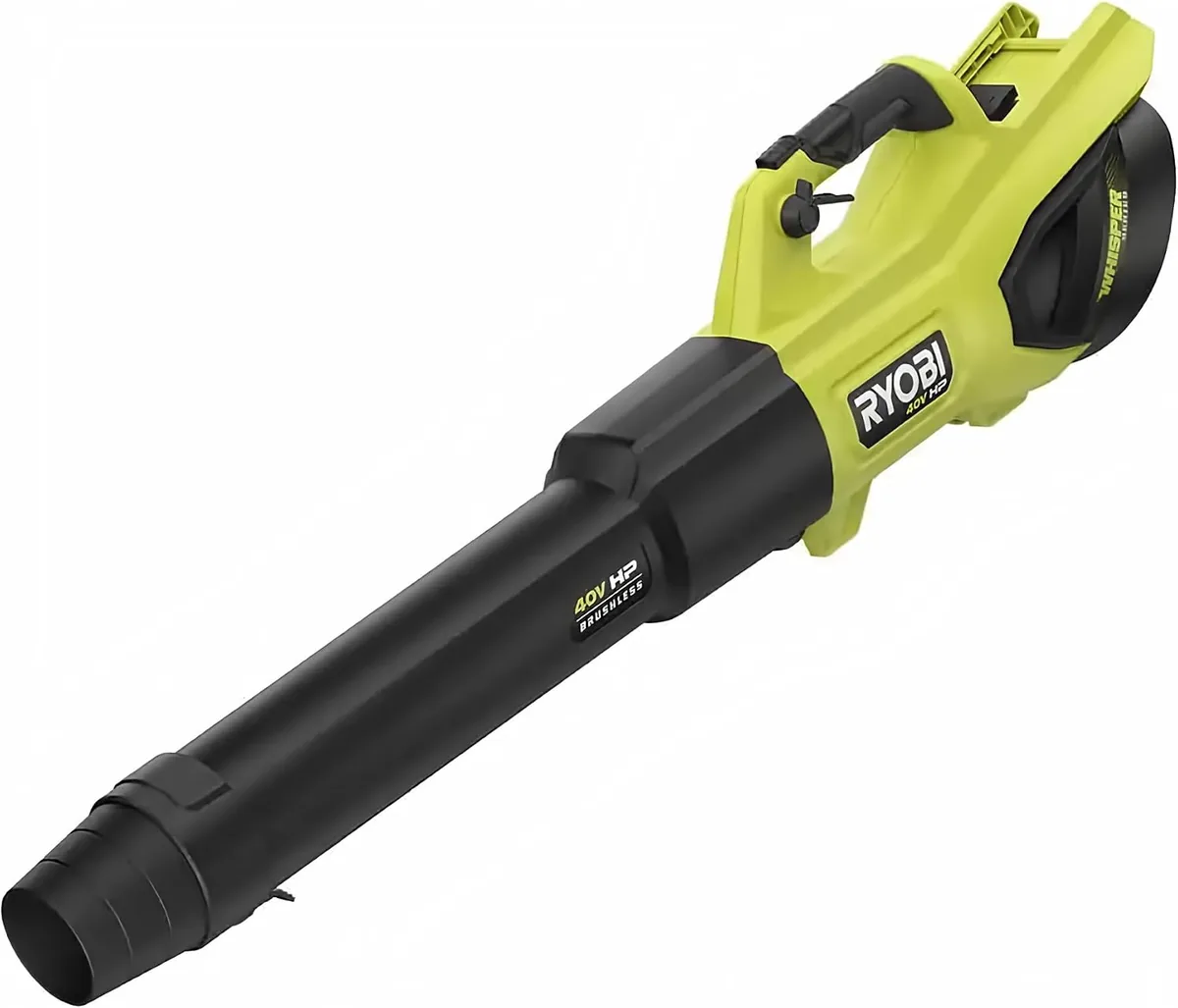
What the Ryobi 40V HP 730 CFM Whisper Series Blower Is and What You Still Need to Buy
The Ryobi 40V HP Brushless Whisper Series 730 CFM Leaf Blower is a cordless handheld with a brushless motor, a one-hand tube and a variable-speed trigger. It blows only, with no vacuum or mulch mode.
According to Ryobi, the box holds the blower, the tube, speed tips and the manual, with batteries and charger sold separately. Check the box contents on the listing, because the Ryobi 730 CFM blower tool only version holds nothing that stores energy.
A first-time buyer adds a charger and a pack, and the Ryobi 40V 730 CFM blower takes any Ryobi 40V battery. Those two are the real cost of starting. Ryobi RY404010 is the blower, RY404010BTL is this tool-only listing and RY404100 is the kit with two 4.0 Ah packs and a charger.
Ryobi RY404010BTL Specs at a Glance
Two rows decide the fit: the push on turbo and the run time, and the run time depends on the pack you add to the Ryobi 40V HP brushless 730 CFM blower.
| Spec | Value |
|---|---|
| Airflow, maker’s figure | 730 CFM |
| Air speed, maker’s figure | 190 mph with the speed tip, 145 mph without it |
| Push on high, about | 11 N |
| Push on turbo, about | 20 N |
| Weight without battery, maker’s figure | 6.5 lb |
| Noise rating, maker’s figure | 57 dB, with no distance given |
| Run time on the box, maker’s claim | About 2 hours on two 4.0 Ah packs, low trigger |
| Warranty, maker’s term | 5 years for household use, 90 days for business use |
Setup, Speed Tips and Controls
Setup takes no tools, and three controls sit under one hand.
Setup and Speed Tips
Slide the tube onto the blower outlet with the tab facing down, press the speed tip on until its tab sits in the notch, and seat the battery last, because a battery tool is live the moment the pack latches. I follow that order every time, and I pull the pack before I carry the tool or clear a jam.
According to Ryobi’s manual, air speed is 190 mph with the speed tip fitted and 145 mph without it. The tip narrows the stream, which raises speed and lowers volume, so I leave it off for wide sweeps and fit it for slab seams and gravel edges. Eye protection and hearing protection go on before the first pull, and the manual keeps bystanders and pets 50 ft away.
Trigger, Turbo Button and Cruise Control
More pressure on the trigger gives more speed, so the trigger is your throttle. While the trigger is down, a press of the turbo button lifts the airflow to maximum, and letting go returns the blower to the speed you held. The 800 CFM sibling has a mode button where the 730 has the turbo button.
Pull the trigger to the speed you want, engage the cruise lever and let go, and the speed stays locked. On the 150-foot gravel strip I set cruise on a middle speed, and my trigger finger stopped cramping halfway down the run. Ryobi lists the tool at 6.5 lb without a battery, and after half an hour the pack shows in my forearm, so I switch hands for the return run.
Performance on Leaves, Gravel and Wet Mats
The Ryobi 730 CFM leaf blower moves more volume than force, so wet leaves decide the result.
Dry and Damp Leaves on the Plot Paths
On the packed paths of the vegetable plot I keep the trigger low, because fast air strips the wood-chip mulch, and I leave the speed tip off to keep the stream wide. Damp leaves that stick to the soil ask for high, and when a patch will not lift I press turbo for a few seconds and let go.
Wet Mats on the Path to the House
A soaked mat is where 20 N runs out. Wet leaves hold on with a film of water and their own weight, so a wide stream that gets under the leading edge does more than a fast thin one on top. On the 4-foot concrete path to the house door I stand at the door end and walk the mat down the path in short turbo presses, and what a second press leaves behind I rake up.
Slab Seams, Gravel and the Pump Shelter
On the slab seams of the work pad the speed tip digs packed grit out of the joints. At the pump shelter, where leaves and twigs collect around the 150-mesh disc filter, I fit the tip, keep the trigger low and aim along the fittings, so grit does not get driven into them. Eye protection stays on for both jobs, and a dust mask goes on in the dusty machinery shed.
On gravel, a steep angle throws stones, so keep the nozzle low and bystanders, cars and windows clear.
Run Time: What Two Hours on the Box Really Means
According to Ryobi, the blower runs about 2 hours on two 4.0 Ah batteries on the low setting, using the variable-speed trigger.
High and turbo draw far more power than a low trigger, and Ryobi gives no minutes for either, so plan a leaf day on the high setting, not on the box figure. Turbo is the biggest drain, so I spend it in short presses and never hold it down across a lawn.
Cold costs minutes too. In lab tests on lithium-ion cells, the anode limited performance at every temperature, and below about -4 F lithium metal plated on it and caused permanent capacity loss (1). On frost mornings I keep the pack indoors until I start.
Whisper Series Noise: What 57 Decibels and 86 Percent Quieter Mean
The Ryobi Whisper Series leaf blower carries 57 dB on its spec table, and Ryobi adds that it is 86 percent quieter than gas. Ryobi gives no distance, no setting and no baseline gas blower for either number, so neither is an ear-level reading.
In a field test of two leaf blowers and a hose vacuum, the combined sound measured about 102 dB(A) near the machines and about 57 dB(A) at 800 feet (2).
Battery blowers still beat fuel blowers: NIOSH sampling of landscaping workers found significantly more noise and carbon monoxide exposure with fuel-powered leaf blowers than with battery versions (3). Hearing protection stays mandatory, and fit matters, since a Cochrane review notes that lack of earplug fit may limit protection for about 40 percent of users (4). The plugs go in before I walk out to the pad, and in the shed I add muffs.
Care, Storage, Rain and Warranty
According to Ryobi’s manual, the blower never goes out in rain or wet conditions: damp leaves are fine, while rain, wet snow and standing water are not.
A pack ages fastest when it sits charged and hot: a modelling study of 36 months of storage at 131 F and a 90 percent charge found the electrolyte conductivity dropped by more than 20 percent (5). I keep a charged pack out of the hot tool shed in summer.
The 5-year tool warranty covers personal, family or household use, and business or commercial use gets 90 days. The battery and charger carry 3 years. I sell fruit from my orchard, so the short term may be mine, and Ryobi decides how orchard work is classed; ask before you count on the five years.
Who Should Buy It and Who Should Skip It
The pack on your shelf decides this purchase more than the blower does.
Buy It If
- You already own Ryobi 40V packs and clear a house lot, a driveway or a small yard.
- You want a turbo button for damp leaves and cruise control for long sweeps.
- You prefer a dedicated turbo button to the mode button on the 800 CFM model.
Skip It If
- You have no Ryobi packs and a tight budget, since the pack and charger are the real cost.
- You clear soaked leaf mats or deep gravel edges, where about 20 N on turbo runs out.
- You work for hire or sell what your land grows, and need cover beyond 90 days.
- You want a vacuum or mulch mode.
Drawbacks and Common Problems
Three drawbacks matter, and each has a workaround.
- Tool only: a first-time buyer pays for a pack and a charger on top, so price the kit against the bare tool plus a pack.
- Modest push: about 20 N on turbo is too little for a soaked mat, so rake deep mats first.
- Short turbo bursts: turbo drains a pack fastest. Plan on high and charge the spare the night before.
The manual also forbids use on a ladder, a rooftop or a tree, so work from the ground.
How the Ryobi 730 CFM Blower Compares With Alternatives
The table covers the two tool-only rivals on 40V packs, and the EGO kits get a paragraph below. More models are in my leaf blower guides.
| Model | Airflow, maker’s figure | In the box | Battery system |
|---|---|---|---|
| Ryobi 730 CFM | 730 CFM | Tool only | Ryobi 40V |
| Ryobi 800 CFM | 800 CFM | Tool only | Ryobi 40V |
| Greenworks 40V | 500 CFM | Tool only | Greenworks 40V |
Ryobi 800 CFM for Higher Airflow
The Ryobi 800 CFM blower takes the same 40V packs and is rated for 800 CFM against the 730’s 730. It swaps the 730’s turbo button for a mode button with Max Power and Max Run Time. Pick the 800 if the higher airflow rating decides it, and the 730 if you want the dedicated turbo button.
EGO LB7654 and LB6504 for a Complete Kit
The EGO LB7654 puts a 5.0 Ah pack and a charger in the box. The LB6504 also ships with a 5.0 Ah pack. Both run on EGO’s 56V system. Pick an EGO kit if you own no battery platform, and the 730 if Ryobi packs already sit on your shelf.
Greenworks 40V 500 CFM for a Lower-Airflow Tool Only
According to Greenworks, this tool-only blower moves 500 CFM at 120 mph and carries a 3-year warranty for personal use. Pick it if you already own Greenworks 40V packs.
My Final Recommendation
I recommend the 730 to owners of Ryobi 40V packs who clear a house lot, a driveway and a small yard and want a dedicated turbo button with cruise control. The 800 CFM listing sits in the same price tier and carries the higher airflow rating, so look at both when you shop and choose the 730 when the turbo button matters more to you.
A first-time buyer should skip both, because the pack and the charger add to the cost. My Ryobi 730 CFM blower review verdict is a buy for the lawn, the yard and the shed pad if Ryobi packs already sit on your shelf, and a pass if you would be buying your first.
Frequently Asked Questions
What are some common issues with Ryobi leaf blowers?
The common issues with this Ryobi blower are a tool-only listing that needs a separate 40V battery and charger, and modest push of about 11 N on high and 20 N on turbo. Turbo drains a pack quickly, and the warranty drops from five years to 90 days for business use.
Are Ryobi 40V and 40V HP interchangeable?
Ryobi says any 40V battery works with any 40V product, so a standard 40V pack fits a 40V HP tool such as this 730 CFM blower. Ryobi does not state how much output the HP tool gives on a standard pack, and its kit version ships with 4.0 Ah packs.
Which Ryobi leaf blower is considered the best?
Among Ryobi’s 40V Whisper handhelds, the 800 CFM model carries the highest airflow rating, with the 730 CFM model in the middle and the 650 CFM model below it. This 730 suits a buyer who wants a dedicated turbo button for short, strong bursts on damp leaves around a house.
Is a Ryobi leaf blower worth buying?
A Ryobi leaf blower is worth buying if you already own Ryobi 40V packs and want a handheld for a house lot, a driveway and a small yard. This 730 CFM model arrives as a bare tool, so a first-time buyer must add a pack and a charger before the first leaf moves.
How long does a Ryobi leaf blower last?
A Ryobi leaf blower runs about 2 hours on two 4.0 Ah packs at a low trigger by Ryobi’s figure, and high or turbo use empties a pack much sooner. Ryobi backs the tool for five years of household use and the battery for three, with 90 days for business use.
References
- Lin H-p, Chua D, Salomon M, et al. Low-Temperature Behavior of Li-Ion Cells. Electrochem Solid-State Lett. 2001;4(6):A71.
- Walker E, Banks JL. Characteristics of Lawn and Garden Equipment Sound: A Community Pilot Study. J Environ Toxicol Stud. 2017;1(1).
- Alexander BM, Graydon PS, Pena M, Feng HA, Beamer BR. Hazardous exposures and engineering controls in the landscaping services industry. Journal of Occupational and Environmental Hygiene. 2025;22(3):189-202.
- Morata TC, Gong W, Tikka C, Samelli AG, Verbeek JH. Hearing protection field attenuation estimation systems and associated training for reducing workers’ exposure to noise. Cochrane Database of Systematic Reviews. 2024;5(5):CD015066.
- Asiri M, Kedhim M, Jain V, et al. Impact of temperature and state-of-charge on long-term storage degradation in lithium-ion batteries: an integrated P2D-based degradation analysis. RSC Adv. 2025;15(28):22576-22586.
Safety Note: Leaf blowers throw debris and can damage your hearing. Wear eye and ear protection, read the manufacturer’s manual, and check your local rules on noise and operating hours.