
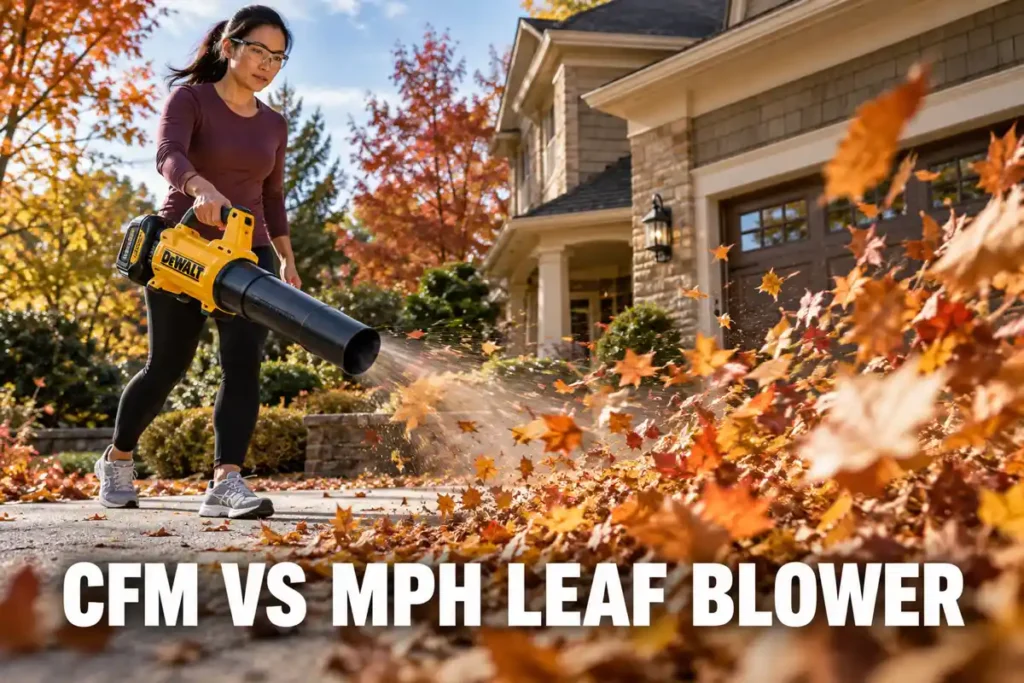
The CFM vs MPH leaf blower question has no single winner: CFM wins on dry leaves and big lawns, MPH wins on gravel, slab seams and gutters, and wet leaves need both. CFM is how much air moves, MPH is how fast it moves, and the force rating in newtons breaks the tie. I look after the lawns and outdoor areas around our family farm, so I read a blower’s two numbers by the job they have to do. Below you get the verdict for each job, a table of real blower pairs, and the way a nozzle trades one number for the other.
CFM vs MPH Leaf Blower: Which Number Matters More?
Volume carries the debris and speed breaks it loose, so the number that matters depends on what holds the debris down. A dry leaf on a lawn holds on to almost nothing, so a wide stream of air wins. A wet leaf on concrete, a stone in a gravel drive or a clump in a slab seam holds on hard, and it needs fast air first and plenty of air second.
Force ties the two together. The push of a jet equals the density of air times the volume of air times its speed, the same law that gives a jet engine its thrust, and a printed rating in newtons states that push directly. When a box shows only CFM and mph, you can multiply them for a rough estimate, as the pairs section shows. A leaf blower CFM rating on its own, or a speed rating on its own, can point you at the wrong machine.
Before you compare the two, my guide on what does CFM mean on a leaf blower covers how that volume figure is measured and what it tells you on its own.
How Air Volume and Air Speed Work Together on Debris
A blower is a fan that pushes air through a tube, and the outlet sets how the air leaves. A wide outlet gives a big, slow stream and a narrow one gives a small, fast stream, so one fan can print a different pair with a different nozzle.
What Each Number Does to a Leaf
Speed decides whether the air can break a leaf, a stone or a clump loose. Moving air drags on whatever lies under it, and the debris stays put until that drag beats the grip of water, dirt or weight. Volume decides how much moves once it is loose. A wide stream keeps rolling a whole pile along, where a narrow one pushes a few leaves and runs out of air.
A jet also pulls in the air around it as it travels, and the amount follows the jet’s momentum and its distance from the tip (1). A momentum model of a round jet matches this (2). As the stream takes in more air it spreads wider and slows down, so the farther the tip sits from the debris, the slower the air that reaches it. The total push of the jet stays about the same, but it spreads over a larger area.
Leaf blower newtons fold volume and speed into one figure, read at the nozzle. According to Husqvarna, blowing force is the better way to compare blowers, and wet or compacted debris needs more power than loose dry debris.
Why Speed Costs More Power Than Volume
A fan has only so much power to give the air each second. The power in the stream grows in step with the volume but with the square of the speed, so spending power on speed buys less push per watt than spending it on volume.
Here is the arithmetic for two imaginary blowers, with round numbers I picked to show the effect. Blower X prints 700 CFM and 100 mph, and Blower Y prints 300 CFM and 250 mph.
- Convert the units. Multiply CFM by 0.000472 for cubic meters per second and mph by 0.447 for meters per second. X becomes 0.330 and 44.7, and Y becomes 0.142 and 111.8.
- Find the mass of air per second. Air weighs about 1.2 kilograms per cubic meter, so X moves 0.40 kilograms each second and Y moves 0.17.
- Multiply the mass by the speed to get newtons. X pushes with about 17.7 N and Y with about 19.0 N.
- Find the power in the stream with half the mass times the speed squared. X needs about 400 watts and Y about 1,060 watts.
Y pushes only 7 percent harder than X while using 2.7 times the power. X is a wide, slow stream for a dry leaf mat, and Y is a thin, fast stream for a slab seam. Much of Y’s power goes into speed that adds little push.
Which Number Matters More for Each Job
I judge a job by what holds the debris down. Where nothing holds it, volume leads. Where water, packing or weight holds it, speed leads until the debris breaks free and volume finishes the move. The table gives the verdict for eight jobs, and the sections under it cover the three jobs people argue about.
| Job | Leads | Why | What I check |
|---|---|---|---|
| Dry leaves on a lawn | CFM | Nothing holds a dry leaf down, so width moves the mat | A round, open outlet and 450 CFM or more |
| Dry leaves on pavement | CFM, then speed | Smooth ground has little grip, and width saves passes | 300 CFM or more with 120 mph or more |
| Wet leaves | Force from both | Water grips the leaf, speed breaks the grip, volume rolls the mat | A printed force near 20 N or more, and the Turbo time |
| Gravel and stones | Speed | A heavy stone needs fast air at one spot, and extra volume only throws it farther | A narrow nozzle and a low throttle |
| Slab seams and packed dirt | Speed | The debris sits in a gap, so width does not help | The narrow nozzle on, not the open outlet |
| Gutters | Speed on a tube | Packed gunk needs fast air, not a wide stream | An extension kit that reaches from the ground |
| Mulch beds and drip lines | Less of both | Full output strips mulch and packs grit into emitters | A variable speed dial |
| A large lawn or an acre | CFM, then runtime | Stream width sets the number of passes | Volume on High, and minutes per pack or tank |
Dry Leaves Need Width
Dry leaves leave when a wide stream rolls under them. On the lawn beside the house, a wide round outlet pushes a dry mat along ahead of me in long, even passes. A narrow, fast jet parts the mat and leaves the pile standing.
Where Leaf Blower CFM vs MPH Advice Splits on Wet Leaves
Advice on wet leaves splits in two. One side says to buy CFM, because volume lifts the mat. The other says to buy speed, because speed breaks the grip. Each side describes half of the job.
A wet leaf sticks because a film of water grips the surface under it, and soaked leaves also weigh far more than dry ones. Speed breaks the grip at the edge of the mat, and volume then rolls the loosened mat away. A fast, thin jet frees the edge and then runs out of air, and a wide, slow stream passes over a bond it cannot break.
That is why I treat about 20 N as my floor for wet leaves. Below it, I go back to the rake for the soaked layer and keep the blower for the dry top. A blower that holds that force only on Turbo has to hold it for the whole job, so I check the minutes as well.
Gravel, Seams and Gutters Need Speed
Gravel, slab seams and gutter gunk share one trait: the debris is small, heavy or packed, so the air needs speed at a small spot and does not need width. A narrow tapered nozzle is the right tool for all three.
On the gravel yard I fit the narrow nozzle, drop the throttle and keep the tip two to three feet from the stone, tilted up. A steep angle digs stones out and throws them, and the speed that frees a stone also turns it into a projectile.
Gravel Safety
Fast air throws stones. Wear eye protection, keep the tip two to three feet from the stone, tilt the tube up and keep people, windows and parked cars out of the line.
For gutters I use the maker’s extension kit and keep my feet on the ground wherever it reaches, because the ladder is the larger risk. US emergency departments treated an average of about 136,000 ladder injuries a year from 1990 to 2005, and about 97 percent of those with a recorded location happened outside work, in settings such as homes and farms (3).
Real Blower Pairs That Show the Trade-Off
Printed pairs show the trade better than theory does. The table sets four rows side by side with the maker’s CFM and mph, the force where one exists, and my estimate, which is CFM times mph times 0.000253. That constant is air density, 1.2 kilograms per cubic meter, with the unit conversions folded in. On all four rows the estimate lands above the printed force, so use it as a rough guide for blowers whose figures are read at the same point, and never as a rating.
| Blower | CFM | MPH | Force (N) | My estimate (N) |
|---|---|---|---|---|
| Echo PB-770T (gas backpack) | 756 | 234 | 33 rated | 44.8 |
| Echo PB-9010T (gas backpack) | 1,110 | 220 | 48 rated | 61.8 |
| Husqvarna 125BVx (gas handheld) | 425 | 130 | 12.5 rated | 14.0 |
| EGO LB7654 (cordless handheld, Turbo) | 765 | 166, or 195 with tapered nozzle | about 25 on Turbo, no nozzle | 32.2 at 166 mph |
What the Pairs Show
The cleanest comparison in the table is the Echo pair. From the PB-770T to the PB-9010T the CFM rises 47 percent, the speed falls 6 percent and Echo’s force rating rises 45 percent, so when two blowers have close speeds, force follows volume.
The Husqvarna 125BVx shows the same thing from the low end. Its 425 CFM and 130 mph are each about 56 percent of the PB-770T’s, and its 12.5 N rating is about 38 percent of the Echo’s 33 N, so cutting both numbers by almost half cuts the push by more than half. The two makers read their figures at the nozzle, which keeps the comparison fair.
The EGO row shows a nozzle at work. According to EGO, the LB7654 moves 765 CFM on Turbo, and its manual lists 166 mph without the tapered nozzle and 195 mph with it. EGO prints no CFM for the nozzle, and a narrower outlet lets the fan push less air, so the speed gain of 17 percent does not become a 17 percent gain in push.
Hearing Protection
Gas blowers are loud to work with. NIOSH sampling of landscaping workers found significantly more noise and carbon monoxide exposure with fuel-powered leaf blowers than with battery versions (4), and in a test of agricultural backpack machines noise topped 100 dB(A) on every machine except one blower with its exhaust inside the hose (5). Wear ear and eye protection every time, and keep gas blowers out of closed sheds.
How Far My Estimate Runs From the Rating
On the four rows with a printed force, my estimate runs 12 to 36 percent high: 12 on the Husqvarna, 29 on the Echo PB-9010T and on the EGO, and 36 on the PB-770T. A maker’s speed is often a peak at the center of the stream, the CFM and the speed may come from different nozzles or modes, and a real stream is not a clean cylinder. Four examples do not make a rule, so treat the estimate as a rough guide for blowers that print both numbers at the same point, and trust a printed force over my sum.
How the Nozzle Trades One Number for the Other
The volume of air equals the area of the outlet times the speed of the air through it. Narrow the outlet and the speed rises while the volume falls, because the fan can push only so much air through a smaller hole. Every pair on a box carries that trade, and arguments over leaf blower mph vs cfm often compare numbers read at different nozzles, so you need to know which nozzle each number belongs to.
My plant protection training taught me the same lesson on the spray side. Air-assisted orchard sprayers balance two numbers: enough air volume to carry the droplets into the tree and enough air speed to reach the canopy. The trade runs through every one of the powered sprayers I have worked with, where the nozzle sets how much leaves the machine and how fast.
The printed CFM also changes with the point where it is read: according to Husqvarna, the 125BVx moves 470 CFM in the housing and 425 CFM at the round nozzle. Match the nozzle to the job:
- Round, open outlet: dry leaves and lawns, where width saves passes.
- Narrow tapered nozzle: gravel, slab seams and gutters, where speed at a small spot does the work.
- Neither at full output: mulch beds, drip lines and tree bases, where close, fast air strips mulch and packs grit into emitters.
Why a High Number in One and a Low Number in the Other Disappoints
A box can print one impressive number and hide a weak partner, or print a peak that belongs to a single mode. Both cause most of the disappointment, and a three-step check catches them.
Lopsided Pairs Fail in Opposite Ways
A fast, thin jet fails by lacking air. It suits a patio, a porch or a slab seam, where a small area needs fast air, and it falls short on a leaf-covered lawn, where the pile needs a stream with some body behind it.
A wide, slow stream fails the other way: it has the air and not the speed to break a wet layer’s grip, so two blowers with the same force can suit different jobs.
A Printed Peak Is Often a Mode
A battery blower’s top figure belongs to its top mode. The EGO LB7654 delivers about 16 N on High and about 25 N on Turbo with no accessory nozzle, and EGO lists about 15 minutes of Turbo on a 5.0 Ah pack. The blower is two machines, and the strong one lasts a quarter of an hour.
How to Read a CFM vs MPH Leaf Blower Pair on a Box
- Look for newtons first. If the maker prints force, compare that, and read the CFM and mph only to see how the force is split.
- Without newtons, multiply CFM by mph by 0.000253. Compare results only between blowers that print both numbers at the same point, such as both at the nozzle.
- Match the split to the job. Choose high CFM for dry leaves and big lawns, high mph with a narrow nozzle for gravel, seams and gutters, and both for wet leaves. Then check which mode and which nozzle each number belongs to.
Pro Tip
Write the printed CFM, mph and force of each candidate on one line, with the mode or nozzle each figure belongs to. When the best CFM and the best mph come from different modes, compare the figures for the mode you will use. I do this before I look at anything else on the box.
Buy on Force First, Then Volume, Then Speed
Buy on force first, then volume, then speed. Force tells you the blower can push the job, volume tells you how many passes it needs, and speed tells you whether it can break the debris loose. Pick volume for a lawn of dry leaves, pick speed and a narrow nozzle for gravel, seams and gutters, and pick a printed force near 20 N or more for wet leaves.
Force settles most mph vs cfm leaf blower arguments, so do not chase the highest mph on a box, because the Echo with the lower speed carries the higher rating. Compare models with the leaf blower guides. Settle the cfm vs mph leaf blower choice by the hardest job on your property, and buy the force that job needs.
Frequently Asked Questions
What is better in a leaf blower, CFM or MPH?
The better number in a leaf blower, CFM or MPH, depends on what holds the debris down. CFM wins on dry leaves and big lawns, and MPH wins on gravel, seams and gutters. When a CFM vs MPH leaf blower comparison ends in a tie, the force rating in newtons settles it.
What’s a good mile per hour for a leaf blower?
A good mile per hour figure for a leaf blower depends on the nozzle and on the CFM behind it. The blowers in this guide print anywhere from 130 mph on a gas handheld to 234 mph on a gas backpack, and the 130 mph model still carries a 12.5 N rating. Read the speed beside the CFM, and use the narrow nozzle when the job is gravel or seams.
Which leaf blower has the highest MPH?
Among the blowers listed here, the Echo PB-770T has the highest MPH at 234 mph, but peak speed does not decide the push. The PB-9010T prints 220 mph and is rated at 48 N against the PB-770T’s 33 N, because it moves 47 percent more air. Compare force before you compare peak mph.
Is higher CFM better for a leaf blower?
Higher CFM is better for a leaf blower when the speed stays high enough to break the debris loose. Volume wins on dry leaves and wide lawns, where it saves passes. On wet leaves, gravel and seams, extra volume without speed leaves the job half done.
What is a good CFM and MPH for a leaf blower?
A good CFM and MPH for a leaf blower is a pair that adds up to the force your hardest job needs. For dry leaves I look for 450 CFM or more with 120 mph or more, and for wet leaves a printed force near 20 N or more. The newtons rating, not either number alone, is the tie-breaker.
References
- Ricou FP, Spalding DB. Measurements of entrainment by axisymmetrical turbulent jets. J. Fluid Mech. 1961;11(1):21-32.
- Franco Medrano F, Fukumoto Y, Velte CM, Hodžić A. Mass Entrainment Rate of an Ideal Momentum Turbulent Round Jet. J. Phys. Soc. Jpn. 2017;86(3):034401.
- D’Souza AL, Smith GA, Trifiletti LB. Ladder-Related Injuries Treated in Emergency Departments in the United States, 1990-2005. American Journal of Preventive Medicine. 2007;32(5):413-418.
- Alexander BM, Graydon PS, Pena M, Feng HA, Beamer BR. Hazardous exposures and engineering controls in the landscaping services industry. Journal of Occupational and Environmental Hygiene. 2025;22(3):189-202.
- Calvo A, Preti C, Caria M, Deboli R. Vibration and Noise Transmitted by Agricultural Backpack Powered Machines Critically Examined Using the Current Standards. IJERPH. 2019;16(12):2210.
Safety Note: Leaf blowers throw debris and can damage your hearing. Wear eye and ear protection, read the manufacturer’s manual, and check your local rules on noise and operating hours.