
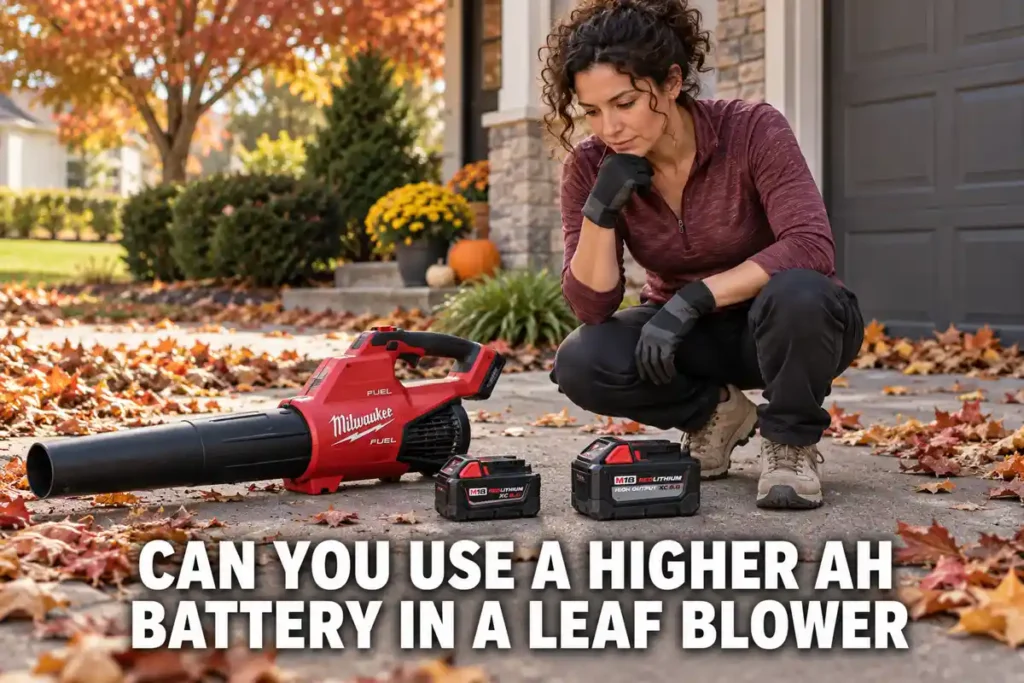
A higher Ah battery from the same maker, on the same voltage platform and seated in the tool’s battery bay, works in a leaf blower and runs it longer. It also adds weight, takes longer to charge, and lifts output only when the smaller pack was holding the tool back.
I size packs on the orchard by the hardest job, counted in minutes of blowing on High. Below you will find what amp hours measure, what a bigger pack changes, where the makers set limits and how to size a pack for your yard.
Can You Use a Higher Ah Battery in a Leaf Blower? Yes, With Two Checks
Two checks decide whether a larger pack works in your tool. The pack must belong to the same maker and the same voltage platform, and it must fit the tool’s battery bay. The amp hours (Ah) printed on a pack say how long it can run the tool. They never change the voltage the tool needs.
- Same maker, same voltage platform. An EGO 56V pack runs EGO 56V tools, and a Ryobi 40V pack runs Ryobi 40V tools. Crossing brands is a separate question from choosing a size, and I leave it out here.
- The pack fits the bay and the tool accepts it. Makers list which packs go with which tools, so read the manual for your model before you buy.
Some makers also recommend a pack size for full output. That is advice about performance, not a rule about what fits, and the power section below shows the cases.
Once both checks pass, a bigger pack changes three things in a predictable way. Runtime grows in proportion to the energy in the pack, the tool gets heavier, and the same charger needs longer to fill it. On a few power-hungry blowers the output rises too, because a small pack can be the limit.
Battery Amp Hours Explained as a Fuel Tank
Amp hours (Ah) measure how much charge a pack holds. A 5.0 Ah pack can supply 5 amps for one hour, or 10 amps for half an hour, in the ideal case. Think of the pack as a fuel tank. Voltage is the pressure behind the fuel, and the tool’s draw is how fast it empties the tank.
Amp hours on a battery say nothing about its voltage, so Ah compares packs fairly only inside one platform. Watt-hours (Wh) work across platforms: volts times amp hours. According to EGO, power in watts is voltage times current, and energy in watt-hours is voltage times capacity in amp hours.
| Pack | Energy (Wh) | Weight (lb) | Energy per pound (Wh/lb, about) |
|---|---|---|---|
| 2.5 Ah | 140 | 2.8 | 50 |
| 4.0 Ah | 224 | 4.8 | 47 |
| 5.0 Ah | 280 | 4.9 | 57 |
| 6.0 Ah | 336 | 6.2 | 54 |
| 7.5 Ah | 420 | 6.3 | 67 |
| 10.0 Ah | 560 | 7.5 | 75 |
| 12.0 Ah | 672 | 7.9 | 85 |
Energy per pound rises with pack size overall, from about 50 Wh per pound on the 2.5 Ah pack to about 85 on the 12.0 Ah pack, with small dips at 4.0 and 6.0 Ah. The tool still gets heavier, since the step from 5.0 to 12.0 Ah adds about 3 pounds. EGO’s product pages mark the 2.5 Ah and 7.5 Ah packs as discontinued, so check which sizes are on sale.
Badges can mislead on other platforms. According to DeWalt, its 20V MAX figure is the initial voltage measured without a load, and the nominal voltage is 18. By the badge its 9.0 Ah FlexVolt pack holds 180 Wh; at the nominal 18 volts it holds about 162 Wh.
What a Bigger Battery Changes
Runtime and weight change every time a pack gets bigger. Output changes only on some tools, and wear is a small side effect of the change.
Runtime Follows Watt-Hours
At one setting, minutes follow watt-hours: twice the energy runs the tool about twice as long. The EGO LB7654 runs about 22 minutes on High from its 5.0 Ah pack, so 280 Wh over 22 minutes is a draw of about 760 W. Scaled by pack energy, that is about 18 minutes on 4.0 Ah, 26 on 6.0 Ah, 44 on 10.0 Ah and 53 on 12.0 Ah. Real packs lose some energy to heat, so the larger ones may land a little under or over.
The first time a pack died at the far end of the plum alley with a pile still waiting, I stopped trusting the average runtime on the box. I now count minutes on High before I look at the Ah number, because wet leaves ask for High.
Weight and Balance
Extra capacity makes the tool heavier. On the EGO LB7654, the step from the kit’s 5.0 Ah pack to a 10.0 Ah pack adds about 2.6 pounds. That takes the tool from about 9.5 pounds to about 12.1 pounds, about 27 percent more weight in your hands.
A handheld that feels light at minute five feels heavy at minute forty. With a big pack my wrist is the first to complain, well before my shoulder, so I swap hands and break a long job by task instead of by battery.
Power Under Load
Capacity is not power. The motor, the fan and the nozzle set how hard a blower can blow, and a pack can only hold the tool under that ceiling. What a pack can do is become the limit. The internal resistance of a cell decides how much power it can deliver and how much energy it wastes as heat (1).
According to EGO, cells arranged in series deliver the voltage, and an identical number of cells added in parallel deliver more capacity and higher power. That holds for packs built from the same cells. An Ah figure alone does not tell you a pack’s power, because cell quality and construction count as much.
Blowing force shows where this matters. Force is the push of the air at the nozzle, measured in newtons (N), and about 4.5 N equal one pound of push. The table shows the top output setting of two EGO blowers with different packs. The two blowers were tested separately, so read each one against its own packs.
| Blower | Pack | Blowing force |
|---|---|---|
| EGO LB8800 | 4.0 Ah | About 20 N |
| EGO LB8800 | 7.5 Ah | About 24 N |
| EGO LB8800 | 12.0 Ah | About 29 N |
| EGO LB7654 | 5.0 Ah | About 25 N |
| EGO LB7654 | 10.0 Ah | About 26 N |
On turbo, the LB8800 empties its 4.0 Ah pack in about 8 minutes, and the LB7654 empties its 5.0 Ah pack in about 13. The faster a blower empties its pack, the more the pack limits the tool, and a bigger pack then lifts the output. Each blower is its own case, and on the LB7654 the gain is small.
I put the gap down to voltage sag: a small pack drops in voltage under a heavy draw, so the blower cannot reach its top output. According to EGO, the LB8800 shows only the bottom two air-speed bars when the pack is under 4.0 Ah, and the LB7654 manual advises a 4.0 Ah pack or larger for best performance.
Cold makes the problem worse. In lab tests at subzero temperatures, higher internal resistance meant lower capacity and less available power (2). On frost mornings I keep the pack indoors until I start, because a pack that gave a full run in October gives less in November.
Wear and Pack Life
A larger pack may also age more gently, because the same job takes a smaller share of its charge, and lab cycling of commercial lithium-ion cells found that discharge rate, depth of discharge and temperature changed the time to reach 80 percent of capacity by thousands of hours (3). That is a cell test, not a tool pack, so I count longer life as a side benefit and buy for runtime.
What a Higher Ah Battery Does Not Change
Amp hours size the tank and nothing else, so two things stay exactly where they were, whatever pack size you choose and whichever tool it goes into.
- Voltage: the platform sets it. An EGO pack stays 56V at every size, a Ryobi pack stays 40V, and a Milwaukee M18 pack stays 18V.
- The ceiling of the tool: the motor, fan and nozzle set the top airflow and speed, and no pack lifts the tool past them. The CFM and mph rating on the box does not move with the pack.
Once a blower reaches its full output on the pack it has, a bigger pack leaves a weak blower weak. If the tool cannot move your wet leaves at full output, extra amp hours only let it fail for longer.
What the Makers Say About Bigger Packs
Every maker I checked says the same thing in different words: stay inside the platform, and the Ah rating changes run time. The exceptions sit in the fine print of each cordless leaf blower battery line, so the table gives what each maker states and the limit to remember.
| Maker (platform) | What the maker says | Limit to remember |
|---|---|---|
| EGO (56V) | According to EGO, all EGO ARC lithium batteries work with all EGO tools and chargers, and a pack with more amp hours than the recommended one gives longer run time. | Recommended sizes apply per tool, as in the power section above. |
| Ryobi (40V) | According to Ryobi, its 40V 4 Ah battery fits over 85 Ryobi 40V tools. | Ryobi’s 18V ONE+ line is a different platform. Multiply 36 V by the amp hours for watt-hours: a 4 Ah pack is about 144 Wh. |
| DeWalt (20V MAX and FlexVolt 60V MAX) | According to DeWalt, the FlexVolt 9.0 Ah pack works in all 20V MAX, 60V MAX and 120V MAX tools and with all 20V MAX chargers. | A 20V MAX pack does not run a 60V MAX blower. The DCBL722 is a 20V MAX blower and the DCBL772 is a 60V MAX FlexVolt blower. |
| Milwaukee (M18) | According to Milwaukee, the 2824-20 works best with two High Output HD8.0 packs or higher capacity. | The tool needs two packs, and two matching packs are the safe choice. |
| Makita (18V LXT) | According to Makita, 18V LXT batteries are fully compatible with LXT products and work only with LXT products. | The 5.0 Ah BL1850B fits only tools with the Star symbol or yellow battery receivers. |
With a DeWalt leaf blower battery, the first question is 20V MAX or 60V MAX, because the badge decides which packs fit. FlexVolt packs fit both lines, while 20V MAX packs fit only the smaller one.
Charging a Bigger Pack
Charging takes longer with a bigger pack, and the charger in the box is usually the slow one. According to EGO, the LB7654 kit ships with a 320 W charger, and the table shows what that costs on bigger packs.
| Pack | 700 W Turbo charger | 320 W kit charger |
|---|---|---|
| 5.0 Ah | 30 | 70 |
| 10.0 Ah | 60 | 130 |
| 12.0 Ah | 75 | 160 |
According to EGO, any EGO charger charges any EGO battery, so a slow big pack has a simple fix: a faster charger. Speed has a cost, because fast charging adds heat, and a lab model checked against measurements on five charge scenarios used accumulated thermal burden to predict how fast charging shortens cycle life (4).
A second pack replaces a big one only when the charger keeps up. Two 5.0 Ah packs give about 44 minutes on High, and the first pack must be full again when the second runs out. The Turbo charger needs 30 minutes against the 22 the second pack lasts, so you wait about 8 minutes, and the kit charger needs 70 minutes, so you wait about 48.
Battery Safety
Take the pack off the tool before you change a nozzle or clear a jam. Warm a cold pack to room temperature before charging it, let a hot pack cool first, and stop using any pack that is damaged or swollen.
How to Pick the Pack Size for Your Yard
Pick the pack by your hardest job, not your average one. The right battery for leaf blower work is the one that covers your longest stretch on High between charges, since High is the setting wet leaves demand.
Four Steps to the Right Size
- Count the minutes you need on High for your hardest job.
- Find the tool’s draw on High in watts. Makers rarely print it, so work it out from a pack you own: multiply its watt-hours by 60 and divide by the minutes it lasts on High. For the LB7654, 280 Wh times 60 divided by 22 minutes is about 760 W.
- Multiply the draw by your minutes and divide by 60 to get the watt-hours you need, then add about 10 percent for heat and cold.
- Pick packs whose watt-hours in the EGO table above cover that figure, and check the maker’s recommended size for your tool.
Then choose one large pack, one small pack plus a spare, or two equal packs. Weight and charger speed break the tie, and a pack that fits your other tools beats a larger one that fits only one.
A Worked Example With 40 Minutes on High
Take the EGO LB7654 on a half-acre job with wet leaves and gravel edges that needs 40 minutes on High. At about 760 W, that is 760 times 40 divided by 60, or about 507 Wh, and about 560 Wh with 10 percent spare. One 10.0 Ah pack holds 560 Wh, and so do two 5.0 Ah packs.
Weight decides between them. One 10.0 Ah pack makes the tool about 12.1 pounds, while a 5.0 Ah pack keeps it near 9.5 pounds, with the second pack carried in a bag for one swap near minute 22. If I swap anyway, I take two 5.0 Ah packs; for 40 straight minutes without a break, one 10.0 Ah pack is simpler.
Size packs by the longest stretch between charges, not by the season. I still add up the High minutes of the lawn, the yard and the orchard strips from late October to mid-November, but only to count how many full charges the season takes.
Starting Points by Yard
| Hardest job | Minutes on High | Energy needed (about) | Pack choice (EGO sizes) |
|---|---|---|---|
| Patio, deck, small lawn | 15 | 210 Wh | One 4.0 Ah (224 Wh) or the kit 5.0 Ah (280 Wh) |
| Quarter-acre lawn with leaf fall | 30 | 420 Wh | A 5.0 Ah plus a spare 4.0 Ah (504 Wh), or one 10.0 Ah (560 Wh) |
| Half acre, wet leaves, gravel edges | 40 | 560 Wh | One 10.0 Ah or two 5.0 Ah (560 Wh) |
| Long day, big yard, orchard strips | 90 | 1,250 Wh | Two 12.0 Ah (1,344 Wh), or a backpack blower |
The table assumes High. On low settings the same pack lasts several times longer: according to EGO, the LB7654 manual lists about 150 minutes on low with a 5.0 Ah pack.
Common Mistakes With Bigger Packs
Four mistakes are easy to make with bigger packs, and each has a short fix.
- Assuming more Ah means a stronger blower. A bigger pack adds minutes and lifts output only where the small pack was the limit. Check the maker’s recommended size before you pay for size.
- Comparing Ah across platforms. The same Ah number means different energy on different voltages, so compare watt-hours, and keep a Ryobi pack with Ryobi tools and an EGO pack with EGO tools.
- Buying a pack under the maker’s recommended size. On the EGO LB8800 a pack under 4.0 Ah caps the air speed at two bars. Before I buy any pack, I read the manual for the recommendation.
- Buying the biggest pack for the smallest job. You carry extra pounds for minutes you never use, so match the pack to the hardest job in the yard table above.
Match the Pack to Your Hardest Job
Minutes follow watt-hours, weight follows the pack, and output rises only on a blower that was starving, so size the pack to the longest stretch you work between charges and check the maker’s recommended size.
My leaf blower guides help you choose the tool to pair with it. A higher Ah battery on the same platform, at or above the maker’s recommended size, gives your leaf blower more minutes where wet leaves need them.
Frequently Asked Questions
Can I use a 6Ah battery instead of 2Ah?
You can use a 6Ah battery instead of a 2Ah battery when both belong to the same maker and voltage platform and the 6Ah pack fits the tool’s bay. A 6Ah pack holds three times the charge, so it runs the tool about three times as long, and it weighs more and takes longer to charge. Check the tool’s manual for a minimum pack size before you buy.
Is a higher Ah battery better?
A higher Ah battery is better when you need runtime and worse when weight or charge time matters more. It lifts blowing force only on a high-draw blower whose smaller pack was the limit.
Does a higher Ah battery give more power?
A higher Ah battery gives more power only when the smaller pack was the limit, and otherwise it gives more runtime. On the EGO LB8800, force at the top setting runs about 20 N on a 4.0 Ah pack and about 29 N on a 12.0 Ah pack, while the EGO LB7654 gains little, from about 25 N on 5.0 Ah to about 26 N on 10.0 Ah.
What are amp hours on a battery?
Amp hours on a battery are the charge capacity of the pack, which makes them the size of its tank. A 5.0 Ah pack can supply 5 amps for one hour, and multiplying amp hours by volts gives the watt-hours you use to compare packs.
How to calculate battery amp hours?
To calculate battery amp hours, multiply the current the tool draws in amps by the hours it runs. A tool drawing 10 amps for 30 minutes uses 5 Ah, and multiplying that by the pack’s volts gives watt-hours for comparing packs.
References
- Schweiger H-G, Obeidi O, Komesker O, et al. Comparison of Several Methods for Determining the Internal Resistance of Lithium Ion Cells. Sensors. 2010;10(6):5604-5625.
- Hossain Ahmed S, Kang X, Bade Shrestha SO. Effects of Temperature on Internal Resistances of Lithium-Ion Batteries. J Energy Resour Technol. 2015;137(3):031901.
- Preger Y, Barkholtz HM, Fresquez A, et al. Degradation of Commercial Lithium-Ion Cells as a Function of Chemistry and Cycling Conditions. J. Electrochem. Soc. 2020;167(12):120532.
- Koo B, Yi J, Lee D, Shin CB, Park S. Modeling the Effect of Fast Charge Scenario on the Cycle Life of a Lithium-Ion Battery. J. Electrochem. Soc. 2018;165(16):A3674-A3683.
Safety Note: Leaf blowers throw debris and can damage your hearing. Wear eye and ear protection, read the manufacturer’s manual, and check your local rules on noise and operating hours.