
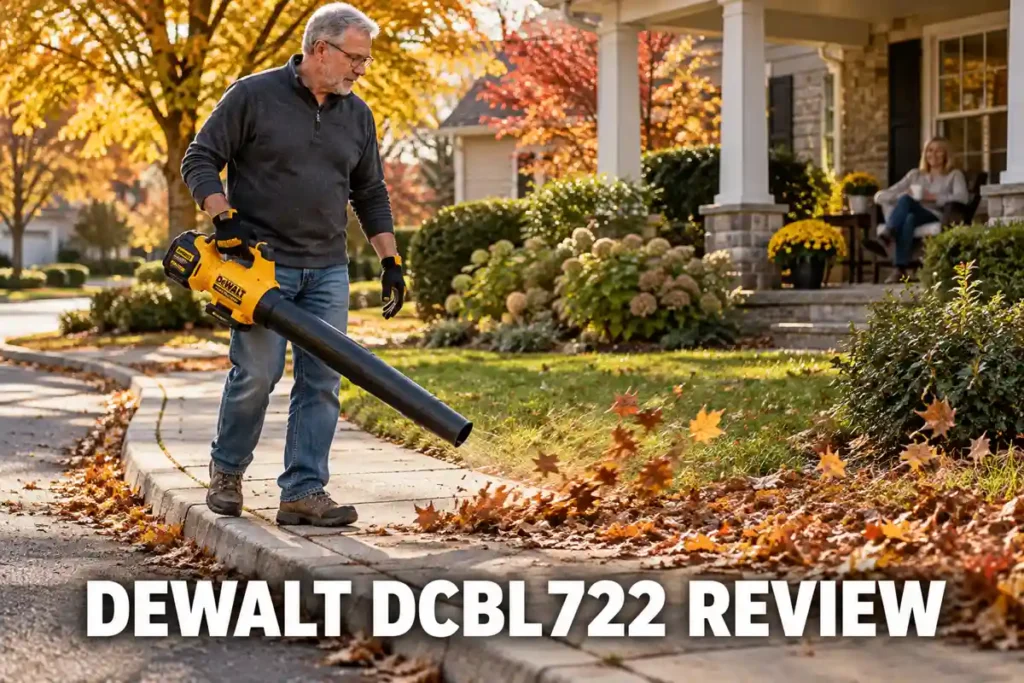
The DeWalt DCBL722 is a light 20V blower that does well on dry leaves, decks and a house lot, and it gives up on wet leaf mats and long jobs. I recommend the bare tool to anyone who already owns DEWALT 20V packs and the kit to anyone who does not, and I skip it for acreage. I keep the lawns, gravel yard and sheds around my 3.7-acre orchard, and I ran this blower along the lawn edge and the concrete path to the house door. Read on for the kit, the pack, the noise rating and the manual’s rain rules.
Affiliate Disclosure: Garden Power Scout is a proud participant in the Amazon Services LLC Associates Program. As an Amazon Associate, we earn from qualifying purchases, at no extra cost to you.
DeWalt DCBL722 Review: My Verdict in Brief
This DEWALT 20V MAX leaf blower is light, simple and short on full power. DEWALT rates it at up to 450 CFM and up to 125 mph with the concentrator nozzle, and its only run time figure is up to 87 minutes for the bare tool on the lowest speed with a 5.0 Ah pack. I pick it for small jobs and for owners with 20V packs, and I leave wet mats and big areas to a stronger tool.
- Who it is for: owners of DEWALT 20V packs with a house lot, a deck and mostly dry leaves.
- What it does best: moves dry leaves, clippings and twigs with a speed lock lever that rests the trigger finger.
- Main trade-off: full power drains the kit’s pack fast, and matted leaves barely move.
What the DeWalt DCBL722P1 Kit Holds and What It Does Not
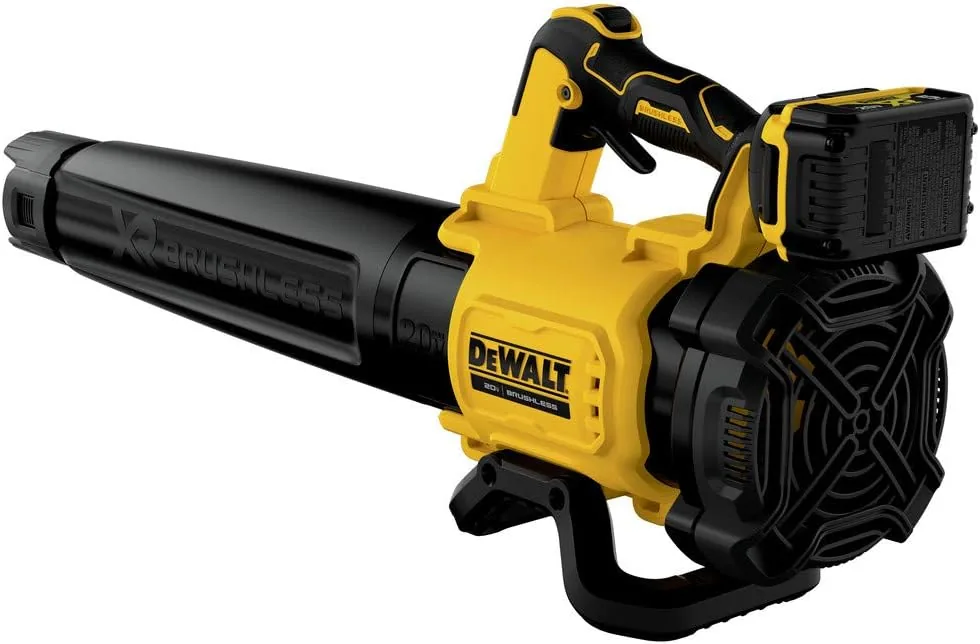
The DEWALT DCBL722P1 is the kit, and the P1 means one battery in the box. According to DEWALT, it holds the blower, one DCB205 5.0 Ah battery, one DCB115 charger and one concentrator nozzle.
DEWALT DCBL722B vs DCBL722P1: Kit or Bare Tool
The DCBL722B is the bare tool: blower and nozzle, with no battery and no charger. It suits an owner with 20V packs on the shelf, who has no use for a second pack and charger, and a buyer without packs needs the kit.
DeWalt DCBL722 Battery: Which Packs Fit
The kit’s DCB205 is a 5.0 Ah pack. The manual also lists the DCB2-series 20V packs from the DCB201 to the DCB240, plus the larger DCB606, DCB609, DCB612 and DCB615. A DEWALT 20V blower battery from that list runs the tool, and the manual warns that other packs risk injury and fire.
DeWalt DCBL722 Specs: Airflow, Air Speed, Weight and Noise
Two rows decide the fit: run time and noise, because DEWALT gives the first only for the lowest speed and the second with no distance.
| Spec | What DEWALT prints |
|---|---|
| Airflow, maker’s figure | Up to 450 CFM |
| Air speed, maker’s figure | Up to 125 mph with the concentrator nozzle fitted |
| Run time, maker’s figure | Up to 87 minutes per charge for the bare tool on the lowest speed with a DCB205; none for high speed |
| Weight, maker’s page data | About 7.2 lb for the tool alone; about 9.4 lb for the kit |
| Noise, maker’s figure | 62 dB(A) on the US page, with no distance given |
According to DEWALT’s page data, the bare tool weighs about 7.2 lb and the kit about 9.4 lb. In one hand along the lawn edge with the pack on, the tool feels light.
Setup, Controls and First Use
Setup follows the manual in this order:
- Set the speed lock lever to OFF and take the battery out.
- Push the tube into the body until it clicks, then pull on it to test the lock.
- Slide the concentrator onto the tube until its tabs click into the holes.
- Fit the battery.
The trigger runs the blower while you hold it. Pushing the lever forward locks it on, and the further forward it goes, the faster the air. Pull the lever back to OFF to stop, and set it there before a battery goes in or comes out.
On a long sweep down the lawn edge I set the lever part way and let my trigger finger rest, which keeps my hand from cramping. After switch-off I wait 10 seconds before I touch the tube, because the fan keeps turning.
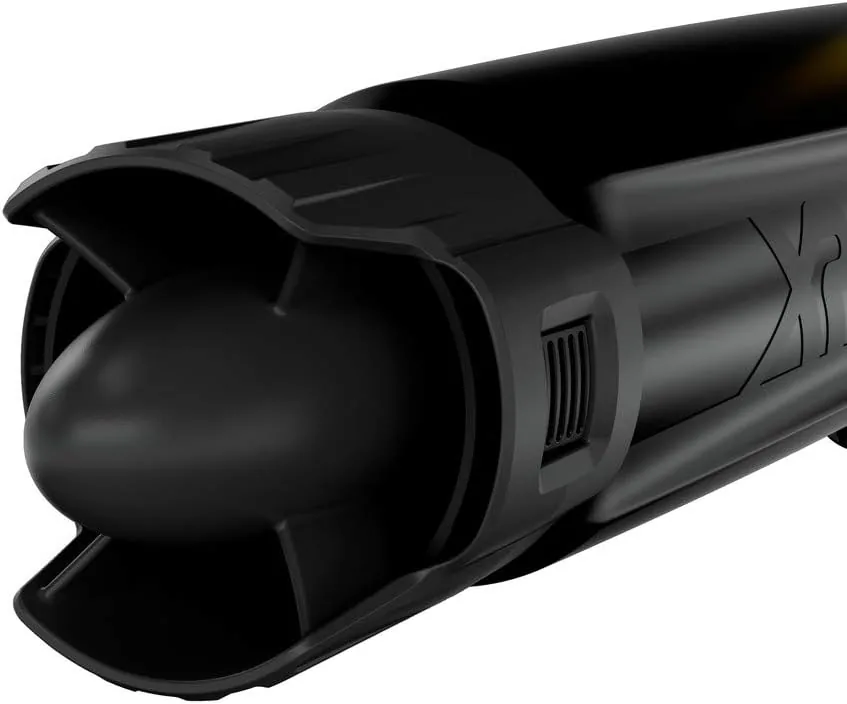
The concentrator is the part I fit for the joint along the concrete path to the house door, where grit packs into the seam. DEWALT’s 125 mph figure needs that nozzle on, and the narrow stream lifts the packed grit that the open tube only scatters.
How It Performs on Dry Leaves, Wet Leaves, Gravel and Gutters
The DCBL722 is a dry-debris tool. A stream pushes with a force that depends on how much air leaves the tube each second and how much that air speeds up (1). A fast stream with modest volume therefore leaves a heavy pile where it lies.
Dry Leaves, Clippings and Twigs
Before the first mow of spring I clear the twigs and seed pods that the shade trees dropped on the lawn, and on a middle setting they travel to the edge without scattering. I hold the tube about 7 inches above the ground, as the manual advises, and sweep from side to side.
Damp and Matted Leaves
Wet leaves need volume under the edge more than speed on top. DEWALT’s manual says not to use the tool under wet conditions or on wet surfaces, so soaked leaves on a wet path are a job for a rake or a wait for a dry day. The hard case for this blower is a mat of leaves that has dried on top on a dry day: the top layer lifts, the packed layer under it stays down, and a rake finishes the job.
Gravel Edges and Flying Debris
On the gravel yard I tilt the tube low and stay on a middle setting, because a steep angle digs stones out and throws them. Of the lawnmower-related eye injuries in US emergency departments, about three quarters came from projectiles such as grass, dirt and rocks, and only 2 percent of those projectile injuries were documented with eye protection (2). I wear safety glasses, and people, pets and windows stay out of the path.
Gutters and High Spots
A gutter at eave height means a ladder. US workplaces saw an estimated 34,000 emergency department visits for ladder injuries in 2011 (3). A running blower in one hand makes that climb worse, so keep this blower for ground-level work and leave high gutters to someone with the right equipment.
Run Time, Charging and Battery Care
DEWALT prints one run time: up to 87 minutes per charge for the bare tool on the lowest speed with a DCB205 pack, and nothing for high speed. The lowest speed is a gentle stream, and jobs that need real air run on high, where the pack lasts far less.
On a cold morning the 5.0 Ah pack ran flat on full power before I finished the lawn. I now plan on high-speed minutes, not on DEWALT’s 87, and one pack suits short jobs such as a deck, a patio or the path to the door, with full power kept for corners and packed grit.
In lab tests, lithium-ion internal resistance rose at subzero temperatures and cut capacity and power (4). Those were lab cells and not a DEWALT pack, but I keep the spare pack in the house until I need it.
The manual sets a charging window of 40 to 104 F, so I charge indoors, never in the unheated tool shed, and let a hot pack cool, since the charger delays a hot pack. DEWALT prints no charge time for the DCB115.
Noise, Weight and Hand Fatigue
DEWALT rates this blower at 62 dB(A) on its US page and names no distance, so the number cannot tell me what reaches my ear. In a field study of gas leaf blowers, sound at 50 feet matched the makers’ ratings, while individual machines read 85 to 101 dB(A) at the study’s central measuring point (5). Those were gas machines, not this cordless model, but they show that a rating given at a distance and a reading near the machine are different numbers.
NIOSH recommends 85 dBA averaged over an eight-hour day and halves the allowed time for every 3 dBA more (6). Poor fit may limit earplug protection for about 40 percent of users (7). I wear earmuffs from the first start.
Against the rake I used before, the blower is easier on my back, and after a long stretch of lawn edge the weight shows in my shoulder rather than in my hand.
Care, Safety and Rain
Care follows five rules from the manual.
- Keep it dry. The manual says no use in wet conditions or on wet surfaces, no exposure to rain, and indoor storage. DEWALT prints no IP rating, so the tool stays out of rain, wet snow and standing water.
- Pull the pack first before you clear a blockage, adjust, clean or store the tool.
- Protect eyes, ears and lungs. Wear ANSI Z87.1 safety glasses, hearing protection and, in dust, a filter mask, since leaf blowing raises measurable dust from the ground (8).
- Keep people away. Bystanders, children and animals stay at least 30 feet back, and the air never points at a person.
- Clean the vents weekly with clean, dry air and eye protection on. Wipe the housing with a cloth dampened in water and mild soap, never solvents.
Who Should Buy the DeWalt DCBL722 and Who Should Skip It
The DCBL722 fits a narrow group, so check both lists.
Buy It If
- You already own DEWALT 20V packs and can run the blower from the drill shelf.
- Your jobs are dry leaves, clippings, decks, patios and driveways on a house lot.
- You want a light tool for a small lawn.
Skip It If
- You clear a large property or work in long sessions.
- Your leaves are wet mats or compacted debris.
- You want a noise distance from the maker.
- You expect to blow in rain or on wet ground, which the manual rules out.
Drawbacks and Common Problems
These limits matter in use.
- Short run at speed. Full power drains the 5.0 Ah pack fast, so keep a second pack on the charger.
- Wet debris. At 450 CFM, matted leaves barely move, and the manual rules out wet use, so wait for a dry day or use a rake.
- Awkward tube removal. The tube comes off only with a screwdriver in the unlocking hole, so I leave it on between jobs.
How the DeWalt 20V Blower Compares With Its Alternatives
The table lists the maker’s figures and the box contents of the closest rivals, and my leaf blower guides cover more models.
| Blower | In the box | Airflow and speed, maker’s figures |
|---|---|---|
| DEWALT DCBL722P1 | Blower, one 5.0 Ah 20V pack, charger, nozzle | Up to 450 CFM; up to 125 mph with the nozzle |
| EGO Power+ LB6151 | Blower, one 2.5 Ah 56V pack, charger, nozzle | 615 CFM; 170 mph with the tapered nozzle |
| WORX WG543 | Blower, one 4.0 Ah 20V pack, charger | 410 CFM in volume mode; 130 mph in speed mode |
| Makita XBU03Z | Tool only; no pack, no charger | 459 CFM; 116 mph at most |
The WORX weighs 3.8 lb with its pack, according to WORX, and the Makita is the bare tool for owners of Makita 18V packs. The EGO moves more maker airflow, on a 56V system that a DEWALT owner would start from scratch.
On DEWALT 20V vs 60V, the FlexVolt DCBL772B is rated at 600 CFM and 125 mph and weighs 7.7 lb bare, according to DEWALT, and it needs 60V packs. It is the stronger tool for big yards.
DEWALT DCBL722 vs DCBL724 and the Older DCBL720
DEWALT now sells a newer 20V MAX XR blower, the DCBL724B, and its page states up to 19 percent more maximum airflow than the DCBL722. DEWALT’s footnote gives the test battery for each figure: a DCB208 for the DCBL724B and a DCB205 for the DCBL722.
In the DEWALT DCBL720 vs DCBL722 comparison, DEWALT’s launch ratings rise from 400 CFM and 90 mph to 450 CFM and 125 mph, the battery socket moves to the rear, and the trigger and nozzle are new.
Warranty and the Seller
DEWALT backs the blower with a 3-year limited warranty, 1 year of free service and a 90-day money-back guarantee, for the original purchaser only. It covers products bought from DEWALT or an authorized seller, and it excludes wear and abuse.
The Amazon listing for this kit sells through other sellers, so check who the seller is and keep the dated receipt. A kit bought from a seller that DEWALT does not authorize falls outside that warranty.
My Final Recommendation on the DeWalt DCBL722
A reader who already owns DEWALT 20V packs should buy the bare tool, and a reader without packs should buy the kit. Either way the blower suits dry leaves, decks, patios and the path to the house door, and it feels light in the hand on packs many owners already hold. It gives up wet leaf mats, large properties and long sessions on one pack, where a stronger blower or a rake does the job.
Check who the seller is on the Amazon listing and keep the dated receipt, because DEWALT’s warranty covers purchases from DEWALT or an authorized seller. Use the DEWALT DCBL722 for the dry jobs it handles well.
Frequently Asked Questions
Is there a difference between DEWALT 20V and 20V Max?
There is no difference between DEWALT 20V and 20V Max in the battery itself, because both names describe the same pack system. DEWALT’s footnote says the 20 volts is the maximum initial voltage measured without a workload, and the nominal voltage is 18, so the DCB205 in this kit is both.
Is it better to have more mph or cfm in a leaf blower?
It is better to have more CFM than mph for most leaf work, because air volume lifts and carries a pile. The DCBL722 shows the split: its 125 mph needs the concentrator nozzle and suits a stuck seam, while its 450 CFM sets how much a wet mat will move.
Is the DEWALT leaf blower any good?
The DEWALT DCBL722 is a good leaf blower for dry leaves, decks and patios, and it feels light in the hand. It runs short on full power and leaves wet leaf mats where they lie, so I rate it for small jobs on a house lot and for owners who already hold DEWALT 20V packs.
Which DEWALT cordless blower is the best?
The best DEWALT cordless blower depends on the job, and for a light blower on 20V packs I pick the DCBL722. The 60V DCBL777 is DEWALT’s strongest 60V handheld, so wet leaves, gravel yards and big properties suit it better if you already own FlexVolt packs or plan to buy them.
Does the power leaf blower really work?
A power leaf blower such as the DCBL722 really works on dry leaves, clippings and light debris, and the concentrator nozzle helps with packed grit. It does little against wet or compacted leaf mats, because 450 CFM is too little air under a soaked pile, so I leave those piles to a rake.
References
- NASA Glenn Research Center. Thrust Equation. Beginners Guide to Aeronautics. Updated June 10, 2026.
- Stange NR, Jennissen CA. Lawnmower-Related Eye Injuries in the U.S., 2004 to 2023. Am J Ophthalmol. 2025;277:7-16.
- Socias CM, Chaumont Menendez CK, Collins JW, Simeonov P. Occupational Ladder Fall Injuries – United States, 2011. Morbidity and Mortality Weekly Report (MMWR), CDC/NIOSH. 2014.
- Hossain Ahmed S, Kang X, Bade Shrestha SO. Effects of Temperature on Internal Resistances of Lithium-Ion Batteries. J Energy Resour Technol. 2015;137(3):031901.
- Walker E, Banks JL. Characteristics of Lawn and Garden Equipment Sound: A Community Pilot Study. J Environ Toxicol Stud. 2017;1(1).
- National Institute for Occupational Safety and Health. Noise-Induced Hearing Loss. Noise and Hearing Loss. Centers for Disease Control and Prevention; 2024.
- Morata TC, Gong W, Tikka C, Samelli AG, Verbeek JH. Hearing protection field attenuation estimation systems and associated training for reducing workers’ exposure to noise. Cochrane Database of Systematic Reviews. 2024;5(5):CD015066.
- Fitz D, Pankratz D, Pederson S, Bristow J. A Semi-portable Enclosure to Measure Emission Rates from Small Fugitive Sources: Leaf Blower Dust Example. Aerosol Air Qual. Res. 2021;21(10):200566.
Safety Note: Leaf blowers throw debris and can damage your hearing. Wear eye and ear protection, read the manufacturer’s manual, and check your local rules on noise and operating hours.