
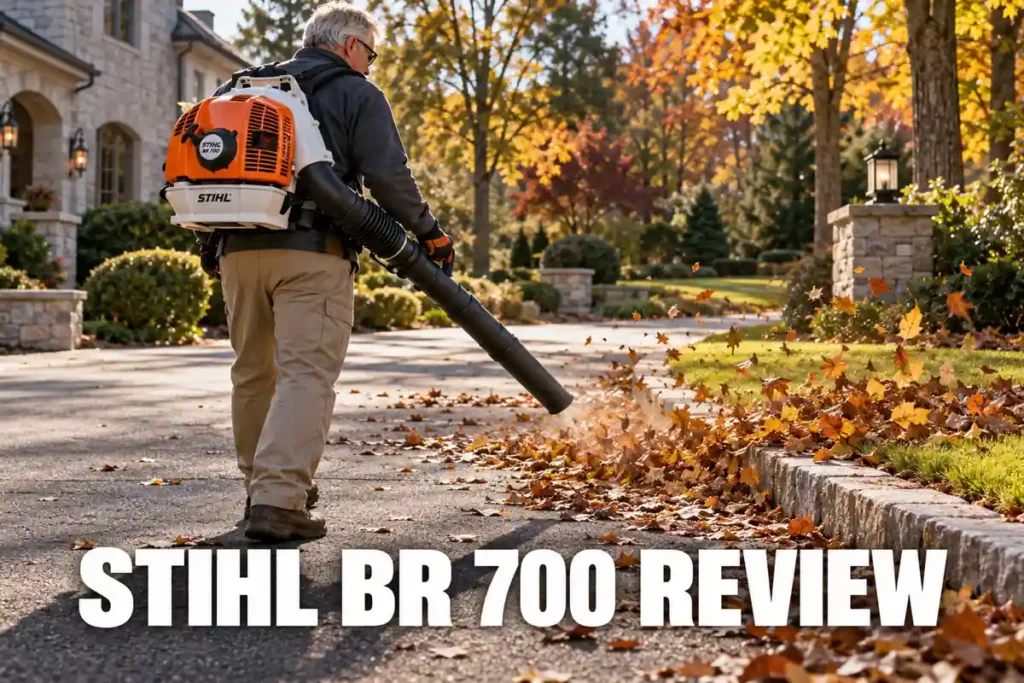
This Stihl BR 700 review ends in a buy for acre-plus yards and orchards: the 64.8 cc gas backpack blower fits that ground, and a Stihl dealer is the first place to buy it. Stihl sells the BR 700 through authorized dealers, and its warranty policy covers dealer purchases. I judge a backpack blower by its tube, because the lower branches over my plum and apricot alleys hang where a fixed pipe would catch, and this one telescopes. You get 35 N of blowing force at 23.6 lb without fuel and pay in noise, a small tank and a dealer trip.
Affiliate Disclosure: Garden Power Scout is a proud participant in the Amazon Services LLC Associates Program. As an Amazon Associate, we earn from qualifying purchases, at no extra cost to you.
Stihl BR 700 Review: My Verdict in Brief
I recommend the Stihl BR 700 gas backpack blower for an acre or more, bought from a Stihl dealer within reach. According to Stihl, it rates 35 N of blowing force with the round nozzle, and its manual lists 912 CFM, the air volume per minute, with the tube fitted.
- Who it is for: acre-plus yards, orchard alleys and gravel, with a dealer in reach.
- What it does best: 35 N of force at 23.6 lb without fuel.
- Main trade-off: a 47.3 fl oz tank and 101 dB(A) at the operator.
- Where to buy: a Stihl dealer first, then the reseller offer on Amazon only if none is in reach.
What the Stihl BR 700 Backpack Blower Is and What Comes in the Box
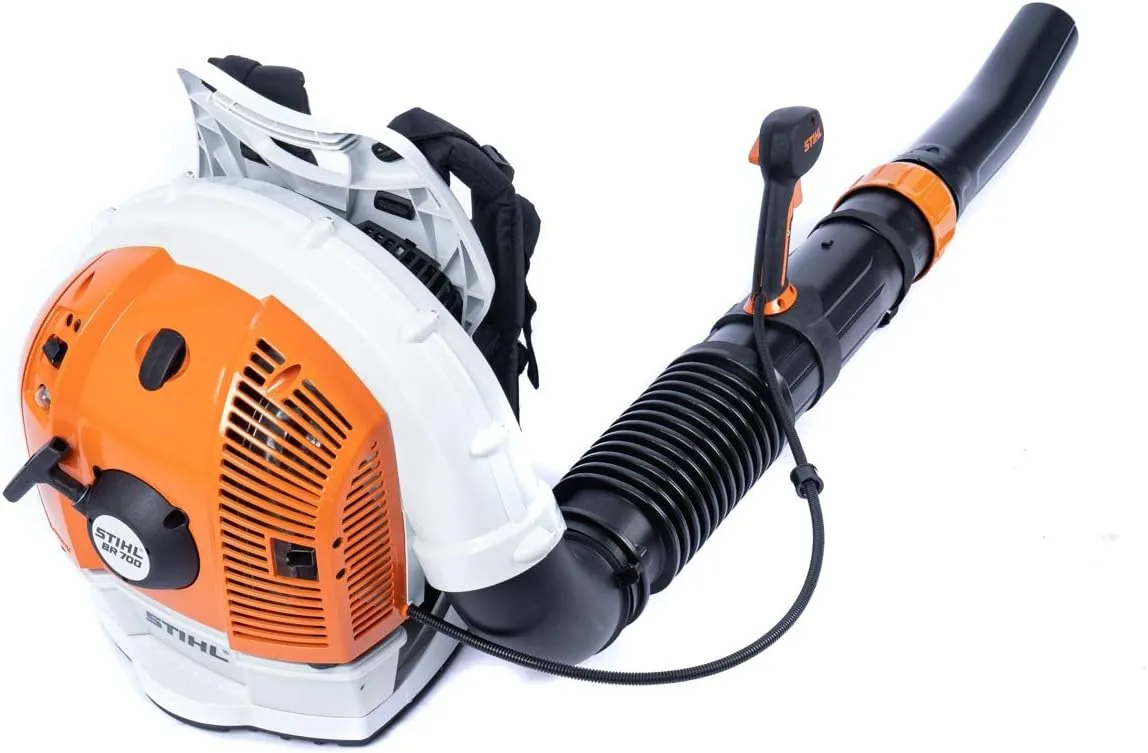
The Stihl BR 700 engine is a STIHL 4-MIX of 64.8 cc that still runs on a 50:1 mix of gasoline and oil.
The manual shows the harness, the blower tube, the pleated hose and straight and curved nozzles, which vary by version. It is a different machine from the Stihl BR 700 X, which has a fixed-length tube. Fuel, oil, plugs, muffs and eye protection are extra.
Stihl BR 700 Specs at a Glance
Two rows decide the fit: blowing force and weight.
| Spec | Figure |
|---|---|
| Engine | STIHL 4-MIX, 64.8 cc, 50:1 fuel mix |
| Blowing force, Stihl’s figure | 35 N with the round nozzle (about 7.9 lb) |
| Air speed, Stihl’s figure | 196 mph maximum |
| Air volume, Stihl’s manual | 912 CFM with the tube, 1,095 CFM without |
| Fuel tank | 47.3 fl oz |
| Weight without fuel | 23.6 lb on Stihl’s US page |
| Weight with a full tank | About 26 lb |
Stihl lists CFM both ways, 912 with the tube fitted and 1,095 without it, so check the setup behind any Stihl BR 700 CFM figure before you compare blowers.
Setup, Fuel Mix and Starting
The Stihl BR 700 fuel mix is 50 parts gasoline to 1 part two-stroke oil, about 2.6 fl oz of oil per US gallon. According to Stihl, mix it with STIHL HP Ultra oil or an oil that meets JASO FB, FC or FD, and use the gasoline grade that Stihl’s manual for the machine names, with at most 10 percent ethanol. Pour the oil into the canister first, then the gasoline, shake it, and write the mixing date on the canister, as I do with a marker. Self-mixed fuel older than 30 days is out.
STIHL MotoMix is a different product: a ready-mixed fuel that goes into the tank as it is and is never mixed with gasoline. According to Stihl, it may be stored for up to 2 years.
Start it outdoors only, never in a shed or garage. These are the manual’s steps:
- Set the blower on the ground, on a clean, dust-free surface, with people clear of the nozzle.
- Turn the choke knob to cold start (warm for a warm engine) and the setting lever to F.
- Press the fuel pump bulb at least five times, and again after every refill.
- Hold the unit with your left hand on the housing and put one foot against the base plate. With your right hand, pull the starter grip slowly until it engages, then briskly. Never pull the rope to full length or let the grip snap back.
- After three attempts at most, move the choke knob to warm and keep cranking until the engine runs.
- Once it runs, blip the throttle trigger and the choke returns to run.
I start it on the swept concrete pad in front of the machinery shed, not on the gravel, because Stihl asks for a clean surface. Above 20 C (68 F) the intake shutter must be in its summer position, or the engine risks overheating.
Performance on Leaves, Wet Mats and Orchard Alleys
I read the newton row first, because force depends on how much air moves each second and how much its speed changes (1). The Stihl BR 700 blower rates 35 N.
Leaves and Wet Mats
Dry leaves leave the lawn at part throttle, and I save the top of the trigger for wet ones. Where October leaves pack against the grass edge of the drainage ditch, a low sweep under the leading edge lifts the mat, and the Stihl BR 700 backpack leaf blower keeps it rolling toward the alley.
Gravel Yards
On the gravel yard I drop to half throttle and keep the nozzle low, since a steep angle throws stones at the shed and the car.
Under the Low Branches
I shorten it until the nozzle clears the lowest branch, then lengthen it on the open lawn.
Harness, Tube and Controls
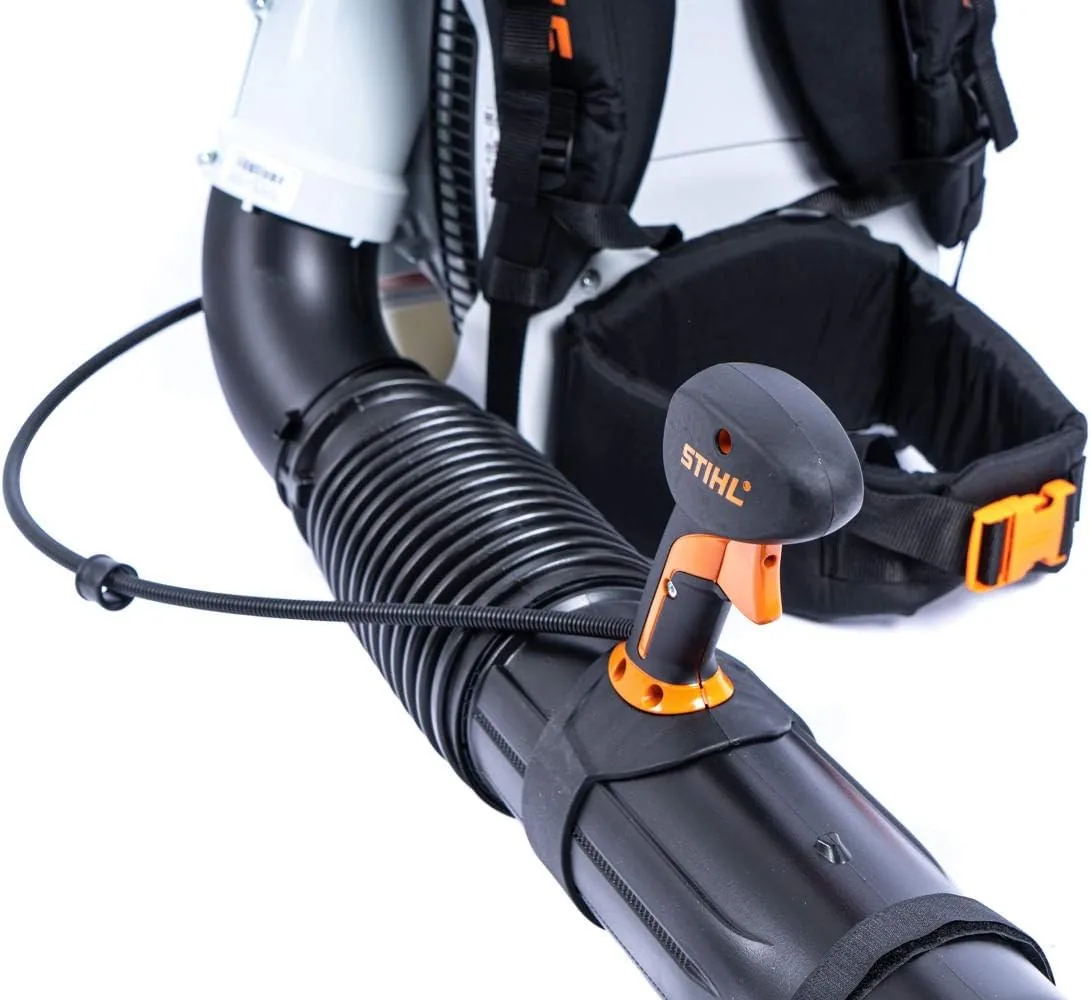
According to Stihl, the harness spreads weight evenly over the shoulders and back, and the backrest pad and hip belt reduce fatigue. The Stihl BR 700 weight is 23.6 lb without fuel and about 26 lb with a full tank. I check that the hip belt carries the load before I touch the trigger, because a laboratory study found that strap force and contact pressure at the shoulders and hips predicted how much discomfort carriers reported (2).
The throttle trigger locks in any position.
Noise, Vibration and Hearing Protection
Stihl’s manual gives 101 dB(A) sound pressure at the operator, to a European standard. In a measurement study, all but one agricultural backpack machine ran above 100 dB(A) (3). NIOSH recommends 85 dBA averaged over eight hours and half the time for every 3 dBA more (4). A machine at 101 dB(A) therefore allows minutes, not hours, without protection.
I put foam plugs in before I touch the starter grip and the earmuffs on over them, and both stay on until the engine stops. Protection muffles a shouted warning, so I agree a hand signal with anyone nearby. Stihl wants every person, vehicle and window 15 m (about 50 ft) away, so I look along the debris path before the throttle opens.
Take breaks, because field measurements of backpack blower vibration ran from about 1.7 to 2.9 m/s2 (5).
Fuel, Maintenance and Upkeep
Stihl gives the BR 700 a 47.3 fl oz tank and publishes no run time per tank. On a long job, I carry a second filled canister to the end of the alley and refuel only with the engine stopped and cool. Keep to Stihl’s 10 percent ethanol cap, because a federal test of 28 small engines found that E20 made engines without fuel feedback run leaner and hotter (6).
Upkeep splits between you and a dealer, and the warranty expects you to follow the schedule in the Stihl BR 700 manual:
- You: check the air filter before work, clean the intake screen and base plate with the engine stopped, and replace the plug after about 100 operating hours (NGK CMR 6 H or BOSCH USR 4AC, gap 0.5 mm).
- A dealer: the fuel pickup body every year, the anti-vibration elements and the valve check.
After a long run at full throttle I let the engine idle a short while before I switch off, as the manual advises.
Who Should Buy It and Who Should Skip It
Buy it from a dealer for an acre or more, and skip it for small lots.
Buy It If
- You clear an acre or more of leaves, orchard alleys or gravel.
- A Stihl dealer is within reach to buy from, to show you the first start and to do the yearly jobs.
Skip It If
- Your lot is under half an acre.
- You want Stihl’s warranty and have no dealer within reach, since the warranty covers dealer purchases.
- You live in California, where Stihl’s page says it is not available.
Drawbacks to Know About
The drawbacks are the 47.3 fl oz tank, the smallest of the five blowers in the comparison table below, and the 101 dB(A) noise, which calls for plugs and muffs together.
Common Problems and How to Fix Them
This section covers the starting and running problems of this engine family.
- Hard starting: old mix, too few bulb presses or a choke left on after the first fire, which floods the engine. Check the Stihl BR 700 spark plug first, as Stihl advises when an engine is hard to start.
- Rough idle and lost power when hot: symptoms owners of this engine family describe, which point to a dealer valve check.
- Stalls at idle: turn the idle speed screw (LA) slowly clockwise until it runs smoothly, as the manual says. Stihl BR 700 carburetor work beyond that goes to a dealer.
How the Stihl BR 700 Compares With Alternatives
Makers measure air volume at different points, so compare force first. For cordless options, see my leaf blower guides.
| Model | Force | Air volume, maker’s figure | Weight, dry | Tank |
|---|---|---|---|---|
| Stihl BR 700 | 35 N | 912 CFM | 23.6 lb | 47.3 fl oz |
| ECHO PB-770T | 33 N | 756 CFM | 24.3 lb | 68.3 fl oz |
| ECHO PB-9010T | 48 N | 1,110 CFM | 26.4 to 27.2 lb | 83.8 fl oz |
| Husqvarna 570BTS | 37 N | 768 CFM | 24.7 lb | 74.4 fl oz |
| Husqvarna 580BTS | 47 N | 1,000 CFM | 26.8 lb | 87.9 fl oz |
According to ECHO, the ECHO PB-770T Gas Backpack Leaf Blower rates 33 N with a 68.3 fl oz tank, a little less push than the Stihl for more fuel on the back, and the ECHO PB-9010T Gas Backpack Leaf Blower rates 48 N with an 83.8 fl oz tank at about 3 lb more dry weight than the BR 700. ECHO also ties its limited warranty to authorized dealers.
According to Husqvarna, the Husqvarna 570BTS Gas Backpack Leaf Blower rates 37 N with a 74.4 fl oz tank at about 1 lb more than the BR 700, and the Husqvarna 580BTS Gas Backpack Leaf Blower rates 47 N with an 87.9 fl oz tank and a padded hip belt at about 3 lb more.
The BR 700 is the lightest of the five and gives up force and tank size for it.
Where to Buy the Stihl BR 700 and How the Warranty Works
Stihl sells the BR 700 as a dealer product, so a Stihl dealer is the first place to buy it.
According to Stihl, products sold through its U.S. dealers are for distribution in the United States only. Stihl’s warranty policy covers products bought from authorized Stihl dealers, and warranty repairs go to any authorized dealer with freight at the buyer’s cost.
According to Stihl, the warranty runs 2 years for home or professional use, and income-producing work, such as a fruit orchard that sells its crop, counts as professional. Its double warranty program doubles the term for household buyers who buy a 6-pack of STIHL HP Ultra oil or at least 1 gallon of MotoMix with the machine, but not for income-producing use, so 2 years is my term, a drawback for a farm buyer like me.
The Amazon page for the BR 700 is a reseller offer, and its price sits above Stihl’s own list price. It suits one reader: a buyer with no dealer in reach who accepts that price. Stihl USA’s part number is 4282 011 1638 US, so compare it with the part number the seller shows, and ask the seller what warranty and return terms come with the unit before you order.
With a Stihl dealer in reach, buy there, and keep the invoice as proof of purchase for the length of the warranty.
Is the Stihl BR 700 Worth Buying? My Recommendation
It is worth buying from a Stihl dealer if your ground matches its size. On an acre of leaf fall, orchard alleys or a gravel yard, 35 N at 23.6 lb without fuel is a strong, fairly light package, and the telescopic tube earns its keep under low branches.
A buyer with no dealer in reach can take the Amazon offer if the price is acceptable and the seller confirms the warranty terms. My Stihl BR 700 review verdict is a buy for acre-plus yards and orchards, from a Stihl dealer, and a pass for small lots.
Frequently Asked Questions
What are the specifications of the STIHL BR 700 gasoline backpack blower?
The STIHL BR 700 gasoline backpack blower has a 64.8 cc 4-MIX engine, 35 N of blowing force, a 196 mph maximum air speed and 912 CFM of air with the tube fitted, according to Stihl. It weighs 23.6 lb without fuel and carries a 47.3 fl oz fuel tank.
What are the differences between the STIHL backpack blower BR 700 and BR 800?
The differences between the STIHL BR 700 and BR 800 are force, weight and tank size: the BR 700 rates 35 N, 23.6 lb and 47.3 fl oz, while the BR 800 C-E rates 41 N, 25.9 lb and 67.6 fl oz. The BR 800 engine is 79.9 cc against 64.8 cc.
Did STIHL recall the BR800?
STIHL recalled the BR 800 Magnum models X and C-E on November 6, 2025, because the fan wheel can break apart and cause a laceration hazard. Neither Stihl’s notice nor the federal safety notice names the BR 700, so check Stihl’s recall page for the affected serial numbers and the free dealer inspection.
How to start a Stihl BR 700 blower?
To start a Stihl BR 700 blower outdoors, set the choke knob to cold start and the lever to F, press the fuel bulb at least five times, hold the housing with your left hand, put a foot on the base plate and pull the grip slowly, then briskly. After three tries, set the choke to warm and keep cranking.
What are the differences between STIHL backpack blowers?
The differences between STIHL backpack blowers come down to force, weight and engine size. On Stihl’s US page the BR 450 rates 28 N at 23.4 lb, the BR 600 rates 31.7 N at about 22 lb, the BR 700 rates 35 N at 23.6 lb, and the BR 800 rates 41 N at 25.9 lb.
References
- NASA Glenn Research Center. Thrust Equation. Beginners Guide to Aeronautics. Updated June 10, 2026.
- Wettenschwiler PD, Lorenzetti S, Stämpfli R, Rossi RM, Ferguson SJ, Annaheim S. Mechanical Predictors of Discomfort during Load Carriage. PLoS ONE. 2015;10(11):e0142004.
- Calvo A, Preti C, Caria M, Deboli R. Vibration and Noise Transmitted by Agricultural Backpack Powered Machines Critically Examined Using the Current Standards. IJERPH. 2019;16(12):2210.
- National Institute for Occupational Safety and Health. Noise-Induced Hearing Loss. Noise and Hearing Loss. Centers for Disease Control and Prevention; 2024.
- Alamin Gabasa SA, Md Razali KA, As’arry A, Abdul Jalil NA. Vibration Transmitted to the Hand by Backpack Blowers. IJAME. 2019;16(2):6697-6705.
- Knoll K, West B, Clark W, et al. Effects of Intermediate Ethanol Blends on Legacy Vehicles and Small Non-Road Engines, Report 1 – Updated. NREL/TP-540-43543; ORNL/TM-2008/117. National Renewable Energy Laboratory; 2009.
Safety Note: Leaf blowers throw debris and can damage your hearing. Wear eye and ear protection, read the manufacturer’s manual, and check your local rules on noise and operating hours.