
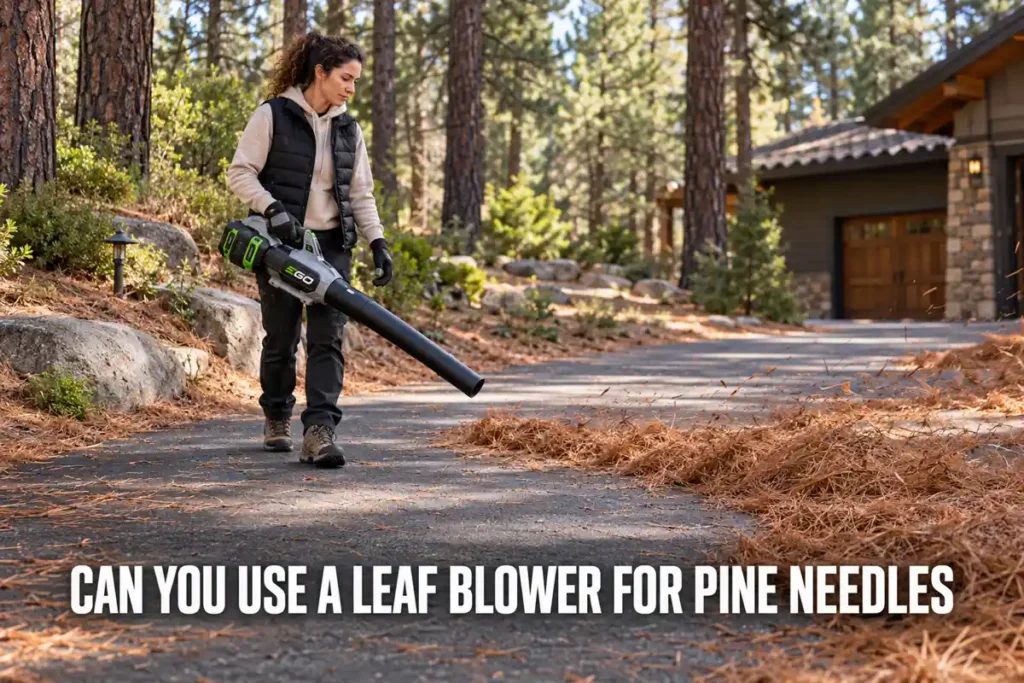
A leaf blower works on pine needles when they are dry, they lie on a hard surface or short grass, and the blower has a fast, narrow jet. It falls short on soaked needles, on layers built up over several seasons and on needles woven into turf, where a rake should make the first pass.
Thin dry twigs and pruning sawdust under my plum rows behave much like needles: a fast jet held low lifts them, and a wide gentle stream sails over them. Below I explain why needles resist, which air speed to look for, how to work each surface and what to do with the pile.
Can You Use a Leaf Blower for Pine Needles? The Short Answer
A blower clears dry needles from hard surfaces and short grass. It needs a fast, narrow nozzle held low. Soaked needles, thick compacted layers and needles woven into turf call for a rake first, with the blower finishing the job.
| Surface | Blower alone? | What works best |
|---|---|---|
| Driveway, patio, work pad | Yes, when dry | Flat or narrow nozzle, low angle, two passes from different directions |
| Short, dry lawn | Yes, with a fast nozzle held low | Rake the thick or woven-in layer first, then blow |
| Beds, mulch and drip lines | Only on the lowest setting | Hand rake; leave straw that is already mulching |
| Gravel | With care | Low throttle, tube tilted up, nozzle 2 to 3 feet from the stones |
| Soaked or compacted needles | Not alone | Wait for a drier day, loosen with a rake, collect on a tarp |
Three things decide the result: how dry the needles are, how fast the air leaves the nozzle and how deep the layer is. The sections below take each in turn.
Why Pine Needles Are Harder to Move Than Leaves
A broad leaf is a sail: even a gentle stream gets under its flat face and lifts it. A pine needle is a thin rod, so the air flows around it and the jet has to hit hard to move it.
How Needles Interlock and Work Down
Needles are stiff and straight, so they cross each other and form a mat. A mat behaves as one object, so the jet has to peel it from an edge instead of lifting single needles. Length changes the tangle: roughly 3 to 5 inches on eastern white and shortleaf pine, 5 to 10 on loblolly and 12 to 14 on longleaf, and the longer they are, the harder the mat is to break.
Needles also work down into turf, between stones and into the joints of pavers. A steep nozzle angle pushes them in further, and a wide, gentle stream skips over whatever sits in a joint.
Water adds a film that holds a needle to the surface and to its neighbors, and soaked debris weighs far more than dry. A wet mat lies flat, and the stream passes over the top of it instead of through it.
Why Air Speed Counts More Than Volume
Moving air presses on a surface with a pressure that grows with the square of its speed, so doubling the air speed quadruples the pressure of the jet. The table compares that pressure at the nozzle for common speed ratings, for the same air density and a surface facing the jet.
| Air speed at the nozzle | Pressure compared with 125 mph |
|---|---|
| 125 mph (typical 20V handheld) | 1.0 times |
| 150 mph | About 1.4 times |
| 190 mph | About 2.3 times |
| 200 mph | About 2.6 times |
A 200 mph jet therefore presses on a needle about 2.6 times harder than a 125 mph jet, even when the slower blower moves more air. This is pressure at the nozzle, not the total push of a whole blower, which also depends on how much air moves. The jet slows as it travels, so a tip held two or three feet above a lawn is far weaker at the grass than one held a few inches off it.
Volume, measured in CFM, sets how wide a path you clear, but volume without speed leaves needles where they lie.
What Your Blower Needs to Move Pine Needles
A leaf blower for pine needles should be judged on air speed at the nozzle first, then on push in newtons, then on volume. Speed lifts the edge of a mat, push moves it along and volume widens the path.
| Class | Box speed, maker’s figure | Push in newtons (N) on the top setting | Fit for needles |
|---|---|---|---|
| Cordless 20V handheld | 125 to 130 mph | Rarely published | Dry needles on smooth paving, a porch or a deck. Wanders over seams and cannot lift a mat. |
| Cordless 36V to 40V handheld | 120 to 200 mph | About 14 to 24 | A driveway and short dry grass on a typical lot. Needs the top setting on grass. |
| Cordless 54V to 60V handheld | 125 to 200 mph | About 17 to 25 | Lawns and loose beds of needles on the stronger models. Runtime falls fast on the top setting. |
| Cordless backpack | 145 to 192 mph | About 26 | Big lawns and long drives, with ears protected. |
| Gas backpack | 184 to 240 mph | 22 to 52 | Acreage and deep loose layers. Damp needles after a rake pass. |
| Walk-behind | Just under 200 mph | Not published | Open ground and long drives. Too heavy for steps and beds. |
My Rough Guide by Surface
This is my working guide, built from the ratings makers publish.
- Dry needles on a hard surface: about 150 mph at the nozzle or more, with a flat or concentrator nozzle. The 125 mph class is the floor, and it needs patience on seams.
- Dry needles on short grass: about 190 mph or more, and about 20 N or more where a maker lists it. Expect to use the top setting.
- Soaked or matted needles: the same speed class, plus a rake pass first. A blower alone will not peel a soaked mat.
I read a maker’s mph figure as the best case at the tip, because the box speed and the box volume are peaks that do not occur together. I add a margin and work close to the surface.
Nozzle, Runtime and Cold
A concentrator nozzle, the narrow tapered tip, raises speed and thins the stream. That helps with needles stuck in seams, and it costs width and can shorten runtime on a cordless motor.
Plan in total minutes, not in jobs. On a 5.0 Ah pack a cordless handheld typically runs about 20 to 25 minutes on its high setting and about 10 to 15 on turbo, though each model differs. At those rates a 40 minute job on high takes about two packs, and 30 minutes of turbo takes two to three. On a frost morning in November my pack gives less than it did in October, so I keep it indoors until I start, and I never charge a cold pack.
How to Blow Pine Needles Off a Driveway, Patio and Steps
Dry needles on a flat, hard surface are the easy case. They lift and travel, so the work is about direction and finishing.
- Check the wind and stand with it at your back or across your body, so it carries the needles toward the pile.
- Fit a flat or concentrator nozzle and pick the speed class from the guide above.
- Hold the nozzle low at a shallow angle and sweep in short passes. A steep angle drives needles into joints.
- Make a second pass from the other direction to catch needles that lie across the first ones.
- Work steps from the top down, so you do not blow a cleared step full again.
- Push the needles into a windrow, a long row along one edge, then onto a tarp and carry them off. Never blow them into the street, a drain or a neighbor’s yard.
On my concrete work pad the open slab clears quickly and the seams between slabs take the time. The narrow nozzle clears the joints that the wide nozzle skips over, so I finish the pad with it. My yard is the exposed part of the farm, so I plan every pass with the wind at my back.
Safety First
Wear safety glasses or goggles and a dust mask, because dry needles throw fine dust and grit at your face. A gas blower needs plugs and earmuffs together from the first minute, and a cordless on its top setting is loud enough for plugs on a long job. Keep people, pets, windows and cars out of the debris path.
How to Blow Pine Needles Off Your Lawn
Short, dry grass is the second easy case, with one catch: needles settle between the blades, and a careless angle pushes them down to the soil.
Hold the nozzle low at a shallow angle, work across the lawn in two directions and push toward a tarp or an open hard surface. Stop when a pass only moves the same needles around. The rest is woven in, and a rake loosens it faster than more air does.
Mow after the blower, not before. A mower chops needles into shorter pieces, and chopped needles stay physically intact for months (1). On my house lawn I clear twigs and pods before the mower goes out, and I use the same order for anything stiff and thin.
A lawn under pines is often thin because of shade and root competition, so needles are rarely the only cause. Clear them before the layer mats and shades the grass.
Blowing Pine Needles Out of Beds, Mulch and Gravel
Beds and mulch are where a blower does the most damage, because the stream that lifts needles also lifts the mulch under them. Drop to the lowest setting, hold the tip well back and be ready to finish by hand.
Fast air strips mulch and dries the soil surface, and a drip line lies loose on the ground, so air can shift it and pack grit into the emitter ends. That is why the wood-chip paths in my vegetable plot and my drip lines get the lowest setting, held at arm’s length, or no blower at all. Needles already lying in a bed are doing a mulch job, so leave them and clear only what has landed on paths, lawn edges and plant leaves.
Pine Needles in Gravel
Needles slip between stones and sit there, and a fast jet throws the stones as readily as the needles. Keep the tip 2 to 3 feet from loose stone, tilt the tube up and use low throttle, as I do in my gravel yard, where stones otherwise leave at ankle height. Wear eye protection and keep people, windows and car paint out of line.
Wet Pine Needles and When to Wait or Rake
Soaked needles are the case where a blower loses. Water makes them stick to the surface and to each other, and the stream passes over the mat instead of lifting it.
- Wait if you can. A dry afternoon changes the job, and needles that have dried part way lift more easily.
- Try the edge on loose, damp needles. A low pass at a shallow angle can roll a thin layer that is only damp on top. If the needles settle again, stop and rake.
- Rake what stays flat. A soaked or compacted mat needs a rake before the blower finishes.
- Expect weight. A wet pile is heavy to tarp, so make smaller piles.
On wet leaves on my yard concrete my blower only slid the mat along, so I wait for a dry afternoon and then work in from the edge with a low pass. A small 20V blower will not move a wet mat at all, and a long wet job means more noise time.
When a Rake, Lawn Sweeper or Mulching Mower Does It Better
A blower moves needles, and some jobs go faster with another tool: thick compacted layers, small beds, quiet hours and very large lawns.
Rakes and Sweepers
A garden rake loosens an old compacted layer so the blower can move it, and a long-handled lawn rake clears a small lawn quietly. I keep a plain rake next to the blower and use it for the first pass on any layer thick enough to hold its shape. A lawn sweeper, push or tow-behind, hooks dry needles with rotating brushes and struggles with wet mats.
Mowers Do Not Make Needles Disappear
Mulching tree leaves into turf with a mower works for broadleaf leaves. A Virginia Tech extension publication states that the technique does not apply to pine needles, because they resist microbial breakdown and remain intact for months even when chopped (1). A mulching mower with a bag still collects chopped needles, so give it the collecting job and carry them off.
Blower-Vacuums
A blower-vacuum can collect needles as well as blow them. In vacuum mode the tool is heavier to carry, and wet needles pack into the intake and clog it. Makers warn about wet, heavy and hard debris, and stones that reach the fan inside damage it. Chopped needles still break down slowly, so the bag needs the same disposal as a raked pile.
What to Do With the Pine Needles You Collect
Collected needles can go to a mulched bed, through a shredder or to a gardener who wants pine straw.
Pine Needle Mulch and Weeds
In a field study of landscape plots in the southern US, pine straw mulch reduced weed growth, held more soil moisture in extended dry spells and kept the soil cooler than unmulched ground (2).
Depth matters less than most people expect. In a separate test of pine straw at 2, 4 and 6 inches, soil moisture did not differ between depths, and only layers of about 4 inches or more evened out swings in soil temperature (3). A 2 inch layer did as well on moisture as a 6 inch one.
What Two Sources Say About Soil Acidity
Fresh needles are acidic, so many gardeners worry that a pine mulch sours the soil under it. Oregon State University Extension says the idea has been debunked, because the acids break down as the needles decompose (4). In one year-long study in Florida, soil under pine straw dropped from pH 5.0 to 4.4, the largest drop among six mulches tested (5).
The two sources disagree, and the Florida study covers one site and one soil. Test the soil under the mulch once a year and compare the reading with the pH your plants prefer.
Shredding, Composting and Giving Away
A big pile of needles goes through a leaf shredder more easily than through a chipper, because needles are light. They break down slowly even when chopped (1), so put only a small share into a mixed compost pile and offer the rest to a gardener or garden club that wants pine straw.
Fire Risk From Dry Pine Needles Near Buildings
Dry pine needles burn, and in dry, wildfire-prone regions the ones lying against a house are a fuel source. A University of Nevada extension test burned eight landscape mulches under dry, hot, windy conditions. All were combustible, and pine needles were among the most hazardous, second only to shredded rubber in cumulative combustion (6).
The authors recommend noncombustible material within 5 feet of a house and pine needle mulch only more than 30 feet away. The mechanism is embers: a NIST review reports that ember accumulation on or near buildings is a common cause of structure fires in wildland-urban areas, and wood parts can ignite from embers (7). Clearing needles from the ground around the house, and from gutters before the dry season, removes that fuel, and a stored pile of needles should sit well away from the house too.
Roofs and gutters carry their own hazard. US emergency departments treated an estimated 136,000 ladder injuries a year on average between 1990 and 2005, and about 97 percent of those with a recorded location happened at homes, farms and other non-occupational sites (8). My house gutters sit at 18 to 20 feet, so I treat them as extension work from the ground.
Roof and Gutter Warning
Never walk on a roof covered in needles and never carry a running blower up a ladder. Clear gutters from the ground with the maker’s extension kit, with safety glasses and a dust mask on, and keep people and windows out of the debris path.
How Often to Clear Pine Needles in Autumn and Through the Year
Pines shed their older inner needles in autumn in a short, heavy burst and drop a few more through the rest of the year. My rule of thumb is to clear hard surfaces weekly at the peak and about monthly after it, the lawn before the layer thickens, and gutters and the ground around the house before the dry season. Charge a second pack the night before the heavy drop, because a cold morning cuts the run.
More tool advice sits in my leaf blower guides. Clearing pine needles with a leaf blower is quick on dry hard ground and slow on wet or thick layers, so pick the day and the tool to match.
Frequently Asked Questions
What is the best garden vacuum for pine needles?
The best garden vacuum for pine needles is a blower-vacuum with a wide intake and a large bag, whose manual approves dry yard debris. Wet needles pack into the intake and clog any of them, so keep vacuum mode for dry needles. For a small lawn, a push rake or a mower with a bag does the same job.
Do pine needles stop weeds?
Pine needles reduce weeds when they lie in an even layer of a few inches over bare soil, and in a field study pine straw cut weed growth compared with unmulched plots. They do not kill weeds that are already growing, so clear those first. A thin or patchy layer lets seedlings through.
Do pine needles make soil acidic?
Pine needles can make soil more acidic, but sources disagree on how much. Oregon State University Extension says a pine needle mulch does not change soil pH, while one Florida study measured a drop from pH 5.0 to 4.4 under pine straw. Test the soil under the mulch once a year if you grow plants that dislike acid.
How to clean up pine needles?
To clean up pine needles, blow or sweep dry ones into a row and rake up wet or woven-in needles first. Work with the wind and push the row onto a tarp so you handle the needles once. Keep the pile away from walls and decks.
Does a leaf blower work on pine needles?
A leaf blower works on dry pine needles lying on hard surfaces and short grass when it has a fast, narrow nozzle. Soaked needles and thick, woven-in layers need a rake pass first. Hold the nozzle low and work in two directions.
References
- Goatley M Jr. “Leave” Them Alone: Lawn Leaf Management. Virginia Cooperative Extension publication 430-521 (SPES-729). Virginia Tech; 2025.
- Singh Z, Maggard A, Barlow R, Kush J. A Comparison of the Attributes of Pine Straw from Southern Pine Species. J Environ Hortic. 2021;39(3):115-122.
- Abdi DE, Fields JS, Beasley J. Pine Straw Mulch Depth Modulates Soil Conditions. HortTechnology. 2023;33(5):464-466.
- Chernoh E. Can pine needles be used as mulch for fruit and maple trees? OSU Extension Service, Oregon State University. December 2024.
- Duryea ML, English RJ, Hermansen LA. A Comparison of Landscape Mulches: Chemical, Allelopathic, and Decomposition Properties. J Arboric. 1999;25(2):88-97.
- Quarles S, Smith E. The Combustibility of Landscape Mulches. SP-11-04. University of Nevada Cooperative Extension; 2011.
- Nazare S, Leventon I, Davis R. Ignitibility of Structural Wood Products Exposed to Embers During Wildland Fires: A Review of Literature. NIST Technical Note 2153. National Institute of Standards and Technology; 2021.
- D’Souza AL, Smith GA, Trifiletti LB. Ladder-Related Injuries Treated in Emergency Departments in the United States, 1990-2005. American Journal of Preventive Medicine. 2007;32(5):413-418.
Safety Note: Leaf blowers throw debris and can damage your hearing. Wear eye and ear protection, read the manufacturer’s manual, and check your local rules on noise and operating hours.