
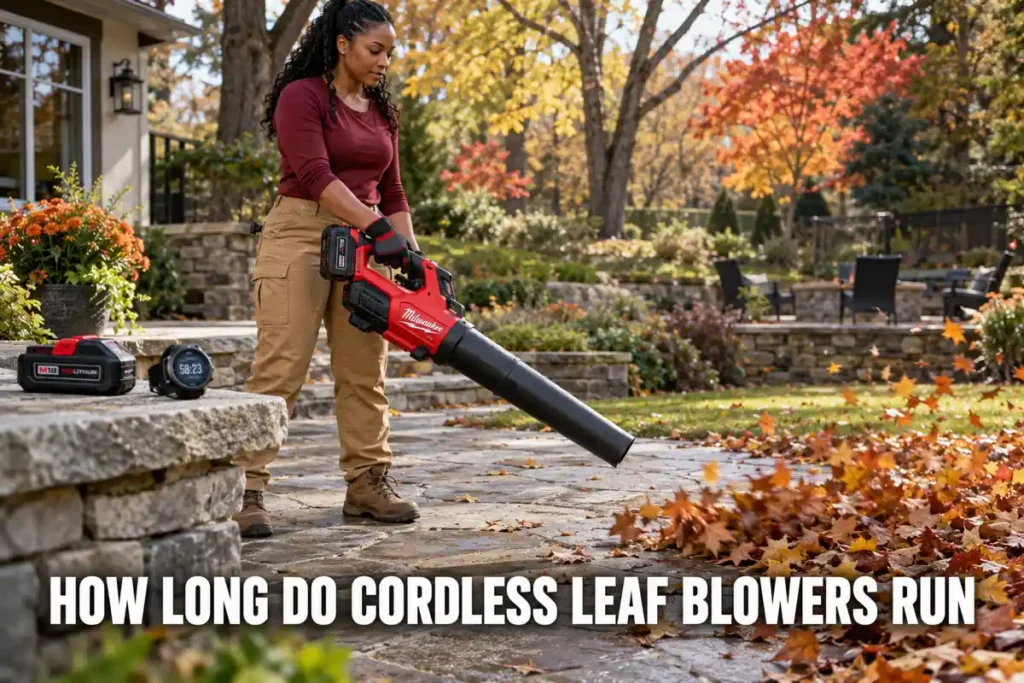
A cordless leaf blower runs about 12 to 30 minutes on high from one 4 to 5 amp-hour (Ah) pack, about 8 to 17 minutes on turbo, and 80 to 200 minutes on low, going by the makers’ figures. The setting you choose changes the run time far more than the pack does, so the number on the box rarely matches a real job.
One November a pack cut out at the end of an orchard row with a pile still lying in the alley, and I have planned my leaf work in minutes by setting ever since. Below are the maker minutes by model, the watts behind them, what shifts them in a yard, and how to count the packs you need.
How Long Do Cordless Leaf Blowers Run? The Short Answer by Setting
The high-setting minutes are the ones to plan on, because wet leaves, gravel and long alleys put the tool there. On my property the high minutes go to the gravel yard and the concrete pad in November, so that is the number I count first.
| Setting | Minutes per charge | Best use |
|---|---|---|
| Turbo or boost | About 8 to 17 on one 4 to 5 Ah pack | Seconds at a time on a stuck wet clump or a packed edge |
| High | About 12 to 30 on one 4 to 5 Ah pack | Wet leaves on gravel or pavement, and long alleys of heavy leaf fall |
| Medium | About 110 on two 8.0 Ah packs (Milwaukee’s dual-battery blower) | Dry leaves on a lawn and light debris |
| Low | EGO prints about 80 to 200 on one 4 to 5 Ah pack, depending on the model | Dust, and the edges of beds and mulch |
The number on the box rarely matches a real job, because many makers print one headline figure and leave the setting out. Greenworks says its 80V 770 CFM blower runs up to 80 minutes, and the page names no setting.
For a full explanation of that CFM figure, my guide on what CFM means in practice on a leaf blower covers how the figure is tested and what it tells you about the fan’s output.
The fan sets the pace, and every step up the dial drains the pack faster. How many years a pack lasts before it needs replacing is a different question, because it depends on how the pack ages and not on the dial.
Cordless Leaf Blower Run Time by Model
The table lists the minutes each maker publishes, the pack behind them and the setting they belong to. The last column gives the minutes a full pack really runs, so you can set it against the maker’s figure. Where a maker prints no minutes, the table says so.
| Model and kit | Pack and energy | Maker’s minutes and setting | Real run, one charge |
|---|---|---|---|
| EGO Power+ LB7654 | One 56V 5.0 Ah pack, 280 Wh | About 150 low, 25 high, 15 boost | About 22 high, about 13 boost |
| Ryobi 40V HP Whisper 730 CFM | Two 40V 4.0 Ah packs in the kit, 144 Wh each | 2 hours on two packs, setting not stated | One pack: about 15 high, about 10.5 turbo |
| Greenworks 80V 770 CFM (BL80L414) | One 80V 4.0 Ah pack | Up to 80, setting not stated | No figure |
| Milwaukee M18 FUEL Dual Battery 2824-20 | Two M18 8.0 Ah packs, 288 Wh | 45 at half throttle, 30 at three-quarter, 17.5 at full, on XC8.0 packs | Full throttle about 15 to 18 on two 8.0 Ah packs, depending on the pack line; medium about 110 |
| Husqvarna 350iB | One BLi30 pack | Estimated 45 on normal mode, boost shorter, no figure | No figure |
| Makita XBU02PT | Two 18V 5.0 Ah packs, 180 Wh | Up to 28 on dial setting 3 | No figure |
| DeWalt DCBL722P1 | One 20V MAX 5.0 Ah pack | None printed | No figure |
| WORX WG543 | One 20V 4.0 Ah pack | None printed | No figure |
Minutes fall steeply as the dial goes up. According to EGO, the LB7654 runs about 150 minutes on low, 25 on high and 15 on boost from the same pack, a 10 to 1 spread. Milwaukee leaf blower battery life follows the same slope: its chart drops from 45 minutes at half throttle to 17.5 at full throttle on the same two packs.
The first thing I check on any spec sheet is which setting the minutes belong to. Where a maker’s number and a real run sit side by side, as with the EGO LB7654, the real run lands about 12 percent under the box on both high (22 against 25) and boost (13 against 15). Plan on the lower number.
Ryobi leaf blower battery life depends on the second pack: the 2 hours covers both 4.0 Ah packs of the kit, and a single pack gives about 15 minutes on high and about 10.5 on turbo. Two packs hold 288 Wh against 144 Wh for one, so the second pack doubles the minutes at any setting.
Some makers print no minutes at all. Makita prints none for the XBU04 and the XBU03SM1, and WORX prints none for the WG543 in the US. DeWalt leaf blower battery life is the hardest to read in advance: DeWalt gives no minutes for its 20V MAX or 60V FlexVolt blowers and says only that the brushless motor helps extend run time.
No Minutes Printed
A missing number says nothing about whether a tool is better or worse. Watt-hours alone do not give minutes either, because the tool’s draw sets the pace: time one full pack at your working setting, then divide the pack’s watt-hours by those hours.
Why Turbo Empties a Pack in Minutes
A battery pack is a tank and the dial is the tap. Leaf blower run time is the pack’s watt-hours divided by the watts the tool draws, multiplied by 60 to give minutes.
The Rule
A watt-hour (Wh) is the size of the tank: volts times amp-hours, so a 56V pack rated 5.0 Ah holds 280 Wh on its label. A watt (W) is how fast the tool drains it.
One EGO Pack at Three Settings
Take the EGO LB7654 and its 5.0 Ah pack, which carries 280 Wh on the label and about 270 Wh at working voltage. About 22 minutes on high works out to about 735 W, because 270 Wh spread over 22 minutes is about 12.3 Wh a minute, and 12.3 times 60 is about 735 W. About 13 minutes on boost works out to about 1,250 W, and EGO’s 150 minutes on low works out to about 108 W.
So boost pulls about 1.7 times the power of high and more than 11 times the power of low. The cause is the fan: a fan’s power rises with the cube of its speed, so 26 percent more fan speed roughly doubles the power it needs.
Heat adds a second cost. The internal resistance of a lithium-ion cell sets how much power it can deliver and how much energy is lost as heat (1), so a pack pushed hard returns a little less than its label. Treat the high-end watt figures here as slight overestimates. I use turbo for seconds at a time, usually on a wet clump at the corner of the machinery shed, and drop back to high because turbo pulls about 1.7 times the power.
One Milwaukee at Three Settings
Milwaukee’s dual-battery blower shows the same pattern on one pair of 8.0 Ah packs, which hold 288 Wh. On that pair, medium ran about 110 minutes, which is about 155 W, and a steady push of 12 newtons (about 2.7 pounds of push from the air jet) ran about 32 minutes, which is about 540 W.
According to Milwaukee, full throttle lasts 17.5 minutes on the same pair, which is about 990 W. Its chart for a pair of 12.0 Ah packs, which hold 432 Wh, shows 26 minutes at full throttle, about 1,000 W. A bigger pack adds minutes and leaves the push unchanged.
| Tool and pack | Setting | Minutes | Average draw |
|---|---|---|---|
| EGO LB7654, 5.0 Ah (270 Wh) | Low, maker’s figure | 150 | About 108 W |
| EGO LB7654, 5.0 Ah (270 Wh) | High | About 22 | About 735 W |
| EGO LB7654, 5.0 Ah (270 Wh) | Boost | About 13 | About 1,250 W |
| Ryobi 730, 4.0 Ah (144 Wh) | High | About 15 | About 575 W |
| Ryobi 730, 4.0 Ah (144 Wh) | Turbo | About 10.5 | About 820 W |
| Milwaukee 2824-20, two 8.0 Ah (288 Wh) | Medium | About 110 | About 155 W |
| Milwaukee 2824-20, two 8.0 Ah (288 Wh) | Steady 12 N push | About 32 | About 540 W |
| Milwaukee 2824-20, two 8.0 Ah (288 Wh) | Full throttle, maker’s figure | 17.5 | About 990 W |
What Changes Run Time in the Yard
Four things move the minutes you actually get: the trigger, the temperature, the age of the pack and the state of the leaves. Some have numbers behind them and others only a direction.
Trigger Use
The fan draws power only while the trigger is held, so the clock time a pack lasts depends on how much of it you spend blowing. Hold the trigger for half of every minute and the pack lasts about twice as long on the clock at that setting, because the fan draws almost nothing while the trigger is up. I release the trigger every time I step to the next section of a row, and the walking costs the pack nothing.
Temperature
A cold pack gives less. In lab work on lithium-ion cells, the energy and power at low temperatures fell substantially, and how much depended on the discharge rate and on how much the cell warmed itself while working (2). Tests of two battery types down to -20 C (-4 F) also found that internal resistance rises as the temperature falls, which lowers both capacity and power (3).
Those were cells on a bench, so they show the direction and not the minutes you lose. According to EGO, its blowers work from 5 to 104 F, its packs work best between 50 and 80 F, and a very cold pack pulses for the first minute while it warms. On frost mornings I keep the spare pack indoors until I walk out.
Pack Age
An older pack holds less energy, and the minutes shrink with it. In a study of pouch cells run through seven charge ranges at three rates and two temperatures, how deeply the cells were discharged and how old they were both changed how much capacity they lost (4). A pack at 80 percent of its original energy gives about 80 percent of the minutes at the same setting.
Wet and Packed Leaves
A wet mat draws the same watts as a dry one at the same setting. What costs minutes is the setting it forces and the extra passes it needs. Wet plum leaves on my gravel yard push me from medium to high. I wait for a partial dry-out and blow the dry areas first.
How to Size the Pack to Your Yard
Count the packs in watt-hours, starting with the high-setting minutes. The method needs one timed session and a calculator, and it works for any tool whose draw you know or can time.
- List the jobs and the setting each one needs. Dry leaves on a lawn take medium or low, a wet mat or a gravel edge takes high, and a stuck spot takes turbo for a few seconds.
- Time each job once. Use a phone stopwatch and count only the minutes the trigger is held.
- Convert minutes to watt-hours. Multiply the minutes by the tool’s average draw at that setting, then divide by 60. For a tool the draw table does not list, run one pack from full to empty at a single setting and divide the pack’s watt-hours by the hours it lasted.
- Divide the total by 80 percent of one pack’s energy, and round up. The 20 percent reserve is my rule of thumb for cold mornings and an aging pack.
A Worked Sum for the EGO LB7654
Say a job needs 20 minutes on high and 40 on low. High: 20 minutes at 735 W is 245 Wh. Low: 40 minutes at 108 W is 72 Wh. The total is 317 Wh.
One 270 Wh pack gives about 216 Wh after the 20 percent reserve, so 317 divided by 216 is 1.5, and the answer is two packs, even though the tool runs 150 minutes on low. The draws come from the table above, so treat the result as an example and not a promise for your yard.
My own yard splits into two sessions: the house lawn, the gravel yard and the concrete pad in one, and the orchard strips under the trees in the other. On a big leaf Saturday I run three packs through both sessions and put the spare on the charger at lunch. Each session gets its own set of charged packs, so I never plan the whole day on one number.
How to Stretch One Charge
These six steps run from the biggest saving to the smallest.
- Drop one step on the dial. Milwaukee’s blower draws about 540 W at a steady 12 N push and about 155 W at medium, against about 990 W at full throttle. Keep high for the wet mat, the gravel edge and the stuck spot.
- Release the trigger between passes. The fan draws almost nothing while the trigger is up.
- Match the nozzle to the job. A tapered tip narrows the stream and speeds the air, and it can load the motor harder, but no maker publishes minutes per nozzle. I fit the tapered tip for stuck spots and the gravel edge and run the wide nozzle across open lawn.
- Start with a full, warm pack. Keep the spare indoors until you need it, since EGO says its packs work best between 50 and 80 F.
- Rake the thick mat first. A rake lifts a wet mat that no setting clears cheaply, and the air finishes what is left. Under the plum rows I rake first and blow the remainder.
- Read the gauge before a big job. According to EGO, its five-light gauge reads in steps of 20 percent, and five green lights mean 80 to 100 percent.
Keep full packs out of a hot shed. In one lab study, pouch cells held fully charged lost about 10 percent of their capacity in nine months at 35 C (95 F) and about 43 percent at 60 C (140 F) (5). Those were pouch cells and not blower packs, but the direction holds for a charged pack left in a shed in July.
When a Second Pack or a Different Tool Is the Answer
I recommend a second pack whenever your hard work on high runs past 80 percent of what one charge covers. That is about 18 to 20 minutes on an EGO LB7654 and about 12 on a Ryobi 730 with one 4.0 Ah pack. Once one spare is not enough, the type of tool matters more than the pack. My old gas handheld never made me count minutes, which I miss, but I do not miss the pull cord or the exhaust.
- Second pack: one EGO 5.0 Ah pack covers about 22 to 25 minutes on high and one Ryobi 4.0 Ah pack about 15, so hard work past 80 percent of that needs a charged spare. An EGO 5.0 Ah pack takes about 30 to 100 minutes to charge, depending on the charger, so charge the spare while you work.
- Dual-pack tool or cordless backpack: judge it by its total watt-hours and the minutes it gives at your working setting, not by how many packs it carries. Milwaukee’s two packs hold 288 Wh, about what one 280 Wh EGO pack holds. A cordless backpack earns its place when it carries more watt-hours than your handheld and its harness takes the weight off your arm.
- Corded: a 12 A corded blower draws up to 1,440 W from the wall and never runs out. It suits work within about 100 feet of an outlet. Skip it for tree rows far from power.
- Gas backpack: it runs until the tank is empty, which suits an acre or more and long wet jobs. It is loud, so wear earplugs and earmuffs together from the first minute. Run it outdoors only, because the exhaust carries carbon monoxide, and stop the engine and let it cool before refueling.
- Rake: a rake is the honest answer for a thick wet mat on a small patch. It is quiet and it never needs a charge.
Safety
Wear safety glasses every time, and a dust mask for dry piles and shed floors. Keep people, pets and windows out of the debris path. Wear ear protection on a cordless blower at turbo, and earplugs with earmuffs together on a gas backpack.
For tool-by-tool choices in each class, see the leaf blower guides.
Plan the Season in Total Minutes
Run one real session on your own yard and write down the trigger-held minutes for each setting. Put those minutes through the sum from the sizing section, minutes times draw, divided by 60, divided by 80 percent of one pack, and round up: the result is your pack count, in place of the number on the box. I charge every pack the night before a leaf day and time one real session with a phone stopwatch, and I keep the spare indoors so it starts warm. With one session on record you know how long a cordless leaf blower runs on your own yard.
Frequently Asked Questions
How long does a Ryobi leaf blower last?
A Ryobi leaf blower lasts about 15 minutes on high and about 10.5 minutes on turbo from one 4.0 Ah pack. According to Ryobi, the 40V HP Whisper 730 CFM kit runs 2 hours on its two packs, though the company names no setting. Years of service depend on how the pack ages, not on the dial.
Which battery leaf blower has the longest run time?
The battery leaf blower with the longest run time is the one that draws the fewest watts from the biggest pack at the setting you use, so pack energy alone does not decide it. The EGO LB7654 shows the spread: according to EGO, one 5.0 Ah pack gives about 150 minutes on low and about 15 on boost. Compare tools at the same setting before you trust the minutes on a box.
Do handheld leaf blowers work well?
Handheld leaf blowers work well on yards up to about half an acre when you own enough charged packs for the hard minutes. They struggle with a thick wet mat and with large properties, where the pack ends the job before the fan does. A cordless backpack or a gas backpack suits those jobs better.
How long does a battery powered leaf blower last?
A battery powered leaf blower lasts about 12 to 30 minutes on high from one 4 to 5 Ah pack, depending on the model, and far longer on low. A second pack doubles the minutes, because the total depends on the energy in the packs and the setting you use. Count the high-setting minutes of your own yard and divide by what one charge covers.
How long do leaf blower batteries last?
Leaf blower batteries last about 12 to 30 minutes of high-setting work per charge, depending on the model, and several times that on low. The pack’s watt-hours are the tank, so a 280 Wh EGO pack runs about twice as long as a 144 Wh Ryobi pack at the same draw. An older or colder pack gives fewer minutes than a new, warm one.
References
- Schweiger H-G, Obeidi O, Komesker O, et al. Comparison of Several Methods for Determining the Internal Resistance of Lithium Ion Cells. Sensors. 2010;10(6):5604-5625.
- Ji Y, Zhang Y, Wang C-Y. Li-Ion Cell Operation at Low Temperatures. J Electrochem Soc. 2013;160(4):A636-A649.
- Hossain Ahmed S, Kang X, Bade Shrestha SO. Effects of Temperature on Internal Resistances of Lithium-Ion Batteries. J Energy Resour Technol. 2015;137(3):031901.
- Gauthier R, Luscombe A, Bond T, et al. How do Depth of Discharge, C-rate and Calendar Age Affect Capacity Retention, Impedance Growth, the Electrodes, and the Electrolyte in Li-Ion Cells?. J. Electrochem. Soc. 2022;169(2):020518.
- Mao Z, Farkhondeh M, Pritzker M, Fowler M, Chen Z. Calendar Aging and Gas Generation in Commercial Graphite/NMC-LMO Lithium-Ion Pouch Cell. J. Electrochem. Soc. 2017;164(14):A3469-A3483.
Safety Note: Leaf blowers throw debris and can damage your hearing. Wear eye and ear protection, read the manufacturer’s manual, and check your local rules on noise and operating hours.