
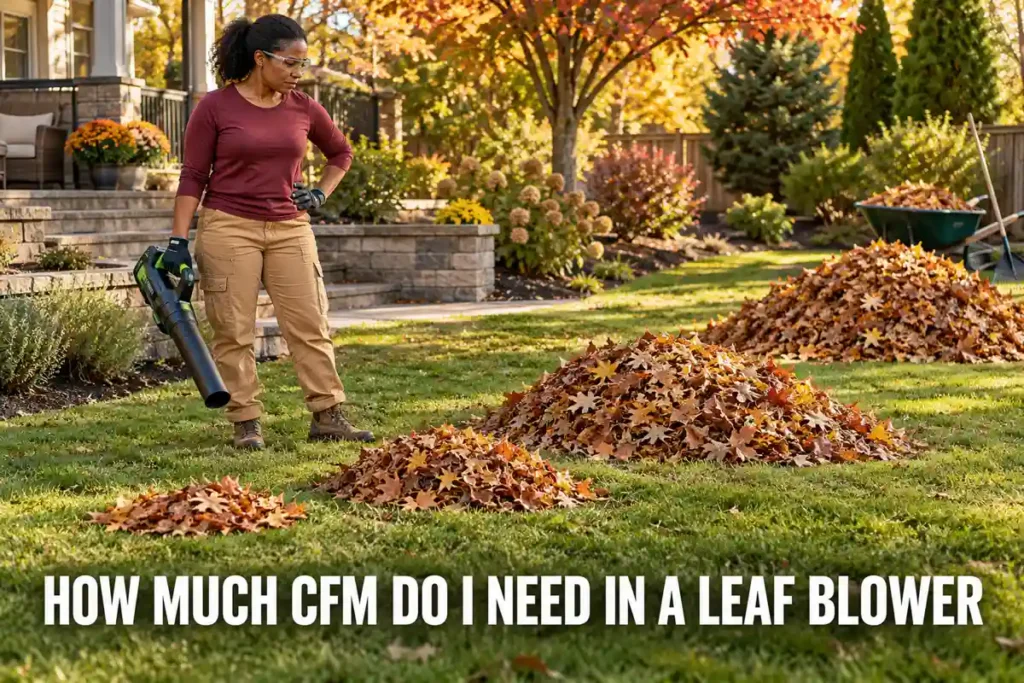
Most homeowners need a leaf blower rated 450 to 650 CFM, which covers an average suburban lot. A patio or a yard under 2,000 square feet needs only 300 to 450, a quarter to a half acre calls for 600 to 800, and past half an acre runtime and your arms decide before airflow does.
I keep up 3.7 acres of orchard plus the lawn, gravel yard and concrete pad around the family house, so I size a blower by the hardest job of the season. Below I adjust the number for debris, surface and tree cover, work through five sample yards and show what extra CFM costs.
If you are new to blower specs, my guide on what the CFM rating measures and how makers test it covers the basics before we get into how much you need.
How Much CFM Do I Need in a Leaf Blower? The Short Answer by Yard Size
Match the rated CFM to the area you actually clear: the lawn, drive, paths and beds under the trees, not the whole lot. A typical suburban lot is about a fifth of an acre, and the cleared part is smaller. Read the table as my guidance, not a standard.
| Cleared area | Square feet | Rated CFM to look for | Blower class | Force to check |
|---|---|---|---|---|
| Patio, deck, short drive (up to 0.05 acre) | Up to 2,000 | 300 to 450 | Corded, or small cordless handheld | About 10 N |
| Small yard (0.05 to 0.12 acre) | 2,000 to 5,000 | 400 to 550 | Cordless handheld, one pack | 10 to 15 N |
| Average lot (0.12 to 0.25 acre) | 5,000 to 10,900 | 450 to 650 | Cordless handheld, 1 to 2 packs | 15 to 25 N |
| Large lot (0.25 to 0.5 acre) | 10,900 to 21,800 | 600 to 800 | Cordless handheld with 2+ packs, battery backpack or gas handheld | 20 N or more |
| Half to one acre | 21,800 to 43,600 | 750 to 1,000 | Battery or gas backpack | 22 to 40 N |
| One acre and up | 43,600 and more | 900 to 1,100+ | Gas backpack or walk-behind | 33 to 48 N |
Read the table in two steps. Take the row for your area, then move one row up for wet leaves or heavy tree cover, and one row down only if the whole yard is hard surface. Gravel is the exception: it keeps a low throttle whatever the row says.
A large lot under heavy trees belongs in the 750 to 1,000 row. The CFM column is the maker’s top rated figure, which on some blowers is a short Turbo burst, so count runtime on High. The last column uses newtons (N), the push of the air at the nozzle, where 10 N is about 2 pounds of push.
How Much CFM Do I Need for Leaf Blower Work on a Small Lot?
A 400 CFM leaf blower clears dry leaves off a patio, a short drive and a small yard that is mostly hard surface, and airflow above about 450 CFM adds weight, noise and a dust cloud.
The 40 by 30 foot concrete pad in front of my machinery shed never needs more than a corded blower, because volume is not what limits that job.
What Changes on a Large Lot
From a quarter acre up, a higher CFM clears more ground per pass, so the number climbs. Above half an acre I treat airflow as the smaller question and runtime and weight as the bigger ones.
What Size Leaf Blower Do I Need? Work Out Your Minutes First
Acres tell you how big the job is, and minutes tell you what to buy. Count the minutes of blowing, then divide by the runtime of one battery pack on High.
- Measure each part you blow (lawn, drive, pad, paths and the beds under your trees) as length times width, add the parts together and divide by 1,000.
- Multiply by 2 to 4 minutes. My rule of thumb is 2 minutes per 1,000 square feet for a light fall of dry leaves and 4 for a heavy fall, with one pass to move the leaves and one to gather them.
- Divide the total by the minutes one pack lasts on High. The answer is the number of packs, or tanks if you run gas.
| Cleared area | Minutes of blowing | EGO LB7654, 5.0 Ah (about 22 min on High) | EGO LB8803-2, 4.0 Ah (about 12.5 min on High) |
|---|---|---|---|
| 0.125 acre (5,445 sq ft) | 11 to 22 | 1 pack | 1 to 2 packs |
| 0.25 acre (10,890 sq ft) | 22 to 44 | 1 to 2 packs | 2 to 4 packs |
| 0.5 acre (21,780 sq ft) | 44 to 87 | 2 to 4 packs | 4 to 7 packs |
| 1 acre (43,560 sq ft) | 87 to 174 | 4 to 8 packs | 7 to 14 packs |
Those runtimes are on High with the pack that ships with each blower. A middle setting stretches either pack, since leaf work is not all on High.
A quarter acre takes one or two charged packs of the LB7654, which is a normal Saturday, and a 700 CFM leaf blower in that class covers it with two. At half an acre the same handheld needs 2 to 7 packs depending on the model and 45 to 90 minutes of holding about 10 pounds, and that is where I stop sizing for CFM and start sizing for the operator.
Adjust the Number for the Debris
A wet leaf weighs far more than a dry one, so debris changes the number more than yard size does. CFM is the volume of air that carries a pile, and wet or heavy material also needs force. Wet leaves stick by surface tension, so a thin fast stream can leave a wet mat lying flat.
| Debris | Rated CFM | Also check | How it behaves |
|---|---|---|---|
| Dry leaves on pavement | 300 to 450 | Air speed | Volume is not the limit, so a corded or small cordless unit works. |
| Dry leaves on lawn | 450 to 650 | Volume | Grass drags on the leaves, so wide passes help. |
| Wet or matted leaves | 600 to 900 | 20 N or more, Turbo runtime | Aim low under the edge of the mat, or wait for a partial dry-out. |
| Acorns, gumballs, pods | 500 to 700 | 15 N or more | They roll rather than lift, and spiky gumballs may need a rake. |
| Twigs and pruning sawdust | 400 to 600 | Dust mask | Sawdust is fine and light, so use a low throttle. |
According to Toro, its 565 CFM model suits sidewalks, patios and dry leaves, and its 900 CFM model suits wet leaves and heavy debris. For a wet November pile on a large lot, I want an 800 CFM leaf blower with at least 20 N behind it.
After a rainy week, the leaf mats on my yard concrete only slid when I swept them from above. Putting the air under the leading edge at a low angle moved them, and the extra speed of a narrow nozzle did not.
Adjust the Number for the Surface
Lawn is the most CFM-hungry surface, and gravel and beds are the least, because there extra volume throws stone and strips mulch instead of moving leaves.
| Surface | Rated CFM | What goes wrong with too much |
|---|---|---|
| Concrete, asphalt, pavers | 300 to 550 | Speed peels the leaves off, and extra volume only throws dust. |
| Lawn | 450 to 700 | Little. The lawn needs volume to lift leaves out of the grass. |
| Gravel, crushed stone | 300 to 500, low throttle | Stones become projectiles at high air speed. |
| Mulch, beds, drip lines | Lowest setting | The air strips mulch, dries the soil and moves drip lines. |
On a small patio or deck, a power sweeper can beat a bigger blower, because it collects the debris instead of scattering it.
Dust is the hidden cost of airflow on dry hard ground. Researchers built a portable enclosure to measure the fine dust that leaf blowing raises from real work surfaces (1). I wear a dust mask for dry piles and for the machinery shed, and I open both doors first.
On my gravel yard I keep the tip 2 to 3 feet off the stone, tilted up, with the throttle low. High speed at a steep angle throws stones at ankles, windows and car paint. Around drip lines and mulched tree bases I put the blower down and rake.
Adjust the Number for Tree Cover
Stand under a full forest canopy in November and the ground is buried in leaves. A yard with a few shade trees gets only a fraction of that, so match your own cover to one of three tiers:
- Light cover: no tree over the cleared area, or one small tree, with a leaf layer under 1 inch. Use the low end of your area row.
- Moderate cover: two to four shade trees, with leaves 1 to 3 inches deep in the heaviest week. Use the middle of the row.
- Heavy cover: a canopy over most of the cleared area, or leaves several inches deep. Use the top of the row or the next row up, and add a second pack or gas.
Heavy cover over half an acre is where a 1000 CFM leaf blower earns its weight. Below that, a second pack beats more airflow, so I add a pack before I buy a bigger blower.
Let a layer under 1 inch dry and mow it in place, and move or shred anything deeper, which is the job of mulching lawn mowers. When the layer is thin, I mow first and blow only the drive and the beds.
Mulched leaves can help a lawn. In one Kentucky bluegrass trial, mulching maple and oak leaves into the turf cut dandelion counts by up to 80 percent after one application at the high rate (2). In suburban yards where leaves were removed every autumn for years, decomposition ran 17 percent slower than where the leaves stayed (3).
Five Worked Examples for Real Yards
Each yard below uses the area table, the adjustments for debris, surface and trees, and my minutes rule.
A Townhouse Patio and Small Yard
The cleared area is 2,500 square feet: a patio, a short path and a strip of lawn with one small tree, all dry leaves. Look for 300 to 450 CFM, a corded or small cordless handheld and 5 to 10 minutes of work.
An Average Suburban Lot
A lot of 8,700 square feet leaves about 7,000 square feet to clear once the house and beds are out. Two maples drop mixed dry and damp leaves, which calls for 450 to 650 CFM in a cordless handheld. Expect 14 to 28 minutes of blowing, so one or two packs on High. Move up a row only if the maples hang over the drive and the leaves stay wet, because at this size extra leaf blower CFM adds weight and nothing else.
My Quarter-Acre House Lawn
The lawn at my family house is about a quarter acre of level grass with two or three shade trees. Add the 40 by 30 foot concrete pad and about 150 feet of gravel yard. The lawn and pad come to roughly 12,000 square feet, which is 24 to 48 minutes of blowing, or two to three charged packs of 22 minutes on High.
Mixed leaf fall and a wet November put me at 600 to 800 CFM in a cordless handheld with three charged packs.
A Half-Acre Wooded Lot
This lot has 21,780 square feet to clear under a heavy canopy, and the leaves are wet by November. Look for 750 to 1,000 CFM and 22 N or more. That is 44 to 87 minutes of blowing, or 2 to 4 packs of a 765 CFM handheld on High, so the right tool is a battery or gas backpack that carries 23 to 27 pounds on your hips.
The Orchard Tree-Row Strips
My orchard is 3.7 acres of apricots and plums planted in 2016. The leaves that matter fall on the tilled strips under the trees and the first feet of the grass alleys. I size the blower for the strips, not the acreage, because the job is to move leaves from under the canopy into the alley, where the mower shreds them.
Every acre of strip is 90 to 175 minutes of blowing by my rule, so I look for 750 to 1,100 CFM and a gas backpack. Two tanks have covered my strips.
When More CFM Is Wasted
More airflow stops paying off in five situations, and in each one a different fix works better.
- Small hard surfaces. Above about 450 CFM on a patio, deck or short drive you add weight, noise and a dust cloud, not speed.
- Beds, mulch and gravel. Extra volume strips mulch and throws stone, so use the lowest setting rather than a bigger blower.
- Turbo-only CFM. The EGO LB7654’s 765 CFM is its Turbo figure, its variable dial covers about 260 to 580 CFM below that, and Turbo ran about 13 minutes on the 5.0 Ah pack. Treat a Turbo-only rating as a short burst and plan your packs on the High runtime.
- Wet matted leaves. More CFM at a high angle can leave the mat flat, and according to Husqvarna wet or compacted debris requires more power. Force, a low angle and a partial dry-out work better.
- Anything beyond about 1,000 CFM on a normal lot. Only walk-behind and acreage work use it. On half an acre or less it brings weight, noise and local-rule risk.
What Extra CFM Costs in Weight, Noise and Runtime
Every extra CFM costs something, and the bill differs by blower type. Many cities also restrict gas blowers or their hours, so check city, county and HOA rules before you buy a gas backpack.
| Blower | Rated CFM | Weight as published | Noise as published | Runtime on High, or tank |
|---|---|---|---|---|
| EGO LB7654 (battery handheld) | 765 | 9.6 lb with 5.0 Ah pack | No ear-level figure | About 22 min on High |
| EGO LB8803-2 (battery handheld) | 880 | About 9.7 lb with 4.0 Ah pack | No ear-level figure | About 12.5 min on High |
| Husqvarna 350iB (battery handheld) | 800 with nozzle | About 10 lb with battery kit | 79.4 dB(A) at the ear | Not published |
| Echo PB-580T (gas backpack) | 517 | 22.7 lb dry | 97 dB(A) at the ear | 62 oz tank |
| Husqvarna 580BTS (gas backpack) | About 1,000 | About 26 lb | 100 dB(A) at the ear | Not published |
| Echo PB-9010T (gas backpack) | 1,110 | 26.7 lb dry (27.2 lb with pipes) | 79.3 dB(A) at 50 ft | 83.8 oz tank |
Weight follows blower class far more than CFM. Across the three gas backpacks, rated airflow doubles from 517 to 1,110 CFM while the published weight rises only about 4 pounds, from 22.7 to 26.7. On a gas backpack, CFM is almost free in weight, and you pay in noise, fuel and tired arms.
On battery, the price of CFM shows up as runtime. The LB8803-2 rates about 15 percent more airflow than the LB7654, and on High it runs about 43 percent shorter, with a 4.0 Ah pack against the 5.0 Ah pack of the LB7654. If you want more CFM from a handheld, plan on a second pack.
Noise follows blower class and measuring distance more than CFM, so compare dB figures only when they share a distance. The gas backpacks that publish an ear-level figure give 97 to 100 dB(A) at the operator’s ear, and Husqvarna publishes 79.4 dB(A) at the ear for its battery 350iB.
Hearing and Eye Protection
Wear ear protection with any gas blower and with a battery blower on Turbo, and wear eye protection every time. Keep bystanders and pets about 50 feet away, and never run a gas blower in a closed shed, because the exhaust is carbon monoxide.
NIOSH recommends 85 dB(A) as the 8-hour average and halves the allowed time for every 3 dB(A) more, which leaves about 15 minutes a day at 100 dB(A). Among 80 landscaping workers, 94 of 119 eight-hour results were at or above 85 dB(A), and fuel-powered blowers gave significantly more noise than battery ones (4). A field test of two leaf blowers and a hose vacuum measured individual machines at 85 to 101 dB(A) (5).
Backpacks add a second cost in the arms and shoulders. Median hand vibration from backpack blowers measured 1.71 to 2.91 m/s2 in one field study, and the authors estimate it could pass the European daily action value after about 5 hours of use a day (6).
After about 90 minutes in a gas backpack, my back is soaked and my ears are tired, even with protection. I take a break every 30 minutes for water and to check the air filter.
Pick the Smallest Blower That Finishes Your Biggest Job
Three things decide the number: the area you clear, the heaviest debris you face and the trees overhead. Size for the wet November pile, then pick the smallest blower that finishes that job in the packs or tanks you are willing to carry. I charge both packs the night before and blow with the wind at my back, which saves me more time than extra CFM would.
Before you shop, write down your cleared square feet, the minutes of blowing that gives you and the runtime of one pack on High. If the answer is more than three packs, look at a backpack instead of a bigger handheld. Match the CFM you need to your cleared area, your debris and your trees, and the leaf blower guides on this site show which models fit.
Frequently Asked Questions
Is 100 CFM good for a leaf blower?
A 100 CFM leaf blower is good only as a sweeper for dust and light debris on a deck or a workbench. It cannot lift a pile of leaves, so for any real yard look for at least 300 CFM.
Is 250 CFM good for a leaf blower?
A 250 CFM leaf blower is good for decks, steps and a small patio with dry leaves. It runs light and quiet, but a lawn needs 450 CFM or more because grass drags on the leaves.
Is 400 cfm enough for a leaf blower?
A rating of 400 CFM is enough for a leaf blower on a patio, a short drive or a small paved area of dry leaves. A lawn needs 450 CFM or more because grass drags on the leaves, and wet leaves, heavy tree cover or anything past a quarter acre needs 600 CFM or more.
Is 500 cfm a lot for a leaf blower?
A leaf blower rated 500 CFM sits in the middle of the homeowner range. It suits small yards and average lots, while wet leaves and larger lots call for 600 to 900 CFM.
Is 600 CFM good for a leaf blower?
A 600 CFM leaf blower is good for large lots, heavy tree cover and damp leaves up to about half an acre. Past that size, a battery or gas backpack at 750 CFM or more finishes sooner.
References
- Fitz D, Pankratz D, Pederson S, Bristow J. A Semi-portable Enclosure to Measure Emission Rates from Small Fugitive Sources: Leaf Blower Dust Example. Aerosol Air Qual. Res. 2021;21(10):200566.
- Kowalewski AR, Buhler DD, Lang NS, Nair MG, Rogers JN. Mulched Maple and Oak Leaves Associated with a Reduction in Common Dandelion Populations in Established Kentucky Bluegrass. HortTechnology. 2009;19(2):297-304.
- Ferlauto M, Schmitt L, Burghardt K. Legacy effects of long-term autumn leaf litter removal slow decomposition rates and reduce soil carbon in suburban yards. Plants People Planet. 2024;6(4):875-884.
- Alexander BM, Graydon PS, Pena M, Feng HA, Beamer BR. Hazardous exposures and engineering controls in the landscaping services industry. Journal of Occupational and Environmental Hygiene. 2025;22(3):189-202.
- Walker E, Banks JL. Characteristics of Lawn and Garden Equipment Sound: A Community Pilot Study. J Environ Toxicol Stud. 2017;1(1).
- Alamin Gabasa SA, Md Razali KA, As’arry A, Abdul Jalil NA. Vibration Transmitted to the Hand by Backpack Blowers. IJAME. 2019;16(2):6697-6705.
Safety Note: Leaf blowers throw debris and can damage your hearing. Wear eye and ear protection, read the manufacturer’s manual, and check your local rules on noise and operating hours.