
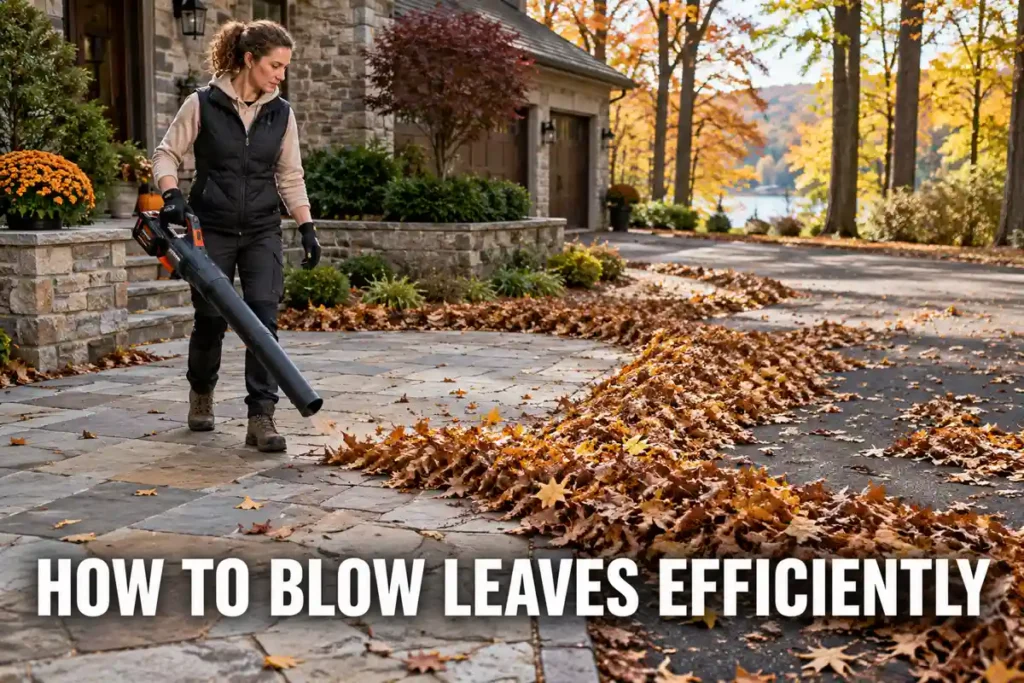
The fastest way to learn how to blow leaves is to settle three things before the blower starts: where the leaves will end up, which way the wind blows, and which ground you clear first. A good plan moves every leaf once, over the shortest distance, and a battery lasts longer when it does.
Every autumn I clear a quarter-acre lawn, a gravel yard and the tree-row strips of a 3.7-acre apricot and plum orchard, and the order of work matters more to me than the machine. Below you get the short version, then each step with the numbers: destination, wind, edges, lanes, tarp, power, and when a rake or mower wins.
How to Blow Leaves Fast: The Short Version of the Plan
Choose where the leaves will end up, work with the wind, clear the beds and edges first, push the open lawn in straight lanes toward one line, and roll that line onto a tarp. That order saves time because a blower only moves leaves onto other ground, so every step either puts them where they stay or undoes your last pass.
- Pick the destination. The place the leaves must end up sets the direction of every pass.
- Check the wind and the dew. Keep the wind behind you or across you, and wait until the leaves are dry enough to move as a layer.
- Clear edges and beds onto the lawn. Hard surfaces, fence lines, walls and corners go first.
- Push the lawn in lanes. Each lane ends at one line, and you never cross ground you have already cleared.
- Roll the windrow onto a tarp. The tarp turns a long line of loose leaves into one load.
- Move the pile. Mulch it, compost it or leave it for collection, but not in the street.
The best way to blow leaves is the one that moves each leaf the shortest distance, once. I run this same order on the lawn, the yard and the orchard strips, and only the destination changes.
Decide Where to Blow Leaves Before You Start
The destination decides how far every leaf travels, so it comes before the first pass. Your options are a tarp that ends at a compost pile or a garden bed, the lawn itself when a mulching mower will chop the layer, a shaded strip where a mower will shred the leaves later, or a curb pile where your town collects them.
Do not blow leaves into street gutters or storm drains. Many towns forbid it, and the rule has a reason: in paired neighborhoods in Madison, Wisconsin, removing leaves before rain cut the phosphorus load in storm runoff by about 84 percent (1). Check your city, county and HOA rules for yard waste dates and bag types before you pick a spot, and never aim the pile at a neighbor’s yard.
Distance is where the time goes. Take a level quarter acre as a square: 43,560 square feet divided by four is 10,890 square feet, about 104 feet on a side. The table shows how the position of the line changes the push.
| Where the line sits | Longest push | Average push |
|---|---|---|
| One edge of the lawn | About 104 ft | About 52 ft |
| A center line | About 52 ft | About 26 ft |
| Two opposite edges | About 52 ft | About 26 ft |
A center line halves the total pushing, as long as the tarp can reach it. The figures assume a square, level lawn and count only the push to the line. A real yard has trees and corners, and rolling the line to the tarp adds distance of its own.
Let the wind pick the layout. In a light breeze I run the line through the middle of the house lawn, parallel to the wind, with the tarp at its downwind end, and blow in from both sides, so the wind crosses my body on every lane and the roll to the tarp has it at my back. When the wind is strong enough to carry leaves back off a sideways push, I give up the shorter distance: the line goes along the downwind edge, every lane runs with the wind, and the tarp waits at the downwind corner.
Read the Wind and Decide When to Blow Leaves
Stand so the wind is behind you or across your body, and push the leaves downwind. Into a breeze the leaves scatter back over cleared ground, and you pay for the same stretch twice in battery or fuel.
Check the gusts, not only the rain forecast, because a calm hour lets a low windrow sit still. My yard is open and flat with a prevailing wind, and the hedgerow breaks it on one side, so I start on the sheltered side and wait out a strong gust rather than fight it.
Time of day matters as well. Dew keeps the leaves heavy until the sun burns it off, which on my place means mid-morning, so I do the beds by hand first and leave the lawn until the surface is dry. Late-autumn mornings are cold, and a cold pack gives less runtime, so on frost mornings I keep the packs indoors until I start. Never charge a lithium-ion pack below freezing: bring it up to room temperature first.
Soaked leaves are a different job. They weigh more and bind into a mat, so a pass moves less of the layer and drains the pack faster. On a wet day I wait for a partial dry-out and do something else.
Choose your hours with the neighbors in mind. In a survey of 6,647 Canadian adults, landscaping equipment ranked third among nine noise sources for annoyance, behind only road traffic and construction (2). Blow in the middle of the day, not at first light, and blow before you spray or apply anything, never after, because the air disturbs what you just put down. In the orchard I clear the strips before I spray.
Protect Yourself First
Eye protection and hearing protection go on before the blower starts. With a gas backpack blower, wear plugs and earmuffs together from the first minute, and with a battery blower, plugs or earmuffs still go on before the first pass. Wear a dust mask for dry, dusty piles, keep people, pets and car windows out of the debris path, and stop the engine and let it cool before you refuel.
Beds and Edges First, Then the Open Lawn
Start with the ground that would otherwise get dirty again: hard surfaces, beds, fence lines, walls and corners, and push all of it onto the open lawn. If you clear the lawn first, every bed you do afterward drops new leaves on it, and you cross the same ground twice. Work from the outside in, so that no pass blows leaves over clean ground.
Some ground stays off the list. I do not use the blower on the flowering strips, the young drip lines or the mulched tree bases, because air strips mulch, packs grit into the emitter ends and, in October, moves the cover crop seed I just sowed. I rake those spots by hand.
Walls, Fences and Corners
A wall or a fence works as a backboard. How to blow leaves out of a corner comes down to that: aim the tip at the wall just above the pile, and the rebound pushes the leaves out and away from the foundation. Along a fence, keep the tube parallel to it and sweep the tip from the fence into the yard as you walk.
How to Blow Leaves Off Mulch Without Moving It
Drop to low power and let the air skim across the top of the bed instead of digging into it. Sweep from the edge of the bed outward in short passes, and stop if you see bare soil or mulch on the move. On the wood-chip paths of my vegetable plot I walk slowly enough that the chips stay put and only the leaves travel, and where the mulch still shifts I switch to the rake.
How to Blow Leaves Into a Pile With Lanes and a Windrow
Work in straight lanes that end at the line, not in circles. Each lane pushes the front edge of the leaf mass forward a few feet, the leaves behind it follow, and the line builds as one low, continuous windrow instead of a scatter of heaps. Whichever layout you chose, the wind is behind you or across you on every lane.
Never re-cross ground you have already cleared. Start the next lane beside the last one, overlap it slightly, and keep the tip close to the leaves. A blower jet pulls in the still air around it as it travels, which widens the stream and slows it with distance (3). So short passes with the tip near the leaves beat long throws across the yard.
Raise and lower the tip as you go, so both the top and the bottom of the layer move. On a slope, blow downhill and collect at the bottom, because leaves pushed uphill roll back as soon as you stop.
A tall pile does not last in the exposed part of my yard, because the first gust spreads it over the lawn again. I keep the windrow low and put the tarp at the end of it, and where the wind keeps picking up I build two or three small piles instead of one.
How to Blow Leaves Onto a Tarp and Move the Pile
A tarp turns a pile of loose leaves into one load. Lay a large polyethylene tarp, around 9 by 12 feet, flat at the downwind end of the windrow, and blow the last of the line onto it.
Fold the near edge over the leaves, gather the corners and drag the tarp to the destination, or run a rope through the grommets so it pulls like a sack. This beats carrying armfuls, and it leaves no pile behind for the next gust.
Damp leaves are heavy, so I load half the tarp and make two trips instead of dragging a full one across the grass. Bagging as you go and running a leaf vacuum are the other ways to finish the job, but I stay with the tarp because the blower does the loading.
Pro Tip
Carry the tarp to the end of the line before you start the blower, so it is already waiting when the first windrow arrives.
When to Switch the Power Down and Up
Set the power by task, not by yard. Use High only on open lawn, drop to low near beds, mulch, gravel and walls, and treat Turbo as a short burst for a stubborn spot.
| Task | Setting | Reason |
|---|---|---|
| Open lawn, thick layer | High | The layer is deep and air does no harm to turf |
| Open lawn, thin dry layer | Medium or low | The lowest setting that still moves the layer saves the pack |
| Beds, mulch and walls | Low | Fast air strips mulch and lifts soil |
| Gravel edge | Low, tip 2 to 3 ft from the stones | Fast air turns loose stones into projectiles |
| Stubborn clump or corner | Turbo, a few seconds at a time | Turbo empties the pack quickly |
Turbo costs minutes. Take one kind of tool as an example: a 56V cordless handheld with a 5.0 Ah pack runs about 22 minutes on High and about 13 on Turbo, and the same pack lasts far longer on low or medium. Other blowers differ, so look up the High runtime of yours before you plan the day. An hour of full High trigger time takes about three such packs, so I run the lanes at the lowest setting that still moves the layer and keep Turbo for a few seconds on the one corner behind the shed.
Size the machine for the hardest job you do, not the average one. The leaf blower guides on this site cover which class fits which yard.
When a Rake or Mower Does Part of the Job Faster
A blower is not always the fastest tool. A rake wins in tight spots, a mulching mower wins on a thin layer, and the blower wins on thick layers over open ground. Split the job and each tool does the part it is quickest at.
Rake or Blow Leaves Depending on the Spot
| Spot | Best tool | Why |
|---|---|---|
| Open lawn, thick layer | Blower, then mower | The blower clears the bulk and the mower chops the rest |
| Lawn with a thin layer | Mulching mower | The pieces fall into the grass and need no pile |
| Driveway and hard surfaces | Blower | Air clears flat ground faster than a rake |
| Corners, steps and under shrubs | Rake | A rake reaches where air scatters the leaves |
| Mulch beds and drip lines | Rake | A rake leaves the mulch and the emitters in place |
Mulching is more than a time saver. In one field trial on a Kentucky bluegrass lawn, mulching maple and oak leaves into the turf cut dandelion counts by up to 80 percent after one application, and the high rate gave the best spring green-up (4). My test is simple: if I can still see grass through the layer, I mow it in, and if I cannot, I blow the bulk off first. The guides to lawn mowers cover which decks mulch well.
Blow Leaves Before or After Mowing
Blow first when the layer is thick or full of twigs and seed pods, because the mower deck throws anything hard and clogs on a heavy mat. Mow the thin remainder afterward so it is chopped into the lawn. Before I mow the house lawn I blow off the twigs and pods, since the deck throws whatever it cannot cut.
How Often to Blow Leaves in Leaf Season
Clear in two or three passes during the main drop rather than one marathon after the last leaf falls. A layer that sits through rain or dew turns into a heavy mat, and a mat takes more passes and more battery than the same leaves would have a week earlier.
My leaf season runs from late October to mid-November. I clear the lawn and the yard two or three times in that window, add a pass after a big wind or a night of rain that drops a thick layer, and finish once the trees are bare.
Your own count depends on the trees. A yard with one early tree that drops everything in a week needs fewer passes than a yard with several species that shed over six weeks.
Mistakes That Double the Work
Most wasted time on leaf day comes from the same eight mistakes, and each one costs a second pass or a dead pack.
- No destination chosen. The leaves get moved twice, once to wherever and once to where they belong.
- Blowing into the wind. The leaves return to cleared ground, and you blow the same stretch again.
- One tall pile in the open. A gust spreads it, and the lane work starts over.
- Full throttle everywhere. The pack empties in minutes, and fast air strips mulch and throws gravel.
- Open lawn before edges and beds. The beds put fresh leaves back on the clean lawn.
- Blowing uphill. The leaves roll back down the moment you stop.
- Tip too high or too far away. The stream widens and slows, so the same leaves need more passes.
- Skipping the tarp. You end up handling the pile in armfuls, or leaving it for the next gust.
What to Do With the Pile After the Last Pass
The pile is a resource. Leaves hold carbon and nutrients, so the best destinations keep them in your yard.
Compost, Mulch and Soil Carbon
Chop the leaves with a mower first so they break down faster, then use them as compost or as mulch around shrubs and in garden beds. Keeping leaves in the yard also pays off in the soil: in suburban yards, long-term autumn leaf removal cut decomposition rates by 17 percent and soil organic carbon by up to 24 percent compared with yards that kept their leaves, while one or two years of changed habits showed no significant difference (5).
Shred Leaves Under Orchard Trees
Shredding leaf litter has a record in orchards. In northeastern US apple orchards, shredding all the litter in November or April cut the next season’s apple scab risk by 80 to 90 percent (6). In South African apple orchards, shredding alone cut fruit scab incidence by 51 percent and severity by 55 percent (7).
Both studies are about apples. I grow apricots and plums, so I do not claim those numbers for my trees. I still blow the leaves from under the canopy into the alley and mow them, because shredded leaves break down faster than whole ones and I prefer a thin crumb under the trees to a mat.
Collect Where Your Town Collects
If your town collects leaves at the curb, follow its dates and bag rules, and never leave the pile in the gutter, where rain carries it into the storm drain. For the rest of the yard work around the pile, see the guides to lawn care tools.
Make the Next Leaf Day a One-Plan Job
Three things carry the whole plan: the destination decides how far every leaf travels, the wind either helps or undoes your pass, and the power setting follows the task. Before the first pass I walk the yard once to pick the line and the spot for the tarp, and I wait for a calm, dry afternoon. Charge both packs the night before, since knowing how to blow leaves in one afternoon counts for little when the pack dies before the last lane.
Frequently Asked Questions
What is the best technique for blowing leaves?
The best technique for blowing leaves is to pick the destination first, work with the wind in straight lanes toward one line, and keep the tip close with short passes. A low windrow rolled onto a tarp finishes the job.
Should you blow your leaves?
You should blow your leaves when they lie thick enough to smother grass, block a drive or fill a bed. A thin layer you can still see grass through can be chopped into the lawn by a mulching mower instead.
What do you use to blow leaves?
You use a leaf blower to blow leaves, plus a tarp to move the pile. A cordless handheld covers small and mid-size yards, and a backpack blower suits large ones.
Can you blow leaves into the street?
You can blow leaves into the street only where your town allows it, and many towns forbid it. Leaves left in the gutter wash into storm drains, so check your city codes and use a tarp instead.
Is it better to rake or blow leaves?
It is better to blow leaves on open lawn and drives and to rake in corners, under shrubs and around delicate beds. A blower is faster on open ground, and a rake is quieter and gentler where air would scatter mulch.
References
- Selbig WR. Evaluation of leaf removal as a means to reduce nutrient concentrations and loads in urban stormwater. Science of The Total Environment. 2016;571:124-133.
- Michaud DS, Marro L, Denning A, Shackleton S, Toutant N, McNamee JP. Annoyance toward landscaping equipment noise in Canada. JASA Express Letters. 2022;2(8):083602.
- Ricou FP, Spalding DB. Measurements of entrainment by axisymmetrical turbulent jets. J. Fluid Mech. 1961;11(1):21-32.
- Kowalewski AR, Buhler DD, Lang NS, Nair MG, Rogers JN. Mulched Maple and Oak Leaves Associated with a Reduction in Common Dandelion Populations in Established Kentucky Bluegrass. HortTechnology. 2009;19(2):297-304.
- Ferlauto M, Schmitt L, Burghardt K. Legacy effects of long-term autumn leaf litter removal slow decomposition rates and reduce soil carbon in suburban yards. Plants People Planet. 2024;6(4):875-884.
- Sutton DK, MacHardy WE, Lord WG. Effects of Shredding or Treating Apple Leaf Litter with Urea on Ascospore Dose of Venturia inaequalis and Disease Buildup. Plant Disease. 2000;84(12):1319-1326.
- von Diest SG, Meitz-Hopkins JC, MacHardy WE, Lennox CL. The Effect of Leaf Shredding on Apple Scab in South African Orchards. Plant Disease. 2016;100(10):2094-2098.
Safety Note: Leaf blowers throw debris and can damage your hearing. Wear eye and ear protection, read the manufacturer’s manual, and check your local rules on noise and operating hours.