
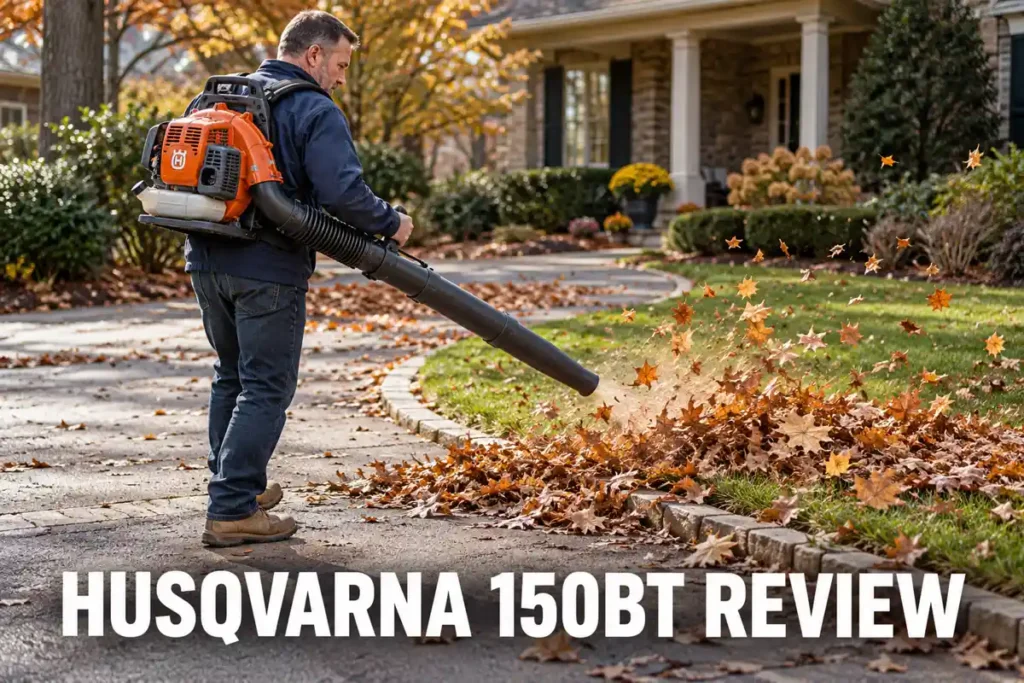
My verdict in this Husqvarna 150BT review: buy it for a quarter to half an acre of lawn, beds and hard ground, and skip it if you clear more than an acre of dry leaves or live under noise limits. According to Husqvarna it pushes 22 N from a 22 lb frame, and you pay for that in noise, fresh fuel and monthly upkeep. I carried it through a leaf season across the lawn around the family house, the gravel yard and the fence line, coming from my old gas handheld. Below: specs, setup, power, upkeep, problems and who should pass.
Affiliate Disclosure: Garden Power Scout is a proud participant in the Amazon Services LLC Associates Program. As an Amazon Associate, we earn from qualifying purchases, at no extra cost to you.
My Husqvarna 150BT Review Verdict in Brief
I recommend the Husqvarna 150BT Gas Backpack Leaf Blower for a yard where leaves, clippings and stuck-down debris sit on lawn, gravel and concrete together. Its edge is a high speed nozzle in the box and a frame of 22 lb dry that the harness puts on the hips.
Specs and What Comes in the Box
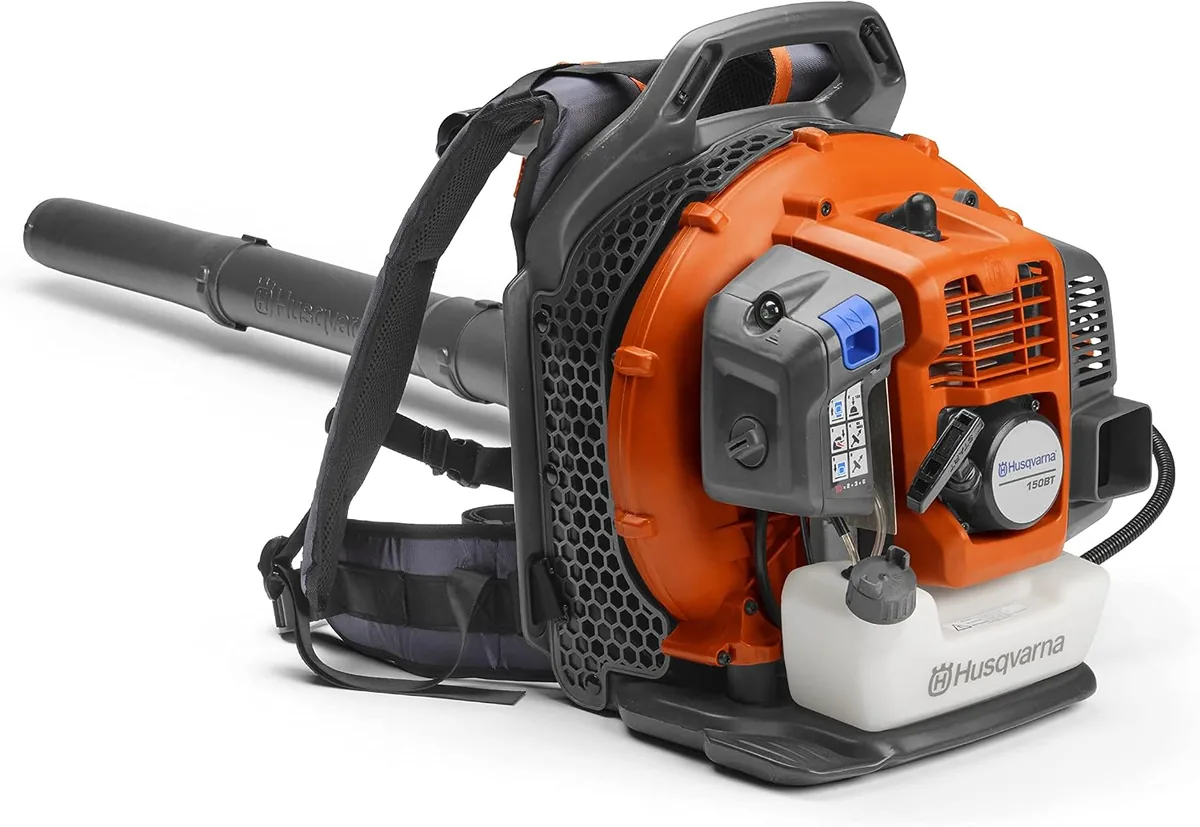
This Husqvarna 150BT backpack blower review covers the current model, 970466901, with a 51.7 cc engine and a catalytic converter. Older 150BT blowers had a different engine, so check the model number before you compare figures from other pages. The Husqvarna 150BT specs below are the maker’s figures.
| Spec | Value |
|---|---|
| Engine | 51.7 cc two-stroke, catalytic converter |
| Airflow in the housing, maker’s figure | 765 CFM |
| Airflow in the pipe, maker’s figure | 452 CFM |
| Air speed with the high speed nozzle, per the manual | 270 mph |
| Blowing force, maker’s figure | 22 N |
| Weight without fuel, per the manual | 22 lb |
| Tank | 1.25 L, about 42 fl oz |
| Fuel mix, per the manual | 50:1, 2 1/2 fl oz of oil per gallon |
The 765 CFM figure is airflow in the housing, and 452 CFM is what moves through the pipe, so it is the number I use to judge what a pile of leaves will do.
The box holds the harness, pipes, both nozzles, a wrench, an air purge bulb and the manual, plus a small sample of 50:1 mix. It has no vacuum or mulching mode, and beyond that sample no fuel or protective gear comes with it.
Assembly, Fuel Mix and First Start
Assembly follows the manual’s order. Lubricate the tubes and hose so they slide together, clamp the hose, fit the handle holder, then add the intermediate pipe and the blower nozzle, with the high speed nozzle on the blower nozzle for higher air speed.
Husqvarna 150BT Fuel Mix
According to Husqvarna, the mix is 50:1, which is 2 1/2 US fl oz of two-stroke oil per gallon of unleaded gasoline rated at least 87 AKI with no more than 10 percent ethanol. Use air-cooled two-stroke oil, never outboard or four-stroke oil, and mix no more than a month at a time. The ethanol limit has a reason: in a Department of Energy test of small engines, exhaust ran 20 to 70 C hotter on 20 percent ethanol than on plain gasoline (1).
I pour half the gasoline into a clean can, add all the oil, shake, add the rest and shake again, as the manual says. The one time I poured the oil by eye, the plug came out wet and sooty and the engine ran rough at idle until I fitted a fresh one.
Starting a Cold Engine
Fill the tank only with the engine stopped and cool, wipe up spills, and carry the blower at least 10 feet from the fueling spot before you start it outdoors.
- Move the choke control to closed and push the air purge bulb at least 10 times.
- Set the throttle control lever to fast idle, put the unit on flat ground with a foot on the foot plate, and hold it with your left hand.
- Pull the cord slowly until you feel resistance, then pull quickly until you hear the ignition sound, usually 2 or 3 pulls and up to 4 in the cold.
- Move the choke to open at once, run the engine for 30 seconds, then set the throttle control to idle.
Never stop the engine at full speed: return to idle first, then push the stop switch.
Power in Real Work and What the High Speed Nozzle Changes
Husqvarna rates the 150BT at 22 N of force and 452 CFM through the pipe, and the manual gives 270 mph with the high speed nozzle. The push of a stream depends on how much air leaves each second and how fast it moves (2), and the high speed nozzle is the part of the kit that raises the speed. That suits stuck-down debris at the edge of the gravel.

Gravel, Hard Ground and Stuck Debris
The high speed nozzle earns its place at the edge of the gravel yard, where grass creeps over the crushed stone. I keep the nozzle low and the throttle down there, because a steep angle at speed throws stones at ankles, windows and car paint, and I keep people and parked cars out of the path.
Before I mow, I clear twigs and seed pods off the lawn with the throttle low, since the mower throws whatever it meets.
Leaves, Wind and the Fence Line
Leaves pile against the fence line in the prevailing wind, so I work along the fence with the wind at my back, as the manual advises, and drive the pile toward the open lawn. On a wet mat after rain I sweep low under the leading edge, because a high sweep only ruffles the top layer.
With 452 CFM in the pipe, a deep pile of dry leaves takes more passes than it would with a bigger machine.
Weight, Harness and Hearing Protection
The 150BT weighs 22 lb dry, according to the manual, and the weight sits on the hips only if the harness is set in the right order.
Harness Fit
The manual sets the order: shoulder straps for height, chest strap closed, waist belt tight, then loosen the shoulder straps a little so the weight rides the hips and pull the load lifters snug. In a load-carriage study, the forces at the shoulders and hips predicted how uncomfortable a pack felt (3). I stop the engine every 30 minutes for water and to check the air filter, and I re-seat the belt then.
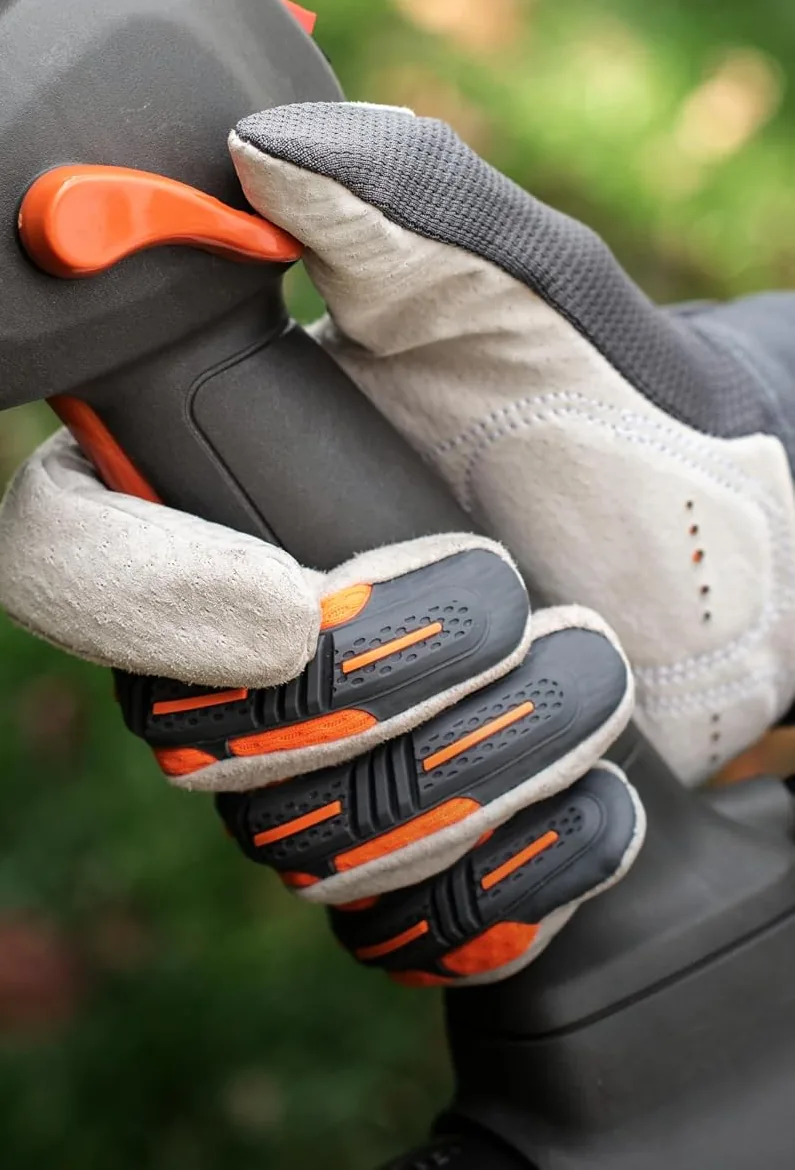
A cruise control option holds the speed, according to Husqvarna, and the manual calls the same lever the throttle control lever. The manual asks for occasional operation only, and in a field study of backpack blowers hand vibration added up with the hours of use per day (4), so I keep the total running time in a day down.
Hearing Protection From the First Minute
Husqvarna’s manual requires approved hearing protection. Every time I run the 150BT, I seat foam plugs first and put earmuffs over them before I touch the cord, and both stay on until the engine is off. It is much louder than any battery blower I have used, and the exhaust smell stayed on my clothes all day after my first leaf session.
Measured levels explain the rule. In one test set, nearly every agricultural backpack machine tested, mist blowers and blowers, ran above 100 dB(A) (5), and NIOSH recommends 85 dBA as the eight-hour limit for workers, with the time halved for every 3 dBA more (6). Plugs protect only when they seal, and a Cochrane review notes that poor fit may limit earplug protection for about 40 percent of users (7). Add ANSI Z87.1 eye protection and a dust mask in dust, as the manual says.
Run Time, Upkeep and Storage
Husqvarna gives no run time. Its fuel figure of 466 g/kWh at the 2.16 hp rating, with a typical gasoline density, works out to about 74 minutes of full-power running on the 1.25 L tank, if that figure holds at full power. On the cover crop edge I run well below full throttle, so I plan a tank as about an hour of work and refuel only when the engine is stopped and cool.
The manual splits upkeep by interval, and the list is long.
| Interval | Task |
|---|---|
| Daily | Check the stop switch, tank, fuel lines and fuel filter, clean the air filter, tighten screws, keep the air intake clear |
| Weekly | Check the starter, rope, damping units and plug, clean the cooling fins and intake screen |
| Monthly | Clean the fuel tank, check the cables, brush the spark arrestor screen on the muffler, replace the plug monthly or more often if needed |
A washable Husqvarna 150BT air filter comes out with the pre-filter after you close the choke, so dirt stays out of the carburetor. A blocked spark arrestor screen overheats the engine, and the manual says a servicing dealer should service the muffler and screen after 50 hours.
Fit a BOSCH WSR6F as the Husqvarna 150BT spark plug, with a gap of 0.023 to 0.027 in, and replace it monthly, or sooner if needed, as the manual says.
For storage, empty the tank and push the purge bulb until the fuel is out, put about 15 ml of two-stroke oil into the cylinder through the plug hole, turn the engine over three times and refit the plug. Store it upright and dry.
Husqvarna 150BT Problems and How to Avoid Them
Most trouble with a two-stroke traces back to fuel, air or the plug. These are the manual’s checks, in the order I run them.
Husqvarna 150BT Won’t Start
When the engine will not start, the manual points to four causes.
- Wrong or old fuel: drain the tank and refill with fresh 50:1 mix.
- A dirty, wet, loose or wrongly gapped plug: clean and dry it, set the gap, tighten it, then check the mix and air filter.
- Idle speed out of adjustment: the idle screw is the one carburetor setting the manual describes.
- Blocked or worn starter pawls: a job for a servicing dealer.
Carburetor and Fuel System
If the engine starts and then stops, the manual names wrong fuel, a clogged air filter or a Husqvarna 150BT carburetor that is not working correctly at idle, a dealer job. The manual describes no main jet adjustment, only the idle screw. A leaking fuel line needs replacing before the next start, and a Husqvarna 150BT fuel line kit supplies the parts.
An engine that overheats points to a blocked spark arrestor screen or dirty cooling fins. Most faults stay away with fresh 50:1 mix measured carefully and a monthly plug.
Parts, Warranty and Service
Husqvarna 150BT parts you will buy are mostly wear items: the plug, the washable air filter, the fuel filter, the purge bulb and the fuel lines. The manual sends carburetor, starter pawl and muffler work to a dealer.
Check the warranty card and the seller for the term. Husqvarna’s warranty statement gives a shorter term for commercial, agricultural or income-producing use on the models it names, which counts against it on a working farm like mine.
Who Should Buy the 150BT and Who Should Skip It
The Husqvarna 150BT leaf blower fits a narrow slice of yards.
Buy It If
- Your yard runs a quarter to half an acre of lawn, beds, gravel and concrete.
- You accept fuel mixing and a monthly service routine.
Skip It If
- You clear more than an acre of heavy dry leaves in long runs.
- Your street has noise limits or close neighbors.
- You do not want to mix two-stroke fuel, or you want a vacuum or mulch mode.
How the 150BT Compares With Alternatives
The comparison rests on air in the pipe, force and dry weight. For other types of blowers, our leaf blower guides are the place to start.
| Model | Airflow in the pipe | Blowing force | Dry weight |
|---|---|---|---|
| Husqvarna 150BT | 452 CFM | 22 N | 22.0 lb |
| Husqvarna 350BT | 494 CFM | 21 N | 22.5 lb |
| Husqvarna 360BT | 631 CFM | 30 N | 23.2 lb |
| Echo PB-770T | 756 CFM | 33 N | 24.3 lb |
| Echo PB-580T | 517 CFM | 22 N | 22.7 lb |
Husqvarna 350BT
According to Husqvarna, the 350BT moves more air in the pipe, 494 CFM against 452 CFM, but pushes with 21 N against 22 N for the 150BT. It has no catalytic converter, so its arrestor screen is a weekly job.
Husqvarna 360BT
The 360BT is the step up, with 30 N and 631 CFM in the pipe for only 1.2 lb more, a better fit for ground past half an acre.
My Recommendation on the 150BT
I recommend the 150BT for mixed ground where 22 N from a 22 lb frame and a high speed nozzle clear leaves, twigs and stuck-down debris. You pay in noise, a fresh 50:1 mix every month and a long upkeep list. Put plugs under earmuffs before the first pull, let the engine cool before every refuel and keep people and windows out of the debris path. My Husqvarna 150BT review verdict is a buy for a quarter to half an acre with a spare plug, a spare filter and a fresh mix in the shed before the leaves fall, and a pass for more than an acre of heavy dry leaves or a street with noise limits.
Frequently Asked Questions
Is the Husqvarna 150BT a good blower?
The Husqvarna 150BT is a good blower for residential yard work of a quarter to half an acre, with 22 N of force, 452 CFM in the pipe, 22 lb dry weight and a high speed nozzle in the box. According to Husqvarna, professional landscapers may prefer higher-tier models for daily use.
What is the fuel mix for Husqvarna 150BT backpack blower?
The mix for this blower is 50:1, which is 2 1/2 US fl oz of two-stroke oil per gallon of unleaded gasoline rated at least 87 AKI with no more than 10 percent ethanol. Use oil for air-cooled engines, never outboard or four-stroke oil, and mix no more than a month at a time.
How do you start a Husqvarna 150BT?
Start a Husqvarna 150BT outdoors with a foot on the foot plate, the choke closed, 10 or more pushes on the purge bulb and the throttle at fast idle. Pull slowly to resistance, then quickly until it fires, usually 2 or 3 pulls and up to 4 in the cold, open the choke, run it 30 seconds and set idle.
What are the common problems with the Husqvarna 150BT?
The common problems with the Husqvarna 150BT are an engine that will not start and one that starts and then stops. For the first, the manual lists wrong fuel, a fouled plug, idle speed or worn starter pawls, and for the second wrong fuel, a clogged air filter or the carburetor idle setting.
Why isn’t my leaf blower blowing hard?
A gas backpack blower loses force when air or fuel is restricted, and on the 150BT the manual names a clogged air intake screen, which decreases blow force. A dirty air filter, a blocked spark arrestor screen, stale fuel or a nozzle held high above the ground also take the push away.
References
- Knoll K, West B, Clark W, et al. Effects of Intermediate Ethanol Blends on Legacy Vehicles and Small Non-Road Engines, Report 1 – Updated. NREL/TP-540-43543; ORNL/TM-2008/117. National Renewable Energy Laboratory; 2009.
- NASA Glenn Research Center. Thrust Equation. Beginners Guide to Aeronautics. Updated June 10, 2026.
- Wettenschwiler PD, Lorenzetti S, Stämpfli R, Rossi RM, Ferguson SJ, Annaheim S. Mechanical Predictors of Discomfort during Load Carriage. PLoS ONE. 2015;10(11):e0142004.
- Alamin Gabasa SA, Md Razali KA, As’arry A, Abdul Jalil NA. Vibration Transmitted to the Hand by Backpack Blowers. IJAME. 2019;16(2):6697-6705.
- Calvo A, Preti C, Caria M, Deboli R. Vibration and Noise Transmitted by Agricultural Backpack Powered Machines Critically Examined Using the Current Standards. IJERPH. 2019;16(12):2210.
- National Institute for Occupational Safety and Health. Noise-Induced Hearing Loss. Noise and Hearing Loss. Centers for Disease Control and Prevention; 2024.
- Morata TC, Gong W, Tikka C, Samelli AG, Verbeek JH. Hearing protection field attenuation estimation systems and associated training for reducing workers’ exposure to noise. Cochrane Database of Systematic Reviews. 2024;5(5):CD015066.
Safety Note: Leaf blowers throw debris and can damage your hearing. Wear eye and ear protection, read the manufacturer’s manual, and check your local rules on noise and operating hours.