
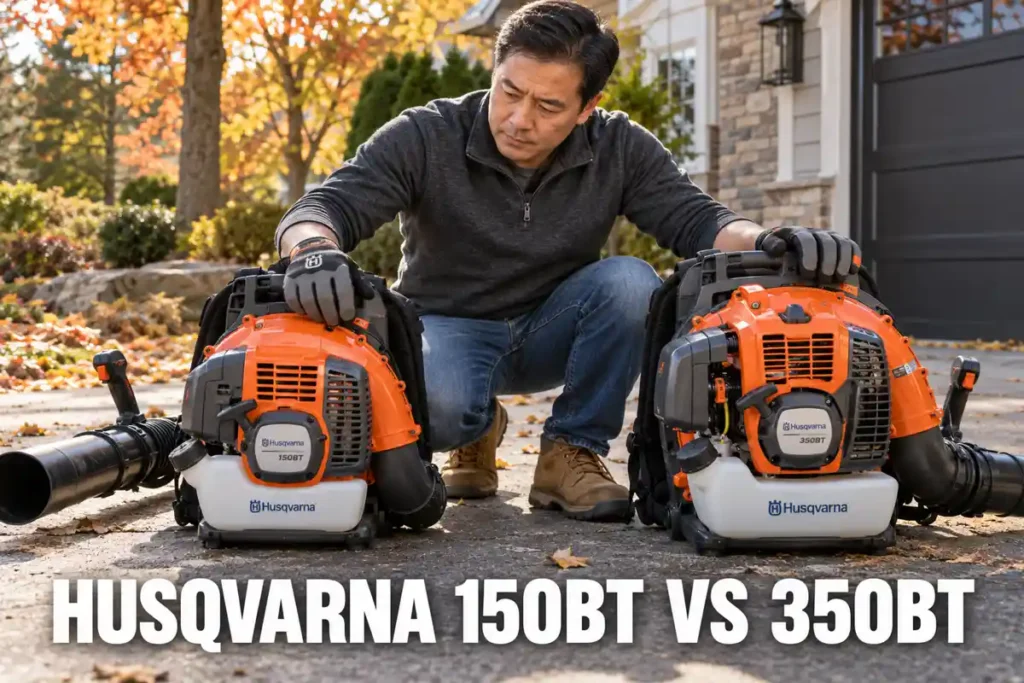
In the Husqvarna 150BT vs 350BT choice I recommend the 350BT for most buyers, because it moves more air through the pipe. The 150BT wins when stuck-down debris on hard ground is the job, since it ships with a high speed nozzle and is rated for 1 N more force. Both are 50:1 two-stroke backpacks with a waist belt, a 1.25 L tank and almost the same weight, so the choice rests on a few numbers that listings print in confusing ways. Both have spent a leaf season on my back in the orchard alleys and the shed yard, and below I keep the numbers that matter apart from the ones that mislead.
Affiliate Disclosure: Garden Power Scout is a proud participant in the Amazon Services LLC Associates Program. As an Amazon Associate, we earn from qualifying purchases, at no extra cost to you.
My Short Answer on Husqvarna 150BT vs 350BT
The Husqvarna 350BT Gas Backpack Leaf Blower is my pick for a quarter acre to an acre of mixed lawn, beds and hard surfaces. According to Husqvarna, its pipe moves 494 CFM against 452 CFM for the Husqvarna 150BT Gas Backpack Leaf Blower, and that extra volume rolls a deep pile of dry leaves ahead of the nozzle. The 150BT earns its place on gravel, concrete and packed dirt, where the high speed nozzle in its box peels off debris that the standard nozzle only shifts.
Plugs and earmuffs go on together from the first minute with either one, and a dust mask goes on over dusty ground.
What Comes With Each Blower
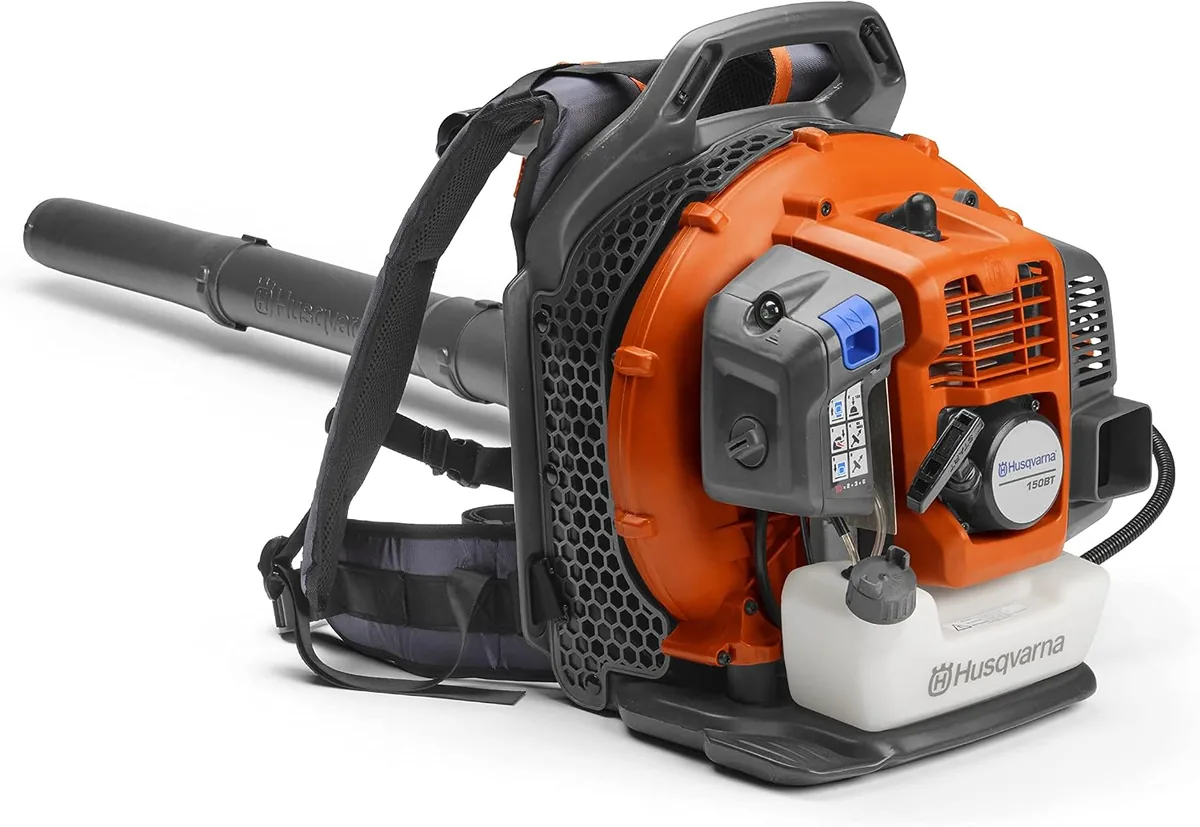
The Husqvarna 150BT backpack blower in this comparison is the current model, 970466901, with a 51.7 cc engine and a catalytic converter. Many pages online still quote the older 150BT, with a 50.2 cc engine and 434 CFM in the pipe, and those figures do not apply to the model you can order today. According to Husqvarna, the box holds the blower with its harness, a blower nozzle, a high speed nozzle, a combination wrench, an air purge bulb and the manual, and the Amazon listing adds a 2.6 oz sample of 50:1 two-stroke mix.
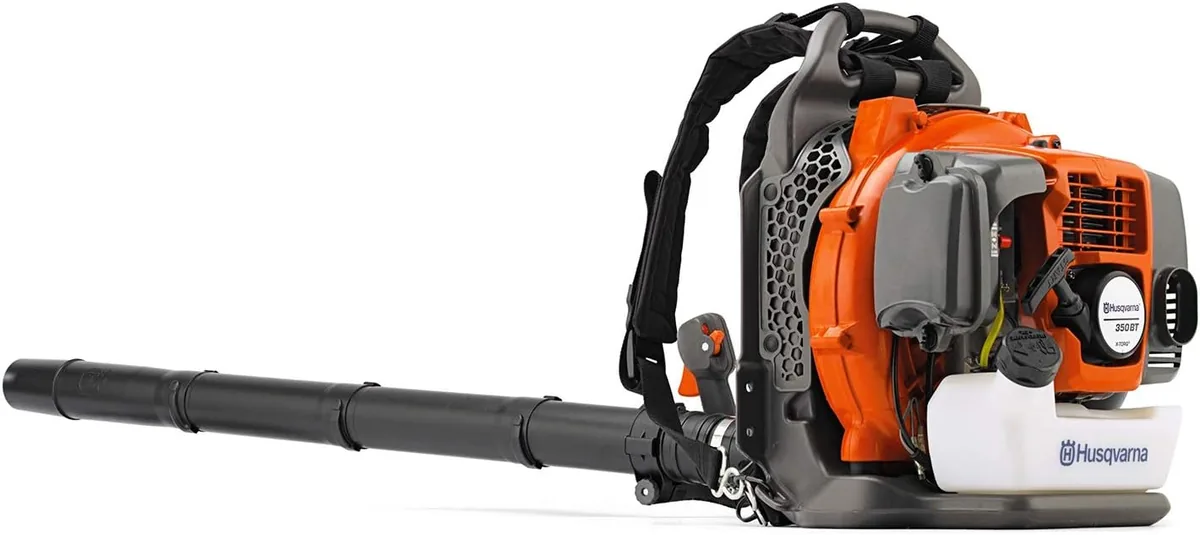
The Husqvarna 350BT leaf blower is model 965877502, with a 50.2 cc X-Torq engine and no catalytic converter. According to Husqvarna, it comes with a round nozzle, a combination wrench, an air purge bulb and the manual, and a flat nozzle is an optional accessory. Neither blower comes with a vacuum kit, ear protection or eye protection, and the only fuel in either box is the 150BT’s 2.6 oz sample, well short of a 42 fl oz tank.
Husqvarna 150BT vs 350BT Specs Side by Side
The Husqvarna 150BT specs below are the maker’s ratings for model 970466901, set beside the Husqvarna 350BT specs for model 965877502. Noise and vibration get a section of their own below.
| Spec | Husqvarna 150BT | Husqvarna 350BT |
|---|---|---|
| Engine | 51.7 cc two-stroke with catalytic converter | 50.2 cc X-Torq two-stroke, no catalytic converter |
| Power, maker’s figure | 2.16 hp at 7,000 rpm | 2.1 hp at 7,500 rpm |
| Airflow in the housing, maker’s figure | 765 CFM | 692 CFM |
| Airflow in the pipe with the round nozzle, maker’s figure | 452 CFM | 494 CFM |
| Air speed, maker’s figure | 270 mph with the high speed nozzle, about 175 mph without it | 180 mph with the round nozzle |
| Blowing force, maker’s figure | 22 N | 21 N |
| Weight without fuel | 22.0 lb | 22.5 lb |
| Fuel tank | 1.25 L, about 42 fl oz | 1.25 L, about 42 fl oz |
| Fuel mix | 50:1, 2 1/2 fl oz of oil per gallon | 50:1, 2 1/2 fl oz of oil per gallon |
| Harness | Padded harness, waist belt, chest strap, load lifters, foot plate on the frame | Padded harness, waist belt, chest strap |
| Muffler screen check in the manual | Monthly | Weekly |
| In the box | Blower nozzle, high speed nozzle, wrench, purge bulb, manual, 2.6 oz 50:1 mix sample | Round nozzle, wrench, purge bulb, manual |
Two rows decide it: airflow in the pipe, where the 350BT leads by 42 CFM, and the box row, where only the 150BT includes a high speed nozzle.
Reading Airflow, Air Speed and Force Correctly
The 765 CFM and 692 CFM on the listings are measured in the housing, before the air travels down the hose and the pipe. According to Husqvarna, what leaves the round nozzle is smaller: 452 CFM for the 150BT and 494 CFM for the 350BT. I compare pipe against pipe, and on that row the 350BT leads by about 9 percent.
That volume shows in the grass clippings that pile up along the plum row after mowing. The 350BT rolled the whole windrow ahead of me, while the 150BT with the high speed nozzle skimmed the top and left a thin layer behind.
Air speed is where the listings mislead most, because each figure belongs to a different nozzle.
- 150BT with the high speed nozzle: 270 mph, according to Husqvarna.
- 150BT without it: about 175 mph, according to Husqvarna’s page.
- 350BT with the round nozzle: 180 mph, according to Husqvarna.
Because the nozzles differ, I do not rank the two blowers on mph. Force combines volume and speed, since a jet of air pushes according to how much air it moves each second and how much faster that air leaves (1). Husqvarna rates the 150BT at 22 N and the 350BT at 21 N, a gap of 1 N, or about a quarter pound of push, and that is a tie in practice.
The high speed nozzle earns its keep around the pump head, where leaves and twigs gather against the filter housing. I use it there at low throttle, because fast air close to the drip fittings can throw grit into them.
Winner: the 350BT, because it moves more air in the pipe, and volume is what rolls a pile.
Husqvarna 150BT vs 350BT Weight, Harness and Comfort
In the Husqvarna 150BT vs 350BT weight comparison, the manuals give 22.0 lb for the 150BT and 22.5 lb for the 350BT without fuel, so half a pound separates them before the tank is filled. A full 1.25 L tank adds about 2 lb, so expect about 24 lb and 24.5 lb on your back at the start of a job.
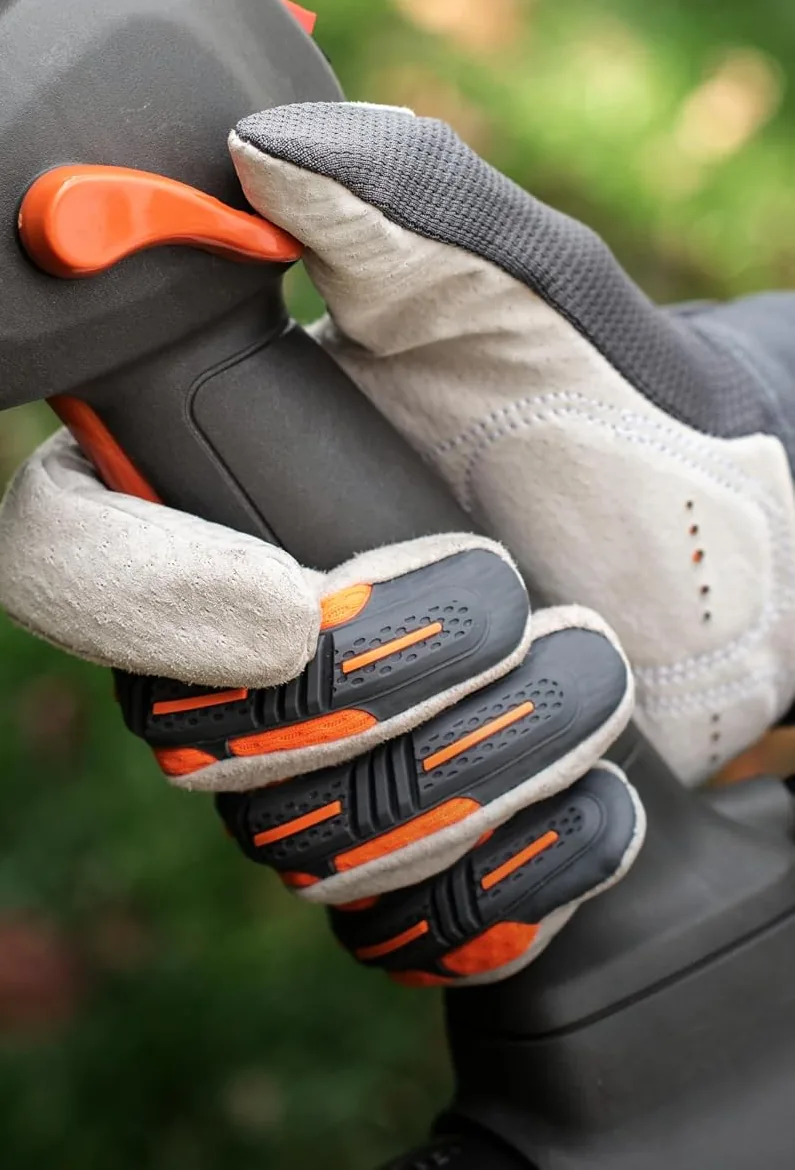
Both blowers have a padded harness with a waist belt and a chest strap, and both manuals want the weight on your hips. The 150BT manual has you tighten the shoulder straps first, then the chest strap and the waist belt, then loosen the shoulder straps a little and snug the load lifters. The 350BT manual asks for snug shoulder straps, then the waist belt.
A load-carriage study found that the forces of the shoulder and hip straps predicted how uncomfortable carriers felt (2). I spend a minute on the fit before I pull the cord for that reason, and on the 150BT the load lifters pull the frame in toward my back, so the engine stops tugging at my shoulders at the end of a row.
Winner: the 150BT, by half a pound and a set of load lifters.

Husqvarna 150BT Fuel Mix, Engine and Tank
The 150BT runs a 51.7 cc two-stroke with a catalytic converter, and the 350BT runs a 50.2 cc X-Torq two-stroke without one. Husqvarna’s ratings put the two engines within 0.06 hp of each other.
According to the 150BT manual, the mix is 50:1, which is 2 1/2 US fl oz of two-stroke oil for air-cooled engines per gallon of unleaded gasoline rated at least 87 AKI (90 RON), with no more than 10 percent ethanol. The 350BT manual gives the same ratio and the same oil amounts, and both manuals say to mix no more than a month of fuel at a time. I mix in a measuring bottle and write the date on the can with a marker, because a can older than a month does not go into either tank.
Both tanks hold 1.25 L, about 42 fl oz. Husqvarna publishes a fuel consumption figure for each blower, 466 g/kWh for the 150BT and 455 g/kWh for the 350BT, and from those I work out about 74 minutes per tank for the 150BT and about 78 minutes for the 350BT at full rated power, with more time at part throttle. Two tanks carry me along the tree-row strips under the plums.
Refueling Safety
Both manuals say to refuel with the engine stopped and cool, and to move at least 10 ft away from the fueling spot before you start the engine.
Winner: the 350BT by a small margin, because Husqvarna’s fuel figure for it is about 2 percent lower.
Noise and Vibration on Both Blowers
Husqvarna publishes noise and vibration ratings for both blowers, but the two sets are not declared on the same basis, so I do not set one against the other. Both are gas backpack blowers, and that class is loud.
In a field test of lawn and garden equipment, individual machines measured between 85 and 101 dB(A) (3). A study of groundskeepers recorded equipment peaks up to 109 dBA, and more than half of the workers’ shift averages were above 85 dBA (4).
Earplug fit is the weak point, since a Cochrane review notes that poor fit may limit protection for about 40 percent of users (5). Properly fitted hearing protection is the minimum on either blower, and plugs with earmuffs over them is the precaution I add. I roll the foam plugs, seat them deep, and put the earmuffs on over them before I pull the cord on either blower, and I add a dust mask on the shed yard.
A field study of backpack blowers tied the hand vibration risk to the hours worked per day (6). On a long job I take short breaks, and I check the vibration damping units at the weekly service, which both manuals list.
Winner: neither. Both are loud, and I recommend plugs with earmuffs over them from the first minute on either one.
Starting, Upkeep and Husqvarna 150BT Problems
The two blowers start differently, and each manual gives its own routine.
- 150BT cold start: close the choke, press the air purge bulb at least 10 times until fuel fills it, set the throttle control at fast idle, put the unit on flat ground with a foot on the foot plate and the left hand holding it, pull slowly to resistance, then pull quickly until it fires. Open the choke, run it for 30 seconds, then let it idle.
- 350BT cold start: close the choke, press the air purge bulb until fuel starts to fill it, set the throttle at one third, hold the unit on flat ground with the left hand and not with the feet, pull slowly to resistance, then pull quickly until it starts. Open the choke gradually and give it two to three minutes to warm.
I start both outdoors on the gravel by the shed door, at least 10 ft from where I fueled, and on the orchard grass I like the 150BT’s foot plate, because it keeps the frame from sliding while I pull.
According to both manuals, the daily and weekly checks cover the handle, stop switch, leaks, filter, fasteners, air intake, starter rope, vibration damping units, spark plug and cooling system. The muffler screen is where they part. The 350BT manual asks for the spark arrestor screen weekly. The 150BT manual puts the check monthly, says a blocked screen overheats the engine, and adds that a screen that clogs often can mean the catalytic converter is losing performance, so a dealer should look at the muffler.
On the 350BT I brush the screen with a wire brush on Sunday evenings, with the engine cold, because the muffler stays very hot even at idle.
Stale fuel is one possible cause of stalling and hard starting, so both manuals cap mixed fuel at one month.
According to Husqvarna’s product pages, the 350BT has a variable speed throttle with an optional cruise control setting, and the 150BT lists a cruise control option.
Winner: the 150BT on routine upkeep, because its muffler screen check is monthly instead of weekly.
Warranty and Value
Amazon lists a two-year warranty on both blowers, and Husqvarna’s US pages show no warranty length for either one. The 350BT manual routes its two-year emissions warranty through authorized servicing dealers and covers parts such as the carburetor, ignition module, fuel tank and fuel lines, and the 150BT manual carries its own emissions warranty text, so check the seller on the listing and keep the receipt.
The Husqvarna 350BT backpack blower and the 150BT both sit in the mid-range tier among gas backpacks. Over three seasons the fuel and plug costs are about the same on both, since the tanks, the fuel figures and the plug schedules sit close together, so the price on the day you buy is the deciding cost. If neither fits your yard, the leaf blower guides cover cordless and bigger gas models.
Winner: neither, because the warranty on the listings is the same and the price on the day decides.
Choose the 150BT If
The 150BT suits the narrower jobs, where air speed and a high speed nozzle matter more than volume.
- Your work is stuck-down debris on hard ground: crusted leaves on concrete, dried mud and sawdust, where the high speed nozzle at 270 mph does the peeling.
- You want a catalytic converter and a muffler screen check once a month.
- You like a foot plate on the frame to hold the unit while you pull the cord, and load lifters that draw the frame in.
- Skip it if most of your work is deep banks of dry leaves, because the pipe moves 42 CFM less air and each pile takes more passes.
In late winter the 150BT is the one I carry to the pruning sawdust and twigs lying under the plum row, with the high speed nozzle on and the throttle low enough to leave the cover crop in place.
Choose the 350BT If
In the Husqvarna 350BT vs 150BT matchup, the 350BT suits the bigger share of yards.
- Your yard is a quarter acre to an acre of lawn, beds and hard surfaces.
- Piles of dry leaves are your main job, and you want the extra 42 CFM in the pipe to roll them.
- You are happy to brush the muffler screen every week.
- Skip it if you need a high speed nozzle in the box.
From late October to mid-November, when the leaves come down fast along the alleys and across the house lawn, the 350BT is the blower I carry first.
Which Husqvarna Backpack Blower to Carry Home
Buy the 350BT if deep piles of dry leaves on a quarter acre to an acre are your main job, and buy the 150BT if stuck-down debris on hard ground is. Either way the first hour decides how much you like it: mix a small batch of fresh 50:1, refuel with the engine stopped and cool, fit the harness so the weight rides your hips, and put plugs and earmuffs on together before the first pull.
Pick the blower that fits the job you do most, and the Husqvarna 150BT vs 350BT decision for your property is made.
Frequently Asked Questions
Which Husqvarna backpack blower is considered the best?
The best Husqvarna backpack blower for most yards is the 350BT, which Husqvarna rates at 494 CFM in the pipe against 452 CFM for the 150BT. The 150BT is the better pick for stuck debris on hard ground, since its high speed nozzle is rated for 270 mph and it weighs half a pound less.
Is the Husqvarna 150BT a good blower?
The Husqvarna 150BT is a good blower for a quarter to half an acre of mixed lawn and hard surfaces. According to Husqvarna it moves 765 CFM in the housing and 452 CFM in the pipe, delivers 22 N of force and weighs 22.0 lb without fuel, with a waist belt and a catalytic converter.
What is the Husqvarna 150BT fuel mix?
The Husqvarna 150BT fuel mix is 50:1, which means 2 1/2 US fl oz of two-stroke oil per gallon of unleaded gasoline rated at least 87 AKI with no more than 10 percent ethanol. According to the manual, never mix more than one month of fuel at a time, and the 350BT manual gives the same ratio.
What are the common problems with the Husqvarna 150BT?
The common problems with the Husqvarna 150BT are stale fuel, a clogged muffler screen and a worn spark plug, which the manual handles with a one-month limit on mixed fuel, a monthly screen check and a weekly plug check. A blocked screen overheats the engine, and one that clogs often can mean the catalytic converter is losing performance.
How do you start the Husqvarna 150BT leaf blower?
You start the Husqvarna 150BT leaf blower on flat ground by closing the choke, pressing the purge bulb 10 times or more, setting the throttle to fast idle, and putting a foot on the foot plate with the left hand on it. Pull slowly to resistance, then quickly until it fires, open the choke, run 30 seconds, then idle.
References
- NASA Glenn Research Center. Thrust Equation. Beginners Guide to Aeronautics. Updated June 10, 2026.
- Wettenschwiler PD, Lorenzetti S, Stämpfli R, Rossi RM, Ferguson SJ, Annaheim S. Mechanical Predictors of Discomfort during Load Carriage. PLoS ONE. 2015;10(11):e0142004.
- Walker E, Banks JL. Characteristics of Lawn and Garden Equipment Sound: A Community Pilot Study. J Environ Toxicol Stud. 2017;1(1).
- Balanay JAG, Kearney GD, Mannarino AJ. Assessment of Occupational Noise Exposure among Groundskeepers in North Carolina Public Universities. Environ Health Insights. 2016;10:83-92.
- Morata TC, Gong W, Tikka C, Samelli AG, Verbeek JH. Hearing protection field attenuation estimation systems and associated training for reducing workers’ exposure to noise. Cochrane Database of Systematic Reviews. 2024;5(5):CD015066.
- Alamin Gabasa SA, Md Razali KA, As’arry A, Abdul Jalil NA. Vibration Transmitted to the Hand by Backpack Blowers. IJAME. 2019;16(2):6697-6705.
Safety Note: Leaf blowers throw debris and can damage your hearing. Wear eye and ear protection, read the manufacturer’s manual, and check your local rules on noise and operating hours.