
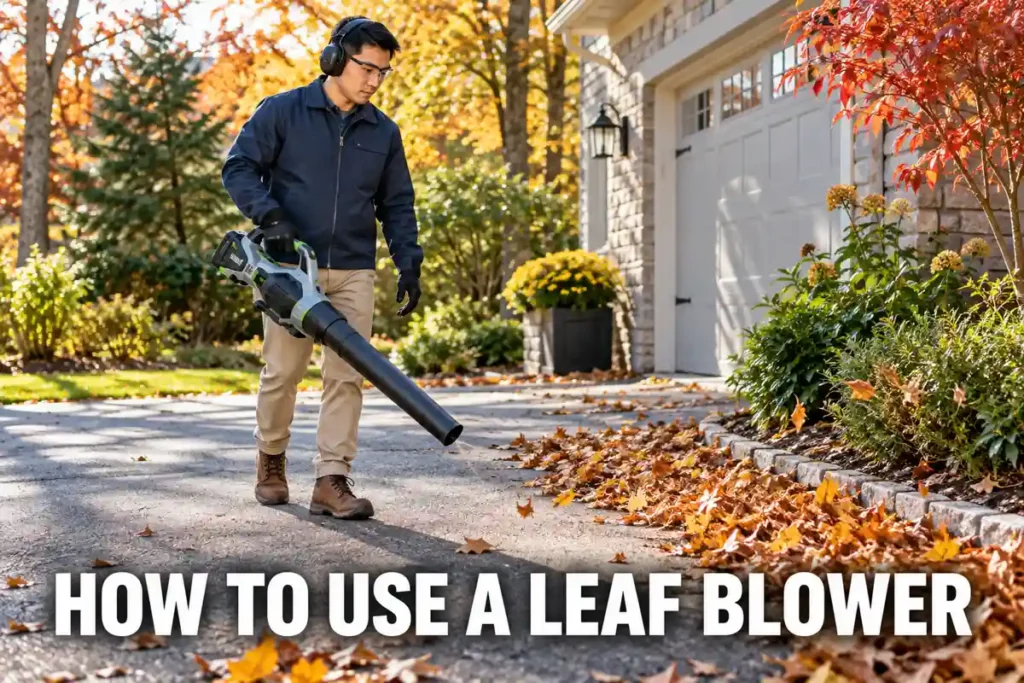
How to use a leaf blower properly comes down to one routine: protect your eyes and ears, check the ground and the tool, start at low speed, and keep the nozzle low with the wind behind you. I run that routine on the lawn around the family house, the gravel yard and the shed floors of our orchard farm, and the ear protection goes on before anything else, battery or gas. The steps come first, then the gear, the starts, the grip, the nozzle and the pattern in detail.
How to Use a Leaf Blower in 8 Steps
Put on eye, ear and hand protection, walk the ground, check the tool, start the blower away from where you refueled or charged it, set your grip, aim low at the lowest throttle that works, and work with the wind. Then stop the machine and store it clean.
- Dress for the job. Eye, ear and hand protection, sturdy shoes, and a dust respirator on dusty ground.
- Walk the ground. Pick up stones and sticks, and note people, pets, windows and cars.
- Check the tool. Parts latched, intake clear, battery seated or cord undamaged, no fuel leaks.
- Start it on open ground. Flat footing, nozzle pointed at nothing, a gas machine 10 feet from the fuel.
- Set your grip and stance. Straight wrist, firm footing, a fitted harness on a backpack.
- Aim low and keep the throttle down. Shallow angle, full pipe length, only as much air as the debris needs.
- Work with the wind. Use a set pattern and never blow into the middle of a pile.
- Shut down and store. Release the throttle, let the machine come to rest, then clean up.
The step I never reorder is the last look before the start: the nozzle points at open ground and nobody is inside 50 feet.
Leaf Blower Safety Gear and Why You Need It
A blower throws debris, makes noise, raises dust and vibrates in your hands, and each piece of gear answers one of those hazards.
| Gear | What it stops | What to look for |
|---|---|---|
| Eye protection | Stones, twigs and grit thrown or bounced back | Glasses or goggles marked ANSI Z87.1, with side protection |
| Hearing protection | Noise at your ear | Plugs or earmuffs; both together on a gas backpack |
| Dust respirator | Dust, pollen and mold from the ground | A particulate respirator that seals to your face |
| Gloves | Cuts, cold and some hand vibration | Sturdy, non-slip gloves |
| Long pants, long sleeves and boots | Debris strikes, a hot muffler and slips | Snug clothing, closed shoes, nothing loose near the intake |
| Space around you | Thrown objects hitting other people | People and pets at least 50 feet (15 m) away |
Hearing Protection Comes First
NIOSH recommends limiting noise to 85 dBA averaged over an eight-hour workday, and it halves the recommended time for every 3 dBA above that (1). The limit is written for workers, but the arithmetic fits a long Saturday too.
Among North Carolina university groundskeepers, 77% of shift averages by the NIOSH method topped 85 dBA, and the loudest grounds equipment reached 109 dBA (2).
Cordless does not mean quiet enough to skip protection. According to EGO’s manual for its European LB6700E 56V handheld, the sound level at the operator’s ear is 91 dB(A). At a steady 91 dBA the halving rule puts the recommended time at about 2 hours a day, so a four-hour cleanup doubles the dose.
| Level at your ear | Recommended time per day |
|---|---|
| 85 dBA | 8 hours |
| 88 dBA | 4 hours |
| 91 dBA | 2 hours |
| 100 dBA | 15 minutes |
Hearing Protection Rule
Wear earplugs and earmuffs together on a gas backpack blower from the first minute. On every other blower, battery or corded, wear plugs or muffs every time.
I notice ear fatigue after a long session on a gas backpack, which is why I double up from the first minute. Fit matters as much as the rating: poor earplug fit may limit protection for about 40% of users (3), so follow the fitting instructions on the pack.
Eyes, Dust and Hands
Thrown debris is the main eye hazard. In U.S. emergency departments, about three quarters of lawn mower eye injuries between 2004 and 2023 came from projectiles such as grass, dirt and rocks, and only 2% of those were documented with eye protection (4).
Leaf blowing lifts measurable fine dust off the ground, and researchers built an enclosure to measure it on real surfaces (5). Echo’s manual says to run at lower speed or dampen the surface to cut dust, and Husqvarna’s says a lower throttle gives less dust as well as less noise.
A first pass with the blower on a dry shed floor raised a cloud, and with the door closed the dust took two days to settle. Now I wet the floor lightly, open both doors, keep the throttle low and wear a dust respirator that seals to my face. Gloves help as well: Echo’s manual says they reduce the transmission of machine vibration.
Checks Before You Start a Leaf Blower
Check the ground you are about to clear, then the tool you are about to run.
- Debris that flies: pick up stones, sticks, toys and wire, and note hose ends, sprinkler heads and drip lines on the soil.
- Targets: open windows and doors, parked cars, play areas and ladders. Close what you can.
- People and pets: keep children, bystanders and pets at least 50 feet (15 m) away, and stop the machine the moment anyone comes inside that distance.
- Wind and weather: note the wind direction, and skip dense fog, heavy rain, strong wind and intense cold.
- Stuck debris: loosen it with a rake or broom first, as EGO, Echo and Husqvarna all advise.
On the gravel yard I walk the edge before every job and pick up the stones that sit on the grass line, because the first pass would send them at the shed wall. In the orchard I look for drip line fittings and tubing before I raise the air.
- Fit: tube and nozzle latched, guards on, no missing or damaged parts.
- Air intake: clear of leaves, since a blocked intake cuts blowing power and raises engine temperature, according to Husqvarna.
- Power: battery fully seated, or cord and plug undamaged.
- Gas and backpacks: no fuel leaks at the lines, vent, tank and cap, the air filter in place, and the harness straps and buckles in good order.
Fitness to Work
Do not run a blower when you are tired, sick, on medication that dulls judgment, or after drinking alcohol. Echo and Husqvarna both say so in their manuals.
How to Start a Battery, Corded or Gas Leaf Blower
Starting differs by power type, and the manual for your model overrules the steps below. Each assumes flat ground and a nozzle pointed at open space.
Starting a Battery Blower
- With the battery out, fit the tube and nozzle until they click.
- Line the battery ribs up with the slots and press down until the battery clicks.
- Squeeze the trigger, or turn the speed dial clockwise. More pressure or more turn gives more air.
- Use the boost button for short bursts; it returns to your setting on release.
These steps follow EGO’s manual for its 56V handhelds. According to EGO, a blower with a speed dial will not start with a charged battery if the dial was not at off when the battery came out, and one pull of the trigger clears the lockout.
Starting a Corded Blower
With a corded blower I check the cord and plug for damage before every use, run it through an outdoor-rated extension cord that is heavy enough for its length, and seat the plug fully with the cord lock or a knot so it cannot pull apart. The cord finds every tree trunk. On the lawn I hang it over my shoulder, work away from the outlet, keep it out of wet grass, and plan the passes around the trunks before I start.
Starting a Gas Blower
Refuel outdoors on bare ground with the engine off and cool, wipe up spills, and carry the machine at least 10 feet (3 m) from the refueling spot before you start it. The Echo and Husqvarna blowers covered here have two-stroke engines, which run on gasoline mixed with two-stroke oil at the maker’s ratio, so use the fuel your own manual names. Never start a gas blower indoors or in a closed shed, because the exhaust carries carbon monoxide.
According to Echo’s manual for the PB-580T, a cold start runs like this:
- Set the throttle lever to idle and the choke to the cold start position.
- Press the primer bulb until fuel shows in it, then 4 or 5 more times.
- Pull the starter handle with short pulls until the engine fires, no more than 5 pulls.
- Move the choke to run and pull until the engine runs.
- Let it warm up at idle for several minutes, then raise the speed gradually.
Husqvarna’s manual for its 570BTS and 580BTS adds two rules: press the machine down with your left hand, never your foot, and never wrap the starter cord around your hand.
Grip, Stance and Harness Fit
How to use a leaf blower effectively starts with posture, because a straight wrist, a relaxed grip and firm footing keep the nozzle steady.
On a handheld, wrap your whole hand around the handle instead of pinching it with thumb and index finger, keep the wrist straight and the tube out in front of your body, and switch hands when the first one tires. Echo’s manual says to take breaks. A field study of backpack blowers found that the vibration reaching the operator’s hands depends on the hours worked in a day (6), so I split long jobs into sessions.
Fit a backpack harness with the engine off or the battery out:
- Loosen all the buckles and put the machine on.
- Set the hip belt over your hip, not down on your stomach, and tighten it until the weight rests on the hip.
- Close the chest strap and adjust it. Husqvarna warns that an open belt can be drawn into the fan, so close every belt your model has.
- Take the machine off, start it the way your manual directs (a gas backpack starts on the ground), and put it on again as the manual shows.
- Find your throttle before you start: it sits on the tube on some models and at the hip on others.
When I tightened the hip belt and loosened the shoulder straps, the weight of the backpack moved off my shoulders and onto my hips. Know the emergency release too: Husqvarna says to open the harness straps and let the machine fall backwards.
Nozzle Height, Angle and Throttle Control
Most leaf blower tips come down to three controls: how low the nozzle sits, what angle it points at, and how far you open the throttle.
Hold the opening as close to the ground as you can and use the full pipe length, which keeps the air current low where the leaves are, according to Husqvarna. A shallow angle, close to parallel with the ground, rolls leaves along. A steep angle digs into soil and scatters debris.
Use the lowest throttle that moves the debris. Husqvarna says full throttle is seldom needed, that many jobs run at half throttle, and that less throttle means less noise, less dust and easier control. Echo’s manual says never to run higher than needed, since a higher engine speed is louder. I start every pass at the lowest setting and add air only until the leaves roll, and dry plum and apricot leaves on the concrete pad need less than I used to give them.
| Job | Throttle | Nozzle and angle |
|---|---|---|
| Dry leaves on walks, patios and drives | Lower speed | Round or flat nozzle, low and shallow |
| Leaves and grass on a lawn or bed | More speed as needed | Low, with the full pipe length |
| Stuck debris and sidewalk gaps | As needed | Edge of the tapered nozzle |
Do not block the end of the pipe, which over-revs the engine, and do not drag the tip over abrasive surfaces, which wears sharp edges into it.
Pro Tip
On a gas machine, open the throttle fully for at least 5 minutes every hour. Echo says continuous low-speed running builds residue on the piston and carbon on the spark arrester screen.
Working With the Wind in a Basic Blowing Pattern
Husqvarna’s manual says to be aware of the wind direction and work with it. In practice, every pass should travel the way the air already moves.
- Stand with the wind at your back or across your body.
- Start at the outer edge, at a fence, wall or border, and push toward one collection point.
- Make overlapping passes in one direction, with the nozzle low and shallow.
- Blow around the outer edges of a pile and never into its middle, which scatters it, according to EGO.
- On a slope, blow downhill and collect at the bottom, because debris pushed uphill comes back when you stop.
Along our fence line, a crosswind kept sending the pile back over ground I had cleared. I moved to the upwind end and worked down the line, and the leaves stayed where I put them.
How to Use a Leaf Blower on Grass
Grass needs a gentler version of the same pattern, because close, fast air strips thin turf and bare soil.
- Rake or loosen stuck leaves and twigs first.
- Hold the nozzle low at a shallow angle, and lift it slightly over thin grass or bare soil.
- Work in one direction, overlap each pass and finish at the collection edge.
What Never to Point a Leaf Blower At
Air that moves leaves also moves stones, twigs and grit, and the exhaust of a gas machine is hot and carries carbon monoxide. Keep the jet and the exhaust away from the following.
- People, pets and children: never direct the air at them, and stop the engine when anyone comes inside 50 feet.
- Open windows, doors and vehicles: thrown grit and stones reach them first, so close windows and doors before you start.
- Dry brush and anything that burns: a gas exhaust runs hot and can throw sparks.
- Your own footing on a ladder, scaffolding or roof: Husqvarna says not to work from any of them.
In October, when the cover crop goes in, I keep the blower off the orchard strips. Air strips the mulch from the tree bases, shifts the drip lines that lie on the soil and drives grit into the emitter ends.
Neighbors, Hours and Local Rules
Noise carries, so courtesy is part of the technique. Echo says to run a blower only at appropriate hours, and Husqvarna names late evening and early morning as times to avoid. Do not blow debris into a neighbor’s garden either. Your town or homeowners association may also set hours and limits on gas machines, so check the local rules first.
Shutting Down and Storing a Leaf Blower
Shut down in the right order, then store the blower dry and out of reach of children.
Shutting Down a Battery or Corded Blower
- Release the trigger or turn the dial to off.
- Remove the battery pack, or unplug the cord.
- Clean the air intakes.
- Store the blower and battery indoors, away from garden chemicals and de-icing salts, and follow the battery maker’s storage advice.
With a corded blower I coil the cord loosely and check it for damage before it goes away.
Shutting Down a Gas Blower
- Return the throttle to idle, then use the stop switch.
- Let the machine cool before you refuel.
- Empty the tank before long storage and return unused fuel to an approved container, as Echo’s manual directs. Mix no more than a month of fuel at a time, since mixed fuel ages.
- Store the blower upright and dry, and brush the debris from the cooling fins and the intake.
Clean up the debris you moved and dispose of it properly. Before winter I drain the tank of my old gas handheld and run the engine dry.
Your First Run With a Leaf Blower
Three habits carry most of the work: protection on before the start, the lowest throttle that moves the debris, and the wind at your back, and on a first run you clear one small section on a dry day. I run the first few feet over bare ground and listen to the machine before I touch a leaf, since a rough idle or a loose tube shows up there. The leaf blower guides go deeper on wet leaves, gravel and whole-yard planning. A blower works best with the nozzle low and the throttle just high enough to move the debris, and that habit is how to use a leaf blower well on any yard.
Frequently Asked Questions
When should you use a leaf blower?
You should use a leaf blower on a dry day with light wind and inside the hours your town allows. Husqvarna’s manual says to skip dense fog, heavy rain, strong wind and intense cold. Your town and homeowners association set the exact hours, so check them before the first run.
Should the choke be open or closed when starting a leaf blower?
The choke should be closed, in the cold start position, when you start a cold engine, and open, in the run position, as soon as it fires. A warm engine starts without the choke, and Husqvarna says to open the choke and keep pulling if the engine floods after several tries. Lever positions differ by maker, so follow your own manual.
How do I make my leaf blower more powerful?
To get full power from your leaf blower, start with a charged battery or fresh fuel, a clear air intake and filter, the full pipe length and the nozzle that suits the job. Do not modify the tool, because the Echo and Husqvarna manuals forbid modifications.
How to use a backpack leaf blower?
To use a backpack leaf blower, fit the harness with the engine off or the battery out so the weight rests on your hip, and close the chest strap and every belt your model has. Find where your model puts the throttle, on the tube or at the hip, and keep the nozzle low with the wind at your back.
How to use a leaf blower to pick up leaves?
A leaf blower picks up leaves only when it is a blower-vac set to vacuum mode with the intake tube and bag fitted. A plain blower has no vacuum intake or bag, so blow the leaves into one pile and collect them with a rake or a tarp. Fit the vacuum parts with the battery out or the engine off, as your manual shows.
References
- National Institute for Occupational Safety and Health. Noise-Induced Hearing Loss. Noise and Hearing Loss. Centers for Disease Control and Prevention; 2024.
- Balanay JAG, Kearney GD, Mannarino AJ. Assessment of Occupational Noise Exposure among Groundskeepers in North Carolina Public Universities. Environ Health Insights. 2016;10:83-92.
- Morata TC, Gong W, Tikka C, Samelli AG, Verbeek JH. Hearing protection field attenuation estimation systems and associated training for reducing workers’ exposure to noise. Cochrane Database of Systematic Reviews. 2024;5(5):CD015066.
- Stange NR, Jennissen CA. Lawnmower-Related Eye Injuries in the U.S., 2004 to 2023. Am J Ophthalmol. 2025;277:7-16.
- Fitz D, Pankratz D, Pederson S, Bristow J. A Semi-portable Enclosure to Measure Emission Rates from Small Fugitive Sources: Leaf Blower Dust Example. Aerosol Air Qual. Res. 2021;21(10):200566.
- Alamin Gabasa SA, Md Razali KA, As’arry A, Abdul Jalil NA. Vibration Transmitted to the Hand by Backpack Blowers. IJAME. 2019;16(2):6697-6705.
Safety Note: Leaf blowers throw debris and can damage your hearing. Wear eye and ear protection, read the manufacturer’s manual, and check your local rules on noise and operating hours.