
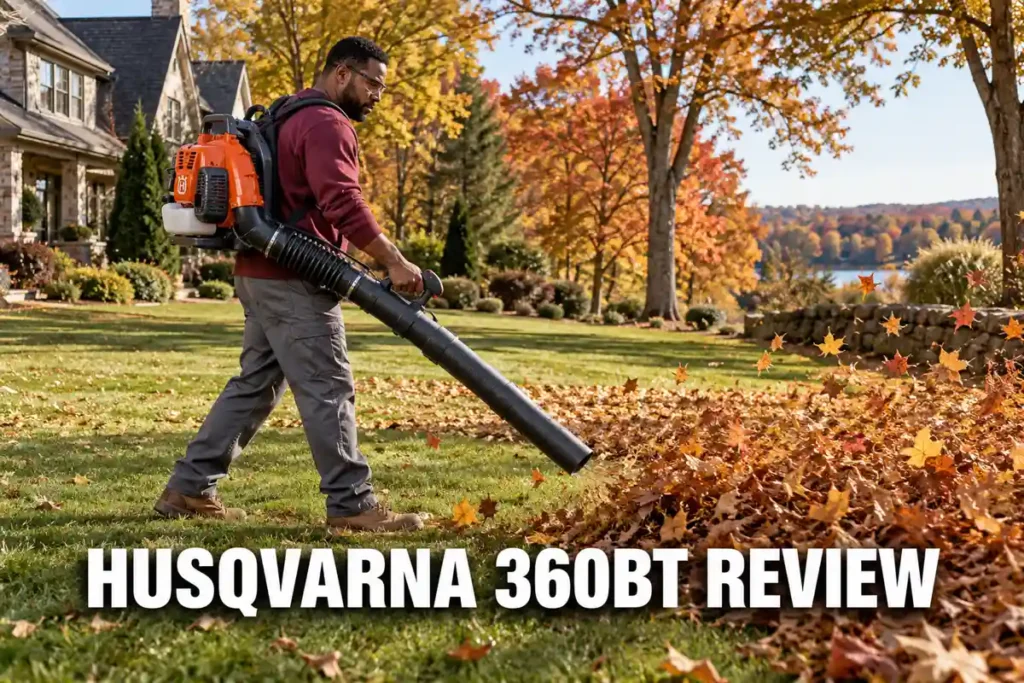
My Husqvarna 360BT review verdict is simple: buy it for half an acre up to a few acres of leaves, clippings and yard debris, and skip it on a small lot or under noise rules. According to Husqvarna, it delivers 30 N of blowing force at 23.2 lb dry, and you pay in noise, fuel mixing and a frequent upkeep schedule. I ran it along the hedgerow base, the drainage ditch edge and the alleys of my 3.7-acre orchard. Below: specs, setup, performance, upkeep and alternatives.
Affiliate Disclosure: Garden Power Scout is a proud participant in the Amazon Services LLC Associates Program. As an Amazon Associate, we earn from qualifying purchases, at no extra cost to you.
Husqvarna 360BT Review: My Verdict in Brief
I recommend the Husqvarna 360BT Gas Backpack Leaf Blower as the mid-size gas backpack for owners of big ground who want force without the heaviest machine. The trade-off is 95 dB(A) at the ear, about 26.7 lb with a full tank, ear protection every time, a fresh 50:1 mix and upkeep on the manual’s schedule.
What the Husqvarna 360BT Backpack Blower Is and What Comes in the Box
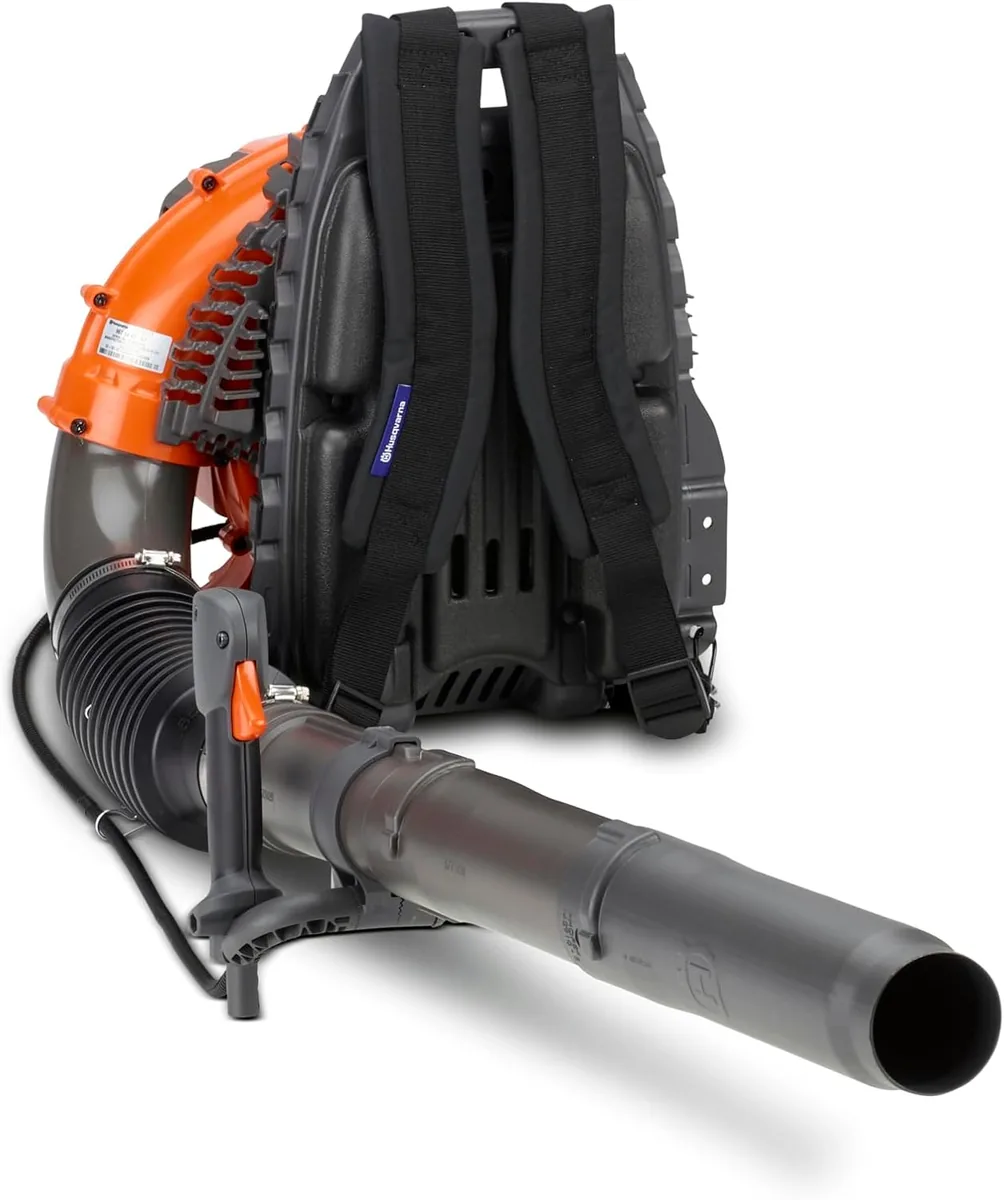
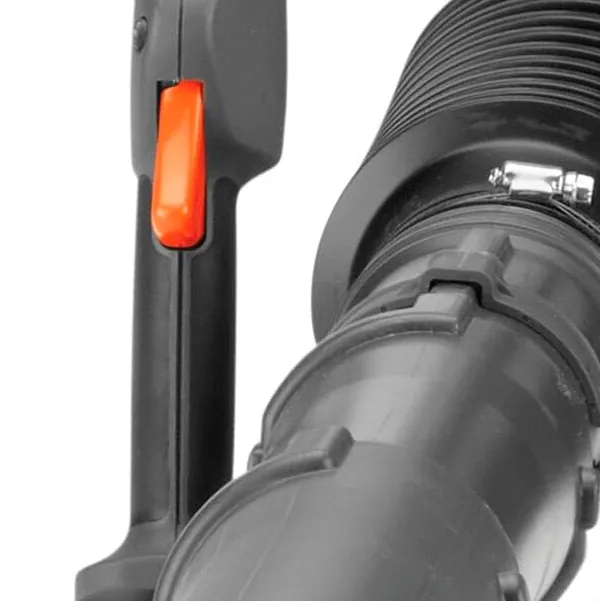
The 360BT is a 65.6 cc X-Torq two-stroke with the throttle on a handle mounted on the blower tube, which you work with your right hand. Husqvarna labels this version Mass Retailer on its US page.
According to Husqvarna’s manual, the box holds the blower with its harness, hose, pipes, round nozzle, combination wrench and operator’s manual. It holds no fuel, no two-stroke oil and no hearing or eye protection, and no vacuum or mulching attachment fits.
Husqvarna 360BT Specs: 890 CFM or 631 CFM?
Two airflow numbers circulate: Husqvarna’s 890 CFM is the air moving inside the housing, and the 631 CFM that leaves the round nozzle at 232 mph is the one that does the work, so use it for any comparison.
| Spec | Figure |
|---|---|
| Engine | 65.6 cc air-cooled two-stroke X-Torq, 3.81 hp |
| Airflow at the nozzle, maker’s figure | 631 CFM |
| Airflow in the housing, maker’s figure | 890 CFM |
| Air speed, round nozzle | 232 mph |
| Blowing force, maker’s figure | 30 N (about 6.7 lb) |
| Fuel tank | 74.4 fl oz (2.2 L) |
| Dry weight | 23.2 lb (10.5 kg) |
| Sound at the operator’s ear, declared | 95 dB(A) |
| Handle vibration, declared | 2.5 m/s2 |
Force comes from how much air the blower moves each second and how much that air speeds up, so volume and speed both count (1). At 30 N, about 6.7 lb of push, the 360BT sits between the Husqvarna 350BT at 21 N and the Husqvarna 570BTS at 37 N.
Husqvarna 360BT Fuel Mix, Setup and First Start
Assembly needs only the combination wrench from the box: clamp the hose to the pipe angle and the control pipe, fit the handle, secure the cable, then add the intermediate pipe and the round nozzle. Husqvarna says to lubricate the control pipe and the hose so the parts slide together.
The mix is 50:1, which is 2.5 fl oz of two-stroke oil per US gallon of gasoline. According to Husqvarna, use fresh unleaded gasoline of at least 87 AKI (90 RON) with no more than 10 percent ethanol, and a two-stroke oil made for air-cooled engines. A US Department of Energy test found that small open-loop engines ran leaner and hotter as ethanol content rose (2), which fits that 10 percent cap.
According to Husqvarna’s manual, mix no more than one month’s supply of fuel at a time. The first start after a winter on the shelf showed me the reason: the can held mix from the autumn, the engine bogged and surged, and it ran cleanly only after I drained the tank and refilled with fresh mix.
Fueling Safety
Stop the engine and let it cool before you open the fuel cap. Work outdoors, do not overfill, wipe up spills and carry the blower 10 ft from the fueling spot before you start it.
A cold start follows seven steps from the manual:
- Move the choke lever to the closed position.
- Press the air purge bulb again and again until fuel starts to fill it.
- Set the throttle control to one third.
- Stand the blower on flat ground and hold it with your left hand, never with your feet.
- Pull the starter handle slowly until you feel resistance, then pull quickly with your right hand until the engine starts.
- Open the choke gradually until it stops.
- Let a cold engine run for 2 to 3 minutes before you work.
Before every start, check that the harness is adjusted and that no loose ends can reach the fan. Never run it indoors, in a shed, a workshop or a garage, with the door open or closed: the exhaust carries carbon monoxide.
How the 360BT Performs on Leaves, Wet Mats and Debris
The 360BT does its best work on loose and damp leaf layers across open ground, where 631 CFM gives the stream its width and 30 N gives it push.
Leaves and Wet Mats
The hedgerow base is where my leaf litter piles deepest, and the stream from the tube lifts that layer out from under the shrubs and rolls it onto the open strip, where the mower can shred it.
According to Husqvarna, the 360BT clears heavy wet leaves, but a mat that has lain through a week of rain needs a rake first, as the manual advises for matted material.

Twigs and Clippings
Mown clippings along the alley edge come up easily at the one third throttle position, which Husqvarna advises whenever it does the job. On dusty ground I wet the surface with a sprayer first, as the manual says, and put the dust mask on before the engine starts, together with plugs and muffs. I keep people and windows out of the line of the debris.
Twigs and clippings stay an outdoor job. Indoor floors in a shed, a workshop or a garage are a job for a broom or a battery or corded blower, never for a gas blower.
Fuel Use and Time per Tank
Husqvarna gives no run time. From its fuel figure of 422 g/kWh at 3.81 hp, the arithmetic is about 80 minutes a tank at full power, and longer at the lower settings.
Weight, Harness, Noise and Vibration
Weight, noise and vibration decide how long you can work, so plan the day in tanks with a break between them.
Weight and Harness
The 360BT weighs 23.2 lb dry, and a full tank adds about 3.5 lb, so expect about 26.7 lb on your back. According to Husqvarna, the harness is ventilated and load-reducing, with wide shoulder straps.
Fit counts: strap force and contact pressure predict much of the discomfort people report when they carry a pack (3), so I adjust the straps before I fill the tank.
Noise and Hearing Protection
Husqvarna declares 95 dB(A) at the operator’s ear. NIOSH recommends 85 dBA averaged over an eight-hour day and halves the allowed time for every 3 dBA more (4), which leaves under an hour a day at 95 dBA without protection.
Plugs go in and the muffs go over them before I touch the starter, and both stay on until the engine is quiet. A Cochrane review reports that poor fit may limit earplug protection for about 40 percent of users (5), so I seat each plug properly, and I stop between tanks when my ears feel tired.
Hand Vibration
Husqvarna declares 2.5 m/s2 at the handle, and field measurements on backpack blowers ran from 1.7 to 2.9 m/s2, with the risk tied to the hours of use each day (6). I rest my hand between tanks.
Maintenance and Storage by the Manual
The manual splits the upkeep into daily, weekly and monthly jobs.
| When | Task |
|---|---|
| Every day | Check the handle and switch, the engine, tank and fuel lines for leaks, the fuel filter and the air intake; clean the air filter; tighten nuts and screws. |
| Every week | Check the starter and rope, the vibration damping units, the spark plug, the cooling system and the spark arrestor screen on the muffler. |
| Every month | Clean the fuel tank, check the cables and replace the spark plug. |
The Husqvarna 360BT air filter is foam: wash it in warm soapy water, let it dry and oil it with Husqvarna air filter oil, the only oil the manual allows. A dirty intake screen lowers the blowing force, so I look at the filter before each session, as the manual’s daily list says.
Brush the spark arrestor screen on the muffler every week, because a blocked screen overheats the engine. The Husqvarna 360BT spark plug is an NGK CMR7H, gapped at 0.024 to 0.027 in, and the manual says to replace it monthly or sooner if needed. For storage, empty the tank, put about 0.5 oz of two-stroke oil in the cylinder, turn the engine over three times and store it upright, dry and cool.
Who Should Buy the 360BT and Who Should Skip It
The 360BT suits ground too big for a handheld and too varied for a machine built only for open lawn: half an acre to a few acres of lawn, farm yard and orchard alleys, with leaf layers, mown clippings and damp debris on open ground, and an owner who keeps to the fuel, plug and screen routine.
Who Should Skip It
- Your lot is under about a quarter acre, where a battery handheld starts faster and quieter.
- Your town limits gas blowers, or your neighbors live close.
- You dislike mixing fuel or pulling a starter cord, or you want a blower that vacuums or mulches.
Drawbacks to Know Before You Buy
The first drawback is the noise: at 95 dB(A) at the ear, plugs and muffs go on together every time.
- Fuel: Husqvarna’s manual advises mixing no more than one month’s supply at a time, so you mix small batches.
- No vacuum or mulch mode: it blows and does nothing else.
- Warranty length: Husqvarna’s US page prints no term for this model, and an orchard like mine that sells fruit may fall under a shorter commercial term. Read the warranty card, keep the receipt and check the seller on the listing.
How the 360BT Compares With Alternatives
The Husqvarna 570BTS Gas Backpack Leaf Blower is the step up at 37 N and 24.7 lb dry if your ground needs more force. According to ECHO, the PB-770T delivers 33 N at 24.3 lb dry. For a battery blower, see my leaf blower guides.
| Model | Force | Airflow at the nozzle | Dry weight |
|---|---|---|---|
| Husqvarna 360BT | 30 N | 631 CFM | 23.2 lb |
| Husqvarna 560BTS | 30 N | 631 CFM | 23.15 lb |
| Husqvarna 350BT | 21 N | 494 CFM | 22.5 lb |
| Husqvarna 570BTS | 37 N | 768 CFM | 24.7 lb |
| ECHO PB-770T | 33 N | 756 CFM | 24.3 lb |
Husqvarna 560BTS
According to Husqvarna’s US pages, the Husqvarna 560BTS Gas Backpack Leaf Blower prints the same engine, airflow, speed and force figures as the 360BT, with declared noise at the ear of 97 against 95 dB(A) and a commercial label against the mass-retailer 360BT. Compare the seller and the warranty paperwork, because the power figures do not separate them.
Husqvarna 350BT
According to Husqvarna, the Husqvarna 350BT Gas Backpack Leaf Blower is the lighter step: 21 N against 30 N, 494 CFM against 631 CFM, and 0.7 lb less at 22.5 lb dry. It is enough for light leaf cover on a smaller lot. For wet leaves, clippings and heavier debris, or from about half an acre up, I recommend the 360BT.
Common Problems and How to Fix Them
Most trouble starts with fuel, air or the plug, and the manual’s troubleshooting table points to the same few causes.
- It will not start: check for the wrong fuel type (drain and refill), an old or badly measured mix, a clogged air filter, a wet or dirty spark plug, a wrong plug gap or a loose plug.
- It starts, then stops: work through the same list, beginning with the mix and the plug.
The manual mentions the Husqvarna 360BT carburetor only for idle trouble: the idle speed screw is the one adjustment it names, and for any other fault it tells you to see your servicing dealer.
My Recommendation After Weighing the 360BT
I recommend the 360BT for half an acre to a few acres of mixed ground, where 30 N at 23.2 lb dry clears leaf layers, clippings and damp debris. You pay in noise at 95 dB(A), a fresh 50:1 mix and upkeep on the manual’s schedule. Put plugs under muffs, let the engine cool before refueling and keep people and windows out of the path of the debris. My Husqvarna 360BT review verdict is a buy for big ground and a pass for a small lot.
Frequently Asked Questions
What are the key differences between the Husqvarna 360BT and 560BTS leaf blowers?
The key differences between the Husqvarna 360BT and 560BTS are small on paper, because Husqvarna’s US pages print the same engine, airflow, speed and force figures for both. They differ in declared noise at the ear, 95 against 97 dB(A), and in how Husqvarna labels them: a mass-retailer model and a commercial backpack blower.
What are the key differences between the Husqvarna 150BT and 360BT leaf blowers?
The 360BT is the larger machine, with 65.6 cc, 30 N and 631 CFM at 23.2 lb dry, against 51.7 cc, 22 N and 452 CFM at 22.0 lb for the 150BT. Husqvarna sells the 360BT for larger properties and heavier debris, so the extra 1.2 lb buys 8 N of force.
Which Husqvarna backpack blower is considered the best?
The best Husqvarna backpack blower is the one that matches your acreage, and for half an acre to a few acres of mixed ground that is the 360BT. Step down to the 350BT for a smaller lot, or up to the 570BTS or 580BTS for an acre or more of wet leaves and heavy debris.
How to start a Husqvarna 360BT leaf blower?
To start a Husqvarna 360BT leaf blower cold, close the choke, press the purge bulb until fuel fills it, set the throttle to one third, stand the blower on flat ground and pull the starter handle. Once it runs, open the choke gradually and let the engine warm for 2 to 3 minutes.
Is it better to have more MPH or CFM in a leaf blower?
It is better to have more CFM than MPH in a leaf blower for most yard work, because air volume rolls a layer of leaves while speed mostly helps peel stuck debris. The 360BT balances both at 631 CFM and 232 mph at the nozzle, which Husqvarna rates at 30 N of blowing force.
References
- NASA Glenn Research Center. Thrust Equation. Beginners Guide to Aeronautics. Updated June 10, 2026.
- Knoll K, West B, Clark W, et al. Effects of Intermediate Ethanol Blends on Legacy Vehicles and Small Non-Road Engines, Report 1 – Updated. NREL/TP-540-43543; ORNL/TM-2008/117. National Renewable Energy Laboratory; 2009.
- Wettenschwiler PD, Lorenzetti S, Stämpfli R, Rossi RM, Ferguson SJ, Annaheim S. Mechanical Predictors of Discomfort during Load Carriage. PLoS ONE. 2015;10(11):e0142004.
- National Institute for Occupational Safety and Health. Noise-Induced Hearing Loss. Noise and Hearing Loss. Centers for Disease Control and Prevention; 2024.
- Morata TC, Gong W, Tikka C, Samelli AG, Verbeek JH. Hearing protection field attenuation estimation systems and associated training for reducing workers’ exposure to noise. Cochrane Database of Systematic Reviews. 2024;5(5):CD015066.
- Alamin Gabasa SA, Md Razali KA, As’arry A, Abdul Jalil NA. Vibration Transmitted to the Hand by Backpack Blowers. IJAME. 2019;16(2):6697-6705.
Safety Note: Leaf blowers throw debris and can damage your hearing. Wear eye and ear protection, read the manufacturer’s manual, and check your local rules on noise and operating hours.