

This Milwaukee 2724-20 review comes down to your battery shelf: buy this 4.9 lb blower if you already own M18 packs, and skip it if you do not. The box holds the blower and nothing else, so a first-time buyer also pays for a pack and a charger before the first leaf moves. I use it for the small jobs around the house, the wood-chip paths of the vegetable plot and the concrete path to the door, where a backpack would be too much machine. Below are the specs, setup, battery choice, performance, noise, upkeep, problems and four alternatives.
Affiliate Disclosure: Garden Power Scout is a proud participant in the Amazon Services LLC Associates Program. As an Amazon Associate, we earn from qualifying purchases, at no extra cost to you.
Milwaukee 2724-20 Review and My Verdict in Brief
I recommend the Milwaukee M18 FUEL 2724-20 450 CFM Handheld Blower (Tool Only) to an M18 owner with a house lot, a drive and mostly dry leaves. Milwaukee rates it at 450 CFM and 120 mph, and it pushes with about 11 N on a 9.0 Ah pack (newtons measure how hard the stream pushes). That is a light push, plenty for dry debris and short for soaked mats. The decision sits in the pack count, because the blower is a cheap addition to a shelf of M18 packs and an expensive first M18 purchase.
- Who it is for: M18 owners with a house lot, a drive, a deck or garden paths to keep clear.
- The main trade-off: a modest push and no published run time, so the packs you own set the real cost.
What the Milwaukee M18 FUEL Blower 2724-20 Is and What You Must Buy With It
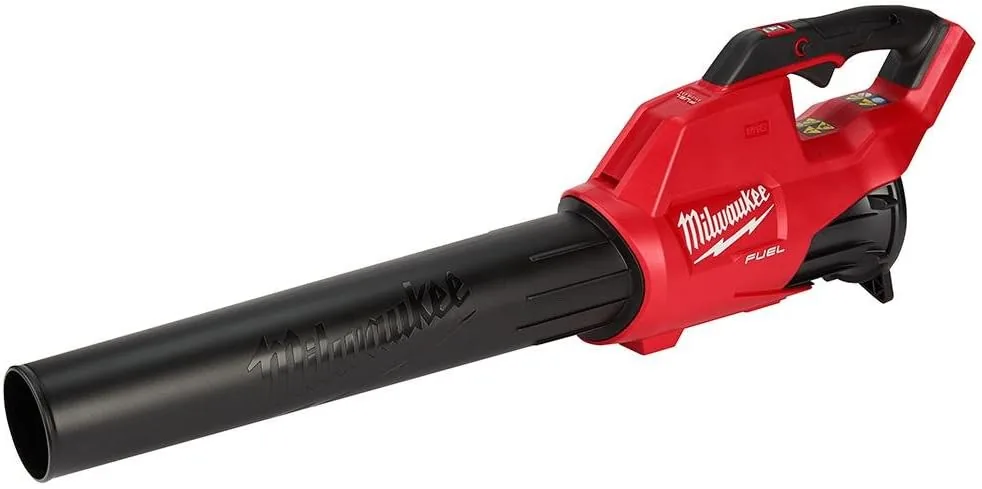
The 2724-20 is the second generation of Milwaukee’s M18 FUEL handheld blower, with a brushless motor and a variable speed trigger. The listing sells the tool only: no pack, no charger and no nozzle come in the carton. A 2724-21HD kit with a pack and a charger is a different listing, and I judge only the bare tool here.
Milwaukee’s M18 system covers well over a hundred tools, and every M18 pack and charger works with this blower. Milwaukee pairs its 450 CFM rating with the High Output XC8.0 pack, so I plan around that pack. A newcomer pays for the blower, a pack and a charger together, while an owner of an M18 drill or saw already holds most of the list.
Milwaukee 2724-20 Specs at a Glance
Two rows decide most purchases, the 4.9 lb tool weight and the missing run time, because the pack you choose sets both the working weight and the minutes.
| Spec | Value |
|---|---|
| Airflow, maker’s figure | 450 CFM on high, 295 CFM on low |
| Air speed, maker’s figure | 120 mph maximum |
| Blowing force | About 11 N with a 9.0 Ah pack; Milwaukee prints no figure |
| Power source | One M18 pack, 18 V |
| Weight, tool only | 4.9 lb |
| Length | 33.8 in |
| Sound, maker’s figure | 62 dB, no distance given |
| Sound at the ear, full speed | About 81 dB |
| Run time | Not published by Milwaukee |
Setup and First Use
I line up the tab on the tube with the notch in the body and slide it in until it snaps, then pull on it to confirm it is locked. The pack slides in until it latches, and the trigger starts the motor.
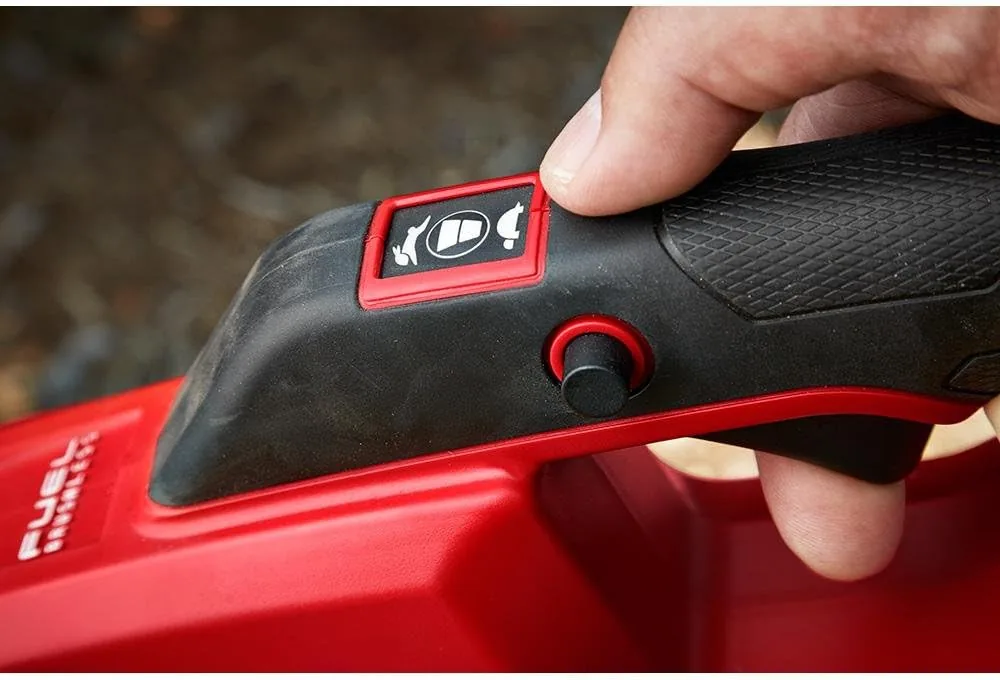
The speed button sets the ceiling, and the Milwaukee leaf blower CFM follows it: the rabbit position allows 450 CFM, the tortoise position 295 CFM, and the trigger scales the air up to that ceiling. Full power arrives in under a second, so I start with the tube pointed at the ground.
The lock-on button holds the trigger at the ceiling you chose, so I pick the setting before I pull. Hold the tube 5 to 6 inches above the surface and sweep side to side.
Safety Before the First Start
Wear eye protection with side shields, ear protection, sturdy footwear and a dust mask on dry, dusty ground. Take the pack off before you change the tube. Keep people, pets and windows out of the debris path, and clear rocks, glass and wire first; Milwaukee puts bystanders 50 feet away.
Which M18 Battery to Use With the 2724-20
My pick for the best Milwaukee battery for leaf blower work with this tool is the High Output XC8.0, the pack Milwaukee names beside the 450 CFM rating. A smaller pack still runs the blower and mostly costs you minutes.
Milwaukee M18 leaf blower battery life depends on the pack, the speed setting and the weather, and Milwaukee gives no run time for this blower. I plan a job in packs, not minutes: I run one full XC8.0 on the job, note how much ground it covers, divide the job by that to get the pack count, and keep one spare on the charger.
Lithium-ion cells deliver much less energy and power at low temperatures (1), and OSHA warns that charging below freezing can leave permanent lithium plating on the anode (2). So I charge in the house, never in the unheated shed.
How It Clears Leaves, Grass and Debris
The push of an air stream depends on how much air leaves the tube each second and how fast it moves, so airflow and air speed work together (3). The Milwaukee blower 2724-20 measures about 11 N with a 9.0 Ah pack, a step above the first generation’s 9 N and well below the 17 N class of the dual-pack Milwaukee and the DeWalt.
Dry Leaves and Hard Surfaces
On the concrete path to the house door, dry leaves go where the tube points, and a steady side-to-side sweep rolls them ahead of the stream. Next to the corded blower in my workshop, this one follows me around the shade tree at the corner of the lawn with no cord to snag on the trunk.
Grass Clippings and Light Debris
After mowing the family lawn, clippings settle on the 4-foot path to the door, and the low setting at 295 CFM gathers them without throwing grit at the door glass.
Garden Paths and Mulch
Milwaukee tunes the low setting for clearing flower beds without moving mulch, and the wood-chip paths of my vegetable plot show why. I start on low, the spent bean leaves lift off, and the chips stay where they are. High throws chips onto the beds, so I switch only for a stubborn corner.
Wet Leaves and Heavy Debris
Wet leaves are where 11 N runs out. After rain, a mat of soaked leaves on the concrete pad slid ahead of the stream and settled again as soon as I eased off the trigger. Heavier twigs stay behind as well. For soaked mats and orchard alleys I reach for a stronger tool or a rake.
Weight, Balance and Noise
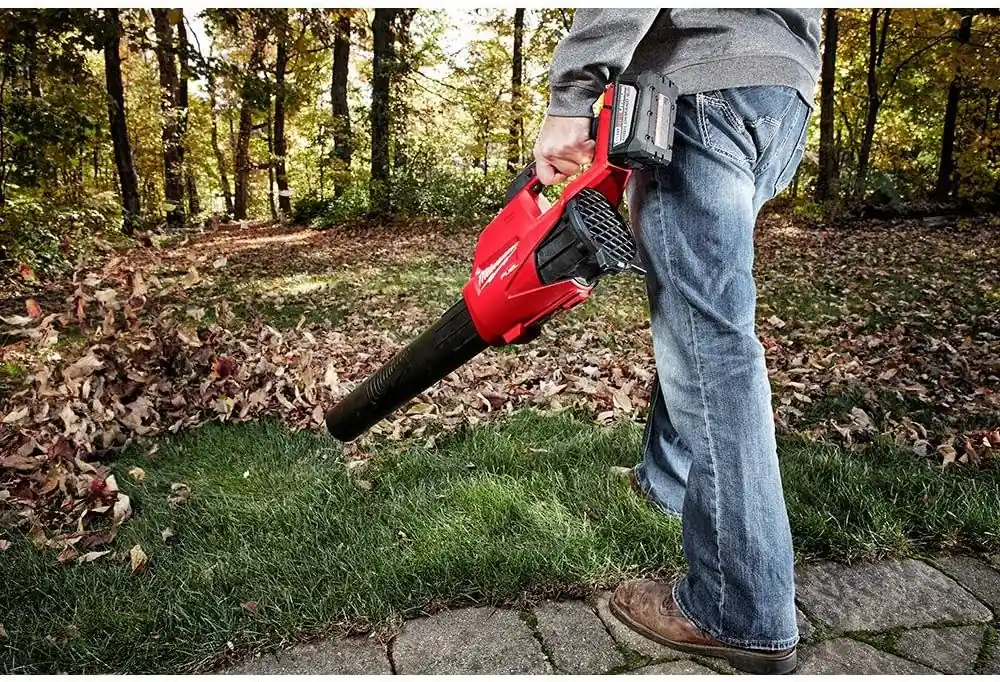
At 4.9 lb bare, this Milwaukee small leaf blower is about a pound lighter than the first generation, and the working weight is about 7 lb with an 8.0 Ah pack, which adds roughly 2.3 lb. Hold the rear of the handle and the nose dips, so I grip nearer the trigger. The intake sits at the rear, so a loose sleeve can be pulled toward it, and I tuck my sleeves in and keep my hair contained, as the manual asks.
Vibration is next to none at full speed and slight on low, so my hand stays comfortable on a long pass. I still change hands between jobs.
Noise and Hearing Protection
Milwaukee lists the sound at 62 dB and gives no distance. At the operator’s ear on full speed the level is about 81 dB, and at 50 feet it is about 67 dB, so the number on the page is not the number at your head. NIOSH recommends limiting exposure to 85 dBA averaged over an eight-hour day and halving the time for every 3 dBA more (4).
I put in ear protection before the first pull of the trigger and check the fit, since poor earplug fit may limit protection for about 40 percent of users (5).
Care, Charging, Storage and Warranty
Keep the vents free of dust, wipe the tool with mild soap on a damp cloth, and keep gasoline, thinner and ammonia cleaners away from it. Never immerse it in liquid, and store it indoors, out of rain and wet places.
A pack stored at a high state of charge loses capacity faster than one stored partly charged (6), so I do not leave a full pack on the charger for weeks. The tube comes off with its latch, which lets the blower hang in the tool shed with the pack on a shelf in the house.
Milwaukee gives three years on the tool to the original purchaser from an authorized Milwaukee distributor, so check the seller on the listing before you order and keep the proof of purchase. Packs carry their own warranty, and blower tubes are excluded as normal wear.
Common Problems and How to Avoid Them
These are the faults the manual tells an owner to check, and each has a short fix.
- Weak airflow on a full pack: clean the pack contacts and the dust from the vents, then try again.
- Tube not secure: take the pack off, reseat the tube until it snaps and pull on it; never run the blower without the tube.
- Odd noise, misalignment or binding: stop, take the pack off and send the tool to a Milwaukee service center, which the manual also asks for as an inspection after six months to a year.
Who Should Buy the Milwaukee 2724-20 and Who Should Skip It
The 2724-20 rewards one kind of buyer and disappoints a few others, and the dividing line is the pack shelf.
Buy It If
- You own M18 packs and want a light blower for them.
- Your jobs are a house lot, a drive, a deck or garden paths with mostly dry leaves.
- You are replacing a corded blower and want to lose the cord.
Skip It If
- You own no M18 packs, because you pay for a platform before the first leaf moves.
- Your leaves lie in soaked mats, or you clear orchard alleys and acre-size yards.
- You need a published run time, a turbo button or a strap.
Drawbacks to Know About
Three limits shape how I use this blower: the push on wet leaves, the mode change and the tube end.
- Modest push on wet leaves: about 11 N moves dry debris and stalls on soaked mats, and there is no turbo for a stubborn corner.
- Mode change needs a released trigger: let go of the trigger and the lock-on before you switch between high and low, so there is no changing mid-pass.
- Plain tube end: there is no metal ring, so the end can scrape concrete if it drags.
How It Compares With Alternatives
Milwaukee’s newer 3017-20 also runs on one pack and, according to Milwaukee, is rated at 500 CFM and 12.2 N; I judge it on its own. For a wider look, see my leaf blower guides.
| Blower | Airflow, maker’s figure | Blowing force | Weight, tool only | In the box |
|---|---|---|---|---|
| Milwaukee 2724-20 | 450 CFM | About 11 N | 4.9 lb | Tool only |
| Milwaukee 2824-20 | 600 CFM | About 17 N | 6.0 lb | Tool only, two packs needed |
| Makita XBU03Z | 459 CFM | About 11 N | 4.6 lb | Tool only |
| DeWalt DCBL772 | 600 CFM | About 17 N | About 6.9 lb | Tool only |
| EGO LB6504 | 650 CFM on turbo | About 20 N on turbo | About 4.8 lb | 5.0 Ah pack and charger |
Milwaukee 2824-20 Dual Battery Blower
The Milwaukee M18 FUEL Dual Battery Blower 2824-20 (Tool Only) adds a second pack and pushes at about 17 N, but it weighs about 10.7 lb with two 8.0 Ah packs. Pick it if you own two High Output packs and want more force on leaf drop.
Makita XBU03Z
The Makita XBU03Z 18V LXT Brushless Blower (Tool Only) follows the same buy-the-pack logic on the 18V LXT platform. Pick it if your shelf already holds Makita 18V LXT packs.
DeWalt DCBL772
The DEWALT 60V MAX FLEXVOLT DCBL772 Handheld Blower (Tool Only) is the stronger tool-only handheld, with 125 mph and about 17 N. It runs on 60V FLEXVOLT packs, so pick it if you own those and clear heavier debris.
EGO LB6504
The EGO Power+ LB6504 650 CFM Blower Kit ships as a kit with a 5.0 Ah pack and a charger. Pick it if you own no cordless packs and want a ready-to-run blower with nearly twice the push.
Is the Milwaukee 2724-20 Worth Buying?
It is worth buying for an M18 owner, and the reason is the pack shelf: a light blower that runs on packs you already hold adds a tool to the shed without adding a battery family. Soaked leaf mats, orchard alleys and acre-size cleanups ask for more push and more packs than it offers, so count the packs you own before you order. My Milwaukee 2724-20 review verdict is a buy for M18 owners with a house lot, a drive and dry leaves, and a pass for first-time cordless buyers and anyone clearing soaked mats.
Frequently Asked Questions
Is the Milwaukee leaf blower any good?
The Milwaukee 2724-20 is a good leaf blower for a house lot, a drive and dry leaves, with 450 CFM, 120 mph and a 4.9 lb body that sits light in one hand. It is a weak choice for soaked leaf mats, because its force is about 11 N, and you must supply the pack and charger yourself.
Is Milwaukee M18 fuel worth the extra money?
Milwaukee M18 FUEL on this blower means a brushless motor with REDLINK PLUS electronics, rated at 450 CFM and 120 mph with the High Output XC8.0 pack, and its value depends on owning M18 packs. The box holds the tool only, so a first-time buyer also pays for a pack and a charger.
What is a good mile per hour for a leaf blower?
A good mile per hour figure for a leaf blower is one backed by enough air volume, and this Milwaukee pairs 120 mph with 450 CFM on high. Speed peels dry debris off hard ground, while volume is what rolls a pile of leaves, so judge the two figures together.
Does Milwaukee make a small handheld blower?
Milwaukee makes a small handheld blower in the M18 FUEL 2724-20, which measures 33.8 inches long and weighs 4.9 lb without a pack or a charger in the box. The dual-battery 2824-20 is a larger handheld at 6.01 lb bare, so the 2724-20 is the smaller of the two Milwaukee handheld models.
Is it better to have more mph or cfm in a leaf blower?
It is better to have mph and CFM working together than either one alone, because a stream’s push depends on how much air moves and how fast. Milwaukee rates this blower at 450 CFM and 120 mph, and a separate force reading of about 11 N with a 9.0 Ah pack shows a light push for dry debris.
References
- Ji Y, Zhang Y, Wang C-Y. Li-Ion Cell Operation at Low Temperatures. J Electrochem Soc. 2013;160(4):A636-A649.
- Occupational Safety and Health Administration. Preventing Fire and/or Explosion Injury from Small and Wearable Lithium Battery Powered Devices. Safety and Health Information Bulletin SHIB 06-20-2019. US Department of Labor; 2019.
- NASA Glenn Research Center. Thrust Equation. Beginners Guide to Aeronautics. Updated June 10, 2026.
- National Institute for Occupational Safety and Health. Noise-Induced Hearing Loss. Noise and Hearing Loss. Centers for Disease Control and Prevention; 2024.
- Morata TC, Gong W, Tikka C, Samelli AG, Verbeek JH. Hearing protection field attenuation estimation systems and associated training for reducing workers’ exposure to noise. Cochrane Database of Systematic Reviews. 2024;5(5):CD015066.
- Keil P, Schuster SF, Wilhelm J, et al. Calendar Aging of Lithium-Ion Batteries. J Electrochem Soc. 2016;163(9):A1872-A1880.
Safety Note: Leaf blowers throw debris and can damage your hearing. Wear eye and ear protection, read the manufacturer’s manual, and check your local rules on noise and operating hours.