
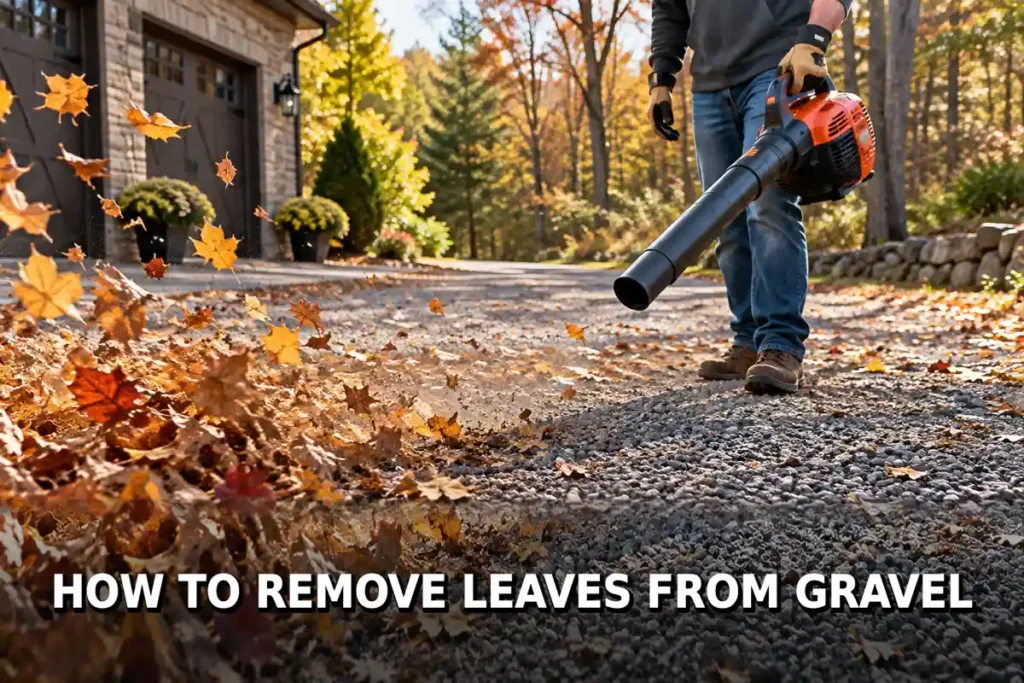
Here is how to remove leaves from gravel with a leaf blower: run it on the lowest speed, aim it across the surface at a shallow angle, and stand 2 to 3 feet back. The air lifts the leaf and the stone stays where it is. I clear the crushed-stone yard beside my orchard every autumn, and on that job the dial on my blower goes down, never up.
Below you get the steps, the reason this works, starting settings by stone size, and what to do with leaves that have settled between the stones.
How to Remove Leaves From Gravel Without Moving the Stones
Use the lowest speed, aim across the surface, and stay 2 to 3 feet back. A leaf is a wide, thin sheet that catches moving air, while a stone is a small, heavy lump that barely does, so gentle air carries the first and passes over the second. Sweep the leaves toward the lawn edge or onto a tarp and the stones stay in the yard.
- Speed: the lowest setting, never turbo. Raise it one step at a time, and only if the leaves do not move.
- Angle: across the surface, at about 15 to 30 degrees above it. Never point the tube down into the stones.
- Distance: the nozzle 2 to 3 feet from the leaves, about knee high.
- Motion: a slow side-to-side fan, walking at an easy pace.
- Direction: always toward one place, such as the lawn edge, a bed that can use the mulch or a tarp.
Any blower with a variable speed dial can do this. A leaf blower for gravel does not need much power, because the job is moving a light leaf, and a single-speed model has to make up for the missing dial with distance.
Eyes, Ears and Bystanders
Put on safety glasses or goggles with side protection, and hearing protection, before the blower starts. According to STIHL’s manual, the air flow can propel small objects at high speed, so keep bystanders and pets at least 50 feet away.
How to Blow Leaves Off Gravel, Step by Step
This is the order I follow on my yard, and it starts before the blower does.
- Walk the area first. Pick up sticks, fruit pits and anything bigger than a leaf, because a blower on low moves leaves and not a stick wedged between stones.
- Put your protection on. Safety glasses or goggles with side shields, hearing protection, long pants and closed shoes.
- Set the dial to the lowest speed. On a blower with only low, high and a turbo button, use low and leave turbo alone.
- Test a corner. Spend about 30 seconds on a patch at the edge. If the leaves move and no stone does, keep that setting.
- Hold the nozzle about knee high. Aim it across the surface at about 15 to 30 degrees, 2 to 3 feet from the leaves.
- Sweep side to side in a fan. Make strokes about 3 to 4 feet wide and let the leaves roll ahead of you.
- Work toward one place. Walk on the cleared side and keep the leaves moving toward the lawn edge or the tarp.
- Step up only when you must. If the leaves stop moving, raise the dial one step and test again. The moment a single stone moves, drop back and finish with a rake.
- Walk the edge last. Kick or rake the stray stones back into the yard.
On my yard I run the corner test at the edge nearest the machinery shed, then work out across the crown of the drive. With my glasses and ear protection already on, I turn the dial up one step, and the first thing I notice is the sound of stones ticking against the shed wall. That is my signal to turn it back down.
Why Air Lifts Leaves but Leaves Stones Behind
A blower works on gravel because a leaf and a stone answer to the same air in very different ways. The mph on the box is the speed at the nozzle opening, and the air that reaches the ground is slower.
Why a Leaf Lifts and a Stone Stays
A leaf is a thin sheet with a wide face, so the air has a large surface to push on and very little weight to move. A stone is the opposite: it is far heavier for the area the air can push on, and it sits in a pocket among its neighbors, where the air near the ground moves slower than the air above. Angular crushed stone also locks against the pieces around it, which makes it harder to start than a round pebble.
How Fast the Air Must Be to Move Stone
Moving a stone takes real air speed, and the speed climbs with the size of the stone. In a wind tunnel, fine gravel with a median size of about 1/4 inch needed a steady wind of about 93 mph before it began to move continuously, and gravel with a median size of 42 mm, roughly 1.65 inches, needed about 211 mph (1). Across these and other soil experiments, the speed needed rose roughly with the square root of the particle size.
Those are steady winds over a whole gravel bed, not a blower jet, so they are not settings. They show that small gravel is the first to go, and that many blowers are rated above 93 mph at the nozzle, which is why the dial and the distance both matter.
How Distance Weakens the Air
A blower tube makes a turbulent jet, and a turbulent jet pulls in the still air around it as it travels, at a rate set by its momentum and its distance from the nozzle (2). Models checked against air jet experiments describe that spreading stream as a cone that draws in air at a steady rate set by the cone’s angle (3). The extra air widens the stream and slows its core, so the jet gets wider and weaker with every foot it travels.
Distance works as a second throttle. Moving the nozzle from 3 feet to 1 foot hits the stones with much faster air than the dial position suggests. That is why I stand back before I touch the dial on the yard.
Gravel Size and How Much Air It Takes
Stone size decides how little air you can get away with. The table lists my own starting points for a variable-speed blower, so treat each row as a place to begin and test a corner first.
| Stone | What it does under air | Where I start | Raise it only if |
|---|---|---|---|
| Pea gravel and fine decorative stone, 1/8 to 3/8 in | Round and loose, so it rolls and skates first | Lowest setting, nozzle 3 ft or more away | The corner test shows leaves moving and no stone; add distance before speed |
| Crushed stone, about 3/4 in | Angular edges lock together, so it moves only at higher speed | Lowest setting, nozzle 2 to 3 ft away | The leaves stay put and no stone has moved; go up one step at a time |
| Driveway crusher run, stone plus fines | Fines bind the surface and it packs hard over time | Lowest setting, nozzle 2 to 3 ft away | The surface is settled and packed, the leaves stay put and no stone moves |
| River rock and cobble, 1 in and up | Heavy enough that most handheld air will not shift it, but small stones lodged between the rocks can move | Lowest setting, nozzle 2 to 3 ft away | The corner test shows no stone moving, large or small; go up one step at a time |
Round, loose stone scatters first, and crushed stone with fines holds. If you have pea gravel, begin with the first row and add distance before you add speed. My yard is crushed stone with a slight crown, and the weak spot is the soft edge where the gravel meets the grass, because that is where a rolling stone ends up on the lawn. I work that edge last and at the lowest setting.
Dry Leaves Versus Wet Leaves on Gravel
Dry leaves are the case this method is built for. They skate across the stone on low air. The thin, light leaves of my apricot and plum trees need only the lowest setting on a dry day.
Wet leaves are different. Water makes them stick to the stone and to each other and adds weight, so they need more force than loose gravel tolerates. On gravel, time and a rake fix wet leaves; more air only moves stones. Wait a day for the top layer to dry, lift one edge of the mat from low and close with the lowest setting that works, or rake it.
After a few November rains my orchard leaves turn into a mat that no low setting shifts, and I reach for the rake. Wet leaves on other surfaces have their own guide. Here the rule is short: the gravel sets how much force you can use.
How to Get Leaves Out of Gravel When They Have Worked Down
Leaves that stay on gravel through wet weather flatten, rot into brown mulch and pack between the stones. A blower on low will not move them, and a blower on high will move the stones first.
Rake the Top Layer, Shallow
Use a flexible-tine rake with short passes and keep the tines just under the leaf layer, so you lift the leaf mold without dragging a pile of stone with it. Then level the stone with the back of the rake. Repeat in a few days if brown mulch still shows between the stones.
Why Vacuum Mode and Gravel Do Not Mix
A blower-vac pulls debris through a spinning impeller, and stone does not belong there. According to Toro’s manual for its blower-vac, you vacuum only leaves and soft items, because hard items such as sticks, rocks, acorns and pine cones will damage the impeller. STIHL’s manual describes its blower as a tool for leaves, grass and similar lightweight material, and Toro’s tells you not to blow hard objects such as nails, bolts or rocks.
Keep vacuum mode off on gravel. Stone goes in with the leaves, and there is no way to keep it out of the intake, so the impeller takes the damage.
Other Tools That Help on Gravel
Sometimes the rake beats the blower, and it always works when the leaves are wet or settled.
- Flexible-tine leaf rake: plastic tines bend over the stone instead of digging in, so use short strokes.
- Gravel rake: a wide-tined rake levels the stone after you have cleared the leaves.
- Tarp: rake or blow the leaves onto it and drag the load away. On uneven stone, drag it slowly, because a tarp can pull gravel onto the path.
- Your hands: pick leaves out by hand around stems, edging and the base of shrubs.
Pick the rake when the leaves are wet, packed down or lying in a thin strip beside a bed, and the blower when they are dry and spread over a wide area.
Keeping Stones, Windows, Cars and People Safe
A blower on gravel throws small, hard things, so the precautions matter more here than on a lawn.
Protect Your Eyes and Ears
The eye is the most exposed target for a thrown stone. A study of US emergency room records found about 120,000 lawn mower eye injuries from 2004 to 2023, and about three quarters came from thrown projectiles such as grass, dirt and rocks, yet only 2 percent of the projectile injuries documented eye protection (4). Hospital records from Queensland tell a similar story for other power tools: 54 percent of the head injuries were metal and wood fragments in the eye, from grinders, drills and saws (5). The first study is about mowers and the second about grinders, drills and saws, not blowers, but a stone thrown by a blower’s air stream is the same kind of hazard: a small, hard piece moving fast toward an eye.
I wear safety glasses with side shields, marked Z87.1, and hearing protection before the blower starts, every time.
Windows, Cars and the Lawn
According to STIHL’s manual, never point the blower at people, pets or windows, and take extra care near solid objects such as trees, cars and walls, because debris can ricochet off them. It also says to switch the blower off at once when someone approaches you. I close the windows and move the cars to the far side of the yard before I start.
Stones that land in the grass are the next hazard, because a mower throws what it hits. I walk the grass edge and pick out stray stones before I mow the alleys.
Dust on Dry Days
Dry gravel and stone fines rise when you blow them. Researchers built a semi-portable enclosure just to measure the fine dust that leaf blowing lifts off the ground (6). On dry days I wear a respirator-grade mask rather than a paper one, and I start with the wind at my back so the dust travels away from me.
Keep Gravel Clean Through the Season
Clear the gravel often and lightly. Leaves left on stone rot into soil in the gaps, and soil is what weeds root in, so a quick pass every week or two in leaf season beats one hard clean-up in December. Once the plum leaves start dropping I make a quick pass every few days instead of waiting for the last of them.
Two things in the ground make the job easier. Landscape fabric under the stone keeps the soil below from mixing upward, and steel or similar edging set flush with the surface keeps the stone from creeping onto the grass. On a small patch, rake the loose leaf litter off the surface in thin passes and level the stone afterward.
My Routine for the Yard Gravel
Three habits carry my gravel work. I start at the lowest dial and stand back before I ever raise it, I rake whatever the blower will not lift, and I walk the lawn edge for stray stones before every mowing. Dry leaves go to the blower, and wet or settled ones go to the rake. Next time, spend your first minute on a corner test and let the stones tell you the right setting.
If you are still choosing a tool, our leaf blower guides cover the options. A blower on its lowest dial, with a rake for whatever it will not lift, is how to remove leaves from gravel and keep the stones in the yard.
Frequently Asked Questions
How to remove leaves from gravel driveway?
To remove leaves from a gravel driveway, run the blower on its lowest speed, aim it across the surface at a shallow angle and stand 2 to 3 feet back, then sweep the leaves toward the lawn edge or a tarp. A packed driveway tolerates a little more air than loose stone, but you still raise the dial one step at a time. Rake instead when the leaves are wet or have settled into the surface.
Can you use a leaf blower on gravel?
You can use a leaf blower on gravel when you keep the speed low, the angle shallow and your distance up. High speed at a steep angle throws stones, and Toro’s manual says not to blow hard objects such as nails, bolts or rocks. The aim is to move the leaves and leave the stones.
How to remove leaves from pea gravel?
To remove leaves from pea gravel, use the lowest setting, stand 3 feet or more back and sweep across the top, because pea gravel is the lightest common stone and scatters first. When the leaves are wet, switch to a flexible-tine rake and work in short strokes.
How to clean dirt from pea gravel?
To clean dirt from pea gravel, rake the loose leaf litter off the surface of a small patch in thin, shallow passes and level the stone again. Dirt that has already worked down between the stones is not something a blower lifts, so the habit that helps most is clearing fallen leaves before they rot into more of it.
How to remove gravel from garden soil?
To remove gravel from garden soil, rake the bed lightly and pick out what is left by hand. Do it before you mow the grass beside it, because a mower throws any stone it hits.
References
- Batt RG, Peabody SA II. Threshold friction velocities for large pebble gravel beds. J Geophys Res Atmos. 1999;104(D20):24273-24279.
- Ricou FP, Spalding DB. Measurements of entrainment by axisymmetrical turbulent jets. J. Fluid Mech. 1961;11(1):21-32.
- Franco Medrano F, Fukumoto Y, Velte CM, Hodžić A. Mass Entrainment Rate of an Ideal Momentum Turbulent Round Jet. J. Phys. Soc. Jpn. 2017;86(3):034401.
- Stange NR, Jennissen CA. Lawnmower-Related Eye Injuries in the U.S., 2004 to 2023. Am J Ophthalmol. 2025;277:7-16.
- Judge C, Eley R, Miyakawa-Liu M, et al. Characteristics of accidental injuries from power tools treated at two emergency departments in Queensland. Emerg Med Australas. 2019;31(3):436-443.
- Fitz D, Pankratz D, Pederson S, Bristow J. A Semi-portable Enclosure to Measure Emission Rates from Small Fugitive Sources: Leaf Blower Dust Example. Aerosol Air Qual. Res. 2021;21(10):200566.
Safety Note: Leaf blowers throw debris and can damage your hearing. Wear eye and ear protection, read the manufacturer’s manual, and check your local rules on noise and operating hours.