
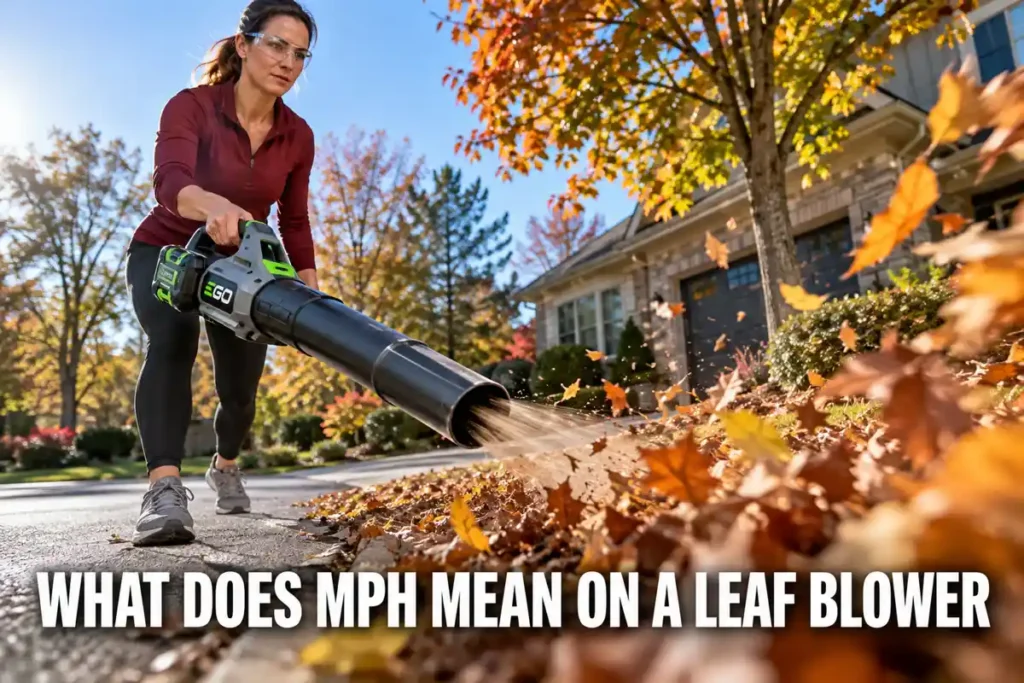
MPH on a leaf blower is miles per hour: the speed of the air as it leaves the nozzle, rated by the maker at one setting. It describes the jet at the tip. Your leaves feel less than that, and the number says nothing about how much air the blower moves.
I blow leaves off a concrete pad, a gravel yard and the strips under my plum trees, and the mph figure decides how I hold the tool on each. Below you will find how makers measure it, real ranges by blower class, how fast the air fades, and how to read a claim on a box.
What Does MPH Mean on a Leaf Blower?
MPH is the speed of the air at the nozzle, in miles per hour. A blower rated at 200 mph sends air out of the tip at 200 miles per hour, about 89 meters per second, at the setting and with the nozzle the maker names. The volume of air is a separate rating, measured in CFM.
My guide on what CFM measures on a leaf blower and how makers test it covers that volume figure in the same detail I go into for speed here.
The rating describes the jet at its fastest point and nowhere else. It says nothing about how much air moves, and nothing about how hard the whole stream pushes, because force depends on volume and speed together. I read the figure as the best case at the tip, since the distance, the angle and the surface all take speed away after that.
Why Pressure Rises With the Square of Speed
Moving air presses on a surface it hits head on with a pressure equal to half the air density times the speed squared, so doubling the speed quadruples the pressure. The table shows the pressure at the tip for common ratings.
| Nozzle speed | Pressure at the tip | Compared with 100 mph |
|---|---|---|
| 100 mph | 25 lb per sq ft | 1.0 times |
| 120 mph | 36 lb per sq ft | 1.4 times |
| 150 mph | 56 lb per sq ft | 2.25 times |
| 200 mph | 100 lb per sq ft | 4.0 times |
| 240 mph | 144 lb per sq ft | 5.8 times |
That square is why speed matters on stuck debris: a 200 mph jet meets the edge of a dried leaf with four times the pressure of a 100 mph jet. Small gaps in a rating add up too, because a jet 10 percent faster carries 21 percent more pressure.
Typical Leaf Blower MPH by Blower Class
No standard defines blower classes or a good speed, so this table is my reading of maker-rated peak figures for the models in each group. Most battery handhelds land between 120 and 200 mph, and gas backpacks sit at 206 to 239 mph. A 150 mph leaf blower falls in the middle of the field.
| Class | Rated MPH | Rated CFM | Examples behind the range |
|---|---|---|---|
| Corded handheld | 140 to 260 | 155 to 725 | Toro Power Sweep, Ultra and PowerJet |
| Cordless 20V class | 125 to 130 | 100 to 450 | DeWalt DCBL722 at 125 mph with its concentrator |
| Cordless 36V to 40V | 120 to 200 | 473 to 800 | Husqvarna 350iB at 200 mph with the round nozzle |
| Cordless 54V to 80V | 145 to 200 | 549 to 880 | EGO LB7654 at 166 mph without the tapered nozzle and up to 200 with it |
| Cordless backpack | 145 to 192 | 570 to 730 | Stihl BGA 300 at 192 mph |
| Gas handheld | 130 to 172 | 392 to 456 | Husqvarna 125BVx at 130 mph, Echo PB-2520 at 170 mph |
| Gas backpack | 206 to 239 | 517 to 1,110 | Echo PB-9010T at 220 mph, Stihl BR 800 C-E at a 239 mph peak |
| Walk-behind | Just under 200 | Not published | Billy Goat F1302SPH |
A bigger machine does not always print a bigger number. The Echo PB-9010T moves 1,110 CFM and rates 220 mph, while the Stihl BR 800 C-E moves 912 CFM and prints a 239 mph peak.
What Is a Good MPH for a Leaf Blower?
A good speed is the one that fits your hardest surface, and the job table later in this guide puts numbers on it. A 125 mph blower such as the DeWalt DCBL722 handles dry leaves on a patio or a path, while wet leaves, packed needles and dried mud ask for more.
I treat 160 mph as my dividing line. Below it I stay with dry leaves, and from 160 up I expect to take on wet leaves with a low tip and a few passes.
How Manufacturers Measure Leaf Blower Air Speed
Makers read the speed at the nozzle, at a setting and with a nozzle they choose, so the box number is a maker’s rating taken at the nozzle. Echo lists the PB-9010T at 220 mph at the nozzle, and Husqvarna lists the 350iB at 200 mph with the round nozzle.
I built my orchard drip system on emitters rated at 2 gallons per hour, and that rating holds only inside the pressure range the maker states. I read a printed mph the same way: it is a rating at one nozzle, one setting and one point on the jet.
Peak Speed Versus Average Speed
Some makers print both. Stihl lists the BR 800 C-E at 199 mph average and 239 mph maximum, and Echo lists the PB-770T at 196 and 234. In both cases the average is about 83 percent of the peak, so a box that prints only the peak runs about 20 percent above the average. By the square rule, that gap is about 44 percent more pressure.
When a box prints a single number, I assume it is the peak.
Which Standard Makers Follow
Gas blower makers often footnote their ratings to ANSI/OPEI B175.2, the US standard for handheld and backpack blowers with combustion engines. It does not cover battery blowers, so a battery rating may follow a different test. I treat every printed mph as the maker’s own rating.
Why Nozzle Shape Changes MPH
A smaller outlet forces the same air to move faster, so a tapered nozzle raises mph and narrows the stream. It trades width for speed and adds no air.
According to EGO’s manual for the LB7650 and LB7654, the blower reaches 166 mph without the tapered nozzle and 195 mph with it, and the product page says up to 200. That is 17.5 percent faster, which is 38 percent more pressure at the tip from a narrower stream.
Treat the nozzle as part of the number, because a 200 mph rating often belongs to the narrow attachment and not to the bare tube.
A sprayer tip works the same way, which is why I read a blower nozzle like one. Swap the tip on a powered sprayer and the pattern narrows while the output per minute falls. On the concrete pad in front of the machinery shed I keep the tapered nozzle on for the seams between slabs, and I take it off for open concrete, where a narrow lane only adds passes.
Why Air Speed Drops Away From the Nozzle
Once the air leaves the tip it mixes with the still air around it, and the jet widens as its speed falls. Measurements of turbulent jets show that the stream drags in the surrounding air as it travels, and the amount grows with the jet’s momentum and its distance from the nozzle (1). A momentum model of a round jet predicted that spreading and matched the authors’ own air-jet experiments (2).
The speed on the box is the speed at the nozzle exit, and it starts to fall as soon as the air leaves the tip. The farther the target sits from the tip, the slower the air that reaches it, so a leaf at the end of a long reach feels only a fraction of the printed number.
Close Beats Fast
For stuck debris, hold the nozzle close and low instead of reaching with a high setting.
Under the plum row I work within a foot or two of the pruning sawdust, which lets me run a lower setting that saves charge and keeps the dust down.
What Different Speeds Do to Wet Leaves, Gravel and Stuck Debris
Speed sets the pressure on the leading edge of whatever you move, so it matters most where debris sticks. Volume then carries the loosened pile away. The table gives the speeds I look for by job, as guidance and not as a standard.
| Job | Speed that fits | Note |
|---|---|---|
| Dry leaves on hard ground | 120 to 150 mph | The low end is enough on a patio or path |
| Dry leaves on lawn | 130 to 170 mph | Grass drags on the air, so I want more speed |
| Wet leaves | 160 to 200 mph or more | Low angle under the edge, and expect more than one pass |
| Pine needles in gravel | 150 to 200 mph | Throttle back near the stones |
| Dried mud or clippings in cracks | 180 to 220 mph with a concentrator | Narrow lane, tip close |
| Dust and sawdust in a shed | Lowest setting | Doors open and a respirator on |
Wet Leaves
A film of water makes leaves cling to each other and to the surface. Speed supplies the pressure to peel the leading edge of the mat, and volume then rolls the loosened leaves forward.
On the concrete path to the house door, soaked apricot leaves stayed put under a high, steep stream. A low tip aimed under the edge lifted the mat, and I worked around the edges of the pile instead of into the middle.
Gravel
Gravel is two jobs. One is lifting sand, needles and leaves out of the stones, and the other is leaving the stones where they are. The job is control, so the throttle matters more than the top speed.
Along the driveway edge, stones scattered when I held the tip close and steep. A shallow angle at a lower throttle cleared the needles and left the stones in place.
Stone Throw
Loose stones become projectiles at these speeds. Wear eye protection every time, keep the tip 2 to 3 feet from loose stone with the throttle low, and keep people, pets, cars and windows out of the line of fire.
Stuck Debris
A high mph leaf blower earns its place on stuck debris such as dried mud, pine needles packed into a crack and clippings baked onto concrete. A concentrator nozzle in the 180 to 220 mph range puts the pressure into a narrow lane, and a wide nozzle does not. Wet clippings paste onto concrete, so wait until they dry.
Dust and Delicate Ground
Speed also raises dust and strips mulch. Around the flowering strips and the young drip lines I start on the lowest setting and keep the tip up, because fast air moves cover-crop seed. In a shed, open the doors and wear a respirator-grade mask.
Hearing Protection
Wear hearing protection whatever the mph. In a community field test of two leaf blowers and a hose vacuum, the individual machines measured 85 to 101 dB(A) near the machines (3). NIOSH sampling of 80 landscaping workers found 94 of 119 eight-hour results at or above the 85 dBA recommended limit, with significantly more noise from fuel-powered blowers than from battery versions (4). Poor earplug fit may limit protection for about 40% of users (5).
How to Read an MPH Claim on the Box
Five checks turn a printed mph into a number you can compare.
- Peak or average. Compare a peak only with a peak and an average only with an average. The highest mph leaf blower among the gas and battery models in this guide is the Stihl BR 800 C-E, at a 239 mph peak.
- Which nozzle. EGO says up to 200 mph with the tapered nozzle attached, DeWalt says 125 mph with the concentrator, and Husqvarna names its round nozzle. A figure with no nozzle named cannot be compared with one that names it.
- Which mode. Battery blowers often rate speed in Turbo, and Turbo drains a pack fast. According to EGO, the LB7654 runs about 15 minutes on Turbo with a 5.0 Ah pack.
- What sits beside it. Echo, Stihl and Husqvarna print newtons, which blend speed and volume into one push figure, and the EGO and DeWalt pages list none. A corded handheld such as the Toro Ultra prints 260 mph beside only 340 CFM, so a 250 mph leaf blower of that kind is a thin jet: read the speed beside the airflow.
- Same name, different numbers. Husqvarna lists the 580BTS at 220 mph on one page and 206 mph on another for a different article number, so name the exact kit before you compare.
What a 200 MPH Leaf Blower Claim Tells You
A 200 mph claim tells you the speed of the jet at the nozzle, for the rating type, nozzle and mode the maker names. When both boxes name a peak with the same kind of nozzle, 200 mph carries four times the tip pressure of 100 mph. It leaves out the width of the stream, the runtime and the airflow.
Between two blowers that both print 200, I pick the one that names its nozzle and lists newtons.
Choose the Speed for Your Hardest Job
Pick the speed for your hardest surface. For dry leaves on hard ground, 120 to 150 mph is enough. For wet leaves, plan on 160 to 200 mph and a low tip under the edge, and for packed debris use a concentrator nozzle at 180 to 220 mph.
Remember three things: the rating is a figure taken at the nozzle, it fades with distance, and pressure rises with the square of speed. To compare two blowers or two settings yourself, blow a strip of dried mud off concrete and keep the nozzle and setting that lift it in one pass at your working distance. Compare models in my leaf blower guides, and read the mph on a leaf blower beside its nozzle, its CFM and its newtons.
Frequently Asked Questions
How many MPH is a good leaf blower?
A good MPH for a leaf blower depends on its class, because most battery handhelds rate 120 to 200 mph, gas handhelds 130 to 172 mph and gas backpacks 206 to 239 mph. Inside a class the nozzle matters too, since it alone moves the EGO LB7654 from 166 to 195 mph.
Is a 120 MPH blower good?
A 120 MPH blower is good for dry leaves on patios, paths and other hard ground. It runs short on soaked leaves and packed debris, where I look for 160 mph or more.
Is it better to have more MPH or cfm in a leaf blower?
More MPH helps on stuck debris and more CFM helps on a loose pile, so neither number settles a purchase alone. Newtons, where a maker prints them, combine both and compare blowers better than either one.
What MPH leaf blower do I need?
The MPH leaf blower you need depends on your hardest surface: 120 to 150 mph for dry leaves on hard ground, 160 to 200 mph for wet leaves and 180 to 220 mph with a concentrator nozzle for packed debris. Check the CFM beside it, because speed with little air is a thin stream.
What is MPH on a leaf blower?
The MPH figure on a box rates how fast the air travels at the tip of the nozzle, at the setting the maker chose. It says nothing about the volume of air, and the speed fades as the air travels, so it is a best-case number.
References
- Ricou FP, Spalding DB. Measurements of entrainment by axisymmetrical turbulent jets. J. Fluid Mech. 1961;11(1):21-32.
- Franco Medrano F, Fukumoto Y, Velte CM, Hodžić A. Mass Entrainment Rate of an Ideal Momentum Turbulent Round Jet. J. Phys. Soc. Jpn. 2017;86(3):034401.
- Walker E, Banks JL. Characteristics of Lawn and Garden Equipment Sound: A Community Pilot Study. J Environ Toxicol Stud. 2017;1(1).
- Alexander BM, Graydon PS, Pena M, Feng HA, Beamer BR. Hazardous exposures and engineering controls in the landscaping services industry. Journal of Occupational and Environmental Hygiene. 2025;22(3):189-202.
- Morata TC, Gong W, Tikka C, Samelli AG, Verbeek JH. Hearing protection field attenuation estimation systems and associated training for reducing workers’ exposure to noise. Cochrane Database of Systematic Reviews. 2024;5(5):CD015066.
Safety Note: Leaf blowers throw debris and can damage your hearing. Wear eye and ear protection, read the manufacturer’s manual, and check your local rules on noise and operating hours.