
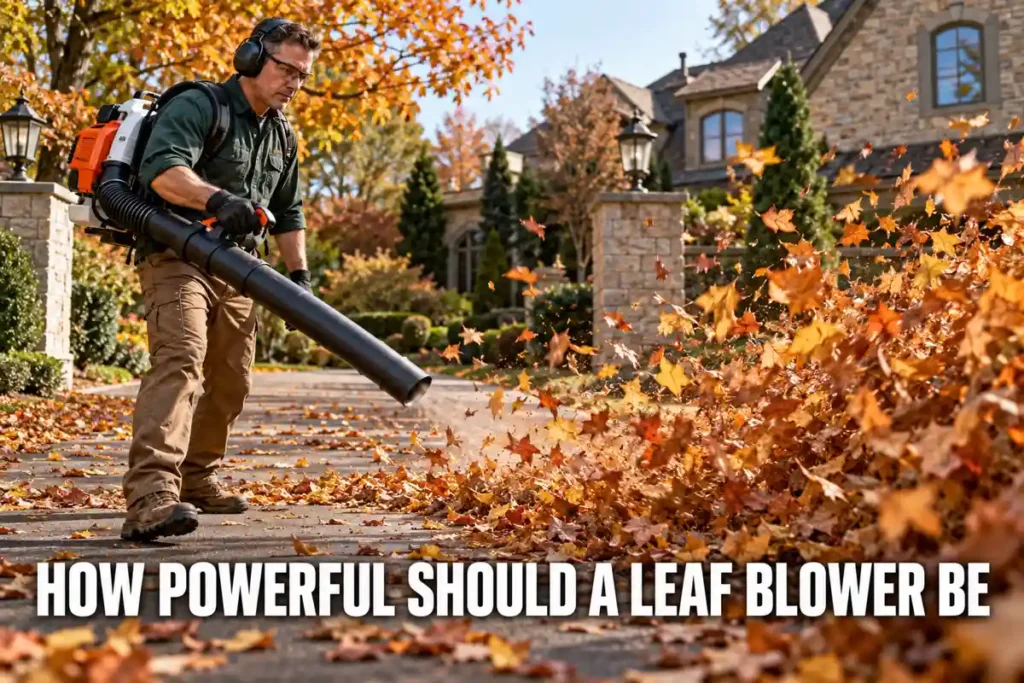
A leaf blower should have enough push to move the wettest pile of your hardest job, and no more: about 150 to 450 CFM for a small yard and 750 to 1,100 CFM for an orchard or farm.
I have worked my family’s farm since 2013, and every autumn I clear leaves from a 3.7-acre apricot and plum orchard, a gravel yard and a quarter-acre lawn. This guide gives a table by yard type, then explains what power means, how to read the ratings, which class delivers it and where too much power hurts.
How Powerful Should a Leaf Blower Be for Your Yard?
Size the blower to the hardest job you do. Wet plum leaves on my gravel yard in November are the test I use, because a blower that clears that pile clears the dry leaves of October with ease. The table below is my own recommendation by yard type, built on blowing force in newtons, the battery or engine behind it, and CFM as a band.
| Yard type | Power class | Air and force to look for | Battery or engine | Skip this class if |
|---|---|---|---|---|
| Small yard (under 0.25 acre, patio, deck, townhouse) | Corded handheld or 20V to 40V cordless handheld | 150 to 450 CFM and 120 mph or more; newtons rarely listed | One 4.0 to 5.0 Ah pack, or a cord with a 100 foot extension | You have wet piles on gravel, or a drive and a side yard as well |
| Suburban lot (0.25 to 0.5 acre) | 36V to 60V cordless handheld, or a 12 A corded unit | 450 to 700 CFM; 17 to 26 N where listed | Two 5.0 Ah packs, or as many as your minutes on High require | The lot has long runs far from an outlet and heavy wet leaves |
| Acreage (0.5 acre to several acres) | Cordless backpack or gas backpack | 600 to 900 CFM; 26 to 41 N | Cordless: enough packs for your minutes on High. Gas: about 60 to 80 cc | Your leaf season is only a few hours and a handheld will do |
| Orchard or farm (tree rows, gravel yard, sheds) | Gas backpack | 750 to 1,100 CFM; 33 to 48 N | Gas engine near 80 cc at the top of the range | You have only a lawn and a gravel pad: a cordless backpack is enough |
| Professional crew (all day, many sites) | Gas backpack at the top of its range, or a professional cordless backpack where rules decide | 40 to 48 N for gas; two-pack runtime on High for cordless | Gas engine near 80 cc, or the largest packs the maker sells | Your town bans gas blowers: choose cordless |
Newtons give the fairest comparison because they blend volume and speed into one push. One newton is about 0.225 pounds of force, so 12.5 N is about 2.8 pounds and 56 N is about 12.6 pounds. Many battery makers do not list newtons, so for those blowers I read CFM and mph together.
My guide on what a leaf blower CFM rating actually tells you covers how that figure is measured and what it means for each class of blower.
These bands describe classes of machine that makers actually sell. No standard sets how many CFM or newtons a quarter acre needs.
What Leaf Blower Power Actually Means
Power on a leaf blower is the push of the air jet. Six numbers describe it, and each answers a different question: how much air, how fast, how hard the jet pushes, and how much battery, cord or engine stands behind it.
| Measure | Unit | What it tells you | Who publishes it |
|---|---|---|---|
| Air volume | CFM (cubic feet per minute) | How much air leaves the tube each minute | Almost every maker |
| Air speed | mph | How fast the jet leaves the nozzle | Almost every maker |
| Blowing force | N (newtons) | The push of the jet at the nozzle, the closest figure to clearing power | Echo, Stihl and Husqvarna; many battery brands do not |
| Battery pack | Volts times amp-hours = Wh | The size of the fuel tank, not the push | Battery makers |
| Cord current | Amps times 120 volts = W | The electricity a corded unit draws from the wall | Corded makers |
| Engine size | cc (cubic centimeters) | The size of the engine, a rough guide to force | Gas makers |
Volts are not power. A “20V Max” label names the unloaded top voltage of a pack whose nominal voltage is 18 volts, so a 20V Max pack is not stronger than an 18V pack. Compare nominal volts and watt-hours instead.
Watt-hours are the tank. A “40V” pack is 36 volts nominal, so a 4.0 Ah pack holds 144 Wh, not 160. A “56V” pack of 5.0 Ah holds about 270 Wh at 54 volts nominal. Divide the watt-hours by the watts the blower draws and you get the hours you can run; multiply by 60 for minutes.
Take a 56V cordless handheld that draws about 735 W on High. One 270 Wh pack lasts 270 divided by 735, or about 0.37 hours, which is about 22 minutes. A full hour on High needs 735 Wh, nearly three packs.
A cord rating works the same way. A 12 A corded blower draws up to 1,440 W and a 7 A unit draws up to 840 W, which is what the motor takes from the wall. I add up my leaf season in total minutes: the house lawn, the gravel yard, the concrete pad and the orchard strips come to several hours, so the minutes a pack lasts on High matter more to me than its voltage.
How to Read Leaf Blower Power Ratings
A rating is one setting on one nozzle. A spray nozzle rating names one nozzle at one pressure, and a blower rating works the same way: the box shows a peak, not the setting you will use all afternoon.
- Setting: find out whether the figure is for Turbo or for the High setting you will really use.
- Measuring point: the same machine can carry two CFM figures, depending on whether the maker measured at the housing, the pipe or the nozzle.
Distance changes the noise number more than most buyers expect. A community field study of lawn equipment found sound levels at 50 feet consistent with the makers’ ratings (1), so a gas blower’s 80 dB(A) at 50 feet is a real figure. Sound falls about 6 dB each time the distance doubles, so a gas backpack rated at 80 dB(A) at 50 feet reaches about 104 dB(A) at 3 feet from the engine.
Engine size is a rough guide at best. The Stihl BR 800 C-E and the Echo PB-9010T both have a 79.9 cc engine, yet their makers rate them at 41 N and 48 N. Fan and housing design count as much as the engine, so compare newtons and not cubic centimeters.
Two checks tell you what a blower can do: the newtons at the nozzle, when the maker lists them, show the push of the jet, and the minutes a full pack lasts on High show endurance only, since a weak blower can run longer than a strong one. A narrow nozzle does not add power. It trades volume for speed, so the jet gets faster and thinner.
Which Blower Class Delivers the Power You Need
Every class of blower stops somewhere. The table lists the ranges that makers publish, from a corded handheld up to a walk-behind unit.
| Class | CFM and mph | Newtons where listed | Weight and run time | Where it stops |
|---|---|---|---|---|
| Corded handheld | 155 to 725 CFM; 140 to 260 mph | Rarely listed | Around 9 lb; no run time limit | Cord reach; snags on beds and trunks |
| Cordless 20V | 100 to 450 CFM; 125 to 130 mph | Not listed | 4 lb and up; roughly 15 to 20 minutes per pack | Wet leaves and big lawns |
| Cordless 36V to 80V handheld | 473 to 880 CFM; 120 to 200 mph | 15 to 26 | About 10 to 11 lb with a pack; 20 to 25 minutes on High per 5.0 Ah pack | Acre-plus jobs; Turbo lasts 10 to 15 minutes |
| Cordless backpack | 570 to 690 CFM; 145 to 192 mph | 26 on one model | 8 to 15 lb tool alone, more with a large pack | Runtime on High over a big property |
| Gas handheld | 392 to 456 CFM; 130 to 172 mph | 12.5 to 15.8 | About 9 lb dry; runs while you refuel | Less push than a backpack; noise and fuel care |
| Gas backpack | 517 to 1,200 CFM; 206 to 239 mph | 22 to 56 | 22.7 to 27.8 lb dry before fuel; about 80 dB(A) at 50 feet | Ears, neighbors and arms on a long day |
| Walk-behind | Not published by most makers; just under 200 mph on one model | Not published | Well over 150 lb; engine of about 13 hp | Steps, beds, tight spaces and orchard rows |
Cordless handhelds at 36V to 80V are the sweet spot for roughly a quarter to half an acre. A high power electric leaf blower in this group now matches small and mid-size gas units on force, although the top gas backpacks still lead.
Anyone shopping for a high power backpack leaf blower should decide first between battery and engine. A cordless backpack is quiet, vibrates little and covers most half-acre jobs, but its packs often cost more than the blower body.
Gas handhelds run as long as you refuel them and work where no outlet reaches. The highest power leaf blower you can carry is a gas backpack: according to Echo, its PB-9510T reaches 1,200 CFM and 56 N.
Walk-behind units sit at the top of the ladder for open ground. One maker claims several times the airflow of a backpack. Steps and tree rows stop it, so I count it as a tool for long drives and open lawns. The leaf blower guides on this site cover specific models in each class.
How Much Power Each Kind of User Needs
Each class does its job well up to a point, and the limit shows in the same few places: wet leaves, distance from an outlet and hours on your back.
Small Yard
A patio, a deck or a townhouse lawn needs little push. A corded unit or a 20V handheld at 150 to 450 CFM clears dry leaves and clippings, and a pack that lasts 15 to 20 minutes is plenty for a job that takes ten. On my land the 40 by 30 foot concrete pad in front of the machinery shed and the path to the house door are the only jobs where this class is enough.
Suburban Lot
A quarter to a half acre is where a 36V to 60V cordless handheld pays off. At 450 to 700 CFM and 17 to 26 N where the maker lists it, the blower moves mixed leaf fall, a drive and a walk. Two 56V, 5.0 Ah packs give about 44 minutes on High by the sum above, and a 36V pack of the same size holds a third less energy, so buy the second pack with the blower and use Turbo only as a boost for one stubborn corner. The quarter-acre lawn around my house, with its two or three shade trees, is the largest area where I call a handheld enough.
Acreage
Past half an acre the limit is minutes more than push. A cordless backpack with two packs, or a gas backpack, at 600 to 900 CFM and 26 to 41 N covers this ground before arm fatigue ends the job.
Orchard or Farm
A high power leaf blower earns its place in an orchard. Leaves fall in the tree-row strips, pruning twigs and sawdust pile up in late winter, and the gravel yard and the machinery shed collect dust and chaff. I use a gas backpack at 750 to 1,100 CFM and 33 to 48 N for this work: one pass down the alley replaces three passes with my old gas handheld, and the long tube reaches under low branches.
A blower is a tool for moving leaves. I push the leaves out of the strips into the alley, where the mower shreds them. Rated force does not carry a pile through a tree row, so technique counts as much as the number on the box.
Professional Crew
All-day work on many sites with wet piles asks for the 40 to 48 N class. I recommend a gas backpack at the top of its range, with a hip throttle and a harness that puts the weight on the hips. Where noise rules decide, a professional cordless backpack with the largest packs is the next best push.
Where Too Much Power Hurts
More power is not free. Each step up in push brings more noise, more weight, more risk to gravel and mulch, and more complaints from the people next door. The right class is the smallest one that clears your hardest job.
Noise and Hearing
At the operator’s ear, a gas backpack sits at 100 dB(A) or more. NIOSH recommends 85 dBA as the eight-hour limit and halves the allowed time for every 3 dBA above it, so 100 dBA allows about 15 minutes a day without protection. A ten-minute pass with no plugs already uses two thirds of that allowance.
In a NIOSH sample of 80 landscaping workers, 94 of 119 eight-hour results were at or above 85 dBA, and fuel-powered leaf blowers gave significantly more noise and carbon monoxide than battery versions (2). Plugs only help when they fit: a Cochrane review notes that poor earplug fit may limit protection for about 40% of users (3).
After about 90 minutes on a gas backpack my back is soaked and my hearing is dull, so I put my plugs in before I pull the cord. Battery blowers are quieter but still call for ear protection at high speed.
Safety
Wear ear and eye protection every time you run a blower. Fit the plugs before you start the engine and check the seal.
Weight and Vibration
A gas backpack weighs 22.7 to 27.8 pounds dry, before fuel, and one cordless backpack reaches about 38 pounds with its large pack. A handheld that feels light at minute five feels heavy at minute forty.
Fit matters as much as weight. In a lab study of load carriage, mechanical factors such as how a load sits and fits explained at least 85% of the variation in shoulder and hip discomfort (4). I adjust the harness until the weight rests on my hips and not on my shoulders.
Vibration adds up with hours. In a field study of backpack blowers, the authors estimated that about 5 hours of use a day could exceed the European daily exposure action value for hand vibration (5).
Gravel, Mulch and Young Trees
Gravel is the stress test for a strong blower. At 150 mph and more, a steep nozzle angle throws stones at ankles, windows and car paint. On my gravel yard I bring the throttle down, not up, and I keep the tip 2 to 3 feet from loose stone at a shallow angle.
Close, fast air strips mulch, dries the surface and can scuff thin bark. Around the young drip line and the mulched tree bases I use a rake, because air displaces the line and fills the emitter ends with grit.
Dust and Fumes
Dry piles throw up soil, mold and pollen, so wear an N95-type mask. Never run a gas blower in a closed shed, because the exhaust fills it with carbon monoxide.
Neighbors and Local Rules
Loud equipment annoys people who never touch it. In a survey of 6,647 Canadian adults, landscaping equipment ranked third among nine noise sources for annoyance, behind only road traffic and construction (6).
Many cities and counties limit gas blowers, set a 50-foot sound limit, restrict hours or seasons, or fine violations, and homeowner associations add rules of their own. Check your city, county and HOA rules before you buy, since a gas blower you may not run is wasted money. Work mid-day and drop to a low setting near the fence.
Common Leaf Blower Power Mistakes
The mistake I see most often is buying for the average job instead of the hardest one. The rest are easy to avoid once you know them.
- Peak mph alone: a fast, thin jet moves little, so check CFM or newtons too.
- “Max” volts as power: compare nominal volts and watt-hours instead.
- A 2.0 Ah kit for a big lawn: count your minutes on High and buy the second pack.
- A handheld for an acre: wrist and shoulder fatigue ends the job, so choose a backpack.
- Gas for a small yard: you pay in fuel, noise and carburetor care for push you never use.
- A 50-foot noise rating read as the level at your ear: wear protection every time.
Pick the Power Class That Fits Your Hardest Job
Three things carry the decision: size for the hardest job; compare newtons and watt-hours, not peak mph or Max volts, and stop at the class you can carry and may legally run for a full shift. On a frost morning I keep the packs indoors until I start, because cold cuts the minutes I get on High.
Next, write down your hardest job and your total minutes for the season, then match both to the tables above. Do that and you will have the right leaf blower power for your yard.
Frequently Asked Questions
What makes a leaf blower powerful?
A leaf blower is powerful when its jet moves a large volume of air at high speed, and that push is measured in newtons. Volume lifts and rolls a pile and speed loosens what sticks, so a fast but thin jet does little on wet leaves. The battery or engine behind the fan sets how hard the jet can push and how long it keeps going.
How many CFM do you need for a leaf blower?
The CFM you need for a leaf blower runs from about 150 to 450 for a small yard, 450 to 700 for a typical lot and 600 to 900 for acreage. Wet leaves and loose gravel push you toward the top of each band, so size for your hardest job.
Does a leaf blower use compressed air?
A leaf blower does not use compressed air. A fan driven by a motor or an engine pulls in the air around it and throws it out through the tube. A compressor stores air under pressure and releases it in a thin, hard jet, which is why compressor nozzles are rated in PSI while a blower’s push is rated in newtons.
What size leaf blower do I need?
The size of leaf blower you need follows your hardest job: a corded or 20V cordless handheld for a patio, a 36V to 60V cordless handheld for a typical lot, and a backpack blower for an acre or more. Choose the class that moves your wettest pile, then check the minutes of runtime on High.
Which leaf blower has the most power?
The most powerful leaf blowers a person can carry are large gas backpacks, which makers rate at up to 56 newtons. Walk-behind units move more air still, but they cannot work steps, beds or orchard rows.
References
- Walker E, Banks JL. Characteristics of Lawn and Garden Equipment Sound: A Community Pilot Study. J Environ Toxicol Stud. 2017;1(1).
- Alexander BM, Graydon PS, Pena M, Feng HA, Beamer BR. Hazardous exposures and engineering controls in the landscaping services industry. Journal of Occupational and Environmental Hygiene. 2025;22(3):189-202.
- Morata TC, Gong W, Tikka C, Samelli AG, Verbeek JH. Hearing protection field attenuation estimation systems and associated training for reducing workers’ exposure to noise. Cochrane Database of Systematic Reviews. 2024;5(5):CD015066.
- Wettenschwiler PD, Lorenzetti S, Stämpfli R, Rossi RM, Ferguson SJ, Annaheim S. Mechanical Predictors of Discomfort during Load Carriage. PLoS ONE. 2015;10(11):e0142004.
- Alamin Gabasa SA, Md Razali KA, As’arry A, Abdul Jalil NA. Vibration Transmitted to the Hand by Backpack Blowers. IJAME. 2019;16(2):6697-6705.
- Michaud DS, Marro L, Denning A, Shackleton S, Toutant N, McNamee JP. Annoyance toward landscaping equipment noise in Canada. JASA Express Letters. 2022;2(8):083602.
Safety Note: Leaf blowers throw debris and can damage your hearing. Wear eye and ear protection, read the manufacturer’s manual, and check your local rules on noise and operating hours.