
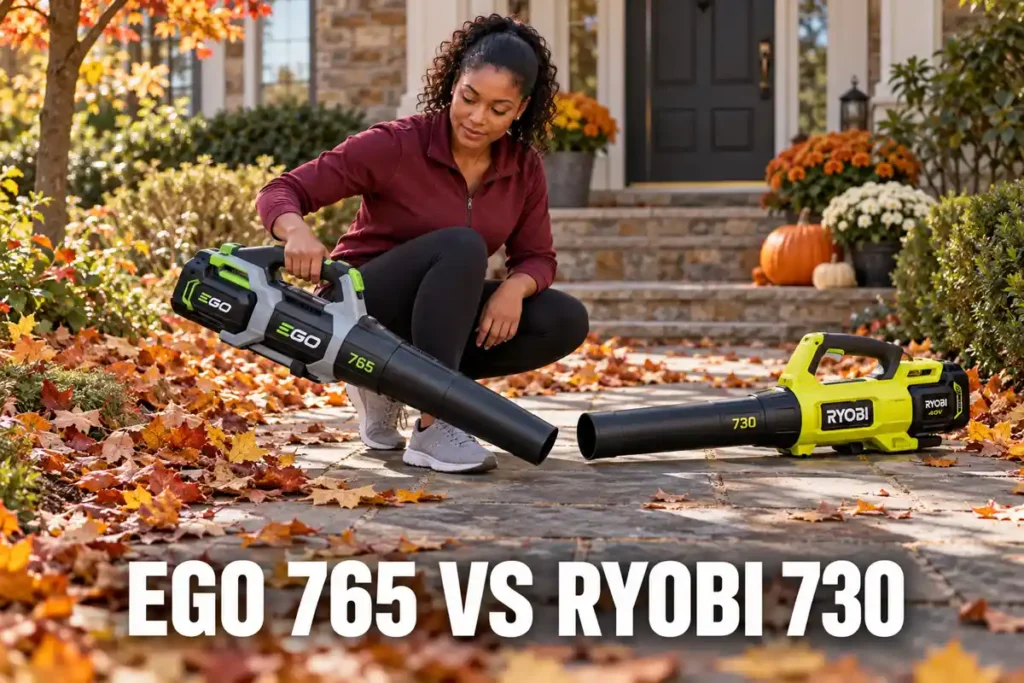
The EGO 765 vs Ryobi 730 decision turns on the box and the battery more than on the 35 CFM between them. I pick the EGO LB7654 for most yards, because its supplied pack gives more force and more minutes, and the Ryobi wins for anyone who already owns 40V batteries and clears dry lawn and drive. I judge a blower by the work one charge finishes: on the crushed-stone yard behind my machinery shed, the EGO’s pack carried me to the last corner, and the Ryobi’s left me finishing the job after a battery swap. Below I compare what each box holds, force, runtime, weight, noise and the battery system.
Affiliate Disclosure: Garden Power Scout is a proud participant in the Amazon Services LLC Associates Program. As an Amazon Associate, we earn from qualifying purchases, at no extra cost to you.
EGO 765 vs Ryobi 730: My Short Answer
Buy the EGO LB7654 if the leaves are wet, the yard runs past a quarter acre, or you want one box that works the day it arrives. The Ryobi is the better buy if your shed already holds 40V packs and the work is light. This article compares the EGO LB7654 kit with the Ryobi 40V HP Whisper Series leaf blower rated at 730 CFM and sold as the RY404010. Ryobi sells two other Whisper Series blowers, at 650 and 800 CFM, and neither one is in the table.
| Spec | EGO LB7654 kit | Ryobi RY404010 (tool only) |
|---|---|---|
| In the box | Blower, one 5.0 Ah battery, charger, tapered and spread nozzles | Blower, tube and speed tips; no battery and no charger |
| Peak airflow, maker’s figure | 765 CFM on boost | 730 CFM on turbo |
| Air speed, maker’s figure | 195 mph with the tapered nozzle | Up to 190 mph with a speed tip |
| Force on high | About 16 N | About 11 N |
| Force on turbo | About 25 N | About 20 N |
| Runtime on high | About 22 min | About 15 min |
| Runtime on turbo | About 13 min | About 11 min |
| Weight, tool only | 4.6 lb | About 6.5 lb |
| Weight with one battery | About 9.6 lb | About 9.7 lb with the 4.0 Ah pack |
| Noise figure on the box | None printed | 57 dB, with no distance given |
| Controls | Variable trigger, locking speed dial, held boost button | Variable trigger, turbo button, cruise control |
Two rows decide it: force, where the EGO leads by about 5 N on both high and turbo, and runtime, where the EGO runs about 7 minutes longer on high.
What Comes in Each Box
The EGO LB7654 vs Ryobi 40V HP Whisper comparison starts with the cardboard, because the two are not sold the same way: EGO’s figures come with the 5.0 Ah pack in its kit, and the Ryobi on Amazon comes with no battery at all.
The EGO LB7654 Kit
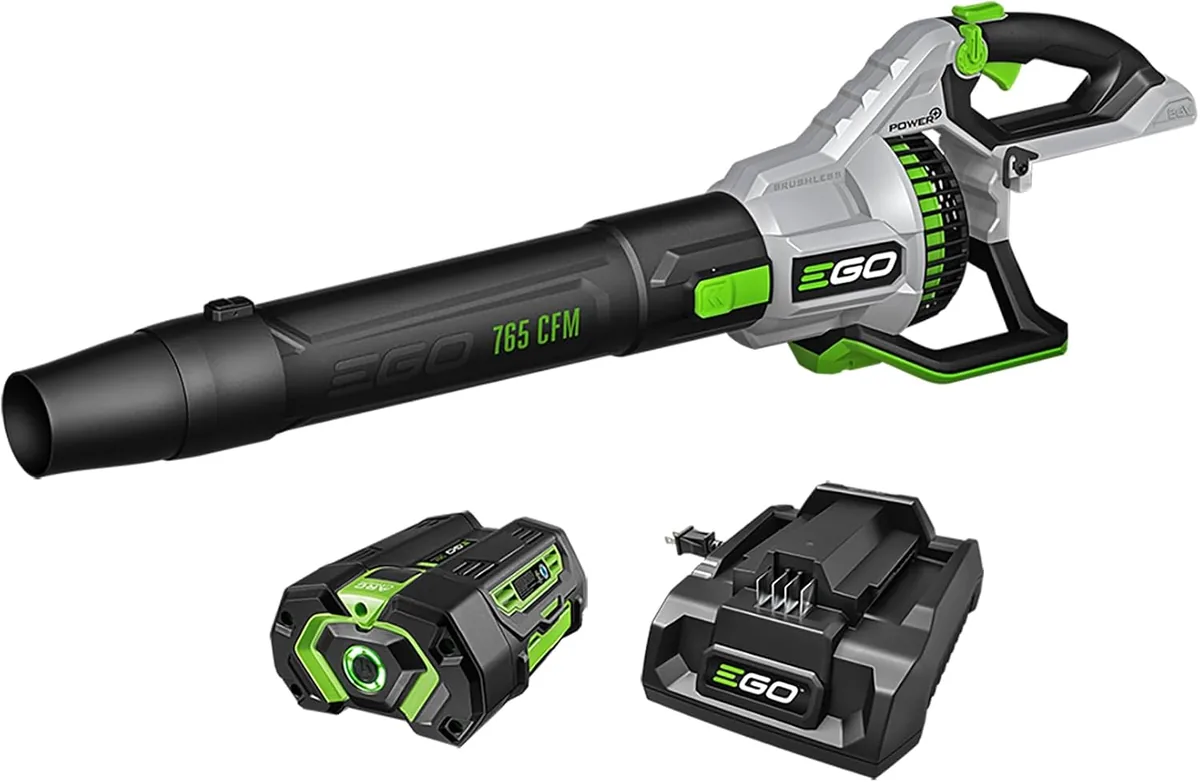
The EGO Power+ LB7654 765 CFM Blower Kit is a complete kit: the LB7650 blower, one 5.0 Ah battery with a fuel gauge, a 320 W charger, a tapered nozzle and a spread nozzle. EGO’s manual also lists a shoulder strap. I charge the pack, clip it on and start work the same afternoon.
The Ryobi 730 Tool Only
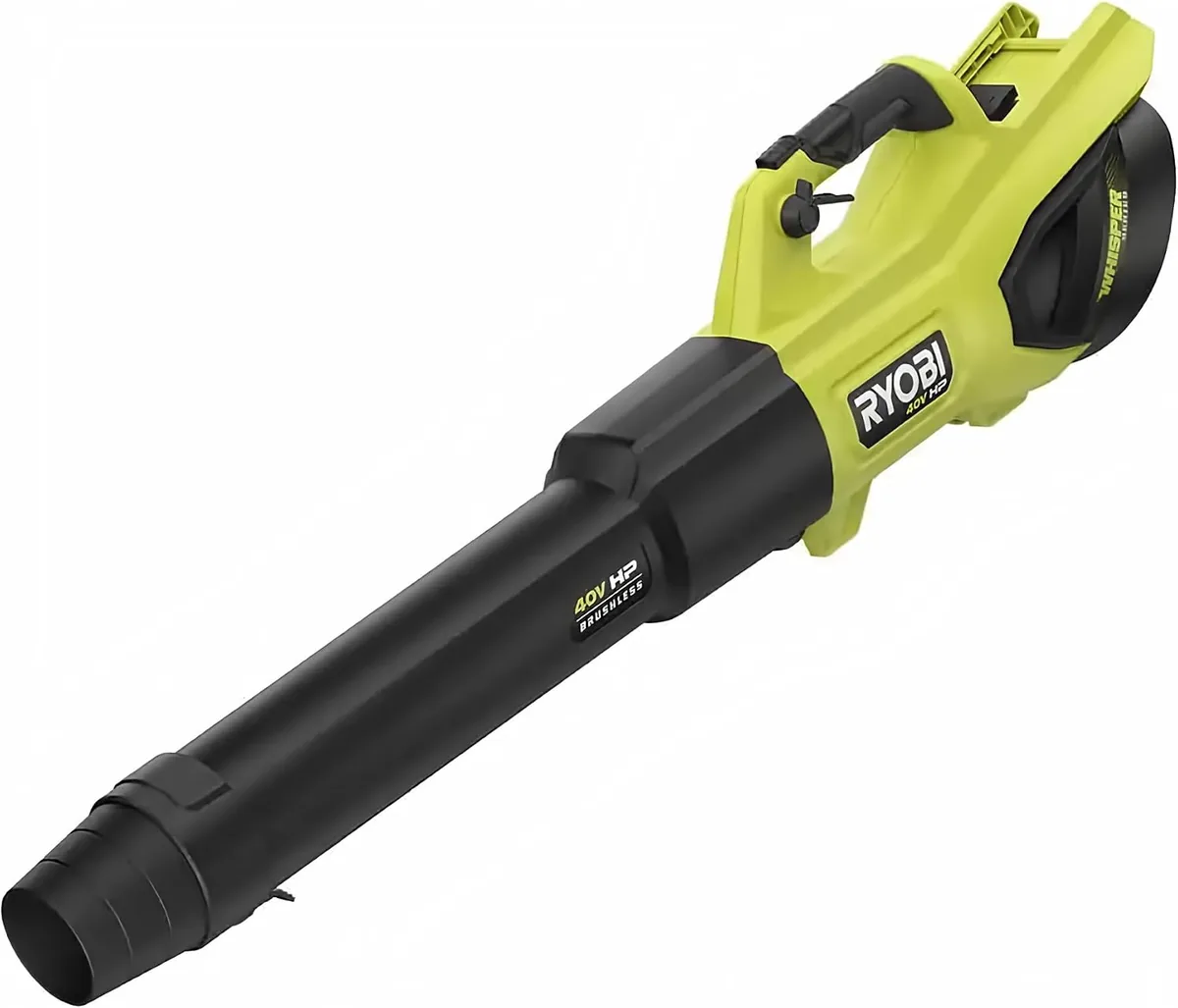
The Ryobi 40V HP Whisper Series 730 CFM Blower (Tool Only) on Amazon is the bare tool, so a battery and a charger are separate. That makes it the lowest way in for someone who already owns 40V Ryobi packs, and an unpleasant surprise for a first-time buyer. The box that matches the EGO kit is Ryobi’s two-battery kit, with two 4.0 Ah packs and a charger, and I treat that as the like-for-like box for the Ryobi 730 CFM blower.
Cost of entry follows the box. The Ryobi tool alone sits at the budget end, and the EGO kit is mid-range. Once the Ryobi has two batteries and a charger, both land in mid-range, so compare kit with kit, or tool with tool, never the Ryobi tool with the EGO kit.
Winner: EGO LB7654, because it works out of the box; the Ryobi wins only for a buyer who already owns 40V packs.
Airflow, Air Speed and Blowing Force
The EGO moves 765 CFM on boost and the Ryobi 730 CFM on turbo, a gap of about 5 percent. Air speed is just as close, at 195 mph on the EGO’s tapered nozzle and up to 190 mph on the Ryobi with a speed tip. The spec sheets tie. Force is where the two blowers separate.
Force is the push you feel against wet leaves and stones, measured in newtons, and one newton is roughly a fifth of a pound of push. On turbo the EGO pushes about 25 N and the Ryobi about 20 N. On high, the setting you use most, it is about 16 N against 11 N, so the EGO is about 40 percent stronger where the work happens.
On the packed strip along my hedgerow, where wet plum leaves stick to the soil, the Ryobi on high only slid the top layer. I had to go to turbo to lift the edge, and turbo is where its pack lasts about 11 minutes. The EGO moved the same strip on high in a couple of passes.
For dry leaves on a lawn or a swept drive, 11 N is enough, and the Ryobi does that job without complaint.
Winner: EGO LB7654, because it pushes about 5 N harder on both high and turbo.
Battery, Runtime and Charging
On a full charge, the EGO ran about 22 minutes on high and about 13 on turbo, and the Ryobi ran about 15 on high and about 11 on turbo. That puts the EGO about 7 minutes ahead where you spend most of your time, and the Ryobi’s turbo burst is the shortest number in the table.
EGO’s manual lists 150 minutes on low, 25 on high and 15 on boost. Ryobi’s claim of 2 hours uses two 4.0 Ah packs at a low setting of about 300 CFM, so those figures describe different settings and different pack counts, and I compare minutes on high.
I plan a leaf session in minutes. Two hours of blowing on high takes five or six EGO packs and more Ryobi batteries than that, so for a job that long I plan around a second pack and the breaks while one charges.
EGO lists about 70 minutes to charge its pack on the supplied charger, and Ryobi publishes no charge time for its pack. How you store the pack matters as much as how you charge it. Depth of discharge and the charge window both change how much capacity a lithium-ion cell loses (1), and a model of 36 months in storage at 55 C and 90 percent charge showed heavy degradation (2). EGO’s battery manual puts the best storage range at 50 to 80 F, and I keep packs of both brands inside, never in a hot truck cab.
Winner: EGO LB7654, because one full charge runs about 7 minutes longer on high and about 2 longer on turbo.
EGO 56V vs Ryobi 40V: Which Battery System to Join
A cordless blower is a battery system with a fan on it, so the packs you already own often decide. According to EGO’s manual, the LB7650 takes EGO’s 56V ARC batteries, the same family that runs EGO’s other yard tools. Ryobi says any Ryobi 40V battery powers every 40V tool, and the 40V HP tools sit inside that same system.
If your shed holds Ryobi 40V tools, buy the Ryobi as a bare tool and spend nothing on a charger. If it holds EGO 56V tools, the LB7650 tool alone fits your packs. If you own neither, the platform matters more than this one blower, so look at the mower, trimmer and saw you will want over the next three seasons.
Winner: neither, because the battery you already own decides.
Weight, Balance and Controls
The bare tools differ: the EGO weighs 4.6 lb and the Ryobi about 6.5 lb. Add a battery and the gap closes, to about 9.6 lb for the EGO with its 5.0 Ah pack and about 9.7 lb for the Ryobi with a 4.0 Ah pack. When I pick up the bare Ryobi after the bare EGO, the 2 lb difference is easy to feel, and it disappears once both packs are clipped on. On the EGO, more than half of the weight is the pack, and it sits behind the grip, so the tube end stays light when I swing it along the alley edge.
Vibration is a separate load from weight. A study of groundskeepers found a lifetime hand-arm vibration dose 33 times that of office workers on the right hand, with handheld blowers measured at about 1.9 m/s2 (3). Those workers used other blowers than these two, so I take it as a reason to rest my hands between passes.
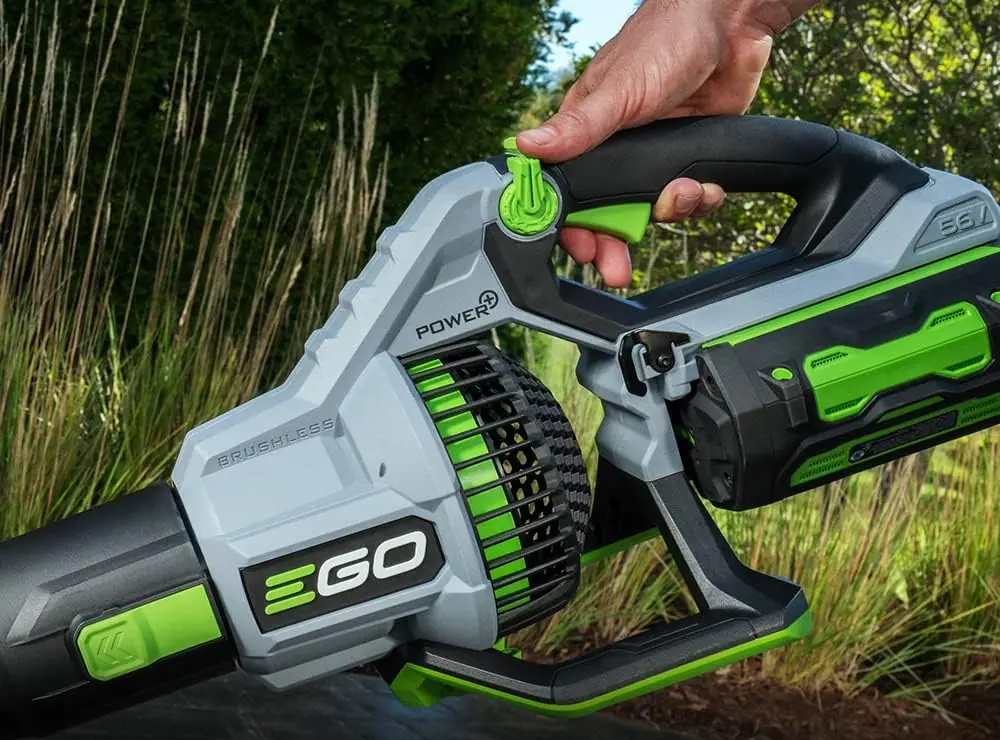
Both blowers have a variable trigger and a way to hold a speed. The EGO’s dial locks any setting, and its boost button works only while you hold it. The Ryobi adds a turbo button and cruise control, with a range of about 250 to 550 CFM. The first time I swapped a pack with the EGO dial left on, the blower would not start until I pulled the trigger once, a protection feature that looks like a fault.
On the Ryobi I set cruise control and walked the length of the house lawn with my hand relaxed on the grip, which is the job that feature is for.
Winner: tie, because weight with a battery is equal and the locking dial and the cruise control do the same job.
Noise and Hearing Protection
Ryobi prints 57 dB for this blower with no distance and no mode, and EGO prints no figure at all. A decibel rating without a distance says little. A field test of two leaf blowers and a hose vacuum running together measured about 102 dB(A) close to the machines and about 57 dB(A) at 800 feet (4). Neither maker’s number is the level at your ear, and I name no winner on them.
Studies show where the real exposure sits. About 77 percent of groundskeeper shift averages by the NIOSH method exceeded 85 dBA (5), and sampling of landscaping workers found more noise with fuel-powered leaf blowers than with battery ones (6).
I hear the Ryobi’s pitch first, a higher whine than the EGO’s lower rush. Both are loud enough that I put my muffs on at the shed door, not at the first leaf. A Cochrane review notes that a poor fit may limit protection for about 40 percent of earplug users (7), so press foam plugs in until they seal, or wear muffs.
Protect Eyes and Ears
Wear ANSI Z87.1 eye protection and hearing protection every time. Keep bystanders and pets well back, and never aim the stream at people, windows or cars.
Winner: none, because neither figure is an ear-level reading.
Which Yard Needs Which Blower
Three yard types cover most buyers.
- Small lawn, dry leaves, a swept drive: either blower works, and the Ryobi is the cheaper way in if you own 40V packs.
- A quarter to half acre, wet leaves or gravel edges: the EGO, because force and minutes on high both count.
- Orchard strips and acreage: neither, on one pack. Plan the work in minutes, buy a second pack, or use a gas backpack.
My orchard shows the third case. A thick mat of plum leaves under the first row takes more high-speed minutes than either pack holds, so I split the work: house lawn and yard one day, the strips another. The Ryobi 800 CFM model is a different, larger blower and sits outside this comparison.
Choose the EGO LB7654 If
Choose the EGO LB7654 if you want the extra push and a complete kit.
- The leaves sit wet and matted under trees, or the debris is heavy.
- You want one box with a battery and a charger inside it.
- You own EGO 56V tools, so the pack does double duty.
Skip it if your jobs run far past one pack, since 22 minutes on high ends and the recharge takes about 70 minutes, or if you already own Ryobi 40V packs and clear only dry leaves.
The pack’s fuel gauge is what I watch on the strip beside the orchard rows. It tells me whether to start the next stretch or turn back to the shed with the battery still above empty.
Choose the Ryobi 730 If
Choose the Ryobi 730 if you already own Ryobi 40V batteries and the work is light.
- Your shed has 40V packs, so the bare tool is all you pay for.
- Your jobs are dry leaves, clippings and a swept drive or deck.
- You like a cruise-control trigger for long sweeps.
Skip it if you clear wet, matted leaves for long stretches, since 11 N on high only slides the top layer and turbo, which lifts the edge, lasts about 11 minutes, or if you want one box with a battery in it.
I reach for it before the first spring mow, to clear twigs and seed pods off the house lawn at a low cruise setting. That is a light, dry job, and one battery covers it with minutes left.
My Pick in the EGO 765 vs Ryobi 730 Choice
I pick the EGO LB7654 for most yards. It weighs the same as the Ryobi with a battery fitted and adds about 5 N of force and about 7 minutes on high from one full charge. The Ryobi is the right choice for a 40V owner with a small, dry yard and a bare tool to buy.
My leaf blower guides cover the wider range of blowers. My verdict on the EGO 765 vs Ryobi 730 is to take the EGO LB7654 for wet or heavy leaves, a yard past a quarter acre or a first cordless blower, and to take the Ryobi 730 only if you already own 40V packs and clear dry leaves from a small lawn or drive, while a full acreage needs more than either one on a single pack.
Frequently Asked Questions
Which brand is better, Ego or Ryobi?
For these two models, EGO is the better brand: the LB7654 pushes about 25 N on turbo against about 20 N for the Ryobi 730, and it runs longer on one pack. Ryobi is the better choice if you already own 40V batteries and your jobs are light, dry lawn and drive work.
Are Ryobi 40V and 40V HP interchangeable?
Ryobi 40V and 40V HP tools are interchangeable, because Ryobi says any Ryobi 40V battery powers every 40V tool, HP tools included. Ryobi does not state how an HP tool performs on a standard battery pack, so check which pack your kit ships with before you buy any battery separately.
What are some common issues with RYOBI leaf blowers?
The common issues with the Ryobi 730 leaf blower are a short turbo burst of about 11 minutes, a tool-only box that needs a separate battery and charger, and a higher-pitched sound. Check the box before you buy, and plan a second pack for any yard that takes more than 15 minutes on high.
Which RYOBI cordless leaf blower is the best?
The best Ryobi cordless leaf blower in this comparison is the 730 CFM Whisper Series, which sits above the 650 CFM model and below the newer 800 CFM blower. It gives most yards enough air, but it trails the EGO LB7654 on both force and runtime from one battery pack.
Which EGO blower is considered the best?
The EGO blower that suits most yards best is the 765 CFM LB7654, which sits above the 670 and 650 CFM models and below the 880 CFM LB8803. It ships with a 5.0 Ah pack and a charger, and so it works the day it arrives for a buyer who owns no other cordless tools.
References
- Gauthier R, Luscombe A, Bond T, et al. How do Depth of Discharge, C-rate and Calendar Age Affect Capacity Retention, Impedance Growth, the Electrodes, and the Electrolyte in Li-Ion Cells?. J. Electrochem. Soc. 2022;169(2):020518.
- Asiri M, Kedhim M, Jain V, et al. Impact of temperature and state-of-charge on long-term storage degradation in lithium-ion batteries: an integrated P2D-based degradation analysis. RSC Adv. 2025;15(28):22576-22586.
- Chen N, Yang S, Oh J. Evaluation of hand-arm vibration (HAV) exposure among groundskeepers in the southeastern United States. Annals of Work Exposures and Health. 2025;69(1):81-95.
- Walker E, Banks JL. Characteristics of Lawn and Garden Equipment Sound: A Community Pilot Study. J Environ Toxicol Stud. 2017;1(1).
- Balanay JAG, Kearney GD, Mannarino AJ. Assessment of Occupational Noise Exposure among Groundskeepers in North Carolina Public Universities. Environ Health Insights. 2016;10:EHI.S39682.
- Alexander BM, Graydon PS, Pena M, Feng HA, Beamer BR. Hazardous exposures and engineering controls in the landscaping services industry. Journal of Occupational and Environmental Hygiene. 2025;22(3):189-202.
- Morata TC, Gong W, Tikka C, Samelli AG, Verbeek JH. Hearing protection field attenuation estimation systems and associated training for reducing workers’ exposure to noise. Cochrane Database of Systematic Reviews. 2024;5(5):CD015066.
Safety Note: Leaf blowers throw debris and can damage your hearing. Wear eye and ear protection, read the manufacturer’s manual, and check your local rules on noise and operating hours.