
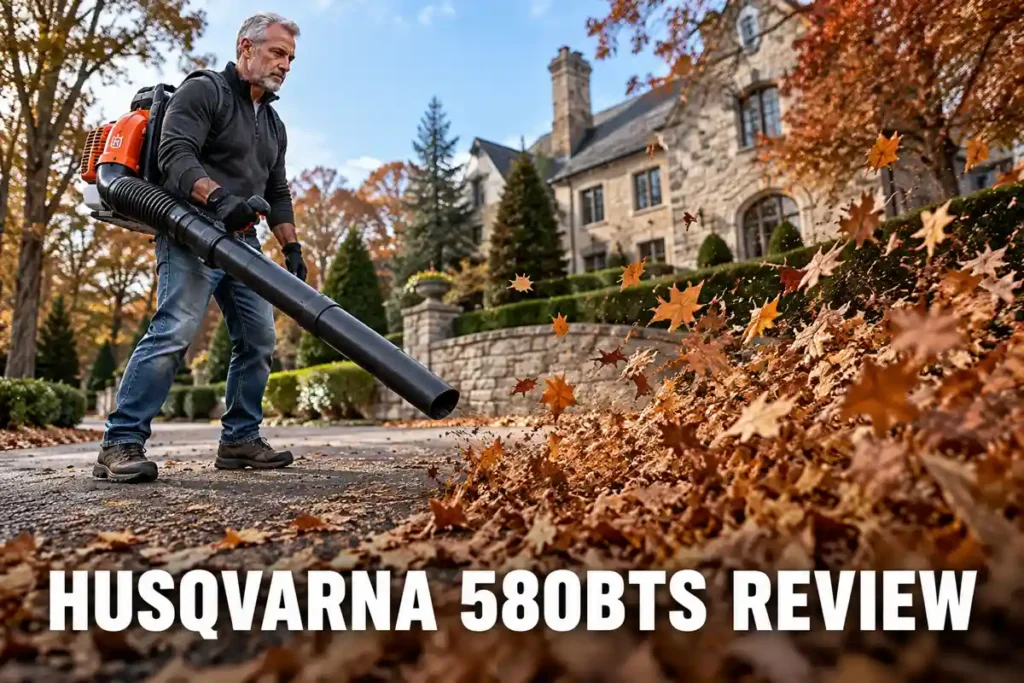
This Husqvarna 580BTS review has a short answer: buy the 47 N gas backpack blower for an acre or more of leaves and debris, and skip it for a small lot. I have run it through leaf fall on my 3.7-acre orchard, the gravel yard and the lawn around the house, and I judge a backpack blower by how the load feels when the second tank runs low. The price is about 31 lb on your back, 106 dB(A) at the ear and a pull cord.
Affiliate Disclosure: Garden Power Scout is a proud participant in the Amazon Services LLC Associates Program. As an Amazon Associate, we earn from qualifying purchases, at no extra cost to you.
Husqvarna 580BTS Review: My Verdict in Brief
The Husqvarna 580BTS Mark III Gas Backpack Leaf Blower is the gas backpack I reach for when the job is an acre of leaf fall or a yard full of storm debris. According to Husqvarna it delivers 47 N of blowing force and 1,000 CFM from a 75.6 cc two-stroke, and the throttle sits in a handle on the tube, so one hand sets the speed and aims the air. You pay in weight, noise and fuel, and the hip belt softens only the first.
- Who it is for: owners of an acre or more with mature trees or storm debris to clear.
- What it does best: pushes wet leaf mats and loose debris down a long alley.
- Main trade-off: about 31 lb fueled, 106 dB(A) at the ear and a pull cord for every restart.
What the Husqvarna 580BTS Backpack Blower Is and What Comes in the Box
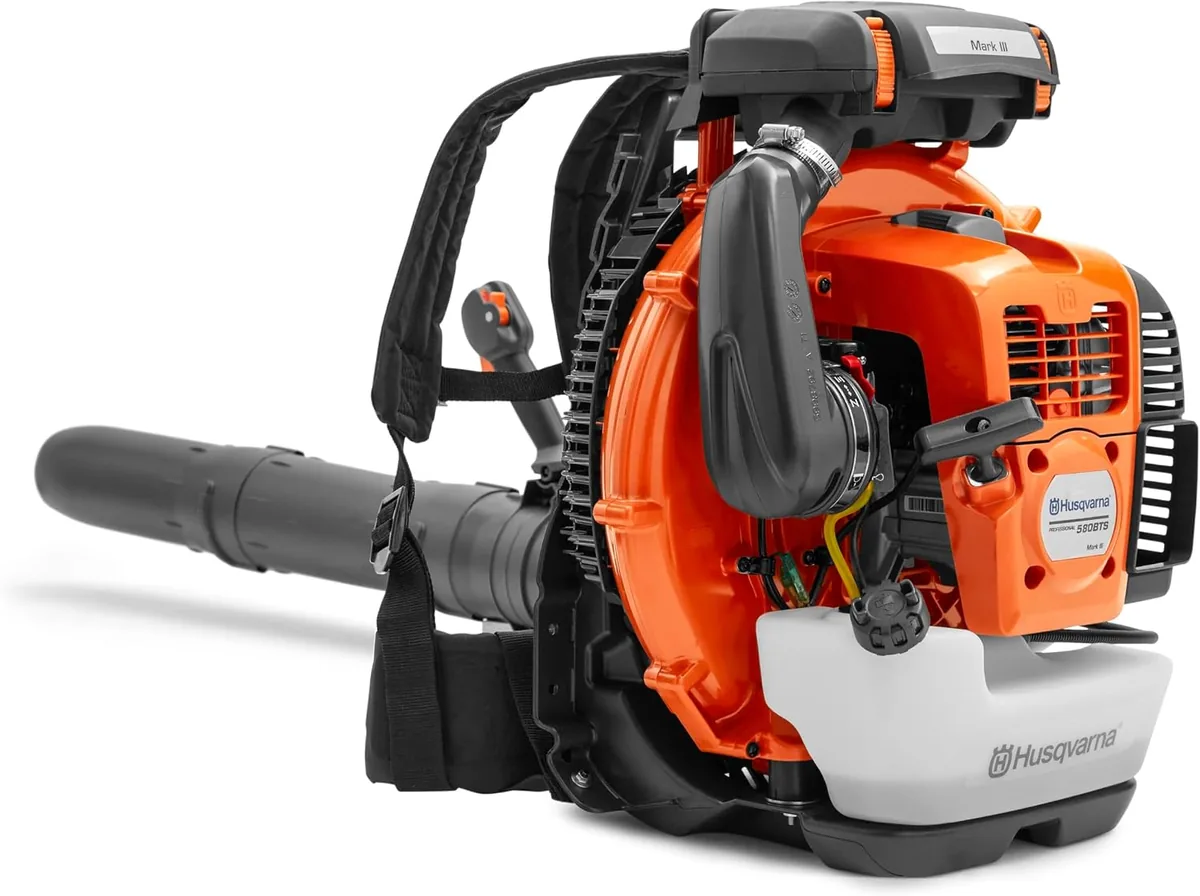
The Husqvarna 580BTS backpack blower is the middle model in Husqvarna’s tube-throttle line, between the 570BTS and the 590BTS. In this line a BTS has its throttle in a handle on the tube, run with the right hand.
Under the orange cover sits a 75.6 cc air-cooled X-TORQ two-stroke rated at 4.6 hp. According to the operator’s manual, the box holds the frame with harness, the engine, a flexible hose, the control pipe, the intermediate pipe, one round standard nozzle, the manual and a combination wrench. Fuel, oil, a mixing bottle and protective gear are all extra, and no vacuum kit exists for this model.
Husqvarna 580BTS Mark III: Which Version You Are Buying
Every figure in this review belongs to the Mark III, the version the Husqvarna US page marks MKIII, the 2025 operator’s manual covers (article number 970 49 91-01) and the Amazon listing calls the 580BTS III. Older pages quote lower numbers that belong to the earlier Husqvarna 580BTS Mark II.
Husqvarna 580BTS Specs at a Glance
Weight and sound level are what you pay for 47 N.
| Spec | Figure |
|---|---|
| Engine | 75.6 cc air-cooled two-stroke, 4.6 hp |
| Airflow | 1,000 CFM at the round nozzle (1,200 CFM in the housing) |
| Air speed | 220 mph at the round nozzle |
| Blowing force | 47 N maximum (Husqvarna figure) |
| Fuel tank | 2.6 L (87.92 fl oz) |
| Dry weight | 26.8 lb without fuel, about 31 lb with a full tank |
| Sound at the ear | 106 dB(A) (Husqvarna figure) |
| Fuel | 50:1 mix, 90 RON (87 AKI) minimum, up to E10 |
| Spark plug | NGK CMR7H, gap 0.6 to 0.7 mm |
Setup, Fuel Mix and Starting
The hose, the control pipe, the intermediate pipe and the round nozzle clamp together, the handle goes on the control pipe with a knob, and a clamp holds the cable to the hose. Fit the harness before the first start with the waist belt snug and the chest strap closed, because the manual warns that an open belt can swing into the fan.
Each tank needs the Husqvarna 580BTS fuel mixture of 50:1, which means 2 1/2 fl oz of two-stroke oil per US gallon of gasoline. According to the manual, use fresh unleaded gasoline of at least 90 RON (87 AKI) with no more than 10 percent ethanol, and oil made for air-cooled engines, never outboard or four-stroke oil. Mix no more than 30 days of fuel at a time.
I fill the tank to 80 percent at the machinery shed, 100 to 150 ft from the nearest row, with the engine cool, and walk at least 10 ft from the fueling spot before I start. The exhaust carries carbon monoxide, and NIOSH sampling of landscaping workers found significantly more carbon monoxide and noise with fuel-powered blowers than with battery ones (1). Never run it in a closed shed. A cold start follows these steps:
- Set the unit on flat ground, close the choke and press the purge bulb until fuel fills it.
- Set the throttle to one-third and hold the unit with your left hand.
- Pull the rope slowly to resistance, then quickly, up to 10 pulls, and never to full extension.
- When it runs, open the choke gradually and let it warm up for 2 to 3 minutes.
Controls and Harness
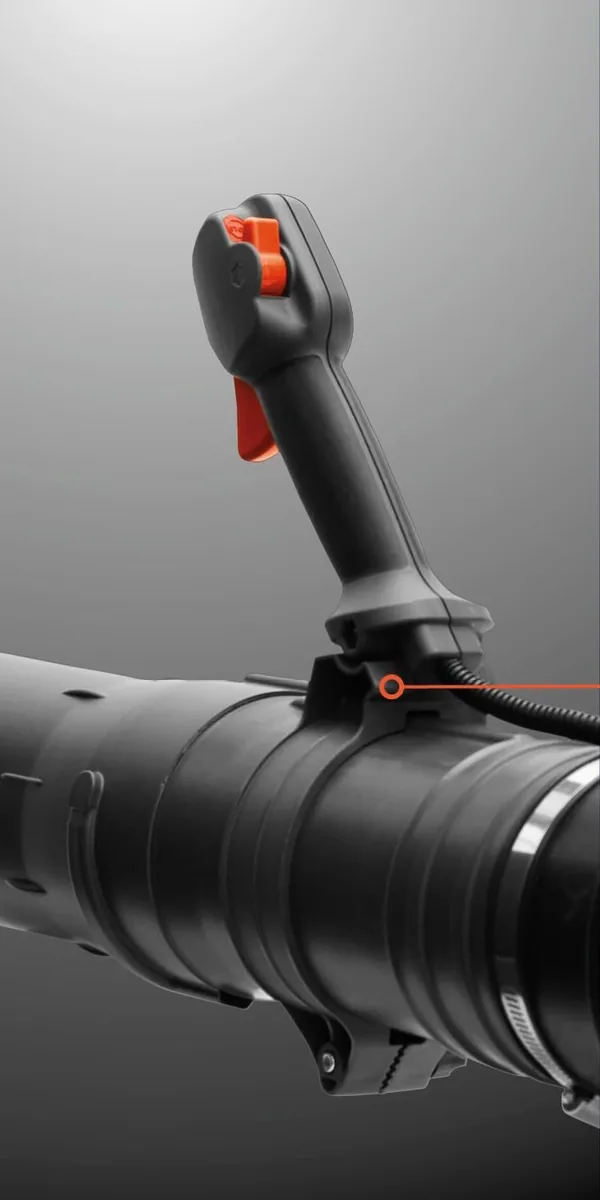
The throttle lever sits in a handle on the tube, so the right hand sets speed and aim together. It has four positions, full, one-third, idle and stop, and the manual says to never stop the engine from full speed. Husqvarna’s page also lists a cruise control option for holding a throttle position, which suits a long alley. I ease the lever back to idle before I reach for the stop.
Husqvarna 580BFS vs 580BTS: Which Throttle Layout Suits You
The 580BFS Mark III shares the engine, tank, airflow and air speed, so the choice comes down to where the throttle sits. The BTS carries the throttle handle on the blower tube, under the right hand, while the frame-mount BFS puts it on the frame at the hip. The BFS also weighs 27.1 lb dry against 26.8 lb and has a bolted-on handle and a stop switch. For the alleys I want speed and aim in the same hand, so the BTS suits my work better.
Performance on Leaves, Debris and Gravel
At 1,000 CFM from the round nozzle, the Husqvarna 580BTS leaf blower rolls a leaf mat over as one sheet. The manual’s advice is most of the technique: hold the nozzle close to the ground, use the lowest throttle that works and work with the wind.
Leaf Mats and Wet Piles
Dry plum leaves on the concrete pad in front of the machinery shed leave at one-third throttle. The wet mat in the shaded corner needs full throttle and a low sweep under its leading edge. I do not use the blower to move a big pile, since the manual calls that slow and noisy.
Gravel, Stones and Tender Ground
On the gravel by the machinery shed, even half throttle sent stones rattling against the shed door. The manual says to keep people, windows and cars out of the line of the air and bystanders 15 m (about 49 ft) away, so I look around before the throttle opens. A low nozzle angle and a lower throttle then keep the stones near the ground. Beside the vegetable plot I drop to one-third, because full power strips the mulch off the paths.
Fuel Use and Run Time per Tank
According to Husqvarna, the engine burns 464 g of fuel per kWh, which at 4.6 hp works out to about 72 fl oz an hour at full power. Filled to the manual’s 80 percent, the Husqvarna 580BTS gas backpack blower holds about 70 fl oz, so full throttle empties the tank in about an hour and part throttle stretches that.
Noise, Weight and Comfort
A gas backpack charges for its power in noise and weight.
Noise and Hearing Protection
According to Husqvarna, sound pressure at the operator’s ear is 106 dB(A). The company prints no 50 ft rating, so the figure reads higher than ratings taken at the longer distance. In a study of agricultural backpack machines, noise topped 100 dB(A) for every unit but one blower with its exhaust inside the hose (2), so the Husqvarna sits in ordinary company.
From the first minute I wear foam plugs under earmuffs, every time, because 106 dB(A) at the ear calls for both. Fit decides the protection, since a Cochrane review notes that poor earplug fit may limit it for about 40 percent of users (3).
Weight and Harness Fit
Without fuel the Husqvarna 580BTS weight is 26.8 lb, and a full tank adds about 4 lb, so you carry about 31 lb. Husqvarna says the padded hip belt moves load to the hips. A load-carriage study found that strap force and contact pressure at the shoulders and hips predicted the discomfort carriers reported (4), so strap fit is worth ten minutes before the first tank.
I tighten the shoulder straps first and the hip belt last, and the weight then rides on my hips. After an hour I notice the heat under the harness, not my shoulders.
Hand Vibration
Husqvarna prints no hand vibration figure here. Field measurements on backpack blowers ran from about 1.7 to 2.9 m/s2, and the authors estimated that more than five hours a day could pass the EU action value (5). Take breaks, keep a loose grip and wear gloves.
Maintenance and Storage
For a machine that works a few weeks a year, the Husqvarna 580BTS manual sets a frequent schedule.
- Daily: check that the throttle handle and the stop control work, look for fuel leaks, clean the air filter and clear the air intake.
- Weekly: brush the cooling fins and the intake screen, check the rope, the dampers and the plug, and clean the spark arrester screen.
- Monthly: clean the fuel tank, check the cables and replace the Husqvarna 580BTS spark plug, an NGK CMR7H.
After one dusty morning at the machinery shed I found the intake screen furred with chaff. A clogged intake cuts blowing force and heats the engine, the manual says, so I brush it at every refill. The Husqvarna 580BTS air filter has two stages, foam and paper: wash the foam in warm soapy water, dry it fully and replace the paper.
For storage, empty the tank, press the purge bulb to clear the fuel, put about 15 ml of two-stroke oil in the cylinder, turn the engine over three times and store it upright and dry.
Common Problems and Limits
- Weak air and a hot engine: a blocked intake screen or dirty cooling fins. Brush both first.
- Hard starting or a rough idle: check the idle speed, the mix and the air filter, then clean the plug.
- Stale fuel or carburetor trouble: mix older than 30 days is the first suspect when the engine bogs, and carburetor work belongs with a Husqvarna dealer.
Who Should Buy It and Who Should Skip It
The 580BTS pays off on big ground and loses its point on a small lot.
Buy It If
- You clear an acre or more, or a yard with many mature trees.
- You face wet leaf mats, storm debris or long alleys between rows.
- You already mix two-stroke fuel and want a hip belt in the box.
Skip It If
- Your lot is under half an acre or is a townhouse yard.
- You dislike mixing fuel or pulling a starter rope, since there is no start button.
- Your back objects to about 31 lb, even with a hip belt.
Drawbacks to Know About
- Fuel and restarts: an 87.92 fl oz tank to refill, an exact 50:1 mix and a pull cord for every restart.
- Warranty fine print: the warranty statement sets the term and the use class, homeowner or professional, and according to Husqvarna a dealer examines a claim. On a working orchard like mine, the question is whether the work counts as professional use.
How It Compares With Alternatives
Two more gas backpack names come up often: the Husqvarna 590BTS, a step above at 56 N with a start button, and Stihl’s BR 800 C-E at 41 N and 912 CFM according to Stihl. For battery blowers, see my leaf blower guides.
| Model | Engine | Airflow | Air speed |
|---|---|---|---|
| Husqvarna 580BTS | 75.6 cc | 1,000 CFM | 220 mph |
| ECHO PB-9010T | 79.9 cc | 1,110 CFM | 220 mph |
| Husqvarna 570BTS | 65.6 cc | 768 CFM | 236 mph |
| ECHO PB-770T | 63.3 cc | 756 CFM | 234 mph |
ECHO PB-9010T
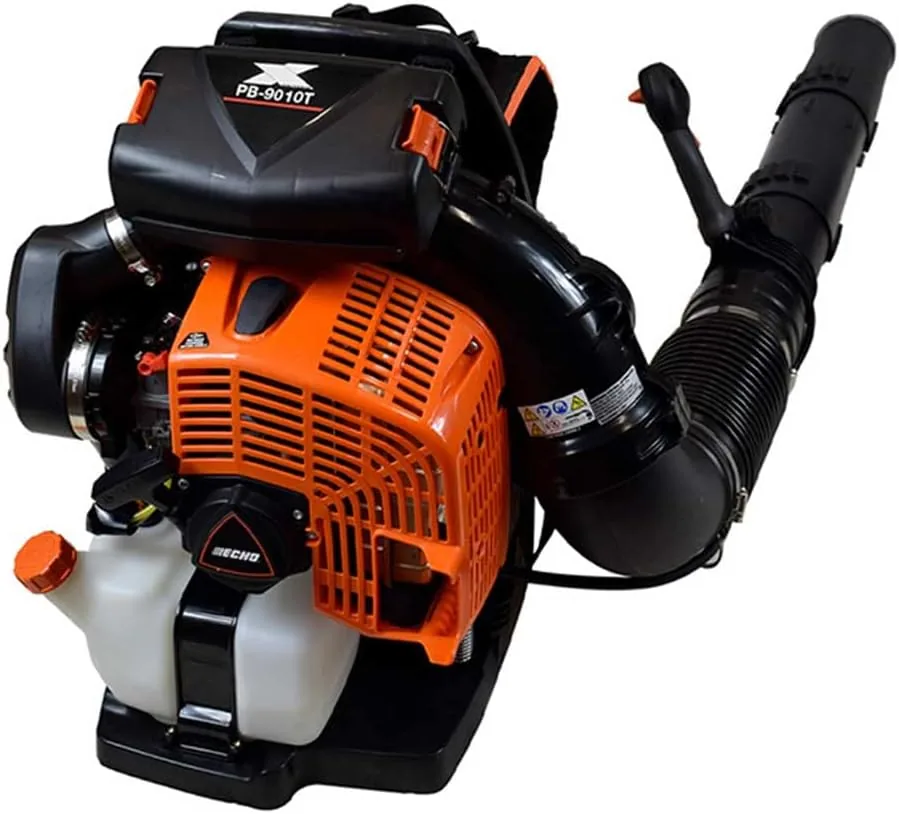
According to ECHO, the ECHO PB-9010T Gas Backpack Leaf Blower is rated at 48 N and 1,110 CFM from a 79.9 cc engine, a little more push than the Husqvarna. Its US build has shoulder straps only, with no hip belt. Pick it if airflow matters more than load on your hips.
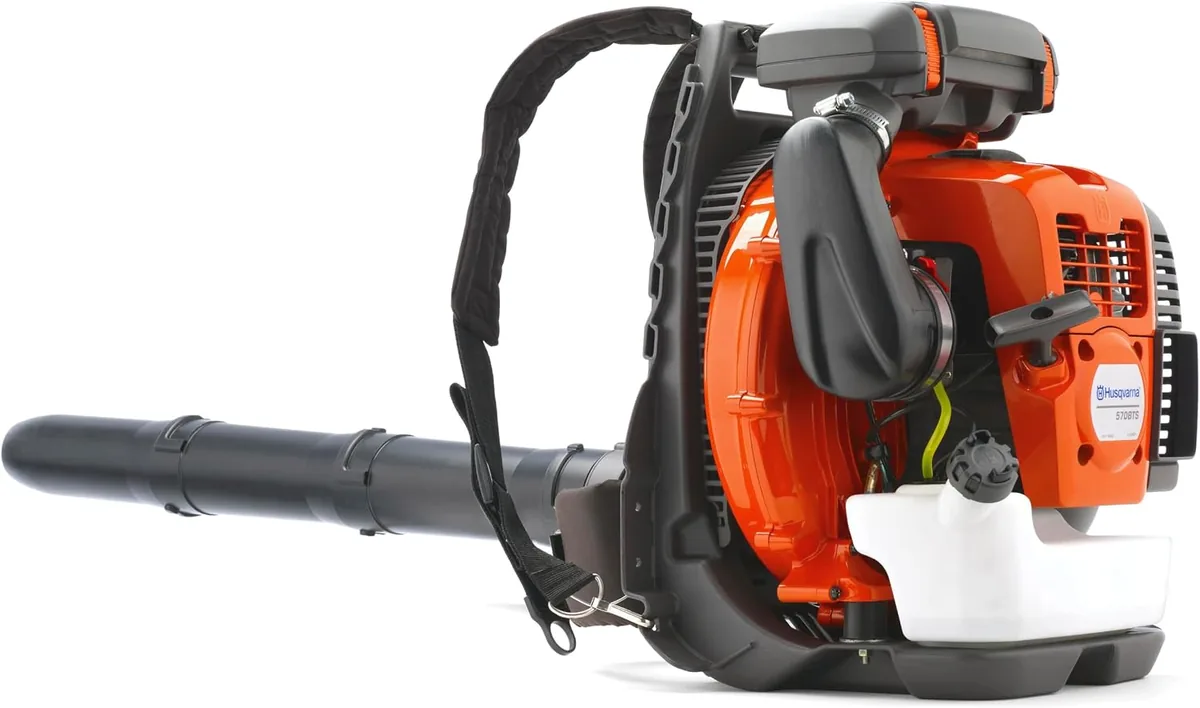
Husqvarna 570BTS
According to Husqvarna, the Husqvarna 570BTS Gas Backpack Leaf Blower gives 37 N and 768 CFM from a 65.6 cc engine at 24.7 lb dry, about 2 lb lighter than the 580BTS. Step down to it if you clear less than an acre of mostly dry leaves.
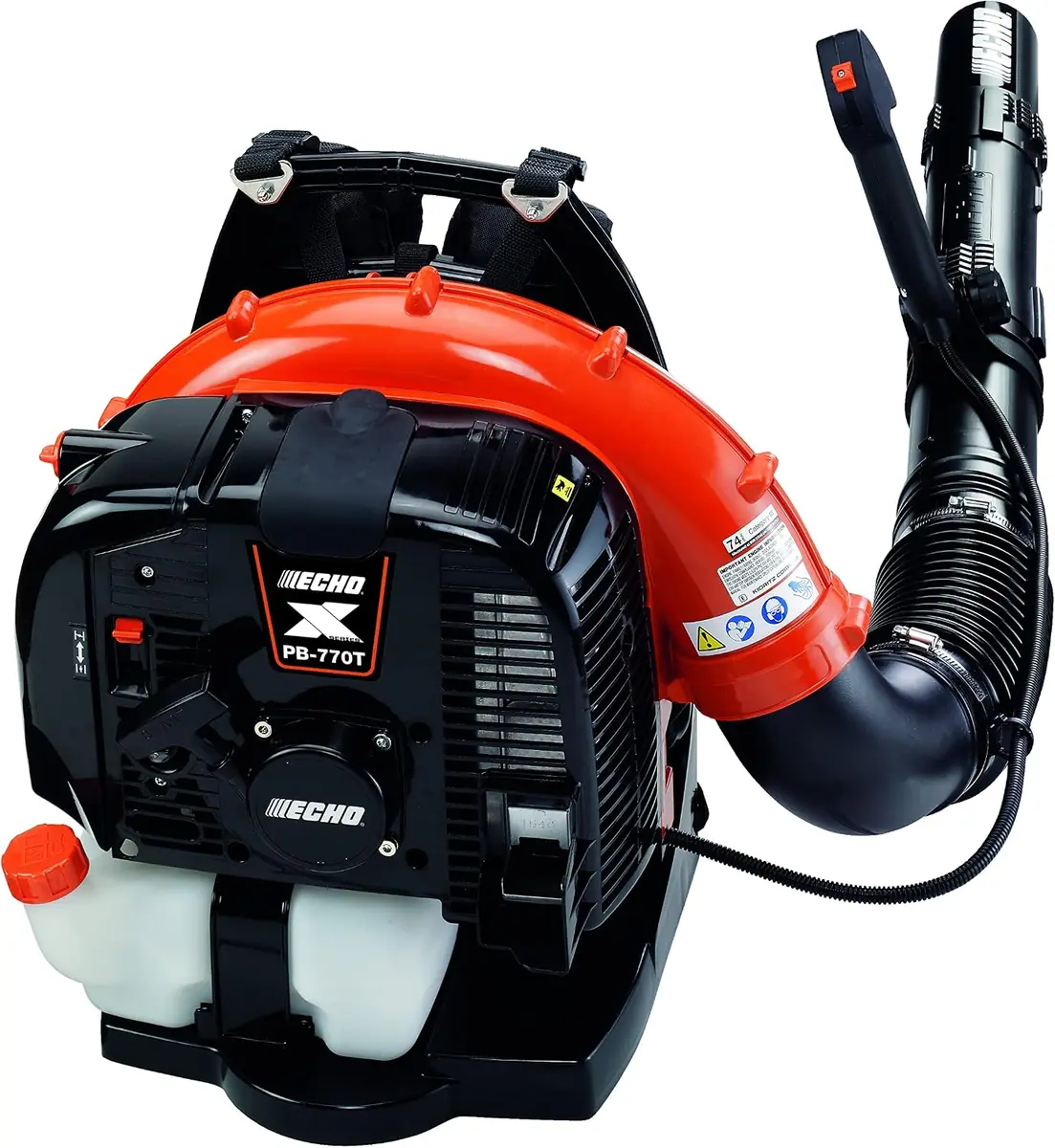
ECHO PB-770T
According to ECHO, the ECHO PB-770T Gas Backpack Leaf Blower runs a 63.3 cc engine for 756 CFM and 234 mph. Pick it for a quarter to one acre, where the 580BTS is more blower than you need.
Is the Husqvarna 580BTS Worth Buying?
It is worth buying if your ground matches its size. On an acre of mature trees or a yard of storm debris, 47 N, 1,000 CFM and an 87.92 fl oz tank do real work. You pay in weight, noise and a fresh 50:1 mix every time. My Husqvarna 580BTS review verdict is a recommendation for an acre or more: cinch the belt, wear plugs under the muffs and keep the mix at 50:1.
Frequently Asked Questions
Does Husqvarna make good backpack blowers?
Husqvarna makes good backpack blowers for owners and crews who clear an acre or more, from the 570BTS at 37 newtons through the 580BTS at 47 to the 590BTS at 56. All three are tube-throttle machines with a padded hip belt, and the price you pay is weight, noise and a premium tier.
What are the key differences between the Husqvarna 580BTS and 590BTS air blowers?
The key differences between the Husqvarna 580BTS and 590BTS are power and starting: the 590BTS has a 79.4 cc engine, 56 N, 1,245 CFM and a start button, while the 580BTS has 75.6 cc, 47 N, 1,000 CFM and a pull cord. The 590BTS also sits in a higher price tier and is connectivity-ready.
What does BT stand for in Husqvarna?
What BT stands for in Husqvarna is not stated, because the company publishes no meaning for the letters in its manual or on its product pages. What the documents show is that a BTS model has its throttle in a handle on the tube, while the BFS model is described by Husqvarna as frame mount.
How much does the Husqvarna 580BTS weigh?
The Husqvarna 580BTS weighs 26.8 lb (12.2 kg) without fuel, according to the operator’s manual and the Husqvarna US page. A full 87.92 fl oz tank adds about 4 lb, so you carry about 31 lb on your back, and the padded hip belt shares that load between your hips and shoulders.
How to crank a Husqvarna backpack leaf blower?
To crank a Husqvarna backpack leaf blower from cold, close the choke, press the purge bulb until fuel fills it, set the throttle to one-third and pull the rope slowly to resistance, then quickly, up to 10 pulls. Once it runs, open the choke gradually and let it warm up for 2 to 3 minutes.
References
- Alexander BM, Graydon PS, Pena M, Feng HA, Beamer BR. Hazardous exposures and engineering controls in the landscaping services industry. Journal of Occupational and Environmental Hygiene. 2025;22(3):189-202.
- Calvo A, Preti C, Caria M, Deboli R. Vibration and Noise Transmitted by Agricultural Backpack Powered Machines Critically Examined Using the Current Standards. IJERPH. 2019;16(12):2210.
- Morata TC, Gong W, Tikka C, Samelli AG, Verbeek JH. Hearing protection field attenuation estimation systems and associated training for reducing workers’ exposure to noise. Cochrane Database of Systematic Reviews. 2024;5(5):CD015066.
- Wettenschwiler PD, Lorenzetti S, Stämpfli R, Rossi RM, Ferguson SJ, Annaheim S. Mechanical Predictors of Discomfort during Load Carriage. PLoS ONE. 2015;10(11):e0142004.
- Alamin Gabasa SA, Md Razali KA, As’arry A, Abdul Jalil NA. Vibration Transmitted to the Hand by Backpack Blowers. IJAME. 2019;16(2):6697-6705.
Safety Note: Leaf blowers throw debris and can damage your hearing. Wear eye and ear protection, read the manufacturer’s manual, and check your local rules on noise and operating hours.