
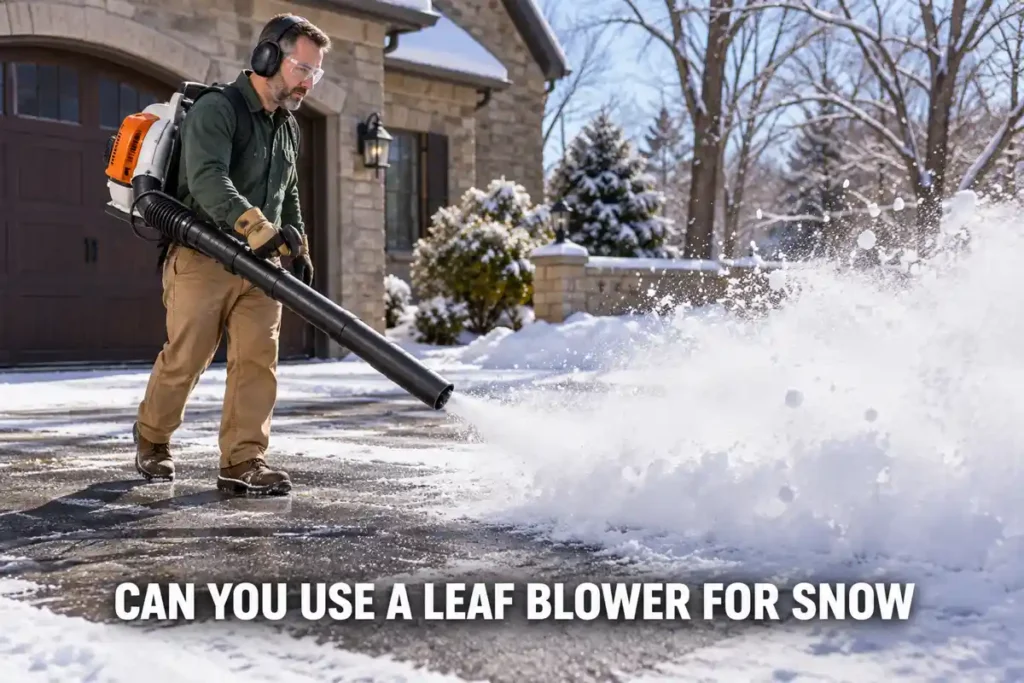
A leaf blower clears light, dry snow, usually about 2 inches deep or less, when you get to it soon after it falls. It slides or smears wet, packed and icy snow instead of lifting it.
Every winter I clear the concrete path to the house door and the work pad in front of the machinery shed on the family farm in Serbia, and the blower earns its place on only one kind of snow. Below you get a table of snow types, what cold does to each power type, a six-step technique and the safety risks.
Can You Use a Leaf Blower for Snow? The Short Answer by Snow Type
A leaf blower works on dry powder and fails on almost everything else. The air jet can peel loose flakes off a surface and throw them, but it cannot break a bond that water has made. About 2 inches of dry powder is the usual working depth, and fluffy snow of 2 to 4 inches goes in layers.
Depth alone misleads. Two inches of fluffy powder is a light job, and two inches of wet snow has the weight of a shovel job, so the table sorts snow by type first and depth second.
Power type matters as well. A gas or cordless blower suits dry, cold powder, and the cordless one stops when the snow turns wet or melts on the housing. I do not recommend a corded blower for snow work at all.
| Snow | How to recognize it | Leaf blower result |
|---|---|---|
| Dry powder, about 2 inches | Falls off a glove when you shake it | Works with a gas or cordless blower. The jet lifts it and throws it clear. |
| Fluffy snow, 2 to 4 inches | Light but deep | Works in layers. Take the top inch, then the next. |
| Average snow, 4 inches or more | Packs when you squeeze it | Slow and tiring. A shovel or snow blower is faster. |
| Wet, heavy snow | Sticks to boots, forms a ball or melts on the tool | Does not lift. The air slides or smears it, and every electric blower goes back in the shed. |
| Trodden or packed snow | Pressed flat and bonded to the ground | Does not work. |
| Ice or a hard crust | Hard and glassy | Does not work, and the jet throws chips. |
The first light snow of the winter is the one I reach for the blower on. I go out before anyone has walked the path to the house door, and the powder lifts off the concrete without leaving a layer behind. Once boots have pressed it flat, the blower stays in the shed and I take the shovel.
Key Takeaway
Go out within hours of the snowfall. A blower wins on powder in the first hours and loses once the snow has been walked on, melted or refrozen.
Leaf Blower for Snow Removal and How Much Snow It Moves
A blower moves snow by weight more than by depth. Wetter snow packs more water into the same space, so a layer of wet snow can weigh several times what the same depth of dry powder does.
Why Air Speed Beats Air Volume on Powder
Dry powder has almost no grip on itself, so the fast core of the air jet at the nozzle peels it off the surface and throws it. Wet snow is glued together by liquid water and weighs far more per cubic foot, so the same jet slides it a few inches and leaves it. Packed snow and ice are already bonded to the ground, and no setting on the dial fixes that.
The air also slows and spreads as it leaves the tube, so the full-force strip is narrow and sits close to the nozzle. Air speed at the surface does the lifting, and air volume decides how wide a strip each pass cleans. The CFM and MPH guides on this site go deeper on both.
According to Echo’s manual for its gas PB-9010T backpack blower, a higher speed setting may be needed to move snow from a driveway. The same manual says never to use a higher speed than the task needs, and that holds for a path too.
A Worked Example on My Work Pad
Picture the work pad in front of my machinery shed after a snowfall. Under dry powder, the blower lifts the top layer off the concrete and throws it clear, which is quick work.
Under wet snow, the same pad holds a heavy layer that clings to the concrete, and the jet only pushes it around, so that is shovel work. The weight decides the tool, not the depth. After the first wet snowfall of a winter I put the blower away and took the shovel to that pad.
Cordless, Corded and Gas Blowers in Cold Weather
Cold changes how each power type behaves before the first flake is blown. Cordless packs lose output, gas engines start harder and corded cables go stiff.
Cordless and Corded Blowers in the Cold
A cordless leaf blower for snow runs on lithium-ion cells, and those cells deliver less energy and less power as they get colder. In laboratory tests on 2.2 Ah cells down to 4 degrees below zero Fahrenheit, energy and power were substantially reduced, and what a cell delivered depended on the discharge rate and on how much the cell warmed itself (1). The main limit at those temperatures was how slowly lithium moves through the electrolyte and the graphite, so the same pack does less work per charge in a hard frost.
Makers print operating ranges. EGO’s manual for its LB6700E blower lists 5°F to 104°F as the recommended operating range, and Milwaukee’s manual for its M18 Brushless blower lists 0°F to 125°F. Check the range printed for your own model before a hard frost.
On a frost morning the pack gives me fewer minutes on High than in October, so I keep the second pack indoors and swap when the first fades. A warm pack holds up better than one that sat in the shed overnight.
Never charge a frozen pack, because charging lithium-ion batteries below freezing can leave permanent metallic lithium on the anode (2). How to store a leaf blower for winter covers the rest.
I do not recommend a corded blower for snow work. Its cable stiffens in the cold and snags on frozen edges, and a cable and plug lying on snow sit where meltwater collects. Read the shock rules in the safety section before you plug anything in.
Gas Blowers in the Cold
A gas leaf blower for snow starts harder when cold. Most two-stroke handhelds want the full routine: full choke, a few presses of the primer bulb, pulls until the engine pops, choke off, one more pull and about 30 seconds of idle before the trigger. Your manual has the exact order for your model.
The throttle cable on my old gas handheld stuck in the cold one morning, and since then I work the trigger a few times before I pull the cord. Snow can also pack into the intake grid and the air filter, so look at both when the engine note changes. Stop the engine and let it cool before you refuel.
Removing Snow With a Leaf Blower Early, Low and Downwind
The technique is six steps, and the order matters more than the power setting.
- Go out soon after the snow stops. Powder compacts and bonds as people walk on it and as the day warms, and a blower cannot undo either.
- Put the wind behind you. The air then carries the snow away with the jet. The farm yard is open and the wind there is steady, so I pick my starting point by the wind direction.
- Hold the nozzle low at a shallow angle. Use the lowest throttle that still moves the snow, because a higher setting costs battery or fuel and throws snow farther than you need.
- Start at the door or the top of a slope. Make short passes that overlap, since the full-force strip is narrow.
- Push the snow to an open edge. Do not blow it into a pile beside the path, where it refreezes and narrows the way, and do not blow it back onto ground you have cleared.
- Stop at wet patches. When the air starts to slide the snow instead of lifting it, or snow melts on the housing of an electric blower, put the blower away and switch to a shovel for that stretch.
Pro Tip
Aim the jet along the surface, not into it. A steep angle digs at concrete seams and throws grit, while a shallow angle rolls the powder ahead of the nozzle.
One mistake I remember happened on a day close to freezing, when the air pushed a slushy layer into ridges that froze overnight and I went back out with a shovel to cut them down. Slush is shovel work. The moisture in the layer and whether it refreezes decide the tool.
For a drive longer than a path, some people move to a backpack leaf blower for snow. Many backpack models burn gas, so the exhaust and noise rules below apply in full, and the snow limits above do not change.
Cars, Steps, Decks and Tight Spots
A blower beats a shovel where the blade cannot reach: corners, gaps and ledges.
Snow on a Car
A leaf blower for snow on car roofs, hoods and trunk lids works only on light powder. Lift the wipers, start at the roof and work down, and hold the nozzle several feet off the paint. Frozen-on snow and ice crust stay where they are, so leave those to a soft brush and the defroster, because forcing them risks scratching the finish.
Steps, Decks and Gravel
Steps, deck gaps, the space beside a rail and the door threshold are where the blower earns its keep. I let the shovel take the open ground and use the blower for the threshold and the corner where the path meets the step, where a shovel blade will not fit.
Gravel is the exception. On my gravel yard the blower throws the stones along with the snow, so I drop to low throttle and tilt the tube up, or I leave that yard to a shovel.
Ice, Shock, Exhaust and Flying Debris in Snow
Four hazards matter in snow, and a blower removes none of them: ice, shock, exhaust and flying debris.
Ice Under and After the Snow
Snow on the ground changes how people fall. In a study of 16 Finnish cities over 14 winters, snow on the ground raised the risk of pedestrian slip injuries more than three times compared with days without snow (3). In Calgary over 11 years, days with ice, ice in the previous 3 days or snow on the ground all brought more emergency department visits for falls on ice and snow (4).
A blower does not remove ice. On a damp day it can leave a wet film that freezes after dark, so check the surface again before anyone walks it.
Warning
Treat every surface you cleared on a damp or near-freezing day as slippery. Take short steps the first time you cross it, and put sand or grit on any shiny patch.
Shock Risk When Snow Counts as Wet
Milwaukee’s manual for its M18 Brushless blower says: do not use in rain or wet locations, because electric shock could occur. Snow melts into water on a warm tool, so snow that melts on the housing puts a cordless blower under that line. I use a cordless model only on dry, cold powder that stays dry on the tool, and the work stops the moment the snow turns wet or melts on the housing. From there the maker’s line applies, and your own manual has one.
Corded blowers have no place in snow work. A nick in a cable lying on wet ground is a shock path, and a ground-fault circuit interrupter (GFCI) outlet does not make wet use acceptable, because it does not change a maker’s ban on wet conditions. An electric leaf blower for snow belongs in the shed once the snow turns wet.
Exhaust and Noise from Gas Blowers
NIOSH sampled 80 landscaping workers, and 94 of 119 eight-hour noise results were at or above the 85 dBA recommended limit (5). That count covers every kind of landscaping work. The part that applies here is the finding that fuel-powered leaf blowers brought significantly more noise and carbon monoxide than battery ones.
NIOSH recommends 85 dBA as the limit over an eight-hour day and halving the exposure time for every 3 dBA more (6). Wear earmuffs over earplugs from the first minute with a gas blower, and hearing protection with a cordless on High. With my old gas handheld I wear both every time, plugs first and muffs over them.
Never start or run a gas blower in a garage, a shed or any enclosed or half-open space, not even with the door open, because the exhaust carries carbon monoxide. Start it outdoors, away from doors and windows.
Eyes and Flying Debris
A blower throws ice crumbs, grit and stones along with the snow, and the jet is aimed at hard ground. Safety glasses stay on every time, and people, pets and windows stay out of the debris path. I put my glasses on before I pull the cord, and the house windows are on the side the jet never faces.
Snow Blower vs Leaf Blower and When a Shovel Wins
Pick a shovel or a snow blower when the snow is wet, heavy or packed, when it is deeper than 2 to 4 inches, when the drive is long or when ice lies under it. A snow blower has an auger that cuts into the snow and throws it, which is why it handles depth and weight that moving air cannot.
- Leaf blower: the first inch or two of dry powder on a path, steps, a deck or a car, within hours of the snowfall.
- Shovel: wet or packed snow, short paths and any patch where the air only slides the snow.
- Snow blower: long drives, snow deeper than 4 inches and snow that has been driven or walked on.
Shovelling is hard on the body. Estimates from sampled US emergency department records put snow shovel injuries and medical emergencies at about 11,500 a year from 1990 to 2006. Lower back injuries made up 34.3% of the estimated cases, and cardiac events were 6.7% of them and included all of the estimated 1,647 deaths over the 17 years (7).
A Quebec study covering winters from 1981 to 2014 found that after a 20 cm snowfall, about 8 inches, the odds of a heart attack admission the next day were 16% higher for men and the odds of death from one were 34% higher, with no clear effect among women (8). The study did not measure shovelling, so it cannot say what caused those cases.
A blower on a light layer replaces lifting with aiming, but it does nothing for a foot of wet snow and it is no medical cure. If you have heart or back trouble, ask your doctor before you clear snow by any method.
A Short Checklist Before the First Snowfall
Three habits cover most of it: go out in the first hours while the snow is dry, keep the second pack indoors until you need it, and take the shovel when the air starts sliding the snow or snow melts on an electric blower. Dry the tool and clear snow from the intake after every session, and keep hearing and eye protection with the blower. I leave the shovel by the door while I use the blower, so a wet patch never tempts me to keep going.
More tool care is in the leaf blower guides. A leaf blower for snow is a quick tool for dry powder and a poor one for anything wetter, and wet snow ends the job for every electric model.
Frequently Asked Questions
Will a leaf blower blow snow?
A leaf blower will blow light, dry powder, usually about 2 inches deep, and fluffy snow of 2 to 4 inches in layers, but it leaves wet, packed and icy snow where it lies. Go out within hours of the snowfall, hold the nozzle low and keep a shovel handy for wet patches.
What is the recommended CFM for blowing snow?
Neither a maker nor a standard gives a recommended CFM for blowing snow. Dry powder at the usual depth decides the job, and on powder the air speed at the surface does most of the lifting, while air volume only widens the strip each pass cleans. Wet or packed snow stays put at any rating.
What is the most efficient way to remove snow?
The most efficient way to remove snow is to match the tool to the snow. Use a leaf blower on the first inch or two of dry powder, a shovel on wet or packed snow and a snow blower on long drives and deep snow.
Can you use a leaf blower to remove snow from a car?
A leaf blower can remove light, dry powder from a car if you start at the roof, keep the nozzle several feet off the paint and lift the wipers first. Frozen-on snow and ice crust stay where they are, so leave those to a soft brush and the defroster.
Can you use an electric leaf blower for snow?
A cordless leaf blower can clear dry, cold powder that stays dry on the tool, and it stops being the right tool the moment the snow turns wet or melts on the housing. Milwaukee’s manual for its M18 blower says not to use it in rain or wet locations, so the maker’s line applies from that point. I do not recommend a corded blower for snow work at all.
References
- Ji Y, Zhang Y, Wang C-Y. Li-Ion Cell Operation at Low Temperatures. J Electrochem Soc. 2013;160(4):A636-A649.
- Occupational Safety and Health Administration. Preventing Fire and/or Explosion Injury from Small and Wearable Lithium Battery Powered Devices. Safety and Health Information Bulletin SHIB 06-20-2019. US Department of Labor; 2019.
- Hippi M, Kangas M. Impact of Weather on Pedestrians’ Slip Risk. Int J Environ Res Public Health. 2022;19(5):3007.
- Tarcea A, Vergouwen M, Sayre EC, White NJ. The Slip and Fall Index: Assessing the risk of slipping and falling on ice. Can J Public Health. 2024;115(2):296-304.
- Alexander BM, Graydon PS, Pena M, Feng HA, Beamer BR. Hazardous exposures and engineering controls in the landscaping services industry. Journal of Occupational and Environmental Hygiene. 2025;22(3):189-202.
- National Institute for Occupational Safety and Health. Noise-Induced Hearing Loss. Noise and Hearing Loss. Centers for Disease Control and Prevention; 2024.
- Watson DS, Shields BJ, Smith GA. Snow shovel-related injuries and medical emergencies treated in US EDs, 1990 to 2006. Am J Emerg Med. 2011;29(1):11-17.
- Auger N, Potter BJ, Smargiassi A, Bilodeau-Bertrand M, Paris C, Kosatsky T. Association between quantity and duration of snowfall and risk of myocardial infarction. CMAJ. 2017;189(6):E235-E242.
Safety Note: Leaf blowers throw debris and can damage your hearing. Wear eye and ear protection, read the manufacturer’s manual, and check your local rules on noise and operating hours.