
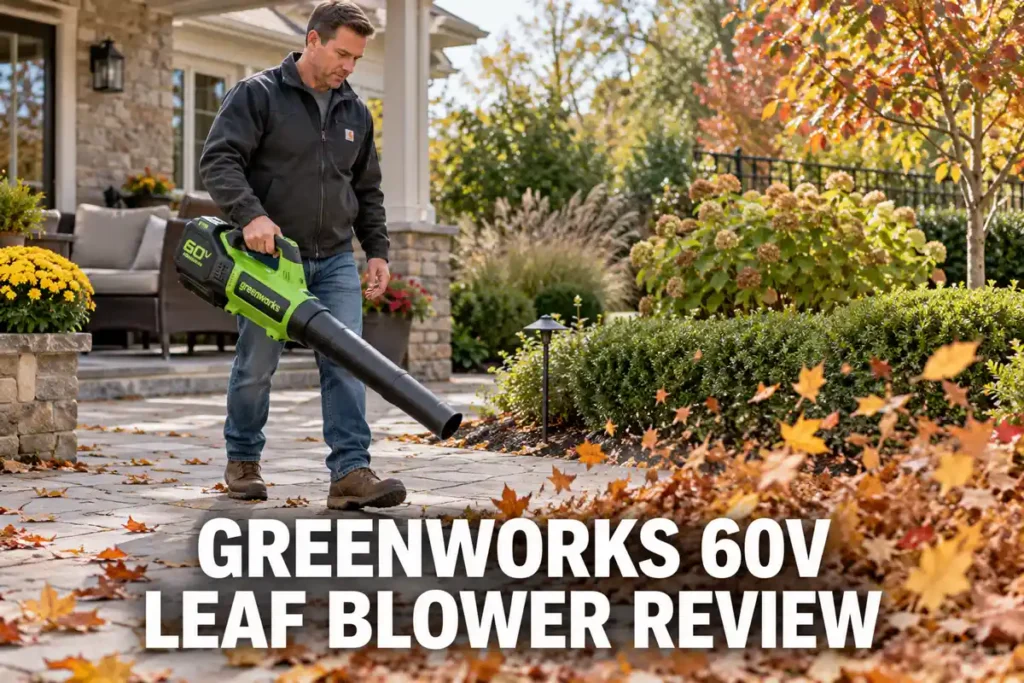
In this Greenworks 60V leaf blower review, my verdict is a buy for owners of a 60V Greenworks battery and a pass for everyone else, because the 660 CFM blower ships tool only, with no battery and no charger. I keep the pit around our irrigation pump head and its 150-mesh disc filter free of leaves and twigs, and a light cordless blower does that job better than my gloved hands. Below I cover what to add, performance, runtime, care and the alternatives.
Affiliate Disclosure: Garden Power Scout is a proud participant in the Amazon Services LLC Associates Program. As an Amazon Associate, we earn from qualifying purchases, at no extra cost to you.
Greenworks 60V Leaf Blower Review: My Verdict on the 660 CFM Model
I recommend this blower for a lawn, a drive and a deck of up to about a quarter acre when a 60V Greenworks battery already sits on your shelf. According to Greenworks, the blower weighs less than 9 lb without a battery, and it works with one hand. Skip it if you have no 60V battery, if your job is an orchard, or if you are paid to do the work.
- Who it is for: owners of a 60V Greenworks battery who clear lawns, drives and decks.
- What it does best: it moves dry leaves and clippings from a light one-hand tool.
- The main trade-off: the battery and charger are extra.
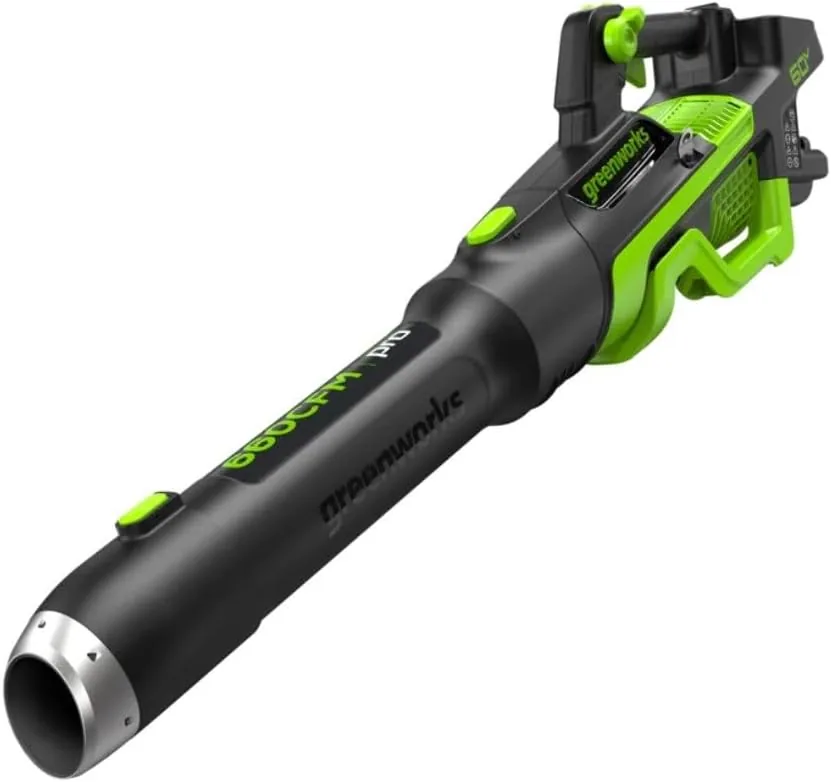
Greenworks 60V Leaf Blower Tool Only and the Battery You Add
Tool only means the box holds the blower, a nozzle and the manual. The battery and the charger are not included.
This is a Greenworks Pro 60V leaf blower, and Greenworks says its 60V battery fits more than 75 tools, so a pack from a mower or trimmer in the same line already does the job. Greenworks’ own page sells the same model number, BL60L253, only as a kit with a 2.5 Ah battery and a charger, so I check on the listing what the box holds before I order any tool-only blower.
With no 60V pack, you buy a battery from the LB6025, LB60251 or BAC series and a charger from the CAC series, as the manual lists them. 40V and 80V packs do not fit.
Specs and What the Numbers Mean
This Greenworks 60V cordless leaf blower is a brushless handheld. Two rows carry the decision: 660 CFM and 180 mph set what it can move, and the battery row sets how long it works.
| Spec | Figure |
|---|---|
| Model number | BL60L253 |
| Airflow, maker’s figure | 660 CFM |
| Air speed, maker’s figure | 180 mph |
| Blowing force | Not published by Greenworks |
| Battery | 60V Greenworks pack, sold separately |
| Run time, Greenworks kit with 2.5 Ah pack | Up to 50 minutes |
| Weight without battery, according to Greenworks | Under 9 lb |
| Warranty | 4 years, personal use |
Treat 660 CFM and 180 mph as peak figures, because Greenworks names no mode and no nozzle for either. Volume lifts a pile and speed peels dry litter off a hard surface, so the two figures need each other.
Setup and First Use
The blower goes together without tools. I fit the tube and the nozzle first and the battery last, because the manual says to remove the battery before any adjustment, and a blower with no pack cannot start while my hands are on the joints.
- Click the tube onto the housing until the tube release button latches.
- Choose a nozzle and click it on the same way.
- Check that both joints are secure.
- Slide the 60V battery in until it clicks.
- Squeeze the trigger for more air, press turbo for maximum airflow, or turn the cruise lever clockwise to hold a speed.
- To stop, turn the cruise lever counterclockwise to release it, release the trigger, then hold the battery release and take the pack out.
Turbo drops back to the set speed when you let go, and the manual warns that it uses the battery faster.
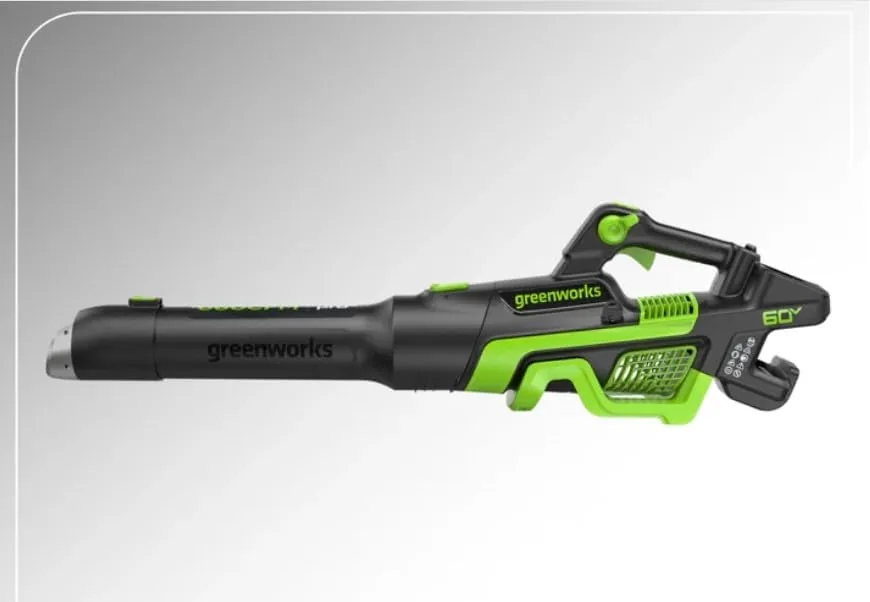
How It Performs on Leaves, Lawn and Gravel
At 660 CFM and 180 mph this is a mid-range handheld, so the surface and the wetness of the debris decide the result.
Dry Leaves and Clippings
Dry leaves and mown clippings are its best work. After the first mow in May, I move the clippings from the foot of the first alley back onto the grass with a low sweep. At the pump head I hold the trigger partway, so the leaves and twigs lift out of the pit without a blast of grit toward the filter fittings.
Damp Leaves
Wet leaves stick by surface tension, so they need volume under the edge. Greenworks says turbo loosens wet leaves, and its manual bans use in rain and on wet surfaces, so I use turbo only on damp leaves on dry ground in dry weather. The leaves that pile against the hedgerow stay damp for days after rain, and there turbo lifts the top layer while the packed bottom layer goes to the rake.
Gravel and Hard Edges
A fast stream throws stone. Where the crushed stone meets the concrete at the machinery shed door, I hold the nozzle low at a shallow angle with the trigger partway down, and I check that no person, car or window sits in line with the stream.
Runtime, Charging and Cold Mornings
The Greenworks 60V leaf blower battery you pick decides the run time more than the blower does. According to Greenworks, the kit’s 2.5 Ah pack runs the blower up to 50 minutes and recharges in up to 50 minutes with the kit’s charger.
Greenworks names no mode for that figure and gives no run time for the bare tool, and turbo uses the battery faster. I treat 50 minutes as a ceiling and plan by packs: on a new blower I watch the battery lights on the first lawn, note where the pack ends, and plan every later job in pack charges.
Below freezing a lithium-ion cell has higher internal resistance and gives less capacity and power (1). The manual allows charging from 39 to 104 F, and OSHA warns that charging lithium-ion batteries below freezing can build up metallic lithium on the anode (2). Bring a cold pack to room temperature before it goes on the charger.
Noise, Weight and Comfort
Greenworks prints no decibel figure for this blower, and its manual shows the ear-protection symbol. For comparison, a field test of gas-powered leaf blowers measured 85 to 101 dB(A) at the center of the test area (3). Those readings come from gas machines and are no rating for this blower. NIOSH recommends 85 dBA averaged over an eight-hour workday as the limit (4).
At the shed door the earmuffs go on before the battery goes in, and the eye protection goes on with them. Poor fit may limit the protection for about 40 percent of earplug users (5), so muffs are my default.
According to Greenworks, the blower weighs less than 9 lb without a battery, so add the weight of the pack you buy. Next to the rake it replaces along the lawn edges, it is the lighter load for my shoulder.
Care, Storage and Warranty
Keep the blower dry. The manual rules out rain, wet surfaces and wet hands, and tells you to store it indoors. Take the battery out before any cleaning or repair, and wipe the blower with a dry cloth.
Protection
Wear hearing protection, ANSI Z87.1 eye protection with side shields, heavy long pants, boots and gloves, and a dust mask for dusty work. Keep bystanders at least 50 feet away and keep people and windows out of the stream.
Store the pack indoors, dry and at part charge. A lab study of lithium-ion cells found that storage at a high charge speeds up capacity loss (6), and the manual allows battery storage from 32 to 113 F.
According to Greenworks, the warranty runs four years, for personal use only. The manual excludes commercial use and does not define it. My orchard sells fruit, so on my land I plan as if this blower carried no warranty.
Who Should Buy It and Who Should Skip It
The blower fits a narrow job well and a wide job badly. It suits these buyers:
- Owners of a 60V Greenworks battery who want a light blower for a lawn, a drive and a deck.
- Yards of up to about a quarter acre, where leaves and clippings are the job.
- Autumn tidy-up of dry or lightly damp leaves and clippings off paths.
Skip it if any of these apply:
- You have no 60V battery and want one box.
- Your job is an orchard or a property larger than a quarter acre, where a stronger tool makes more sense.
- You are paid to do the work, because the warranty excludes commercial use.
- Your leaves lie in soaked mats or in the rain.
Drawbacks and Common Problems
Three limits decide whether this blower suits you:
- Tool only surprises: a buyer who misses “battery and charger not included” owns a blower that cannot run.
- No published force: Greenworks prints no newtons, so I judge strength on the job.
- Personal-use warranty: the manual excludes commercial use, which matters for an orchard that sells fruit.
If the blower is weak, stop it, take the battery out and clear leaves from the air intake vent, because the manual says a blocked intake or impeller cuts blowing power and heats the motor. If it does not start, check that the battery clicked in and both tubes are latched.
How It Compares With Alternatives
The right pick follows the battery you own. My leaf blower guides cover the wider range.
| Blower | Airflow, maker’s figure | In the box |
|---|---|---|
| Greenworks 60V 660 CFM (this review) | 660 CFM | No battery, no charger |
| Greenworks 40V 500 CFM | 500 CFM | No battery, no charger |
| Greenworks 60V 610 CFM kit | 610 CFM | 2.5 Ah pack and charger |
| EGO LB6504 | 650 CFM on turbo | 5.0 Ah pack and charger |
| EGO LB7654 | 765 CFM on boost | 5.0 Ah pack and charger |
| Ryobi 40V HP Whisper | 730 CFM on turbo | No battery, no charger |
Greenworks 40V and the 60V Kit
Greenworks 40V 500 CFM Leaf Blower (Tool Only) is the smaller Greenworks on another platform, so pick it if you own 40V packs and the job is light. The Greenworks 60V 610 CFM kit carries its own pack and charger, so pick it if you have no 60V battery.
EGO LB6504 and LB7654
EGO Power+ LB6504 650 CFM Blower Kit and EGO Power+ LB7654 765 CFM Blower Kit each come as a kit with a 5.0 Ah pack and charger. Pick the LB6504 for a bigger yard and the LB7654 for a larger property still.
Ryobi 40V HP Whisper
Ryobi 40V HP Whisper Series 730 CFM Blower (Tool Only) is also sold tool only and adds cruise control. Pick it if Ryobi 40V packs already sit in your shed.
My Recommendation on the Greenworks 60V Leaf Blower
Buy it if a 60V Greenworks battery already lives on your shelf and your work is a lawn, a drive and a deck of up to about a quarter acre. You get a brushless handheld with a trigger start, a turbo button and a cruise control lever, and the pack from your mower or trimmer does the powering.
Skip it if you need a pack in the box, an orchard cleared or a warranty for paid work. A buyer with no 60V battery is better served by a kit, and a bigger property calls for a stronger tool than a 660 CFM handheld. My Greenworks 60V leaf blower review verdict is a buy for a 60V owner and a pass for everyone who would have to buy the battery and charger first.
Frequently Asked Questions
Is it better to have more MPH or CFM in a leaf blower?
More CFM beats more MPH for most yard work, because air volume lifts and carries a pile of leaves. MPH earns its place on hard surfaces, where a fast stream peels off stuck litter, so a blower that pairs high volume with decent speed, as this 660 CFM and 180 mph model does, covers both jobs.
How long does a Greenworks 60V battery last?
According to Greenworks, the kit’s 2.5 Ah 60V battery runs this blower up to 50 minutes on one charge, and the kit’s charger refills it in up to 50 minutes. Turbo drains the pack faster and cold shortens the run, so plan a big job in pack charges and keep a second pack ready.
Which Greenworks leaf blower is the best?
The best Greenworks leaf blower follows the battery line you own and the size of your yard. This 660 CFM tool-only model suits owners of a 60V pack, the 610 CFM kit suits a first 60V buyer, and the 80V backpack blower suits bigger lots and longer jobs on the 80V line.
Which is better, Greenworks or Stihl?
Neither brand is better on the facts alone: Greenworks sells this blower on a shared 60V battery platform, and Stihl sells through authorized dealers only. According to Stihl, its warranty covers only dealer purchases, and its gas blowers list 13 to 41 N of force, a figure Greenworks does not print for this model.
Do leaf blowers work on wet leaves?
Leaf blowers work on wet leaves when enough air gets under the edge of the mat, and Greenworks says this blower’s turbo button loosens wet leaves. Its manual still bans use in rain and on wet surfaces, so wait for dry ground and rake the packed layer that the stream will not lift.
References
- Hossain Ahmed S, Kang X, Bade Shrestha SO. Effects of Temperature on Internal Resistances of Lithium-Ion Batteries. J Energy Resour Technol. 2015;137(3):031901.
- Occupational Safety and Health Administration. Preventing Fire and/or Explosion Injury from Small and Wearable Lithium Battery Powered Devices. Safety and Health Information Bulletin SHIB 06-20-2019. US Department of Labor; 2019.
- Walker E, Banks JL. Characteristics of Lawn and Garden Equipment Sound: A Community Pilot Study. J Environ Toxicol Stud. 2017;1(1).
- National Institute for Occupational Safety and Health. Noise-Induced Hearing Loss. Noise and Hearing Loss. Centers for Disease Control and Prevention; 2024.
- Morata TC, Gong W, Tikka C, Samelli AG, Verbeek JH. Hearing protection field attenuation estimation systems and associated training for reducing workers’ exposure to noise. Cochrane Database of Systematic Reviews. 2024;5(5):CD015066.
- Keil P, Schuster SF, Wilhelm J, et al. Calendar Aging of Lithium-Ion Batteries. J Electrochem Soc. 2016;163(9):A1872-A1880.
Safety Note: Leaf blowers throw debris and can damage your hearing. Wear eye and ear protection, read the manufacturer’s manual, and check your local rules on noise and operating hours.